Recognition: unknown
Flow instability in Stokes layer of Carreau fluids
Pith reviewed 2026-05-07 14:27 UTC · model grok-4.3
The pith
In Carreau fluids the Stokes layer grows unstable only when the perturbation velocity stays in phase with the oscillating base shear.
A machine-rendered reading of the paper's core claim, the machinery that carries it, and where it could break.
Core claim
The central discovery is that linear instability in the time-periodic Stokes layer of a Carreau fluid is controlled by the phase relationship between the perturbation field and the oscillatory base flow. When these fields remain in phase, the disturbance extracts energy efficiently from the time-dependent shear; a phase mismatch suppresses the transfer and stabilizes the flow. This energy-production route parallels the classical mechanism in steady shear layers yet is identified here for the first time in a purely oscillatory setting. The stabilizing influence of stronger shear-thinning is monotonic in the power-law index n, whereas the effect of the characteristic time Λ is non-monotonic.
What carries the argument
The phase-synchronized energy production term that appears in the perturbation kinetic-energy budget when the disturbance velocity aligns with the oscillating base shear.
If this is right
- Stronger shear-thinning (lower n) steadily raises the Reynolds number at which the Stokes layer first becomes unstable.
- The non-monotonic dependence on Λ implies an intermediate response time that can either promote or suppress instability depending on the shear-thinning strength.
- The phase-alignment criterion supplies a diagnostic that can be applied to other time-periodic shear flows without repeating the full Floquet calculation.
- The binomial expansion for the base flow is reliable only at small Λ, beyond which the full numerical solution must be retained.
Where Pith is reading between the lines
- The same phase condition could be tested in other periodic wall flows such as those driven by vibrating plates or oscillating pressure gradients.
- Once the linear threshold is crossed, nonlinear simulations would reveal whether the instability saturates into finite-amplitude waves or leads directly to turbulent mixing.
- The monotonic stabilization with decreasing n suggests that deliberately engineered shear-thinning fluids could be used to delay transition in oscillatory industrial or biological channels.
Load-bearing premise
Small-amplitude linear perturbations remain sufficient to describe the instability across the full range of n and Λ without nonlinear saturation or higher-order effects.
What would settle it
A direct numerical simulation of the nonlinear Carreau Stokes layer at the predicted critical parameters that checks whether disturbances grow only when kept in phase with the base oscillation and decay when deliberately phase-shifted.
Figures







read the original abstract
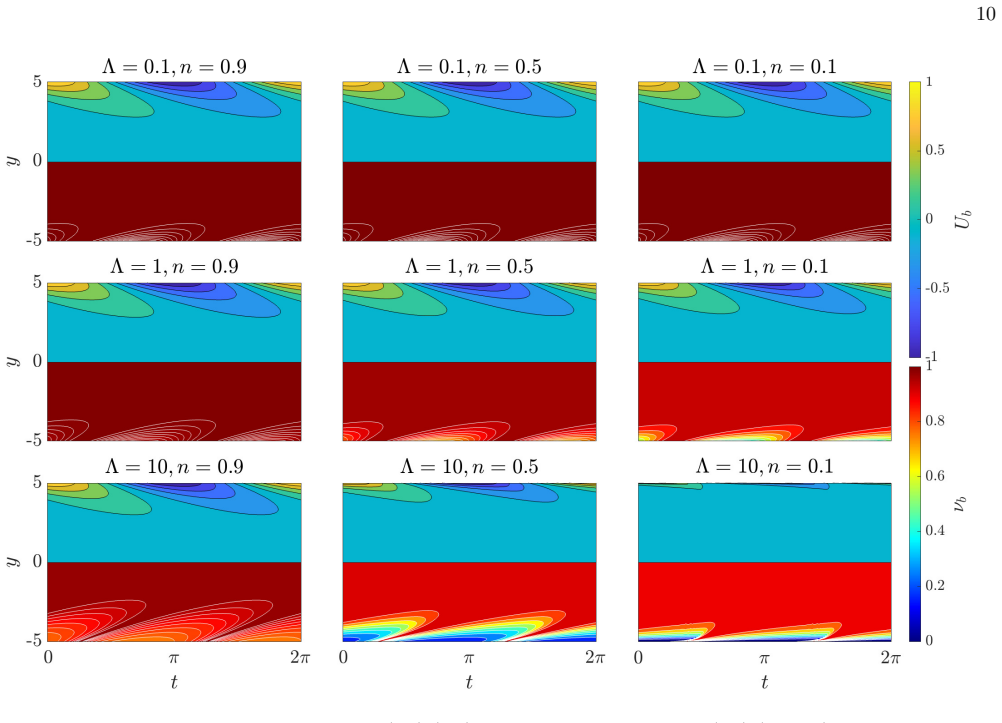
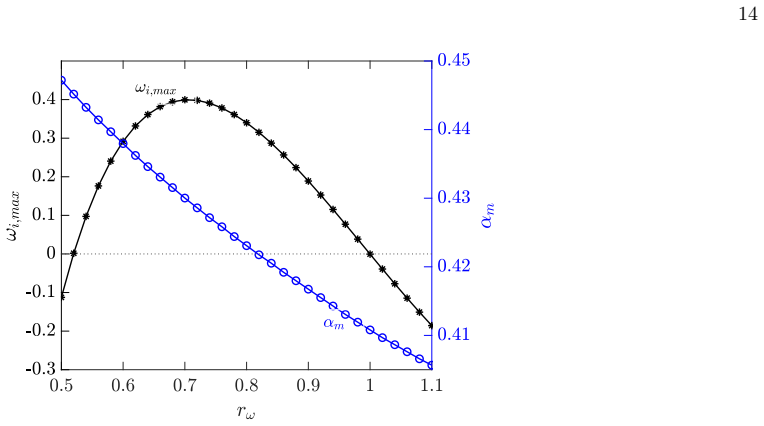
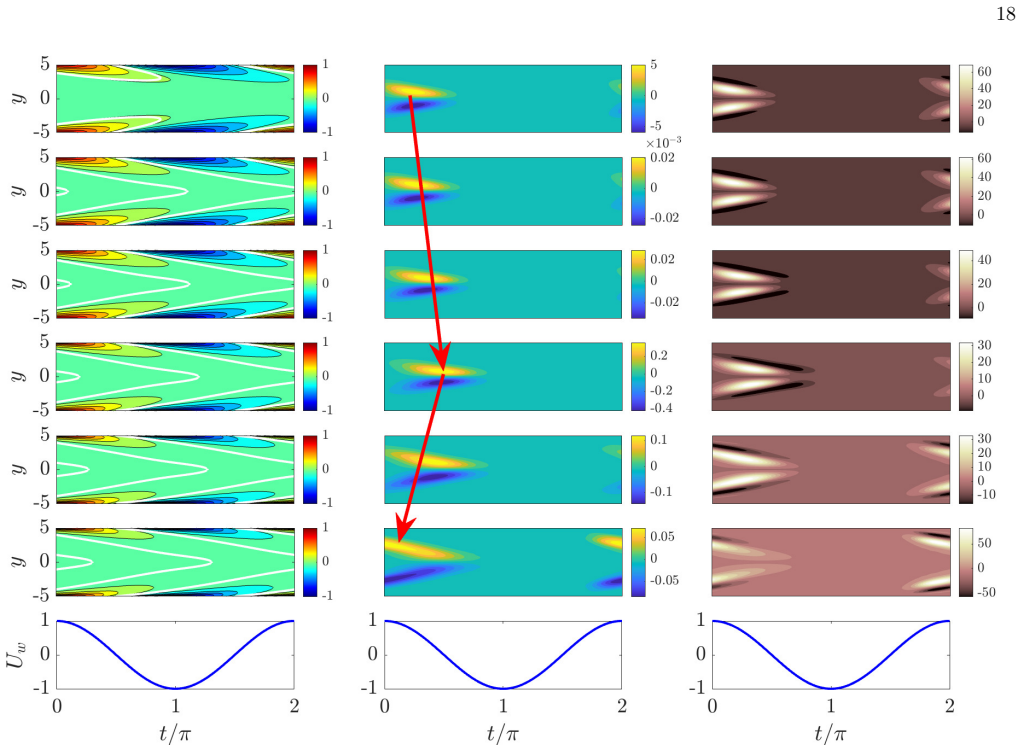
This study investigates the influence of shear-thinning on the instability of a prototype time-periodic flow, the Stokes layer, in Carreau fluids. The time-dependent base flow was solved using a numerical method and a binomial expansion method. The expansion is conducted in terms of the nondimensional characteristic time ($\Lambda$), which quantifies the fluid's response time in viscosity to changes in shear rate. The expansion method shows good agreement with the numerical solution, provided that $\Lambda$ remains small. To understand the effect of shear-thinning on time-periodic flow instability, a Floquet analysis was conducted to examine two key parameters of the Carreau model, i.e., $\Lambda$ and the power-law exponent $n$. Our results show that decreasing $n$, which signifies stronger shear-thinning behavior, has a monotonic stabilizing effect on the flow within the range of investigated $n$. In contrast, increasing $\Lambda$ has a non-monotonic effect on the flow instability, which can be observed in both the weakly and strongly shear-thinning regimes. To clarify the instability mechanism, we perform an energy analysis showing that instability arises when the perturbation field is in phase with the oscillatory base flow, enabling efficient energy extraction from the time-dependent shear. A phase mismatch suppresses this transfer and stabilises the flow. This mechanism parallels the classical energy-production process in steady shear flows, where streamwise and wall-normal velocity perturbations exhibit a characteristic phase difference. Crucially, it is identified here for the first time in a time-periodic shear flow.
Editorial analysis
A structured set of objections, weighed in public.
Referee Report
Summary. The paper examines the linear stability of the time-periodic Stokes layer in Carreau fluids, solving the base flow via both direct numerical integration and a binomial expansion in the characteristic time Λ (valid for small Λ). A Floquet analysis is performed over the power-law index n and Λ, showing that decreasing n produces monotonic stabilization while Λ exerts a non-monotonic influence. An energy budget extracted from the Floquet eigenmodes indicates that instability occurs when the perturbation velocity field is in phase with the oscillatory base flow, permitting net energy extraction from the time-dependent shear; a phase mismatch suppresses this transfer.
Significance. If the linear Floquet results remain valid across the examined parameter space, the work supplies the first explicit demonstration that the classical Reynolds-stress production mechanism in steady shear flows has a direct analogue in time-periodic shear, driven by instantaneous phase alignment rather than a fixed spatial phase shift. The dual base-flow methods and standard Floquet/energy tools provide a reproducible framework for non-Newtonian oscillatory flows.
major comments (2)
- [Floquet analysis] Floquet analysis section: the linearized operator for the Carreau viscosity is evaluated on the instantaneous total shear rate; for n ≪ 1 this renders the perturbation equations strongly nonlinear even at formally infinitesimal amplitudes once the base-flow shear is O(1). No evidence is supplied that the computed growth rates are independent of initial amplitude, that the time-periodic modes satisfy the linearized equations to machine precision, or that spatial/temporal resolution is converged for the smallest n and largest Λ examined.
- [Energy analysis] Energy analysis (following the Floquet results): the reported phase-alignment mechanism and the non-monotonic Λ dependence are extracted from eigenmodes whose validity is unverified outside the small-Λ regime where the binomial expansion agrees with numerics. Without documented checks on nonlinear effects or grid convergence across the full (n, Λ) range, the central claim that instability arises precisely when the perturbation is in phase with the base flow rests on an unconfirmed linear assumption.
minor comments (2)
- [Abstract and base-flow section] The abstract states that the expansion agrees with numerics 'provided that Λ remains small,' yet the main text should quantify the Λ threshold at which the two base-flow solutions diverge by a stated tolerance (e.g., L2 norm < 10^{-4}).
- [Numerical methods] Figure captions and text should explicitly state the number of Fourier modes retained in the Floquet expansion and the time-stepping scheme used for the base flow, together with any observed sensitivity of the critical Reynolds number to these choices.
Simulated Author's Rebuttal
We thank the referee for the careful and constructive report. The two major comments correctly identify the need for explicit verification of the linear regime and numerical fidelity across the full parameter space. We respond to each point below and will incorporate the requested checks in a revised manuscript.
read point-by-point responses
-
Referee: [Floquet analysis] Floquet analysis section: the linearized operator for the Carreau viscosity is evaluated on the instantaneous total shear rate; for n ≪ 1 this renders the perturbation equations strongly nonlinear even at formally infinitesimal amplitudes once the base-flow shear is O(1). No evidence is supplied that the computed growth rates are independent of initial amplitude, that the time-periodic modes satisfy the linearized equations to machine precision, or that spatial/temporal resolution is converged for the smallest n and largest Λ examined.
Authors: We agree that additional documentation is required to confirm the validity of the linearization, especially for small n. In the revised manuscript we will add a dedicated verification subsection (or appendix) containing: (i) growth-rate independence tests under successive reductions of the initial perturbation amplitude (down to 10^{-6} relative to the base flow) for the smallest n and largest Λ; (ii) residual norms demonstrating that the computed Floquet modes satisfy the linearized equations to machine precision (typically 10^{-12} or better); and (iii) systematic spatial and temporal grid-convergence studies at the extreme parameter values. These tests will be performed using the same direct numerical base-flow solver employed for the primary results. revision: yes
-
Referee: [Energy analysis] Energy analysis (following the Floquet results): the reported phase-alignment mechanism and the non-monotonic Λ dependence are extracted from eigenmodes whose validity is unverified outside the small-Λ regime where the binomial expansion agrees with numerics. Without documented checks on nonlinear effects or grid convergence across the full (n, Λ) range, the central claim that instability arises precisely when the perturbation is in phase with the base flow rests on an unconfirmed linear assumption.
Authors: The energy budget is computed from the Floquet eigenmodes of the linearized operator, and the phase-alignment interpretation follows directly from the structure of those modes. We accept that explicit verification across the entire (n, Λ) domain was not provided. In the revision we will extend the amplitude-independence, residual, and grid-convergence tests described above to every (n, Λ) point used in the energy analysis. We will also clarify that the binomial expansion serves only as an auxiliary check for small Λ; all Floquet and energy results are obtained from the direct numerical base flow, which is employed uniformly over the reported parameter space. revision: yes
Circularity Check
No circularity: independent numerical/Floquet procedures on independent inputs
full rationale
The paper solves the base flow either numerically or via binomial expansion in the independent parameter Λ (valid only for small Λ), then applies standard Floquet analysis varying the independent inputs n and Λ. The energy budget is extracted directly from the resulting eigenmodes to identify the phase condition for instability. None of these steps reduce by construction to a fitted quantity, self-citation chain, or renamed input; the central mechanism is a derived consequence of the linearized operator and is not presupposed. This is the normal case of a self-contained analysis whose outputs are not definitionally equivalent to its inputs.
Axiom & Free-Parameter Ledger
free parameters (2)
- n
- Λ
axioms (2)
- domain assumption Flow is incompressible and two-dimensional.
- domain assumption Perturbations remain small enough for linear Floquet analysis to apply.
Reference graph
Works this paper leans on
-
[1]
At the order ofΛ 0 At the zeroth order, we have ∂Ub0 ∂t = 1 2 ∂ ∂y ∂Ub0 ∂y ,(15) which is the same equation for the Newtonian fluid, as shown in Eq. (4)
-
[2]
Since Ub0 =U 0(y)eit +U ∗ 0 (y)e−it, we anticipate that the cubic term in the above equation can generate harmonicse it and e3it
At the order ofΛ 2 At this order, we have ∂Ub1 ∂t = 1 2 ∂ ∂y ∂Ub1 ∂y + n−1 2 ( ∂Ub0 ∂y )3 .(16) 8 To analyze this equation, we notice that (∂Ub 0 ∂y )3 is the non-homogeneous part of the partial differential equation. Since Ub0 =U 0(y)eit +U ∗ 0 (y)e−it, we anticipate that the cubic term in the above equation can generate harmonicse it and e3it. Therefore...
-
[3]
At the order ofΛ 4 At this order, we obtain ∂Ub2 ∂t = 1 2 ∂ ∂y h ∂Ub2 ∂y + n−1 2 3 ∂Ub0 ∂y 2 ∂Ub1 ∂y + (n−1)(n−3) 8 ( ∂Ub0 ∂y )5 i .(19) A procedure similar to that in the previous section III B 2 can be followed by assumingU b2(y, t) =U 21eit +U 23e3it + U25e5it +c.c., which leads to three ODEs as shown in Appendix C 2. Because manual derivation of the t...
-
[4]
[68] reported a weakly turbulent 18 FIG
studied the chaos in the shear-thinned Taylor-Couette flow and Esmael et al. [68] reported a weakly turbulent 18 FIG. 12. Mode patterns of the base flow velocity (U b in the first column), the real part of the multiplied perturbation field (Real(˜u∗˜v) in the second column) and the resulting energy production (fP R in the third column) for the Stokes laye...
-
[5]
Solutions at the order ofΛ 2 a. Solving forU 13 We solve for the general solution ofU 13 first, which is 6iU13 = ∂2U13 ∂y2 .(C1) AssumingU 13(y) =Ce my, we have 6iCe my =m 2Ce my orm 2 −6i= 0.(C2) Ny = 79N y = 99N y = 119N y = 139 Nf = 180 0.085102 + 0.313332i 0.089645 + 0.313556i 0.092050 + 0.313670i 0.093473 + 0.313735i Nf = 200 0.092948−0.180231i 0.098...
-
[6]
We can get forU 21 iU21 = 1 2 ∂ ∂y [ ∂U21 ∂y + n−1 2 3( ∂U0 ∂y 2 ∂U ∗ 11 ∂y + ∂U ∗ 0 ∂y 2 ∂U13 ∂y + 2∂U0 ∂y ∂U ∗ 0 ∂y ∂U11 ∂y ) + (n−1)(n−3) 8 10( ∂U0 ∂y )3( ∂U ∗ 0 ∂y )2]
ODEs for the solutions at the order ofΛ 4 The corresponding ODEs forU 21,U 23 andU 25 are presented as follows. We can get forU 21 iU21 = 1 2 ∂ ∂y [ ∂U21 ∂y + n−1 2 3( ∂U0 ∂y 2 ∂U ∗ 11 ∂y + ∂U ∗ 0 ∂y 2 ∂U13 ∂y + 2∂U0 ∂y ∂U ∗ 0 ∂y ∂U11 ∂y ) + (n−1)(n−3) 8 10( ∂U0 ∂y )3( ∂U ∗ 0 ∂y )2]. (C19) We can get forU 23 3iU23 = 1 2 ∂ ∂y h ∂U23 ∂y + n−1 2 3( ∂U0 ∂y 2 ...
-
[7]
At the order ofΛ 6 At this order, we have ∂Ub3 ∂t = 1 2 ∂ ∂y h ∂Ub3 ∂y + 3n−1 2 h ∂Ub0 ∂y 2 ∂Ub2 ∂y + ∂Ub0 ∂y ∂Ub1 ∂y 2i + 5(n−1)(n−3) 8 ( ∂Ub0 ∂y )4 ∂Ub1 ∂y + (n−1)(n−3)(n−5) 48 ( ∂Ub0 ∂y )7 i .(C22) A procedure similar to can be followed withU b3(y, t) =U 31eit +U33e3it +U35e5it +U37e7it +c.c.and the corresponding ODEs forU 31,U 33,U 35 andU 37 to be so...
-
[8]
G. G. Stokes, On the effect of the internal friction of fluids on the motion of pendulums, Trans. Camb. Phil. Soc.9, 1 (1851)
-
[9]
A. K. Oppenheim,Combustion in piston engines: technology, evolution, diagnosis and control(Springer, 2004)
2004
-
[10]
M. ¨O. C ¸ arpinlioˇ glu and M. Y. G¨ undoˇ gdu, A critical review on pulsatile pipe flow studies directing towards future research topics, Flow Meas. Instrum.12, 163 (2001)
2001
-
[11]
D. N. Ku, Blood flow in arteries, Annu. Rev. Fluid Mech.29, 399 (1997). 24
1997
-
[12]
S. H. Davis, The stability of time-periodic flows, Annu. Rev. Fluid Mech.8, 57 (1976)
1976
-
[13]
Hall, The linear stability of flat Stokes layers, Proc
P. Hall, The linear stability of flat Stokes layers, Proc. R. Soc. Lond. A359, 151 (1978)
1978
-
[14]
Von Kerczek and S
C. Von Kerczek and S. H. Davis, Linear stability theory of oscillatory Stokes layers, J. Fluid Mech.62, 753 (1974)
1974
-
[15]
P. J. Blennerhassett and A. P. Bassom, The linear stability of flat Stokes layers, J. Fluid Mech.464, 393 (2002)
2002
-
[16]
Hall, On the instability of Stokes layers at high Reynolds numbers, J
P. Hall, On the instability of Stokes layers at high Reynolds numbers, J. Fluid Mech.482, 1 (2003)
2003
-
[17]
S. J. Cowley, High frequency Rayleigh instability of Stokes layers, inStability of Time Dependent and Spatially Varying Flows: Proceedings of the Symposium on the Stability of Time Dependent and Spatially Varying Flows Held August 19–23, 1985, at NASA Langley Research Center, Hampton, Virginia(Springer, 1987) pp. 261–275
1985
-
[18]
P. J. Blennerhassett and A. P. Bassom, The linear stability of high-frequency oscillatory flow in a channel, J. Fluid Mech. 556, 1 (2006)
2006
-
[19]
Luo and X
J. Luo and X. Wu, On the linear instability of a finite Stokes layer: instantaneous versus Floquet modes, Phys. Fluids22, 054106 (2010)
2010
-
[20]
Blondeaux and G
P. Blondeaux and G. Vittori, Revisiting the momentary stability analysis of the Stokes boundary layer, J. Fluid Mech. 919, A36 (2021)
2021
-
[21]
Biau, Transient growth of perturbations in Stokes oscillatory flows, J
D. Biau, Transient growth of perturbations in Stokes oscillatory flows, J. Fluid Mech.794, R4 (2016)
2016
-
[22]
Zhang, On the intracyclic instability in Stokes layers, J
M. Zhang, On the intracyclic instability in Stokes layers, J. Fluid Mech.1013, A50 (2025)
2025
-
[23]
Vittori and R
G. Vittori and R. Verzicco, Direct simulation of transition in an oscillatory boundary layer, J. Fluid Mech.371, 207 (1998)
1998
-
[24]
Blondeaux and G
P. Blondeaux and G. Vittori, Wall imperfections as a triggering mechanism for Stokes-layer transition, J. Fluid Mech.264, 107 (1994)
1994
-
[25]
Costamagna, G
P. Costamagna, G. Vittori, and P. Blondeaux, Coherent structures in oscillatory boundary layers, J. Fluid Mech.474, 1 (2003)
2003
-
[26]
Thomas, C
C. Thomas, C. Davies, A. P. Bassom, and P. J. Blennerhassett, Evolution of disturbance wavepackets in an oscillatory Stokes layer, J. Fluid Mech.752, 543 (2014)
2014
-
[27]
Thomas, A
C. Thomas, A. P. Bassom, P. J. Blennerhassett, and C. Davies, Direct numerical simulations of small disturbances in the classical Stokes layer, J. Eng. Math.68, 327 (2010)
2010
-
[28]
M. Hino, M. Sawamoto, and S. Takasu, Experiments on transition to turbulence in an oscillatory pipe flow, J. Fluid Mech. 75, 193 (1976)
1976
-
[29]
M. Hino, M. Kashiwayanagi, A. Nakayama, and T. Hara, Experiments on the turbulence statistics and the structure of a reciprocating oscillatory flow, J. Fluid Mech.131, 363 (1983)
1983
-
[30]
B. L. Jensen, B. M. Sumer, and J. Fredsøe, Turbulent oscillatory boundary layers at high Reynolds numbers, J. Fluid Mech.206, 265 (1989)
1989
-
[31]
Akhavan, R
R. Akhavan, R. D. Kamm, and A. H. Shapiro, An investigation of transition to turbulence in bounded oscillatory Stokes flows Part 1. Experiments, J. Fluid Mech.225, 395 (1991)
1991
-
[32]
Merkli and H
P. Merkli and H. Thomann, Transition to turbulence in oscillating pipe flow, J. Fluid Mech.68, 567 (1975)
1975
-
[33]
D. C. Winter and R. M. Nerem, Turbulence in pulsatile flows, Ann. Biomed. Eng.12, 357 (1984)
1984
-
[34]
Akhavan, R
R. Akhavan, R. D. Kamm, and A. H. Shapiro, An investigation of transition to turbulence in bounded oscillatory Stokes flows Part 2. Numerical simulations, J. Fluid Mech.225, 423 (1991)
1991
-
[35]
C. E. Grosch and H. Salwen, The stability of steady and time-dependent plane Poiseuille flow, J. Fluid Mech.34, 177 (1968)
1968
-
[36]
C. H. Von Kerczek, The instability of oscillatory plane Poiseuille flow, J. Fluid Mech.116, 91 (1982)
1982
-
[37]
Pier and P
B. Pier and P. J. Schmid, Linear and nonlinear dynamics of pulsatile channel flow, J. Fluid Mech.815, 435 (2017)
2017
-
[38]
Pier and P
B. Pier and P. J. Schmid, Optimal energy growth in pulsatile channel and pipe flows, J. Fluid Mech.926, A11 (2021)
2021
-
[39]
Alexy, J
T. Alexy, J. Detterich, P. Connes, K. Toth, E. Nader, P. Kenyeres, J. Arriola-Montenegro, P. Ulker, and M. J. Simmonds, Physical properties of blood and their relationship to clinical conditions, Front. Physiol.13, 906768 (2022)
2022
-
[40]
Nouar, A
C. Nouar, A. Bottaro, and J. P. Brancher, Delaying transition to turbulence in channel flow: revisiting the stability of shear-thinning fluids, J. Fluid Mech.592, 177 (2007)
2007
-
[41]
Chikkadi, A
V. Chikkadi, A. Sameen, and R. Govindarajan, Preventing transition to turbulence: a viscosity stratification does not always help, Phys. Rev. Lett.95, 264504 (2005)
2005
-
[42]
Chekila, C
A. Chekila, C. Nouar, E. Plaut, and A. Nemdili, Subcritical bifurcation of shear-thinning plane Poiseuille flows, J. Fluid Mech.686, 272 (2011)
2011
-
[43]
P. T. Griffiths, S. O. Stephen, A. P. Bassom, and S. J. Garrett, Stability of the boundary layer on a rotating disk for power-law fluids, J. Non-Newton. Fluid Mech.207, 1 (2014)
2014
-
[44]
A. A. Arosemena, H. I. Andersson, and J. Solsvik, Turbulent channel flow of generalized Newtonian fluids at a low Reynolds number, J. Fluid Mech.908, A43 (2021)
2021
-
[45]
A. A. Arosemena, R. Andersson, H. I. Andersson, and J. Solsvik, Effects of shear-thinning rheology on near-wall turbulent structures, J. Fluid Mech.925, A37 (2021)
2021
-
[46]
N. J. Balmforth, Y. Forterre, and O. Pouliquen, The viscoplastic Stokes layer, J. Non-Newton. Fluid Mech.158, 46 (2009)
2009
-
[47]
D. R. Hewitt and N. J. Balmforth, Stokes layers in complex fluids, J. Non-Newton. Fluid Mech.334, 105328 (2024)
2024
-
[48]
Ort´ ın, Stokes layers in oscillatory flows of viscoelastic fluids, Philos
J. Ort´ ın, Stokes layers in oscillatory flows of viscoelastic fluids, Philos. Trans. R. Soc. A Math. Phys. Eng. Sci.378, 20190521 (2020)
2020
-
[49]
Plaut, N
E. Plaut, N. Roland, and C. Nouar, Nonlinear waves with a threefold rotational symmetry in pipe flow: influence of a strongly shear-thinning rheology, J. Fluid Mech.818, 595 (2017)
2017
-
[50]
Boyko and H
E. Boyko and H. A. Stone, Flow rate–pressure drop relation for shear-thinning fluids in narrow channels: approximate solutions and comparison with experiments, J. Fluid Mech.923, R5 (2021). 25
2021
-
[51]
M. I. Alam, A. Raj, P. M. Khan, S. Kumar, and S. Roy, Numerical simulation of flow of a shear-thinning Carreau fluid over a transversely oscillating cylinder, J. Fluid Mech.921, A23 (2021)
2021
-
[52]
Henry, S
D. Henry, S. Millet, S. Dagois-Bohy, V. Botton, and H. Ben Hadid, Rayleigh–B´ enard flow for a Carreau fluid in a paral- lelepiped cavity, J. Fluid Mech.936, A24 (2022)
2022
-
[53]
Singh and P
S. Singh and P. V. S. N. Murthy, Significance of skewness and kurtosis on the solute dispersion in pulsatile Carreau–Yasuda fluid flow in a tube with wall absorption, J. Fluid Mech.962, A42 (2023)
2023
-
[54]
Ashkenazi and E
A. Ashkenazi and E. Boyko, Radial flow of shear-thinning fluids: theoretical results, simulations and comparison with experiments, J. Fluid Mech.1017, A25 (2025)
2025
-
[55]
Milocco, G
E. Milocco, G. Giamagas, F. Zonta, and A. Soldati, Laminar turbulent behavior in shear-thickening channel flow, Phys. Rev. Fluids10, 073301 (2025)
2025
-
[56]
B´ aez-Amador, R
J. B´ aez-Amador, R. Ba˜ nos, J. Arcos, F. M´ endez, and O. Bautista, Flow enhancement produced by a pulsatile flow of shear-thinning fluids in circular and concentric annular tubes, J. Non-Newton. Fluid Mech.334, 105346 (2024)
2024
-
[57]
S. Chun, E. Boyko, I. C. Christov, and J. Feng, Flow rate–pressure drop relations for shear-thinning fluids in deformable configurations: Theory and experiments, Phys. Rev. Fluids9, 043302 (2024)
2024
-
[58]
R. B. Bird, C. F. Curtiss, R. C. Armstrong, and O. Hassager,Dynamics of Polymeric Liquids, Volume 2: Kinetic Theory (Wiley, 1987)
1987
-
[59]
R. Seto, R. Mari, J. F. Morris, and M. M. Denn, Discontinuous shear thickening of frictional hard-sphere suspensions, Phys. Rev. Lett.111, 218301 (2013)
2013
-
[60]
C. Ness, R. Seto, and R. Mari, The physics of dense suspensions, Annu. Rev. Condens. Matter Phys.13, 97 (2022)
2022
-
[61]
Nouar and I
C. Nouar and I. Frigaard, Stability of plane Couette–Poiseuille flow of shear-thinning fluid, Phys. Fluids21, 064104 (2009)
2009
-
[62]
E. A. Coddington and N. Levinson,Theory of ordinary differential equations(New York: McGraw-Hill, 1955)
1955
-
[63]
Thomas, A
C. Thomas, A. P. Bassom, P. J. Blennerhassett, and C. Davies, The linear stability of oscillatory Poiseuille flow in channels and pipes, Proc. R. Soc. A: Math., Phys. & Eng. Sci.467, 2643 (2011)
2011
-
[64]
J. A. Weideman and S. C. Reddy, A MATLAB differentiation matrix suite, ACM Trans. Math. Softw.26, 465 (2000)
2000
-
[65]
L. N. Trefethen,Spectral methods in MATLAB, Software, environments, and tools (Society for Industrial and Applied Mathematics, 2000)
2000
-
[66]
R. E. Khayat, Chaos in the thermal convection of weakly shear-thinning fluids, J. Non-Newton. Fluid Mech.63, 153 (1996)
1996
-
[67]
Albaalbaki and R
B. Albaalbaki and R. E. Khayat, Finite-amplitude Rayleigh-B´ enard convection for weakly shear thinning fluids, J. Phys.: Conf. Ser.137, 012024 (2008)
2008
-
[68]
C.-l. Sun, Y. J. Lin, C.-I. Rau, and S.-Y. Chiu, Flow characterization and mixing performance of weakly-shear-thinning fluid flows in a microfluidic oscillator, J. Non-Newton. Fluid Mech.239, 1 (2017)
2017
-
[69]
Casanellas and J
L. Casanellas and J. Ort´ ın, Vortex ring formation in oscillatory pipe flow of wormlike micellar solutions, J. Rheol.58, 149 (2014)
2014
-
[70]
Nouar, N
C. Nouar, N. Kabouya, J. Dusek, and M. Mamou, Modal and non-modal linear stability of the plane Bingham-Poiseuille flows, J. Fluid Mech.577, 211 (2007)
2007
-
[71]
P. J. Schmid and D. S. Henningson,Stability and transition in shear flows, Applied mathematical sciences No. 142 (Springer Verlag, New York, 2001)
2001
-
[72]
N. S. Kelly, H. S. Gill, A. N. Cookson, and K. H. Fraser, Influence of shear-thinning blood rheology on the laminar-turbulent transition over a backward facing step, Fluids5, 57 (2020)
2020
-
[73]
Lacassagne, N
T. Lacassagne, N. Cagney, and S. Balabani, Shear-thinning mediation of elasto-inertial Taylor–Couette flow, J. Fluid Mech. 915, A91 (2021)
2021
-
[74]
Ashrafi and R
N. Ashrafi and R. E. Khayat, Shear-thinning-induced chaos in Taylor-Couette flow, Phys. Rev. E61, 1455 (2000)
2000
-
[75]
Esmael, C
A. Esmael, C. Nouar, A. Lef` evre, and N. Kabouya, Transitional flow of a non-Newtonian fluid in a pipe: Experimental evidence of weak turbulence induced by shear-thinning behavior, Phys. Fluids22, 101701 (2010)
2010
-
[76]
L. A. Low, C. Mummery, B. R. Berridge, C. P. Austin, and D. A. Tagle, Organs-on-chips: into the next decade, Nat. Rev. Drug Discov.20, 345 (2021)
2021
-
[77]
Maschmeyer, A
I. Maschmeyer, A. K. Lorenz, K. Schimek, T. Hasenberg, A. P. Ramme, J. H¨ ubner, M. Lindner, C. Drewell, S. Bauer, A. Thomas, N. S. Sambo, F. Sonntag, R. Lauster, and U. Marx, A four-organ-chip for interconnected long-term co-culture of human intestine, liver, skin and kidney equivalents, Lab Chip15, 2688 (2015)
2015
-
[78]
H. A. Stone, A. D. Stroock, and A. Ajdari, Engineering flows in small devices: Microfluidics toward a lab-on-a-chip, Annu. Rev. Fluid Mech.36, 381 (2004)
2004
-
[79]
T. C. Niederkorn and J. M. Ottino, Chaotic mixing of shear-thinning fluids, AIChE J.40, 1782 (1994)
1994
-
[80]
Kumar and P
D. Kumar and P. K. Mondal, Mixing of inelastic non-Newtonian fluids with inlet swirl, J. Fluid Mech.997, A20 (2024)
2024
discussion (0)
Sign in with ORCID, Apple, or X to comment. Anyone can read and Pith papers without signing in.