Recognition: unknown
StreakMind: AI detection and analysis of satellite streaks in astronomical images with automated database integration
Pith reviewed 2026-05-07 13:03 UTC · model grok-4.3
The pith
StreakMind uses a trained YOLO model to detect satellite streaks in astronomical images, reconstruct their geometry, and match them to known orbits for database storage.
A machine-rendered reading of the paper's core claim, the machinery that carries it, and where it could break.
Core claim
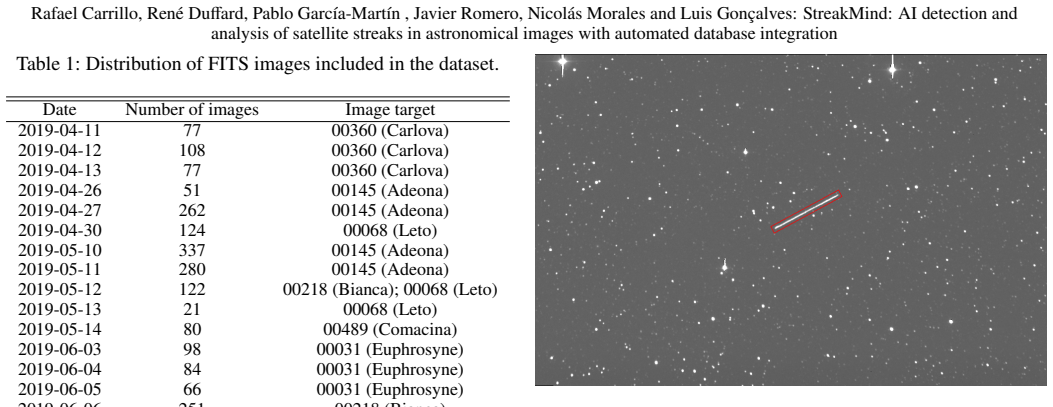
StreakMind trains a YOLO OBB model on a hybrid dataset of 2335 images drawn from La Sagra Observatory observations, applies it to processed FITS frames, performs geometric refinement and inter-frame association, executes satellite cross-identification, and stores the final identifications with Gaussian-based confidence scores in a relational database. On the held-out test set the model attains 94 percent precision and 97 percent recall while reliably recovering faint streaks and producing consistent geometric reconstructions.
What carries the argument
A YOLO oriented bounding box (OBB) detector combined with post-processing steps for geometric refinement, inter-frame association, satellite cross-identification, and Gaussian confidence scoring.
If this is right
- Large astronomical surveys can process streaked exposures automatically instead of discarding them or relying on manual inspection.
- Geometric reconstructions remain consistent enough to support reliable orbital tracking of detected objects.
- Cross-identification with known catalogs allows the system to distinguish artificial satellites from natural near-Earth objects in routine observations.
- Storing results in a structured database enables queries across multiple nights and instruments for space situational awareness.
Where Pith is reading between the lines
- If the generalization assumption holds, the same pipeline could be retrained on data from other sites to create a distributed network that monitors streak contamination globally.
- The database output could be used to forecast future satellite passes that might contaminate planned observations at a given telescope.
- Extending the inter-frame association step over longer time baselines might allow tracking of individual debris objects as their orbits evolve.
Load-bearing premise
The hybrid dataset of 2335 images is representative enough of images from other observatories, instruments, and conditions that the model generalizes without large drops in performance.
What would settle it
Running the trained model on several thousand new images from a different observatory that uses different telescopes and experiences different atmospheric conditions, then measuring whether precision stays above 90 percent and recall above 95 percent.
Figures


read the original abstract
Artificial satellites and space debris increasingly contaminate astronomical images, affecting scientific surveys and producing large volumes of streaked exposures. Manual inspection is no longer feasible at scale, and reliable detection and characterisation of streaks has become essential for both data-quality control and the monitoring of objects in Earth orbit. We present StreakMind, an automated pipeline designed to detect Near-Earth Objects and satellite streaks in astronomical images, characterise their geometry, and cross-identify them with known orbital objects. The system integrates all inference results into a structured database suitable for large surveys. A YOLO OBB model was trained on a hybrid dataset of 2335 images and applied to processed FITS frames. Geometric refinement, inter-frame association, satellite cross-identification, and Gaussian-based confidence scoring were then used to produce final identifications stored in a relational database. Observations from La Sagra Observatory were used to develop and test the method. On the test set, the model achieved a precision of 94 percent and a recall of 97 percent. It reliably detected faint streaks, delivered consistent geometric reconstructions, and performed robust satellite cross-identification. StreakMind demonstrates strong potential for large-scale automated analysis of linear streaks produced by both Near-Earth Objects and artificial satellites, contributing to space situational awareness.
Editorial analysis
A structured set of objections, weighed in public.
Referee Report
Summary. The manuscript presents StreakMind, an automated pipeline for detecting and characterizing satellite and Near-Earth Object streaks in astronomical images. It employs a YOLO OBB model trained on a hybrid dataset of 2335 images collected at La Sagra Observatory, followed by geometric refinement, inter-frame association, satellite cross-identification via orbital catalogs, Gaussian confidence scoring, and storage of results in a relational database. The central empirical claim is that the model achieves 94% precision and 97% recall on a held-out test set while reliably handling faint streaks and delivering consistent geometry.
Significance. If the performance generalizes, the pipeline could offer a practical contribution to automated data-quality control and space-situational-awareness efforts in large-scale surveys, where manual inspection is infeasible. The end-to-end integration of detection, geometric reconstruction, cross-identification, and database ingestion is a pragmatic strength for operational deployment.
major comments (2)
- [Abstract / Results] Abstract and evaluation description: the central claim of 94% precision and 97% recall on the test set is presented without any information on train/test split ratios, baseline comparisons against other detectors or classical streak-finding algorithms, error analysis, or quantitative results on edge cases (overlapping streaks, varying seeing, filter, or exposure time). These omissions leave the performance figures unsupported and directly undermine the assertion of reliable faint-streak detection.
- [Methods / Discussion] Dataset and generalization section: all 2335 images originate from a single observatory (La Sagra). No external validation set, no ablation across instruments or observing conditions, and no domain-shift experiments are reported. Because the manuscript explicitly positions the system for “large-scale surveys” at other facilities, the single-site training distribution is load-bearing for that broader claim and requires explicit testing.
minor comments (2)
- [Dataset description] Clarify whether the hybrid dataset contains any images from instruments other than those at La Sagra; if not, the term “hybrid” should be defined more precisely.
- [Methods] The manuscript would benefit from a short table summarizing the YOLO OBB training hyperparameters, augmentation strategy, and exact definition of the test-set positive/negative labels.
Simulated Author's Rebuttal
We thank the referee for the constructive review and for acknowledging the potential utility of StreakMind for automated streak detection in large surveys. We address each major comment below and indicate the revisions we will make.
read point-by-point responses
-
Referee: [Abstract / Results] Abstract and evaluation description: the central claim of 94% precision and 97% recall on the test set is presented without any information on train/test split ratios, baseline comparisons against other detectors or classical streak-finding algorithms, error analysis, or quantitative results on edge cases (overlapping streaks, varying seeing, filter, or exposure time). These omissions leave the performance figures unsupported and directly undermine the assertion of reliable faint-streak detection.
Authors: We agree that the evaluation requires additional supporting details. The manuscript reports the 94% precision and 97% recall on the held-out test set but does not specify the train/test split ratio, include baseline comparisons, or provide quantitative edge-case analysis. In the revised manuscript we will update the abstract and results section to state the split ratio explicitly, add comparisons to classical streak-finding algorithms where feasible, and include an error analysis subsection with quantitative results on overlapping streaks, varying seeing, filters, and exposure times. revision: yes
-
Referee: [Methods / Discussion] Dataset and generalization section: all 2335 images originate from a single observatory (La Sagra). No external validation set, no ablation across instruments or observing conditions, and no domain-shift experiments are reported. Because the manuscript explicitly positions the system for “large-scale surveys” at other facilities, the single-site training distribution is load-bearing for that broader claim and requires explicit testing.
Authors: We acknowledge that the dataset is drawn exclusively from La Sagra Observatory and that no external validation, instrument ablations, or domain-shift experiments are reported. This limits the strength of claims for other facilities. In the revised manuscript we will add a dedicated discussion subsection that explicitly states the single-site limitation, discusses likely sources of domain shift, moderates the language regarding large-scale surveys at other sites, and outlines future multi-site validation plans. We cannot, however, conduct the requested external tests without access to additional datasets from other observatories. revision: partial
- Conducting external validation, ablations across instruments/conditions, and domain-shift experiments, as these require multi-observatory datasets that are unavailable in the present study.
Circularity Check
No significant circularity; standard ML training and held-out evaluation
full rationale
The manuscript presents a supervised learning pipeline: a YOLO OBB model is trained on a 2335-image hybrid dataset collected at La Sagra Observatory and evaluated on a held-out test split, yielding reported precision of 94% and recall of 97%. No equations, derivations, parameter-fitting steps that rename fitted quantities as predictions, or load-bearing self-citations appear in the provided text. The performance figures are ordinary out-of-sample metrics on data withheld from training; they are not equivalent to the training inputs by construction. Questions about single-observatory generalization or domain shift are matters of external validity, not circularity in the claimed derivation chain.
Axiom & Free-Parameter Ledger
axioms (1)
- domain assumption A YOLO OBB model trained on 2335 hybrid images will generalize to unseen astronomical frames from La Sagra Observatory and similar sites.
Reference graph
Works this paper leans on
-
[1]
P., Tollerud, E
Astropy Collaboration, Robitaille, T. P., Tollerud, E. J., et al. 2013, A&A, 558, A33
2013
-
[2]
2006, in Astronomical Society of the Pacific Conference Series, V ol
Berthier, J., Vachier, F., Thuillot, W., et al. 2006, in Astronomical Society of the Pacific Conference Series, V ol. 351, Astronomical Data Analysis Software and Systems XV , ed. C. Gabriel, C. Arviset, D. Ponz, & S. Enrique, 367
2006
-
[3]
2013, PSFEx: Point Spread Function Extractor, Astrophysics Source Code Library, record ascl:1301.001
Bertin, E. 2013, PSFEx: Point Spread Function Extractor, Astrophysics Source Code Library, record ascl:1301.001
2013
-
[4]
2024, Journal of Space Safety Engineer- ing, 11, 498, space Debris: Update to The State of the Art
Billot, N., Hellmich, S., Benz, W., et al. 2024, Journal of Space Safety Engineer- ing, 11, 498, space Debris: Update to The State of the Art
2024
-
[5]
F., Morbidelli, A., Jedicke, R., et al
Bottke, W. F., Morbidelli, A., Jedicke, R., et al. 2002, Icarus, 156, 399
2002
-
[6]
A., Mahabal, A., Ye, Q., et al
Duev, D. A., Mahabal, A., Ye, Q., et al. 2019, MNRAS, 486, 4158
2019
-
[7]
Everingham, M., Van Gool, L., Williams, C. K. I., Winn, J., & Zisserman, A. 2010, International Journal of Computer Vision, 88, 303 Gaia Collaboration, Vallenari, A., Brown, A. G. A., et al. 2023, A&A, 674, A1
2010
-
[8]
D., Yeomans, D
Giorgini, J. D., Yeomans, D. K., Chamberlin, A. B., et al. 1996, in AAS/Division for Planetary Sciences Meeting Abstracts, V ol. 28, AAS/Division for Plane- tary Sciences Meeting Abstracts #28, 25.04 Gonçalves, L. F. P., Billot, N., Hellmich, S., et al. 2026, Acta Astronautica, 239, 61
1996
-
[9]
2016, Deep Learning (Cambridge, MA: MIT Press),http://www.deeplearningbook.org
Goodfellow, I., Bengio, Y ., & Courville, A. 2016, Deep Learning (Cambridge, MA: MIT Press),http://www.deeplearningbook.org
2016
-
[10]
Y ., Helou, G., Kneib, J.-P., et al
Irureta-Goyena, B. Y ., Helou, G., Kneib, J.-P., et al. 2025, PASP, 137, 054503
2025
-
[11]
& Qiu, J
Jocher, G. & Qiu, J. 2024, Ultralytics YOLO11
2024
-
[12]
YOLOv11: An Overview of the Key Architectural Enhancements
Khanam, R. & Hussain, M. 2024, arXiv e-prints, arXiv:2410.17725
work page internal anchor Pith review arXiv 2024
-
[13]
2022, A&A, 661, A85
Kruk, S., García Martín, P., Popescu, M., et al. 2022, A&A, 661, A85
2022
-
[14]
2019, MNRAS, 485, 5831
Lieu, M., Conversi, L., Altieri, B., & Carry, B. 2019, MNRAS, 485, 5831
2019
-
[15]
2020, Journal of the American Association of Variable Star Observers, 48, 262 Pöntinen, M., Granvik, M., Nucita, A
Parrott, D. 2020, Journal of the American Association of Variable Star Observers, 48, 262 Pöntinen, M., Granvik, M., Nucita, A. A., et al. 2023, A&A, 679, A135 Project Pluto. 2025, Sat_ID: Satellite Identification Service,https://www. projectpluto.com/sat_id.htm, accessed: 2025-09-26
2020
-
[16]
V ., Grogin, N., Ryon, J., & Lucas, R
Stark, D. V ., Grogin, N., Ryon, J., & Lucas, R. 2022, Improved Identification of Satellite Trails in ACS/WFC Imaging Using a Modified Radon Transform, Instrument Science Report ACS 2022-8, 25 pages Stˇanescu, M., Popescu, M. M., Curelaru, L., et al. 2025, A&A, 704, A13
2022
-
[17]
1986, in Society of Photo-Optical Instrumentation Engineers (SPIE) Conference Series, V ol
Tody, D. 1986, in Society of Photo-Optical Instrumentation Engineers (SPIE) Conference Series, V ol. 627, Instrumentation in astronomy VI, ed. D. L. Crawford, 733
1986
-
[18]
2025, New A, 119, 102410
Vaduvescu, O., Stanescu, M., Popescu, M., et al. 2025, New A, 119, 102410
2025
-
[19]
Ward, J. H. 1963, Journal of the American Statistical Association, 58, 236
1963
-
[20]
2018, IEEE Transactions on Pattern Analysis and Machine Intelligence, 41, 1
Xia, G.-S., Bai, X., Ding, J., et al. 2018, IEEE Transactions on Pattern Analysis and Machine Intelligence, 41, 1
2018
-
[21]
Zhai, C., Shao, M., Saini, N., et al. 2024, PASP, 136, 034401 Article number, page 12 Rafael Carrillo, René Duffard, Pablo García-Martín , Javier Romero, Nicolás Morales and Luis Gonçalves: StreakMind: AI detection and analysis of satellite streaks in astronomical images with automated database integration Appendix A: OBB construction and clipping procedu...
2024
-
[21]
Zhai, C., Shao, M., Saini, N., et al. 2024, PASP, 136, 034401 Article number, page 12 Rafael Carrillo, René Duffard, Pablo García-Martín , Javier Romero, Nicolás Morales and Luis Gonçalves: StreakMind: AI detection and analysis of satellite streaks in astronomical images with automated database integration Appendix A: OBB construction and clipping procedu...
2024
discussion (0)
Sign in with ORCID, Apple, or X to comment. Anyone can read and Pith papers without signing in.