Recognition: unknown
Dynamic properties of a confined quasi-two-dimensional granular fluid driven by a stochastic bath with friction
Pith reviewed 2026-05-07 13:29 UTC · model grok-4.3
The pith
External driving from an interstitial gas modifies the transport coefficients of a quasi-two-dimensional granular fluid.
A machine-rendered reading of the paper's core claim, the machinery that carries it, and where it could break.
Core claim
The central claim is that the transport coefficients derived from the Enskog kinetic equation for the driven granular system differ from those of the corresponding dry granular gas because the external bath supplies energy continuously through drag and fluctuations. Specifically, the shear viscosity, bulk viscosity, thermal conductivity, and cooling rate acquire explicit dependence on the friction coefficient and the noise intensity, which reduces the effective cooling and alters the density dependence. This leads to analytical predictions for the steady-state temperature and the fourth velocity moment that are confirmed by DSMC simulations, while a linear stability analysis of the uniform (
What carries the argument
The Enskog kinetic equation for the Delta-model augmented with a viscous drag term and a stochastic Langevin force, expanded to first order in spatial gradients via the Chapman-Enskog procedure.
Load-bearing premise
The modeling of energy injection through the specific combination of modified collision rules, viscous drag, and Langevin noise accurately represents the real physics of the interstitial gas at the densities studied.
What would settle it
Measuring the shear viscosity in a quasi-two-dimensional granular experiment while systematically varying the background gas pressure and comparing to the predicted dependence on friction coefficient would falsify the claim if systematic disagreement appears.
Figures



read the original abstract
This paper investigates the dynamic properties of a confined quasi-two-dimensional granular fluid at moderate densities, modeled within the framework of the Enskog kinetic equation. The system is described using the so-called $\Delta$-model, which incorporates energy injection through modified collision rules, and is further extended to account for the influence of an interstitial gas via a viscous drag force and a stochastic Langevin-like term. By applying the Chapman-Enskog method, the Navier-Stokes transport coefficients and the cooling rate are derived analytically considering the leading terms in a Sonine polynomial expansion. The study focuses on steady-state conditions and examines how the combined effects of inelastic collisions and external driving influence transport properties such as the viscosity and the thermal conductivity. Theoretical predictions for the steady temperature and the kurtosis are validated against direct simulation Monte Carlo (DSMC) results, showing excellent agreement. The findings reveal that the external driving significantly alters the transport coefficients compared to dry (no gas phase) granular systems, challenging previous assumptions that neglected these effects. Additionally, a linear stability analysis demonstrates that the homogeneous steady state is stable across the explored parameter space.
Editorial analysis
A structured set of objections, weighed in public.
Referee Report
Summary. The manuscript derives the Navier-Stokes transport coefficients and cooling rate for a quasi-two-dimensional granular fluid at moderate densities using the Enskog kinetic equation. The system incorporates the Δ-model for inelastic collisions with energy injection, augmented by viscous drag and a stochastic Langevin term to model interstitial gas effects. Employing the Chapman-Enskog expansion with the leading Sonine polynomial approximation, analytic expressions are obtained for viscosity, thermal conductivity, and related quantities under steady-state conditions. DSMC simulations are used to validate predictions for the homogeneous steady-state temperature and kurtosis, with reported good agreement. The authors conclude that external driving alters the transport coefficients relative to dry granular systems and that the homogeneous steady state is linearly stable.
Significance. If the derivations hold, the work is significant for providing closed-form expressions for transport in driven granular fluids that include gas-phase effects, which are often neglected in confined systems. The analytic Chapman-Enskog treatment combined with DSMC validation for the homogeneous state offers a concrete advance over purely dry granular models, and the stability analysis supports the physical relevance of the homogeneous reference state. These results could inform modeling of real quasi-2D granular flows where friction and stochastic forcing from surrounding gas are present.
major comments (1)
- [Results section] Results section (DSMC validation): DSMC simulations confirm only the steady temperature and kurtosis in the homogeneous state, as stated in the abstract. No direct comparisons are reported for the derived transport coefficients (shear viscosity, thermal conductivity, or cooling rate) against DSMC under driven non-equilibrium conditions such as shear or heat flux. Because the central claim is that external driving 'significantly alters' these coefficients relative to dry systems, the absence of such tests leaves the quantitative accuracy of the first-Sonine expressions unverified within the model's dynamics.
minor comments (2)
- [Abstract] Abstract: The phrase 'showing excellent agreement' lacks quantitative detail (e.g., relative errors, specific values of restitution coefficient, packing fraction, or friction strength used in the DSMC runs). Adding these would strengthen the claim without altering the derivation.
- [Model section] Model section: The precise definition of the Δ-model collision rules and the coupling between the viscous drag coefficient and the Langevin noise strength should be stated explicitly with equations, as these choices directly enter the Enskog collision operator and the resulting transport expressions.
Simulated Author's Rebuttal
We thank the referee for their thorough review and positive assessment of the significance of our work. We provide a point-by-point response to the major comment below.
read point-by-point responses
-
Referee: [Results section] Results section (DSMC validation): DSMC simulations confirm only the steady temperature and kurtosis in the homogeneous state, as stated in the abstract. No direct comparisons are reported for the derived transport coefficients (shear viscosity, thermal conductivity, or cooling rate) against DSMC under driven non-equilibrium conditions such as shear or heat flux. Because the central claim is that external driving 'significantly alters' these coefficients relative to dry systems, the absence of such tests leaves the quantitative accuracy of the first-Sonine expressions unverified within the model's dynamics.
Authors: We agree that our DSMC simulations are restricted to the homogeneous steady state, providing validation only for the steady temperature and kurtosis. The Navier-Stokes transport coefficients are derived analytically using the Chapman-Enskog expansion to first order in gradients, with the first Sonine polynomial approximation, around the homogeneous reference state. The claim that external driving alters the coefficients is based on comparing our analytic expressions (which include the stochastic bath and friction terms) to the corresponding expressions for the dry granular gas (without those terms). While we acknowledge that direct DSMC measurements of viscosity or thermal conductivity in driven inhomogeneous states would offer stronger numerical support, implementing such tests requires careful setup of boundary conditions or external fields compatible with the stochastic driving, which goes beyond the current scope of the manuscript. The good agreement for the homogeneous state confirms the accuracy of the collision model and the moment approximations used. We will revise the manuscript to include a brief discussion of the validation scope in the results or conclusions section. revision: partial
Circularity Check
Standard first-principles Chapman-Enskog derivation from driven Enskog equation; no reduction to inputs
full rationale
The derivation begins from the Enskog kinetic equation modified by the Δ-model collision rules plus explicit viscous drag and stochastic Langevin terms. The Navier-Stokes transport coefficients and cooling rate are obtained via the standard Chapman-Enskog expansion to first Sonine order, yielding explicit analytic expressions in terms of the model parameters (restitution coefficient, drag strength, noise intensity, density). Steady-state temperature and kurtosis are then computed from these expressions and compared to independent DSMC simulations; the transport coefficients themselves are not fitted to data nor renamed from known results. No self-citation is invoked as a load-bearing uniqueness theorem, and the central claim (altered coefficients relative to dry granular gases) follows directly from the explicit formulas rather than by construction. The approach is self-contained against external benchmarks.
Axiom & Free-Parameter Ledger
axioms (2)
- domain assumption Enskog kinetic equation applies to the quasi-2D confined granular fluid at moderate densities
- domain assumption Leading terms in Sonine polynomial expansion suffice for transport coefficients
Reference graph
Works this paper leans on
-
[1]
equilibrium state
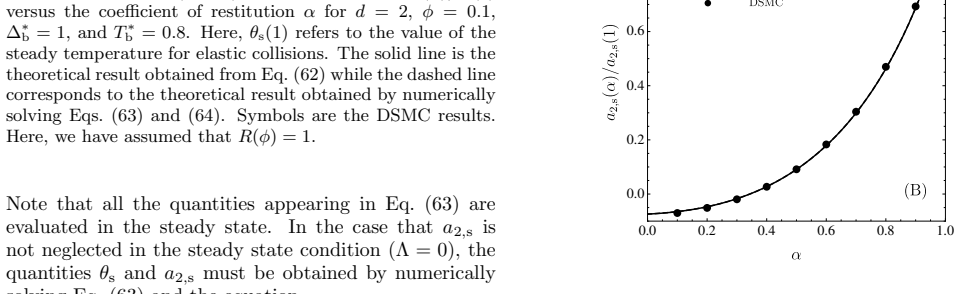
and for very dilute suspensions, the corresponding drift coefficient is γ≡γ St = 3πσηg m .(15) However, for moderately dense suspensions, hydrody- namic interactions and lubrication effects may modify the isolated–particle drag. In this regime, for low Reynolds number, these effects can be (phenomenologically) ac- counted for by writingγas γ=γ StR(ϕ),(16)...
-
[2]
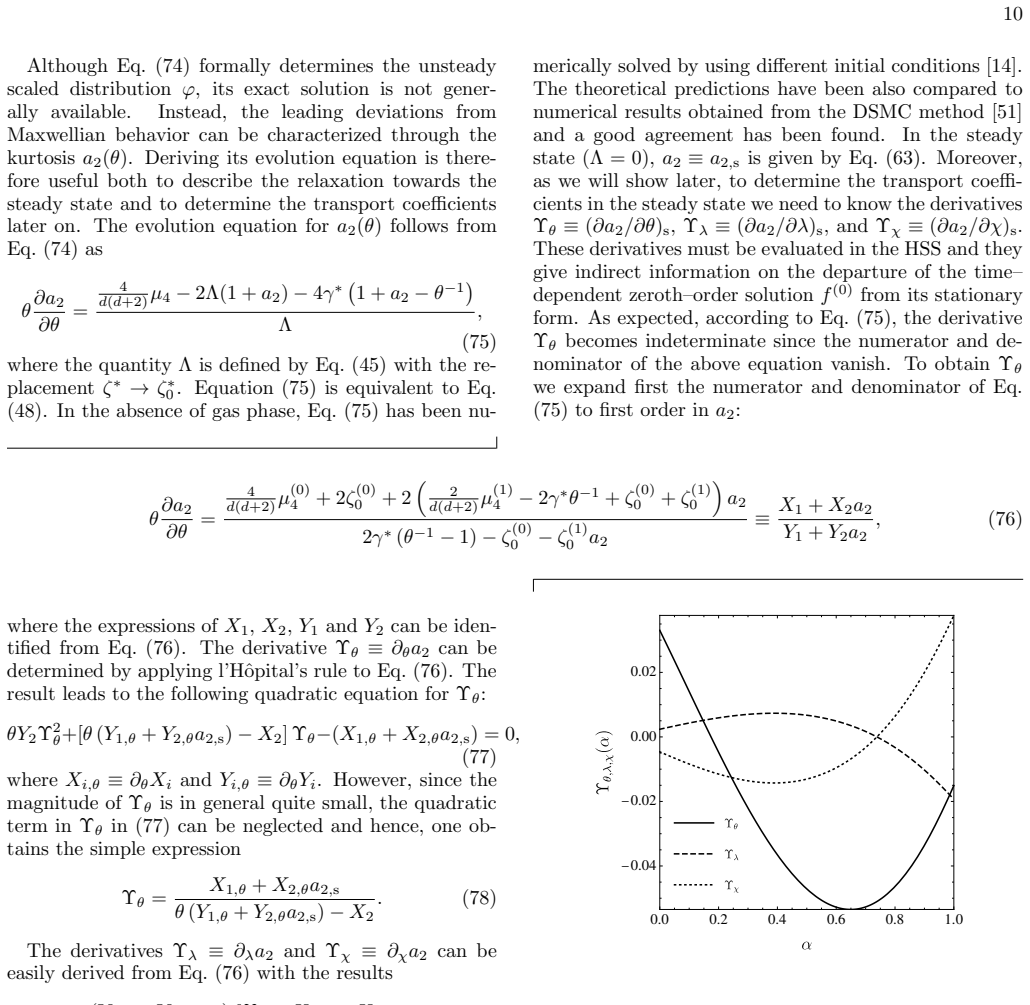
Equation (75) is equivalent to Eq. (48). In the absence of gas phase, Eq. (75) has been nu- merically solved by using different initial conditions [14]. The theoretical predictions have been also compared to numerical results obtained from the DSMC method [51] and a good agreement has been found. In the steady state (Λ = 0),a 2 ≡a 2,s is given by Eq. (63)...
-
[3]
1 +α (d+ 2) + d√π(d+ 1) Γ d 2 Γ d+1 2 ×θ−1/2∆∗ bIη # ηk + d d+ 2 η′ b,(96) η′ b = 22d+ 1 2 (d+ 2) √π χϕ2
+σ dχ × Z dv2 Z dbσΘ( bσ·g)( bσ·g) bσf (0)(v1)X(v2). (91) In addition, upon writing Eqs. (85) and (90) we have accounted for the fact that the first-order contribution to the cooling rateζ (1) =ζ U ∇ ·U, where ζU =ζ (1,0) +ζ (1,1),(92) ζ(1,0) =− 2d−1 d ϕχ 3 2(1−α 2)−2θ −1∆∗2 b −4 r 2 π 1− 1 16 a2 αθ−1/2∆∗ b # ,(93) ζ(1,1) =− 2mπ d−1 2 dnT χσd−1 Z dv1 Z dv...
2048
-
[4]
Here,η(1) refers to the shear viscosity coefficient for elastic collisions
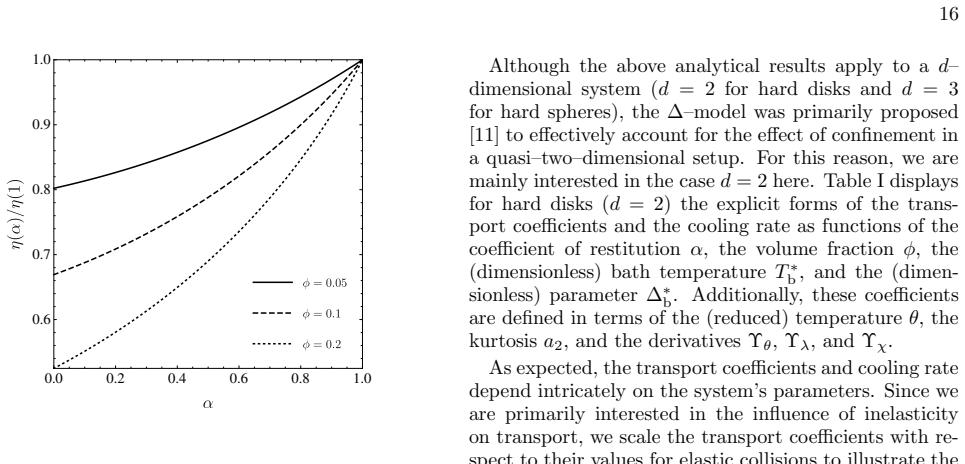
Three different values ofϕhave been considered:ϕ= 0.05 (solid),ϕ= 0.1 (dashed) andϕ= 0.2 (dotted). Here,η(1) refers to the shear viscosity coefficient for elastic collisions. 0.0 0.2 0.4 0.6 0.8 1.0 0.65 0.70 0.75 0.80 0.85 0.90 0.95 1.00 Figure 6. Plot of the (scaled) bulk viscosityη b(α)/ηb(1) ver- sus the coefficient of restitutionαford= 2, ∆ ∗ b = 0.5...
-
[5]
For this reason, we are mainly interested in the cased= 2 here
to effectively account for the effect of confinement in a quasi–two–dimensional setup. For this reason, we are mainly interested in the cased= 2 here. Table I displays for hard disks (d= 2) the explicit forms of the trans- port coefficients and the cooling rate as functions of the coefficient of restitutionα, the volume fractionϕ, the (dimensionless) bath...
-
[6]
Here, in contrast to the conventional ∆–model [18], ζU is different from zero for elastic collisions (ζU(1)̸= 0). We observe that the ratioζ U(α)/ζU(1) decreases with in- creasing inelasticity regardless of the density considered. Moreover, the influence of density onζ U (reduced with respect to its elastic value) is very weak. In summary, the study perfo...
-
[7]
Clustering, order, and collapse in a driven granular monolayer,
J. S. Olafsen and J. S. Urbach, “Clustering, order, and collapse in a driven granular monolayer,” Phys. Rev. Lett.81, 4369–4372 (1998)
1998
-
[8]
Propa- gating front in an excited granular layer,
W. Losert, D. G. W. Cooper, and J. P. Gollub, “Propa- gating front in an excited granular layer,” Phys. Rev. E 59, 5855–5861 (1999)
1999
-
[9]
Nonequilibrium two-phase coexistence in a con- fined granular layer,
A. Prevost, P. Melby, D. A. Egolf, and J. S. Ur- bach, “Nonequilibrium two-phase coexistence in a con- fined granular layer,” Phys. Rev. E70, 050301(R) (2004)
2004
-
[10]
Fluctuations and criticality of a granular solid-liquid-like phase transition,
G. Castillo, N. Mujica, and R. Soto, “Fluctuations and criticality of a granular solid-liquid-like phase transition,” Phys. Rev. Lett.109, 095701 (2012)
2012
-
[11]
Universality and criticality of a second-order granular solid-liquid-like phase transition,
G. Castillo, N. Mujica, and R. Soto, “Universality and criticality of a second-order granular solid-liquid-like phase transition,” Phys. Rev. E91, 012141 (2015)
2015
-
[12]
Critical phenomena in quasi- two-dimensional vibrated granular systems,
M. Guzm´ an and R. Soto, “Critical phenomena in quasi- two-dimensional vibrated granular systems,” Phys. Rev. E97, 012907 (2018)
2018
-
[13]
Hyperuniform states gen- erated by a critical friction field,
G. Castillo, N. Mujica, N. Sep´ ulveda, J. C. Sobrazo, M. Guzm´ an, and R. Soto, “Hyperuniform states gen- erated by a critical friction field,” Phys. Rev. E100, 032902 (2019)
2019
-
[14]
Kinetic theory of a confined quasi-one-dimensional gas of hard disks,
M. Mayo, J. J. Brey, M. I. Garc´ ıa Soria, and P. Maynar, “Kinetic theory of a confined quasi-one-dimensional gas of hard disks,” Physica A597, 127237 (2022)
2022
-
[15]
Dynamics of an inelastic tagged particle under strong confinement,
P. Maynar, M. I. Garc´ ıa Soria, and J. J. Brey, “Dynamics of an inelastic tagged particle under strong confinement,” Phys. Fluids34, 123321 (2022)
2022
-
[16]
Confined granular gases under the influence of vibrating walls,
M. Mayo, J. C. Petit, M. I. Garc´ ıa Soria, and P. Maynar, “Confined granular gases under the influence of vibrating walls,” J. Stat. Mech.123208(2023)
2023
-
[17]
Hydrodynamic modes in a confined granular fluid,
R. Brito, D. Risso, and R. Soto, “Hydrodynamic modes in a confined granular fluid,” Phys. Rev. E87, 022209 (2013)
2013
-
[18]
Dynamic properties in a collisional model for confined granular fluid. A review,
R. Brito, R. Soto, and V. Garz´ o, “Dynamic properties in a collisional model for confined granular fluid. A review,” Entropy28, 454 (2026)
2026
-
[19]
Homogeneous steady state of a confined gran- ular gas,
J. J. Brey, M. I. Garc´ ıa de Soria, P. Maynar, and V. Buz´ on, “Homogeneous steady state of a confined gran- ular gas,” Phys. Rev. E88, 062205 (2013)
2013
-
[20]
Homogeneous hydrodynamics of a collisional model of confined granular gases,
J. J. Brey, P. Maynar, M. I. Garc´ ıa de Soria, and V. Buz´ on, “Homogeneous hydrodynamics of a collisional model of confined granular gases,” Phys. Rev. E89, 052209 (2014)
2014
-
[21]
Shear viscosity of a model for confined granular media,
R. Soto, D. Risso, and R. Brito, “Shear viscosity of a model for confined granular media,” Phys. Rev. E90, 062204 (2014)
2014
-
[22]
Hydrodynamics for a model of a confined quasi- two-dimensional granular gas,
J. J. Brey, V. Buz´ on, P. Maynar, and M. Garc´ ıa de Soria, “Hydrodynamics for a model of a confined quasi- two-dimensional granular gas,” Phys. Rev. E91, 052201 (2015)
2015
-
[23]
Stability analysis of the homogeneous hydrodynam- ics of a model for a confined granular gas,
J. J. Brey, V. Buz´ on, M. I. Garc´ ıa de Soria, and P. May- nar, “Stability analysis of the homogeneous hydrodynam- ics of a model for a confined granular gas,” Phys. Rev. E 93, 062907 (2016)
2016
-
[24]
Enskog kinetic theory for a model of a confined quasi-two-dimensional granular fluid,
V. Garz´ o, R. Brito, and R. Soto, “Enskog kinetic theory for a model of a confined quasi-two-dimensional granular fluid,” Phys. Rev. E98, 052904 (2018)
2018
-
[25]
Enskog kinetic theory for a model of a confined quasi-two-dimensional granular fluid,
V. Garz´ o, R. Brito, and R. Soto, “Enskog kinetic theory for a model of a confined quasi-two-dimensional granular fluid,” Phys. Rev. E102 (Erratum), 059901 (2020)
2020
-
[26]
Energy nonequipar- tition in a collisional model of a confined quasi-two- dimensional granular mixture,
R. Brito, R. Soto, and V. Garz´ o, “Energy nonequipar- tition in a collisional model of a confined quasi-two- dimensional granular mixture,” Phys. Rev. E102, 052904 (2020)
2020
-
[27]
Navier–Stokes trans- port coefficients for a model of a confined quasi-two di- mensional granular binary mixture,
V. Garz´ o, R. Brito, and R. Soto, “Navier–Stokes trans- port coefficients for a model of a confined quasi-two di- mensional granular binary mixture,” Phys. Fluids33, 023310 (2021)
2021
-
[28]
Applications of the kinetic theory for a model of a confined quasi-two dimen- sional granular binary mixture: Stability analysis and thermal diffusion segregation,
V. Garz´ o, R. Brito, and R. Soto, “Applications of the kinetic theory for a model of a confined quasi-two dimen- sional granular binary mixture: Stability analysis and thermal diffusion segregation,” Phys. Fluids36, 033326 (2024)
2024
-
[29]
Diffusion of impurities in a moderately dense confined granular gas,
R. G´ omez Gonz´ alez, V. Garz´ o, R. Brito, and R. Soto, “Diffusion of impurities in a moderately dense confined granular gas,” Phys. Fluids36, 123387 (2024)
2024
-
[30]
Transport proper- ties in a model of confined granular mixtures at moderate densities,
D. Gonz´ alez M´ endez and V. Garz´ o, “Transport proper- ties in a model of confined granular mixtures at moderate densities,” Phys. Fluids38, 033343 (2026)
2026
-
[31]
Attractor nonequi- librium stationary states in perturbed long-range inter- acting systems,
M. Joyce, J. Morand, and P. Viot, “Attractor nonequi- librium stationary states in perturbed long-range inter- acting systems,” Phys. Rev. E93, 052129 (2016)
2016
-
[32]
Interplay between an absorbing phase transition and synchronization in a driven granular system,
R. Maire, A. Plati, M. Stockinger, E. Trizac, F. Small- enburg, and G. Foffi, “Interplay between an absorbing phase transition and synchronization in a driven granular system,” Phys. Rev. Lett.132, 238202 (2024)
2024
-
[33]
Dy- namical and structural properties of an absorbing phase transition: A case study from granular systems,
R. Maire, A. Plati, F. Smallenburg, and G. Foffi, “Dy- namical and structural properties of an absorbing phase transition: A case study from granular systems,” J. Stat. Mech.123206(2025)
2025
-
[34]
Quasi-crystalline order in vibrating granular matter,
A. Plati, R. Maire, E. Fayen, F. Boulogne, F. Restagno, F. Smallenburg, and G. Foffi, “Quasi-crystalline order in vibrating granular matter,” Nature Phys.20, 465–471 (2024)
2024
-
[35]
Enhancing (quasi-)long-range or- der in a two-dimensional driven crystal,
R. Maire and A. Plati, “Enhancing (quasi-)long-range or- der in a two-dimensional driven crystal,” J. Chem. Phys. 161, 054902 (2024)
2024
-
[36]
Non- equilibrium coexistence between a fluid and a hotter or colder crystal of granular hard disks,
R. Maire, A. Plati, F. Smallenburg, and G. Foffi, “Non- equilibrium coexistence between a fluid and a hotter or colder crystal of granular hard disks,” J. Chem. Phys. 162, 124901 (2025)
2025
-
[37]
Hyperuniformity and conserva- tion laws in non-equilibrium systems,
R. Maire and L. Chaix, “Hyperuniformity and conserva- tion laws in non-equilibrium systems,” J. Chem. Phys. 163, 214507 (2025)
2025
-
[38]
Transport coeffi- cients for granular suspensions at moderate densities,
R. G´ omez Gonz´ alez and V. Garz´ o, “Transport coeffi- cients for granular suspensions at moderate densities,” J. Stat. Mech.093204(2019)
2019
-
[39]
Kinetic theory of granular particles immersed in a molecular gas,
R. G´ omez Gonz´ alez and V. Garz´ o, “Kinetic theory of granular particles immersed in a molecular gas,” J. Fluid Mech.943, A9 (2022)
2022
-
[40]
Rheology of granular particles immersed in a molecular gas under uniform shear flow,
M. G´ omez Gonz´ alez, R. Garc´ ıa Chamorro and V. Garz´ o, “Rheology of granular particles immersed in a molecular gas under uniform shear flow,” Phys. Rev. E109, 064901 (2024)
2024
-
[41]
Diffusion of intruders in a granular gas thermostatted by a bath of elastic hard spheres,
R. G´ omez Gonz´ alez and V. Garz´ o, “Diffusion of intruders in a granular gas thermostatted by a bath of elastic hard spheres,” J. Fluid Mech.1022, A36 (2025)
2025
-
[42]
Inertial effects in suspensions and porous-media flows,
D. L. Koch and R. J. Hill, “Inertial effects in suspensions and porous-media flows,” Annu. Rev. Fluid Mech.33, 619–647 (2001)
2001
-
[43]
Enskog kinetic theory for monodisperse gas- solid flows,
V. Garz´ o, S. Tenneti, S. Subramaniam, and C. M. 26 Hrenya, “Enskog kinetic theory for monodisperse gas- solid flows,” J. Fluid Mech.712, 129–168 (2012)
2012
-
[44]
Simple shear flows of di- lute gas–solid suspensions,
H-K Tsao and D. L. Koch, “Simple shear flows of di- lute gas–solid suspensions,” J. Fluid Mech.296, 211–245 (1995)
1995
-
[45]
Sim- ple shear flows of dense gas-solid suspensions at finite Stokes numbers,
A. S. Sangani, G. Mo, H-K Tsao, and D. L. Koch, “Sim- ple shear flows of dense gas-solid suspensions at finite Stokes numbers,” J. Fluid Mech.313, 309–341 (1996)
1996
-
[46]
Particle pressure and marginal stability limits for a homogeneous monodisperse gas-fluidized bed: Kinetic theory and numerical simula- tions,
D. L. Koch and A. S. Sangani, “Particle pressure and marginal stability limits for a homogeneous monodisperse gas-fluidized bed: Kinetic theory and numerical simula- tions,” J. Fluid Mech.400, 229 (1999)
1999
-
[47]
Driven inelastic-particle systems with drag,
J. J. Wylie, Q. Zhang, Y. Li, and X. Hengyi, “Driven inelastic-particle systems with drag,” Phys. Rev. E79, 031301 (2009)
2009
-
[48]
Shear thickening in granular suspensions: Interparticle friction and dynamically correlated clus- ters,
C. Heussinger, “Shear thickening in granular suspensions: Interparticle friction and dynamically correlated clus- ters,” Phys. Rev. E88, 050201(R) (2013)
2013
-
[49]
Active microrhelogy of driven granular particles,
T. Wang, M. Grob, A. Zippelius, and M. Sperl, “Active microrhelogy of driven granular particles,” Phys. Rev. E 89, 042209 (2014)
2014
-
[50]
Revisiting ignited-quenched tran- sition and the non-newtonian rheology of a sheared di- lute gas-solid suspension,
S. Saha and M. Alam, “Revisiting ignited-quenched tran- sition and the non-newtonian rheology of a sheared di- lute gas-solid suspension,” J. Fluid Mech.833, 206–246 (2017)
2017
-
[51]
Kinetic the- ory of shear thickening for a moderately dense gas-solid suspension: From discontinuous thickening to continuous thickening,
H. Hayakawa, S. Takada, and V. Garz´ o, “Kinetic the- ory of shear thickening for a moderately dense gas-solid suspension: From discontinuous thickening to continuous thickening,” Phys. Rev. E96, 042903 (2017)
2017
-
[52]
Burnett-order constitutive rela- tions, second moment anisotropy and co-existing states in sheared dense gas-solid suspensions,
S. Saha and M. Alam, “Burnett-order constitutive rela- tions, second moment anisotropy and co-existing states in sheared dense gas-solid suspensions,” J. Fluid Mech. 887, A9 (2020)
2020
-
[53]
En- skog kinetic theory of rheology for a moderately dense inertial suspension,
S. Takada, H. Hayakawa, A. Santos, and V. Garz´ o, “En- skog kinetic theory of rheology for a moderately dense inertial suspension,” Phys. Rev. E102, 022907 (2020)
2020
-
[54]
Enskog kinetic theory for multicomponent granular suspensions,
R. G´ omez Gonz´ alez, N. Khalil, and V. Garz´ o, “Enskog kinetic theory for multicomponent granular suspensions,” Phys. Rev. E101, 012904 (2020)
2020
-
[55]
Tracer diffusion in granular suspensions: Testing the Enskog kinetic theory with direct-simulation Monte Carlo and molecular dy- namics,
A. Puertas and R. G´ omez Gonz´ alez, “Tracer diffusion in granular suspensions: Testing the Enskog kinetic theory with direct-simulation Monte Carlo and molecular dy- namics,” Phys. Rev. E113, 035414 (2026)
2026
-
[56]
Chapman and T
S. Chapman and T. G. Cowling,The Mathematical The- ory of Nonuniform Gases(Cambridge University Press, Cambridge, 1970)
1970
-
[57]
G. A. Bird,Molecular Gas Dynamics and the Direct Sim- ulation Monte Carlo of Gas Flows(Clarendon, Oxford, 1994)
1994
-
[58]
Rheology of dense polydisperse granular fluids under shear,
J. F. Lutsko, “Rheology of dense polydisperse granular fluids under shear,” Phys. Rev. E70, 061101 (2004)
2004
-
[59]
Lattice-Boltzmann simulations of low-Reynolds-number flow past mono- and bidisperse arrays of spheres: Results for the permeability and drag force,
M. A. Van der Hoef, R. Beetstra, and J. A. M. Kuipers, “Lattice-Boltzmann simulations of low-Reynolds-number flow past mono- and bidisperse arrays of spheres: Results for the permeability and drag force,” J. Fluid Mech.528, 233–254 (2005)
2005
-
[60]
Erratum: Drag force of intermediate Reynolds number flow past mono- and bidisperse arrays of spheres [AIChE j. 53, 489 (2007)],
R. Beetstra, M. A. Van der Hoef, and J. A. M. Kuipers, “Erratum: Drag force of intermediate Reynolds number flow past mono- and bidisperse arrays of spheres [AIChE j. 53, 489 (2007)],” AIChE J.53, 3020–3020 (2007)
2007
-
[61]
Fluid-particle drag in low- Reynolds-number polydisperse gas-solid suspensions,
X. Yin and S. Sundaresan, “Fluid-particle drag in low- Reynolds-number polydisperse gas-solid suspensions,” AIChE J.55, 1352–1368 (2009)
2009
-
[62]
Brilliantov and T
N. Brilliantov and T. P¨ oschel,Kinetic Theory of Granu- lar Gases(Oxford University Press, Oxford, 2004)
2004
-
[63]
Garz´ o,Granular Gaseous Flows(Springer Nature, Cham, 2019)
V. Garz´ o,Granular Gaseous Flows(Springer Nature, Cham, 2019)
2019
-
[64]
Kinetic theory for a monodisperse gas-solid suspension,
D. L. Koch, “Kinetic theory for a monodisperse gas-solid suspension,” Phys. Fluids A2, 1711–1722 (1990)
1990
-
[65]
Rheology of suspensions with high particle inertia and moderate fluid inertia,
J. J. Wylie, D. L. Koch, and J. C. Ladd, “Rheology of suspensions with high particle inertia and moderate fluid inertia,” J. Fluid Mech.480, 95 (2003)
2003
-
[66]
Velocity distribu- tions in homogeneous granular fluids: the free and heated case,
T. P. C. van Noije and M. H. Ernst, “Velocity distribu- tions in homogeneous granular fluids: the free and heated case,” Granular Matter1, 57–64 (1998)
1998
-
[67]
Nearest-neighbor statistics for packings of hard spheres and disks,
S. Torquato, “Nearest-neighbor statistics for packings of hard spheres and disks,” Phys. Rev. E51, 3170–3182 (1995)
1995
-
[68]
Enskog kinetic theory for a model of a confined quasi-two-dimensional granular fluid,
V. Garz´ o, R. Brito, and R. Soto, “Enskog kinetic theory for a model of a confined quasi-two-dimensional granular fluid,” arXiv: 1803.03429v7(2026)
-
[69]
While the present study was being conducted, some ty- pos were found in the forms obtained in Ref. [18]. The expressions displayed here are the corrected results
-
[70]
Influence of a drag force on linear transport in low-density gases. Stability analysis,
J. C. P´ erez-Fuentes and V. Garz´ o, “Influence of a drag force on linear transport in low-density gases. Stability analysis,” Physica A410, 428–438 (2014)
2014
-
[71]
Hydrodynamics for granular flow at low density,
J. Javier Brey, James W. Dufty, Chang Sub Kim, and Andr´ es Santos, “Hydrodynamics for granular flow at low density,” Phys. Rev. E58, 4638 (1998)
1998
-
[72]
S. R. de Groot, W. A. van Leeuwen, and C. G. van Weert,Relativistic Kinetic Theory: Principles and Ap- plications(North–Holland, Amsterdam, 1980)
1980
-
[73]
Cercignani and G
C. Cercignani and G. Kremer,The Relativistic Boltz- mann Equation: Theory and Applications(Birkh¨ ausser, Berlin, 2002)
2002
-
[74]
Instabilities in a free granular fluid described by theEnskog equation,
V. Garz´ o, “Instabilities in a free granular fluid described by theEnskog equation,” Phys. Rev. E72, 021106 (2005)
2005
-
[75]
Mass and heat fluxes for a binary granular mixture at low density,
V. Garz´ o, J. M. Montanero, and J. W. Dufty, “Mass and heat fluxes for a binary granular mixture at low density,” Phys. Fluids18, 083305 (2006)
2006
-
[76]
N. S. Nise,Control Systems Engineering(Wiley, 2020)
2020
-
[77]
Diffusion of impurities in a granular gas,
V. Garz´ o and J. M. Montanero, “Diffusion of impurities in a granular gas,” Phys. Rev. E69, 021301 (2004)
2004
-
[78]
Mass transport of impu- rities in a moderately dense granular gas,
V. Garz´ o and F. Vega Reyes, “Mass transport of impu- rities in a moderately dense granular gas,” Phys. Rev. E 79, 041303 (2009)
2009
-
[79]
Diffusion transport coefficients for granular binary mixtures at low density: Thermal diffusion segregation,
V. Garz´ o, J. A. Murray, and F. Vega Reyes, “Diffusion transport coefficients for granular binary mixtures at low density: Thermal diffusion segregation,” Phys. Fluids25, 043302 (2013)
2013
-
[80]
Diffusion of intruders in granular suspensions: Enskog theory and random walk interpretation,
R. G´ omez Gonz´ alez, E. Abad, S. Bravo Yuste, and V. Garz´ o, “Diffusion of intruders in granular suspensions: Enskog theory and random walk interpretation,” Phys. Rev. E108, 024903 (2023)
2023
discussion (0)
Sign in with ORCID, Apple, or X to comment. Anyone can read and Pith papers without signing in.