Recognition: unknown
Quantum Resource Estimation for Minimising Energy Grid Losses
Pith reviewed 2026-05-07 04:07 UTC · model grok-4.3
The pith
Reformulating distribution network reconfiguration as a higher-order unconstrained binary optimisation problem reduces the number of qubits required for quantum solutions.
A machine-rendered reading of the paper's core claim, the machinery that carries it, and where it could break.
Core claim
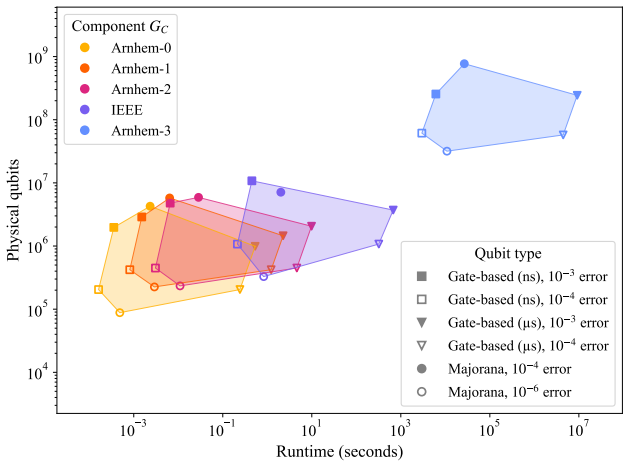
The central discovery is that DNR for minimising energy losses can be formulated as a HUBO problem without auxiliary variables. For the real Alliander MV network, each biconnected component is mapped to a HUBO, cost and mixer operators are constructed, and quantum resource estimation provides counts of logical qubits, rotation gates, and estimated physical qubits and execution time. The results show that resource requirements depend on both component size and structural properties such as connectivity and cyclicity.
What carries the argument
Higher-order unconstrained binary optimisation (HUBO) formulation that directly represents the network reconfiguration objective and constraints as a polynomial in binary variables.
If this is right
- Quantum solvers for power grid reconfiguration would need fewer qubits than those using quadratic unconstrained binary optimisation.
- Resource estimates can be used to project when quantum hardware will be sufficient for practical distribution networks.
- Network structure, including cycles and connectivity, becomes a key factor in assessing quantum feasibility beyond mere node count.
- Distribution system operators could evaluate quantum readiness for specific grid segments based on their graph properties.
Where Pith is reading between the lines
- Similar HUBO mappings might apply to other combinatorial optimisation tasks in energy systems, such as unit commitment or transmission planning.
- Success here would encourage hybrid classical-quantum workflows where biconnected components are solved independently.
- Over time, this could support dynamic reconfiguration in response to fluctuating renewable generation and demand.
Load-bearing premise
The load-bearing premise is that the HUBO problem formulation correctly and completely represents the distribution network reconfiguration objective and constraints for the Alliander medium voltage network, without modeling inaccuracies that would affect the quantum solution quality.
What would settle it
Computing the exact minimum power loss configuration for one biconnected component of the Alliander network using a classical brute-force or integer programming solver and verifying it matches the configuration found by optimizing the HUBO objective.
Figures

read the original abstract
Distribution network reconfiguration (DNR) can minimise power losses by identifying the optimal topology of the electricity grid. Determining the minimum loss configuration is NP-hard, and classical optimisation methods struggle to scale to real-world distribution grids. This paper explores the use of gate-based quantum computing to solve DNR for power loss reduction. We formulate DNR as a higher-order unconstrained binary optimisation (HUBO) problem, avoiding the need for auxiliary variables, thereby reducing the required number of qubits. This is applied to a real medium voltage (MV) network operated by Alliander, a Dutch distribution system operator (DSO). For each biconnected component in the network graph, we construct the corresponding HUBO, derive the cost and mixer operators, and determine the number of required logical qubits and rotation gates. These are then mapped to physical qubits and execution time estimates using quantum resource estimation (QRE). The results suggest that the quantum resource requirements depend not only on component size but also on structural characteristics such as connectivity and cyclicity. Overall, the novelty of this work lies in directly framing the optimisation problem as a HUBO, applying it to real-world MV networks, and performing a QRE to assess future feasibility.
Editorial analysis
A structured set of objections, weighed in public.
Referee Report
Summary. The manuscript formulates distribution network reconfiguration (DNR) to minimize power losses as a higher-order unconstrained binary optimization (HUBO) problem that avoids auxiliary variables. It applies the approach to a real medium-voltage network operated by Alliander, constructs the HUBO for each biconnected component, derives the corresponding cost and mixer operators, and performs quantum resource estimation (QRE) to obtain counts of logical qubits, rotation gates, physical qubits, and execution time. The results indicate that resource requirements depend on both component size and structural properties such as connectivity and cyclicity.
Significance. If the HUBO mapping is shown to be exact, the work would be significant for providing the first concrete quantum resource estimates for a real-world distribution-grid optimization problem drawn from an operational Dutch DSO network. The direct HUBO encoding without auxiliary variables is a technically interesting choice that could lower qubit overhead relative to standard QUBO reductions, and the reported dependence of resources on cyclicity offers a falsifiable structural insight that could guide future algorithm and hardware development.
major comments (2)
- [Formulation and Methods] The central claim that DNR is exactly encoded as a HUBO without auxiliary variables (Abstract and formulation section) is load-bearing for all subsequent QRE numbers, yet the manuscript supplies neither the explicit higher-order polynomial for the power-loss objective nor the algebraic steps that enforce radiality. Because power losses are governed by nonlinear Kirchhoff equations that depend on active edges, it is essential to verify that the derived cost operator reproduces the true minimum-loss radial configurations rather than an approximation or soft-penalty surrogate; without this derivation or a small-instance validation, the reported qubit and gate counts apply to an unverified problem.
- [Results and QRE] Table or figure presenting the QRE results (e.g., logical qubits, rotation-gate counts, physical-qubit estimates after error correction) for the Alliander biconnected components is missing or insufficiently detailed. The manuscript states that requirements depend on connectivity and cyclicity, but provides no tabulated data, no error bars on the estimates, and no comparison against a baseline QUBO formulation or classical solver to quantify the claimed qubit reduction.
minor comments (2)
- [Abstract] The abstract refers to 'cost and mixer operators' without specifying the underlying algorithm (QAOA, VQE, or other); the main text should state the variational ansatz and the precise form of the mixer Hamiltonian.
- [Throughout] All acronyms (DNR, HUBO, QRE, MV, DSO) should be defined at first use in the main text; the current abstract assumes reader familiarity.
Simulated Author's Rebuttal
We thank the referee for their thorough review and insightful comments, which have helped us identify areas for improvement in the manuscript. We address each of the major comments below and outline the revisions we plan to make.
read point-by-point responses
-
Referee: The central claim that DNR is exactly encoded as a HUBO without auxiliary variables (Abstract and formulation section) is load-bearing for all subsequent QRE numbers, yet the manuscript supplies neither the explicit higher-order polynomial for the power-loss objective nor the algebraic steps that enforce radiality. Because power losses are governed by nonlinear Kirchhoff equations that depend on active edges, it is essential to verify that the derived cost operator reproduces the true minimum-loss radial configurations rather than an approximation or soft-penalty surrogate; without this derivation or a small-instance validation, the reported qubit and gate counts apply to an unverified problem.
Authors: We appreciate the referee highlighting the need for explicit verification of the HUBO formulation. While the manuscript describes the mapping from DNR to HUBO and notes the avoidance of auxiliary variables, we acknowledge that the full explicit polynomial and step-by-step algebraic derivation were omitted for conciseness. In the revised manuscript, we will expand the formulation section to include the complete higher-order objective function derived from the power loss expression and the constraints for radiality (ensuring no cycles and connectivity). Additionally, we will provide a small-scale validation example on a simple network where the optimal configuration is known analytically, demonstrating that the HUBO cost function correctly identifies the minimum-loss radial topology. This will confirm the exactness of the encoding without relying on penalties or approximations. revision: yes
-
Referee: Table or figure presenting the QRE results (e.g., logical qubits, rotation-gate counts, physical-qubit estimates after error correction) for the Alliander biconnected components is missing or insufficiently detailed. The manuscript states that requirements depend on connectivity and cyclicity, but provides no tabulated data, no error bars on the estimates, and no comparison against a baseline QUBO formulation or classical solver to quantify the claimed qubit reduction.
Authors: We agree that the QRE results require more detailed presentation to support the claims. In the revised version, we will add a comprehensive table summarizing the quantum resource estimates for each biconnected component of the Alliander network, including logical qubit counts, rotation gate counts, estimated physical qubits under a specific error correction scheme, and projected execution times. We will also include error bars reflecting uncertainties in the estimation process and a comparative analysis against a standard QUBO reduction of the same problem to quantify the qubit savings achieved by the direct HUBO approach. This will provide concrete data backing the dependence on structural properties like connectivity and cyclicity. revision: yes
Circularity Check
No significant circularity; derivation is self-contained
full rationale
The paper directly maps the DNR problem (power-loss minimization subject to radiality) onto a HUBO formulation in switch variables, constructs explicit cost and mixer operators per biconnected component, and feeds the resulting operator descriptions into standard QRE routines to obtain logical-qubit and gate counts. No equation is shown to be equivalent to its own input by construction, no fitted parameter is relabeled as a prediction, and no load-bearing premise rests on a self-citation or author-supplied uniqueness theorem. The reported dependence of resource counts on connectivity and cyclicity is an output of applying the same construction to different subgraphs of the Alliander network, not a tautology. The chain therefore remains independent of the target results.
Axiom & Free-Parameter Ledger
axioms (2)
- domain assumption Distribution network reconfiguration can be accurately represented as a higher-order unconstrained binary optimization problem without auxiliary variables.
- domain assumption Quantum resource estimation applied to the derived cost and mixer operators yields reliable estimates of physical qubit counts and execution times.
Reference graph
Works this paper leans on
-
[1]
Powerdistributionnetworkreconfigurationtechniques: A thorough review,
H.Lotfi,M.E.Hajiabadi,andH.Parsadust,“Powerdistributionnetworkreconfigurationtechniques: A thorough review,”Sustainability, vol. 16, no. 23, p. 10307, 2024
2024
-
[2]
Evaluatingelectricitydistributionnetwork reconfiguration to minimize power loss on existing networks,
W.VanWestering,M.VanDerMeulen,andW.Bosma,“Evaluatingelectricitydistributionnetwork reconfiguration to minimize power loss on existing networks,” inCIRED Workshop 2016, p. 65, IET, 2016
2016
-
[3]
Challenges and opportunities in quantum optimization,
A. Abbaset al., “Challenges and opportunities in quantum optimization,”Nature Reviews Physics, vol. 6, no. 12, pp. 718–735, 2024
2024
-
[4]
A QUBO Formulation for Minimum Loss Spanning Tree Reconfiguration Problems in Electric Power Networks,
F. F. C. Silvaet al., “A QUBO Formulation for Minimum Loss Spanning Tree Reconfiguration Problems in Electric Power Networks,”IEEE Transactions on Power Systems, vol. 38, pp. 4559– 4571, Sept. 2023
2023
-
[5]
A quantum computing approach for minimum loss problems in electrical distribution networks,
F. F. C. Silva, P. M. S. Carvalho, and L. A. F. M. Ferreira, “A quantum computing approach for minimum loss problems in electrical distribution networks,”Scientific Reports, vol. 13, p. 10777, July 2023
2023
-
[6]
Bias-fielddigitizedcounterdiabaticquantumalgorithmforhigher-orderbinary optimization,
S.V.Romeroetal.,“Bias-fielddigitizedcounterdiabaticquantumalgorithmforhigher-orderbinary optimization,”Communications Physics, vol. 8, p. 348, Aug. 2025
2025
-
[7]
Network reconfiguration in distribution systems for loss reduction and load balancing,
M. Baran and F. Wu, “Network reconfiguration in distribution systems for loss reduction and load balancing,”IEEE Transactions on Power Delivery, vol. 4, no. 2, pp. 1401–1407, 1989
1989
-
[8]
A quantum approximate optimization algorithm,
E. Farhi, J. Goldstone, and S. Gutmann, “A quantum approximate optimization algorithm,” Nov
-
[9]
arXiv:1411.4028 [quant-ph]
work page internal anchor Pith review arXiv
-
[10]
Assessing requirements to scale to practical quantum advantage,
M. E. Beverlandet al., “Assessing requirements to scale to practical quantum advantage,” Nov
-
[11]
arXiv:2211.07629 [quant-ph]
work page internal anchor Pith review arXiv
-
[12]
Distributiongridreconfigurationreducespowerlossesand helps integrate renewables,
C.Lueken,P.M.Carvalho,andJ.Apt,“Distributiongridreconfigurationreducespowerlossesand helps integrate renewables,”Energy Policy, vol. 48, pp. 260–273, 2012. 8
2012
discussion (0)
Sign in with ORCID, Apple, or X to comment. Anyone can read and Pith papers without signing in.