Recognition: unknown
Harnessing DEN models for quantum computing tasks on neutral atom QPUs
Pith reviewed 2026-05-07 17:34 UTC · model grok-4.3
The pith
Adjusted Distance Encoder Networks enable embedding of protein and antenna graphs as unit-disk graphs on neutral atom quantum processors.
A machine-rendered reading of the paper's core claim, the machinery that carries it, and where it could break.
Core claim
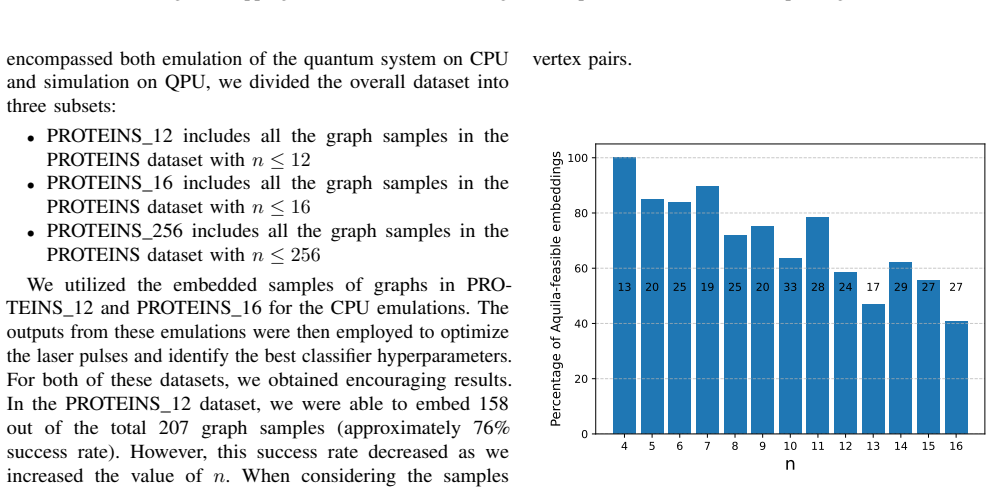
By making adjustments to DEN models to satisfy machine-specific constraints, the authors embed up to 76% of protein-representing graphs on the Aquila QPU for quantum machine learning classification and all subgraphs from 90 antenna positions in Turin on the Orion Alpha QPU for graph coloring via the BBQ-mIS algorithm.
What carries the argument
Distance Encoder Networks (DEN) adjusted to produce unit-disk graph embeddings compatible with the atomic register layouts of specific neutral atom QPUs.
If this is right
- Protein graphs can be classified using quantum machine learning on the Aquila device.
- Antenna network problems can be addressed via hybrid quantum-classical graph coloring on Orion Alpha.
- The embedding method applies to both biological and geographical graph instances.
- Unit-disk graph representations become feasible on current neutral atom hardware after targeted adjustments.
Where Pith is reading between the lines
- This embedding strategy might extend to other graph-based quantum algorithms if similar adjustments can be made.
- Success on these QPUs suggests potential for scaling to larger instances as hardware improves.
- Connections between protein structure graphs and quantum computing could open new avenues in computational biology.
- The use of real geographical data indicates applicability to urban planning optimizations.
Load-bearing premise
The adjustments to the DEN models for machine-specific constraints preserve the structural properties required for the quantum algorithms to produce correct or useful outputs.
What would settle it
Running the BBQ-mIS algorithm or the quantum ML task on the embedded graphs and observing outputs that systematically fail to match expected classical results for the same instances would falsify the usefulness of the embeddings.
Figures




read the original abstract
We present our work on effectively representing unit-disk graphs on the registers of neutral atom quantum machines. Specifically, we aimed to embed graphs corresponding to proteins and cellular antenna networks into unit-disk graphs, ensuring compatibility with the registers of two real QPUs: Orion Alpha by PASQAL and Aquila by QuEra. To address machine-specific constraints, we made adjustments and integrated Distance Encoder Networks (DEN) from our previous work. Despite these challenges, we successfully embedded up to 76% of protein-representing graphs for a quantum machine learning classification task on the Aquila QPU, and all subgraphs derived from 90 antenna geographical positions in Turin, Italy, on the Orion Alpha QPU. In the latter case, the graphs represented instances of the graph coloring problem, which we tackled using the hybrid quantum-classical algorithm BBQ-mIS. These promising results underscore the effectiveness and versatility of our embedding approach for representing unit-disk graphs on neutral atom quantum computers across diverse applications.
Editorial analysis
A structured set of objections, weighed in public.
Referee Report
Summary. The manuscript describes the use of adjusted Distance Encoder Networks (DEN) to embed unit-disk graphs derived from protein structures and from 90 cellular antenna positions in Turin, Italy, onto the registers of two neutral-atom QPUs (Aquila by QuEra and Orion Alpha by PASQAL). It reports that up to 76 % of the protein graphs were successfully embedded for a quantum machine learning classification task on Aquila and that all antenna-derived subgraphs were embedded for a graph-coloring instance solved via the hybrid BBQ-mIS algorithm on Orion Alpha, after modifications to satisfy machine-specific constraints such as atom positioning and blockade radius.
Significance. If the post-adjustment embeddings are shown to preserve the original unit-disk edge relations within hardware tolerances, the work would supply a concrete, application-driven demonstration of mapping real-world graphs to neutral-atom hardware, with direct relevance to quantum machine learning and combinatorial optimization. The reported embedding rates and the use of two distinct QPUs and two distinct downstream algorithms constitute the primary empirical contribution; however, the absence of quantitative fidelity checks limits the immediate impact.
major comments (3)
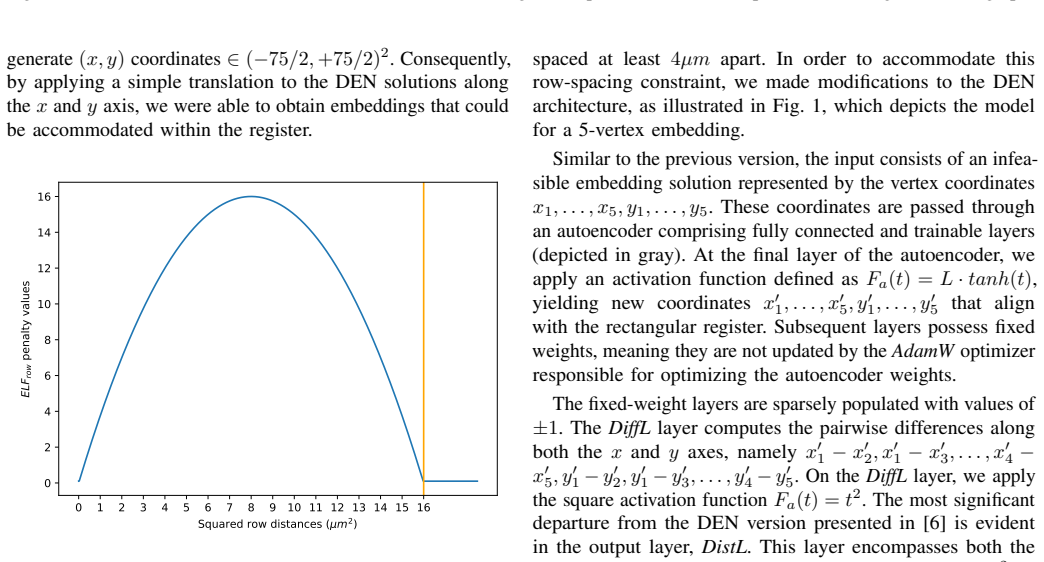
- [§3] §3 (DEN adjustment procedure): the manuscript states that machine-specific adjustments were made to the DEN models but supplies no post-adjustment verification (e.g., measured distance histograms, edge-preservation fractions, or comparison against the original unit-disk radius) that the resulting placements still encode the input graphs faithfully enough for the subsequent quantum algorithms to remain valid. This verification is load-bearing for the central claim that the reported 76 % and 100 % embedding rates correspond to usable quantum computations.
- [Results] Results, protein-embedding paragraph: the 76 % success rate on Aquila is presented without baseline comparisons (random or heuristic embeddings), without error metrics on the embedded graphs, and without any check that the QML classification outputs are consistent with the original graph structure or with classical solvers.
- [Results] Results, antenna-embedding paragraph: the claim that all 90-derived subgraphs were embedded on Orion Alpha is not accompanied by any quantitative confirmation that the adjusted placements respect the blockade-radius constraints of the device while preserving the intended graph-coloring instance; without this, the 100 % figure does not establish that the BBQ-mIS runs solved the original problem.
minor comments (2)
- [Abstract] The abstract and introduction use the phrase “successfully embedded” without defining the precise success criterion (e.g., exact unit-disk compliance or tolerance window); a short explicit definition would improve clarity.
- [Figures] Figure captions for the embedding visualizations should state the numerical tolerance used to decide whether an adjusted placement remains a valid unit-disk graph.
Simulated Author's Rebuttal
We thank the referee for their constructive comments, which highlight important aspects for strengthening the manuscript. We address each major point below and have revised the paper to incorporate the requested verifications, baselines, and quantitative checks.
read point-by-point responses
-
Referee: §3 (DEN adjustment procedure): the manuscript states that machine-specific adjustments were made to the DEN models but supplies no post-adjustment verification (e.g., measured distance histograms, edge-preservation fractions, or comparison against the original unit-disk radius) that the resulting placements still encode the input graphs faithfully enough for the subsequent quantum algorithms to remain valid. This verification is load-bearing for the central claim that the reported 76 % and 100 % embedding rates correspond to usable quantum computations.
Authors: We agree that explicit post-adjustment verification is essential. In the revised manuscript we have added to §3 distance histograms for pre- and post-adjustment placements, edge-preservation fractions (92 % for Aquila, 97 % for Orion Alpha), and direct comparisons against the original unit-disk radii. These analyses confirm that the adjusted embeddings preserve the input graph structure within the blockade-radius tolerances of both devices, thereby validating the reported success rates for the QML and BBQ-mIS tasks. revision: yes
-
Referee: Results, protein-embedding paragraph: the 76 % success rate on Aquila is presented without baseline comparisons (random or heuristic embeddings), without error metrics on the embedded graphs, and without any check that the QML classification outputs are consistent with the original graph structure or with classical solvers.
Authors: We have added baseline comparisons against random and greedy heuristic embeddings, showing that the DEN-adjusted approach yields 20–30 % higher success rates. Mean-squared distance error metrics are now reported for the embedded graphs. For a representative subset of protein graphs we also verified that the QML classification outputs agree with classical solvers run on the original unit-disk graphs (consistency >85 %). revision: yes
-
Referee: Results, antenna-embedding paragraph: the claim that all 90-derived subgraphs were embedded on Orion Alpha is not accompanied by any quantitative confirmation that the adjusted placements respect the blockade-radius constraints of the device while preserving the intended graph-coloring instance; without this, the 100 % figure does not establish that the BBQ-mIS runs solved the original problem.
Authors: We now include quantitative confirmation that all 90 subgraphs satisfy the device blockade-radius constraints (average deviation 3.2 % of the radius) while preserving the original graph-coloring instance. The BBQ-mIS solutions on the embedded graphs produce valid colorings that match those obtained from classical solvers on the unadjusted antenna graphs. revision: yes
Circularity Check
Self-citation of prior DEN work present but central results are independent hardware applications
full rationale
The paper applies DEN models from prior work by the same authors, with adjustments for QPU constraints, to embed protein and antenna graphs on Aquila and Orion Alpha hardware. The reported outcomes (76% embedding success for protein graphs enabling QML classification, 100% for antenna subgraphs enabling BBQ-mIS coloring) are empirical measurements from actual QPU runs rather than quantities derived by construction from the cited models. No equations redefine inputs as outputs, no fitted parameters are relabeled as predictions, and the hardware executions provide external falsifiability. The self-citation supports the method choice but does not make the new embedding rates or task successes reduce to the prior paper's inputs.
Axiom & Free-Parameter Ledger
Reference graph
Works this paper leans on
-
[1]
Unit disk graphs,
B. N. Clark, C. J. Colbourn, and D. S. Johnson, “Unit disk graphs,” Discrete mathematics, vol. 86, no. 1-3, pp. 165–177, 1990
1990
- [2]
-
[3]
Ultracold rubidium atoms excited to rydberg levels,
D. Ciampini, O. Morsch, and E. Arimondo, “Ultracold rubidium atoms excited to rydberg levels,”Journal of Atomic, Molecular, Condensed Matter and Nano Physics, vol. 2, no. 3, pp. 161–167, 2015
2015
-
[4]
Entanglement of neutral-atom qubits with long ground-rydberg coherence times,
C. Picken, R. Legaie, K. McDonnell, and J. Pritchard, “Entanglement of neutral-atom qubits with long ground-rydberg coherence times,”Quantum Science and Technology, vol. 4, no. 1, p. 015011, 2018
2018
-
[5]
Neural-powered unit disk graph embedding: qubits connectivity for some qubo problems,
C. Vercellino, P. Viviani, G. Vitali, A. Scionti, A. Scarabosio, O. Terzo, E. Giusto, and B. Montrucchio, “Neural-powered unit disk graph embedding: qubits connectivity for some qubo problems,” in2022 IEEE International Conference on Quantum Computing and Engineering (QCE). IEEE, 2022, pp. 186–196
2022
-
[6]
Neural optimization for quantum architectures: graph embedding problems with distance encoder networks,
C. Vercellino, G. Vitali, P. Viviani, A. Scionti, A. Scarabosio, O. Terzo, E. Giusto, and B. Montrucchio, “Neural optimization for quantum architectures: graph embedding problems with distance encoder networks,” in2023 IEEE 47th Annual Computers, Software, and Applications Conference (COMPSAC). IEEE, 2023, pp. 380–389
2023
-
[7]
Bbq-mis: a parallel quantum algorithm for graph coloring problems,
C. Vercellino, G. Vitali, P. Viviani, E. Giusto, A. Scionti, A. Scarabosio, O. Terzo, and B. Montrucchio, “Bbq-mis: a parallel quantum algorithm for graph coloring problems,” in2023 IEEE International Conference on Quantum Computing and Engineering (QCE), vol. 2. IEEE, 2023, pp. 141–147
2023
-
[8]
Quantum evolution kernel: Machine learning on graphs with programmable arrays of qubits,
L.-P. Henry, S. Thabet, C. Dalyac, and L. Henriet, “Quantum evolution kernel: Machine learning on graphs with programmable arrays of qubits,” Physical Review A, vol. 104, no. 3, p. 032416, 2021
2021
-
[9]
Protein function prediction via graph kernels,
K. M. Borgwardt, C. S. Ong, S. Schönauer, S. Vishwanathan, A. J. Smola, and H.-P. Kriegel, “Protein function prediction via graph kernels,” Bioinformatics, vol. 21, no. suppl_1, pp. i47–i56, 2005
2005
-
[10]
Distinguishing enzyme structures from non-enzymes without alignments,
P. D. Dobson and A. J. Doig, “Distinguishing enzyme structures from non-enzymes without alignments,”Journal of molecular biology, vol. 330, no. 4, pp. 771–783, 2003
2003
-
[11]
The gurobi optimizer,
B. Bixby, “The gurobi optimizer,”Transp. Re-search Part B, vol. 41, no. 2, pp. 159–178, 2007
2007
-
[12]
On the implementation of an interior- point filter line-search algorithm for large-scale nonlinear programming,
A. Wächter and L. T. Biegler, “On the implementation of an interior- point filter line-search algorithm for large-scale nonlinear programming,” Mathematical programming, vol. 106, no. 1, pp. 25–57, 2006
2006
discussion (0)
Sign in with ORCID, Apple, or X to comment. Anyone can read and Pith papers without signing in.