Recognition: unknown
Interface pinch-off in the presence of a soluble surfactant
Pith reviewed 2026-05-07 14:14 UTC · model grok-4.3
The pith
Soluble surfactants keep surface tension nearly constant until droplet pinch-off
A machine-rendered reading of the paper's core claim, the machinery that carries it, and where it could break.
Core claim
We study numerically and experimentally the breakup of a pendant droplet loaded with a soluble surfactant in the limit where surfactant sorption is limited only by diffusion. Surfactant transfer toward the interface is enhanced by convection, so diffusion does not constitute a significant barrier over most of the breakup and surfactant sorption maintains the surface tension practically constant across the interface. Diffusion hinders the surfactant sorption only very close to the interface pinch-off. The droplet shape in the diffusion-limited model deviates significantly from that in the insoluble case over most of the breakup. The dynamics of a millimeter-sized droplet loaded with Surfynol
What carries the argument
Diffusion-limited surfactant sorption model, where convection enhances transfer and maintains constant surface tension until near pinch-off
Load-bearing premise
Surfactant sorption is limited only by diffusion, with convection making any barrier negligible except very close to pinch-off.
What would settle it
If measured droplet shapes or breakup times deviated from the diffusion-limited predictions at times much larger than 10-20 microseconds before pinch-off, or if matching required adjustable parameters.
Figures







read the original abstract
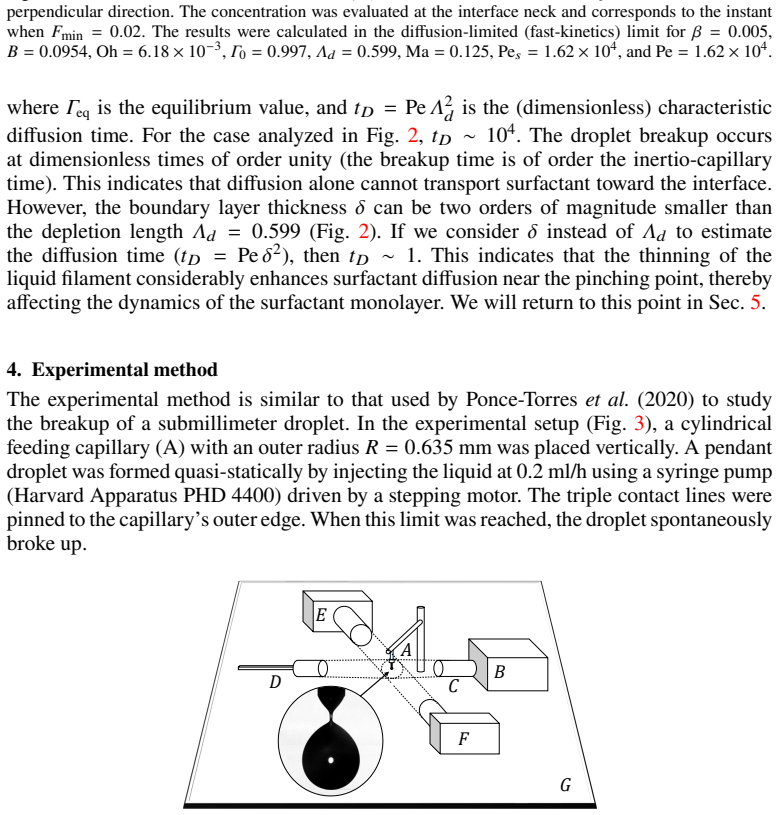
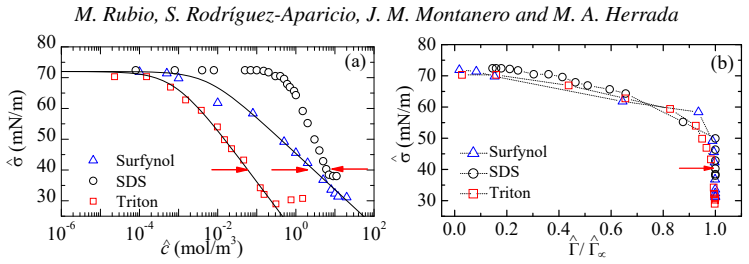
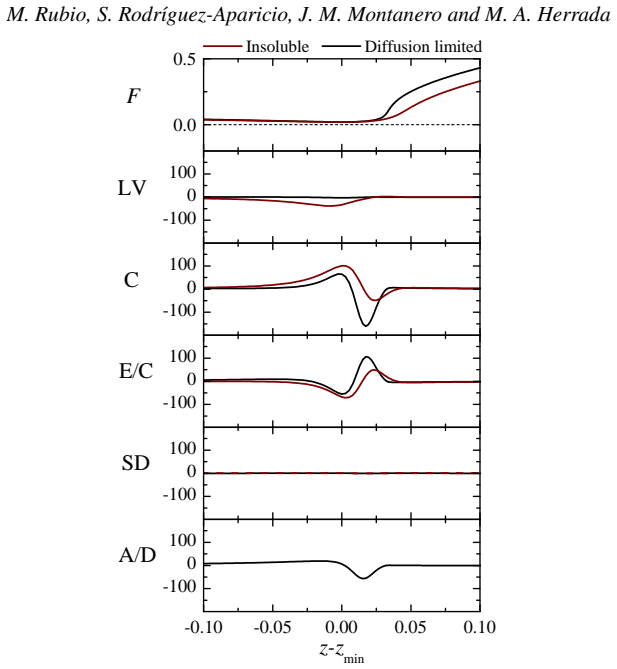
We study numerically and experimentally the breakup of a pendant droplet loaded with a soluble surfactant. We consider the limit in which surfactant sorption is limited only by diffusion. Surfactant transfer toward the interface is enhanced by convection. As a consequence, diffusion does not constitute a significant barrier over most of the breakup, and surfactant sorption maintains the surface tension practically constant across the interface. Diffusion hinders the surfactant sorption only very close to the interface pinch-off. The droplet shape in the diffusion-limited model deviates significantly from that in the insoluble case over most of the breakup. In the insoluble case, the droplet shape is affected by surfactant depletion, which leads to a local increase in surface tension and Marangoni stress. The dynamics of a millimeter-sized droplet loaded with Surfynol 465 agree remarkably well with predictions from the diffusion-limited model, without any parameter fitting, down to pinching times of the order of $10-20$ $\mu$s. Sodium dodecyl sulfate (SDS) produces essentially the same effects as those for Surfynol 465. Therefore, both Surfynol 465 and SDS maintain a practically constant surface tension throughout most of the droplet breakup. Slow-kinetics surfactants, such as Triton X-100, differ significantly from Surfynol 465 and SDS. The most evident effect of the surfactant adsorption energy barrier is the shortening of the filament that bridges the upper meniscus and the detached lower drop. Comparing the filament length to that of a clean interface with the same surface tension allows one to evaluate the rate of surfactant adsorption.
Editorial analysis
A structured set of objections, weighed in public.
Referee Report
Summary. The manuscript studies the breakup of pendant droplets containing soluble surfactants in the diffusion-limited sorption limit, where convection enhances surfactant transport such that surface tension remains nearly constant until very near pinch-off. Numerical simulations show significant deviation from the insoluble-surfactant case due to the absence of depletion-induced Marangoni stresses. Experiments with Surfynol 465 and SDS match the diffusion-limited predictions without adjustable parameters down to pinch-off times of 10-20 μs, while Triton X-100 exhibits shorter filaments due to its adsorption barrier; filament length relative to a clean interface is proposed as a diagnostic for adsorption rate.
Significance. The parameter-free quantitative agreement between the diffusion-limited model and millimeter-scale experiments for Surfynol 465 and SDS constitutes a notable strength, providing direct validation that sorption maintains constant tension over most of the process. This distinguishes the regime from insoluble surfactants (where depletion raises local tension) and slow-kinetics cases, with implications for controlling droplet dynamics in applications such as atomization and emulsification.
major comments (2)
- [Abstract] Abstract: the central claim of 'remarkable' agreement without parameter fitting down to 10-20 μs is load-bearing, yet the abstract provides no information on experimental error bars, uncertainty quantification, or the precise numerical discretization and boundary conditions used for the convection-enhanced diffusion equation; these details are required to evaluate robustness.
- [Modeling section] Modeling section (diffusion-limited formulation): the assertion that 'diffusion does not constitute a significant barrier over most of the breakup' relies on convection dominating transport, but lacks an explicit timescale comparison (e.g., convective vs. diffusive fluxes or local Péclet number) near the neck; without this, the transition to diffusion-limited behavior very close to pinch-off remains qualitative.
minor comments (2)
- Figure captions and text should explicitly state the number of experimental repeats and how the pinching time is measured (e.g., from image analysis threshold) to allow readers to assess the 10-20 μs agreement.
- The proposal to use filament length relative to a clean interface as a diagnostic for adsorption rate is useful, but would benefit from a brief sensitivity analysis showing how the length scales with the adsorption barrier height.
Simulated Author's Rebuttal
We thank the referee for the positive summary, recognition of the parameter-free agreement as a strength, and recommendation for minor revision. We address the two major comments point by point below.
read point-by-point responses
-
Referee: [Abstract] Abstract: the central claim of 'remarkable' agreement without parameter fitting down to 10-20 μs is load-bearing, yet the abstract provides no information on experimental error bars, uncertainty quantification, or the precise numerical discretization and boundary conditions used for the convection-enhanced diffusion equation; these details are required to evaluate robustness.
Authors: We agree that the abstract is concise and does not detail error bars or numerics. The experimental uncertainties (camera resolution, timing precision, and run-to-run repeatability) are quantified in the Experimental Methods section, where the agreement for Surfynol 465 and SDS is shown to lie within these bounds across multiple trials. Numerical implementation (axisymmetric finite-element discretization with adaptive refinement near the neck, no-flux boundary conditions away from the interface, and symmetry conditions) is fully specified in the Modeling section. Given abstract length limits, we will add one sentence noting that the reported agreement is parameter-free and holds within experimental uncertainties, while retaining the full technical details in the main text. revision: partial
-
Referee: [Modeling section] Modeling section (diffusion-limited formulation): the assertion that 'diffusion does not constitute a significant barrier over most of the breakup' relies on convection dominating transport, but lacks an explicit timescale comparison (e.g., convective vs. diffusive fluxes or local Péclet number) near the neck; without this, the transition to diffusion-limited behavior very close to pinch-off remains qualitative.
Authors: We accept that an explicit timescale comparison would make the argument more quantitative. In the revised manuscript we will insert a short paragraph in the Modeling section that evaluates the local Péclet number Pe = U R / D (using the simulated radial velocity U and instantaneous neck radius R together with the known bulk diffusivities of Surfynol 465 and SDS). This calculation shows Pe ≫ 1 over the great majority of the breakup, with diffusion becoming comparable only when the neck radius falls below ~10 μm in the final microseconds, thereby justifying the diffusion-limited regime until very close to pinch-off. revision: yes
Circularity Check
No significant circularity detected in derivation chain
full rationale
The paper presents a diffusion-limited sorption model solved numerically and compares its predictions directly to independent experimental measurements of pendant-droplet breakup for Surfynol 465 and SDS, with no adjustable parameters fitted to the target data. The central claim of agreement down to 10-20 μs pinch-off times rests on this external validation and explicit distinction from insoluble-surfactant and slow-kinetics cases, rather than any self-referential definition, renamed fit, or self-citation that reduces the result to its inputs. All modeling assumptions are stated upfront and the numerical-experimental match is falsifiable against the reported observations.
Axiom & Free-Parameter Ledger
axioms (2)
- standard math Incompressible Navier-Stokes equations govern the flow inside the droplet.
- domain assumption Surfactant sorption is limited only by diffusion, with convection enhancing transfer except near pinch-off.
Reference graph
Works this paper leans on
-
[1]
J., Walker, L
Alvarez, N. J., Walker, L. M. & Anna, S. L.2010 Diffusion-limited adsorption to a spherical geometry: the impact of curvature and competitive time scales.Phys. Rev. E82, 011604
2010
-
[2]
& Basaran, O
Ambravaneswaran, B. & Basaran, O. A.1999 Effects of insoluble surfactants on the nonlinear deformation and breakup of stretching liquid bridges.Phys. Fluids11, 997–1015
1999
-
[3]
L.2016 Droplets and bubbles in microfluidic devices.Annu
Anna, S. L.2016 Droplets and bubbles in microfluidic devices.Annu. Rev. Fluid Mech.48, 285–309. Castrej´on-Pita, J. R., Castrej ´on-Pita, A. A., Thete, S. S., Sambath, K., Hutchings, I. M., Hinch, J.,
2016
-
[4]
Lister, J. R. & Basaran, O. A.2015 Plethora of transitions during breakup of liquid filaments.Proc. Natl. Acad. Sci.112, 4582–4587
2015
-
[5]
& Matar, O.2021 Role of surfactant-induced Marangoni stresses in drop-interface coalescence.J
Constante-Amores, C., Batchvarov, A., Kahouadji, L., Shin, S., Chergui, J., Juric, D. & Matar, O.2021 Role of surfactant-induced Marangoni stresses in drop-interface coalescence.J. Fluid Mech.925, A15
2021
-
[6]
V., Matar, O
Craster, R. V., Matar, O. K. & Papageorgiou, D. T.2002 Pinchoff and satellite formation in surfactant covered viscous threads.Phys. Fluids14, 1364–1376
2002
-
[7]
V., Matar, O
Craster, R. V., Matar, O. K. & Papageorgiou, D. T.2009 Breakup of surfactant-laden jets above the critical micelle concentration.J. Fluid Mech.629, 195–219
2009
-
[8]
A., Hauner, I., Velikov, K
Deblais, A., Herrada, M. A., Hauner, I., Velikov, K. P., van Roon, T., Kellay, H., Eggers, J. & Bonn, D. 2018 Viscous effects on inertial drop formation.Phys. Rev. Lett.121, 254501
2018
-
[9]
& Tsamopoulos, J.2003 A quasi-elliptic transformation for moving boundary problems with large anisotropic deformations.J
Dimakopoulos, Y. & Tsamopoulos, J.2003 A quasi-elliptic transformation for moving boundary problems with large anisotropic deformations.J. Comput. Phys.192, 494–522
2003
-
[10]
Dravid, V., Songsermpong, S., Xue, Z., Corvalan, C. M. & Sojka, P. E.2006 Two-dimensional modeling of the effects of insoluble surfactant on the breakup of a liquid filament.Chem. Eng. Sci61, 3577–3585
2006
-
[11]
Eggers, J.1993 Universal pinching of 3D axisymmetric free-surface flow.Phys. Rev. Lett.71, 3458–3460. Fern´andez-Mart´ınez, D., Vega, E. J., Montanero, J. M., Guti ´errez-Hern´andez, U. J. & Fernandez-
1993
-
[12]
Colloid Int
Rivas, D.2026 Influence of surfactant kinetics on rapid interface creation via microjet impact on liquid pools.J. Colloid Int. Sci.717, 140335
2026
-
[13]
& Maldarelli, C.2016 Effect of surfactant on the break-up of a liquid thread: Modeling, computations and experiments.Int
Hameed, M. & Maldarelli, C.2016 Effect of surfactant on the break-up of a liquid thread: Modeling, computations and experiments.Int. J. Mass Transfer92, 303–311
2016
-
[14]
& Papageorgiou, D.2008 Influence of insoluble surfactant on the deformation and breakup of a bubble or thread in a viscous fluid.J
Hameed, M., Siegel, M., Young, Y.-N., Li, J., Booty, M. & Papageorgiou, D.2008 Influence of insoluble surfactant on the deformation and breakup of a bubble or thread in a viscous fluid.J. Fluid Mech.594, 307–340
2008
-
[15]
& Langevin, D.2015 Adsorption–desorption kinetics of surfactants at liquid surfaces.Adv
He, Y., Yazhgur, P., Salonen, A. & Langevin, D.2015 Adsorption–desorption kinetics of surfactants at liquid surfaces.Adv. Colloid Interface Sci.222, 377–384
2015
-
[16]
A.2025 Goodbye christoffel symbols: A flexible and practical approach for solving physical problems in curved spaces.Comput
Herrada, M. A.2025 Goodbye christoffel symbols: A flexible and practical approach for solving physical problems in curved spaces.Comput. Phys. Commun.315, 109727
2025
-
[17]
A & Montanero, J
Herrada, M. A & Montanero, J. M.2016 A numerical method to study the dynamics of capillary fluid systems.J. Comput. Phys.306, 137–147
2016
-
[18]
& Stebe, K
Jin, F., Balasubramaniam, R. & Stebe, K. J.2004 Surfactant adsorption to spherical particles: the intrinsic length scale governing the shift from diffusion to kinetic-controlled mass transfer.J. Adhes.80, 773–796
2004
-
[19]
Jin, F., Gupta, N. R. & Stebe, K. J.2006 The detachment of a viscous drop in a viscous solution in the presence of a soluble surfactant.Phys. Fluids18, 022103
2006
-
[20]
& Blyth, M
Kalogirou, A. & Blyth, M. G.2019 The role of soluble surfactants in the linear stability of two-layer flow in a channel.J. Fluid Mech.873, 18–48
2019
-
[21]
M., Wagoner, B
Kamat, P. M., Wagoner, B. W., Castrej´on-Pita, A. A., Castrej´on-Pita, J. R., Anthony, C. R., & Basaran, 0X0-20 Journal of Fluid Mechanics O. A.2020 Surfactant-driven escape from endpinching during contraction of nearly inviscid filaments.J. Fluid Mech.899, A28
2020
-
[22]
M., Wagoner, B
Kamat, P. M., Wagoner, B. W., Thete, S. S. & Basaran, O. A.2018 Role of Marangoni stress during breakup of surfactant-covered liquid threads: Reduced rates of thinning and microthread cascades.Phys. Rev. Fluids 3, 043602
2018
-
[23]
M., Jenkinson, H., Miller, R
Kovalchuk, N. M., Jenkinson, H., Miller, R. & Simmons, M. J. H.2018 Effect of soluble surfactants on pinch-off of moderately viscous drops and satellite size.J. Colloid Interface Sci.516, 182–191
2018
-
[24]
& Sprittles, J
Li, Y. & Sprittles, J. E.2016 Capillary breakup of a liquid bridge: identifying regimes and transitions.J. Fluid Mech.797, 29–59
2016
-
[25]
Liao, Y.-C., Franses, E. I. & Basaran, O. A.2006 Deformation and breakup of a stretching liquid bridge covered with an insoluble surfactant monolayer.Phys. Fluids18, 022101
2006
-
[26]
& Squires, T
Manikantan, H. & Squires, T. M.2020 Surfactant dynamics: hidden variables controlling fluid flows.J. Fluid Mech.892, P1. Mart´ınez-Calvo, A. & Sevilla, A.2020 Universal thinning of liquid filaments under dominant surface forces. Phys. Rev. Lett.125, 114502
2020
-
[27]
McGough, P. T. & Basaran, O. A.2006 Repeated formation of fluid threads in breakup of a surfactant-covered jet.Phys. Rev. Lett.96, 054502
2006
-
[28]
Milliken, W. J. & Leal, L. G.1994 The influence of surfactant on the deformation and breakup of a viscous drop: the effect of surfactant solubility.J. Colloid Sci. Interface Sci.166, 275–285
1994
-
[29]
T.1995 On the breakup of viscous liquid threads.Phys
Papageorgiou, D. T.1995 On the breakup of viscous liquid threads.Phys. Fluids7, 1529–1544
1995
-
[30]
A., Zolnikov, I
Penkina, Y. A., Zolnikov, I. M., Pomazyonkova, A. E. & Avramenko, G. V.2016 Colloid-chemical properties of nonionic gemini surfactants Surfynol 400 series with different degrees of oxyethylation. Butlerov Communications46, 92–101
2016
-
[31]
H., Dhoker, G
Peregrine, D. H., Dhoker, G. & Symon, A.1990 The bifurcation of liquid bridges.J. Fluid Mech.212, 25–39
1990
-
[32]
M., Herrada, M
Ponce-Torres, A., Montanero, J. M., Herrada, M. A., Vega, E. J. & Vega, J. M.2017 Influence of the surface viscosity on the breakup of a surfactant-laden drop.Phys. Rev. Lett.118, 024501
2017
-
[33]
A., Eggers, J
Ponce-Torres, A., Rubio, M., Herrada, M. A., Eggers, J. & Montanero, J. M.2020 Influence of the surface viscous stress on the pinch-off of free surfaces loaded with nearly-inviscid surfactants.Sci. Rep.10, 16065
2020
-
[34]
Prosser, A. J. & Franses, E. I.2001 Adsorption and surface tension of ionic surfactants at the air-water interface: review and evaluation of equilibrium models.Colloids and Surfaces A178, 1–40
2001
-
[35]
& Kellay, H.2009 Effect of surface tension variations on the pinch-off behavior of small fluid drops in the presence of surfactants.Phys
Roche, M., Aytouna, M., Bonn, D. & Kellay, H.2009 Effect of surface tension variations on the pinch-off behavior of small fluid drops in the presence of surfactants.Phys. Rev. Lett.103, 264501. de Saint Vincent, M. R., Petit, J., Aytouna, M., Delville, J. P., Bonn, D. & Kellay, H.2012 Dynamic interfacial tension effects in the rupture of liquid necks.J. F...
2009
-
[36]
Stone, H. A. & Leal, L. G.1990 The effects of surfactants on drop deformation and breakup.J . Fluid Mech. 220, 161–186
1990
-
[37]
& Sasaki, T.1970 Radiotracer studies on adsorption of surface active substance at aqueous surface
Tajima, K., Muramatsu, M. & Sasaki, T.1970 Radiotracer studies on adsorption of surface active substance at aqueous surface. I. Accurate measurement of adsorption of Tritiated Sodium Dodecylsulfate.Bull. Chem. Soc. Japan43, 1991–1998
1970
-
[38]
Timmermans, M.-L. E. & Lister, J. R.2002 The effect of surfactant on the stability of a liquid thread.J. Fluid Mech.459, 289–306
2002
-
[39]
C., Quetzeri-Santiago, M
Varghese, N., Sykes, T. C., Quetzeri-Santiago, M. A., Castrej ´on-Pita, A. A. & Castrej ´on-Pita, J. R. 2024 Effect of surfactants on the splashing dynamics of drops impacting smooth substrates.Langmuir40, 8781–8790
2024
-
[40]
J., Montanero, J
Vega, E. J., Montanero, J. M., Herrada, M. A. & Ferrera, C.2014 Dynamics of an axisymmetric liquid bridge close to the minimum-volume stability limit.Phys. Rev. E90, 013015
2014
-
[41]
& Booty, M
Wang, Q., Siegel, M. & Booty, M. R.2014 Numerical simulation of drop and bubble dynamics with soluble surfactant.Phys. Fluids26, 052102
2014
-
[42]
H., Liu, X
Wee, H., Kumar, A. H., Liu, X. & Basaran, O. A.2024 Escape from pinch-off during contraction of liquid sheets and two-dimensional drops of low-viscosity fluids.Phys. Rev. Fluids9, 103601. 0X0-21
2024
discussion (0)
Sign in with ORCID, Apple, or X to comment. Anyone can read and Pith papers without signing in.