Gauge-Field-Mediated Symmetry Breaking of Matters Under Electromagnetic Fields and Its Impact on Spin Dynamics
Pith reviewed 2026-05-21 00:00 UTC · model grok-4.3
The pith
The gauge-field term in spin-orbit coupling drives symmetry breaking and enables dynamical spin states under electromagnetic fields.
A machine-rendered reading of the paper's core claim, the machinery that carries it, and where it could break.
Core claim
When a condensed-matter system is subjected to external electromagnetic fields, the gauge-invariant formulation of physical operators must explicitly incorporate the gauge-field contribution. The authors demonstrate that the symmetry breaking and consequent spin dynamics are governed by the gauge-field term, without which the spins remain symmetry-constrained. Real-time time-dependent density functional theory calculations reveal that when the gauge-field term in the time-dependent Hamiltonian perturbs the symmetry of the canonical term, a dynamical spin state gradually develops during the time evolution beyond the symmetry-frozen states.
What carries the argument
The gauge-field term in the gauge-invariant formulation of the spin-orbit coupling operator, which perturbs symmetry in the time-dependent Hamiltonian under external electromagnetic fields.
If this is right
- The full gauge-invariant spin-orbit coupling must be retained for quantitative accuracy in nonequilibrium spin-orbit dynamics.
- Symmetry constraints on spin states are lifted once the gauge-field term perturbs the canonical spin-orbit term.
- Dynamical spin evolution appears in systems with mirror, glide, or screw-rotational symmetry when electromagnetic fields are applied.
- Even weak external fields can produce observable spin dynamics through this gauge-mediated mechanism.
Where Pith is reading between the lines
- Spintronic devices might use tailored electromagnetic pulses to control spin states via this previously overlooked gauge contribution.
- The same gauge-field symmetry breaking could be tested in orbital or charge dynamics under external fields in related materials.
- Analytical models derived from the gauge term might complement the numerical TDDFT results to predict spin precession rates.
Load-bearing premise
Real-time time-dependent density functional theory calculations can isolate the gauge-field term as the dominant symmetry-perturbing mechanism without significant interference from numerical approximations or other dynamical effects.
What would settle it
If spin dynamics remain absent or unchanged in simulations when the gauge-field term is deliberately omitted from the time-dependent Hamiltonian, or if experiments on symmetry-protected systems show no evolving spin states under applied fields, the claim would be falsified.
Figures


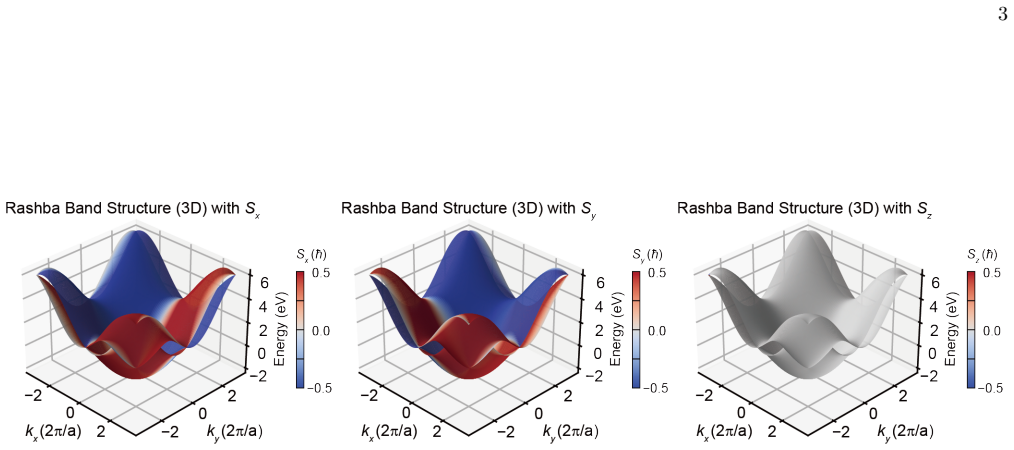


read the original abstract
When a condensed-matter system is subjected to external electromagnetic fields, the gauge-invariant formulation of physical operators must explicitly incorporate the gauge-field contribution. However, in the context of spin-orbit coupling (SOC), this gauge-field term is often regarded as negligible or merely additive compared to the canonical SOC, which is typically localized near atomic cores. Here, we demonstrate that the symmetry breaking and consequent spin dynamics are governed by the gauge-field term, without which the spins remain symmetry-constrained. We perform real-time time-dependent density functional theory calculations to investigate spin-orbit dynamics, focusing on representative cases with mirror, glide, and screw-rotational symmetry. We demonstrate that when the gauge-field term in the time-dependent Hamiltonian perturbs the symmetry of the canonical term, a dynamical spin state gradually develops during the time evolution, beyond the symmetry-frozen states. We suggest that, for nonequilibrium spin-orbit dynamics, the gauge-invariant formulation of SOC is not only formally required but also quantitatively essential, even for a weak external field.
Editorial analysis
A structured set of objections, weighed in public.
Referee Report
Summary. The paper claims that the gauge-field term in the spin-orbit coupling (SOC) Hamiltonian is the dominant driver of symmetry breaking and ensuing spin dynamics in condensed-matter systems under external electromagnetic fields. Using real-time time-dependent density functional theory (TDDFT) on representative cases with mirror, glide, and screw-rotational symmetry, it asserts that the canonical SOC term alone keeps spins symmetry-constrained, while inclusion of the gauge-field correction allows a dynamical spin state to develop during time evolution. The abstract concludes that the gauge-invariant formulation is quantitatively essential even for weak fields.
Significance. If the central computational demonstration holds after proper controls, the work would establish that gauge-field contributions to SOC cannot be neglected in nonequilibrium spin dynamics, with potential consequences for modeling spin-orbit torques, ultrafast magnetism, and symmetry-protected spin textures in materials under light or electric fields.
major comments (2)
- [Abstract] Abstract: the central claim that symmetry breaking and spin dynamics are governed by the gauge-field term (and absent without it) is supported only by the statement that 'TDDFT calculations show the effect,' with no quantitative results, spin-polarization time series, difference metrics between the two Hamiltonians, or error analysis provided. This leaves the attribution to the gauge term only moderately supported.
- [Computational results] Computational results section: no side-by-side control runs are reported that toggle solely the gauge-field correction in the time-dependent Hamiltonian while freezing all other numerical parameters (basis set, time step, propagation scheme). Real-time TDDFT is known to admit artificial symmetry breaking from finite-basis incompleteness or vector-potential handling; without such toggled comparisons and quantified convergence of spin polarization versus basis size or dt, the isolation of the gauge term as the symmetry-perturbing mechanism remains unverified.
minor comments (1)
- [Abstract] The abstract refers to 'representative cases' with mirror, glide, and screw symmetries but does not specify the material systems or crystal structures used; adding this information would improve reproducibility.
Simulated Author's Rebuttal
We thank the referee for the constructive and detailed comments. We address each major comment below and have revised the manuscript to improve clarity and provide additional supporting details where needed.
read point-by-point responses
-
Referee: [Abstract] Abstract: the central claim that symmetry breaking and spin dynamics are governed by the gauge-field term (and absent without it) is supported only by the statement that 'TDDFT calculations show the effect,' with no quantitative results, spin-polarization time series, difference metrics between the two Hamiltonians, or error analysis provided. This leaves the attribution to the gauge term only moderately supported.
Authors: We agree that the abstract would benefit from a concise quantitative summary to better support the central claim. The main text already contains the relevant time series and comparisons, but we will revise the abstract to include a brief statement highlighting the key quantitative distinction: the development of finite spin polarization (on the scale of 0.01–0.1 μ_B per relevant atom) over the simulation time when the gauge-field term is included, versus strictly zero polarization when it is omitted. We will also add a reference to the primary figures showing these time evolutions. revision: yes
-
Referee: [Computational results] Computational results section: no side-by-side control runs are reported that toggle solely the gauge-field correction in the time-dependent Hamiltonian while freezing all other numerical parameters (basis set, time step, propagation scheme). Real-time TDDFT is known to admit artificial symmetry breaking from finite-basis incompleteness or vector-potential handling; without such toggled comparisons and quantified convergence of spin polarization versus basis size or dt, the isolation of the gauge term as the symmetry-perturbing mechanism remains unverified.
Authors: We thank the referee for highlighting this important methodological point. Our calculations were performed precisely by toggling only the gauge-field correction while holding the basis set, time step, propagation algorithm, and all other numerical parameters fixed; the resulting contrast in spin dynamics is shown in the time-evolution plots of the results section. To make the control protocol fully explicit and to rule out numerical artifacts, we will add a dedicated paragraph in the computational results section describing these toggled runs together with convergence data for spin polarization as a function of basis size and time step, including quantitative difference metrics between the two Hamiltonians. revision: yes
Circularity Check
No significant circularity in computational demonstration of gauge-field symmetry breaking
full rationale
The paper advances its central claim through real-time TDDFT simulations that compare spin dynamics with and without the gauge-field term in the time-dependent Hamiltonian. No analytical derivation chain is presented that reduces a result to its own inputs by construction, nor are any predictions obtained by fitting parameters to subsets of the same data and then relabeling them. The evidence consists of numerical time evolution under representative symmetries (mirror, glide, screw), which constitutes an independent computational test rather than a self-referential definition or self-citation load-bearing argument. Any self-citations that may exist pertain to standard TDDFT methodology and do not substitute for the reported simulations. The result is therefore self-contained against external benchmarks and receives the default low-circularity assessment.
Axiom & Free-Parameter Ledger
axioms (1)
- domain assumption Real-time TDDFT provides a reliable description of nonequilibrium spin-orbit dynamics under weak external fields
Lean theorems connected to this paper
-
IndisputableMonolith/Cost/FunctionalEquation.leanwashburn_uniqueness_aczel unclear?
unclearRelation between the paper passage and the cited Recognition theorem.
We demonstrate that the symmetry breaking and consequent spin dynamics are governed by the gauge-field term, without which the spins remain symmetry-constrained. ... ĤSOC = ĤCN_SOC + ĤGF_SOC
-
IndisputableMonolith/Foundation/AlexanderDuality.leanalexander_duality_circle_linking unclear?
unclearRelation between the paper passage and the cited Recognition theorem.
real-time time-dependent density functional theory calculations ... mirror, glide, and screw-rotational symmetry
What do these tags mean?
- matches
- The paper's claim is directly supported by a theorem in the formal canon.
- supports
- The theorem supports part of the paper's argument, but the paper may add assumptions or extra steps.
- extends
- The paper goes beyond the formal theorem; the theorem is a base layer rather than the whole result.
- uses
- The paper appears to rely on the theorem as machinery.
- contradicts
- The paper's claim conflicts with a theorem or certificate in the canon.
- unclear
- Pith found a possible connection, but the passage is too broad, indirect, or ambiguous to say the theorem truly supports the claim.
Reference graph
Works this paper leans on
-
[1]
Nature571(7764), 240–244 (2019) https://doi.org/10
Siegrist, F., Gessner, J.A., Ossiander, M., Denker, C., Chang, Y.-P., Schr¨ oder, M.C., Guggenmos, A., Cui, Y., Walowski, J., Martens, U., Dewhurst, J.K., Kleineberg, U., M¨ unzenberg, M., Sharma, S., Schultze, M.: Light-wave dynamic control of magnetism. Nature571(7764), 240–244 (2019) https://doi.org/10. 1038/s41586-019-1333-x
work page 2019
-
[2]
Nature Communications15(1), 2043 (2024) https://doi
Xu, Y., Zhang, F., Fert, A., Jaffres, H.-Y., Liu, Y., Xu, R., Jiang, Y., Cheng, H., Zhao, W.: Orbitronics: light-induced orbital currents in ni studied by terahertz emission experiments. Nature Communications15(1), 2043 (2024) https://doi. org/10.1038/s41467-024-46405-6
-
[3]
npj Spintronics3(1), 3 (2025) https://doi.org/10.1038/ s44306-024-00068-7
Salikhov, R., Lysne, M., Werner, P., Ilyakov, I., Sch¨ uler, M., Oliveira, T.V.A.G., Ponomaryov, A., Arshad, A., Prajapati, G.L., Deinert, J.-C., Makushko, P., Makarov, D., Cowan, T., Fassbender, J., Lindner, J., Lindner, A., Ortix, C., Kovalev, S.: Spin-orbit interaction driven terahertz nonlinear dynamics in transition metals. npj Spintronics3(1), 3 (20...
work page 2025
-
[4]
A., H¨ ubener, H., De Giovannini, U
Sato, S.A., H¨ ubener, H., De Giovannini, U., Rubio, A.: Technical review: Time- dependent density functional theory for attosecond physics ranging from gas- phase to solids. npj Computational Materials11(1), 233 (2025) https://doi.org/ 10.1038/s41524-025-01715-1
-
[5]
Kirilyuk, A., Kimel, A.V., Rasing, T.: Ultrafast optical manipulation of mag- netic order. Rev. Mod. Phys.82, 2731–2784 (2010) https://doi.org/10.1103/ RevModPhys.82.2731
work page 2010
-
[6]
Manchon, A., ˇZelezn´ y, J., Miron, I.M., Jungwirth, T., Sinova, J., Thiaville, A., Garello, K., Gambardella, P.: Current-induced spin-orbit torques in ferromagnetic and antiferromagnetic systems. Rev. Mod. Phys.91, 035004 (2019) https://doi. org/10.1103/RevModPhys.91.035004
-
[7]
Progress in Surface Science 98(2), 100705 (2023) https://doi.org/10.1016/j.progsurf.2023.100705
Liu, H., Cao, H., Meng, S.: Floquet engineering of topological states in realis- tic quantum materials via light-matter interactions. Progress in Surface Science 98(2), 100705 (2023) https://doi.org/10.1016/j.progsurf.2023.100705
-
[8]
Foldy, L.L., Wouthuysen, S.A.: On the dirac theory of spin 1/2 particles and its non-relativistic limit. Phys. Rev.78, 29–36 (1950) https://doi.org/10.1103/ PhysRev.78.29
work page 1950
-
[9]
Manchon, A., Zhang, S.: Theory of spin torque due to spin-orbit coupling. Phys. Rev. B79, 094422 (2009) https://doi.org/10.1103/PhysRevB.79.094422 12
-
[10]
Annals of Physics325(5), 1104–1117 (2010) https://doi.org/10.1016/j.aop.2010.01.007
Tokatly, I.V., Sherman, E.Y.: Gauge theory approach for diffusive and preces- sional spin dynamics in a two-dimensional electron gas. Annals of Physics325(5), 1104–1117 (2010) https://doi.org/10.1016/j.aop.2010.01.007
-
[11]
Abedinpour, S.H., Vignale, G., Tokatly, I.V.: Gauge-invariant formulation of spin- current density-functional theory. Phys. Rev. B81, 125123 (2010) https://doi. org/10.1103/PhysRevB.81.125123
-
[12]
Tatara, G.: Effective gauge field theory of spintronics. Physica E: Low-dimensional Systems and Nanostructures106, 208–238 (2019) https://doi.org/10.1016/j. physe.2018.05.011
work page doi:10.1016/j 2019
-
[13]
An Introduction to quantum field theory,
Peskin, M.E., Schroeder, D.V.: An Introduction to Quantum Field Theory. Addison-Wesley, Reading, USA (1995). https://doi.org/10.1201/9780429503559
-
[14]
Shankar, R.: Principles of Quantum Mechanics. Springer, ??? (2004). https://books.google.co.kr/books?id=MaUunQAACAAJ
work page 2004
-
[15]
Physics Letters B688(1), 55–58 (2010) https://doi.org/10.1016/j.physletb.2010.03.045
Chen, P., Ji, X., Xu, Y., Zhang, Y.: Angular momentum in non-relativistic qed and photon contribution to spin of hydrogen atom. Physics Letters B688(1), 55–58 (2010) https://doi.org/10.1016/j.physletb.2010.03.045
-
[16]
Haidar, M., Zhong, Z.-X., Korobov, V.I., Karr, J.-P.: Nonrelativistic qed approach to the fine- and hyperfine-structure corrections of ordermα 6 andmα 6(m/m): Application to the hydrogen atom. Phys. Rev. A101, 022501 (2020) https://doi. org/10.1103/PhysRevA.101.022501
-
[17]
Korobov, V.I., Karr, J.-P., Haidar, M., Zhong, Z.-X.: Hyperfine structure in the h+ 2 and hd + molecular ions at ordermα 6. Phys. Rev. A102, 022804 (2020) https://doi.org/10.1103/PhysRevA.102.022804
-
[18]
Haidar, M., Korobov, V.I., Hilico, L., Karr, J.-P.: Higher-order corrections to spin-orbit and spin-spin tensor interactions in hydrogen molecular ions: Theory and application to h+ 2 . Phys. Rev. A106, 022816 (2022) https://doi.org/10.1103/ PhysRevA.106.022816
work page 2022
-
[19]
PRX Quantum5, 020322 (2024) https://doi.org/10.1103/PRXQuantum.5.020322
Asano, T., Giese, E., Di Pumpo, F.: Quantum field theory for multipolar compos- ite bosons with mass defect and relativistic corrections. PRX Quantum5, 020322 (2024) https://doi.org/10.1103/PRXQuantum.5.020322
-
[20]
Journal of High Energy Physics2011(2), 107 (2011) https://doi.org/10.1007/JHEP02(2011)107
Chen, P., Ji, X., Zhang, Y.: Effective angular momentum operators in nrqed and matching at one-loop order. Journal of High Energy Physics2011(2), 107 (2011) https://doi.org/10.1007/JHEP02(2011)107
-
[21]
Paz, G.: An introduction to nrqed. Modern Physics Letters A 30(26), 1550128 (2015) https://doi.org/10.1142/S021773231550128X https://doi.org/10.1142/S021773231550128X 13
-
[22]
Fr¨ ohlich, J., Studer, U.M.: Gauge invariance and current algebra in nonrelativistic many-body theory. Rev. Mod. Phys.65, 733–802 (1993) https://doi.org/10.1103/ RevModPhys.65.733
work page 1993
-
[23]
Laser induced ultrafast demagnetization: an \emph{ab-initio} perspective
Krieger, K., Dewhurst, J., Elliott, P., Sharma, S., Gross, E.: Laser induced ultra- fast demagnetization: anab-initioperspective. arXiv preprint arXiv:1406.6607 (2014)
work page internal anchor Pith review Pith/arXiv arXiv 2014
-
[24]
Computer Physics Communications209, 92–95 (2016) https://doi.org/10.1016/ j.cpc.2016.09.001
Dewhurst, J.K., Krieger, K., Sharma, S., Gross, E.K.U.: An efficient algorithm for time propagation as applied to linearized augmented plane wave method. Computer Physics Communications209, 92–95 (2016) https://doi.org/10.1016/ j.cpc.2016.09.001
work page 2016
-
[25]
Kim, B., Park, N., Kim, K.-W.: Relativistic spin-lattice interaction compatible with discrete translation symmetry in solids. Phys. Rev. Lett.134, 256303 (2025) https://doi.org/10.1103/q46t-hck1
-
[26]
npj Computational Materials8(1), 145 (2022) https://doi.org/10.1038/s41524-022-00831-6
Tancogne-Dejean, N., Eich, F.G., Rubio, A.: Effect of spin-orbit coupling on the high harmonics from the topological dirac semimetal na3bi. npj Computational Materials8(1), 145 (2022) https://doi.org/10.1038/s41524-022-00831-6
-
[27]
Lysne, M., Murakami, Y., Sch¨ uler, M., Werner, P.: High-harmonic generation in spin-orbit coupled systems. Phys. Rev. B102, 081121 (2020) https://doi.org/10. 1103/PhysRevB.102.081121
work page 2020
-
[28]
Pittalis, S., Vignale, G., Eich, F.G.: U(1)×SU(2) gauge invariance made simple for density functional approximations. Phys. Rev. B96, 035141 (2017) https: //doi.org/10.1103/PhysRevB.96.035141
-
[29]
Nature Communications9(1), 2492 (2018) https://doi.org/10.1038/s41467-018-04939-6
Liu, Y., Besbas, J., Wang, Y., He, P., Chen, M., Zhu, D., Wu, Y., Lee, J.M., Wang, L., Moon, J., Koirala, N., Oh, S., Yang, H.: Direct visualization of current-induced spin accumulation in topological insulators. Nature Communications9(1), 2492 (2018) https://doi.org/10.1038/s41467-018-04939-6
-
[30]
Nature511(7510), 449–451 (2014) https://doi.org/10.1038/nature13534
Mellnik, A.R., Lee, J.S., Richardella, A., Grab, J.L., Mintun, P.J., Fischer, M.H., Vaezi, A., Manchon, A., Kim, E.A., Samarth, N., Ralph, D.C.: Spin-transfer torque generated by a topological insulator. Nature511(7510), 449–451 (2014) https://doi.org/10.1038/nature13534
-
[31]
Tian, J., S ¸ahin, C., Miotkowski, I., Flatt´ e, M.E., Chen, Y.P.: Opposite current- induced spin polarizations in bulk-metallic bi 2se3 and bulk-insulating bi 2te2se topological insulator thin flakes. Phys. Rev. B103, 035412 (2021) https://doi. org/10.1103/PhysRevB.103.035412
-
[32]
Lai, Y.-J., Huang, M.-R., Duan, H.-J., Yang, M., Wang, R.-Q., Deng, M.- X.: Current-induced nonequilibrium hidden spin polarization in topological dirac semimetals. Phys. Rev. Lett.135, 106505 (2025) https://doi.org/10.1103/ 14 snby-9xsr
work page 2025
-
[33]
Nanotechnology35(19), 195704 (2024) https://doi.org/10.1088/1361-6528/ad2639
Lodge, M.S., Marcellina, E., Zhu, Z., Li, X.-P., Kaczorowski, D., Fuhrer, M.S., Yang, S.A., Weber, B.: Symmetry-selective quasiparticle scattering and electric field tunability of the zrsis surface electronic structure. Nanotechnology35(19), 195704 (2024) https://doi.org/10.1088/1361-6528/ad2639
-
[34]
Yen, Y., Guo, G.-Y.: Tunable large spin hall and spin nernst effects in the dirac semimetals ZrXY (X = Si, Ge; Y = S, Se, Te). Phys. Rev. B101, 064430 (2020) https://doi.org/10.1103/PhysRevB.101.064430
-
[35]
Communications Physics4(2021) https://doi.org/10.1038/s42005-021-00555-x
Gatti, G., Gos´ albez Mart´ ınez, D., Roth, S., Fanciulli, M., Zacchigna, M., Kall¨ ane, M., Rossnagel, K., Jozwiak, C., Bostwick, A., Rotenberg, E., Magrez, A., Berger, H., Vobornik, I., Fujii, J., Yazyev, O., Grioni, M., Crepaldi, A.: Hidden bulk and surface effects in the spin polarization of the nodal-line semimetal zrsite. Communications Physics4(202...
-
[36]
An, C., Wang, S.: Diameter-selected synthesis of single crystalline trigonal sele- nium nanowires. Materials Chemistry and Physics101(2), 357–361 (2007) https: //doi.org/10.1016/j.matchemphys.2006.06.011
-
[37]
Gates, B., Mayers, B., Cattle, B., Xia, Y.: Synthesis and characterization of uniform nanowires of trigonal selenium. Advanced Functional Materi- als12(3), 219–227 (2002) https://doi.org/10.1002/1616-3028(200203)12:3⟨219:: AID-ADFM219⟩3.0.CO;2-U
-
[38]
Chemistry of Materials15(20), 3852–3858 (2003) https:// doi.org/10.1021/cm034193b
Mayers, B.T., Liu, K., Sunderland, D., Xia, Y.: Sonochemical synthesis of trigonal selenium nanowires. Chemistry of Materials15(20), 3852–3858 (2003) https:// doi.org/10.1021/cm034193b . doi: 10.1021/cm034193b
-
[39]
Giannozzi, P., Andreussi, O., Brumme, T., Bunau, O., Buongiorno Nardelli, M., Calandra, M., Car, R., Cavazzoni, C., Ceresoli, D., Cococcioni, M., Colonna, N., Carnimeo, I., Dal Corso, A., Gironcoli, S., Delugas, P., DiStasio, R.A., Ferretti, A., Floris, A., Fratesi, G., Fugallo, G., Gebauer, R., Gerstmann, U., Giustino, F., Gorni, T., Jia, J., Kawamura, M...
-
[40]
Giannozzi, P., Baroni, S., Bonini, N., Calandra, M., Car, R., Cavazzoni, C., Ceresoli, D., Chiarotti, G.L., Cococcioni, M., Dabo, I., Dal Corso, A., Giron- coli, S., Fabris, S., Fratesi, G., Gebauer, R., Gerstmann, U., Gougoussis, C., Kokalj, A., Lazzeri, M., Martin-Samos, L., Marzari, N., Mauri, F., Mazzarello, R., Paolini, S., Pasquarello, A., Paulatto,...
-
[41]
Physical review letters77(18), 3865 (1996)
Perdew, J.P., Burke, K., Ernzerhof, M.: Generalized gradient approximation made simple. Physical review letters77(18), 3865 (1996)
work page 1996
-
[42]
Shin, D., Sato, S.A., H¨ ubener, H., Giovannini, U.D., Kim, J., Park, N., Rubio, A.: Unraveling materials berry curvature and chern numbers from real-time evolution of bloch states. Proceedings of the National Academy of Sciences116(10), 4135–4140 (2019) https://doi.org/10.1073/pnas.1816904116 https://www.pnas.org/doi/pdf/10.1073/pnas.1816904116
-
[43]
physica status solidi (b)243(5), 1121–1138 (2006)
Yabana, K., Nakatsukasa, T., Iwata, J.-I., Bertsch, G.: Real-time, real-space implementation of the linear response time-dependent density-functional theory. physica status solidi (b)243(5), 1121–1138 (2006)
work page 2006
-
[44]
Bertsch, G.F., Iwata, J.-I., Rubio, A., Yabana, K.: Real-space, real-time method for the dielectric function. Phys. Rev. B62, 7998–8002 (2000) https://doi.org/ 10.1103/PhysRevB.62.7998
-
[45]
Blase, X., Rubio, A., Louie, S.G., Cohen, M.L.: Mixed-space formalism for the dielectric response in periodic systems. Phys. Rev. B52, 2225–2228 (1995) https: //doi.org/10.1103/PhysRevB.52.R2225
-
[46]
Shin, D., Lee, G., Miyamoto, Y., Park, N.: Real-time propagation via time- dependent density functional theory plus the hubbard u potential for electron– atom coupled dynamics involving charge transfer. Journal of Chemical Theory and Computation12(1), 201–208 (2016) 16 Supplementary Information of Gauge-Field-Mediated Symmetry Breaking of Matters Under El...
work page 2016
discussion (0)
Sign in with ORCID, Apple, or X to comment. Anyone can read and Pith papers without signing in.