Recognition: unknown
Non-Markovian Electroweak Baryogenesis: Memory Effects on CP-Violating Transport and Gravitational Waves
Pith reviewed 2026-05-07 15:41 UTC · model grok-4.3
The pith
Non-Markovian memory effects shift the optimal bubble wall velocity lower and create non-monotonic baryon asymmetry dependence that Markovian models cannot match.
A machine-rendered reading of the paper's core claim, the machinery that carries it, and where it could break.
Core claim
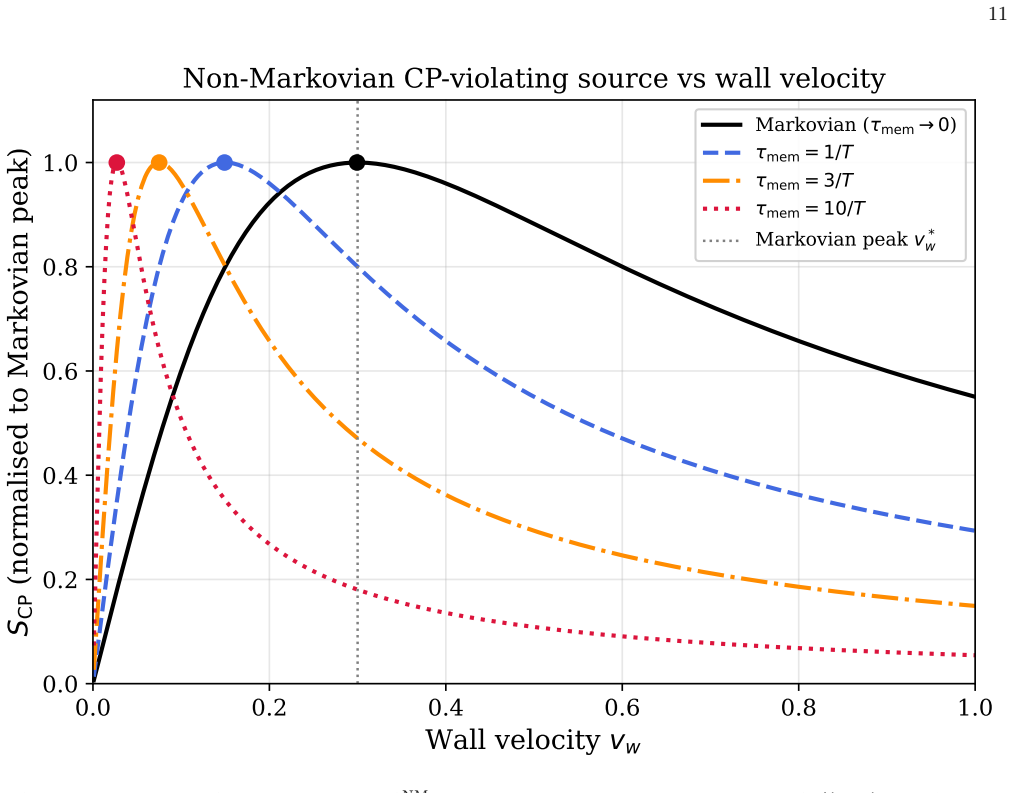
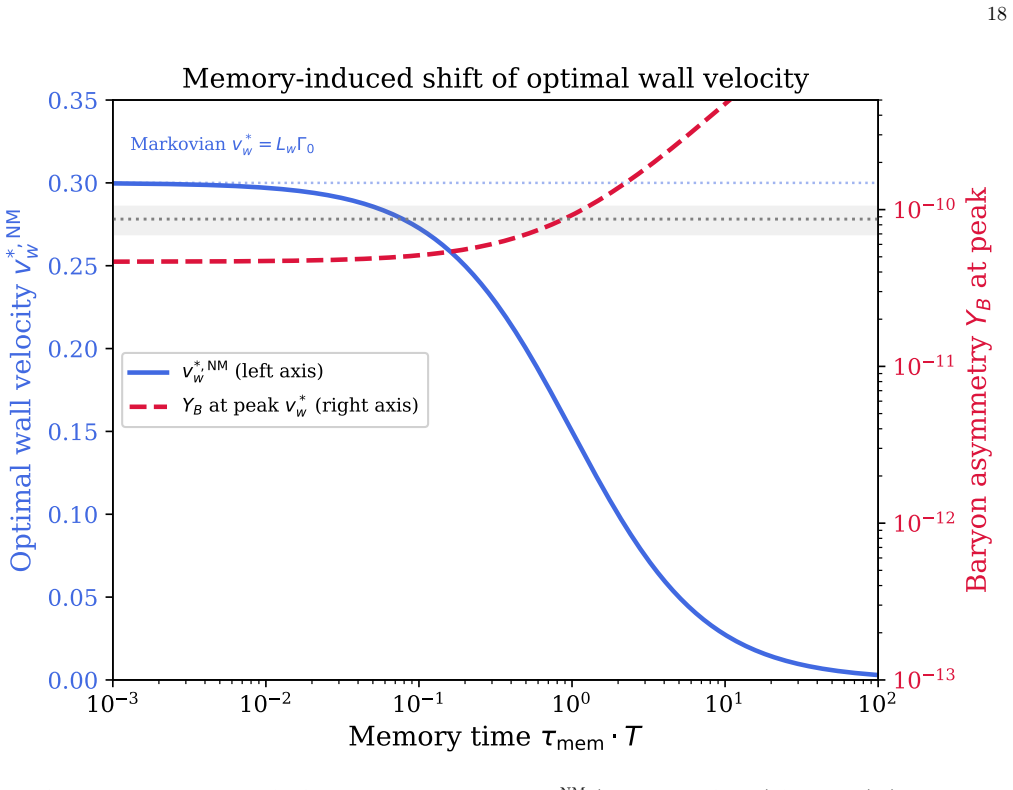
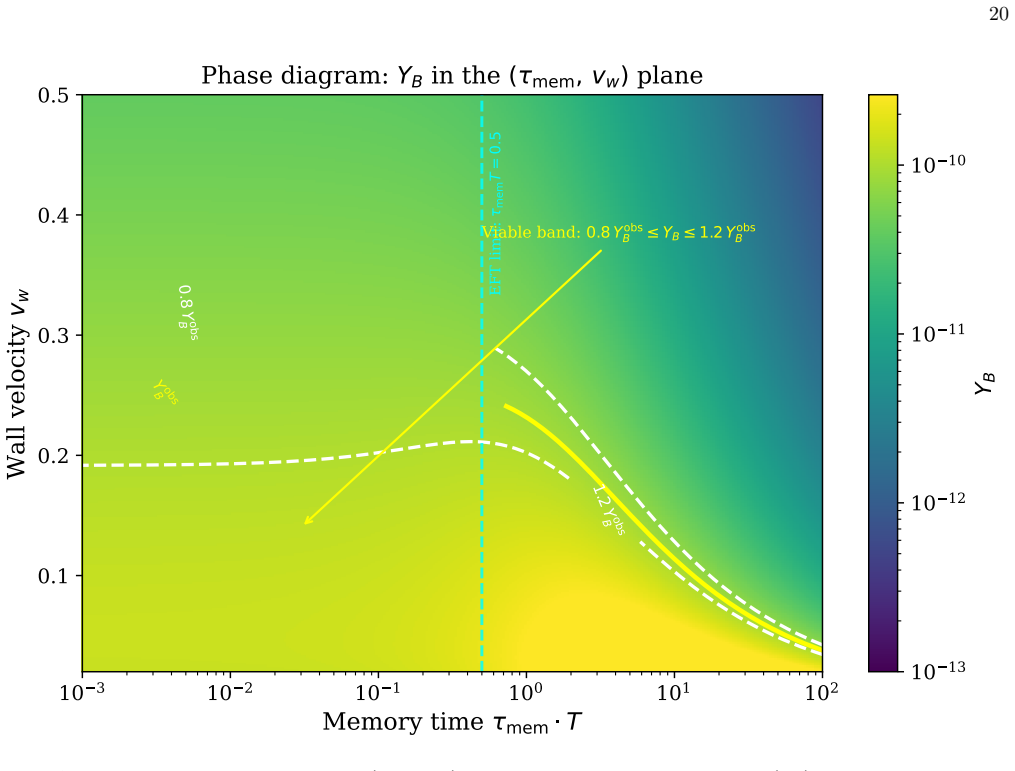
Within the Schwinger-Keldysh real-time effective field theory and the Kadanoff-Baym hierarchy, when the relaxation time of CP-violating mediators becomes comparable to the bubble-wall crossing time, transport dynamics acquire temporal nonlocality. This produces memory-kernel corrections to the CP-violating source and diffusion equations beyond the Markovian approximation. The corrections shift the optimal wall velocity to smaller values, narrow the viable parameter space, and induce a characteristic non-monotonic dependence of the baryon asymmetry on the memory timescale for sub-optimal wall velocities that cannot be reproduced by a consistent Markovian reparameterisation.
What carries the argument
Memory-kernel corrections to the CP-violating source and diffusion equations, derived from the Kadanoff-Baym hierarchy when mediator relaxation times match bubble-wall crossing times.
If this is right
- The optimal bubble-wall velocity shifts to smaller values.
- The viable parameter space for generating the observed baryon asymmetry narrows.
- Baryon asymmetry shows non-monotonic dependence on memory timescale for sub-optimal velocities.
- Memory effects enhance the duration and amplitude of the effective source for gravitational-wave signals.
Where Pith is reading between the lines
- Measurements of the baryon asymmetry could be used to place direct constraints on the memory timescale of CP-violating mediators.
- Correlated observations from gravitational-wave detectors and collider searches for CP violation could jointly test whether the non-Markovian regime is realized.
- Similar memory-kernel effects may appear in transport calculations for other cosmological phase transitions that involve comparable relaxation and crossing timescales.
Load-bearing premise
The relaxation time of CP-violating mediators is comparable to the bubble-wall crossing time so that non-Markovian memory effects become important in the transport dynamics.
What would settle it
A concrete model calculation that produces only monotonic dependence of the baryon asymmetry on the memory timescale, without the predicted non-monotonic feature at sub-optimal wall velocities, would falsify the central claim.
Figures





read the original abstract
We develop a non-Markovian extension of electroweak baryogenesis within the Schwinger--Keldysh real-time effective field theory framework and the Kadanoff--Baym hierarchy. When the relaxation time of CP-violating mediators becomes comparable to the bubble-wall crossing time, transport dynamics acquire temporal nonlocality, leading to memory-kernel corrections to the CP-violating source and diffusion equations beyond the Markovian approximation. These effects shift the optimal wall velocity to smaller values, narrow the viable parameter space, and induce a characteristic non-monotonic dependence of the baryon asymmetry on the memory timescale for sub-optimal wall velocities, which cannot be reproduced by a consistent Markovian reparameterisation. A systematic parameter analysis identifies regions compatible with the observed baryon asymmetry and constrains the allowed memory timescale from hydrodynamic stability and the physical range of the CP-violating phase. We also assess the correlated impact on the stochastic gravitational-wave signal, finding that memory effects can enhance the effective source duration and amplitude, although much of the viable parameter space remains below near-future detector sensitivities and theoretical uncertainties remain at the order-of-magnitude level. These results establish non-Markovian transport as a well-motivated extension of electroweak baryogenesis and introduce the memory timescale as a parameter testable through baryon asymmetry measurements, collider CP probes, and gravitational-wave observations.
Editorial analysis
A structured set of objections, weighed in public.
Referee Report
Summary. The manuscript develops a non-Markovian extension of electroweak baryogenesis within the Schwinger-Keldysh real-time effective field theory and Kadanoff-Baym hierarchy. When the relaxation time of CP-violating mediators is comparable to the bubble-wall crossing time, temporal nonlocality induces memory-kernel corrections to the CP-violating source and diffusion equations. These corrections shift the optimal wall velocity to smaller values, narrow the viable parameter space, produce a non-monotonic dependence of the baryon asymmetry on the memory timescale (unreproducible by Markovian reparameterization), and modify the stochastic gravitational-wave signal. A parameter scan constrains the memory timescale via hydrodynamic stability and the physical range of the CP-violating phase while matching the observed baryon asymmetry, with an assessment of GW detectability.
Significance. If the central results hold, the work would introduce the memory timescale as a new, testable parameter in electroweak baryogenesis, constrained by first-principles transport and observable quantities. The systematic exploration of non-Markovian effects, their correlation with gravitational-wave amplitude and duration, and the identification of regions compatible with the baryon asymmetry constitute a clear advance over standard Markovian treatments. The paper ships a concrete, falsifiable signature (non-monotonic baryon asymmetry vs. memory timescale) that could be probed by collider CP measurements and future GW observatories, although GW predictions remain at order-of-magnitude level.
major comments (2)
- [§4.1] §4.1 (Kadanoff-Baym hierarchy truncation): the derivation of the memory kernel assumes the quasi-particle and gradient expansions remain controlled when the mediator relaxation time τ_rel becomes comparable to the wall transit time τ_wall. No explicit error estimate, convergence test, or higher-order term assessment is supplied for this marginal regime, which is precisely the regime in which the claimed shifts in wall velocity and non-monotonic baryon asymmetry are generated. This truncation directly underpins the reliability of the numerical results for the asymmetry and GW spectrum.
- [§5.3] §5.3 (numerical results): the non-monotonic dependence of the baryon asymmetry on the memory timescale is asserted to be a distinctive non-Markovian signature. However, the manuscript does not present a side-by-side comparison against a Markovian model whose parameters have been re-tuned to reproduce the same integrated source strength, leaving open whether the non-monotonicity is an artifact of the particular truncation or a genuine physical effect.
minor comments (2)
- [Abstract] The abstract states that 'theoretical uncertainties remain at the order-of-magnitude level' for the GW signal, yet no quantitative breakdown of these uncertainties (e.g., variation with wall velocity or memory timescale) appears in the text or figures.
- [Figures 4-6] Figure captions and axis labels for the baryon asymmetry and GW spectra should explicitly indicate the range of memory timescales scanned and the hydrodynamic stability cut applied.
Simulated Author's Rebuttal
We thank the referee for the careful reading and constructive comments. We address each major comment point by point below, providing clarifications and indicating the revisions we will implement to strengthen the manuscript.
read point-by-point responses
-
Referee: [§4.1] §4.1 (Kadanoff-Baym hierarchy truncation): the derivation of the memory kernel assumes the quasi-particle and gradient expansions remain controlled when the mediator relaxation time τ_rel becomes comparable to the wall transit time τ_wall. No explicit error estimate, convergence test, or higher-order term assessment is supplied for this marginal regime, which is precisely the regime in which the claimed shifts in wall velocity and non-monotonic baryon asymmetry are generated. This truncation directly underpins the reliability of the numerical results for the asymmetry and GW spectrum.
Authors: We acknowledge that an explicit error estimate for the quasi-particle and gradient expansions in the regime τ_rel ≈ τ_wall would strengthen the presentation. The manuscript relies on the standard validity conditions of the Kadanoff-Baym hierarchy, where the memory kernel arises as a controlled correction when the relaxation time is comparable to the wall transit time. To address the concern directly, we will revise §4.1 to include a quantitative estimate of higher-order terms, scaling with powers of the ratio τ_rel/τ_wall, together with a numerical convergence test obtained by varying the truncation order. This addition will confirm that the reported shifts in wall velocity and the non-monotonic baryon asymmetry remain robust within the controlled regime. revision: yes
-
Referee: [§5.3] §5.3 (numerical results): the non-monotonic dependence of the baryon asymmetry on the memory timescale is asserted to be a distinctive non-Markovian signature. However, the manuscript does not present a side-by-side comparison against a Markovian model whose parameters have been re-tuned to reproduce the same integrated source strength, leaving open whether the non-monotonicity is an artifact of the particular truncation or a genuine physical effect.
Authors: The non-monotonic dependence originates from the nonlocal temporal structure of the memory kernel, which cannot be reproduced by any local Markovian source term even after re-tuning its integrated strength. The manuscript already states that the feature is absent under consistent Markovian reparameterization. To make the distinction explicit, we will add in the revised §5.3 a direct side-by-side comparison: the baryon asymmetry versus memory timescale (or wall velocity) for the non-Markovian case is contrasted with a Markovian model whose CP-violating source is adjusted to match the same integrated strength. This comparison will demonstrate that the non-monotonicity is absent in the re-tuned Markovian case, confirming it as a genuine physical signature of temporal nonlocality. revision: yes
Circularity Check
No circularity: derivation introduces memory timescale as independent parameter and constrains it externally
full rationale
The paper's central derivation starts from the Schwinger-Keldysh real-time EFT and Kadanoff-Baym hierarchy (standard frameworks), derives memory-kernel corrections when relaxation time approaches wall-crossing time, and treats the memory timescale as a new free parameter. This parameter is then bounded by hydrodynamic stability and the physical range of the CP-violating phase while the baryon asymmetry is required to match the observed value; the resulting shifts in wall velocity, parameter space, and non-monotonic dependence are computed outputs rather than inputs. No self-citation is invoked to justify the truncation or kernel form, no fitted quantity is relabeled as a prediction, and no ansatz is smuggled via prior work by the same author. The chain remains self-contained against external benchmarks.
Axiom & Free-Parameter Ledger
free parameters (1)
- memory timescale
axioms (1)
- domain assumption Schwinger-Keldysh real-time effective field theory and Kadanoff-Baym hierarchy correctly describe CP-violating transport when relaxation time is comparable to bubble-wall crossing time
Reference graph
Works this paper leans on
-
[1]
a shift of the peak positionv ∗,NM w toward smaller values, which can bring the peak closer to or further from the chosenv w depending on the initial position
-
[2]
The competition between these two effects leads to three qualitatively distinct regimes, which we now analyse in turn
an overall suppression of the source amplitude by (1 + Γ 0τmem)−1, which reducesY B regardless of the peak alignment. The competition between these two effects leads to three qualitatively distinct regimes, which we now analyse in turn. Sub-peak regime (vw < v ∗ w) In the Markovian limitτ mem →0, the chosenv w liesbelowthe peak positionv ∗ w =L wΓ0, i.e. ...
-
[2]
The competition between these two effects leads to three qualitatively distinct regimes, which we now analyse in turn
an overall suppression of the source amplitude by (1 + Γ 0τmem)−1, which reducesY B regardless of the peak alignment. The competition between these two effects leads to three qualitatively distinct regimes, which we now analyse in turn. Sub-peak regime (vw < v ∗ w) In the Markovian limitτ mem →0, the chosenv w liesbelowthe peak positionv ∗ w =L wΓ0, i.e. ...
-
[3]
Increasingτ mem suppresses Γeff and henceS NM CP , reducingY B at fixedv w through the factor (1+Γ0τmem)−1 acting on the source (Eq. (43)). At the benchmarkv w = 0.1> v ∗ w, this suppression is monotonic and uncompensated
-
[4]
(81)–(82), amplifying Ω GW by the factor in Eq
Simultaneously, increasingϵ mem = Γ0τmem enhancesβ −1 mem andκ mem v through Eqs. (81)–(82), amplifying Ω GW by the factor in Eq. (86). These effects operate in opposite directions in the (Y B,Ω GW) plane, producing the anti-correlation visible in Fig. 8: points with largerτ mem (yellow/orange in the colour scale) have lowerYB and higher ΩGW, while smalle...
-
[5]
is maximised at Γ 0 =v w/Lw and is monotonically decreasing for Γ 0 > v w/Lw. Any attempt to mimic the non-Markovianτ mem dependence by varying Γ 0 →Γ eff(τmem) would require Γ 0 toincreaseat smallτ mem (to move the Markovian peak towardv w) and thendecreaseat largeτ mem. But Γ 0 is a fixed physical quantity set by the model parameters; it cannot vary wit...
-
[5]
is maximised at Γ 0 =v w/Lw and is monotonically decreasing for Γ 0 > v w/Lw. Any attempt to mimic the non-Markovianτ mem dependence by varying Γ 0 →Γ eff(τmem) would require Γ 0 toincreaseat smallτ mem (to move the Markovian peak towardv w) and thendecreaseat largeτ mem. But Γ 0 is a fixed physical quantity set by the model parameters; it cannot vary wit...
-
[6]
V. A. Kuzmin, V. A. Rubakov and M. E. Shaposhnikov, Phys. Lett. B155(1985), 36 doi:10.1016/0370-2693(85)91028-7
-
[7]
P. B. Arnold and L. D. McLerran, Phys. Rev. D36(1987), 581 doi:10.1103/PhysRevD.36.581
-
[8]
V. A. Rubakov and M. E. Shaposhnikov, Usp. Fiz. Nauk166(1996), 493-537 doi:10.1070/PU1996v039n05ABEH000145 [arXiv:hep-ph/9603208 [hep-ph]]
-
[9]
M. Trodden, Rev. Mod. Phys.71(1999), 1463-1500 doi:10.1103/RevModPhys.71.1463 [arXiv:hep-ph/9803479 [hep-ph]]
-
[10]
D. E. Morrissey and M. J. Ramsey-Musolf, New J. Phys.14(2012), 125003 doi:10.1088/1367-2630/14/12/125003 [arXiv:1206.2942 [hep-ph]]
-
[11]
G. A. White, Morgan & Claypool, 2016, ISBN 978-1-68174-456-8, 978-1-68174-457-5 doi:10.1088/978-1-6817-4457-5 32
-
[12]
A. D. Sakharov, Pisma Zh. Eksp. Teor. Fiz.5(1967), 32-35 doi:10.1070/PU1991v034n05ABEH002497
-
[13]
A. G. Cohen, D. B. Kaplan and A. E. Nelson, Ann. Rev. Nucl. Part. Sci.43(1993), 27-70 doi:10.1146/annurev.ns.43.120193.000331 [arXiv:hep-ph/9302210 [hep-ph]]
-
[14]
Finite temperature field theory and phase transitions
M. Quiros, [arXiv:hep-ph/9901312 [hep-ph]]
work page internal anchor Pith review arXiv
-
[15]
M. Carena, M. Quiros, M. Seco and C. E. M. Wagner, Nucl. Phys. B650(2003), 24-42 doi:10.1016/S0550-3213(02)01065-9 [arXiv:hep-ph/0208043 [hep-ph]]
-
[16]
T. Prokopec, M. G. Schmidt and S. Weinstock, Annals Phys.314(2004), 208-265 doi:10.1016/j.aop.2004.06.002 [arXiv:hep- ph/0312110 [hep-ph]]
-
[17]
T. Konstandin, T. Prokopec and M. G. Schmidt, Nucl. Phys. B716(2005), 373-400 doi:10.1016/j.nuclphysb.2005.03.013 [arXiv:hep-ph/0410135 [hep-ph]]
-
[18]
G. W. Anderson and L. J. Hall, Phys. Rev. D45(1992), 2685-2698 doi:10.1103/PhysRevD.45.2685
-
[19]
A. E. Nelson, D. B. Kaplan and A. G. Cohen, Nucl. Phys. B373(1992), 453-478 doi:10.1016/0550-3213(92)90440-M
-
[20]
P. Huet and A. E. Nelson, Phys. Rev. D53(1996), 4578-4597 doi:10.1103/PhysRevD.53.4578 [arXiv:hep-ph/9506477 [hep-ph]]
-
[21]
M. Joyce, T. Prokopec and N. Turok, Phys. Rev. D53(1996), 2958-2980 doi:10.1103/PhysRevD.53.2958 [arXiv:hep- ph/9410282 [hep-ph]]
-
[22]
J. M. Cline, M. Joyce and K. Kainulainen, JHEP07(2000), 018 doi:10.1088/1126-6708/2000/07/018 [arXiv:hep- ph/0006119 [hep-ph]]
-
[23]
J. M. Cline, A. Friedlander, D. M. He, K. Kainulainen, B. Laurent and D. Tucker-Smith, Phys. Rev. D103(2021) no.12, 123529 doi:10.1103/PhysRevD.103.123529 [arXiv:2102.12490 [hep-ph]]
-
[24]
J. M. Cline, M. Joyce and K. Kainulainen, [arXiv:hep-ph/0110031 [hep-ph]]
work page internal anchor Pith review arXiv
-
[25]
Kainulainen, JCAP11(2021) no.11, 042 doi:10.1088/1475-7516/2021/11/042 [arXiv:2108.08336 [hep-ph]]
K. Kainulainen, JCAP11(2021) no.11, 042 doi:10.1088/1475-7516/2021/11/042 [arXiv:2108.08336 [hep-ph]]
-
[26]
B. Laurent and J. M. Cline, Phys. Rev. D106(2022) no.2, 023501 doi:10.1103/PhysRevD.106.023501 [arXiv:2204.13120 [hep-ph]]
-
[27]
M. Carena, G. Nardini, M. Quiros and C. E. M. Wagner, Nucl. Phys. B812(2009), 243-263 doi:10.1016/j.nuclphysb.2008.12.014 [arXiv:0809.3760 [hep-ph]]
-
[28]
J. M. Cline and K. Kainulainen, JCAP01(2013), 012 doi:10.1088/1475-7516/2013/01/012 [arXiv:1210.4196 [hep-ph]]
-
[29]
M. Postma and J. van de Vis, JHEP02(2020), 090 doi:10.1007/JHEP02(2020)090 [arXiv:1910.11794 [hep-ph]]
-
[30]
J. R. Espinosa, T. Konstandin, J. M. No and G. Servant, JCAP06(2010), 028 doi:10.1088/1475-7516/2010/06/028 [arXiv:1004.4187 [hep-ph]]
-
[31]
L. Fromme, S. J. Huber and M. Seniuch, JHEP11(2006), 038 doi:10.1088/1126-6708/2006/11/038 [arXiv:hep-ph/0605242 [hep-ph]]
- [32]
-
[33]
J. S. Schwinger, J. Math. Phys.2(1961), 407-432 doi:10.1063/1.1703727
-
[34]
L. V. Keldysh, Sov. Phys. JETP20(1965), 1018-1026 doi:10.1142/9789811279461 0007
-
[35]
E. Calzetta and B. L. Hu, Phys. Rev. D37(1988), 2878 doi:10.1103/PhysRevD.37.2878
-
[36]
J. Berges, AIP Conf. Proc.739(2004) no.1, 3-62 doi:10.1063/1.1843591 [arXiv:hep-ph/0409233 [hep-ph]]
-
[37]
Danielewicz, Annals Phys.152(1984), 239-304 doi:10.1016/0003-4916(84)90092-7
P. Danielewicz, Annals Phys.152(1984), 239-304 doi:10.1016/0003-4916(84)90092-7
-
[38]
E. P. Wigner, Phys. Rev.40(1932), 749-760 doi:10.1103/PhysRev.40.749
-
[39]
J. E. Moyal, Proc. Cambridge Phil. Soc.45(1949), 99-124 doi:10.1017/S0305004100000487
-
[40]
N. Aghanimet al.[Planck], Astron. Astrophys.641(2020), A6 [erratum: Astron. Astrophys.652(2021), C4] doi:10.1051/0004-6361/201833910 [arXiv:1807.06209 [astro-ph.CO]]
-
[41]
C. Caprini, M. Hindmarsh, S. Huber, T. Konstandin, J. Kozaczuk, G. Nardini, J. M. No, A. Petiteau, P. Schwaller and G. Servant,et al.JCAP04(2016), 001 doi:10.1088/1475-7516/2016/04/001 [arXiv:1512.06239 [astro-ph.CO]]
-
[42]
C. Caprini, M. Chala, G. C. Dorsch, M. Hindmarsh, S. J. Huber, T. Konstandin, J. Kozaczuk, G. Nardini, J. M. No and K. Rummukainen,et al.JCAP03(2020), 024 doi:10.1088/1475-7516/2020/03/024 [arXiv:1910.13125 [astro-ph.CO]]
-
[43]
C. Grojean and G. Servant, Phys. Rev. D75(2007), 043507 doi:10.1103/PhysRevD.75.043507 [arXiv:hep-ph/0607107 [hep-ph]]
-
[44]
M. Hindmarsh, S. J. Huber, K. Rummukainen and D. J. Weir, Phys. Rev. D92(2015) no.12, 123009 doi:10.1103/PhysRevD.92.123009 [arXiv:1504.03291 [astro-ph.CO]]
-
[45]
J. R. Espinosa, Nucl. Phys. B475(1996), 273-292 doi:10.1016/0550-3213(96)00297-0 [arXiv:hep-ph/9604320 [hep-ph]]
-
[46]
J. R. Espinosa and M. Quiros, Phys. Rev. D76(2007), 076004 doi:10.1103/PhysRevD.76.076004 [arXiv:hep-ph/0701145 [hep-ph]]
-
[47]
D. Curtin, P. Meade and C. T. Yu, JHEP11(2014), 127 doi:10.1007/JHEP11(2014)127 [arXiv:1409.0005 [hep-ph]]
-
[48]
G. Kurup and M. Perelstein, Phys. Rev. D96(2017) no.1, 015036 doi:10.1103/PhysRevD.96.015036 [arXiv:1704.03381 [hep-ph]]
-
[49]
A. Chaudhuri and K. Kohri, Nucl. Phys. B1018(2025), 117098 doi:10.1016/j.nuclphysb.2025.117098 [arXiv:2404.10288 [hep-ph]]
-
[50]
A. Chaudhuri, Nucl. Phys. B1024(2026), 117357 doi:10.1016/j.nuclphysb.2026.117357 [arXiv:2507.13135 [astro-ph.CO]]
-
[51]
G. Aadet al.[ATLAS], Eur. Phys. J. C83(2023) no.9, 774 doi:10.1140/epjc/s10052-023-11873-5 [arXiv:2301.06822 [hep- ex]]
-
[52]
A. Tumasyanet al.[CMS], Nature607(2022) no.7917, 60-68 [erratum: Nature623(2023) no.7985, E4] doi:10.1038/s41586- 022-04892-x [arXiv:2207.00043 [hep-ex]]. 33
-
[53]
Search for the Standard Model Higgs boson at LEP
R. Barateet al.[LEP Working Group for Higgs boson searches, ALEPH, DELPHI, L3 and OPAL], Phys. Lett. B565 (2003), 61-75 doi:10.1016/S0370-2693(03)00614-2 [arXiv:hep-ex/0306033 [hep-ex]]
-
[54]
G. D. Moore and T. Prokopec, Phys. Rev. Lett.75(1995), 777-780 doi:10.1103/PhysRevLett.75.777 [arXiv:hep-ph/9503296 [hep-ph]]
-
[55]
P. John and M. G. Schmidt, Nucl. Phys. B598(2001), 291-305 [erratum: Nucl. Phys. B648(2003), 449-452] doi:10.1016/S0550-3213(00)00768-9 [arXiv:hep-ph/0002050 [hep-ph]]
-
[56]
H. A. Weldon, Phys. Rev. D28(1983), 2007 doi:10.1103/PhysRevD.28.2007
-
[57]
P. B. Arnold, G. D. Moore and L. G. Yaffe, JHEP01(2003), 030 doi:10.1088/1126-6708/2003/01/030 [arXiv:hep- ph/0209353 [hep-ph]]
-
[58]
J. Ghiglieri, O. Kaczmarek, M. Laine and F. Meyer, Phys. Rev. D94(2016) no.1, 016005 doi:10.1103/PhysRevD.94.016005 [arXiv:1604.07544 [hep-lat]]
-
[59]
J. P. Blaizot and E. Iancu, Phys. Rept.359(2002), 355-528 doi:10.1016/S0370-1573(01)00061-8 [arXiv:hep-ph/0101103 [hep-ph]]
-
[60]
G. D. Moore, Phys. Rev. D62(2000), 085011 doi:10.1103/PhysRevD.62.085011 [arXiv:hep-ph/0001216 [hep-ph]]
-
[61]
P. B. Arnold, G. D. Moore and L. G. Yaffe, JHEP11(2000), 001 doi:10.1088/1126-6708/2000/11/001 [arXiv:hep- ph/0010177 [hep-ph]]
-
[62]
G. D. Moore, C. r. Hu and B. Muller, Phys. Rev. D58(1998), 045001 doi:10.1103/PhysRevD.58.045001 [arXiv:hep- ph/9710436 [hep-ph]]
-
[63]
M. D’Onofrio, K. Rummukainen and A. Tranberg, Phys. Rev. Lett.113(2014) no.14, 141602 doi:10.1103/PhysRevLett.113.141602 [arXiv:1404.3565 [hep-ph]]
-
[64]
P. B. Arnold, D. Son and L. G. Yaffe, Phys. Rev. D55(1997), 6264-6273 doi:10.1103/PhysRevD.55.6264 [arXiv:hep- ph/9609481 [hep-ph]]
-
[65]
E. W. Kolb and M. S. Turner, Front. Phys.69(1990), 1-547 Taylor and Francis, 2019, ISBN 978-0-429-49286-0, 978-0- 201-62674-2 doi:10.1201/9780429492860
-
[66]
J. Engel, M. J. Ramsey-Musolf and U. van Kolck, Prog. Part. Nucl. Phys.71(2013), 21-74 doi:10.1016/j.ppnp.2013.03.003 [arXiv:1303.2371 [nucl-th]]
-
[67]
C. Cesarotti, Q. Lu, Y. Nakai, A. Parikh and M. Reece, JHEP05(2019), 059 doi:10.1007/JHEP05(2019)059 [arXiv:1810.07736 [hep-ph]]
-
[68]
V. Andreevet al.[ACME], Nature562(2018) no.7727, 355-360 doi:10.1038/s41586-018-0599-8
-
[69]
E. Fuchs, M. Losada, Y. Nir and Y. Viernik, JHEP05(2020), 056 doi:10.1007/JHEP05(2020)056 [arXiv:2003.00099 [hep-ph]]
-
[70]
A. Chaudhuri and J. Das, Phys. Rev. D106(2022) no.9, 095016 doi:10.1103/PhysRevD.106.095016 [arXiv:2206.08699 [hep-ph]]
-
[71]
T. Srivastava, J. Das, A. Ghosh and A. Chaudhuri, JCAP02(2026), 032 doi:10.1088/1475-7516/2026/02/032 [arXiv:2507.05917 [hep-ph]]
- [72]
- [73]
- [74]
-
[75]
P. Athron, C. Bal´ azs, A. Fowlie, L. Morris and L. Wu, Prog. Part. Nucl. Phys.135(2024), 104094 doi:10.1016/j.ppnp.2023.104094 [arXiv:2305.02357 [hep-ph]]
-
[76]
P. Borah, P. Ghosh, S. Roy and A. K. Saha, JHEP08(2023), 029 doi:10.1007/JHEP08(2023)029 [arXiv:2301.05061 [hep-ph]]
-
[77]
M. Hindmarsh, S. J. Huber, K. Rummukainen and D. J. Weir, Phys. Rev. D96(2017) no.10, 103520 [erratum: Phys. Rev. D101(2020) no.8, 089902] doi:10.1103/PhysRevD.96.103520 [arXiv:1704.05871 [astro-ph.CO]]
-
[78]
C. Caprini, R. Durrer and G. Servant, JCAP12(2009), 024 doi:10.1088/1475-7516/2009/12/024 [arXiv:0909.0622 [astro- ph.CO]]
discussion (0)
Sign in with ORCID, Apple, or X to comment. Anyone can read and Pith papers without signing in.