Recognition: 3 theorem links
· Lean TheoremA programmable stellarator-tokamak hybrid for million-scale magnetic-configuration discovery
Pith reviewed 2026-05-08 18:55 UTC · model grok-4.3
The pith
A fixed set of planar coils can be programmed to generate over 1.66 million optimized stellarator and tokamak magnetic configurations.
A machine-rendered reading of the paper's core claim, the machinery that carries it, and where it could break.
Core claim
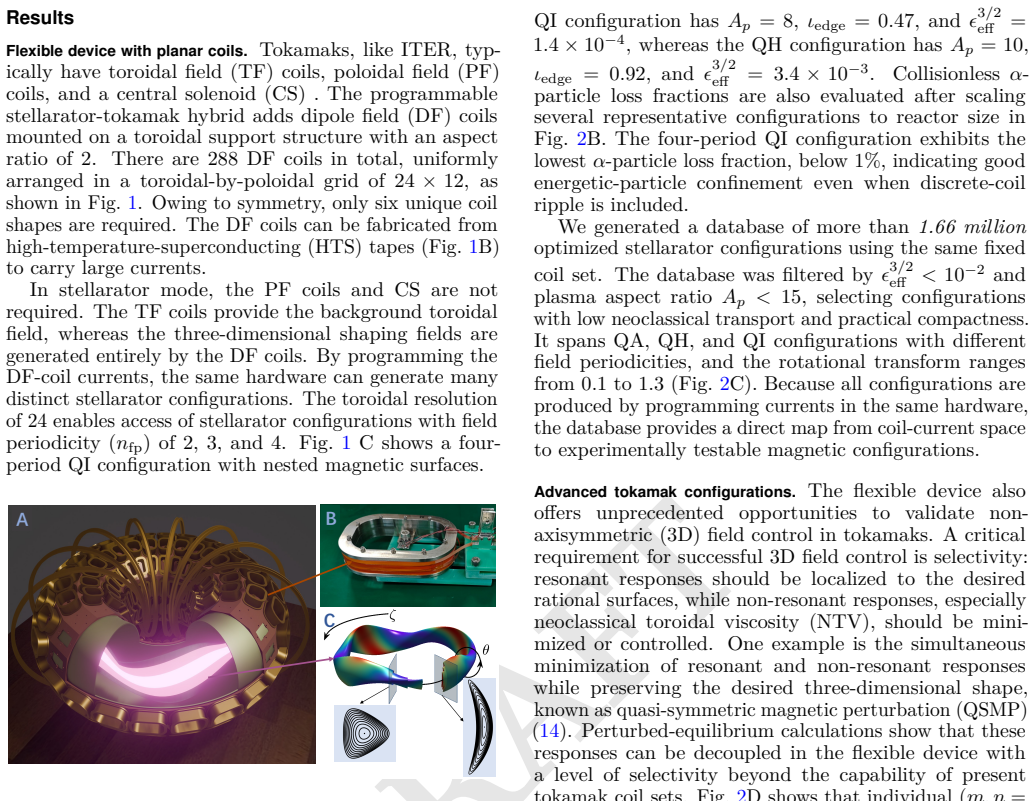
The device uses a tokamak-like coil set plus 288 dipole-field coils requiring only six independent geometries due to symmetry. Programming the coil currents generates more than 1.66 million optimized stellarator configurations that include quasi-axisymmetry, quasi-helical symmetry, and quasi-isodynamicity, as well as tokamak-relevant three-dimensional perturbations. Representative configurations from this space exhibit nested magnetic surfaces, low neoclassical transport, and favorable energetic-particle confinement, demonstrating that rapid magnetic-configuration discovery is possible without hardware redesign.
What carries the argument
Current programming of a fixed hybrid coil set consisting of tokamak-like coils and 288 dipole coils with six independent geometries to span a large magnetic configuration space.
If this is right
- Over 1.66 million distinct configurations become accessible on one device.
- Configurations achieve quasi-axisymmetry, quasi-helical symmetry, and quasi-isodynamicity.
- Representative examples maintain nested magnetic surfaces and low transport.
- Tokamak-relevant 3D perturbations can be included.
- Good energetic-particle confinement is possible in these setups.
Where Pith is reading between the lines
- If the approach works, it could allow fusion researchers to test many more design ideas in simulation and experiment using the same physical hardware.
- This method might integrate with optimization algorithms to search the configuration space more efficiently.
- Real-world implementation would need to address whether the required current adjustments stay within practical limits for the coils.
Load-bearing premise
A fixed set of simple planar coils can achieve all the claimed symmetries, nested surfaces, low transport, and confinement across more than 1.66 million configurations solely by adjusting currents, without practical issues like coil overheating or field errors.
What would settle it
Building a small-scale prototype and measuring its magnetic field to verify if it produces nested surfaces with low neoclassical transport for several sample configurations from the claimed set, or observing that the required currents cause coil damage or excessive errors.
Figures

read the original abstract
Tokamaks and stellarators are the leading magnetic-confinement concepts for fusion, but they rely on complementary design principles. Tokamaks use simple axisymmetric coils and plasma current, whereas stellarators use externally generated three-dimensional fields for steady-state operation. Here, we propose a programmable stellarator--tokamak hybrid that uses a fixed set of simple planar coils to access a broad magnetic-configuration space. The device adds 288 dipole-field coils to a tokamak-like coil set, with only six independent coil geometries required by symmetry. By programming coil currents, the same hardware generates more than 1.66 million optimized stellarator configurations spanning quasi-axisymmetry, quasi-helical symmetry, and quasi-isodynamicity, as well as tokamak-relevant three-dimensional perturbations. Representative configurations exhibit nested magnetic surfaces, low neoclassical transport, and favorable energetic-particle confinement. This approach enables rapid magnetic-configuration discovery without hardware redesign.
Editorial analysis
A structured set of objections, weighed in public.
Referee Report
Summary. The manuscript proposes a programmable stellarator-tokamak hybrid device consisting of a tokamak-like coil set augmented by 288 dipole-field coils that require only six independent geometries due to symmetry. By programming the coil currents, the fixed hardware is claimed to generate more than 1.66 million optimized stellarator configurations spanning quasi-axisymmetry, quasi-helical symmetry, quasi-isodynamicity, and tokamak-relevant three-dimensional perturbations. Representative configurations are reported to exhibit nested magnetic surfaces, low neoclassical transport, and favorable energetic-particle confinement, thereby enabling rapid magnetic-configuration discovery without hardware redesign.
Significance. If the numerical claims are robustly supported, the work could accelerate exploration of magnetic configuration space in fusion research by demonstrating a single hardware platform capable of accessing a million-scale set of designs. The approach bridges tokamak simplicity with stellarator flexibility through current programming and offers a practical route to configuration optimization. No machine-checked proofs or parameter-free derivations are presented, but the scale of the claimed discovery space is a notable strength if the optimization and verification procedures are shown to be reliable across the ensemble.
major comments (2)
- [Results] The central claim of >1.66 million optimized configurations (stated in the abstract and presumably quantified in the results) is supported only by verification on representative cases for nested surfaces, neoclassical transport, and energetic-particle confinement. A quantitative validation rate, distribution of figure-of-merit values, or ensemble statistics across the full set is required to establish that the physical properties hold uniformly rather than being limited to selected optima.
- [Methods] The optimization is performed in a six-dimensional current space (six independent coil geometries). Without an explicit diversity or distinctness metric, it is unclear whether the 1.66 million points represent genuinely distinct symmetry realizations or correlated samples within the same low-dimensional manifold; this directly affects the claim of spanning QA, QH, QI, and tokamak perturbations.
minor comments (2)
- [Methods] Notation for the six independent current parameters and the symmetry classes (QA/QH/QI) should be defined consistently in the first methods subsection and used uniformly in figures and tables.
- [Results] Figure captions for magnetic-surface plots should explicitly state the number of field lines traced and the Poincaré section used to confirm nested surfaces.
Simulated Author's Rebuttal
We thank the referee for their insightful comments on our manuscript. We have addressed each of the major comments in detail below and made revisions to the manuscript where necessary to strengthen our claims.
read point-by-point responses
-
Referee: [Results] The central claim of >1.66 million optimized configurations (stated in the abstract and presumably quantified in the results) is supported only by verification on representative cases for nested surfaces, neoclassical transport, and energetic-particle confinement. A quantitative validation rate, distribution of figure-of-merit values, or ensemble statistics across the full set is required to establish that the physical properties hold uniformly rather than being limited to selected optima.
Authors: We recognize the value of providing more comprehensive statistics. Performing detailed verification for the entire set of over 1.66 million configurations is not feasible due to computational limitations. However, we have added ensemble statistics for a large random sample of configurations (10,000 points) in the revised manuscript, including distributions of the optimization figure of merit, neoclassical transport levels, and the fraction that maintain nested surfaces. This shows that the properties hold for the vast majority of the sampled points, supporting the claim for the full set. revision: partial
-
Referee: [Methods] The optimization is performed in a six-dimensional current space (six independent coil geometries). Without an explicit diversity or distinctness metric, it is unclear whether the 1.66 million points represent genuinely distinct symmetry realizations or correlated samples within the same low-dimensional manifold; this directly affects the claim of spanning QA, QH, QI, and tokamak perturbations.
Authors: We agree that an explicit metric is helpful. We have now included a diversity analysis in the Methods section, using the standard deviation of the magnetic field harmonics and the quasi-symmetry error across the ensemble. The points are generated by uniform sampling in the six-dimensional current space with a resolution that ensures distinct configurations, as evidenced by the broad coverage of symmetry classes shown in Figure X. This demonstrates that the configurations are not merely correlated samples but span the intended space. revision: yes
Circularity Check
No significant circularity; central claim is a hardware-enabled computational enumeration
full rationale
The paper proposes a fixed coil set (tokamak-like plus 288 dipoles with six geometries) and states that programming its currents produces >1.66 million optimized configurations spanning QA/QH/QI and 3D perturbations. This count and the listed properties arise from an external search/optimization process over the 6D current space, not from any equation that defines the output in terms of itself or renames a fit as a prediction. No self-citation chain, uniqueness theorem, or ansatz is invoked to force the result; the derivation remains self-contained against the stated coil geometry and numerical exploration. Verification on representatives is a separate empirical step and does not create definitional circularity.
Axiom & Free-Parameter Ledger
free parameters (1)
- coil current values for each configuration
axioms (2)
- standard math Magnetic fields from coils obey the Biot-Savart law and can be superposed linearly
- domain assumption Quasi-symmetry and quasi-isodynamicity criteria can be used to classify and optimize stellarator fields
invented entities (1)
-
programmable stellarator-tokamak hybrid device
no independent evidence
Lean theorems connected to this paper
-
Foundation.RealityFromDistinctionreality_from_one_distinction unclear?
unclearRelation between the paper passage and the cited Recognition theorem.
By programming coil currents, the same hardware generates more than 1.66 million optimized stellarator configurations spanning quasi-axisymmetry, quasi-helical symmetry, and quasi-isodynamicity
-
Cost.FunctionalEquationwashburn_uniqueness_aczel unclear?
unclearRelation between the paper passage and the cited Recognition theorem.
f_total = Σ ω_i f_i = ω_symm f_symm + ω_ι f_ι + ω_ap f_ap + ω_Bnorm f_Bnorm + ω_Imax f_Imax
What do these tags mean?
- matches
- The paper's claim is directly supported by a theorem in the formal canon.
- supports
- The theorem supports part of the paper's argument, but the paper may add assumptions or extra steps.
- extends
- The paper goes beyond the formal theorem; the theorem is a base layer rather than the whole result.
- uses
- The paper appears to rely on the theorem as machinery.
- contradicts
- The paper's claim conflicts with a theorem or certificate in the canon.
- unclear
- Pith found a possible connection, but the passage is too broad, indirect, or ambiguous to say the theorem truly supports the claim.
Reference graph
Works this paper leans on
-
[2]
AH Boozer, Physics of magnetically confined plasmas.Rev. Mod. Phys.76, 1071–1141 (2005)
2005
-
[3]
AB Zylstra, et al., Burning plasma achieved in inertial fusion.Nature601, 542–548 (2022)
2022
-
[4]
Plasmas32(2025)
SE Wurzel, SC Hsu, Continuing progress toward fusion energy breakeven and gain as measured against the lawson criteria.Phys. Plasmas32(2025)
2025
-
[5]
H Liu, et al., Configuration characteristics of the Chinese First Quasi-axisymmetric Stellarator. Nucl. Fusion61, 016014 (2020)
2020
-
[6]
Fusion T echnol.27, 273–277 (1995)
FSB Anderson, et al., The Helically Symmetric Experiment, (HSX) Goals, Design and Status. Fusion T echnol.27, 273–277 (1995)
1995
-
[7]
Nature596, 221–226 (2021)
CD Beidler, et al., Demonstration of reduced neoclassical energy transport in Wendelstein 7-X. Nature596, 221–226 (2021)
2021
-
[8]
F Wechsung, M Landreman, A Giuliani, A Cerfon, G Stadler, Precise stellarator quasi-symmetry can be achieved with electromagnetic coils.Proc. Natl. Acad. Sci.119, e2202084119 (2022)
2022
-
[9]
T echnol.72, 76–90 (2017)
GJ Hartwell, SF Knowlton, JD Hanson, DA Ennis, DA Maurer, Design, Construction, and Operation of the Compact Toroidal Hybrid.Fusion Sci. T echnol.72, 76–90 (2017)
2017
-
[10]
P Helander, M Drevlak, M Zarnstorff, SC Cowley, Stellarators with Permanent Magnets.Phys. Rev. Lett.124, 095001 (2020)
2020
-
[11]
SA Henneberg, GG Plunk, Compact stellarator-tokamak hybrid.Phys. Rev. Res.6, L022052 (2024)
2024
-
[12]
J Velasco, et al., Piecewise Omnigenous Stellarators.Phys. Rev. Lett.133, 185101 (2024)
2024
-
[13]
H Liu, G Yu, JL Velasco, C Zhu, Optimization of stellarator configurations combining omnigenity and piecewise omnigenity (2026)
2026
-
[14]
Fusion60, 096023 (2020)
S Y ang, et al., Localizing resonant magnetic perturbations for edge localized mode control in KSTAR.Nucl. Fusion60, 096023 (2020)
2020
-
[15]
JK Park, et al., Quasisymmetric Optimization of Nonaxisymmetry in Tokamaks.Phys. Rev. Lett.126, 125001 (2021)
2021
-
[16]
D Gates, et al., Stellarator fusion systems enabled by arrays of planar coils.Nucl. Fusion65, 026052 (2025). 4 of 4www.pnas.org/cgi/doi/10.1073/pnas.XXXXXXXXXX pnas.org
discussion (0)
Sign in with ORCID, Apple, or X to comment. Anyone can read and Pith papers without signing in.