Recognition: unknown
Theoretical Calculation of Electron Transfer Between Calcium Ground-State Atoms and Rydberg Atoms
Pith reviewed 2026-05-07 12:48 UTC · model grok-4.3
The pith
Electron transfer between calcium ground-state atoms and Rydberg atoms reaches interaction strengths of 70 GHz at 200-700 a0.
A machine-rendered reading of the paper's core claim, the machinery that carries it, and where it could break.
Core claim
The electronic interaction for electron exchange between a Rydberg calcium atom and a ground-state calcium atom is large, ranging from 10^{-5} E_h (70 GHz) to 10^{-8} E_h at internuclear distances of 200 to 700 a0, implying efficient charge transfer that affects molecular dynamics where ultralong-range Rydberg molecules also form.
What carries the argument
Theoretical evaluation of the charge-transfer interaction matrix element with explicit assessment of approximations at large separations.
If this is right
- Charge transfer occurs efficiently at the stated large separations.
- The process alters the molecular dynamics of ultralong-range Rydberg molecules in the same distance range.
- The interaction is strong enough to be relevant for experiments with calcium Rydberg atoms.
Where Pith is reading between the lines
- Analogous near-resonant transfer may appear in other alkaline-earth species once their Rydberg energies are matched to electron affinity.
- State-selective ionization signals could reveal the transfer in trapped-atom arrays without needing full molecular spectroscopy.
Load-bearing premise
Rydberg state energies are close enough to the calcium electron affinity for resonant or near-resonant transfer, and the calculation approximations remain valid from 200 to 700 a0.
What would settle it
Measurement of charge-transfer rates or the presence or absence of ultralong-range Rydberg molecules at internuclear distances of 200-700 a0 in a calcium sample.
Figures


read the original abstract
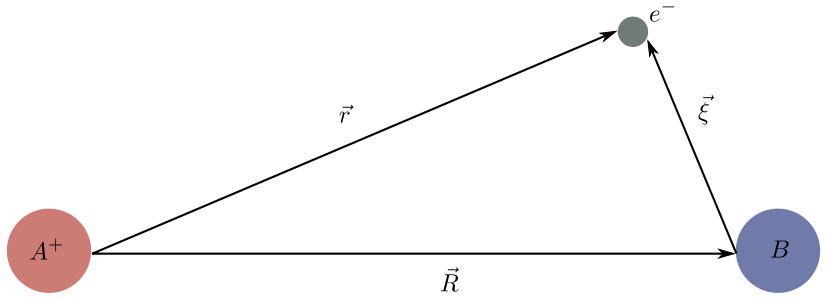
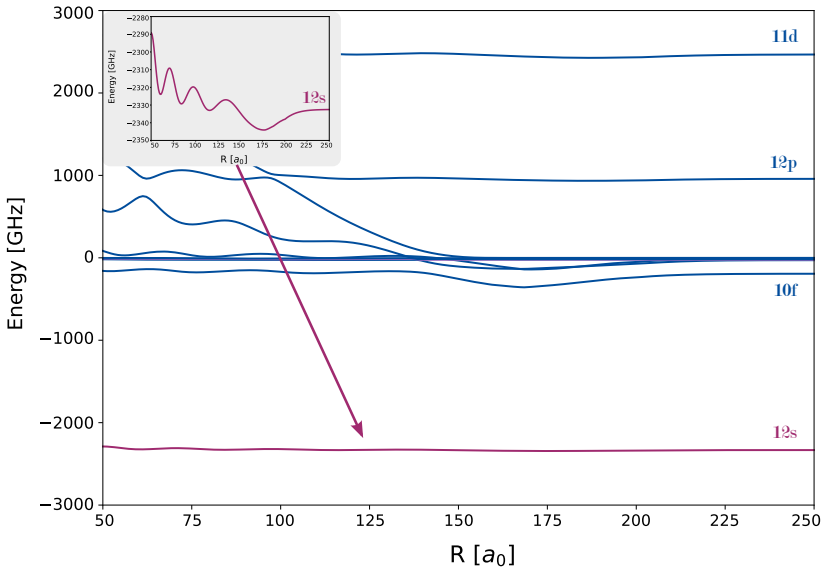
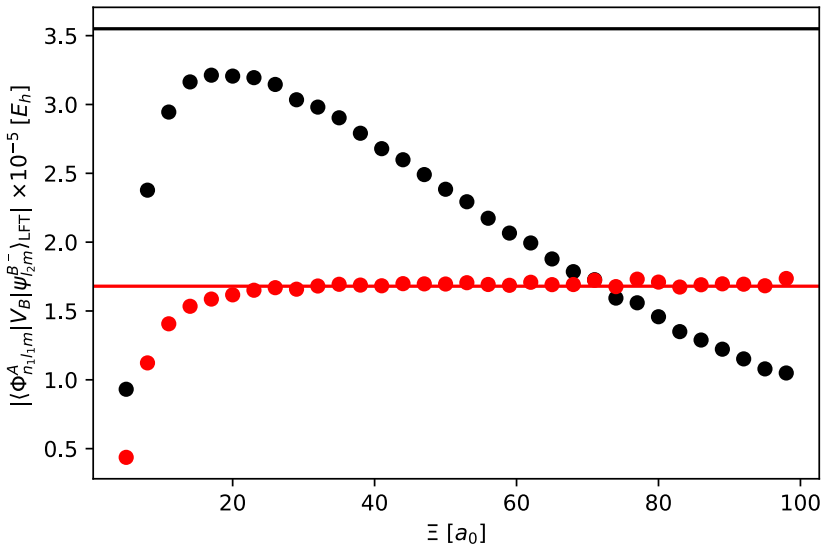
We calculated the electronic interaction associated with the exchange of an electron between an atom of calcium excited to a Rydberg state ($n\sim 10-15$) and another, neighbouring calcium atom in its ground state. In this range the Rydberg states have an energy that is comparable to the electron affinity of Ca, enabling resonant or near resonant charge transfer at large internuclear separations (200-700 $a_0$). We calculated the interaction strength while systematically and critically assessing the approximations made, and found it to be large, ranging from $10^{-5}$ $E_h$ (70 GHz) to $10^{-8}$ $E_h$. Charge transfer is thus expected to be efficient and to significantly affect the molecular dynamics at a range of internuclear distances where ultralong range Rydberg molecules also exist.
Editorial analysis
A structured set of objections, weighed in public.
Referee Report
Summary. The manuscript calculates the electronic interaction strength for resonant or near-resonant electron transfer between a calcium atom in a Rydberg state (n ≈ 10–15) and a ground-state calcium atom at large internuclear separations (200–700 a0). After assessing the approximations used, the authors report interaction strengths ranging from 10^{-5} E_h (≈70 GHz) to 10^{-8} E_h and conclude that charge transfer is efficient and will significantly affect molecular dynamics in the same distance regime where ultralong-range Rydberg molecules form.
Significance. If the reported coupling values are reliable, the work identifies a charge-transfer channel that can compete with ultralong-range Rydberg-molecule formation in calcium systems. This would be relevant for interpreting spectra and dynamics in cold Rydberg gases and for designing experiments that exploit or avoid such processes at large R.
major comments (2)
- [Abstract] Abstract: the claim that approximations were 'systematically and critically assessed' is not supported by explicit derivation steps, error estimates, or benchmark comparisons in the text. Without these, the central numerical result (10^{-5}–10^{-8} E_h) cannot be independently verified.
- [Results (distance dependence)] Results section on R = 200 a0: the large-R asymptotic treatment of the charge-transfer coupling is applied at distances comparable to the Rydberg orbital size (⟨r⟩ ≈ n² a0 ≈ 100 a0 for n ≈ 10). Standard first-order or asymptotic overlap approximations become unreliable in this marginal-overlap regime; the reported 10^{-5} E_h value at the short end of the interval may therefore be overestimated, weakening the assertion that transfer remains efficient across the entire 200–700 a0 range.
minor comments (2)
- [Methods/Results] The manuscript should include a table or figure explicitly comparing the calculated couplings to any available limiting-case analytic expressions or to results from alternative methods (e.g., full two-center molecular-orbital calculations at selected R).
- [Notation and units] Notation: define E_h and the precise Rydberg principal quantum numbers used for each plotted or tabulated point to avoid ambiguity when readers compare to other Ca Rydberg literature.
Simulated Author's Rebuttal
We thank the referee for their careful reading and constructive comments on our manuscript. We address each major comment point by point below, indicating the revisions we will implement.
read point-by-point responses
-
Referee: [Abstract] Abstract: the claim that approximations were 'systematically and critically assessed' is not supported by explicit derivation steps, error estimates, or benchmark comparisons in the text. Without these, the central numerical result (10^{-5}–10^{-8} E_h) cannot be independently verified.
Authors: We agree that the abstract phrasing would benefit from stronger support in the main text. While the methods and results sections discuss the approximations employed, we will add a dedicated subsection providing explicit derivation steps for the asymptotic coupling, quantitative error estimates from neglected higher-order terms, and benchmark comparisons to numerical two-center calculations for representative n values. These additions will enable independent verification of the reported interaction strengths. revision: yes
-
Referee: [Results (distance dependence)] Results section on R = 200 a0: the large-R asymptotic treatment of the charge-transfer coupling is applied at distances comparable to the Rydberg orbital size (⟨r⟩ ≈ n² a0 ≈ 100 a0 for n ≈ 10). Standard first-order or asymptotic overlap approximations become unreliable in this marginal-overlap regime; the reported 10^{-5} E_h value at the short end of the interval may therefore be overestimated, weakening the assertion that transfer remains efficient across the entire 200–700 a0 range.
Authors: This is a valid point; R = 200 a0 lies near the boundary of the large-R regime. We will expand the discussion to quantify the approximation's accuracy via estimates of higher-order corrections and limited exact calculations at selected points. We will revise the text to note that the 200 a0 value may be overestimated by a factor of ~2, while remaining on the order of 10^{-5} E_h and thus indicative of efficient transfer. The distance range will be retained but with explicit caveats on validity at the lower end; the conclusion that charge transfer competes with ultralong-range molecule formation is unaffected. revision: partial
Circularity Check
No circularity; derivation rests on standard atomic-physics methods without self-referential reduction.
full rationale
The paper reports a direct theoretical computation of the electron-transfer interaction strength for Ca Rydberg-ground state pairs at large R, with the result stated as a computed numerical range after critical assessment of approximations. No equations, fitted parameters, or self-citations are shown that would make the quoted interaction values (10^{-5} to 10^{-8} E_h) reduce to an input by construction, nor is any uniqueness theorem or ansatz imported from prior author work. The derivation chain is therefore self-contained against external benchmarks of quantum chemistry or perturbation theory for resonant charge exchange.
Axiom & Free-Parameter Ledger
axioms (2)
- domain assumption Rydberg states (n~10-15) have energies comparable to the electron affinity of ground-state Ca
- domain assumption Standard approximations for electronic interaction at large internuclear distance remain valid
Reference graph
Works this paper leans on
-
[1]
Mollet and F
S. Mollet and F. Merkt, Physical Review A82(3), 032510 (2010)
2010
-
[2]
Beyer and F
M. Beyer and F. Merkt, The Journal of Chemical Physics149(3), 031102 (2018)
2018
-
[3]
Peper and J
M. Peper and J. Deiglmayr, Journal of Physics B: Atomic, Molecular and Optical Physics 53(6), 064001 (2020)
2020
-
[4]
Hummel, P
F. Hummel, P. Schmelcher, H. Ott and H.R. Sadeghpour, New Journal of Physics22(6), 063060 (2020)
2020
-
[5]
Bogot, M
A. Bogot, M. Poline, M. Ji, A. Dochain, A. Simonsson, S. Ros´ en, H. Zettergren, H.T. Schmidt, R.D. Thomas and D. Strasser, Science383(6680), 285–289 (2024)
2024
-
[6]
Poline, A
M. Poline, A. Dochain, S. Ros´ en, M. Ji, P. Reinhed, A. Simonsson, M. Larsson, H.T. Schmidt, H. Zettergren, R.D. Thomas, S.G. Ard, N.S. Shuman and A.A. Viggiano, Phys- ical Review Letters132(2), 023001 (2024)
2024
-
[7]
Poline, A
M. Poline, A. Dochain, S. Ros´ en, M. Ji, H. Cederquist, H. Zettergren, H.T. Schmidt, M. Larsson, S.G. Ard, N.S. Shuman, A.A. Viggiano and R.D. Thomas, Nature Communica- tions16(1), 8528 (2025)
2025
-
[8]
M¨ ull, F
D. M¨ ull, F. Grussie, K. Blaum, S. George, J. G¨ ock, M. Grieser, R. Von Hahn, Z. Harman, ´A. K´ alosi, C.H. Keitel, C. Krantz, C. Lyu, O. Novotn´ y, F. Nuesslein, D. Paul, V.C. Schmidt, S. Singh, S. Sunil Kumar, X. Urbain, A. Wolf and H. Kreckel, Physical Review A104(3), 032811 (2021)
2021
-
[9]
Petrunin, H.H
V.V. Petrunin, H.H. Andersen, P. Balling and T. Andersen, Physical Review Letters76 (5), 744–747 (1996)
1996
-
[10]
McLaughlin and D.W
K.W. McLaughlin and D.W. Duquette, Phys. Rev. Lett.72(8), 1176–1179 (1994)
1994
-
[11]
Reicherts, T
M. Reicherts, T. Roth, A. Gopalan, M.W. Ruf, H. Hotop, C. Desfran¸ cois and I.I. Fab- rikant, Europhys. Lett.40(2), 129–134 (1997)
1997
-
[12]
Fabrikant and M.I
I.I. Fabrikant and M.I. Chibisov, Phys. Rev. A61(2), 022718 (2000)
2000
-
[13]
Lorensen, H.V
H.Q. Lorensen, H.V. Parks, E.M. Spain, J.E. Smedley, C.H. Greene and S.R. Leone, Phys. Rev. A54(2), 1577–1585 (1996)
1996
-
[14]
Eiles and C.H
M.T. Eiles and C.H. Greene, Physical Review Letters115(19), 193201 (2015)
2015
-
[15]
Markson and H.R
S. Markson and H.R. Sadeghpour, Journal of Physics B: Atomic, Molecular and Optical Physics49(11), 114006 (2016)
2016
-
[16]
Kirrander, S
A. Kirrander, S. Rittenhouse, M. Ascoli, E.E. Eyler, P.L. Gould and H.R. Sadeghpour, Physical Review A87(3), 031402 (2013)
2013
-
[17]
Giannakeas, M.T
P. Giannakeas, M.T. Eiles, F. Robicheaux and J.M. Rost, Physical Review A102(3), 033315 (2020)
2020
-
[18]
C. Fey, F. Hummel and P. Schmelcher, Molecular Physics118(2), e1679401 (2020)
2020
-
[19]
Eiles, Journal of Physics B: Atomic, Molecular and Optical Physics52(11), 113001 (2019)
M.T. Eiles, Journal of Physics B: Atomic, Molecular and Optical Physics52(11), 113001 (2019)
2019
-
[20]
Omont, Journal de Physique38(11), 1343–1359 (1977)
A. Omont, Journal de Physique38(11), 1343–1359 (1977)
1977
-
[21]
Aymar, C.H
M. Aymar, C.H. Greene and E. Luc-Koenig, Reviews of Modern Physics68(4), 1015–1123 (1996)
1996
-
[22]
A. Dochain, Systematic Study of Mutual Neutralization Reactions between Atomic Species Using the Merged Beam Method and an Asymptotic Model|DIAL.Pr - BO- REAL https://dial.uclouvain.be/pr/boreal/object/boreal:263451
-
[23]
Poline, X
M. Poline, X. Yuan, S. Badin, M. Ji, S. Ros´ en, S. Indrajith, R.D. Thomas, H.T. Schmidt, H. Zettergren, A.S.P. Gomes and N. Sisourat, Physical Review A106(1), 012812 (2022)
2022
-
[24]
Greene, A.S
C.H. Greene, A.S. Dickinson and H.R. Sadeghpour, Physical Review Letters85(12), 15 2458–2461 (2000)
2000
-
[25]
Bendkowsky, B
V. Bendkowsky, B. Butscher, J. Nipper, J.P. Shaffer, R. L¨ ow and T. Pfau, Nature458 (7241), 1005–1008 (2009)
2009
-
[26]
Yuan and Z
J. Yuan and Z. Zhang, Physical Review A42(9), 5363–5373 (1990)
1990
-
[27]
Kramida and Y
A. Kramida and Y. Ralchenko, NIST Atomic Spectra Database, NIST Standard Reference Database 78 National Institute of Standards and Technology 1999
1999
-
[28]
Peper and J
M. Peper and J. Deiglmayr, Physical Review Letters126(1), 013001 (2021)
2021
-
[29]
DeSalvo, J.A
B.J. DeSalvo, J.A. Aman, F.B. Dunning, T.C. Killian, H.R. Sadeghpour, S. Yoshida and J. Burgd¨ orfer, Physical Review A92(3), 031403 (2015)
2015
-
[30]
Booth, S.T
D. Booth, S.T. Rittenhouse, J. Yang, H.R. Sadeghpour and J.P. Shaffer, Science348 (6230), 99–102 (2015)
2015
-
[31]
Mitroy and J.Y
J. Mitroy and J.Y. Zhang, The Journal of Chemical Physics128(13), 134305 (2008)
2008
-
[32]
Rescigno and C.W
T.N. Rescigno and C.W. McCurdy, Physical Review A62(3), 032706 (2000)
2000
-
[33]
G´ en´ evriez, D
M. G´ en´ evriez, D. Wehrli and F. Merkt, Physical Review A100(3), 032517 (2019)
2019
-
[34]
Dzuba and G.F
V.A. Dzuba and G.F. Gribakin, Physical Review A55(3), 2443–2446 (1997)
1997
-
[35]
Barklem, Physical Review A104(6), 062806 (2021)
P.S. Barklem, Physical Review A104(6), 062806 (2021)
2021
-
[36]
Robicheaux, P
F. Robicheaux, P. Giannakeas and C.H. Greene, Physical Review A92(2), 022711 (2015)
2015
-
[37]
Janev and A
R.K. Janev and A. Salin, Journal of Physics B: Atomic and Molecular Physics5(2), 177–183 (1972)
1972
-
[38]
Giannakeas, C.H
P. Giannakeas, C.H. Greene and F. Robicheaux, Physical Review A94(1), 013419 (2016)
2016
-
[39]
DLMF: Chapter 10 Bessel Functions https://dlmf.nist.gov/10
-
[40]
Virtanen, R
P. Virtanen, R. Gommers, T.E. Oliphantet al., Nature Methods17(3), 261–272 (2020)
2020
-
[41]
Fabrikant, Physical Review A48(5), R3411–R3413 (1993)
I.I. Fabrikant, Physical Review A48(5), R3411–R3413 (1993)
1993
-
[42]
Desfran¸ cois, Physical Review A51(5), 3667–3675 (1995)
C. Desfran¸ cois, Physical Review A51(5), 3667–3675 (1995)
1995
-
[43]
Dochain, V.M
A. Dochain, V.M. Andrianarijaona and X. Urbain, Physical Review A108(4), 042809 (2023)
2023
-
[44]
Ning and Y
C. Ning and Y. Lu, Journal of Physical and Chemical Reference Data51(2), 021502 (2022). 16
2022
discussion (0)
Sign in with ORCID, Apple, or X to comment. Anyone can read and Pith papers without signing in.