Recognition: unknown
Real-time Krylov Diagonalisation for Open Quantum Systems
Pith reviewed 2026-05-14 21:09 UTC · model grok-4.3
The pith
Real-time Krylov subspace methods adapt to Lindblad dynamics to estimate the Liouvillian gap in Kerr Cat qubits.
A machine-rendered reading of the paper's core claim, the machinery that carries it, and where it could break.
Core claim
Real-time quantum Krylov subspace methods can be adapted to investigate open quantum systems described by the Lindblad formalism. Applied to a two-photon-driven superconducting Kerr resonator, the method constructs a subspace from real-time Lindblad evolution and uses it to estimate the Liouvillian gap within the Kerr Cat qubit regime.
What carries the argument
The real-time Krylov subspace generated from Lindblad evolution trajectories, which approximates the spectrum of the non-Hermitian Liouvillian superoperator.
If this is right
- The approach yields the Liouvillian gap without computing the full spectrum of large non-Hermitian operators.
- It enables gap estimation for open-system sizes where exact methods become intractable.
- The gap value directly informs the relaxation timescale and steady-state fidelity in cat-qubit encodings.
- The same subspace construction can supply approximate eigenvectors for further open-system observables.
Where Pith is reading between the lines
- The technique may extend to other non-Hermitian generators such as those appearing in non-Markovian master equations.
- Hybrid quantum-classical implementations could use short-time quantum evolution to build the subspace on hardware.
- Error bounds on the gap estimate could be derived by monitoring subspace convergence with increasing Krylov dimension.
Load-bearing premise
The Krylov subspace built from real-time Lindblad evolution remains accurate and efficient for non-Hermitian dynamics without needing prohibitive dimensions or uncontrolled approximations.
What would settle it
Exact diagonalization of the Liouvillian on a small instance of the Kerr resonator model, followed by direct numerical comparison of the gap value to the Krylov estimate; a large discrepancy would show the subspace fails to capture the spectrum.
Figures

read the original abstract
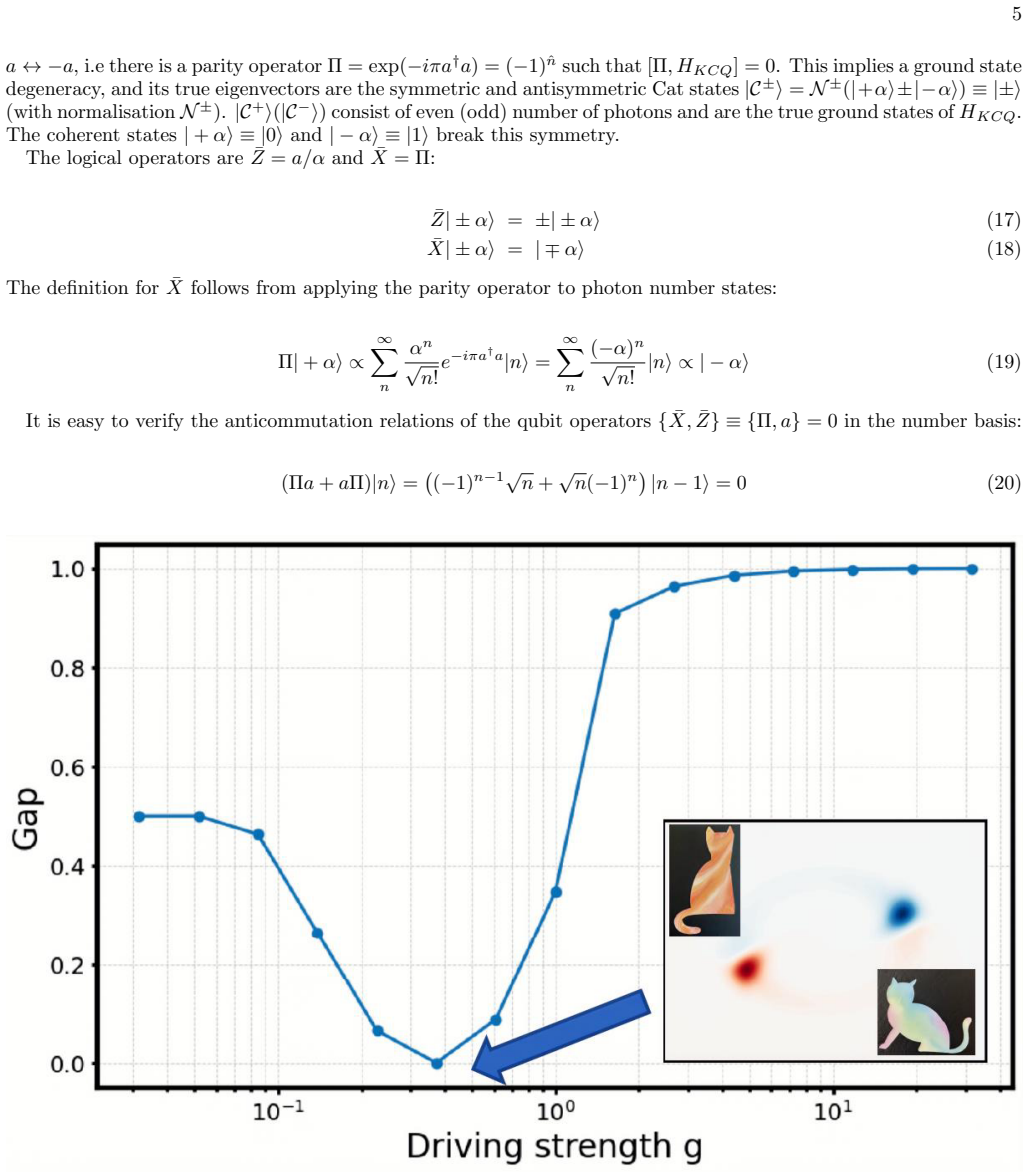
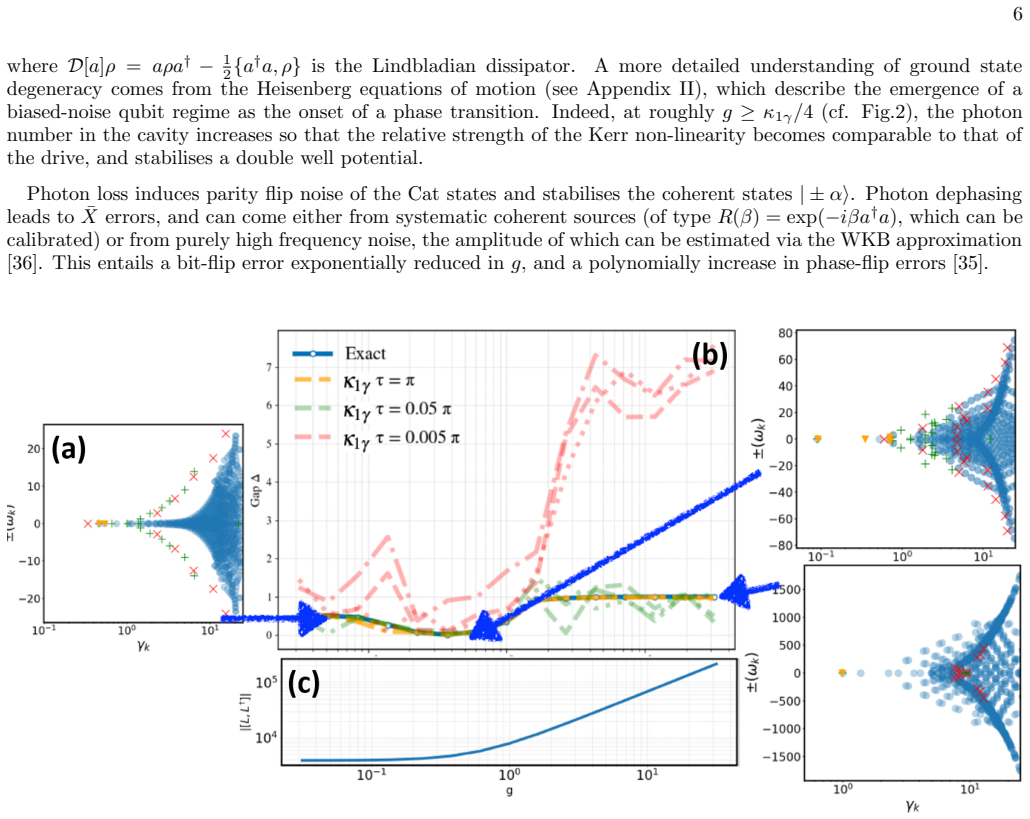
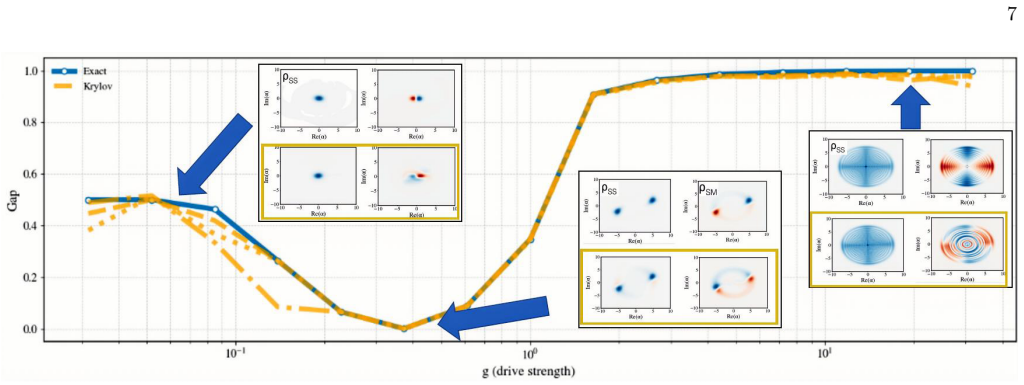
In this chapter, we demonstrate how real-time quantum Krylov subspace methods can be adapted to investigate open quantum systems described by the Lindblad formalism. We apply these methods to a two-photon-driven superconducting Kerr resonator and illustrate their use in estimating the Liouvillian gap within the Kerr Cat qubit regime. This is based on work done between November 2025 and January 2026 and on the talk given in early February 2026 at the Kwekfest 2026 conference, to celebrate L.C. Kwek's lifetime achievements.
Editorial analysis
A structured set of objections, weighed in public.
Referee Report
Summary. The manuscript demonstrates an adaptation of real-time quantum Krylov subspace methods to open quantum systems governed by the Lindblad master equation. It applies the approach to a two-photon-driven superconducting Kerr resonator and uses it to estimate the Liouvillian gap in the Kerr cat qubit regime.
Significance. If validated with sufficient accuracy and efficiency, the method could provide a practical route to extracting low-lying spectral information from non-Hermitian Liouvillians without full diagonalization. This is relevant for quantifying relaxation rates and bit-flip error suppression in driven-dissipative superconducting circuits such as cat qubits.
major comments (2)
- [Method adaptation section] The section describing the Krylov subspace construction does not supply explicit equations for the real-time propagation under the Lindblad superoperator or the subsequent projection onto the non-Hermitian subspace; without these, it is impossible to verify that the adaptation preserves the essential spectral properties of the Liouvillian.
- [Results / Kerr cat application] No convergence data, subspace-dimension scaling, or comparison against exact diagonalization (even for small Hilbert-space truncations) is presented for the Kerr resonator example; this leaves the central claim that the subspace remains accurate and tractable for non-Hermitian dynamics unsupported.
minor comments (2)
- [Abstract] The abstract opens with 'In this chapter,' which is inconsistent with a standalone journal article; revise to 'In this work' or equivalent.
- [Introduction] The manuscript should include at least one reference to established real-time Krylov techniques for closed systems and to existing Lindblad diagonalization methods to clarify the incremental contribution.
Simulated Author's Rebuttal
We thank the referee for their detailed review and constructive suggestions. We address each major comment below and will revise the manuscript accordingly.
read point-by-point responses
-
Referee: [Method adaptation section] The section describing the Krylov subspace construction does not supply explicit equations for the real-time propagation under the Lindblad superoperator or the subsequent projection onto the non-Hermitian subspace; without these, it is impossible to verify that the adaptation preserves the essential spectral properties of the Liouvillian.
Authors: We agree that explicit equations are essential for reproducibility and verification. In the revised manuscript, we will expand the method section to include the explicit form of the real-time evolution operator under the Lindblad superoperator L, given by the Krylov approximation |ψ(t)⟩ ≈ V exp(t H_K) V† |ψ0⟩ where H_K is the projected non-Hermitian matrix. We will also detail the Arnoldi iteration adapted for the non-Hermitian case to ensure the spectral properties of the Liouvillian are preserved. revision: yes
-
Referee: [Results / Kerr cat application] No convergence data, subspace-dimension scaling, or comparison against exact diagonalization (even for small Hilbert-space truncations) is presented for the Kerr resonator example; this leaves the central claim that the subspace remains accurate and tractable for non-Hermitian dynamics unsupported.
Authors: We acknowledge the lack of supporting numerical validation in the current version. For the revised manuscript, we will add figures showing the convergence of the estimated Liouvillian gap with increasing Krylov subspace dimension for the two-photon-driven Kerr resonator. Additionally, we will include comparisons with exact diagonalization results for small system sizes (e.g., truncated to 4-8 levels) to demonstrate accuracy in the cat qubit regime. revision: yes
Circularity Check
No significant circularity detected
full rationale
The manuscript describes an adaptation of real-time quantum Krylov subspace methods to Lindblad open-system dynamics, with application to estimating the Liouvillian gap in a Kerr-cat qubit. No equations, parameter-fitting procedures, or derivation steps are exhibited that reduce any claimed prediction or result to a fitted input, self-definition, or self-citation chain by construction. The central contribution is presented as a methodological demonstration whose validity rests on external numerical or experimental benchmarks rather than internal redefinition of quantities.
Axiom & Free-Parameter Ledger
Reference graph
Works this paper leans on
-
[1]
Shor’s algorithm is possible with as few as 10,000 reconfigurable atomic qubits (2026)
Cain, M., et al. “Shor’s algorithm is possible with as few as 10,000 reconfigurable atomic qubits (2026).” arXiv preprint arXiv:2603.28627
-
[2]
Exponential quantum advantage in processing massive classical data
Zhao, Haimeng, et al. “Exponential quantum advantage in processing massive classical data.” arXiv preprint arXiv:2604.07639 (2026)
work page internal anchor Pith review Pith/arXiv arXiv 2026
-
[3]
Accelerating computational materials discovery with machine learning and cloud high-performance computing: from large-scale screening to experimental validation
Chen, Chi, et al. “Accelerating computational materials discovery with machine learning and cloud high-performance computing: from large-scale screening to experimental validation.” Journal of the American Chemical Society 146.29 (2024): 20009-20018
2024
-
[4]
Deep learning in mechanical metamaterials: from prediction and generation to inverse design
Zheng, Xiaoyang, et al. “Deep learning in mechanical metamaterials: from prediction and generation to inverse design.” Advanced Materials 35.45 (2023): 2302530
2023
-
[5]
Accelerating chip design with machine learning
Khailany, Brucek. “Accelerating chip design with machine learning.” Proceedings of the 2020 ACM/IEEE Workshop on Machine Learning for CAD. 2020
2020
-
[6]
Microsoft’s quantum chip leaves some physicists sceptical
Castelvecchi, Davide. “Microsoft’s quantum chip leaves some physicists sceptical.” (2025): 872-872
2025
-
[7]
New directions in the pursuit of Majorana fermions in solid state systems
Alicea, Jason. “New directions in the pursuit of Majorana fermions in solid state systems.” Reports on progress in physics 75.7 (2012): 076501
2012
-
[8]
Search for Majorana fermions in superconductors
Beenakker, Carlo WJ. “Search for Majorana fermions in superconductors.” Annu. Rev. Condens. Matter Phys. 4.1 (2013): 113-136
2013
-
[9]
Designing quantum technologies with a quantum computer
Naranjo, Juan, et al. “Designing quantum technologies with a quantum computer.” arXiv preprint arXiv:2601.22091 (2026)
-
[10]
High-threshold and low-overhead fault-tolerant quantum memory
Bravyi, Sergey, et al. “High-threshold and low-overhead fault-tolerant quantum memory.” Nature 627.8005 (2024): 778-782
2024
-
[11]
Quantum error correction below the surface code threshold
Google AI, “Quantum error correction below the surface code threshold.” Nature 638, no. 8052 (2025): 920-926
2025
-
[12]
Disentangling hype from practicality: On realistically achieving quantum advantage
Hoefler, Torsten, Thomas H¨ aner, and Matthias Troyer. “Disentangling hype from practicality: On realistically achieving quantum advantage.” Communications of the ACM 66.5 (2023): 82-87
2023
-
[13]
Classical solution of the FeMo-cofactor model to chemical accuracy and its implications
Zhai, Huanchen, et al. “Classical solution of the FeMo-cofactor model to chemical accuracy and its implications.” arXiv preprint arXiv:2601.04621 (2026). 8
-
[14]
Hamiltonian simulation by qubitization
Low, Guang Hao, and Isaac L. Chuang. “Hamiltonian simulation by qubitization.” Quantum 3 (2019): 163
2019
-
[15]
Fault-tolerant quantum simulations of chemistry in first quantization
Su, Yuan, et al. “Fault-tolerant quantum simulations of chemistry in first quantization.” PRX Quantum 2.4 (2021): 040332
2021
-
[16]
Quantum Krylov subspace algorithms for ground-and excited-state energy estimation
Cortes, Cristian L., and Stephen K. Gray. “Quantum Krylov subspace algorithms for ground-and excited-state energy estimation.” Physical Review A 105.2 (2022): 022417
2022
-
[17]
A non-orthogonal variational quantum eigensolver
Huggins, William J., et al. “A non-orthogonal variational quantum eigensolver.” New Journal of Physics 22.7 (2020): 073009
2020
-
[18]
Real-time evolution for ultracompact Hamiltonian eigenstates on quantum hardware
Klymko, Katherine, et al. “Real-time evolution for ultracompact Hamiltonian eigenstates on quantum hardware.” PRX Quantum 3.2 (2022): 020323
2022
-
[19]
Exact and efficient Lanczos method on a quantum computer
Kirby, William, Mario Motta, and Antonio Mezzacapo.“Exact and efficient Lanczos method on a quantum computer.” Quantum 7 (2023): 1018
2023
-
[20]
Subspace methods for electronic structure simulations on quantum computers
Motta, Mario, et al. “Subspace methods for electronic structure simulations on quantum computers.” Electronic Structure 6.1 (2024): 013001
2024
-
[21]
A theory of quantum subspace diagonalization
Epperly, Ethan N., Lin Lin, and Yuji Nakatsukasa. “A theory of quantum subspace diagonalization.” SIAM Journal on Matrix Analysis and Applications 43.3 (2022): 1263-1290
2022
-
[22]
Analysis of quantum Krylov algorithms with errors
Kirby, William. “Analysis of quantum Krylov algorithms with errors.” Quantum 8 (2024): 1457
2024
-
[23]
Krylov diagonalization of large many-body Hamiltonians on a quantum processor
Yoshioka, Nobuyuki, et al. “Krylov diagonalization of large many-body Hamiltonians on a quantum processor.” Nature Communications 16.1 (2025): 5014
2025
-
[24]
Quantum-centric algorithm for sample-based krylov diagonalization
Yu, Jeffery, et al. “Quantum-centric algorithm for sample-based krylov diagonalization.” arXiv preprint arXiv:2501.09702 (2025)
-
[25]
Evaluating the evidence for exponential quantum advantage in ground-state quantum chemistry
Lee, Seunghoon, et al. “Evaluating the evidence for exponential quantum advantage in ground-state quantum chemistry.” Nature communications 14.1 (2023): 1952
2023
-
[26]
Sampling error analysis in quantum krylov subspace diagonalization
Lee, Gwonhak, Dongkeun Lee, and Joonsuk Huh. “Sampling error analysis in quantum krylov subspace diagonalization.” Quantum 8 (2024): 1477
2024
-
[27]
Nielsen, Michael A., and Isaac L. Chuang. Quantum computation and quantum information. Cambridge university press, 2010
2010
-
[28]
Numerical methods for large eigenvalue problems: revised edition
Saad, Yousef. Numerical methods for large eigenvalue problems: revised edition. Society for Industrial and Applied Math- ematics, 2011
2011
-
[29]
Spectral theory of Liouvillians for dissipative phase transitions
Minganti, Fabrizio, et al. “Spectral theory of Liouvillians for dissipative phase transitions.” Physical Review A 98.4 (2018): 042118
2018
-
[30]
Operator growth and Krylov construction in dissipative open quantum systems
Bhattacharya, Aranya, et al. “Operator growth and Krylov construction in dissipative open quantum systems.” Journal of High Energy Physics 2022.12 (2022): 1-31
2022
-
[31]
Krylov complexity in open quantum systems
Liu, Chang, Haifeng Tang, and Hui Zhai. “Krylov complexity in open quantum systems.” Physical Review Research 5.3 (2023): 033085
2023
-
[32]
Operator dynamics in Lindbladian SYK: a Krylov com- plexity perspective
Bhattacharjee, Budhaditya, Pratik Nandy, and Tanay Pathak. “Operator dynamics in Lindbladian SYK: a Krylov com- plexity perspective.” Journal of High Energy Physics 2024.1 (2024): 1-42
2024
-
[33]
Krylov Complexity for Open Quantum System: Dissipation and Decoherence
Bhattacharyya, Arpan, Sayed Gool, and S. Shajidul Haque. “Krylov complexity for open quantum system: dissipation and decoherence.” arXiv preprint arXiv:2509.14810 (2025)
work page internal anchor Pith review Pith/arXiv arXiv 2025
-
[34]
A quantum super-Krylov method for ground state energy estimation
Byrne, Adam, et al. “A quantum super-Krylov method for ground state energy estimation.” arXiv e-prints (2024): arXiv- 2412
2024
-
[35]
Dynamically protected cat-qubits: a new paradigm for universal quantum computation
Mirrahimi, Mazyar, et al. “Dynamically protected cat-qubits: a new paradigm for universal quantum computation.” New Journal of Physics 16.4 (2014): 045014
2014
-
[36]
A driven Kerr oscillator with two-fold degeneracies for qubit protection
Venkatraman, Jayameenakshi, et al. “A driven Kerr oscillator with two-fold degeneracies for qubit protection.” Proceedings of the National Academy of Sciences 121.24 (2024): e2311241121
2024
-
[37]
Stabilization and operation of a Kerr-cat qubit
Grimm, Alexander, et al. “Stabilization and operation of a Kerr-cat qubit.” Nature 584.7820 (2020): 205-209
2020
-
[38]
Quantum control of an oscillator with a Kerr-cat qubit
Ding, Andy Z., et al. “Quantum control of an oscillator with a Kerr-cat qubit.” Nature Communications 16.1 (2025): 5279
2025
-
[39]
Confining the state of light to a quantum manifold by engineered two-photon loss
Leghtas, Zaki, et al. “Confining the state of light to a quantum manifold by engineered two-photon loss.” Science 347.6224 (2015): 853-857
2015
-
[40]
Exponential suppression of bit-flips in a qubit encoded in an oscillator
Lescanne, Rapha¨ el, et al. “Exponential suppression of bit-flips in a qubit encoded in an oscillator.” Nature Physics 16.5 (2020): 509-513
2020
-
[41]
Real-time quantum error correction beyond break-even
Sivak, Volodymyr V., et al.“Real-time quantum error correction beyond break-even.” Nature 616.7955 (2023): 50-55
2023
-
[42]
Quantum critical regime in a quadratically driven nonlinear photonic lattice
Rota, Riccardo, et al. “Quantum critical regime in a quadratically driven nonlinear photonic lattice.” Physical review letters 122.11 (2019): 110405
2019
-
[43]
Driven-dissipative phase transition in a Kerr oscillator: From semiclassical PT symmetry to quantum fluctuations
Zhang, Xin HH, and Harold U. Baranger. “Driven-dissipative phase transition in a Kerr oscillator: From semiclassical PT symmetry to quantum fluctuations.” Physical Review A 103.3 (2021): 033711
2021
-
[44]
Observation of first-and second-order dissipative phase transitions in a two-photon driven Kerr resonator
Beaulieu, Guillaume, et al. “Observation of first-and second-order dissipative phase transitions in a two-photon driven Kerr resonator.” Nature communications 16.1 (2025): 1954
2025
-
[45]
Digital quantum simulation of open quantum systems using quantum imaginary–time evolution
Kamakari, Hirsh, et al. “Digital quantum simulation of open quantum systems using quantum imaginary–time evolution.” PRX quantum 3.1 (2022): 010320
2022
-
[46]
Variational quantum algorithm for unitary dilation
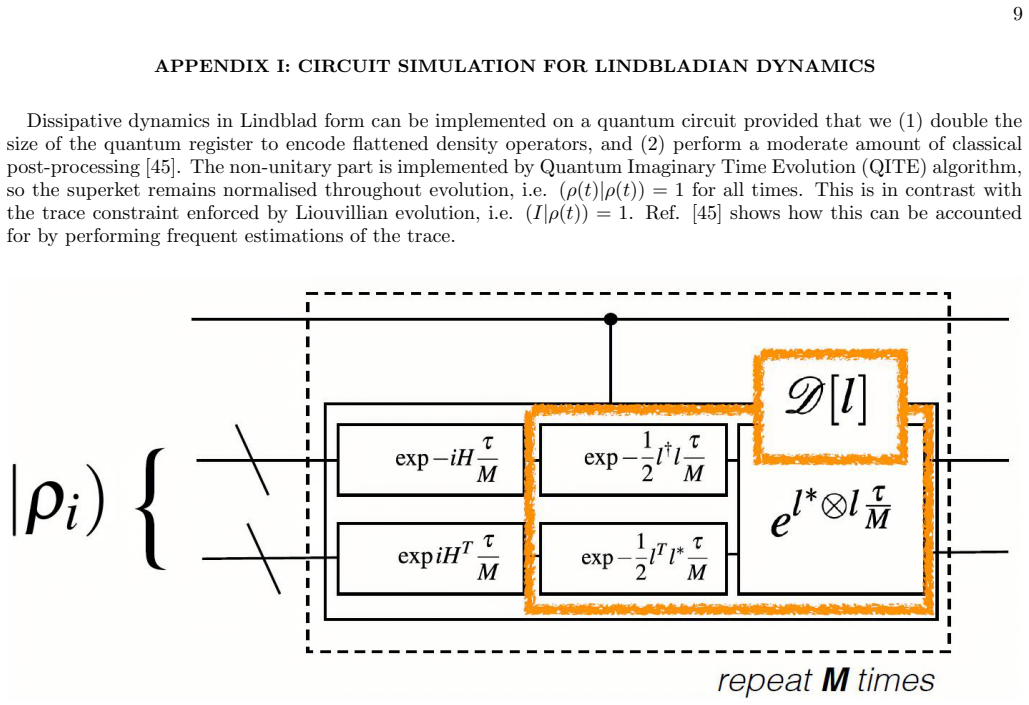
Li, S. X., et al. “Variational quantum algorithm for unitary dilation.” arXiv preprint arXiv:2510.19157 (2025). 9 APPENDIX I: CIRCUIT SIMULA TION FOR LINDBLADIAN DYNAMICS Dissipative dynamics in Lindblad form can be implemented on a quantum circuit provided that we (1) double the size of the quantum register to encode flattened density operators, and (2) ...
discussion (0)
Sign in with ORCID, Apple, or X to comment. Anyone can read and Pith papers without signing in.