pith. machine review for the scientific record. sign in

arxiv: 2605.03721 · v1 · submitted 2026-05-05 · 🌌 astro-ph.IM

Recognition: unknown

The First Look of Gaia: Daily data quality and instrument health assessment with automated early warnings

Authors on Pith no claims yet

Pith reviewed 2026-05-07 12:43 UTC · model grok-4.3

classification 🌌 astro-ph.IM
keywords Gaia missiondata quality monitoringastrometric solutioninstrument healthearly warningsDPACsatellite diagnostics
0
0 comments X

The pith

Gaia First Look delivers daily data quality monitoring and early warnings for the mission's instrument health.

A machine-rendered reading of the paper's core claim, the machinery that carries it, and where it could break.

The paper describes the Gaia First Look system, which was designed to monitor data quality throughout the Gaia mission's long operational period. It achieves this by running a limited internal astrometric solution each day, incorporating daily calibrations from the broader data processing consortium, and analyzing diagnostic data from the satellite. This approach allows detection of both immediate issues and gradual changes in performance. A sympathetic reader would care because consistent data quality is essential for the mission's goal of precise whole-sky astrometry over more than ten years, and early detection prevents larger problems from affecting the final catalog.

Core claim

The Gaia First Look implemented its own limited astrometric solution, and used the daily calibrations from other segments of the DPAC, as well as the diagnostic data from the satellite itself, in order to obtain a complete picture of the situation of the Gaia satellite on a daily basis. This led to a short-term health and data quality check, but also to a broader overview of the longer-term trends and evolutions within the payload. Potential issues were reported for further analysis and mitigation.

What carries the argument

The Gaia First Look (FL) system, which combines a limited astrometric solution with daily calibrations and satellite diagnostics to assess data quality and instrument health.

If this is right

  • Daily monitoring identifies short-term problems for immediate reporting to other DPAC groups.
  • Longer-term trends in payload performance are tracked over the mission duration.
  • Detrimental impacts on data quality are detected and ways to mitigate them are discussed and implemented.
  • Findings include individual effects and evolutions that occurred during operations.

Where Pith is reading between the lines

These are editorial extensions of the paper, not claims the author makes directly.

  • Such a system could help maintain data integrity in other long-duration space astronomy missions by providing routine health checks.
  • If the limited solution proves robust, it might reduce reliance on full daily reprocessing for initial quality flags.
  • Integration of diagnostic data with astrometric checks may reveal correlations between instrument states and measurement precision not visible in isolated analyses.

Load-bearing premise

A limited internal astrometric solution combined with existing daily calibrations and satellite diagnostics is sufficient to detect and correctly interpret both short-term problems and longer-term trends in data quality.

What would settle it

Discovery of a significant data quality issue or instrument anomaly during the mission that the First Look system did not flag in its daily assessments but was identified through other means.

Figures
Figures reproduced from arXiv: 2605.03721 by A. Abreu Aramburu, A. Mora, A. Sagrista Selles, C. Crowley, E. Fernandez del Peloso, E. Serpell, J. Mart\'in-Fleitas, M. Altmann, M. Biermann, M. Davidson, M. Hauser, N. Rowell, S. Jordan, T. Br\"usemeister, U. Bastian, U. Stampa, W. L\"offler, Z. Balog.

Figure 1
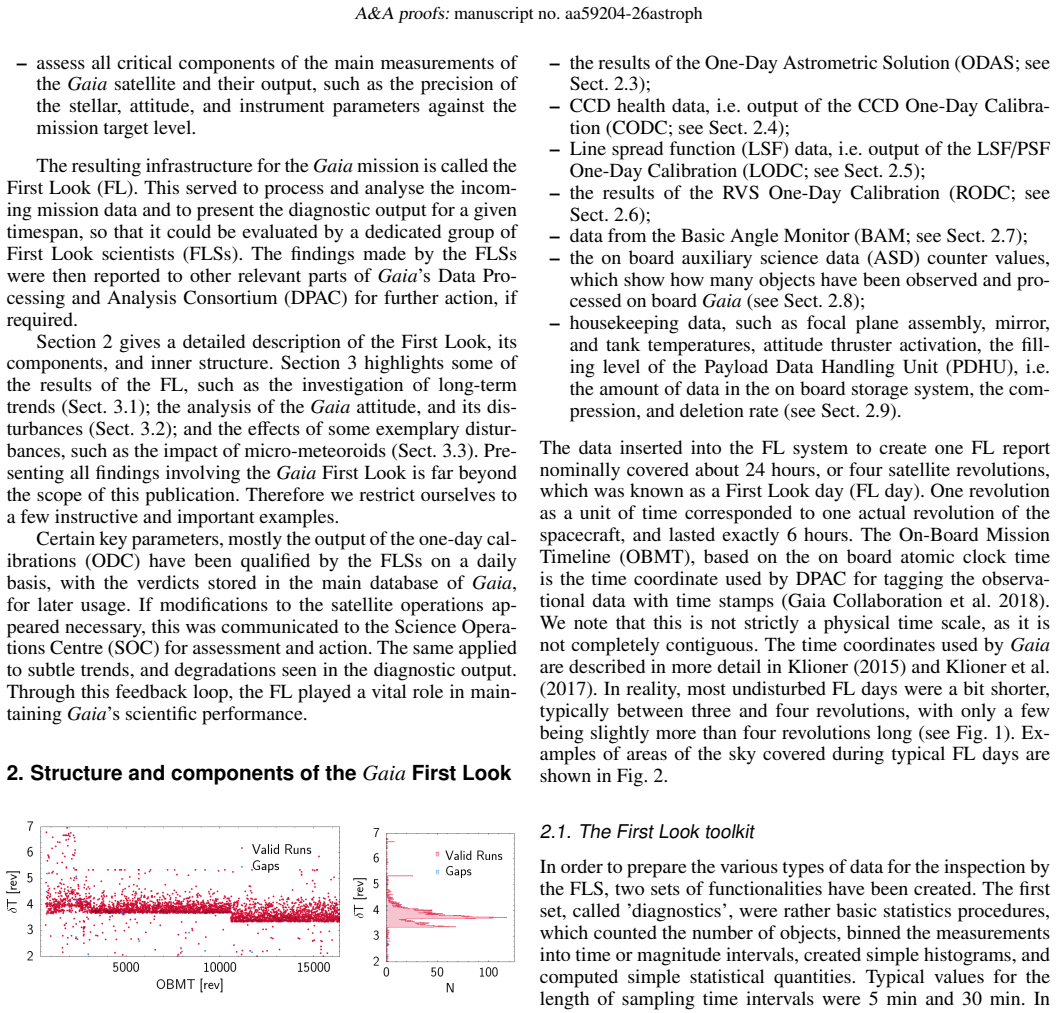
Figure 1. Figure 1: Length of the First Look days over the entire mission. δT is the length of each FL day, i.e. the timespan covered by each FL run, given in units of revolution. The left panel shows the evolution over time, while the right panel shows the corresponding histogram, which highlights the overall distribution of the FL day lengths. Valid FL runs, i.e. those that have real data in them, are shown in red, while ga… view at source ↗
Figure 2
Figure 2. Figure 2: Sky coverage (given in equatorial coordinates) of two FL days spaced about one month apart. The blue pattern is the complete Gaia sky coverage starting at OBMT=10,000 rev to the end of operations (OBMT=16,385.671 rev), the red track represents a FL day that lasted from January 4 to 5, 2023, and the orange track another day, between February 4 and 5, 2023. In this plot the trace for just the first telescope… view at source ↗
Figure 3
Figure 3. Figure 3: Data flow diagram of the FL-system. SR#1 to SR#n indicate the IDT subruns (see Sect. 2.2) results of these diagnostics were then piped into tasks belonging to the second set, i.e. the ’analyses’. These were more sophisti￾cated and elaborate procedures, presenting a more physical un￾derstanding of the results. Again, typical outputs were tables, graphs, and histogram plots. In order to give access to longer… view at source ↗
Figure 4
Figure 4. Figure 4: Samples of the BAM fringe pattern. The upper panel shows FoV1, the lower panel FoV2 view at source ↗
Figure 5
Figure 5. Figure 5: Six-hour periodic oscillations of the Basic Angle. Shown are the data for one arbitrarily chosen FL day, which does not show any anomalies. The red points denote the AL fringe phase of FoV1 and the blue points FoV2. The combined values, i.e. the total BA variations are shown in violet. We note that the absolute values are shifted by the amount indicated in the legend in order to fit them in the same plot s… view at source ↗
Figure 6
Figure 6. Figure 6: Count rates for detected objects and objects confirmed for astrometric observations of the two FL days shown in view at source ↗
Figure 7
Figure 7. Figure 7: Gaia Prompt particle event count rates during a larger solar outburst, which took place on October 30 and 31, 2021. The combined FoV1 count rates are shown in red and those for FoV2 in blue. We note that in order to avoid overlap the FoV2 values have been shifted by 200,000 counts. The grey horizontal line indicates the PPE count rate level without the disturbance (with respect to FoV1 in this plot), i.e. … view at source ↗
Figure 8
Figure 8. Figure 8: Temperatures of the propellant after OBMT=8000 rev. The upper panel shows the fuel temperatures and the lower one the oxidiser values. For each propellant component there are five thermistor type sensors, three in the upper half and two in the lower half of each tank. The significant events listed in view at source ↗
Figure 9
Figure 9. Figure 9: Temperatures of the focal plane array. Shown are the readings of the thermistors closest to the AF (red points), SM (blue), and RVS (green) parts of the FPA. As in the previous figures, the significant events listed in view at source ↗
Figure 10
Figure 10. Figure 10: Temperatures of the focal plane array during the safe-mode events of 2017 and 2018. Shown are the readings of the thermistors closest to the AF (in red), SM (in blue), and RVS (in green) parts of the FPA. The values corresponding to the 2017 safe-mode are depicted as open circles in darker colours, while the 2018 data are shown as smaller dots in lighter colours. The OBMT had been shifted for both events … view at source ↗
Figure 11
Figure 11. Figure 11: Evolution of the Cramér-Rao lower bound (CRLB) during the mission. The upper panel shows the complete mission from 2014 to early 2025. As in the previous figures, the significant events listed in view at source ↗
Figure 12
Figure 12. Figure 12: Behaviour of the Cramér-Rao lower bound (CRLB) during a safe mode (upper panel) and a refocusing (lower panel). The time and duration of the are indicated respectively by the shaded area and the vertical line. In both plots the number of observed sources of Window Class 2 (binned to 1 rev) are also shown in the system could be followed, and potential issues identified long before the data was even touched… view at source ↗
Figure 13
Figure 13. Figure 13: Zeroth order along-scan parameter of the astrometric large-scale calibration. The upper panel shows the complete mission, while the lower plot depicts the quiet phase, after OBMT=8200 rev. FoV1 is shown in red and FoV2 in blue. As in the previous figures, the significant events listed in view at source ↗
Figure 14
Figure 14. Figure 14: Zeroth-order along-scan parameter of the astrometric large￾scale calibration during a safe mode (upper panel) and a refocusing (lower panel). The time and duration are indicated respectively by the shaded area and the vertical line. FoV1 is shown in red and FoV2 in blue. The values have been shifted by ±530 mas (upper panel) and ±516 mas (lower panel) for better visibility. no event-related evolution afte… view at source ↗
Figure 15
Figure 15. Figure 15: Evolution of the focal length of Gaia as determined by ODAS. Shown is the fractional change of the focal length with respect to the nominal value. FoV1 is represented by red data points, FoV2 by blue dots. As in the previous figures, the significant events listed in view at source ↗
Figure 16
Figure 16. Figure 16: Behaviour of the focal length of Gaia as determined by ODAS during a safe mode (upper panel) and a refocusing (lower panel). Shown is the fractional change of the focal length with respect to the nominal value. The time and duration are indicated respectively by the shaded area and the vertical line. FoV1 is represented by red data points, FoV2 by blue dots. individual values. Like in the case of the foca… view at source ↗
Figure 17
Figure 17. Figure 17: Long-term evolution of the Gaia Basic Angle as determined by ODAS. The values derived by the different window classes are represented by different colours. As in the previous figures, the significant events listed in view at source ↗
Figure 18
Figure 18. Figure 18: 2D histogram of the along-scan astrometric residuals of the ODAS primary sources between OBMT=8000 rev and 14400 rev. Shown is FoV1. The upper panel shows a range of ±3 mas, while the middle panel is a zoom-in on the ϵη (vertical) direction. The median and ±1 − σ contour lines are shown in light green in the middle panel, while only the median contour is depicted in the upper plot for reasons of clarity. … view at source ↗
Figure 19
Figure 19. Figure 19: Long-term evolution of the Gaia Basic Angle as measured by the Basic Angle Monitor. The measurements shown in this plot have been averaged over one FL day. As in the previous figures, the significant events listed in view at source ↗
Figure 21
Figure 21. Figure 21: Behaviour of the Basic Angle of Gaia as determined by the BAM during a safe mode (upper panel) and a refocusing (lower panel). The red points denote the AL fringe position of FoV1 and the blue points FoV2. The combined values, i.e. the BA variations are shown in violet. The time and duration are indicated respectively by the shaded area and the vertical line. We note that the absolute values are shifted b… view at source ↗
Figure 23
Figure 23. Figure 23: Comparison of OGA2–NSL and pair rates for an undisturbed stretch of attitude data. Shown are the pair rate analysis derived scan￾rates for Fov1 (red symbols) and FoV2 (blue symbols), as well as the 50th percentile for both FoV in orange. The data points of the OGA2- NSL attitude approximation are shown as green crosses connected by a green solid line. A number of micro-clanks of various amplitudes can be seen view at source ↗
Figure 24
Figure 24. Figure 24: Comparison of the OGA2–NSL and pair rates for a micro-meteoroid impact. The same event, occurring at OBMT=14021.1300 rev, is shown in more detail in view at source ↗
Figure 22
Figure 22. Figure 22: Schematic representations of the three main types of rate ex￾cursions seen in the transition time differences. The green shaded areas indicate the times required to traverse one detector, the yellow areas the transition time for the gap between two consecutive detectors. All schematic curves have a magnitude of 10 mas/sec; the duration time of the propellant movement is 7.2 sec. Gaia recorded the sky usin… view at source ↗
Figure 25
Figure 25. Figure 25: Pair rates for typical examples of the three main types of rate excursion. The upper row shows a clank event that occurred at OBMT=12405.5142 rev, the second row a micro-meteoroid impact that occurred at OBMT=14021.1300 rev, and the bottom row a propellant movement (oxidiser) that happened at OBMT=6743.6293 rev. The plots show the unsubtracted data in red and the subtracted data in dark blue. Since the cl… view at source ↗
Figure 26
Figure 26. Figure 26: The two types of quasi-periodic rate excursions (QPREs). The upper panel shows the high-cadence QPREs, which generally occur at time intervals between 15 and 25 minutes (0.04 and 0.07 rev). The cen￾tre panel is a zoomed-in image highlighting the individual QPRE sig￾natures (especially in the AL direction, green curve). The lower panel shows the higher-amplitude QPREs with a cadence of one heliotropic revo… view at source ↗
Figure 27
Figure 27. Figure 27: PPE and RIP count rates around each of the five micro￾meteoroid impact events discussed in this section. Shown are for each FoV the mean values over all seven CCD rows, and their standard devi￾ation (error bars), which for the RIP is scaled by 1 10 for better visibility. The left column depicts the PPE rates and the right column the rejected ripples (RIP). than that fact, the WFS had the same scanning pro… view at source ↗
Figure 31
Figure 31. Figure 31: Basic angle during the time of the impact of June 12, 2023. The upper panel shows the BA with the same binning as Figs. 5 and 20, while the lower panel is averaged over 6 hours (one revolution) per point, thus removing the 6-hour oscillation. We note that for reasons of visibility the data has been shifted by the amounts stated in the legend view at source ↗
Figure 29
Figure 29. Figure 29: Cramér–Rao lower bound at the time of the impact of April 5, 2023. FoV1 is shown in red, FoV2 in blue, and the incident is indicated as a green vertical line view at source ↗
Figure 30
Figure 30. Figure 30: Zeroth-order astrometric calibration averaged over all AF de￾tectors at the time of the solar eclipse by the moon and micro-meteoroid impact in May–June 2023. FoV1 is depicted in red, and FoV2 in blue. Exponential functions, parametrising the relaxation process after both events have been fitted to the data and are shown here for the FoV1 data. For the eclipse the data points used for its computation are … view at source ↗
Figure 33
Figure 33. Figure 33: Efficiency of the AOCS object confirmation after the initial event of April 2, 2024 (upper panel), and after the stray-light enhance￾ment in October 2024 (lower panel). The upper panel shows FoV1, Row 4, the most affected row; the lower panel shows FoV1, Row 6 as the Row 4 data was inhibited for usage for the AOCS during the stray￾light peaks. The ASD4 counts for the objects invalidated for the AOCS use a… view at source ↗
read the original abstract

The ESA Gaia mission is a 10+ year astrometric whole-sky scan, demanding consistent data quality over the whole timespan of operations Aims. The Gaia First Look (FL) is a system whose aim is monitoring the data quality to identify problems, which includes early warning capabilities for potential upcoming issues. Methods. In order to achieve its goals, the Gaia FL implemented its own limited astrometric solution, and used the daily calibrations from other segments of the Data Processing and Analysis Consortium (DPAC), as well as the diagnostic data from the satellite itself, in order to obtain a complete picture of the situation of the Gaia satellite on a daily basis. This led to a short-term health and data quality check, but also to a broader overview of the longer-term trends and evolutions within the payload. Potential issues that were encountered were reported to other groups within DPAC for further analysis purposes. When required, ways to mitigate the problems were discussed, and implemented. Results. We show a number of findings by the Gaia FL concerning longer-term evolution, individual but common effects, as well as detrimental impacts, all of which occurred over the operational phase of the Gaia mission

Editorial analysis

A structured set of objections, weighed in public.

Desk editor's note, referee report, simulated authors' rebuttal, and a circularity audit. Tearing a paper down is the easy half of reading it; the pith above is the substance, this is the friction.

Referee Report

1 major / 2 minor

Summary. The manuscript describes the Gaia First Look (FL) operational system for daily monitoring of data quality and instrument health during the Gaia mission. It outlines the implementation of a limited internal astrometric solution integrated with daily calibrations from other DPAC segments and satellite diagnostic data to enable short-term checks, long-term trend analysis, problem identification, early warnings, and mitigation discussions. The paper reports that this workflow produced findings on longer-term evolutions, common individual effects, and detrimental impacts observed over the mission's operational phase.

Significance. If the described workflow operated as stated, the paper provides useful documentation of the practical monitoring framework that supported consistent data quality for the decade-long Gaia astrometric survey. It illustrates real-world application of automated daily assessment and early-warning mechanisms in a large-scale space mission, offering reference value for instrument health tracking and lessons for future astrometric or survey projects. The emphasis on integration of multiple data sources and reporting of encountered issues adds operational context without introducing unverified predictions.

major comments (1)
  1. [Methods] Methods section (as summarized in the abstract): The claim that the limited astrometric solution combined with DPAC calibrations and diagnostics yields a 'complete picture' of the satellite situation is presented without any quantitative validation, error budget, or direct comparison to the full DPAC astrometric solution. This detail is load-bearing for assessing whether the system reliably detected the reported short-term problems and longer-term trends.
minor comments (2)
  1. [Results] Results section: While the abstract states that 'a number of findings' are shown, the manuscript would benefit from at least one concrete quantitative example (e.g., a specific anomaly metric or trend slope) to illustrate the early-warning outputs.
  2. The abstract contains standard section headings (Aims, Methods, Results) but the full text should ensure consistent use of these or equivalent headings for readability.

Simulated Author's Rebuttal

1 responses · 0 unresolved

We thank the referee for their positive overall assessment and for the constructive comment on the methods description. We address the point below and have revised the manuscript accordingly.

read point-by-point responses
  1. Referee: [Methods] Methods section (as summarized in the abstract): The claim that the limited astrometric solution combined with DPAC calibrations and diagnostics yields a 'complete picture' of the satellite situation is presented without any quantitative validation, error budget, or direct comparison to the full DPAC astrometric solution. This detail is load-bearing for assessing whether the system reliably detected the reported short-term problems and longer-term trends.

    Authors: We agree that the phrasing 'complete picture' in the abstract risks implying a level of exhaustiveness that is not quantitatively demonstrated in the manuscript. In the revised version we have replaced this with 'comprehensive daily overview' throughout the abstract and introduction. We have also added a short paragraph in the Methods section clarifying that the limited astrometric solution is intentionally reduced in scope and computational cost to enable daily operation; it therefore cannot be directly compared to the full DPAC solution, which incorporates additional observations, longer time baselines, and more sophisticated modelling. While an explicit error budget is outside the scope of this operational paper, we now reference how FL detections were subsequently confirmed by the main DPAC processing chains and led to documented mitigation actions. These changes preserve the paper's focus on the practical monitoring workflow while addressing the concern about validation. revision: yes

Circularity Check

0 steps flagged

No significant circularity: descriptive operational report with no derivations or self-referential predictions

full rationale

The manuscript is an operational description of the Gaia First Look (FL) pipeline for daily monitoring. It states that FL 'implemented its own limited astrometric solution, and used the daily calibrations from other segments of the DPAC, as well as the diagnostic data from the satellite itself' to produce health checks and trend overviews. No equations, fitted parameters, or quantitative predictions are presented that reduce to prior inputs by construction. No self-citations are invoked as load-bearing uniqueness theorems or ansatzes. The reported findings are empirical observations from the implemented workflow rather than derived results that loop back to the method itself. This matches the reader's assessment of a purely descriptive account without falsifiable predictions or circular reductions.

Axiom & Free-Parameter Ledger

0 free parameters · 0 axioms · 0 invented entities

No mathematical model, free parameters, or new physical entities are introduced; the work is an engineering description of daily operations.

pith-pipeline@v0.9.0 · 5600 in / 1025 out tokens · 39803 ms · 2026-05-07T12:43:50.976447+00:00 · methodology

discussion (0)

Sign in with ORCID, Apple, or X to comment. Anyone can read and Pith papers without signing in.

Reference graph

Works this paper leans on

16 extracted references

  1. [1]

    & Biermann, M

    Bastian, U. & Biermann, M. 2005, A&A, 438, 745

  2. [2]

    A., Altmann, M., et al

    Bouquillon, S., Mendez, R. A., Altmann, M., et al. 2017, A&A, 606, A27 Cramér, H. 1945, Mathematical Methods of Statistics

  3. [3]

    C., et al

    Crowley, C., Kohley, R., Hambly, N. C., et al. 2016, A&A, 595, A6

  4. [4]

    2016, A&A, 595, A3 Gaia Collaboration, Brown, A

    Fabricius, C., Bastian, U., Portell, J., et al. 2016, A&A, 595, A3 Gaia Collaboration, Brown, A. G. A., Vallenari, A., et al. 2018, A&A, 616, A1 Gaia Collaboration, Prusti, T., de Bruijne, J. H. J., et al. 2016, A&A, 595, A1 Gaia Collaboration, Vallenari, A., Brown, A. G. A., et al. 2023, A&A, 674, A1

  5. [5]

    2017, in International Conference on Space Optics, ICSO 2012, ed

    Gielesen, W., de Bruijn, D., van den Dool, T., et al. 2017, in International Conference on Space Optics, ICSO 2012, ed. B. Cugny, E. Armandillo, & N. Karafolas, V ol. 10564, International Society for Optics and Photonics (SPIE), 105641Z

  6. [6]

    2018, Gaia DR2 documenta- tion Chapter 2: Astrometric and photometric pre-processing, Gaia DR2 documentation, European Space Agency; Gaia Data Processing and Analysis Consortium

    Hobbs, D., Clotet, M., Castaneda, J., et al. 2018, Gaia DR2 documenta- tion Chapter 2: Astrometric and photometric pre-processing, Gaia DR2 documentation, European Space Agency; Gaia Data Processing and Analysis Consortium. Online athttps://gea.esac.esa.int/archive/ documentation/GDR2/chap_astpre/

  7. [7]

    Systèmes de référence spatio-temporels

    Klioner, S. 2015, in Journées 2014 “Systèmes de référence spatio-temporels”, ed. Z. Malkin & N. Capitaine, 55

  8. [8]

    A., Geyer, R., Steidelmüller, H., & Butkevich, A

    Klioner, S. A., Geyer, R., Steidelmüller, H., & Butkevich, A. G. 2017, Space Sci. Rev., 212, 1423

  9. [9]

    A., Hernández, J., et al

    Lindegren, L., Klioner, S. A., Hernández, J., et al. 2021, A&A, 649, A2

  10. [10]

    2012, A&A, 538, A78 Löffler, W., Bastian, U., Biermann, M

    Lindegren, L., Lammers, U., Hobbs, D., et al. 2012, A&A, 538, A78 Löffler, W., Bastian, U., Biermann, M. Jordan, S., et al. 2026, —,

  11. [11]

    A., Silva, J

    Mendez, R. A., Silva, J. F., Orostica, R., & Lobos, R. 2014, PASP, 126, 798

  12. [12]

    Mora, A., Biermann, M., Brown, A. G. A., et al. 2014, in Society of Photo- Optical Instrumentation Engineers (SPIE) Conference Series, V ol. 9143, Space Telescopes and Instrumentation 2014: Optical, Infrared, and Millime- ter Wave, ed. J. Oschmann, Jacobus M., M. Clampin, G. G. Fazio, & H. A. MacEwen, 91430X

  13. [13]

    Rao, R. C. 1945, Bull. Calcutta Math. Soc., 37, 81

  14. [14]

    Risquez, D., van Leeuwen, F., & Brown, A. G. A. 2013, A&A, 551, A19

  15. [15]

    2021, A&A, 649, A11 van Leeuwen, F

    Rowell, N., Davidson, M., Lindegren, L., et al. 2021, A&A, 649, A11 van Leeuwen, F. 2007, Hipparcos, the New Reduction of the Raw Data, V ol. 350 1 Zentrum für Astronomie der Universität Heidelberg, Astronomisches

  16. [16]

    Castillo, Villanueva de la Cañada, 28692 Madrid, Spain 6 Universidad Complutense de Madrid, Av. Complutense, s/n, Moncloa - Aravaca, 28040 (Madrid), Spain 7 HE Space Operations BV for European Space Agency (ESA), Camino bajo del Castillo, s/n, Urbanizacion Villafranca del Castillo, Villanueva de la Cañada, 28692 Madrid, Spain 8 Aurora Technology B.V . for...