Recognition: unknown
Ensemble Engineering to Overcome Destructive Cancellation in Quantum Measurements
Pith reviewed 2026-05-07 17:09 UTC · model grok-4.3
The pith
Encoding sampling distributions into prepared quantum states recovers operator contributions suppressed by cancellation under uniform averaging.
A machine-rendered reading of the paper's core claim, the machinery that carries it, and where it could break.
Core claim
Reformulating correlators in a basis-resolved representation reveals that destructive cancellation stems from the mismatch between uniform ensemble weights and operator sign structure; encoding the sampling distribution in the quantum state aligns the weights to expose previously suppressed operator-resolved contributions, as verified on IBM devices with up to 20 qubits for infinite-temperature correlation functions using both amplitude amplification and shallow circuits.
What carries the argument
Quantum ensemble engineering, a framework that encodes the sampling distribution directly into the prepared quantum state to align ensemble weights with the sign structure of the measured operator and thereby reduce destructive cancellation.
If this is right
- Operator-resolved contributions that cancel under uniform averaging become resolvable.
- A practical tradeoff arises between amplification strength and noise robustness.
- The method extends directly to multi-qubit diagonal observables.
- A path exists toward non-diagonal generalizations while preserving near-term hardware compatibility.
Where Pith is reading between the lines
- The approach could integrate with existing error-mitigation protocols to further reduce total measurement cost.
- Similar state-encoded weighting might improve efficiency in other sampling-heavy quantum algorithms such as variational methods.
- Adaptive circuits that adjust the encoded distribution based on early measurement feedback could optimize alignment on the fly.
Load-bearing premise
That encoding a non-uniform sampling distribution into the quantum state can be achieved with circuit depth and noise levels that do not erase the benefit of reduced cancellation on current NISQ hardware.
What would settle it
A side-by-side execution on an IBM 20-qubit processor of the same infinite-temperature correlation function measurement using both uniform sampling and the shallow engineered circuit, checking whether specific operator contributions rise above noise only in the engineered case at fixed total shot count.
Figures






read the original abstract
On noisy intermediate-scale quantum (NISQ) devices, expectation values of many observables are obtained through sampling-based approximations to trace-like quantities. A central limitation of this approach is destructive cancellation under near-uniform ensembles, which can render physically relevant signals effectively unresolvable. Here we show that this limitation is not simply statistical, but reflects a structural mismatch between ensemble weights and the operator-dependent sign structure of the measured correlator. We introduce a general framework for mitigating this effect through quantum ensemble engineering, in which the sampling distribution is encoded directly in the prepared quantum state. By reformulating correlators in a basis-resolved representation, we make the origin of cancellation explicit and derive strategies for aligning ensemble weights with operator structure. We realize this approach using two complementary circuit constructions: a Grover-type amplitude amplification protocol that provides a structure-aligned benchmark, and an oracle-free shallow circuit designed for near-term hardware constraints. Using the infinite-temperature correlation function as a representative setting, we demonstrate on IBM quantum processors with up to 20 qubits that engineered ensembles expose operator-resolved contributions that are strongly suppressed under uniform averaging. We identify a practical tradeoff between amplification strength and noise robustness, extend the framework to multi-qubit diagonal observables, and outline a path toward non-diagonal generalizations. These results position ensemble engineering as a new tool for improving measurement efficiency in near-term quantum algorithms.
Editorial analysis
A structured set of objections, weighed in public.
Referee Report
Summary. The paper introduces a framework for 'quantum ensemble engineering' to mitigate destructive cancellation in sampling-based expectation value estimation on NISQ devices. It reformulates correlators in a basis-resolved representation to expose the structural mismatch between uniform ensemble weights and operator sign structure, then derives two circuit constructions (a Grover-type amplitude amplification benchmark and an oracle-free shallow circuit) that encode non-uniform sampling distributions directly in the prepared state. Using the infinite-temperature correlation function as the test case, the authors report a hardware demonstration on IBM processors with up to 20 qubits in which engineered ensembles recover operator-resolved contributions that are strongly suppressed under uniform averaging; they also discuss the amplification-noise tradeoff and extensions to multi-qubit diagonal observables.
Significance. If the hardware results can be shown to isolate the structural benefit of ensemble engineering from device noise, the work would offer a useful new tool for improving measurement efficiency in near-term quantum algorithms. The provision of explicit circuit constructions, the identification of a practical tradeoff, and the extension to multi-qubit observables are concrete strengths that could be built upon. The approach is grounded in standard quantum mechanics rather than ad-hoc fitting, which strengthens its conceptual contribution.
major comments (2)
- [Hardware demonstration / results] Hardware demonstration (results section): the manuscript does not provide a quantitative decomposition of the recovered signal into (i) the intended structural alignment of ensemble weights with operator sign structure versus (ii) hardware-specific error channels that may preferentially suppress or enhance certain basis contributions. Because the central claim is that engineered ensembles expose suppressed contributions due to this alignment (rather than noise effects), the absence of such a decomposition leaves the interpretation of the IBM data ambiguous and load-bearing for the paper's conclusions.
- [Methods / results] Methods and data presentation: the paper reports results on IBM processors up to 20 qubits but supplies no detailed error bars, data exclusion criteria, full circuit parameters, or statistical analysis protocols. This makes it impossible to assess whether the observed improvement is robust or sensitive to post-selection choices, directly affecting verifiability of the claimed tradeoff between amplification strength and noise robustness.
minor comments (2)
- [Introduction / framework] Notation: the distinction between the 'basis-resolved representation' and the standard Pauli basis could be clarified with an explicit equation early in the text to avoid reader confusion when the operator sign structure is introduced.
- [Circuit constructions] Figure clarity: the circuit diagrams for the oracle-free shallow construction would benefit from explicit depth and gate-count annotations to allow direct comparison with the Grover benchmark.
Simulated Author's Rebuttal
We thank the referee for their constructive feedback and positive assessment of the conceptual contributions of our work. We address the two major comments point by point below. Where the comments identify gaps in the presentation of the hardware results and methods, we have revised the manuscript to improve clarity, verifiability, and robustness of the claims.
read point-by-point responses
-
Referee: Hardware demonstration (results section): the manuscript does not provide a quantitative decomposition of the recovered signal into (i) the intended structural alignment of ensemble weights with operator sign structure versus (ii) hardware-specific error channels that may preferentially suppress or enhance certain basis contributions. Because the central claim is that engineered ensembles expose suppressed contributions due to this alignment (rather than noise effects), the absence of such a decomposition leaves the interpretation of the IBM data ambiguous and load-bearing for the paper's conclusions.
Authors: We agree that a clearer separation of structural effects from hardware noise is important for unambiguous interpretation. In the revised manuscript we have added a dedicated subsection (now Section IV.C) that performs a quantitative basis-resolved comparison of the engineered ensemble against the uniform ensemble executed on the identical IBM hardware and calibration. We include (i) ideal-circuit simulations of the sign-structure alignment, (ii) noisy simulations using the device’s reported error rates, and (iii) the experimental differential signal. The observed recovery tracks the theoretically predicted alignment of sampling weights with operator signs, while the uniform ensemble remains suppressed under the same noise model. Although a complete isolation of every possible error channel is not feasible with standard calibration data, the differential performance between the two ensembles under identical conditions provides direct evidence that the improvement originates from the engineered distribution rather than from noise preferentially enhancing certain basis states. We have also added a brief discussion of the remaining ambiguity and its implications for future work. revision: yes
-
Referee: Methods and data presentation: the paper reports results on IBM processors up to 20 qubits but supplies no detailed error bars, data exclusion criteria, full circuit parameters, or statistical analysis protocols. This makes it impossible to assess whether the observed improvement is robust or sensitive to post-selection choices, directly affecting verifiability of the claimed tradeoff between amplification strength and noise robustness.
Authors: We acknowledge that the original manuscript lacked sufficient methodological detail for full reproducibility and robustness assessment. In the revised version we have expanded the Methods section and added a new Supplementary Information document containing: (i) complete circuit parameters, gate counts, and transpilation settings for all experiments up to 20 qubits; (ii) error bars derived from 10 independent runs with 8192 shots each, together with bootstrap resampling; (iii) explicit data-exclusion criteria based on IBM’s standard calibration thresholds (readout error < 5 %, two-qubit gate error < 2 %); and (iv) a statistical protocol describing how the amplification-noise tradeoff curves were constructed and tested for sensitivity to post-selection. These additions directly address verifiability and allow readers to evaluate the robustness of the reported tradeoff. revision: yes
Circularity Check
Derivation self-contained via standard operator reformulation
full rationale
The paper begins from the standard sampling approximation to trace quantities on NISQ hardware and introduces a basis-resolved representation of correlators (explicitly derived from the definition of the infinite-temperature correlation function). From this representation the origin of sign-induced cancellation is identified and alignment strategies are obtained by direct comparison of ensemble weights to operator sign structure. Both the Grover benchmark and the oracle-free shallow circuit follow from established amplitude amplification and state-preparation techniques without introducing fitted parameters or self-referential definitions. No load-bearing self-citations, ansatzes smuggled via prior work, or renaming of known results appear in the derivation chain. Hardware results are presented as empirical illustration rather than as part of the formal derivation, leaving the logical steps independent of the experimental outcomes.
Axiom & Free-Parameter Ledger
Reference graph
Works this paper leans on
-
[1]
Ac- cordingly,p z shows no systematic dependence on z and is typically of order 2 −n, with fluctuations that are not correlated with the operator profile
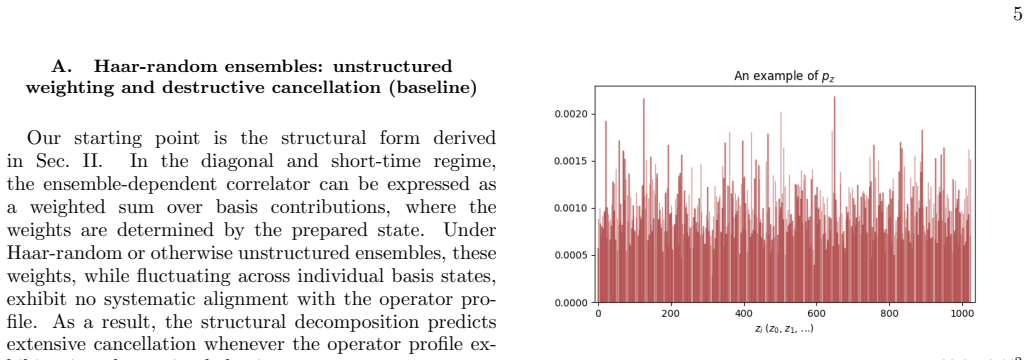
Near-uniformity ofp z under Haar sampling A defining feature of Haar-random states, as well as sufficiently deep local random quantum circuits that approximate unitary designs [15], is that their computational-basis weights are nearly structureless. Ac- cordingly,p z shows no systematic dependence on z and is typically of order 2 −n, with fluctuations tha...
-
[2]
Operator profiles: structure exists, but appears as sign-alternating patterns Even for simple diagonal observables such as Pauli-Z strings, the operator profilea z(0) =⟨z|A(0)|z⟩is highly FIG. 1. Example of the basis-resolved weightsp z =|⟨r|P ↑|z⟩|2 for a Haar-random initial state. The distribution exhibits no localized enhancement across the computation...
-
[3]
Conse- quently, the cumulative sumS(i) defined in Eq
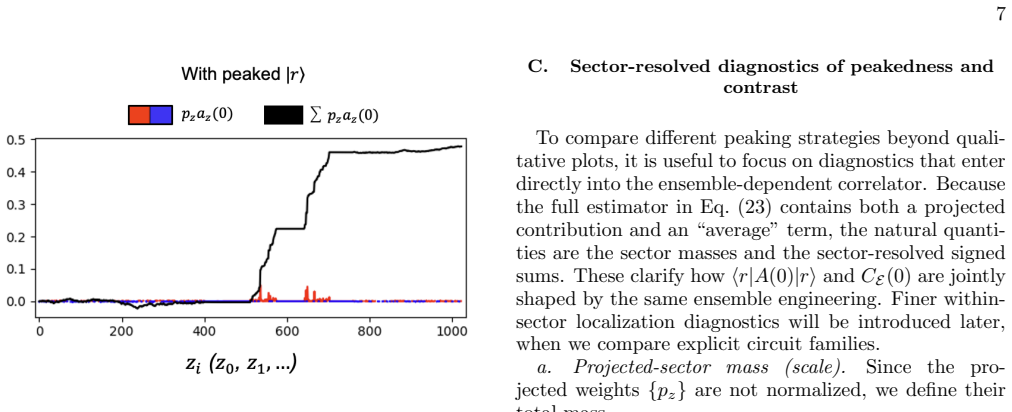
Weighted contributions and cumulative cancellation Combining the near-uniformp z with the sign- alternatinga z(0) yields signed contributionsp zaz(0) of comparable magnitude but alternating sign. Conse- quently, the cumulative sumS(i) defined in Eq. (25) ex- hibits random-walk-like fluctuations and remains small compared to the scale of individual contrib...
-
[4]
±-sector contrast
Interpreting the⟨r|A(0)|r⟩term in the Haar baseline The second term in Eq. (23) originates from the−I component in the decompositionZ= 2P ↑ −Iand is re- quired to preserve the intended “±-sector contrast” of a Pauli-Zcorrelator. For Haar-random states and trace- less diagonal observables,E[⟨r|A(0)|r⟩]≈0, so in the uni- form baseline this term typically re...
-
[5]
Instead, probability mass is concentrated in a restricted region of the computational basis
From global averaging to localized partial sums Under a peaked state|r⟩, the weightsp z are no longer dominated by unstructured, random-like fluctuations. Instead, probability mass is concentrated in a restricted region of the computational basis. As a result, the weighted sum is no longer dominated by global averag- ing over allz; it is governed by a loc...
-
[6]
estimate the ITCF
The average term becomes part of the contrast in engineered ensembles In peaked ensembles, it is generally not appropriate to regard⟨r|A(0)|r⟩as a featureless background. To expose the shared structure, define the full computational-basis weights qz ≡ |⟨z|r⟩| 2, X z qz = 1.(26) IfP ↑ acts on a fixed qubitk, then pz =δ zk,0 qz.(27) Introducing the compleme...
-
[7]
Good-set definition without exhaustive evaluation ofa z We donotconstruct an oracle by exhaustively evalu- atinga z over the full basis. For diagonal observables, es- pecially Pauli-Zstrings and projector-based targets, the predicate can instead be derived directly from operator structure through simple rules such as: •bit constraints (e.g.,z i = 0 for se...
-
[8]
A parity predicate may be implemented by ac- cumulating parity onto an ancilla, applying an ancilla phase flip, and uncomputing
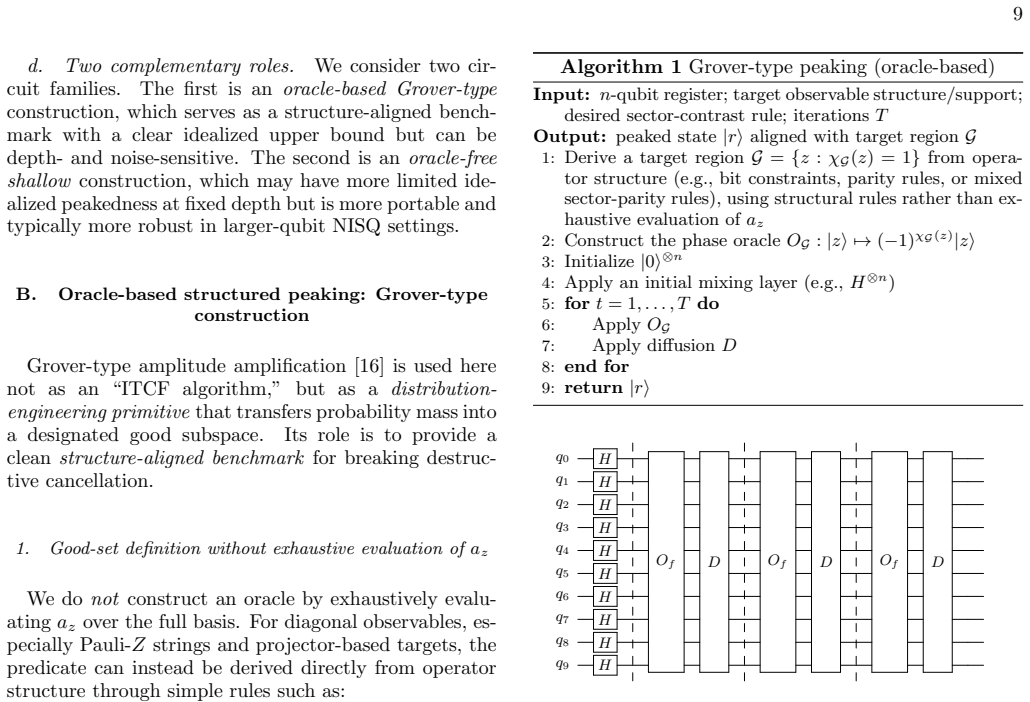
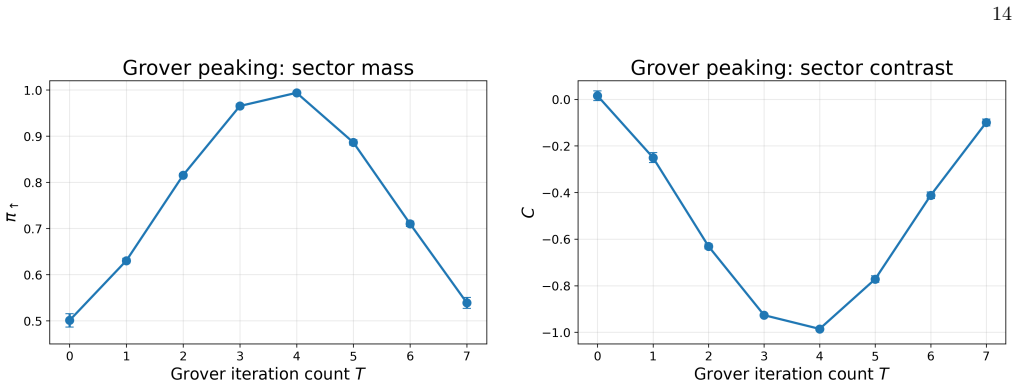
Circuit template and implementation notes The Grover-type peaked circuit repeats the sequence initial mixing→O f →D forTiterations, withTacting as the main peakedness knob. A parity predicate may be implemented by ac- cumulating parity onto an ancilla, applying an ancilla phase flip, and uncomputing. A bit-constraint predicate may be implemented by mappin...
-
[9]
AtT= 0, the initial mixing layer yields an approxi- mately uniform distribution,q z ≃2 −n
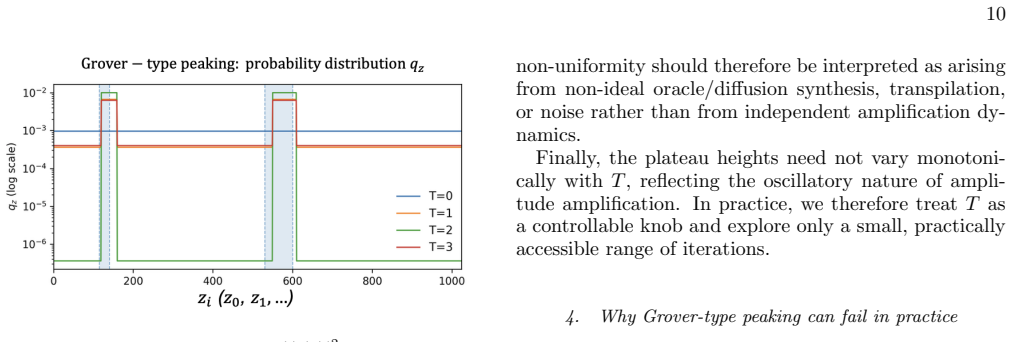
Weight distributions produced by Grover-type peaking Figure 6 shows the computational-basis weightsqz pro- duced by Grover-type peaking for several iteration counts T. AtT= 0, the initial mixing layer yields an approxi- mately uniform distribution,q z ≃2 −n. AsTincreases, amplitude amplification transfers probability mass into Gand depletes the unmarked c...
-
[10]
Simple sign/parity predicates often yieldf≈1/2, which limits concentration into a small number of states
Why Grover-type peaking can fail in practice Grover-type peaking may appear weaker than ex- pected, or may fail to produce a useful contrast gain, for several reasons: 1.The good-set fractionfmay be too large. Simple sign/parity predicates often yieldf≈1/2, which limits concentration into a small number of states. 2.IncreasingP(G)need not increase contras...
-
[11]
Construction principle: partial superposition, bias, and targeted sparse entanglement A typical shallow template combines: (i)selective Hadamards, producing partial rather than global super- position; (ii)single-qubit bias rotations, such asR y(θi), to tune coarse sector populations; and (iii)targeted sparse entangling operations, typically a small number...
-
[12]
Using operator structure without an oracle For diagonal Pauli-Zstrings, the value ofa z depends only on the bits within the support of the operator. Ac- cordingly, the placement of selective Hadamards, bias ro- tations, and sparse entanglers can be chosen by simple structural rules: focus operations on the observable sup- port and on the projector-related...
-
[13]
The shaded window indicates the tar- geted blockG, namely the basis region selected by the imposed bit and sector-bias pattern
Weight distributions produced by shallow peaking Figure 8 shows the computational-basis weightsq z in- duced by the oracle-free shallow construction for several shaping depthsd. The shaded window indicates the tar- geted blockG, namely the basis region selected by the imposed bit and sector-bias pattern. Atd= 0, the baseline biasing layer concentrates mos...
-
[14]
Meaningful peakedness can arise already from sim- ple support-restricted operations and sparse entanglers, without requiring full variational optimization
Knobs and tuning (pre-variational heuristics) The primary knobs are the rotation angles{θi}, the en- tangling pattern (edge set)E, and the entangling depth d. Meaningful peakedness can arise already from sim- ple support-restricted operations and sparse entanglers, without requiring full variational optimization. In Sec. V, we sweep these knobs over restr...
-
[15]
For example, lightweight lo- cal randomization before or after the template can in- crease shot-to-shot diversity while preserving the in- tended peakedness and alignment
What it produces as an ensemble Shallow peaking is naturally interpreted as an ensemble-generation rule. For example, lightweight lo- cal randomization before or after the template can in- crease shot-to-shot diversity while preserving the in- tended peakedness and alignment. When used, such ran- domization is applied in a sector-preserving manner so that...
-
[16]
For multi-qubit Pauli-Zstrings, the diagonal opera- tor profilea z is parity-defined over the support of the operator
Multi-qubit diagonal extensions Projectors can be extended to a multi-qubit subsetS as Π(S) ↑ = O i∈S |0⟩⟨0|i,(49) and diagonal observables can be extended to multi-qubit Pauli-Zstrings, or linear combinations thereof, as A(0) = O j∈supp(A) Zj (or a sum of such terms).(50) The same logic applies: if the prepared ensemble concen- trates weight into sectors...
-
[17]
One can then apply the same logic in the rotated basis
Brief outlook on non-diagonal observables For non-diagonal Pauli terms involvingXorY, one can rotate to an appropriate measurement basis using single-qubit unitaries, for exampleU X =Hfor theX basis andU Y =HS † for theYbasis, before measuring in the computational basis. One can then apply the same logic in the rotated basis. More general non-diagonal ob-...
2048
-
[18]
Preskill, Quantum computing in the nisq era and be- yond, Quantum2, 79 (2018)
J. Preskill, Quantum computing in the nisq era and be- yond, Quantum2, 79 (2018)
2018
-
[19]
Boixo, S
S. Boixo, S. V. Isakov, V. N. Smelyanskiy, R. Babbush, N. Ding, Z. Jiang, M. J. Bremner, J. M. Martinis, and H. Neven, Characterizing quantum supremacy in near- term devices, Nature Physics14, 595 (2018)
2018
-
[20]
Arute, K
F. Arute, K. Arya, R. Babbush, D. Bacon, J. C. Bardin, R. Barends, R. Biswas, S. Boixo, F. G. Brandao, D. A. Buell,et al., Quantum supremacy using a programmable superconducting processor, Nature574, 505 (2019)
2019
-
[21]
Gharibyan, M
H. Gharibyan, M. Mullath, N. Sherman, V. Su, H. Tepa- nyan, and Y. Zhang, Heuristic quantum advantage with peaked circuits (2025)
2025
-
[22]
Bouland, B
A. Bouland, B. Fefferman, C. Nirkhe, and U. Vazirani, On the complexity and verification of quantum random circuit sampling, Nature Physics15, 159 (2019)
2019
-
[23]
S. Aaronson and Y. Zhang, On verifiable quantum ad- vantage with peaked circuit sampling, arXiv preprint arXiv:2404.14493 (2024)
-
[24]
E. N. Epperly, J. A. Tropp, and R. J. Webber, Xtrace: Making the most of every sample in stochastic trace es- timation, SIAM Journal on Matrix Analysis and Appli- cations45, 1 (2024)
2024
-
[25]
Bartsch and J
C. Bartsch and J. Gemmer, Dynamical typicality of quantum expectation values, Physical Review Letters 102, 110403 (2009)
2009
-
[26]
M. Kim, M. Sajjan, and S. Kais, A deep dive into the interplay of structured quantum peaked circuits and infi- nite temperature correlation functions, 2025 IEEE Inter- national Conference on Quantum Computing and Engi- neering (QCE)01, 2011 (2025)
2025
-
[27]
Kumaran, M
K. Kumaran, M. Sajjan, B. Pokharel, J. Gibbs, J. Cohn, B. Jones, S. Mostame, S. Kais, and A. Banerjee, Quan- tum simulation of superdiffusion breakdown in heisen- berg chains via 2d interactions (2025)
2025
-
[28]
Iitaka and T
T. Iitaka and T. Ebisuzaki, Random phase vector for cal- culating the trace of a large matrix, Physical Review E 69, 057701 (2004)
2004
-
[29]
Richter and A
J. Richter and A. Pal, Simulating hydrodynamics on noisy intermediate-scale quantum devices with random circuits, Phys. Rev. Lett.126, 230501 (2021)
2021
-
[30]
T. A. Elsayed and B. V. Fine, Regression relation for pure quantum states and its implications for efficient comput- ing, Physical Review Letters110, 070404 (2013)
2013
-
[31]
Steinigeweg, J
R. Steinigeweg, J. Gemmer, and W. Brenig, Spin- current autocorrelations from single pure-state propaga- tion, Physical Review Letters112, 120601 (2014)
2014
-
[32]
F. G. S. L. Brand˜ ao, A. W. Harrow, and M. Horodecki, Local random quantum circuits are approximate polynomial-designs, Communications in Mathematical Physics346, 397 (2016)
2016
-
[33]
L. K. Grover, Quantum mechanics helps in searching for a needle in a haystack, Physical Review Letters79, 325 (1997)
1997
-
[34]
Brassard, P
G. Brassard, P. Hoyer, M. Mosca, and A. Tapp, Quan- tum amplitude amplification and estimation, inQuantum Computation and Information, Contemporary Mathe- matics, Vol. 305 (2002) pp. 53–74
2002
-
[35]
A. Javadi-Abhari, M. Treinish, K. Krsulich, C. J. Wood, J. Lishman, J. Gacon, S. Martiel, P. D. Na- tion, L. S. Bishop, A. W. Cross, B. R. Johnson, and J. M. Gambetta, Quantum computing with qiskit (2024), arXiv:2405.08810 [quant-ph]
work page internal anchor Pith review arXiv 2024
-
[36]
Temme, S
K. Temme, S. Bravyi, and J. M. Gambetta, Error mitiga- tion for short-depth quantum circuits, Physical Review Letters119, 180509 (2017)
2017
-
[37]
Waring, C
J.-B. Waring, C. Pere, and S. L. Beux, Noise aware util- ity optimization of nisq devices, 2024 22nd IEEE Inter- regional NEWCAS Conference (NEWCAS) , 168 (2024)
2024
-
[38]
Kandalaet al., Hardware-efficient variational quan- tum eigensolver for small molecules and quantum mag- nets, Nature549, 242 (2017)
A. Kandalaet al., Hardware-efficient variational quan- tum eigensolver for small molecules and quantum mag- nets, Nature549, 242 (2017)
2017
-
[39]
J. Li, R. Fan, H. Wang, B. Ye, B. Zeng, H. Zhai, X. Peng, and J. Du, Measuring out-of-time-order correlators on a nuclear magnetic resonance quantum simulator, Phys. Rev. X7, 031011 (2017)
2017
-
[40]
Swingle, Unscrambling the physics of out-of-time- order correlators, Nature Physics14(2018)
B. Swingle, Unscrambling the physics of out-of-time- order correlators, Nature Physics14(2018)
2018
-
[41]
K. A. Landsmanet al., Verified quantum information scrambling, Nature567, 61 (2019)
2019
-
[42]
Xu and B
S. Xu and B. Swingle, Scrambling dynamics and out-of- time-ordered correlators in quantum many-body systems: a tutorial, PRX Quantum5, 010201 (2024)
2024
-
[43]
Sajjan, V
M. Sajjan, V. Singh, R. Selvarajan, and S. Kais, Imagi- nary components of out-of-time-order correlator and in- formation scrambling for navigating the learning land- scape of a quantum machine learning model, Physical Review Research5, 013146 (2023)
2023
-
[44]
Xia and S
R. Xia and S. Kais, Hybrid quantum-classical neural net- work for calculating ground state energies of molecules, Entropy22, 828 (2023)
2023
-
[45]
S. N. Fricke, H. Mao, M. Sajjan, J. Demarteau, B. A. H. A. Ajoy, V. Witherspoon, and S. K. J. A. Reimer, Out-of-time-order correlators bridge classical transport and quantum dynamics, The Journal of Chemical Physics 164, 134201 (2026)
2026
discussion (0)
Sign in with ORCID, Apple, or X to comment. Anyone can read and Pith papers without signing in.