Recognition: unknown
Thermal activation rate of dilute axion stars close to the maximum mass
Pith reviewed 2026-05-07 13:42 UTC · model grok-4.3
The pith
Dilute axion stars near maximum mass have thermal lifetimes scaling as e^N times the dynamical time, rendering metastable states effectively stable.
A machine-rendered reading of the paper's core claim, the machinery that carries it, and where it could break.
Core claim
Close to the maximum mass, the saddle-node bifurcation normal form combined with instanton theory yields a thermal activation rate whose inverse, the lifetime of metastable dilute axion stars, scales as t_life ∼ e^N t_D. With N ∼ 10^57 and t_D ∼ 10 hours for typical QCD axion stars, or N ∼ 10^96 and t_D ∼ 100 Myr for ultralight axion cores, the resulting lifetime is so long that metastable equilibrium states can be treated as stable in practice.
What carries the argument
Instanton theory applied to the normal form of the saddle-node bifurcation in the energy landscape near the maximum mass of the self-gravitating condensate.
If this is right
- Metastable axion stars near maximum mass survive for times far longer than the age of the universe and can therefore be regarded as stable for astrophysical purposes.
- The identical exponential scaling protects quantum cores of dark matter halos made of ultralight axions against thermal decay.
- The same long lifetimes apply to self-gravitating systems in globular clusters, the Brownian mean field model, and laboratory Bose-Einstein condensates with attractive interactions.
- Thermal activation is negligible compared with quantum tunneling for determining the practical stability of these objects.
Where Pith is reading between the lines
- Observed axion star candidates could sit slightly above the formal maximum mass in long-lived metastable states without immediate collapse.
- The exponential suppression may allow similar normal-form calculations to estimate thermal stability in other bosonic dark matter models with attractive self-interaction.
- If the dynamical time remains the only relevant scale, thermal effects drop out of cosmic evolution calculations for axion stars once N exceeds roughly 100.
Load-bearing premise
The normal form of the saddle-node bifurcation accurately captures the shape of the potential barrier near the maximum mass and instanton theory applies without large gravitational corrections.
What would settle it
Observation of a dilute axion star with mass near the maximum value that collapses or disperses on a timescale much shorter than e^N times its dynamical time would show the calculated rate is wrong.
Figures




read the original abstract
We compute the thermal activation rate of metastable self-gravitating Bose-Einstein condensates with attractive self-interaction (e.g., dilute axion stars) by using the instanton theory. Explicit analytical results are given close to the maximum mass $M_{\rm max}$ [P.H. Chavanis, Phys. Rev. D 84, 043531 (2011)] by using the normal form of the saddle-node bifurcation close to that point. We show that the lifetime of metastable states is extremely long, scaling as $t_{\rm life}\sim e^N\, t_D$, where $N$ is the number of bosons in the system and $t_D$ is the dynamical time ($N\sim 10^{57}$ and $t_D\sim 10\, {\rm hrs}$ for typical QCD axion stars; $N\sim 10^{96}$ and $t_D\sim 100\, {\rm Myrs}$ for the quantum core of a dark matter halo made of ultralight axions). Therefore, metastable equilibrium states can be considered as stable equilibrium states in practice. We compare our results with similar results obtained for Bose-Einstein condensates in laboratory, globular clusters and self-gravitating Brownian particles in astrophysics, the Brownian mean field model (BMF) in statistical mechanics, and bacterial populations in biology. Our presentation parallels the calculation of the quantum tunneling rate of dilute axion stars given in a previous paper [P.H. Chavanis, Phys. Rev. D 102, 083531 (2020)]. These calculations can find application in various domains of physics and astrophysics.
Editorial analysis
A structured set of objections, weighed in public.
Referee Report
Summary. The manuscript computes the thermal activation rate of metastable dilute axion stars (self-gravitating Bose-Einstein condensates with attractive interactions) near the maximum mass M_max using instanton theory applied to the normal form of the saddle-node bifurcation. It derives an explicit lifetime scaling t_life ∼ e^N t_D (with N the boson number and t_D the dynamical time) and concludes that the metastable states are effectively stable for astrophysical parameters (N ∼ 10^57 for QCD axion stars; N ∼ 10^96 for ultralight axion dark-matter cores). The presentation parallels the author's prior quantum-tunneling calculation and includes comparisons to laboratory BECs, globular clusters, the Brownian mean-field model, and bacterial populations.
Significance. If the central derivation holds, the work supplies a clean analytical framework for practical stability of axion stars and analogous systems, with the e^N scaling providing a falsifiable prediction that lifetimes vastly exceed dynamical times. The explicit reduction to the saddle-node normal form near M_max and the direct parallel to the 2020 quantum-tunneling paper are genuine strengths, enabling quantitative cross-field comparisons without additional free parameters.
major comments (2)
- [derivation of normal-form reduction (near the M_max expansion)] The reduction of the Gross-Pitaevskii-Poisson functional to the canonical saddle-node normal form (used to obtain the instanton action) is load-bearing for the linear-in-N exponent. The manuscript should supply the explicit expansion coefficients of the next-order terms in the effective potential and demonstrate that they remain irrelevant within a few percent of M_max; without this, O(1) corrections to the bounce action cannot be ruled out.
- [instanton action evaluation (thermal activation rate section)] The instanton (bounce) calculation in the reduced model omits possible O(1) corrections arising from the long-range gravitational potential, the finite-temperature fluctuation spectrum around the saddle, or relativistic corrections to the underlying axion field theory. An estimate or scaling argument showing these corrections do not alter the leading e^N behavior is required to support the practical-stability claim.
minor comments (2)
- [abstract and parameter estimates] The dynamical time t_D is quoted as ∼10 hrs for QCD axion stars and ∼100 Myr for ultralight axion cores; a precise definition (e.g., in terms of the central density or orbital period) would aid reproducibility.
- [comparison section] A compact table comparing the activation exponents, prefactors, and relevant N ranges across the laboratory BEC, globular-cluster, BMF, and biological cases would clarify the cross-disciplinary parallels.
Simulated Author's Rebuttal
We thank the referee for the positive overall assessment and the detailed, constructive comments on our manuscript. We address each major comment point by point below and will incorporate the requested additions and clarifications in the revised version.
read point-by-point responses
-
Referee: [derivation of normal-form reduction (near the M_max expansion)] The reduction of the Gross-Pitaevskii-Poisson functional to the canonical saddle-node normal form (used to obtain the instanton action) is load-bearing for the linear-in-N exponent. The manuscript should supply the explicit expansion coefficients of the next-order terms in the effective potential and demonstrate that they remain irrelevant within a few percent of M_max; without this, O(1) corrections to the bounce action cannot be ruled out.
Authors: We appreciate the referee highlighting the importance of justifying the normal-form reduction. In the revised manuscript we will explicitly compute and tabulate the coefficients of the next-order terms in the expansion of the effective potential about the saddle-node bifurcation point. We will further show, both analytically and with a numerical check, that these higher-order contributions remain below a few percent for mass deviations |M - M_max|/M_max ≲ 0.05, which is the relevant regime for long-lived metastable states. This establishes that they do not generate O(1) corrections to the leading instanton action, thereby preserving the linear-in-N scaling of the exponent. revision: yes
-
Referee: [instanton action evaluation (thermal activation rate section)] The instanton (bounce) calculation in the reduced model omits possible O(1) corrections arising from the long-range gravitational potential, the finite-temperature fluctuation spectrum around the saddle, or relativistic corrections to the underlying axion field theory. An estimate or scaling argument showing these corrections do not alter the leading e^N behavior is required to support the practical-stability claim.
Authors: We agree that a quantitative discussion of possible sub-leading corrections strengthens the practical-stability conclusion. In the revision we will add a dedicated paragraph providing scaling estimates: (i) the long-range gravitational potential is already incorporated at mean-field level and its fluctuation corrections around the saddle are suppressed by additional powers of 1/N; (ii) finite-temperature fluctuations about the instanton saddle contribute only to the prefactor, not to the leading exponential; (iii) relativistic corrections to the axion field theory are negligible for the dilute, non-relativistic regime considered here (v/c ≪ 1). Because the leading bounce action itself scales linearly with N, any O(1) additive corrections leave the dominant e^N dependence of the lifetime unchanged. revision: yes
Circularity Check
No significant circularity; derivation is self-contained
full rationale
The paper derives the thermal activation rate analytically via instanton theory applied to the standard normal form of the saddle-node bifurcation near M_max (referenced from prior work). The claimed lifetime scaling t_life ∼ e^N t_D emerges directly from evaluating the instanton action in that reduced model, where the barrier height and dynamical time yield the exponential dependence on particle number N as a calculational output rather than an input or fit. Self-citations to the author's earlier papers on M_max and quantum tunneling are present but not load-bearing for the new thermal result, which rests on the explicit instanton computation within the effective Gross-Pitaevskii-Poisson framework. No step reduces the final expression to a redefinition or tautology of the inputs.
Axiom & Free-Parameter Ledger
axioms (2)
- domain assumption The system is a dilute axion star described by self-gravitating BEC with attractive interaction
- domain assumption Instanton theory can be applied to compute thermal activation rates in these gravitational systems
Reference graph
Works this paper leans on
-
[1]
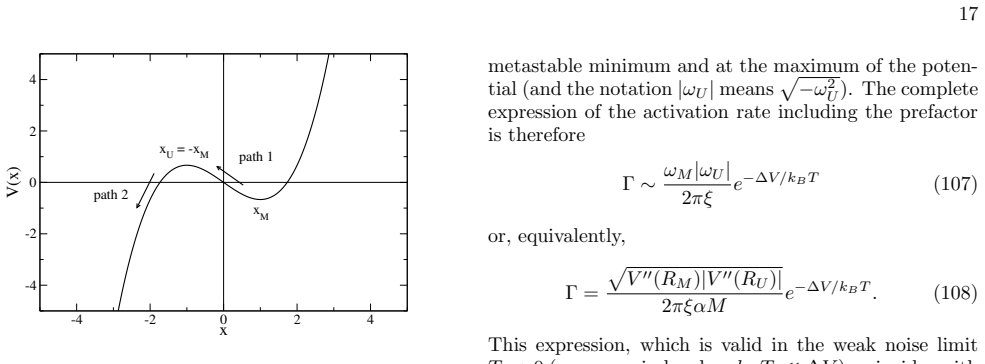
The difference of potential between the local mini- mum and the local maximum creates a barrier of height ∆V=V(x U)−V(x M). In classical mechanics, the mo- tion of the particle is described by Newton’s equation m d2x dt2 =− dV dx .(E1) In quantum mechanics, the particle is represented by a complex wave functionψ(x, t) whose evolution is gov- erned by the ...
-
[2]
Feynman path integral Dirac [198–200] suggested that there is an interesting relation between the quantum propagator⟨x|e−iHt/ℏ |x0⟩, which gives the probability amplitude of the particle in xat timetassuming that it was located inx 0 at time t0 = 0, and the classical action of a particle of massmin a potentialV(x): Sclass[x(t)] = Z 1 2 m˙x2 −V(x(t)) dt= Z...
-
[3]
Euclidean action The functional integral (E5) requires delicate integra- tions on oscillatory functions. To overcome this prob- lem, it is convenient to study its analytical continuation to purely imaginary times for which the corresponding Feynman-Kac functional integral is well-defined. To this end we make the substitutiont→ −it(rotation ofπ/2 in the co...
-
[4]
quantum instanton
Quantum escape rate We now specifically apply the path integral formalism to the computation of the escape rate of a quantum par- ticle out of a metastable state. As discussed at the begin- ning of this Appendix, we assume that the potentialV(x) has a local minimum atx M (metastable equilibrium), a maximum atx U (unstable equilibrium) and a global min- im...
-
[5]
managed to determine the prefactor explicitly by showing that the fluctuation determinant can be evalu- ated exactly with the Gelfand-Yaglom [206] method. 61 Eq. (E10) is the dynamical generalization of the WKB formula [92], which gives the stationary solution forℏ→0. 44
-
[6]
The semiclassical limit and the instanton In the semiclassical approximationℏ→0, we have to determine the trajectoryx c(t) that minimizes the eu- clidean actionS[x(t)] defined by Eq. (E7). The station- ary points ofS[x(t)] can be obtained in different manners. First method:The extremal conditionδS/δx= 0 (least action principle) applied to Eq. (E7) yields ...
-
[7]
WKB formula We can now repeat the calculations detailed in Sec. IV of [90] and find that the quantum tunneling rate (decay probability per unit time) is given by Γ∼ r mωM v2 M πℏ e − 2 ℏ R xM x′ M √ 2m[V(x)−V(x M)]dx ,(E16) whereω 2 M =V ′′(xM)/mis the squared pulsation of the particle at the metastable minimum of the potential and vM, which depends on th...
-
[8]
tunnel effect
Early literature on quantum tunneling The problem of escape from metastable states by quan- tum mechanical tunneling 62 occurs in many domains of physics. The probability that a quantum particle remains in a metastable state decreases exponentially rapidly with time as P(t)∼e −Γt ∼e −t/tlife ,(E19) where Γ is the rate coefficient andtlife ∼1/Γ is the typi...
1931
-
[9]
The work of Langer
to develop a path integral approach instead of using WKB methods (see footnote 2 of their paper). The work of Langer
-
[10]
to the problem of first order phase transitions in statistical mechanics was also mentioned by Stone [104] at the end of his paper. 67 The fact that quantum tunneling is very improbable and can be neglected in many (but not all) cases of physical interest was 46 Appendix F: Derivation of the escape rate of a Brownian particle from a metastable state by us...
-
[11]
We assume that the potentialV(x) has a local minimum atx M and a local maximum atx U
The Smoluchowski equation We consider an overdamped particle of massmand mobilityµ= 1/ξm(whereξis the friction coefficient) evolving in a one-dimensional potentialV(x). We assume that the potentialV(x) has a local minimum atx M and a local maximum atx U. It may also possess a global minimum atx S or be unbounded from below. We shall consider this second p...
-
[12]
(see the discussion in [210]). Identifying the equilibrium state of the Smoluchowski equation with the canonical Boltzmann distribution Peq(x) = 1 Z e−βV(x) ,(F5) whereβ= 1/k BTis the inverse temperature of the bath andZa normalization factor, we find that the diffusion coefficient, the friction coefficient and the temperature are related to each other by...
-
[13]
(F4) reduces to the diffusion equation
and Eq. (F4) reduces to the diffusion equation. Suppose that, at the initial time, the particle is local- ized in the local minimum of the potential. According to the deterministic laws of motion [see Eq. (F1)] it cannot go away from it. This minimum is a stable equilibrium state in which the particle is at rest. For a small pertur- bation, the overdamped...
-
[14]
Wiener path integral and Onsager-Machlup functional The distribution of a Gaussian white noiseη(t) is given by P[η(t)]∝e − 1 2 R tf ti η2(t)dt .(F7) The probability of the pathx(t) is then obtained by ex- pressingη(t) in terms ofx(t) using Eq. (F2). This gives P[x(t)]∝e −S[x(t)]/kB T ,(F8) where S[x(t)] = ξm 4 Z ˙x+ V ′(x(t)) ξm 2 dt(F9) is the so-called ...
-
[15]
instanton
Thermal escape rate We now specifically apply the path integral formal- ism to the computation of the escape rate of a Brow- nian particle out of a metastable state. As discussed at the beginning of this Appendix, we assume that the potentialV(x) has a local minimum atx M (metastable equilibrium), a maximum atx U (unstable equilibrium) and a global minimu...
-
[16]
The weak noise limit and the instanton In the weak noise limitT→0, we have to deter- mine the trajectoryx c(t) that minimizes the Onsager- Machlup functionalS[x] defined by Eq. (F9). As indi- cated previously, the Onsager-Machlup functional (F9) can be viewed as an actionS[x(t)]. It can be written as S= Z L(x,˙x)dt,(F13) where L(x,˙x) = ξm 4 ˙x+ V ′(x) ξm...
-
[17]
Kramers formula We can now repeat the calculations detailed in Sec. V and find that the thermal activation rate (decay proba- bility per unit time) is given by Γ∼ ωM |ωU | 2πξ e−∆V /kB T ,(F20) whereω 2 M =V ′′(xM)/mandω 2 U =−V ′′(xU)/mare the squared pulsations of the fictive particle at the metastable minimum and at the maximum of the po- tential (the ...
-
[18]
Early literature on thermal activation The problem of escape from metastable states un- der the effect of thermal noise occurs in many domains of physics. The probability that a Brownian particle remains in a metastable state decreases exponentially rapidly with time as P(t)∼e −Γt ∼e −t/tlife ,(F22) 49 where Γ is the rate coefficient andtlife ∼1/Γ is the ...
-
[19]
and Arrhenius [94] discovered empirically that the rate of escape follows the law from Eq. (105). Early theoretical works were made by Farkas [245] and Becker and D¨ oring [246] in the context of homogeneous nucleation of supersaturated vapors, and by Polanyi and Wigner [247] and Eyring [248] in chemical physics. In particular, Eyring [248] developed the ...
-
[20]
via the calculation of the mean first passage time. The calculation of thermal activation rates for over- damped Brownian particles in the weak noise limit from the path integral formalism based on the Onsager- Machlup functional was performed by Caroliet al.[251, 252] and Weiss [253] by using the analogy with quantum tunneling. It was also developed by B...
-
[21]
Actually, the theory of Brown- ian motion is the simplest example of application of On- sager’s linear thermodynamics
Relation to Onsager’s linear thermodynamics In this section we make the connection between the previous results and the linear thermodynamics of On- sager [157, 255, 256]. Actually, the theory of Brown- ian motion is the simplest example of application of On- sager’s linear thermodynamics. 70 We follow a presenta- tion similar to the one developed in [156...
-
[22]
From the Smoluchowski equation to the Schr¨ odinger equation in imaginary time Let us consider an overdamped Brownian particle of massmevolving in a one-dimensional potentialV(x). The probability densityP(x, t) of finding the Brownian particle inxat timetis governed by the Smoluchowski equation ∂P ∂t = ∂ ∂x D ∂P ∂x +βP V ′(x) ,(G1) where the diffusion coe...
-
[23]
(G16) 73 There is also a long list of works that followed the seminal paper of Nelson [139] on stochastic quantization (see a detailed list of references in [140])
From the Onsager-Machlup functional to the euclidean action According to Appendix F 2, the transition probability from (x0, t0) to (x, t) for an overdamped Brownian par- ticle of massmin a one-dimensional potentialV(x) is given by the path integral P(x, t|x0, t0) = Z Dx(t)J[x(t)]e −S[x(t)]/kB T ,(G13) where S[x(t)] = ξm 4 Z t t0 ˙x+ V ′(x(t)) ξm 2 dt(G14)...
-
[24]
From the WKB formula to the Kramers formula We have shown in Appendix G 1 that the Smolu- chowski equation with a potentialV(x) could be trans- formed into a Schr¨ odinger equation in imaginary time (Kac equation) with a potentialU(x) related toV(x) by Eq. (G4). On the other hand, we have shown in Appendix G 2 that the Onsager-Machlup functional of a Brow...
-
[25]
The stationary solution of the Kac equation (G6) co- incides with the stationary solution of the Schr¨ odinger equation (G5) withE= 0
From the WKB formula to the Boltzmann formula In line with the previous section, we can make a link between the WKB formula for a quantum particle in a potentialU(x) and the Boltzmann formula for a Brown- ian particle in a potentialV(x). The stationary solution of the Kac equation (G6) co- incides with the stationary solution of the Schr¨ odinger equation...
-
[26]
Early literature on the connection between the Onsager-Machlup and Feynman path integrals The connection between the probability distribution for fluctuation paths introduced by Onsager and Machlup
-
[27]
in Brownian theory and the euclidean (Kac) ver- sion [203, 204] of the path integrals introduced by Feyn- man [201] in quantum mechanics was first made by On- sager and Machlup [157] (without knowning the works of Feynman and Kac), Hashitsume [280], Saito and Namiki [207], Falkoff [281, 282], Wiegel [283, 284], Graham [279], Moreau [285], Ito [286], Carol...
-
[28]
Peccei, H.R
R.D. Peccei, H.R. Quinn, Phys. Rev. Lett.38, 1440 (1977)
1977
-
[29]
Marsh, Phys
D. Marsh, Phys. Rep.643, 1 (2016)
2016
-
[30]
Arvanitaki, S
A. Arvanitaki, S. Dimopoulos, S. Dubovsky, N. Kaloper, J. March-Russell, Phys. Rev. D81, 123530 (2010)
2010
-
[31]
W. Hu, R. Barkana, A. Gruzinov, Phys. Rev. Lett.85, 1158 (2000)
2000
-
[32]
Alcubierre, F.S
M. Alcubierre, F.S. Guzm´ an, T. Matos, D. N´ u˜ nez, L.A. Ure˜ na-L´ opez, P. Wiederhold, Class. Quantum Grav.19, 5017 (2002)
2002
-
[33]
Moczet al., Mon
P. Moczet al., Mon. Not. R. Astron. Soc.471, 4559 (2017)
2017
-
[34]
Moczet al., Mon
P. Moczet al., Mon. Not. R. Astron. Soc.494, 2027 (2020)
2027
-
[35]
B¨ ohmer, T
C.G. B¨ ohmer, T. Harko, J. Cosmol. Astropart. Phys. 06, 025 (2007)
2007
-
[36]
Chavanis, Phys
P.H. Chavanis, Phys. Rev. D84, 043531 (2011)
2011
-
[37]
Chavanis, L
P.H. Chavanis, L. Delfini, Phys. Rev. D84, 043532 (2011)
2011
-
[38]
Rindler-Daller, P.R
T. Rindler-Daller, P.R. Shapiro, Mon. Not. R. Astron. Soc.422, 135 (2012)
2012
-
[39]
Madelung, Z
E. Madelung, Z. Phys.40, 322 (1927) 55
1927
-
[40]
Su´ arez, V.H
A. Su´ arez, V.H. Robles, T. Matos, Astrophys. Space Sci. Proc.38, 107 (2014)
2014
-
[41]
Rindler-Daller, P.R
T. Rindler-Daller, P.R. Shapiro, Astrophys. Space Sci. Proc.38, 163 (2014)
2014
-
[42]
Chavanis,Self-gravitating Bose-Einstein conden- sates, in Quantum Aspects of Black Holes, edited by X
P.H. Chavanis,Self-gravitating Bose-Einstein conden- sates, in Quantum Aspects of Black Holes, edited by X. Calmet (Springer, 2015)
2015
-
[43]
Lee, EPJ Web of Conferences168, 06005 (2018)
J.W. Lee, EPJ Web of Conferences168, 06005 (2018)
2018
-
[44]
Braaten, H
E. Braaten, H. Zhang, Rev. Mod. Phys.91, 041002 (2019)
2019
-
[45]
Niemeyer, Prog
J.C. Niemeyer, Prog. Part. Nucl. Phys.113, 103787 (2020)
2020
-
[46]
P.H. Chavanis,The maximum mass of dilute axion stars in The sixteenth Marcel Grossmann meeting on recent developments in theoretical and experimental general relativity, astrophysics, and relativistic field theories. Editors R. Ruffini, and G. Vereshchagin, 2149–2173 (2023)
2023
-
[47]
Ferreira, Astron
E. Ferreira, Astron. Astrophys. Rev.29, 7 (2021)
2021
-
[48]
Hui, Ann
L. Hui, Ann. Rev. Astron. Astrophys.59, 247 (2021)
2021
-
[49]
Visinelli, Int
L. Visinelli, Int. J. Mod. Phys. D30, 2130006 (2021)
2021
-
[50]
Khoury, SciPost Phys
J. Khoury, SciPost Phys. Lect. Notes42, 1 (2022)
2022
-
[51]
Matos, L.A
T. Matos, L.A. Ure˜ na-L´ opez, J.W. Lee, Frontiers in As- tronomy and Space Science11, 1347518 (2024)
2024
-
[52]
Padilla, J.C
L.E. Padilla, J.C. Hidalgo, T.D. Gomez-Aguilar, K.A. Malik, G. German, Frontiers in Astronomy and Space Science11, 1361399 (2024)
2024
-
[53]
Chavanis, Front
P.H. Chavanis, Front. Astron. Space Sci.12, 1538434 (2025)
2025
-
[54]
Chavanis, Phys
P.H. Chavanis, Phys. Rev. D98, 023009 (2018)
2018
-
[55]
Kaup, Phys
D.J. Kaup, Phys. Rev.172, 1331 (1968)
1968
-
[56]
Ruffini, S
R. Ruffini, S. Bonazzola, Phys. Rev.187, 1767 (1969)
1969
-
[57]
Colpi, S.L
M. Colpi, S.L. Shapiro, I. Wasserman, Phys. Rev. Lett. 57, 2485 (1986)
1986
-
[58]
Chavanis, T
P.H. Chavanis, T. Harko, Phys. Rev. D86, 064011 (2012)
2012
-
[59]
Chavanis, Phys
P.H. Chavanis, Phys. Rev. D107, 103503 (2023)
2023
-
[60]
Chavanis, Phys
P.H. Chavanis, Phys. Rev. D103, 123551 (2021)
2021
-
[61]
Lynden-Bell, Mon
D. Lynden-Bell, Mon. Not. R. Astron. Soc.136, 101 (1967)
1967
-
[62]
Seidel, W.M
E. Seidel, W.M. Suen, Phys. Rev. Lett.72, 2516 (1994)
1994
-
[63]
Guzm´ an, L.A
F.S. Guzm´ an, L.A. Ure˜ na-L´ opez, Phys. Rev. D69, 124033 (2004)
2004
-
[64]
Guzm´ an, L.A
F.S. Guzm´ an, L.A. Ure˜ na-L´ opez, Astrophys. J.645, 814 (2006)
2006
-
[65]
Schive, T
H.Y. Schive, T. Chiueh, T. Broadhurst, Nature Physics 10, 496 (2014)
2014
-
[66]
Schiveet al., Phys
H.Y. Schiveet al., Phys. Rev. Lett.113, 261302 (2014)
2014
-
[67]
Schwabe, J
B. Schwabe, J. Niemeyer, J. Engels, Phys. Rev. D94, 043513 (2016)
2016
-
[68]
P. Mocz, L. Lancaster, A.Fialkov, F. Becerra, P.H. Cha- vanis, Phys. Rev. D97, 083519 (2018)
2018
-
[69]
Veltmaat, J.C
J. Veltmaat, J.C. Niemeyer, B. Schwabe, Phys. Rev. D 98, 043509 (2018)
2018
-
[70]
Moczet al., Phys
P. Moczet al., Phys. Rev. Lett.123, 141301 (2019)
2019
-
[71]
Veltmaat, B
J. Veltmaat, B. Schwabe, J.C. Niemeyer, Phys. Rev. D 101, 083518 (2020)
2020
-
[72]
Moczet al., Mon
P. Moczet al., Mon. Not. R. Astron. Soc.521, 2608 (2023)
2023
-
[73]
Chavanis, Phys
P.H. Chavanis, Phys. Rev. D100, 083022 (2019)
2019
-
[74]
Chavanis, Eur
P.H. Chavanis, Eur. Phys. J. B95, 48 (2022)
2022
-
[75]
Navarro, C.S
J.F. Navarro, C.S. Frenk, S.D.M. White, Mon. Not. R. astr. Soc.462, 563 (1996)
1996
-
[76]
Moore, T
B. Moore, T. Quinn, F. Governato, J. Stadel, G. Lake, Mon. Not. R. astr. Soc.310, 1147 (1999)
1999
-
[77]
Chavanis, Phys
P.H. Chavanis, Phys. Rev. D100, 123506 (2019)
2019
-
[78]
Chavanis, Phys
P.H. Chavanis, Phys. Rev. D101, 063532 (2020)
2020
-
[79]
Levkov, A.G
D.G. Levkov, A.G. Panin, I.I. Tkachev, Phys. Rev. Lett. 121, 051301 (2018)
2018
-
[80]
Eggemeier, J.C
B. Eggemeier, J.C. Niemeyer, Phys. Rev. D100, 063528 (2019)
2019
discussion (0)
Sign in with ORCID, Apple, or X to comment. Anyone can read and Pith papers without signing in.