Recognition: unknown
VERSUS: An excursion-set-inspired void-finder for the Stage-IV era
Pith reviewed 2026-05-07 04:15 UTC · model grok-4.3
The pith
VERSUS identifies spherical underdensities that match excursion-set void size function predictions without any post-processing of the catalogue.
A machine-rendered reading of the paper's core claim, the machinery that carries it, and where it could break.
Core claim
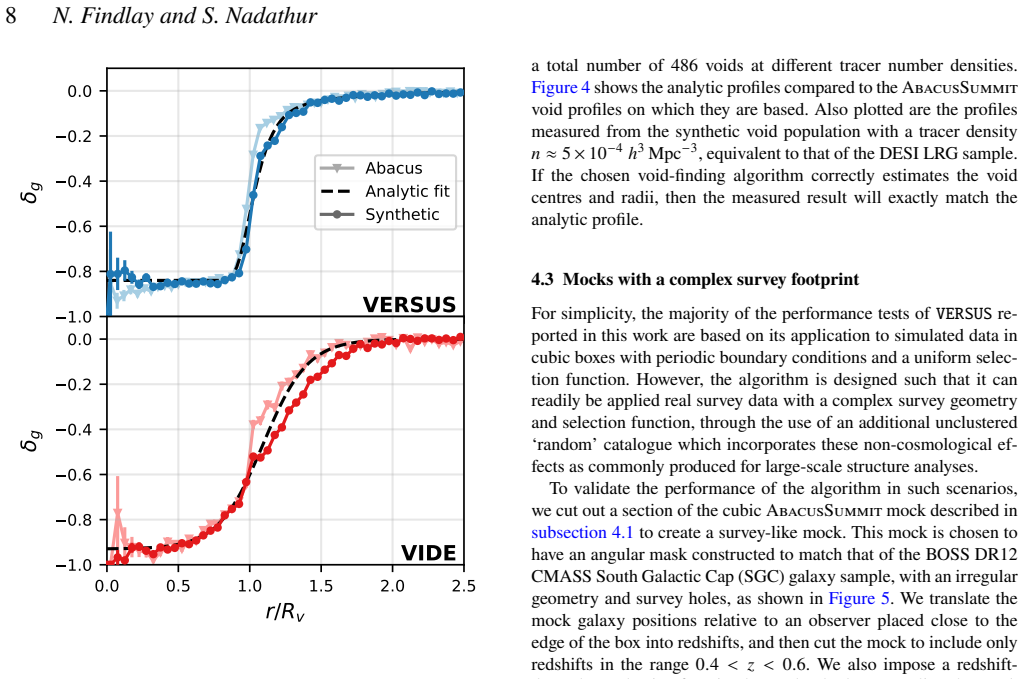
VERSUS is an excursion-set-inspired void finder that selects spherical underdensities in the density field; when applied to both synthetic particle sets and realistic galaxy mocks that include survey systematics, it produces void catalogues whose size function matches theoretical predictions across 25 < R [h^{-1} Mpc] < 61 without any post-processing.
What carries the argument
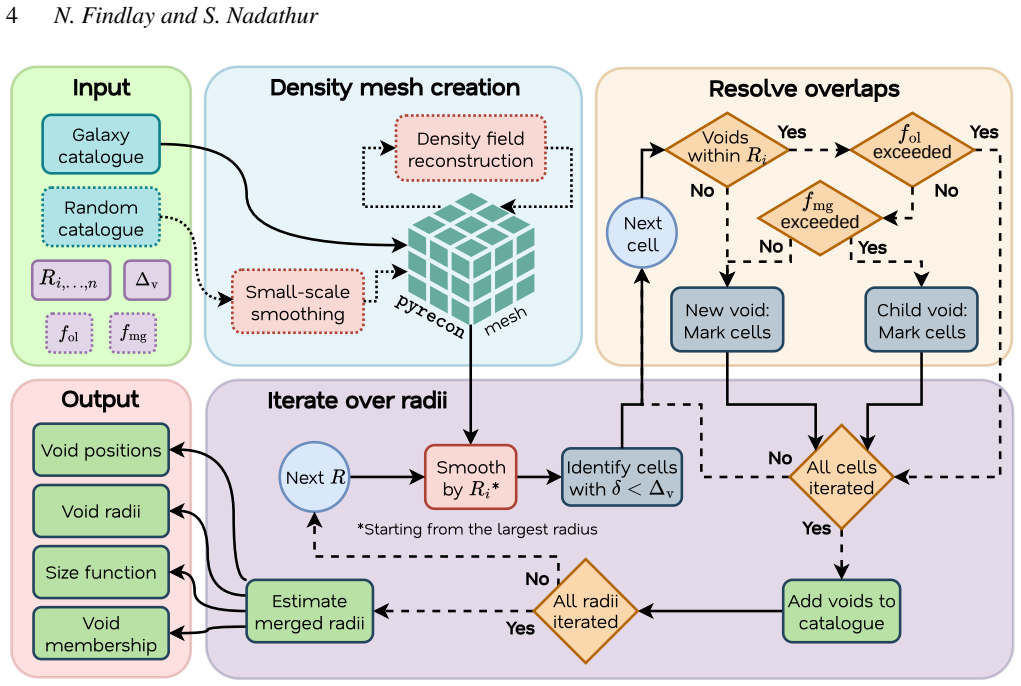
The VERSUS algorithm, which locates spherical underdensities whose radii are set to agree with excursion-set predictions for the void size function.
If this is right
- Void catalogues can be compared directly to theoretical predictions without additional cleaning steps.
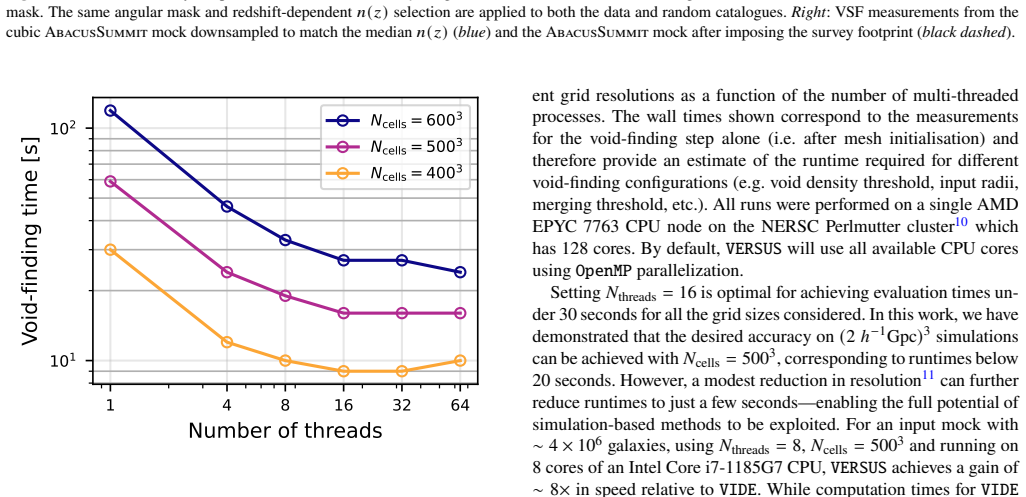
- The computational speed supports simulation-based modelling of void statistics for cosmological inference.
- The same code pipeline can be applied unchanged to observational data from Stage-IV surveys.
- No post-processing is required, which simplifies the full analysis chain from raw catalogue to cosmological constraints.
Where Pith is reading between the lines
- The spherical selection criterion could be relaxed in future versions to test how much the size-function agreement depends on the assumed shape.
- Combining VERSUS voids with other large-scale structure statistics such as galaxy clustering or weak lensing could tighten constraints on dark energy.
- The method's efficiency opens the possibility of running the finder on thousands of simulated realisations to build covariance matrices for Stage-IV analyses.
- If the agreement holds on real data, the same framework could be extended to higher-redshift or alternative gravity models where excursion-set predictions differ.
Load-bearing premise
Voids in the real density field are close enough to spherical, and the galaxy-halo connection plus systematics in the AbacusSummit mock are representative of actual Stage-IV survey data.
What would settle it
Running VERSUS on real Stage-IV survey data and finding that the measured void size function deviates from the excursion-set prediction by more than the reported mock agreement level in the 25-61 h^{-1} Mpc range.
Figures





read the original abstract
We present VERSUS, a publicly available, fast void-finding algorithm designed to identify spherical underdensities in the density field that can be accurately described by excursion set predictions of the void size function. We validate the algorithm against both a synthetic distribution of particles designed to trace a known input void population, and mock galaxy sample built from a $(2\ h^{-1}\text{Gpc})^3$ AbacusSummit simulation populated with a realistic galaxy-halo connection, including systematic effects designed to mimic real survey data. In all cases, VERSUS demonstrates excellent performance, achieving strong agreement with theoretical predictions for the void size function across the range $25 < R \,[\ h^{-1}\text{Mpc}] < 61$ without requiring any post-processing of the void catalogue. The code is user-friendly, modular, and readily applicable to observational survey data. Its computational efficiency further enables the use of simulation-based modelling approaches, facilitating robust and consistent cosmic void analyses with Stage-IV surveys.
Editorial analysis
A structured set of objections, weighed in public.
Referee Report
Summary. The paper presents VERSUS, a publicly available void-finding algorithm inspired by excursion-set theory to identify spherical underdensities in the density field. It is validated on a synthetic particle distribution designed to trace a known input void population and on a mock galaxy catalog from a (2 h^{-1}Gpc)^3 AbacusSummit simulation that includes a realistic galaxy-halo connection and survey-like systematics. The central claim is that VERSUS achieves strong agreement with theoretical void size function predictions in the range 25 < R [h^{-1}Mpc] < 61 without any post-processing of the catalogue, with the code being fast, modular, and suitable for Stage-IV survey data.
Significance. If the performance claims are substantiated with quantitative metrics, VERSUS would offer a computationally efficient and theoretically aligned tool for void analyses in Stage-IV surveys. Its public release, lack of required post-processing, and design to match excursion-set predictions directly could support simulation-based modeling approaches and improve consistency across large datasets. These features address practical needs in the field for scalable void finders.
major comments (3)
- [Abstract and §4] Abstract and §4 (validation sections): The claims of 'excellent performance' and 'strong agreement' with the theoretical void size function are presented without any quantitative metrics such as reduced chi-squared, Kolmogorov-Smirnov statistics, or reported uncertainties/error bars on the size function measurements. This absence makes it impossible to objectively evaluate the level of agreement or the robustness of the no-post-processing assertion.
- [§3 and §4.2] §3 (algorithm) and §4.2 (AbacusSummit validation): The specific radius range 25 < R < 61 h^{-1}Mpc is highlighted for agreement but no a priori justification, sensitivity tests, or full-range results are provided; it is unclear whether this interval was chosen based on theoretical expectations or selected after observing where the finder matches the input theory, which risks circularity given the excursion-set-inspired design.
- [§4.3] §4.3 (mock catalog results): Validation relies on a single (2 h^{-1}Gpc)^3 realization with one specific galaxy-halo connection model; no tests are shown for variations in tracer bias, additional redshift-space distortion modeling, or survey geometry effects, which are load-bearing for the claim of Stage-IV readiness and generalization beyond the tested setup.
minor comments (3)
- [Abstract] Abstract: The volume notation '(2 h^{-1}Gpc)^3' has minor LaTeX formatting inconsistencies that could be cleaned for readability.
- [Figures in §4] Figure captions and legends (throughout validation sections): Some panels comparing size functions would benefit from explicit inclusion of the theoretical curve with uncertainty bands and clearer axis labels to aid interpretation.
- [Discussion] Discussion section: A brief comparison table or text contrasting VERSUS runtime and accuracy against established finders (e.g., ZOBOV) would strengthen the presentation of its advantages.
Simulated Author's Rebuttal
We thank the referee for their constructive and detailed comments, which have helped us identify areas where the manuscript can be clarified and strengthened. We address each major comment below and indicate the revisions we will implement.
read point-by-point responses
-
Referee: Abstract and §4 (validation sections): The claims of 'excellent performance' and 'strong agreement' with the theoretical void size function are presented without any quantitative metrics such as reduced chi-squared, Kolmogorov-Smirnov statistics, or reported uncertainties/error bars on the size function measurements. This absence makes it impossible to objectively evaluate the level of agreement or the robustness of the no-post-processing assertion.
Authors: We agree that quantitative metrics would allow readers to assess the agreement more objectively. In the revised manuscript we will report the measured void size function with Poisson error bars (or jackknife estimates where appropriate) and include the reduced chi-squared value comparing the binned measurements to the theoretical prediction over 25 < R < 61 h^{-1}Mpc. This addition will directly support the claims of strong agreement without post-processing. revision: yes
-
Referee: §3 (algorithm) and §4.2 (AbacusSummit validation): The specific radius range 25 < R < 61 h^{-1}Mpc is highlighted for agreement but no a priori justification, sensitivity tests, or full-range results are provided; it is unclear whether this interval was chosen based on theoretical expectations or selected after observing where the finder matches the input theory, which risks circularity given the excursion-set-inspired design.
Authors: The interval 25 < R < 61 h^{-1}Mpc is the regime in which excursion-set theory is expected to describe the void population, as motivated by the theoretical framework in Section 2 (above the simulation resolution limit and below scales where other physics dominate). To remove any ambiguity, the revised manuscript will present the full void size function over a wider range (approximately 15–80 h^{-1}Mpc) together with the theoretical curve, accompanied by an explicit discussion of where and why deviations appear. We will also add sensitivity tests varying the density-threshold parameter of the algorithm. revision: partial
-
Referee: §4.3 (mock catalog results): Validation relies on a single (2 h^{-1}Gpc)^3 realization with one specific galaxy-halo connection model; no tests are shown for variations in tracer bias, additional redshift-space distortion modeling, or survey geometry effects, which are load-bearing for the claim of Stage-IV readiness and generalization beyond the tested setup.
Authors: A single, very large-volume realization is the standard approach for initial validation of a new algorithm because it minimizes sample variance while remaining computationally tractable. The mock already incorporates a realistic HOD galaxy-halo connection and survey-like systematics. In the revision we will expand Section 4.3 to state the modeling assumptions more explicitly and to describe how VERSUS can be applied to different bias models or RSD treatments. Comprehensive tests across multiple independent realizations and varied HOD parameters lie beyond the scope of the present work and will be noted as planned future extensions. revision: partial
- Comprehensive robustness tests across multiple independent simulation realizations and a range of galaxy-halo connection models, which would require additional large-volume simulations not available within the current study.
Circularity Check
Synthetic validation of excursion-set-inspired void finder reduces to input by construction
specific steps
-
self definitional
[Abstract]
"We present VERSUS, a publicly available, fast void-finding algorithm designed to identify spherical underdensities in the density field that can be accurately described by excursion set predictions of the void size function. We validate the algorithm against both a synthetic distribution of particles designed to trace a known input void population, and mock galaxy sample built from a (2 h^{-1}Gpc)^3 AbacusSummit simulation [...] In all cases, VERSUS demonstrates excellent performance, achieving strong agreement with theoretical predictions for the void size function across the range 25 < R [h⁻"
The algorithm is explicitly defined to find voids 'that can be accurately described by excursion set predictions'. The synthetic test data is constructed to trace a 'known input void population' whose size function is the same theoretical prediction. Recovering 'strong agreement with theoretical predictions' on this data is therefore equivalent to recovering the input by construction, not an independent derivation or validation of the size function.
full rationale
The paper designs VERSUS specifically to recover spherical underdensities matching excursion-set void size function predictions, then validates on synthetic particle data constructed to trace a known input void population (whose size function is the same theoretical one). The reported 'strong agreement' and 'excellent performance' without post-processing is therefore tautological for the synthetic case rather than an independent test. The AbacusSummit mock offers a more separate check, but the central claim of Stage-IV readiness and no-post-processing success still rests on the design choice aligning identification with the theory being validated. This matches pattern 1 (self-definitional) and produces partial circularity (score 6) while leaving independent content in the mock and real-data applicability.
Axiom & Free-Parameter Ledger
axioms (2)
- domain assumption Excursion set theory provides accurate predictions for the size function of spherical underdensities in the cosmic density field.
- domain assumption The AbacusSummit mock with realistic galaxy-halo connection and added systematics is representative of Stage-IV survey data.
Reference graph
Works this paper leans on
-
[1]
Pisaniet al., Cosmic voids: a novel probe to shed light on our Universe, Bull
Cosmic voids: a novel probe to shed light on our Universe. , keywords =. doi:10.48550/arXiv.1903.05161 , archivePrefix =. 1903.05161 , primaryClass =
-
[2]
The era of precision cosmology with voids. arXiv e-prints , keywords =. doi:10.48550/arXiv.2601.14362 , archivePrefix =. 2601.14362 , primaryClass =
-
[3]
Counting voids to probe dark energy. , keywords =. doi:10.1103/PhysRevD.92.083531 , archivePrefix =. 1503.07690 , primaryClass =
-
[4]
The perspective of voids on rising cosmology tensions. , keywords =. doi:10.1051/0004-6361/202347572 , archivePrefix =. 2212.07438 , primaryClass =
-
[5]
A hierarchy of voids: much ado about nothing. , keywords =. doi:10.1111/j.1365-2966.2004.07661.x , archivePrefix =. astro-ph/0311260 , primaryClass =
-
[6]
Cosmic voids in coupled dark energy cosmologies: the impact of halo bias. , keywords =. doi:10.1093/mnras/stv2503 , archivePrefix =. 1506.08831 , primaryClass =
-
[7]
On the linearity of tracer bias around voids. , keywords =. doi:10.1093/mnras/stx785 , archivePrefix =. 1610.06176 , primaryClass =
-
[8]
On the relative bias of void tracers in the Dark Energy Survey. , keywords =. doi:10.1093/mnras/stz1470 , archivePrefix =. 1806.06860 , primaryClass =
-
[9]
Cosmological exploitation of cosmic void statistics. New numerical tools in the CosmoBolognaLib to extract cosmological constraints from the void size function. , keywords =. doi:10.1051/0004-6361/201730852 , archivePrefix =. 1703.07848 , primaryClass =
-
[10]
Cosmic voids uncovered - first-order statistics of depressions in the biased density field. , keywords =. doi:10.1093/mnras/stz2115 , archivePrefix =. 1902.04585 , primaryClass =
-
[11]
Multi-probe cosmology forecasts from HOD-based forward modeling of galaxy and void statistics. arXiv e-prints , keywords =. doi:10.48550/arXiv.2504.08221 , archivePrefix =. 2504.08221 , primaryClass =
-
[12]
Neutrino Mass Constraint from an Implicit Likelihood Analysis of BOSS Voids. , keywords =. doi:10.3847/1538-4357/ad434e , archivePrefix =. 2307.07555 , primaryClass =
-
[13]
Cosmological inference with cosmic voids and neural network emulators. , keywords =. doi:10.1051/0004-6361/202554592 , archivePrefix =. 2502.05262 , primaryClass =
-
[14]
R., Cole S., Efstathiou G., Kaiser N., 1991, @doi [ApJ] 10.1086/170520 , 379, 440
Excursion Set Mass Functions for Hierarchical Gaussian Fluctuations. , keywords =. doi:10.1086/170520 , adsurl =
-
[15]
Alternatives to the Press-Schechter cosmological mass function. , keywords =. doi:10.1093/mnras/243.1.133 , adsurl =
-
[16]
The excursion set theory of halo mass functions, halo clustering, and halo growth,
The Excursion Set Theory of Halo Mass Functions, Halo Clustering, and Halo Growth. International Journal of Modern Physics D , keywords =. doi:10.1142/S0218271807010511 , archivePrefix =. astro-ph/0611454 , primaryClass =
-
[17]
The Nonlinear Evolution of Rare Events. , keywords =. doi:10.1086/174121 , archivePrefix =. astro-ph/9311066 , primaryClass =
-
[18]
The abundance of voids and the excursion set formalism. , keywords =. doi:10.1093/mnras/stt1169 , archivePrefix =. 1304.6087 , primaryClass =
-
[19]
Detecting Neutrino Mass by Combining Matter Clustering, Halos, and Voids. , keywords =. doi:10.3847/1538-4357/ac0e91 , archivePrefix =. 2102.05049 , primaryClass =
-
[20]
Cosmological Constraints from the BOSS DR12 Void Size Function. , keywords =. doi:10.3847/1538-4357/acde54 , archivePrefix =. 2212.03873 , primaryClass =
-
[21]
Euclid: Cosmological forecasts from the void size function. , keywords =. doi:10.1051/0004-6361/202244095 , archivePrefix =. 2205.11525 , primaryClass =
-
[22]
DEMNUni: disentangling dark energy from massive neutrinos with the void size function. , keywords =. doi:10.1088/1475-7516/2023/12/044 , archivePrefix =. 2212.09740 , primaryClass =
-
[23]
Cosmology with Voids from the Nancy Grace Roman Space Telescope. , keywords =. doi:10.3847/1538-4357/ae07d9 , archivePrefix =. 2410.19713 , primaryClass =
-
[24]
The universal multiplicity function: counting haloes and voids. , keywords =. doi:10.1088/1475-7516/2024/10/079 , archivePrefix =. 2401.14451 , primaryClass =
-
[25]
Cosmic voids in modified gravity models with massive neutrinos. , keywords =. doi:10.1093/mnras/stab1112 , archivePrefix =. 2009.03309 , primaryClass =
-
[26]
Cosmological exploitation of the size function of cosmic voids identified in the distribution of biased tracers. , keywords =. doi:10.1093/mnras/stz1989 , archivePrefix =. 1904.01022 , primaryClass =
-
[27]
Astronomy and Computing , keywords =
VIDE: The Void IDentification and Examination toolkit. Astronomy and Computing , keywords =. doi:10.1016/j.ascom.2014.10.002 , archivePrefix =. 1406.1191 , primaryClass =
-
[28]
Guess the cheese flavour by the size of its holes: a cosmological test using the abundance of popcorn voids. , keywords =. doi:10.1093/mnras/stad1146 , archivePrefix =. 2212.06849 , primaryClass =
-
[29]
The Aspen-Amsterdam void finder comparison project. , keywords =. doi:10.1111/j.1365-2966.2008.13307.x , archivePrefix =. 0803.0918 , primaryClass =
-
[30]
Clustering in real space and in redshift space. , keywords =. doi:10.1093/mnras/227.1.1 , adsurl =
-
[31]
An evolution free test for non-zero cosmological constant. , keywords =. doi:10.1038/281358a0 , adsurl =
-
[32]
The Baryon Oscillation Spectroscopic Survey of SDSS-III. , keywords =. doi:10.1088/0004-6256/145/1/10 , archivePrefix =. 1208.0022 , primaryClass =
-
[33]
The DESI Experiment Part I: Science,Targeting, and Survey Design
The DESI Experiment Part I: Science,Targeting, and Survey Design. arXiv e-prints , keywords =. doi:10.48550/arXiv.1611.00036 , archivePrefix =. 1611.00036 , primaryClass =
work page internal anchor Pith review doi:10.48550/arxiv.1611.00036
-
[34]
, year = 1970, month = mar, volume =
Gravitational instability: An approximate theory for large density perturbations. , year = 1970, month = mar, volume =
1970
-
[35]
Improving Cosmological Distance Measurements by Reconstruction of the Baryon Acoustic Peak
Improving Cosmological Distance Measurements by Reconstruction of the Baryon Acoustic Peak. , keywords =. doi:10.1086/518712 , archivePrefix =. astro-ph/0604362 , primaryClass =
-
[36]
2012, MNRAS, 423, 600, doi: 10.1111/j.1365-2966.2012.20901.x
A 2 per cent distance to z = 0.35 by reconstructing baryon acoustic oscillations - I. Methods and application to the Sloan Digital Sky Survey. , keywords =. doi:10.1111/j.1365-2966.2012.21888.x , archivePrefix =. 1202.0090 , primaryClass =
-
[37]
A Zeldovich reconstruction method for measuring redshift space distortions using cosmic voids. , keywords =. doi:10.1093/mnras/sty2799 , archivePrefix =. 1805.09349 , primaryClass =
-
[38]
Beyond BAO: Improving cosmological constraints from BOSS data with measurement of the void-galaxy cross-correlation. , keywords =. doi:10.1103/PhysRevD.100.023504 , archivePrefix =. 1904.01030 , primaryClass =
-
[39]
Astronomy and Computing , keywords =
CosmoBolognaLib: C++ libraries for cosmological calculations. Astronomy and Computing , keywords =. doi:10.1016/j.ascom.2016.01.005 , archivePrefix =. 1511.00012 , primaryClass =
-
[40]
ABACUSSUMMIT: a massive set of high-accuracy, high-resolution N-body simulations. , keywords =. doi:10.1093/mnras/stab2484 , archivePrefix =. 2110.11398 , primaryClass =
-
[41]
The ABACUS cosmological N-body code. , keywords =. doi:10.1093/mnras/stab2482 , archivePrefix =. 2110.11392 , primaryClass =
-
[42]
COMPASO: A new halo finder for competitive assignment to spherical overdensities. , keywords =. doi:10.1093/mnras/stab2980 , archivePrefix =. 2110.11408 , primaryClass =
-
[43]
ABACUSHOD: a highly efficient extended multitracer HOD framework and its application to BOSS and eBOSS data. , keywords =. doi:10.1093/mnras/stab3355 , archivePrefix =. 2110.11412 , primaryClass =
-
[44]
Planck 2018 results. VI. Cosmological parameters. , keywords =. doi:10.1051/0004-6361/201833910 , archivePrefix =. 1807.06209 , primaryClass =
-
[45]
The DESI one-per cent survey: exploring the halo occupation distribution of luminous red galaxies and quasi-stellar objects with ABACUSSUMMIT. , keywords =. doi:10.1093/mnras/stae359 , archivePrefix =. 2306.06314 , primaryClass =
-
[46]
Validation of the Scientific Program for the Dark Energy Spectroscopic Instrument. , keywords =. doi:10.3847/1538-3881/ad0b08 , archivePrefix =. 2306.06307 , primaryClass =
-
[47]
, year = 2002, month = aug, volume =
The Halo Occupation Distribution: Toward an Empirical Determination of the Relation between Galaxies and Mass. , keywords =. doi:10.1086/341469 , archivePrefix =. astro-ph/0109001 , primaryClass =
-
[48]
The Astrophysical Journal , author =
Theoretical Models of the Halo Occupation Distribution: Separating Central and Satellite Galaxies. , keywords =. doi:10.1086/466510 , archivePrefix =. astro-ph/0408564 , primaryClass =
-
[49]
The Astrophysical Journal , author =
Galaxy Evolution from Halo Occupation Distribution Modeling of DEEP2 and SDSS Galaxy Clustering. , keywords =. doi:10.1086/521074 , archivePrefix =. astro-ph/0703457 , primaryClass =
-
[50]
Part I: the void size function
Redshift-space effects in voids and their impact on cosmological tests. Part I: the void size function. , keywords =. doi:10.1093/mnras/staa3252 , archivePrefix =. 2007.12064 , primaryClass =
-
[51]
The GIGANTES Data Set: Precision Cosmology from Voids in the Machine-learning Era. , keywords =. doi:10.3847/1538-4357/ac7d4b , archivePrefix =. 2107.02304 , primaryClass =
-
[52]
Sparse sampling, galaxy bias, and voids. , keywords =. doi:10.1093/mnras/stu893 , archivePrefix =. 1309.5087 , primaryClass =
-
[53]
Findlay , Nathan and others. 2026
2026
-
[54]
REVOLVER: REal-space VOid Locations from surVEy Reconstruction
-
[55]
ZOBOV: a parameter-free void-finding algorithm. , keywords =. doi:10.1111/j.1365-2966.2008.13180.x , archivePrefix =. 0712.3049 , primaryClass =
-
[56]
2019, The Journal of Open Source Software, 4, 1298, 10.21105/joss.01298
Andrea Zonca and Leo Singer and Daniel Lenz and Martin Reinecke and Cyrille Rosset and Eric Hivon and Krzysztof Gorski , title =. 2019 , month = mar, publisher =. doi:10.21105/joss.01298 , url =
-
[57]
HEALPix: A Framework for High-Resolution Discretization and Fast Analysis of Data Distributed on the Sphere. , eprint =. doi:10.1086/427976 , adsurl =
work page internal anchor Pith review doi:10.1086/427976
-
[58]
Watershed void finders and their connection with theoretical models
The nature of voids - I. Watershed void finders and their connection with theoretical models. , keywords =. doi:10.1093/mnras/stv2131 , archivePrefix =. 1504.06510 , primaryClass =
-
[59]
Tracing underdensities with biased galaxies
The nature of voids - II. Tracing underdensities with biased galaxies. , keywords =. doi:10.1093/mnras/stv1994 , archivePrefix =. 1507.00197 , primaryClass =
-
[60]
Formation of Galaxies and Clusters of Galaxies by Self-Similar Gravitational Condensation. , year = 1974, month = feb, volume =. doi:10.1086/152650 , adsurl =
-
[61]
1993, MNRAS, 262, 627, doi: 10.1093/mnras/262.3.627
Merger rates in hierarchical models of galaxy formation. , keywords =. doi:10.1093/mnras/262.3.627 , adsurl =
-
[62]
An analytic model for the spatial clustering of dark matter haloes. , keywords =. doi:10.1093/mnras/282.2.347 , archivePrefix =. astro-ph/9512127 , primaryClass =
-
[63]
L., Crittenden, R., Melchiorri, A., Hobson, M
An excursion set model of hierarchical clustering: ellipsoidal collapse and the moving barrier. , keywords =. doi:10.1046/j.1365-8711.2002.04950.x , archivePrefix =. astro-ph/0105113 , primaryClass =
-
[64]
The evidence of absence: galaxy voids in the excursion set formalism. , keywords =. doi:10.1111/j.1365-2966.2005.09862.x , archivePrefix =. astro-ph/0509148 , primaryClass =
-
[65]
Meddelanden fran Lunds Astronomiska Observatorium Serie I , year = 1922, month = mar, volume =
On some relations in stellar statistics. Meddelanden fran Lunds Astronomiska Observatorium Serie I , year = 1922, month = mar, volume =
1922
-
[66]
Sparkling: Spherical cosmic voids finder
-
[67]
Pylians: Python libraries for the analysis of numerical simulations
discussion (0)
Sign in with ORCID, Apple, or X to comment. Anyone can read and Pith papers without signing in.