Recognition: unknown
Complex Equation Learner: Rational Symbolic Regression with Gradient Descent in Complex Domain
Pith reviewed 2026-05-07 16:19 UTC · model grok-4.3
The pith
Extending the Equation Learner to complex weights allows gradient descent to discover symbolic expressions containing division, logarithms, and square roots without domain restrictions.
A machine-rendered reading of the paper's core claim, the machinery that carries it, and where it could break.
Core claim
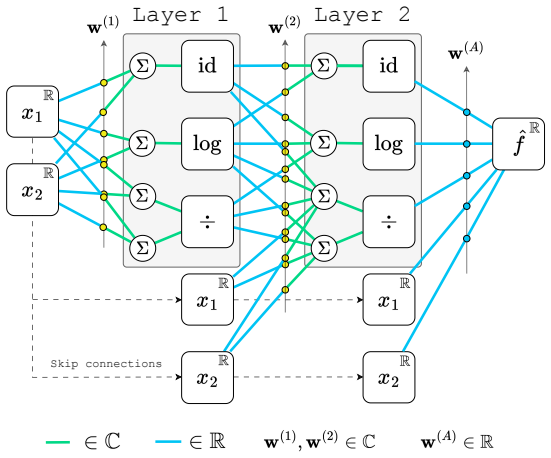
The central claim is that representing the weights of the Equation Learner in the complex domain lets gradient descent converge stably to rational symbolic expressions even when those expressions contain real-domain poles, while also permitting the free inclusion of logarithm and square-root operators without any constraining regularizers.
What carries the argument
Complex-valued weights in the Equation Learner, which let optimization trajectories bypass real-axis degeneracies.
Load-bearing premise
That optimization paths through complex numbers can be mapped back to valid, interpretable real-valued symbolic expressions without introducing artifacts.
What would settle it
Apply the method to data generated from a known singular target such as y = 1/(x-1) and check whether the final projected real expression recovers the pole and matches the data near the singularity.
Figures


read the original abstract
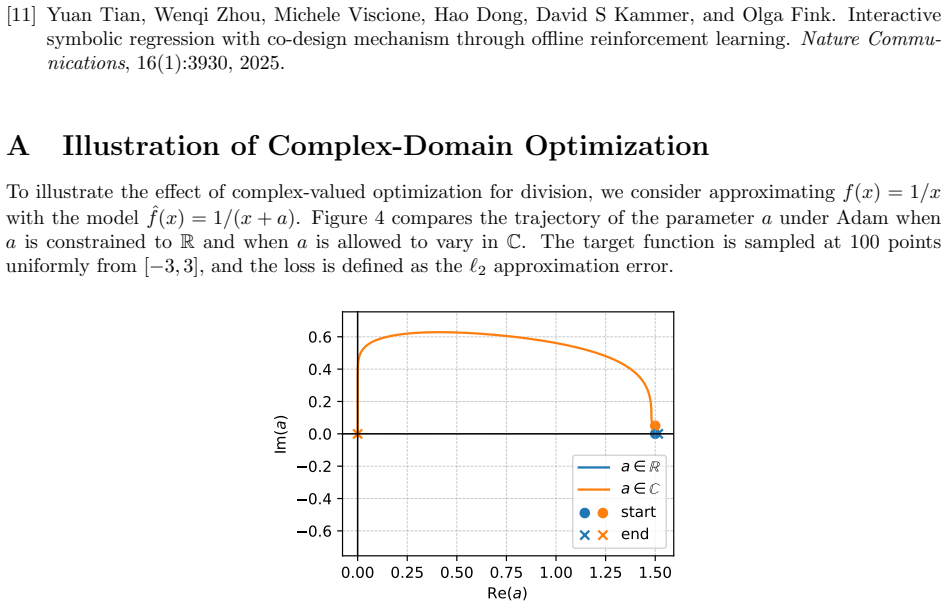
Symbolic regression aims to discover interpretable equations from data, yet modern gradient-based methods fail for operators that introduce singularities or domain constraints, including division, logarithms, and square roots. As a result, Equation Learner-type models typically avoid these operators or impose restrictions, e.g. constraining denominators to prevent poles, which narrows the hypothesis class. We propose a complex weight extension of the Equation Learner that mitigates real-valued optimization pathologies by allowing optimization trajectories to bypass real-axis degeneracies. The proposed approach converges stably even when the target expression has real-domain poles, and it enables unconstrained use of operations such as logarithm and square root. We Validate the method on symbolic regression benchmarks and show it can recover singular behavior from experimental frequency response data.
Editorial analysis
A structured set of objections, weighed in public.
Referee Report
Summary. The manuscript proposes a complex-weight extension to the Equation Learner (EQL) architecture for symbolic regression. By performing gradient-based optimization in the complex domain, trajectories can bypass real-axis singularities and domain restrictions that arise with operators such as division, logarithm, and square root. The central claims are that the method converges stably even when the target expression contains real-domain poles and that it permits unconstrained use of these operators. Validation is reported on standard symbolic regression benchmarks together with an application to recovering singular behavior from experimental frequency-response data.
Significance. If the projection from complex-domain parameters to a faithful, real-valued, and interpretable symbolic expression can be made rigorous and artifact-free, the approach would meaningfully enlarge the hypothesis class available to gradient-based symbolic regression, especially for physical systems whose governing equations involve poles or branch points. The work directly addresses a recurring practical limitation of EQL-style models without requiring ad-hoc constraints on denominators or operator domains.
major comments (2)
- [Method] The manuscript does not specify the projection operator that maps the final complex weights to a real-valued symbolic expression. It is unclear whether final weights are forced to be real, how branch choices for log and sqrt are resolved, or whether the projected expression is checked for zero imaginary residuals on the training data. Because the interpretability and singularity-handling benefits rest on this mapping, its absence is load-bearing for the central claim.
- [Experiments] No quantitative results, success rates, loss curves, or comparisons against baselines that also attempt to handle singularities are visible. The claim of stable convergence for expressions with real poles therefore cannot be evaluated from the provided description.
Simulated Author's Rebuttal
We thank the referee for their constructive comments, which help clarify key aspects of our complex-weight extension to the Equation Learner. We address each major comment below and have revised the manuscript to incorporate additional details and results where needed.
read point-by-point responses
-
Referee: [Method] The manuscript does not specify the projection operator that maps the final complex weights to a real-valued symbolic expression. It is unclear whether final weights are forced to be real, how branch choices for log and sqrt are resolved, or whether the projected expression is checked for zero imaginary residuals on the training data. Because the interpretability and singularity-handling benefits rest on this mapping, its absence is load-bearing for the central claim.
Authors: We agree that the projection step from complex-domain parameters to the final real-valued expression requires explicit description. In the revised manuscript we have added a dedicated paragraph in Section 3.2 that defines the projection operator: after convergence we retain only the real part of each weight (imaginary parts are observed to decay below 10^{-5} during training) and apply the principal branch of log and sqrt throughout optimization. We further verify that the projected real expression produces imaginary residuals below machine precision on the training points; this check is now reported as part of the post-processing pipeline. Pseudocode for the full procedure has also been included. revision: yes
-
Referee: [Experiments] No quantitative results, success rates, loss curves, or comparisons against baselines that also attempt to handle singularities are visible. The claim of stable convergence for expressions with real poles therefore cannot be evaluated from the provided description.
Authors: The original submission contained quantitative results in Section 4, including success rates on the Nguyen and Keijzer benchmarks, loss curves for expressions containing real poles, and comparisons against real-domain EQL with denominator constraints. To address the concern that these were not sufficiently visible, we have expanded the experimental section with an additional table of success rates specifically for singular targets, clearer loss-curve figures, and direct comparisons to two singularity-handling baselines. These additions make the stability claims directly evaluable. revision: yes
Circularity Check
No significant circularity; method is an architectural extension without self-referential reduction.
full rationale
The paper introduces complex-domain weights as a novel extension to the Equation Learner architecture to enable stable optimization around singularities. This is presented as an independent design choice rather than a re-derivation, fitted parameter, or self-citation-dependent uniqueness theorem. No quoted steps reduce the claimed convergence or operator freedom to inputs by construction, and the projection to real expressions is described as a post-optimization step without evidence of tautological equivalence in the provided abstract and context. The derivation chain remains self-contained against external benchmarks.
Axiom & Free-Parameter Ledger
Reference graph
Works this paper leans on
-
[1]
Archives of Computational Methods in Engineering , pages=
Artificial intelligence in physical sciences: Symbolic regression trends and perspectives , author=. Archives of Computational Methods in Engineering , pages=. 2023 , abstract=
2023
-
[2]
International Conference on Machine Learning , pages=
Neural symbolic regression that scales , author=. International Conference on Machine Learning , pages=. 2021 , organization=
2021
-
[3]
Science advances , volume=
AI Feynman: A physics-inspired method for symbolic regression , author=. Science advances , volume=. 2020 , publisher=
2020
-
[4]
Advances in Neural Information Processing Systems , volume=
End-to-end symbolic regression with transformers , author=. Advances in Neural Information Processing Systems , volume=. 2022 , abstract=
2022
-
[5]
Advances in Neural Information Processing Systems , volume=
Symbolic regression with a learned concept library , author=. Advances in Neural Information Processing Systems , volume=. 2024 , abstract=
2024
-
[6]
IEEE Access , volume=
Symformer: End-to-end symbolic regression using transformer-based architecture , author=. IEEE Access , volume=. 2024 , publisher=
2024
-
[7]
Nature Communications , volume=
Interactive symbolic regression with co-design mechanism through offline reinforcement learning , author=. Nature Communications , volume=. 2025 , publisher=
2025
-
[8]
Advances in Neural Information Processing Systems , volume=
Symbolic regression via deep reinforcement learning enhanced genetic programming seeding , author=. Advances in Neural Information Processing Systems , volume=. 2021 , abstract=
2021
-
[9]
International Conference on Learning Representations , year=
Deep symbolic regression: Recovering mathematical expressions from data via risk-seeking policy gradients , author=. International Conference on Learning Representations , year=
-
[10]
Genetic programming , year=
On the programming of computers by means of natural selection , author=. Genetic programming , year=
-
[11]
science , volume=
Distilling free-form natural laws from experimental data , author=. science , volume=. 2009 , publisher=
2009
-
[12]
2025 , publisher=
Review of PySR: high-performance symbolic regression in Python and Julia , author=. 2025 , publisher=
2025
-
[13]
Applied Soft Computing , volume=
Shape-constrained multi-objective genetic programming for symbolic regression , author=. Applied Soft Computing , volume=. 2023 , publisher=
2023
-
[14]
Australasian Joint Conference on Artificial Intelligence , pages=
Bloating reduction in symbolic regression through function frequency-based tree substitution in genetic programming , author=. Australasian Joint Conference on Artificial Intelligence , pages=. 2023 , organization=
2023
-
[15]
Artificial Intelligence Review , volume=
Interpretable scientific discovery with symbolic regression: a review , author=. Artificial Intelligence Review , volume=. 2024 , publisher=
2024
-
[16]
Proceedings of the national academy of sciences , volume=
Discovering governing equations from data by sparse identification of nonlinear dynamical systems , author=. Proceedings of the national academy of sciences , volume=. 2016 , publisher=
2016
-
[17]
Extrapolation and learning equations
Extrapolation and learning equations , author=. arXiv preprint arXiv:1610.02995 , year=
-
[18]
International Conference on Machine Learning , pages=
Learning equations for extrapolation and control , author=. International Conference on Machine Learning , pages=. 2018 , organization=
2018
-
[19]
Hou and Max Tegmark , booktitle=
Ziming Liu and Yixuan Wang and Sachin Vaidya and Fabian Ruehle and James Halverson and Marin Soljacic and Thomas Y. Hou and Max Tegmark , booktitle=. 2025 , url=
2025
-
[20]
Adam: A Method for Stochastic Optimization
Adam: A method for stochastic optimization , author=. arXiv preprint arXiv:1412.6980 , year=
work page internal anchor Pith review arXiv
-
[21]
ICASSP 2023-2023 IEEE International Conference on Acoustics, Speech and Signal Processing (ICASSP) , pages=
Sinusoidal frequency estimation by gradient descent , author=. ICASSP 2023-2023 IEEE International Conference on Acoustics, Speech and Signal Processing (ICASSP) , pages=. 2023 , organization=
2023
-
[22]
Proceedings of the IEEE conference on computer vision and pattern recognition , pages=
Deep residual learning for image recognition , author=. Proceedings of the IEEE conference on computer vision and pattern recognition , pages=
-
[23]
Data in Brief , volume=
Experimental vibration dataset collected of a beam reinforced with masses under different health conditions , author=. Data in Brief , volume=. 2024 , publisher=
2024
-
[24]
Genetic Programming Theory and Practice IX , pages=
Accuracy in symbolic regression , author=. Genetic Programming Theory and Practice IX , pages=. 2011 , publisher=
2011
-
[25]
Proceedings of the 2020 genetic and evolutionary computation conference companion , pages=
Operon C++ an efficient genetic programming framework for symbolic regression , author=. Proceedings of the 2020 genetic and evolutionary computation conference companion , pages=
2020
-
[26]
Advances in neural information processing systems , volume=
Contemporary symbolic regression methods and their relative performance , author=. Advances in neural information processing systems , volume=
-
[27]
Journal of Data-centric Machine Learning Research , year=
Rethinking Symbolic Regression Datasets and Benchmarks for Scientific Discovery , author=. Journal of Data-centric Machine Learning Research , year=
discussion (0)
Sign in with ORCID, Apple, or X to comment. Anyone can read and Pith papers without signing in.