Recognition: unknown
Evolution of passive scalar mixing layers in stratified and unstratified homogeneous turbulence
Pith reviewed 2026-05-07 13:52 UTC · model grok-4.3
The pith
Stratification suppresses vertical mixing of passive scalars after the layer reaches a width set by the vertical integral length of horizontal velocity.
A machine-rendered reading of the paper's core claim, the machinery that carries it, and where it could break.
Core claim
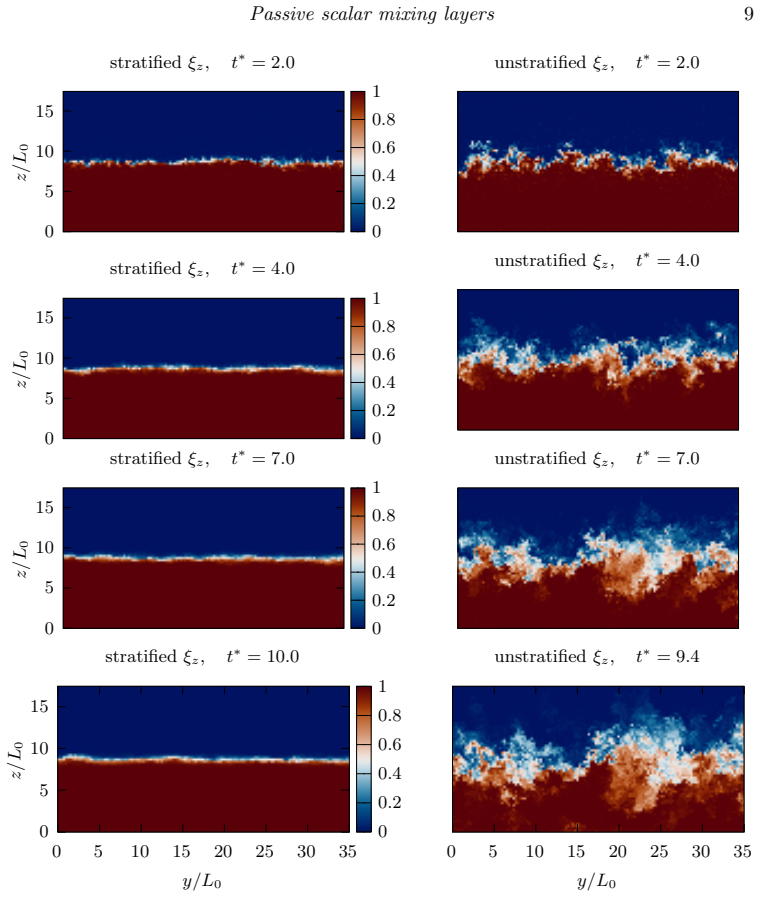
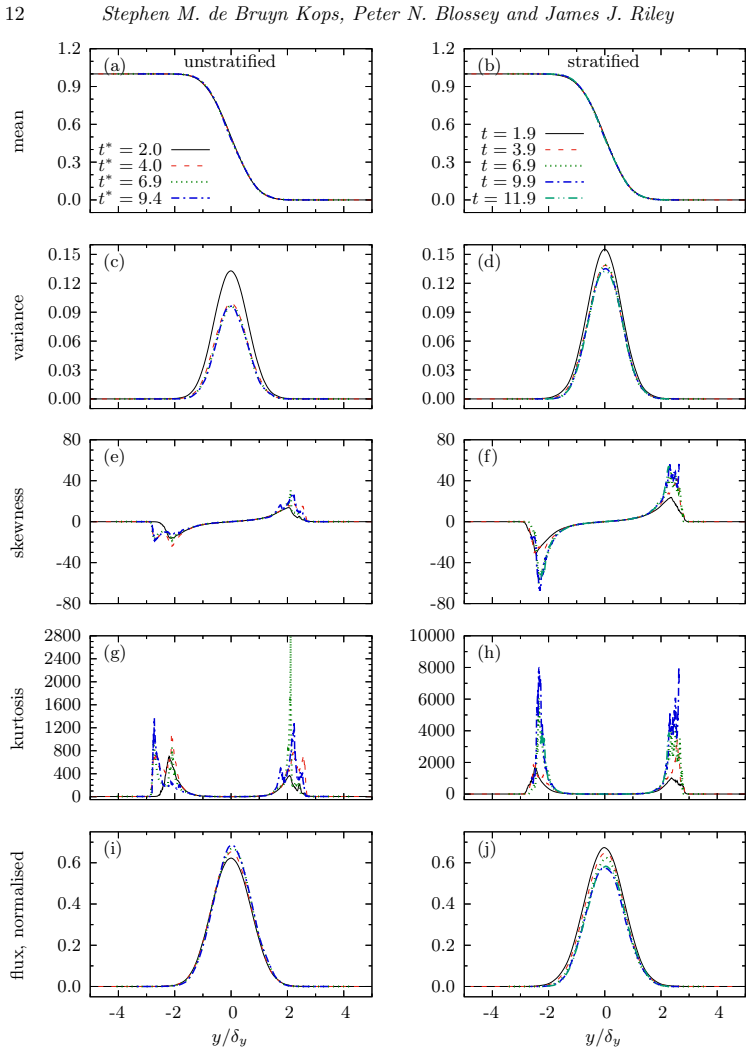
In decaying stratified homogeneous turbulence a vertical passive scalar mixing layer grows initially until its width becomes proportional to the vertical integral length of the horizontal velocity; after this early phase further spreading is negligible because stratification maintains the vertical Froude number of order one and prevents large-scale stirring. The transverse mixing layer behaves much like the unstratified case, although scalar fluctuations are more intense and the interface more intermittent. When the mean profile is known, a one-constant eddy-diffusivity model represents the transverse scalar flux adequately; when the profile shape must be assumed, a two-constant model works,
What carries the argument
Two passive scalar mixing layers (vertical and transverse) whose growth is limited by the vertical integral length scale of horizontal velocity under the constraint that the vertical Froude number remains order one.
If this is right
- Vertical transport of passive scalars is effectively suppressed after an initial transient in stably stratified homogeneous turbulence.
- Transverse scalar fluctuations remain stronger and the turbulent-non-turbulent interface more intermittent under stratification.
- A simple one-constant eddy-diffusivity closure suffices for the transverse scalar flux once the mean profile is prescribed.
- A two-constant model for the transverse flux is accurate only when the scalar field remains in quasi-equilibrium with the velocity field so that its length scale can be scaled from the kinetic energy.
Where Pith is reading between the lines
- The same Froude-number constraint may limit vertical dispersion of large plumes in the atmosphere or ocean.
- At higher Prandtl numbers the anticipated reverse buoyancy flux could allow renewed vertical spreading that is absent at Pr = 0.7.
- The results imply that scalar fields in stratified environments spread primarily in the horizontal plane once the vertical scale is set by the velocity field.
Load-bearing premise
The two mixing layers are assumed to represent a plume much larger than the velocity length scales and a Prandtl number of 0.7 is taken to be representative without strong reverse-buoyancy effects.
What would settle it
A simulation or observation in which the vertical scalar layer continues to spread significantly while the vertical Froude number stays near one and the vertical velocity integral length remains unchanged would falsify the central claim.
Figures





read the original abstract
High-resolution large-eddy simulations of decaying stratified and unstratified homogeneous turbulence are used to understand the mixing of passive scalars in stably stratified flows. Two passive scalar mixing layers, one in the vertical direction and the other in the transverse direction, are a model for a plume that is very large relative to the length scale of the velocity. In the transverse direction, the evolution of the passive scalar is broadly similar in the stratified and unstratified cases, although it does spread slightly faster when stratified. Also, the intensity of the scalar fluctuations is higher in the stratified case, and the turbulent/non-turbulent interface is more intermittent. In the vertical direction, though, the stratified case has almost no mixing because the stratification prevents large-scale stirring. Initially, the stratified passive layer grows until its width is proportional to the vertical integral length of the horizontal velocity, which is itself constrained to maintain the vertical Froude number order one. After this early growth, there is little additional spreading of the passive scalar. Modelling of the stratified scalar flux in the transverse direction is done effectively with a one-constant model if the mean profile is known, and a two-constant model if the profile shape must be assumed. In the latter case, the model is good only if the scalar is in quasi-equilibrium with the velocity field such that the length scale of the scalar can be scaled from the kinetic energy. In this study, the Prandtl number of the active and passive scalars is 0.7. It is anticipated that the reverse buoyancy flux resulting from higher Prandtl numbers will affect the passive scalar mixing.
Editorial analysis
A structured set of objections, weighed in public.
Referee Report
Summary. The manuscript reports high-resolution large-eddy simulations of decaying homogeneous turbulence (stratified and unstratified) to study the evolution of two passive scalar mixing layers, one vertical and one transverse, as a model for a large plume relative to the velocity scale. Transverse mixing is broadly similar but slightly faster when stratified, with higher scalar fluctuation intensity and a more intermittent turbulent/non-turbulent interface. Vertical mixing is strongly suppressed in the stratified case: the layer grows initially until its width matches the vertical integral length of the horizontal velocity (itself set to keep the vertical Froude number O(1)), after which spreading largely ceases. Simple one- and two-constant models for the stratified scalar flux are tested, with the latter requiring quasi-equilibrium between scalar and velocity fields. All runs use Pr = 0.7; higher Prandtl numbers are noted as likely to introduce reverse buoyancy flux effects.
Significance. If the reported suppression mechanism and modeling results hold, the work supplies useful empirical constraints on scalar transport in stably stratified decaying turbulence, with direct relevance to plume dispersion and mixing in the atmosphere and ocean. The directional comparison and the explicit linkage of vertical growth to the Fr ~ O(1) integral-length constraint are the central contributions; the modeling section offers practical closures when mean profiles are known. No machine-checked proofs or parameter-free derivations are present, but the simulation-based falsifiable observations on growth limits constitute a concrete testbed for future theory.
major comments (3)
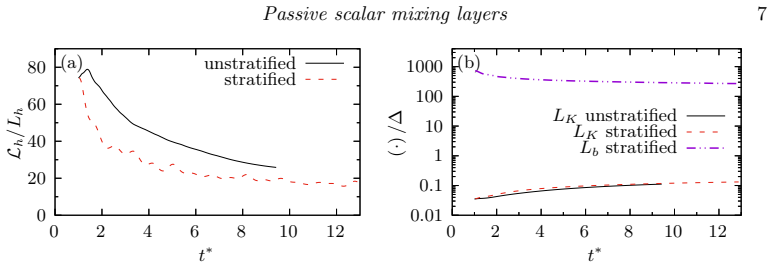
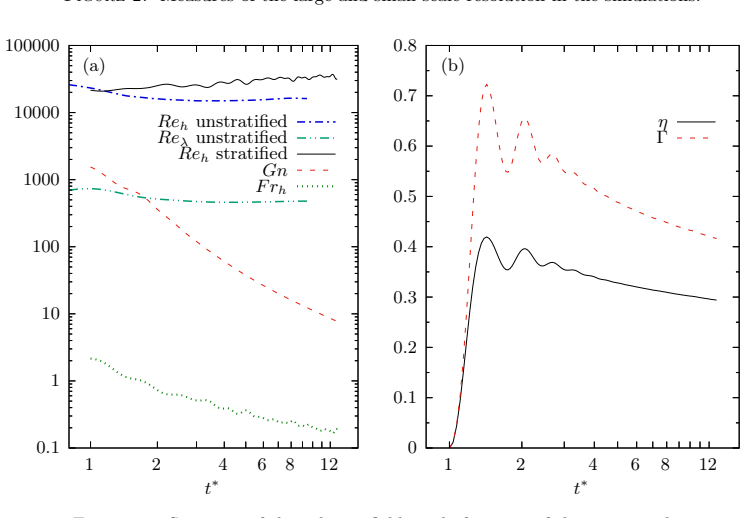
- [abstract and vertical-mixing results section] The central vertical-mixing claim (abstract and results) states that the passive layer grows until its width equals the vertical integral length of horizontal velocity, which is 'constrained to maintain the vertical Froude number order one,' after which spreading halts. In unforced decaying turbulence u_rms decreases while N is fixed, so the length scale required for Fr ~ O(1) shrinks; a passive scalar layer cannot contract. The manuscript must therefore demonstrate (via time series of L_v, u_rms, and Fr) that the measured vertical integral length remains proportional to u_rms/N throughout the reported plateau phase rather than the plateau arising simply from overall decay and suppressed w. Without this explicit check the proposed mechanism is at risk of internal inconsistency.
- [methods section] Methods and numerical validation details are insufficient to assess whether the reported suppression and growth limits are robust. Grid resolution, filter width, initial-condition spectra, and any benchmark comparisons (e.g., against known unstratified scalar mixing rates or established stratified decay laws) are not provided; numerical dissipation or domain-size effects could therefore influence the vertical integral length and the apparent Fr constraint.
- [modeling section] The two-constant flux model is stated to work 'only if the scalar is in quasi-equilibrium with the velocity field such that the length scale of the scalar can be scaled from the kinetic energy.' The manuscript should quantify this quasi-equilibrium assumption (e.g., by showing the ratio of scalar to velocity time scales or spectra) during the period when the model is applied; otherwise the reported model performance cannot be generalized.
minor comments (2)
- [abstract] The abstract and text refer to 'high-resolution' LES without stating the effective Reynolds number or grid points; a brief statement of these quantities would aid reproducibility.
- [transverse-mixing results] The statement that 'the turbulent/non-turbulent interface is more intermittent' in the stratified transverse case would benefit from a quantitative measure (e.g., interface thickness PDF or fractal dimension) rather than qualitative description.
Simulated Author's Rebuttal
We thank the referee for their careful and constructive review of our manuscript. The comments have identified areas where additional clarification and data will strengthen the presentation of our results on scalar mixing in stratified turbulence. We address each major comment point by point below and will revise the manuscript accordingly.
read point-by-point responses
-
Referee: [abstract and vertical-mixing results section] The central vertical-mixing claim (abstract and results) states that the passive layer grows until its width equals the vertical integral length of horizontal velocity, which is 'constrained to maintain the vertical Froude number order one,' after which spreading halts. In unforced decaying turbulence u_rms decreases while N is fixed, so the length scale required for Fr ~ O(1) shrinks; a passive scalar layer cannot contract. The manuscript must therefore demonstrate (via time series of L_v, u_rms, and Fr) that the measured vertical integral length remains proportional to u_rms/N throughout the reported plateau phase rather than the plateau arising simply from overall decay and suppressed w. Without this explicit check the proposed mechanism is at risk of internal inconsistency.
Authors: We appreciate the referee highlighting this important consistency check for the proposed vertical mixing suppression mechanism. In our simulations the vertical integral length L_v remains proportional to u_rms/N during the plateau phase because stratification modulates the decay of the horizontal velocity components, keeping the vertical Froude number O(1). To make this explicit, we will add time-series plots of L_v(t), u_rms(t), and Fr_v(t) in the revised manuscript, confirming the maintained scaling throughout the period of arrested spreading. revision: yes
-
Referee: [methods section] Methods and numerical validation details are insufficient to assess whether the reported suppression and growth limits are robust. Grid resolution, filter width, initial-condition spectra, and any benchmark comparisons (e.g., against known unstratified scalar mixing rates or established stratified decay laws) are not provided; numerical dissipation or domain-size effects could therefore influence the vertical integral length and the apparent Fr constraint.
Authors: We agree that the methods section requires expansion for reproducibility and to demonstrate robustness. In the revised manuscript we will add the grid resolution and domain size, the LES filter width, the form of the initial velocity and scalar spectra, and direct benchmark comparisons against unstratified scalar mixing rates and established stratified decay laws. These additions will confirm that the observed vertical growth limit and Fr constraint are not influenced by numerical dissipation or domain-size effects. revision: yes
-
Referee: [modeling section] The two-constant flux model is stated to work 'only if the scalar is in quasi-equilibrium with the velocity field such that the length scale of the scalar can be scaled from the kinetic energy.' The manuscript should quantify this quasi-equilibrium assumption (e.g., by showing the ratio of scalar to velocity time scales or spectra) during the period when the model is applied; otherwise the reported model performance cannot be generalized.
Authors: We thank the referee for this suggestion. We will quantify the quasi-equilibrium assumption in the revised modeling section by adding the ratio of scalar to velocity integral time scales (computed from autocorrelations) and spectral comparisons between the scalar and kinetic energy fields during the time window in which the two-constant model is applied. This will substantiate the assumption and clarify the conditions under which the model can be generalized. revision: yes
Circularity Check
No circularity: observations from LES data, not derived or fitted by construction
full rationale
The paper reports outcomes from high-resolution large-eddy simulations of decaying homogeneous turbulence with passive scalars. The central statements about vertical mixing layer growth halting when the layer width becomes proportional to the vertical integral length scale (to keep vertical Froude number O(1)) are presented as direct simulation results, not as predictions from a closed mathematical model or parameters fitted to the same data. No self-definitional steps, fitted inputs renamed as predictions, or load-bearing self-citations appear in the derivation chain. The work is self-contained against external benchmarks via the reported DNS/LES outputs.
Axiom & Free-Parameter Ledger
axioms (2)
- domain assumption Boussinesq approximation for density variations in stratified flow
- domain assumption Large-eddy simulation closure for subgrid scales in decaying turbulence
Reference graph
Works this paper leans on
-
[1]
Borgas, Michael S. and Sawford, Brian L. and Xu, Shuyi and Donzis, Diego A. and Yeung, P. K. , title = ". Physics of Fluids , volume = 16, number = 11, pages =. doi:10.1063/1.1780550 , url =
-
[2]
Turbulence is an Ineffective Mixer when Schmidt Numbers Are Large , author =. Phys. Rev. Lett. , volume = 126, issue = 7, pages = 074501, numpages = 6, year = 2021, month =
2021
-
[3]
F. Feraco and R. Marino and A. Pumir and L. Primavera and P. D. Mininni and A. Pouquet and D. Rosenberg , title =. doi:10.1209/0295-5075/123/44002 , url =
-
[4]
Turbulence generation by large-scale extreme vertical drafts and the modulation of local energy dissipation in stably stratified geophysical flows , author =. Phys. Rev. Fluids , volume = 7, issue = 3, pages = 033801, numpages = 14, year = 2022, month =. doi:10.1103/PhysRevFluids.7.033801 , url =
-
[5]
Renormalization Methods Applied to Turbulence Theory
McComb, David. Renormalization Methods Applied to Turbulence Theory. Theories of Turbulence
-
[6]
Turbulence comes in bursts in stably stratified flows , author =. Phys. Rev. E , volume = 89, issue = 4, pages = 043002, numpages = 8, year = 2014, month =. doi:10.1103/PhysRevE.89.043002 , url =
-
[7]
Invariant manifolds in stratified turbulence , author =. Phys. Rev. Fluids , volume = 4, issue = 5, pages = 052402, numpages = 8, year = 2019, month =. doi:10.1103/PhysRevFluids.4.052402 , url =
-
[8]
From waves to convection and back again: The phase space of stably stratified turbulence , author =. Phys. Rev. Fluids , volume = 5, issue = 6, pages = 064802, numpages = 26, year = 2020, month =. doi:10.1103/PhysRevFluids.5.064802 , url =
-
[9]
Applied Numerical Mathematics , publisher =
On the construction and analysis of absorbing layers in CEM , author =. Applied Numerical Mathematics , publisher =
-
[10]
Nonlinear stability analysis of stratified fluid equilibria , author =. Philos. Trans. R. Soc. Lond. Ser. A-Math. Phys. Eng. Sci. , volume = 318, pages =
-
[11]
Shear flow induced interface instability , author =. Exp. Fluids , volume = 31, pages =
-
[12]
Abdilghanie, A. M. and Diamessis, P. J. , year =
-
[13]
The internal gravity wave field emitted by a stably stratified turbulent wake , author =
-
[14]
The Theory of Turbulent Jets , author =
-
[15]
Astrophys
Mechanical wave-energy flux in magnetoatmospheres - discrete and continuous spectra , author =. Astrophys. Space Sci. , volume = 78, pages =
-
[16]
Astrophys
The critical layers and other singular regions in ideal hydrodynamics and magnetohydrodynamics , author =. Astrophys. Space Sci. , volume = 105, pages =
-
[17]
Critical layer singularities and complex eigenvalues in some differential-equations of mathematical physics , author =. Phys. Rep.-Rev. Sec. Phys. Lett. , volume = 142, pages =
-
[18]
A nonlinear eigenvalue problem in astrophysical magnetohydrodynamics - some properties of the spectrum , author =. J. Math. Phys. , volume = 30, pages =
-
[19]
The Hitchhiker's Guide to the Galaxy , author =
-
[20]
Suppression of turbulence in magnetically stabilized ferroliquids , author =. Int. J. Eng. Sci. , volume = 19, pages =
-
[21]
KSME Int
Spanwise growth of vortex structure in wall turbulence , author =. KSME Int. J. , volume = 15, pages =
-
[22]
The three-dimensionalization of stratified flow over twodimensional topography , author =. J. Atmos. Sci. , volume = 55, pages =
-
[23]
, year = 2001, journal =
Afzal, N. , year = 2001, journal =. Power law and log law velocity profiles in turbulent boundarylayer flow: equivalent relations at large
2001
-
[24]
Relationship between stokes number and intrinsic frequencies in particle-laden flows , author =. AIAA J. , volume = 32, pages =
-
[25]
Effect of stokes number on particle dispersion , author =. Atom. Sprays , volume = 4, pages =
-
[26]
Numerical simulation of particle transport in planar shear layers , author =. Comput. Fluids , volume = 25, pages =
-
[27]
Dispersion of evaporating droplets in a swirling axisymmetric jet , author =. Aiaa J. , volume = 37, pages =
-
[28]
and Boegman, L
Aghsaee, P. and Boegman, L. and Diamessis, P. J. and Lamb, Kevin G. , year =
-
[29]
On the mechanisms of modifying the structure of turbulent homogeneous shear flows by dispersed particles , author =. Phys. Fluids , volume = 12, pages =
-
[30]
On the mechanisms of modifying the structure of turbulent homogeneous shear flows by dispersed pARTICLEs , author =. Phys. Fluids , volume = 12, pages =
-
[31]
Direct numerical simulation of pARTICLE dispersion in homogeneous turbulent shear flows , author =. Phys. Fluids , volume = 13, pages =
-
[32]
High Temp
The use of a model of axisymmetric turbulence for analysis of statistical characteristics of pulsation motion in a uniformmean-shear-flow , author =. High Temp. , volume = 38, pages =
-
[33]
Shear instability of fluid interfaces: Stability analysis , author =. Phys. Rev. E , volume = 65, pages =
-
[34]
Flow Turbul
Analysis of streamwise velocity fluctuations in turbulent pipe flow with the use of an ultrasonic Doppler flowmeter , author =. Flow Turbul. Combust. , volume = 67, pages =
-
[35]
Near-inertial mixing: Modulation of shear, strain and microstructure at low latitude , author =. J. Geophys. Res.-Oceans , volume = 106, pages =
-
[36]
Observations of overturning in the thermocline: The context of ocean mixing , author =. J. Phys. Oceanogr. , volume = 30, pages =
-
[37]
Patterns of turbulent and double-diffusive phenomena: Observations from a rapid-profiling microconductivity probe , author =. J. Phys. Oceanogr. , volume = 30, pages =
-
[38]
Quantification of stratospheric mixing from turbulence microstructure measurements , author =. Geophys. Res. Lett. , volume = 27, pages =
-
[39]
Almalkie , year = 2007, school =
S. Almalkie , year = 2007, school =. Pseudo-spectral Direct Numerical Simulation of
2007
-
[40]
Almalkie and S
S. Almalkie and S. M. de Bruyn Kops , year = 2012, journal =. Energy Dissipation Rate Surrogates in Incompressible
2012
-
[41]
Kinetic Energy Dynamics in Forced, Homogeneous, and Axisymmetric Stably Stratified Turbulence , author =
-
[42]
The Two-Frequency Microwave Technique for Measuring Ocean-Wave Spectra from Airplane and Satellite , author =
-
[43]
IEEE Trans
The Effect of Orbital Motions on Synthetic Aperture Radar Imagery of Ocean Waves , author =. IEEE Trans. Antennas Propagat. , volume = 27, number = 5, pages =
-
[44]
and Schroter, J
Alpers, W. and Schroter, J. and Schlude, F. and Muller, H. J. and Koltermann, K. P. , year = 1981, journal =. Ocean surface current measurements by an
1981
-
[45]
On the Detectability of Ocean Surface Waves by Real and Synthetic Aperture Radar , author =. J. Geophys. Res. , volume =
-
[46]
W. R. Alpers and C. Bruening , year = 1986, journal =. On the Relative Importance of Motion-Related Contributions to the
1986
-
[47]
Stratified Flows , publisher =
Differential property transport due to incomplete mixing in a stratified fluid , author =. Stratified Flows , publisher =
-
[48]
LES computations and comparison with Kolmogorov theory for two-point pressure-velocity correlations and structure functions for globally anisotropic turbulence , author =. J. Fluid Mech. , volume = 403, pages =
-
[49]
Random forcing of three-dimensional homogeneous turbulence , author =. Phys. Fluids , volume = 11, pages =
-
[50]
International Journal Of Heat And Mass Transfer , volume = 39, pages =
Velocity near-field of variable density turbulent jets , author =. International Journal Of Heat And Mass Transfer , volume = 39, pages =
-
[51]
Series 2000 Waveform Sampler Systems Operations Manual , year = 1991, month =
2000
-
[52]
Diffusion Behind a Line Source In Grid Turbulence , author =. Turbulent Shear Flows 4: Selected Papers from the Fourth International Symposium on Turbulent Shear Flows, University of Karlsruhe, Karlsruhe, FRG, September 12-14, 1983 , publisher =
1983
-
[53]
M. G. Ancona , year = 1994, journal =. Fully-
1994
-
[54]
Andreassen and P
O. Andreassen and P. O. Hvidsten and D. C. Fritts and S. Arendt , year = 1998, journal =. Vorticity dynamics in a breaking internal gravity wave
1998
-
[55]
Computational Fluid Mechanics and Heat Transfer , author =
-
[56]
Particle motion in the stagnation zone of an impinging air-jet , author =. J. Fluid Mech. , volume = 299, pages =
-
[57]
and Meneveau, C
Anderson, R. and Meneveau, C. , year = 1999, journal =. Effects of the similarity model in finite-difference
1999
-
[58]
An experimental study of the dissipative and vortical motion in turbulent boundary layers , author =. J. Fluid Mech. , volume = 439, pages =
-
[59]
Ocean Circulation , year = 2002, publisher =
2002
-
[60]
Errors in Mean Vertical Velocities Measured by Boundary Layer Wind Profilers , author =. J. Atmos. Oceanic. Tech. , volume = 14, pages =
-
[61]
ACM Sigmod record , publisher =
OPTICS: Ordering points to identify the clustering structure , author =. ACM Sigmod record , publisher =
-
[62]
High-order velocity structure functions in turbulent shear flows , author =. J. Fluid Mech. , volume = 140, pages =
-
[63]
Joint statistics between temperature and its dissipation in a turbulent jet , author =. Phys. Fluids , volume = 28, pages =
-
[64]
Antonia, R. A. and Orlandi, P. , year = 2003, journal =. On
2003
-
[65]
Effect of Schmidt number on small-scale passive scalar turbulence , author =. Appl. Mech. Rev. , volume = 56, number = 6, pages =
-
[66]
Similarity of Decaying Isotropic Turbulence with a Passive Scalar , author =. J. Fluid Mech. , volume = 505, pages =
-
[67]
Approach to the 4/5 law in homogeneous isotropic turbulence , author =. J. Fluid Mech. , volume = 550, pages =
-
[68]
On the correlation between temperature and velocity structure functions in turbulent shear flows , author =. Phys. Rev. A , volume = 30, pages =
-
[69]
Lognormality of temperature dissipation in a turbulent boundary layer , author =
-
[70]
Structure function of temperature fluctuations in turbulent shear flows , author =
-
[71]
Antonia, R. A. and Chambers, A. J. and Satyaprakash, B. R. , year = 1981, journal = blm, volume = 21, pages =
1981
-
[72]
Conditional sampling in turbulence measurement , author =
-
[73]
Statistics of fine-scale velocity in turbulent plane and circular jets , author =. J. Fluid Mech. , volume = 119, pages =
-
[74]
Temperature structure functions in turbulent shear flows , author =. Phys. Rev. A , volume = 30, pages =
-
[75]
Organized structures in a turbulent plane jet: topology and contribution to momentum and heat transport , author =
-
[76]
Fluid Dyn
Turbulence structure in boundary layers over different types of surface roughness , author =. Fluid Dyn. Res. , volume = 28, pages =
-
[77]
and Arimitsu, T
Arimitsu, N. and Arimitsu, T. , year = 2011, journal =. Verification of the scaling relation within
2011
-
[78]
Vector Tensors and the Basic Equations of Fluid Mechanics , author =
-
[79]
and Piomelli, U
Armenio, V. and Piomelli, U. , year = 2000, journal =. A
2000
-
[80]
An investigation of stably stratified turbulent channel flow using large-eddy simulation , author =
discussion (0)
Sign in with ORCID, Apple, or X to comment. Anyone can read and Pith papers without signing in.