Recognition: unknown
Nonuniform superconducting states from Majorana flat bands
Pith reviewed 2026-05-07 12:54 UTC · model grok-4.3
The pith
Majorana flat bands in topological superconductors make the uniform superconducting state unstable at zero temperature.
A machine-rendered reading of the paper's core claim, the machinery that carries it, and where it could break.
Core claim
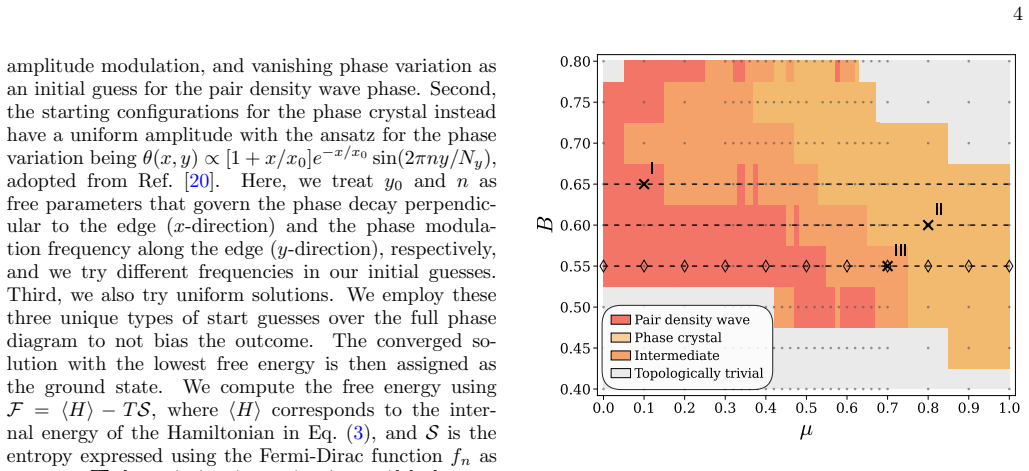
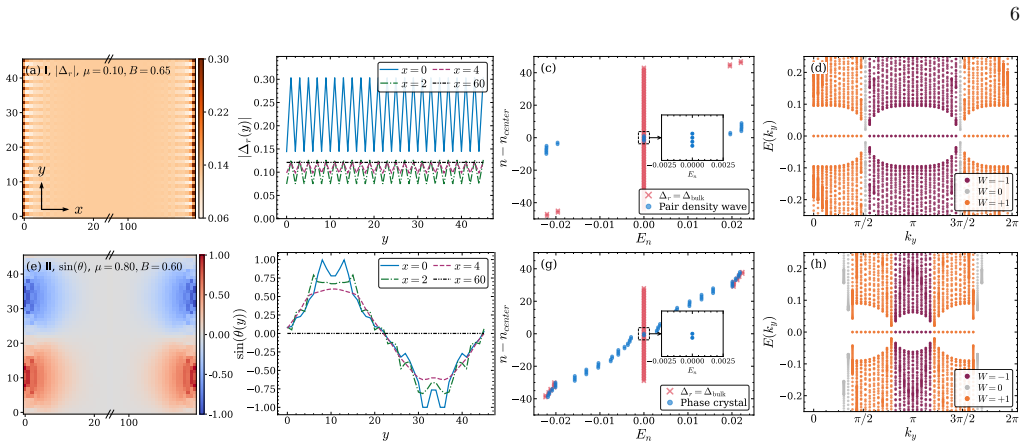
Self-consistent calculations show that in magnetic-adatom topological superconductors the uniform superconducting order parameter accompanied by a Majorana flat band is never the ground state at zero temperature. Instead the order parameter develops either edge-localized amplitude modulations forming a pair density wave or edge-localized phase modulations forming a phase crystal, both of which gap the flat band according to the winding number set by chemical potential. When amplitude modulations are insufficient to hybridize all Majorana states the system crosses over to the phase crystal, with a broad intermediate region of comparable amplitude and phase modulations lying between the two.
What carries the argument
The Majorana flat band of edge states that is removed by spatial modulations of the superconducting order parameter, whose type is selected by the chemical potential through the winding number.
If this is right
- The uniform superconducting solution with an intact Majorana flat band never minimizes the free energy at zero temperature.
- The zero-temperature phase diagram is occupied by a pair density wave that gives way to a phase crystal when amplitude modulations become insufficient to hybridize every Majorana state.
- A broad intermediate regime exists in which amplitude and phase modulations are comparable.
- The pair density wave remains stable up to approximately 80 percent of the bulk superconducting transition temperature, while the phase crystal appears only at lower temperatures and the intermediate regime is suppressed.
- Winding numbers controlled by chemical potential dictate which nonuniform state gaps the flat band.
Where Pith is reading between the lines
- Similar instabilities of uniform superconductivity may appear in other platforms that host flat bands of zero-energy states.
- The temperature window separating the pair density wave from the phase crystal could be used to distinguish the two phases in transport or scanning-probe experiments.
- If the mean-field energetics remain valid, the same mechanism may operate in higher-dimensional or disordered realizations of topological superconductivity.
Load-bearing premise
The self-consistent mean-field treatment of the superconducting order parameter on the specific magnetic adatom lattice accurately identifies the lowest-energy state among uniform, pair-density-wave, and phase-crystal solutions.
What would settle it
A zero-temperature calculation or measurement that finds the uniform superconducting state to have lower free energy than either modulated state while leaving the Majorana flat band gapless would falsify the claim.
Figures



read the original abstract
Zero-energy flat bands within the superconducting gap can give rise to competing ordered phases. We investigate such phases in topological superconductors based on the magnetic adatom platform hosting a flat band of Majorana edge states. Our self-consistent calculations of the superconducting order parameter show the emergence of both a pair density wave with edge-localized amplitude modulations and a phase crystal characterized by edge-localized phase modulations. These two phases lower the free energy of the system by gapping out the Majorana flat band, as dictated by winding numbers, which are primarily tuned by the chemical potential. In fact, at zero temperature the uniform superconducting solution with Majorana flat band never survives and the phase diagram features a pair density wave, while the order parameter transitions into a phase crystal when amplitude modulations are insufficient to hybridize all the Majorana states. A broad intermediate region connects these two phases with comparable modulations in both amplitude and phase. At finite temperatures, the pair density wave survives up to around 80% of the bulk superconducting transition temperature, while the phase crystal only appears at lower temperatures and the intermediate region is strongly suppressed. Our findings establish the ubiquity of emergent nonuniform superconducting phases and their temperature-dependent behavior in topological superconductors.
Editorial analysis
A structured set of objections, weighed in public.
Referee Report
Summary. The manuscript investigates competing nonuniform superconducting phases in a magnetic adatom platform that hosts a Majorana flat band. Self-consistent mean-field calculations of the order parameter are used to show that, at zero temperature, the uniform superconducting solution is never stable for any chemical potential supporting the flat band; instead the system realizes an edge-localized pair-density-wave (PDW) state or a phase-crystal state (with phase modulations) that gaps the flat band, with the choice governed by winding numbers primarily tuned by chemical potential. An intermediate regime with mixed amplitude and phase modulations is identified, and the temperature dependence is mapped, with the PDW surviving to roughly 80% of the bulk Tc while the phase crystal appears only at lower temperatures.
Significance. If the central numerical claims hold, the work establishes that Majorana flat bands generically select nonuniform superconducting orders that lower the free energy by gapping zero-energy states, with a concrete temperature-dependent phase diagram. The explicit connection to winding numbers and the demonstration that the uniform state is disfavored provide a useful organizing principle for topological superconductors on adatom lattices. The finite-temperature results add practical value for experimental searches.
major comments (3)
- [§3] §3 (self-consistent gap-equation iteration) and associated figures: the assertion that the uniform solution 'never survives' at T=0 rests on free-energy comparisons performed on finite lattices with open boundaries. Because both the Majorana flat band and the stabilizing modulations are edge-localized, the absence of any reported transverse-size scaling (or analytic argument for the thermodynamic limit) leaves open the possibility that finite-width effects artificially favor or suppress hybridization; this directly undermines the load-bearing claim that the uniform saddle point is always unstable.
- [§4] §4 (phase-diagram construction): the transition criterion 'when amplitude modulations are insufficient to hybridize all the Majorana states' is stated without a quantitative diagnostic (e.g., the fraction of ungapped spectral weight, explicit winding-number evaluation as a function of chemical potential, or the eigenvalue spectrum of the Bogoliubov-de Gennes matrix). Without this, the distinction between PDW, intermediate, and phase-crystal regimes cannot be verified independently of the numerical output.
- [§2] §2 (numerical methods): no convergence criteria, tolerance thresholds, number of random initial conditions, or checks for metastable solutions are reported for the iterative solver. Given that the central result is a global free-energy comparison among competing order-parameter profiles, the lack of these controls makes it impossible to rule out that the uniform state is simply not being reached from the chosen starting points.
minor comments (3)
- [Abstract] The abstract states that winding numbers 'dictate' the gapping but provides no formula or reference for their calculation; a one-sentence definition or citation in the main text would clarify the topological argument.
- [Figures] Figure captions should explicitly list the chemical-potential values, lattice dimensions, and temperature for each panel to allow direct comparison with the phase-diagram claims.
- [§5] A brief statement on the bulk superconducting gap magnitude used to normalize temperatures would help readers assess the reported 80% Tc survival of the PDW.
Simulated Author's Rebuttal
We thank the referee for the careful and constructive report. The comments identify key points that strengthen the manuscript, and we have revised it accordingly. Below we respond point by point to the major comments.
read point-by-point responses
-
Referee: [§3] §3 (self-consistent gap-equation iteration) and associated figures: the assertion that the uniform solution 'never survives' at T=0 rests on free-energy comparisons performed on finite lattices with open boundaries. Because both the Majorana flat band and the stabilizing modulations are edge-localized, the absence of any reported transverse-size scaling (or analytic argument for the thermodynamic limit) leaves open the possibility that finite-width effects artificially favor or suppress hybridization; this directly undermines the load-bearing claim that the uniform saddle point is always unstable.
Authors: We agree that a systematic transverse-size scaling analysis is necessary to confirm the result in the thermodynamic limit. In the revised manuscript we have added calculations for widths up to W=24 (doubling the largest size in the original submission) together with a finite-size scaling plot of the free-energy difference between the uniform and modulated states. The difference converges to a finite nonzero value, consistent with the edge-localized hybridization mechanism. We have also included a short analytic argument in the effective low-energy theory of the Majorana flat band showing that the uniform saddle point remains unstable for any finite hybridization strength in the large-width limit. revision: yes
-
Referee: [§4] §4 (phase-diagram construction): the transition criterion 'when amplitude modulations are insufficient to hybridize all the Majorana states' is stated without a quantitative diagnostic (e.g., the fraction of ungapped spectral weight, explicit winding-number evaluation as a function of chemical potential, or the eigenvalue spectrum of the Bogoliubov-de Gennes matrix). Without this, the distinction between PDW, intermediate, and phase-crystal regimes cannot be verified independently of the numerical output.
Authors: We accept that an explicit quantitative diagnostic is required. The revised manuscript now reports (i) the fraction of ungapped zero-energy spectral weight versus chemical potential, (ii) the winding number of the order-parameter phase evaluated directly from the self-consistent solution, and (iii) the low-lying BdG eigenvalue spectrum for representative points in each regime. These diagnostics are used to delineate the PDW, intermediate, and phase-crystal regions and are shown in new panels of the phase diagram. revision: yes
-
Referee: [§2] §2 (numerical methods): no convergence criteria, tolerance thresholds, number of random initial conditions, or checks for metastable solutions are reported for the iterative solver. Given that the central result is a global free-energy comparison among competing order-parameter profiles, the lack of these controls makes it impossible to rule out that the uniform state is simply not being reached from the chosen starting points.
Authors: We have expanded §2 to document the numerical protocol in detail: the iterative solver is terminated when the residual norm of the gap equation falls below 10^{-8}; at least 20 independent random initial conditions are used for each parameter set; and free energies of all converged solutions are compared to identify the global minimum. We explicitly verify that initializing near the uniform state yields a converged uniform solution whose free energy lies above that of the modulated states, confirming that the uniform saddle point is not an artifact of initialization. revision: yes
Circularity Check
No circularity: claims follow from direct numerical solution of self-consistent gap equations
full rationale
The paper's central results are obtained by numerically iterating the self-consistent mean-field gap equation on a finite lattice model of magnetic adatoms, then comparing the free energies of the converged uniform, PDW, and phase-crystal order-parameter configurations. These comparisons are performed directly from the model's Hamiltonian and the resulting Bogoliubov-de Gennes spectrum; the statement that the uniform solution 'never survives' at T=0 is an output of those energy rankings rather than an input or a redefinition. No fitted parameters are renamed as predictions, no ansatz is smuggled via self-citation, and no uniqueness theorem from prior work by the same authors is invoked to force the nonuniform states. The calculation is therefore self-contained against the stated model and mean-field approximation.
Axiom & Free-Parameter Ledger
axioms (2)
- domain assumption Mean-field approximation for the superconducting order parameter
- domain assumption Winding numbers of the Majorana flat band are primarily tuned by chemical potential
Reference graph
Works this paper leans on
-
[1]
A. A. Abrikosov, On the Magnetic Properties of Super- conductors of the Second Group, Sov. Phys. JETP5, 1174 (1957)
1957
-
[2]
Fulde and R
P. Fulde and R. A. Ferrell, Superconductivity in a strong spin-exchange field, Phys. Rev.135, A550 (1964)
1964
-
[3]
A. I. Larkin and Y. N. Ovchinnikov, Nonuniform state of superconductors, Zh. Eksp. Teor. Fiz.47, 1136 (1964)
1964
-
[4]
Himeda, T
A. Himeda, T. Kato, and M. Ogata, Stripe states with spatially oscillatingd-wave superconductivity in the two- dimensionalt−t ′ −Jmodel, Phys. Rev. Lett.88, 117001 (2002)
2002
-
[5]
E. Berg, E. Fradkin, E.-A. Kim, S. A. Kivelson, V. Oganesyan, J. M. Tranquada, and S. C. Zhang, Dy- namical layer decoupling in a stripe-ordered high-T c su- perconductor, Phys. Rev. Lett.99, 127003 (2007)
2007
-
[6]
E. Berg, E. Fradkin, and S. A. Kivelson, Theory of the striped superconductor, Phys. Rev. B79, 064515 (2009)
2009
-
[7]
Barkman, A
M. Barkman, A. Samoilenka, and E. Babaev, Surface pair-density-wave superconducting and superfluid states, Phys. Rev. Lett.122, 165302 (2019)
2019
-
[8]
A. B. Vorontsov, Andreev bound states in superconduct- ing films and confined superfluid 3He, Philos. Trans. R. Soc. A376, 20150144 (2018)
2018
-
[9]
Sigrist, Time-reversal symmetry breaking states in high-temperature superconductors, Prog
M. Sigrist, Time-reversal symmetry breaking states in high-temperature superconductors, Prog. Theor. Phys. 99, 899 (1998)
1998
-
[10]
Matsumoto and H
M. Matsumoto and H. Shiba, Coexistence of different symmetry order parameters near a surface ind-wave su- perconductors III, J. Phys. Soc. Jpn.65, 2194 (1996)
1996
-
[11]
Fogelstr¨ om, D
M. Fogelstr¨ om, D. Rainer, and J. A. Sauls, Tunneling into current-carrying surface states of high-t c supercon- ductors, Phys. Rev. Lett.79, 281 (1997)
1997
-
[12]
Honerkamp, K
C. Honerkamp, K. Wakabayashi, and M. Sigrist, Insta- bilities at [110] surfaces ofd x2−y2 superconductors, EPL 50, 368 (2000)
2000
-
[13]
L¨ ofwander, V
T. L¨ ofwander, V. S. Shumeiko, and G. Wendin, Time- reversal symmetry breaking at josephson tunnel junc- tions of purely d-wave superconductors, Phys. Rev. B 62, R14653 (2000)
2000
-
[14]
A. M. Black-Schaffer, D. S. Golubev, T. Bauch, F. Lom- bardi, and M. Fogelstr¨ om, Model evidence of a super- conducting state with a full energy gap in small cuprate islands, Phys. Rev. Lett.110, 197001 (2013)
2013
-
[15]
A. C. Potter and P. A. Lee, Edge ferromagnetism from majorana flat bands: Application to split tunneling- conductance peaks in high-T c cuprate superconductors, Phys. Rev. Lett.112, 117002 (2014)
2014
-
[16]
H˚ akansson, T
M. H˚ akansson, T. L¨ ofwander, and M. Fogelstr¨ om, Spontaneously broken time-reversal symmetry in high- temperature superconductors, Nat. Phys.11, 755 (2015)
2015
-
[17]
Nagai, Y
Y. Nagai, Y. Ota, and K. Tanaka, Time-reversal sym- metry breaking and gapped surface states due to spon- taneous emergence of new order ind-wave nanoislands, Phys. Rev. B96, 060503 (2017)
2017
-
[18]
Holmvall, A
P. Holmvall, A. B. Vorontsov, M. Fogelstr¨ om, and T. L¨ ofwander, Broken translational symmetry at edges of high-temperature superconductors, Nat. Commun.9, 2190 (2018)
2018
-
[19]
Holmvall, A
P. Holmvall, A. B. Vorontsov, M. Fogelstr¨ om, and T. L¨ ofwander, Spontaneous symmetry breaking at sur- faces ofd-wave superconductors: Influence of geometry and surface ruggedness, Phys. Rev. B99, 184511 (2019)
2019
-
[20]
Holmvall, M
P. Holmvall, M. Fogelstr¨ om, T. L¨ ofwander, and A. B. Vorontsov, Phase crystals, Phys. Rev. Res.2, 013104 (2020)
2020
-
[21]
Matsubara and H
S. Matsubara and H. Kontani, Emergence ofd±ip-wave superconducting state at the edge ofd-wave supercon- ductors mediated by ferromagnetic fluctuations driven by andreev bound states, Phys. Rev. B101, 235103 (2020)
2020
-
[22]
N. W. Wennerdal, A. Ask, P. Holmvall, T. L¨ ofwander, and M. Fogelstr¨ om, Breaking time-reversal and trans- lational symmetry at edges ofd-wave superconductors: Microscopic theory and comparison with quasiclassical theory, Phys. Rev. Res.2, 043198 (2020)
2020
-
[23]
K. M. Seja, N. Wall-Wennerdal, T. L¨ ofwander, and M. Fogelstr¨ om, Spontaneous splitting ofd-wave surface states: Competition between circulating currents and edge magnetization, Phys. Rev. B110, 064502 (2024)
2024
-
[24]
D. Chakraborty, T. L¨ ofwander, M. Fogelstr¨ om, and A. M. Black-Schaffer, Disorder-robust phase crystal in high-temperature superconductors stabilized by strong correlations, npj Quantum Mater.7, 10.1038/s41535- 022-00450-w (2022)
-
[25]
P. M. Bonetti, D. Chakraborty, X. Wu, and A. P. Schny- der, Interaction-driven first-order and higher-order topo- logical superconductivity, Phys. Rev. B109, L180509 (2024)
2024
-
[26]
K. M. Seja, N. Wall-Wennerdal, T. L¨ ofwander, A. M. Black-Schaffer, M. Fogelstr¨ om, and P. Holmvall, Impurity strength–temperature phase diagram with phase crystals and competing time-reversal symmetry breaking states in nodald-wave superconductors, Phys. Rev. B111, 094513 (2025)
2025
-
[27]
Covington, M
M. Covington, M. Aprili, E. Paraoanu, L. H. Greene, F. Xu, J. Zhu, and C. A. Mirkin, Observation of surface- induced broken time-reversal symmetry in yba 2cu3O7 tunnel junctions, Phys. Rev. Lett.79, 277 (1997)
1997
-
[28]
L. Alff, H. Takashima, S. Kashiwaya, N. Terada, H. Ihara, Y. Tanaka, M. Koyanagi, and K. Kajimura, Spatially continuous zero-bias conductance peak on (110) yba2cu3o7−δ surfaces, Phys. Rev. B55, R14757 (1997)
1997
-
[29]
J. Y. T. Wei, N.-C. Yeh, D. F. Garrigus, and M. Strasik, Directional tunneling and andreev reflection on yba2cu3o7−δ single crystals: Predominance ofd-wave pairing symmetry verified with the generalized blonder, tinkham, and klapwijk theory, Phys. Rev. Lett.81, 2542 (1998)
1998
-
[30]
Dagan and G
Y. Dagan and G. Deutscher, Doping and magnetic field dependence of in-plane tunneling into YBa 2Cu3O7−x: Possible evidence for the existence of a quantum criti- cal point, Phys. Rev. Lett.87, 177004 (2001). 15
2001
-
[31]
W. K. Neils and D. J. Van Harlingen, Experimental test for subdominant superconducting phases with complex order parameters in cuprate grain boundary junctions, Phys. Rev. Lett.88, 047001 (2002)
2002
-
[32]
Y. Li, D. Wang, and C. Wu, Spontaneous breaking of time-reversal symmetry in the orbital channel for the boundary majorana flat bands, New J. Phys.15, 085002 (2013)
2013
-
[33]
Wakatsuki, M
R. Wakatsuki, M. Ezawa, and N. Nagaosa, Majorana fermions and multiple topological phase transition in ki- taev ladder topological superconductors, Phys. Rev. B 89, 174514 (2014)
2014
-
[34]
Mizushima and M
T. Mizushima and M. Sato, Topological phases of quasi- one-dimensional fermionic atoms with a synthetic gauge field, New J. Phys.15, 075010 (2013)
2013
-
[35]
D. Wang, Z. Huang, and C. Wu, Fate and remnants of majorana zero modes in a quantum wire array, Phys. Rev. B89, 174510 (2014)
2014
-
[36]
C. Qu, M. Gong, Y. Xu, S. Tewari, and C. Zhang, Majorana fermions in quasi-one-dimensional and higher- dimensional ultracold optical lattices, Phys. Rev. A92, 023621 (2015)
2015
-
[37]
H. Hu, F. Zhang, and C. Zhang, Majorana doublets, flat bands, and dirac nodes ins-wave superfluids, Phys. Rev. Lett.121, 185302 (2018)
2018
-
[38]
T.-P. Choy, J. M. Edge, A. R. Akhmerov, and C. W. J. Beenakker, Majorana fermions emerging from magnetic nanoparticles on a superconductor without spin-orbit coupling, Phys. Rev. B84, 195442 (2011)
2011
-
[39]
Martin and A
I. Martin and A. F. Morpurgo, Majorana fermions in su- perconducting helical magnets, Phys. Rev. B85, 144505 (2012)
2012
-
[40]
Pientka, L
F. Pientka, L. I. Glazman, and F. von Oppen, Topological superconducting phase in helical shiba chains, Phys. Rev. B88, 155420 (2013)
2013
-
[41]
Y. Kim, M. Cheng, B. Bauer, R. M. Lutchyn, and S. Das Sarma, Helical order in one-dimensional magnetic atom chains and possible emergence of majorana bound states, Phys. Rev. B90, 060401 (2014)
2014
-
[42]
Schecter, K
M. Schecter, K. Flensberg, M. H. Christensen, B. M. Andersen, and J. Paaske, Self-organized topological su- perconductivity in a yu-shiba-rusinov chain, Phys. Rev. B93, 140503 (2016)
2016
-
[43]
Nadj-Perge, I
S. Nadj-Perge, I. K. Drozdov, B. A. Bernevig, and A. Yazdani, Proposal for realizing majorana fermions in chains of magnetic atoms on a superconductor, Phys. Rev. B88, 020407 (2013)
2013
-
[44]
P¨ oyh¨ onen, A
K. P¨ oyh¨ onen, A. Weststr¨ om, J. R¨ ontynen, and T. Oja- nen, Majorana states in helical shiba chains and ladders, Phys. Rev. B89, 115109 (2014)
2014
-
[45]
Sedlmayr, J
N. Sedlmayr, J. M. Aguiar-Hualde, and C. Bena, Flat Majorana bands in two-dimensional lattices with inho- mogeneous magnetic fields: Topology and stability, Phys. Rev. B91, 115415 (2015)
2015
-
[46]
A. V. Balatsky, I. Vekhter, and J.-X. Zhu, Impurity- induced states in conventional and unconventional su- perconductors, Rev. Mod. Phys.78, 373 (2006)
2006
-
[47]
R¨ ontynen and T
J. R¨ ontynen and T. Ojanen, Topological superconduc- tivity and high chern numbers in 2d ferromagnetic shiba lattices, Phys. Rev. Lett.114, 236803 (2015)
2015
-
[48]
J. Li, T. Neupert, Z. Wang, A. H. Macdonald, A. Yaz- dani, and B. A. Bernevig, Two-dimensional chiral topo- logical superconductivity in Shiba lattices, Nat. Com- mun.7, 12297 (2016)
2016
-
[49]
Schneider, P
L. Schneider, P. Beck, T. Posske, D. Crawford, E. Mas- cot, S. Rachel, R. Wiesendanger, and J. Wiebe, Topolog- ical Shiba bands in artificial spin chains on superconduc- tors, Nat. Phys.17, 943 (2021)
2021
-
[50]
Chatterjee, S
P. Chatterjee, S. Banik, S. Bera, A. K. Ghosh, S. Prad- han, A. Saha, and A. K. Nandy, Topological supercon- ductivity by engineering noncollinear magnetism in mag- net/superconductor heterostructures: A realistic pre- scription for the two-dimensional kitaev model, Phys. Rev. B109, L121301 (2024)
2024
-
[51]
Sedlmayr, M
N. Sedlmayr, M. Guigou, P. Simon, and C. Bena, Ma- joranas with and without a ’character’: hybridization, braiding and majorana number, J. Phys. Condens. Mat- ter27, 455601 (2015)
2015
-
[52]
B. W. Heinrich, J. I. Pascual, and K. J. Franke, Single magnetic adsorbates ons-wave superconductors, Prog. Surf. Sci.93, 1 (2018)
2018
-
[53]
S.-H. Ji, T. Zhang, Y.-S. Fu, X. Chen, X.-C. Ma, J. Li, W.-H. Duan, J.-F. Jia, and Q.-K. Xue, High-resolution scanning tunneling spectroscopy of magnetic impurity in- duced bound states in the superconducting gap of pb thin films, Phys. Rev. Lett.100, 226801 (2008)
2008
-
[54]
M. Ruby, F. Pientka, Y. Peng, F. von Oppen, B. W. Hein- rich, and K. J. Franke, End states and subgap structure in proximity-coupled chains of magnetic adatoms, Phys. Rev. Lett.115, 197204 (2015)
2015
-
[55]
Kamlapure, L
A. Kamlapure, L. Cornils, J. Wiebe, and R. Wiesendan- ger, Engineering the spin couplings in atomically crafted spin chains on an elemental superconductor, Nat. Com- mun.9, 3253 (2018)
2018
-
[56]
K. Yang, W. Paul, S.-H. Phark, P. Willke, Y. Bae, T. Choi, T. Esat, A. Ardavan, A. J. Heinrich, and C. P. Lutz, Coherent spin manipulation of individual atoms on a surface, Science366, 509 (2019)
2019
-
[57]
Schneider, S
L. Schneider, S. Brinker, M. Steinbrecher, J. Hermenau, T. Posske, S. Lounis, J. Wiebe, and R. Wiesendanger, Controlling in-gap end states by linking nonmagnetic atoms and artificially-constructed spin chains on super- conductors, Nat. Commun.11, 4707 (2020)
2020
-
[58]
C. Mier, J. Hwang, J. Kim, Y. Bae, F. Nabeshima, Y. Imai, A. Maeda, N. Lorente, A. Heinrich, and D.- J. Choi, Atomic manipulation of in-gap states in the β−bi 2Pd superconductor, Phys. Rev. B104, 045406 (2021)
2021
-
[59]
Rachel and R
S. Rachel and R. Wiesendanger, Majorana quasiparticles in atomic spin chains on superconductors, Phys. Rep. 1099, 1 (2025)
2025
-
[60]
Nadj-Perge, I
S. Nadj-Perge, I. K. Drozdov, J. Li, H. Chen, S. Jeon, J. Seo, A. H. MacDonald, B. A. Bernevig, and A. Yaz- dani, Observation of majorana fermions in ferromagnetic atomic chains on a superconductor, Science346, 602 (2014)
2014
-
[61]
Schneider, P
L. Schneider, P. Beck, J. Neuhaus-Steinmetz, J. Wiebe, and R. Wiesendanger, Precursors of Majorana modes and their length-dependent energy oscillations probed at both ends of atomic Shiba chains, Nat. Nanotechnol.17, 384 (2022)
2022
-
[62]
Crawford, E
D. Crawford, E. Mascot, M. Shimizu, P. Beck, L. Schnei- der, J. Wiebe, R. Wiesendanger, D. K. Morr, and S. Rachel, Majorana modes with side features in magnet- superconductor hybrid systems, npj Quantum Mater.7, 117 (2022)
2022
-
[63]
M. O. Soldini, F. K¨ uster, G. Wagner, S. Das, A. Ku- betzka, R. Wiesendanger, S. Brinker, S. Lounis, S. S. P. 16 Parkin, B. A. Bernevig, T. Neupert, and H. Kim, Two- dimensional Shiba lattices as a possible platform for crys- talline topological superconductivity, Nat. Phys.19, 1848 (2023)
2023
-
[64]
Zhu,Bogoliubov-de Gennes Method and Its Appli- cations, Lecture Notes in Physics, Vol
J.-X. Zhu,Bogoliubov-de Gennes Method and Its Appli- cations, Lecture Notes in Physics, Vol. 924 (Springer In- ternational Publishing, 2016)
2016
-
[65]
Altland and M
A. Altland and M. R. Zirnbauer, Nonstandard symme- try classes in mesoscopic normal-superconducting hybrid structures, Phys. Rev. B55, 1142 (1997)
1997
-
[66]
A. P. Schnyder, S. Ryu, A. Furusaki, and A. W. W. Lud- wig, Classification of topological insulators and super- conductors in three spatial dimensions, Phys. Rev. B78, 195125 (2008)
2008
-
[67]
L. Fu, C. L. Kane, and E. J. Mele, Topological insulators in three dimensions, Phys. Rev. Lett.98, 106803 (2007)
2007
-
[68]
J. E. Moore and L. Balents, Topological invariants of time-reversal-invariant band structures, Phys. Rev. B75, 121306 (2007)
2007
-
[69]
Roy, Topological phases and the quantum spin hall ef- fect in three dimensions, Phys
R. Roy, Topological phases and the quantum spin hall ef- fect in three dimensions, Phys. Rev. B79, 195322 (2009)
2009
-
[70]
Ryu and Y
S. Ryu and Y. Hatsugai, Topological origin of zero-energy edge states in particle-hole symmetric systems, Phys. Rev. Lett.89, 077002 (2002)
2002
-
[71]
S. Ryu, A. P. Schnyder, A. Furusaki, and A. W. W. Lud- wig, Topological insulators and superconductors: Tenfold way and dimensional hierarchy, New J. Phys.12, 065010 (2010)
2010
-
[72]
X. G. Wen and A. Zee, Winding number, family index theorem, and electron hopping in a magnetic field, Nucl. Phys. B316, 641 (1989)
1989
-
[73]
M. Sato, Y. Tanaka, K. Yada, and T. Yokoyama, Topol- ogy of andreev bound states with flat dispersion, Phys. Rev. B83, 224511 (2011)
2011
-
[74]
Y. Niu, S. B. Chung, C.-H. Hsu, I. Mandal, S. Raghu, and S. Chakravarty, Majorana zero modes in a quantum ising chain with longer-ranged interactions, Phys. Rev. B 85, 035110 (2012)
2012
-
[75]
Tewari and J
S. Tewari and J. D. Sau, Topological invariants for spin- orbit coupled superconductor nanowires, Phys. Rev. Lett. 109, 150408 (2012)
2012
-
[76]
Barzilai and J
J. Barzilai and J. M. Borwein, Two-point step size gra- dient methods, IMA J. Numer. Anal.8, 141 (1988)
1988
-
[77]
Kosztin, i
I. Kosztin, i. c. v. Kos, M. Stone, and A. J. Leggett, Free energy of an inhomogeneous superconductor: A wave- function approach, Phys. Rev. B58, 9365 (1998)
1998
-
[78]
H. Kim, A. Palacio-Morales, T. Posske, S. Loth, M. Brudigam, M. Pohalski, J. Roland, B. A. Bernevig, R. Wiesendanger, and J. Wiebe, Toward tailoring Ma- jorana bound states in artificially constructed magnetic atom chains on elemental superconductors, Sci. Adv.4, eaar5251 (2018)
2018
-
[79]
J. D. Sau and S. Tewari, Topologically protected surface majorana arcs and bulk weyl fermions in ferromagnetic superconductors, Phys. Rev. B86, 104509 (2012)
2012
-
[80]
N. F. Q. Yuan, C. L. M. Wong, and K. T. Law, Prob- ing majorana flat bands in nodald x2−y2-wave supercon- ductors with rashba spin–orbit coupling, Physica E Low Dimens. Syst. Nanostruct.55, 30 (2014)
2014
discussion (0)
Sign in with ORCID, Apple, or X to comment. Anyone can read and Pith papers without signing in.