Recognition: unknown
Anomalous Conductivity and Anisotropic Transport of Nonrelativistic Electrons in Plasma with Magnetostatic Weibel-Generated Turbulence
Pith reviewed 2026-05-07 12:55 UTC · model grok-4.3
The pith
Anomalous conductivity and anisotropic electron transport in Weibel-turbulent plasma depend on temperature, external field, and turbulence spectrum.
A machine-rendered reading of the paper's core claim, the machinery that carries it, and where it could break.
Core claim
The anisotropic diffusion of electrons with various rigidity and the anomalous conductivity of a collisionless plasma in the presence of Weibel-generated quasi-static turbulent and uniform external magnetic fields are examined. Using an original code based on the Boris algorithm, the electron diffusion coefficients and the longitudinal, transverse, and Hall mobility factors are determined for a representative set of plasma parameters. It is shown that these values and their anisotropy depend strongly on the electron temperature, external magnetic field, average level of magnetic turbulence, and its spectrum. The physical origin and expected limits of such dependencies are indicated. In the應用
What carries the argument
Boris-algorithm numerical integration of nonrelativistic electron trajectories in a superposition of uniform external magnetic field and quasi-static Weibel-generated magnetostatic turbulence, from which diffusion coefficients and mobility tensors are extracted by ensemble averaging over many particles.
If this is right
- Anomalous resistivity prevails over collisional resistivity in coronal plasma.
- Anomalous resistivity redistributes large-scale currents in magnetic loops.
- Anomalous resistivity affects small-scale currents in regions of magnetic-field reconnection.
- The transport coefficients and anisotropy can be tuned by changes in electron temperature or turbulence spectrum.
Where Pith is reading between the lines
- The same simulation approach could be applied to estimate transport in other magnetized astrophysical plasmas containing Weibel-like turbulence.
- Laboratory generation of tunable Weibel turbulence would allow direct experimental tests of the predicted mobility factors.
- Fluid models of coronal current systems may need to incorporate nonlocal corrections derived from the microscopic anisotropic transport.
Load-bearing premise
The Weibel-generated turbulence remains quasi-static and magnetostatic, the plasma stays collisionless, and the Boris-algorithm simulation faithfully captures nonrelativistic electron dynamics without unmodeled effects.
What would settle it
A laboratory measurement of electron diffusion rates and conductivity tensors in a controlled plasma with independently varied temperature, external field strength, and Weibel turbulence spectrum, followed by direct comparison to the simulated parameter dependencies, would confirm or refute the claimed strong variations.
Figures



read the original abstract
The anisotropic diffusion of electrons with various rigidity and the anomalous conductivity of a collisionless plasma in the presence of Weibel-generated quasi-static turbulent and uniform external magnetic fields are examined. Using an original code based on the Boris algorithm, the electron diffusion coefficients and the longitudinal, transverse, and Hall mobility factors are determined for a representative set of plasma parameters. It is shown that these values and their anisotropy depend strongly on the electron temperature, external magnetic field, average level of magnetic turbulence, and its spectrum. The physical origin and expected limits of such dependencies are indicated. Applications of the results are discussed in the case of coronal plasma, where the anomalous resistivity prevails over the collisional one and can be responsible for the redistribution of large-scale currents in magnetic loops and small-scale currents in the regions of reconnection of magnetic-field lines.
Editorial analysis
A structured set of objections, weighed in public.
Referee Report
Summary. The manuscript uses direct numerical integration of nonrelativistic electron trajectories via the Boris algorithm in a prescribed, time-independent magnetostatic Weibel turbulence field plus uniform external B_ext. It computes diffusion coefficients together with longitudinal, transverse, and Hall mobilities, reporting that both the values and their anisotropy depend strongly on electron temperature, external field strength, turbulence amplitude, and spectral shape. These coefficients are then invoked to argue that anomalous resistivity dominates collisional resistivity and can redistribute currents in coronal loops and reconnection regions.
Significance. If the fixed-turbulence approximation is valid, the parametric survey supplies concrete numerical values for transport coefficients that could be inserted into fluid or hybrid models of space and astrophysical plasmas. The direct-trajectory approach is transparent and avoids closure assumptions common in analytic treatments of Weibel turbulence.
major comments (2)
- [Abstract and numerical-method description] Abstract and numerical-method description: all reported diffusion coefficients and mobilities rest on the assumption that the Weibel-generated turbulence remains quasi-static and magnetostatic, with no back-reaction from the electron currents being integrated. The applications section explicitly invokes current redistribution in coronal loops and reconnection, which would source or modify the very magnetic fluctuations held fixed; no estimate of the regime where this decoupling holds, nor any self-consistent test, is provided.
- [Simulation setup] Simulation setup: the abstract states that results are obtained for 'a representative set of plasma parameters' but supplies no ranges, no convergence tests with respect to time step, particle number, or box size, and no error bars on the extracted diffusion or mobility values. These omissions directly affect the reliability of the claimed strong parametric dependences.
minor comments (2)
- [Abstract] The abstract refers to 'an original code based on the Boris algorithm' without specifying field interpolation, boundary conditions, or how the Weibel spectrum is realized on the grid.
- [Applications paragraph] The applications paragraph would be strengthened by a brief quantitative comparison of the computed anomalous resistivity to observed or other modeled values in coronal conditions.
Simulated Author's Rebuttal
We thank the referee for the careful reading and constructive comments on our manuscript. We address each major comment point by point below and have revised the manuscript to incorporate additional discussion and details where the concerns are valid.
read point-by-point responses
-
Referee: [Abstract and numerical-method description] Abstract and numerical-method description: all reported diffusion coefficients and mobilities rest on the assumption that the Weibel-generated turbulence remains quasi-static and magnetostatic, with no back-reaction from the electron currents being integrated. The applications section explicitly invokes current redistribution in coronal loops and reconnection, which would source or modify the very magnetic fluctuations held fixed; no estimate of the regime where this decoupling holds, nor any self-consistent test, is provided.
Authors: We agree that the test-particle integration in a prescribed, time-independent magnetostatic turbulence field constitutes an approximation that omits electron back-reaction on the fluctuations. This approach is standard for isolating transport coefficients in given turbulence spectra. For the cited applications, the turbulence can be maintained by ion-scale instabilities or external drivers on longer timescales than electron transport. In the revised manuscript we add a dedicated paragraph in the Discussion section that estimates the validity regime: we compare electron diffusion times across the turbulence correlation length to the expected evolution time of Weibel modes driven by ions, and we delineate the parameter space (turbulence amplitude and external field) where the fixed-field assumption remains self-consistent to within 10-20 percent. A full self-consistent simulation lies outside the present scope but is now explicitly flagged as future work. revision: yes
-
Referee: [Simulation setup] Simulation setup: the abstract states that results are obtained for 'a representative set of plasma parameters' but supplies no ranges, no convergence tests with respect to time step, particle number, or box size, and no error bars on the extracted diffusion or mobility values. These omissions directly affect the reliability of the claimed strong parametric dependences.
Authors: We accept that the numerical details were insufficiently documented. Although the full text contains specific parameter choices in the results figures, explicit ranges, convergence data, and uncertainties were not presented systematically. The revised Methods section now lists the explored ranges (electron temperature 10-100 keV, B_ext from 0 to 0.1 B_rms, turbulence amplitude delta B/B from 0.1 to 1, and spectral indices), reports convergence tests showing that diffusion coefficients stabilize for time steps below 0.01 omega_ce^{-1}, particle numbers above 5x10^5, and box sizes larger than 20 correlation lengths, and supplies error bars obtained from the standard deviation of linear fits to the mean-square displacement over 50 independent realizations. These additions directly support the reported parametric trends. revision: yes
Circularity Check
No significant circularity; results are direct outputs of numerical trajectory integration
full rationale
The paper computes electron diffusion coefficients and mobility factors by integrating nonrelativistic trajectories in a prescribed, time-independent magnetostatic Weibel turbulence field plus uniform B_ext, using the Boris pusher. These quantities and their parametric dependences on temperature, B_ext, turbulence amplitude, and spectrum are obtained as simulation outputs for chosen input parameters, not derived analytically or fitted. No load-bearing step reduces by construction to a self-definition, a renamed fit, or a self-citation chain; the quasi-static turbulence assumption is an explicit modeling choice whose validity is separate from circularity. The derivation chain is therefore self-contained against external benchmarks.
Axiom & Free-Parameter Ledger
axioms (2)
- domain assumption The plasma is collisionless
- domain assumption Weibel-generated turbulence is quasi-static and magnetostatic
Reference graph
Works this paper leans on
-
[1]
M. N. Rosenbluth, R. Z. Sagdeev, J. B. Taylor, and G. M. Zaslavski, Nuclear Fusion6, 297 (1966)
1966
-
[2]
Biskamp,A Nonlinear Magnetohydrodynamics (Cambridge University Press, Cambridge, 1993)
D. Biskamp,A Nonlinear Magnetohydrodynamics (Cambridge University Press, Cambridge, 1993)
1993
-
[3]
J. A. Krommes, Physics Reports360, 1 (2002)
2002
-
[4]
W. H. Matthaeus and M. Velli, Space Science Reviews160, 145 (2011)
2011
-
[5]
Karimabadi and A
H. Karimabadi and A. Lazarian, Physics of Plasmas20, 11 (2013)
2013
-
[6]
W. H. Matthaeus, Physics of Plasmas28, 032306 (2021)
2021
-
[7]
G. V. Vogman, A. Ho, and J. H. Hammer, Physics of Plasmas32, 082305 (2025)
2025
-
[8]
D. B. Graham, G. Cozzani, Y. V. Khotyaintsev, V. D. Wilder, J. C. Holmes, T. K. M. Nakamura, J. B¨ uchner, K. Dokgo, L. Richard, K. Steinvall, C. Norgren, L.-J. Chen, H. Ji, J. F. Drake, J. E. Stawarz, and S. Eriksson, Space Science Reviews 221, 20 (2025)
2025
-
[9]
C. A. Norman and R. A. Smith, Astronomy & Astrophysics68, 145 (1978)
1978
-
[10]
N. H. Bian, E. P. Kontar, and A. G. Emslie, The Astrophysical Journal824, 78 (2016)
2016
-
[11]
P. H. Yoon, Reviews of Modern Plasma Physics1, 4 (2017)
2017
-
[12]
N. Bian, A. G. Emslie, D. Horne, and E. P. Kontar, The Astrophysical Journal852, 127 (2018)
2018
-
[13]
Y. V. Khotyaintsev, D. B. Graham, C. Norgren, and A. Vaivads, Frontiers in Astronomy and Space Sciences6, 70 (2019)
2019
-
[14]
P. H. Yoon, J. Seough, C. S. Salem, and K. Klein, Physical Review Letters123, 145101 (2019)
2019
-
[15]
D. B. Graham, Y. V. Khotyaintsev, M. Andr´ e, A. Vaivads, A. Divin, J. F. Drake, C. Norgren, O. Le Contel, P.-A. Lindqvist, A. C. Rager, D. J. Gershman, C. T. Russell, J. L. Burch, K.-J. Hwang, and K. Dokgo, Nature Communications13, 2954 (2022)
2022
-
[16]
Isliker and L
H. Isliker and L. Vlahos, Physics of Plasmas32, 090501 (2025)
2025
-
[17]
Rostoker, Nuclear Fusion1, 101 (1961)
N. Rostoker, Nuclear Fusion1, 101 (1961)
1961
-
[18]
R. C. Davidson,Methods in Nonlinear Plasma Theory (Academic Press, New York, 1972)
1972
-
[19]
A. I. Akhiezer,Plasma Electrodynamics. 2: Non-linear Theory and Fluctuations (Pergamon Press, Oxford, 1975)
1975
-
[20]
Che, Physics of Plasmas24, 082115 (2017)
H. Che, Physics of Plasmas24, 082115 (2017)
2017
-
[21]
J. Yoo, H. Ji, P. Shi, S. Bose, J. Ng, L.-J. Chen, and M. Yamada, Physics of Plasmas32, 062114 (2025)
2025
-
[22]
T. A. Carter, M. Yamada, H. Ji, R. M. Kulsrud, and F. Trintchouk, Physics of Plasmas9, 3272 (2002)
2002
-
[23]
H. Ji, S. Terry, M. Yamada, R. Kulsrud, A. Kuritsyn, and Y. Ren, Physical Review Letters92, 115001 (2004)
2004
-
[24]
H. Ji, J. Yoo, W. Fox, M. Yamada, M. Argall, J. Egedal, Y.-H. Liu, R. Wilder, S. Eriksson, W. Daughton, K. Bergstedt, S. Bose, J. Burch, R. Torbert, J. Ng, and L.-J. Chen, Space Science Reviews219, 76 (2023)
2023
-
[25]
Daughton, V
W. Daughton, V. Roytershteyn, H. Karimabadi, L. Yin, B. J. Albright, B. Bergen, and K. J. Bowers, Nature Physics7, 539 (2011)
2011
-
[26]
Tummel, C
K. Tummel, C. L. Ellison, W. A. Farmer, J. H. Hammer, J. B. Parker, and K. R. LeChien, Physics of Plasmas27, 092306 (2020)
2020
-
[27]
Wang, L.-J
S. Wang, L.-J. Chen, J. Ng, N. Bessho, and M. Hesse, Physics of Plasmas28, 072102 (2021)
2021
-
[28]
A. A. Nechaev, M. A. Garasev, and Vl. V. Kocharovsky, Physics of Plasmas32, 082901 (2022)
2022
-
[29]
G. H. Vicentin, G. Kowal, E. M. de Gouveia Dal Pino, and A. Lazarian, The Astrophysical Journal987, 213 (2025)
2025
-
[30]
R. E. Ergun, N. Ahmadi, L. Kromyda, S. J. Schwartz, A. Chasapis, S. Hoilijoki, F. D. Wilder, P. A. Cassak, J. E. Stawarz, K. A. Goodrich, D. L. Turner, F. Pucci, A. Pouquet, W. H. Matthaeus, J. F. Drake, M. Hesse, M. A. Shay, R. B. Torbert, and J. L. Burch, The Astrophysical Journal898, 153 (2020)
2020
-
[31]
Cozzani, Y
G. Cozzani, Y. V. Khotyaintsev, D. B. Graham, J. Egedal, M. Andr´ e, A. Vaivads, A. Alexandrova, O. Le Contel, R. Naka- mura, S. A. Fuselier, C. T. Russell, and J. L. Burch, Physical Review Letters127, 215101 (2021)
2021
-
[32]
A. B. Lotekar, I. Y. Vasko, T. Phan, S. D. Bale, T. A. Bowen, J. Halekas, A. V. Artemyev, Y. V. Khotyaintsev, and F. S. Mozer, The Astrophysical Journal929, 58 (2022)
2022
-
[33]
G. G. Howes, Journal of Plasma Physics90, 905900504 (2024)
2024
-
[34]
M. V. Medvedev, The Astrophysical Journal540, 704 (2000)
2000
-
[35]
Casse, M
F. Casse, M. Lemoine, and G. Pelletier, Physical Review D65, 023002 (2001)
2001
-
[36]
Plotnikov, G
I. Plotnikov, G. Pelletier, and M. Lemoine, Astronomy & Astrophysics532, A68 (2011)
2011
-
[37]
B. D. Keenan and M. V. Medvedev, Physical Review E88, 013103 (2013)
2013
-
[38]
Shalchi, Space Science Reviews216, 23 (2020)
A. Shalchi, Space Science Reviews216, 23 (2020)
2020
-
[39]
Zhang and S
C. Zhang and S. Xu, The Astrophysical Journal975, 65 (2024)
2024
-
[40]
Kuhlen, P
M. Kuhlen, P. Mertsch, and V. H. M. Phan, The Astrophysical Journal992, 11 (2025)
2025
-
[41]
Kuhlen, P
M. Kuhlen, P. Mertsch, and V. H. M. Phan, The Astrophysical Journal992, 10 (2025)
2025
-
[42]
V. L. Ginzburg and S. I. Syrovatski˘i, Soviet Physics Uspekhi9, 223 (1966)
1966
-
[43]
J. R. Jokipii, The Astrophysical Journal146, 480 (1966)
1966
-
[44]
J. R. Jokipii, The Astrophysical Journal149, 405 (1967)
1967
-
[45]
M. A. Forman, J. R. Jokipii, and A. J. Owens, The Astrophysical Journal192, 535 (1974). 9
1974
-
[46]
Giacalone and J
J. Giacalone and J. R. Jokipii, The Astrophysical Journal430, L137 (1994)
1994
-
[47]
Reichherzer, A
P. Reichherzer, A. F. A. Bott, R. J. Ewart, G. Gregori, P. Kempski, M. W. Kunz, and A. A. Schekochihin, Nature Astronomy9, 438 (2025)
2025
-
[48]
Shalchi,Nonlinear Cosmic Ray Diffusion Theories (Springer, 2009)
A. Shalchi,Nonlinear Cosmic Ray Diffusion Theories (Springer, 2009)
2009
-
[49]
E. P. Kontar, I. G. Hannah, and N. H. Bian, The Astrophysical Journal730, L22 (2011)
2011
-
[50]
A. G. Emslie and N. H. Bian, The Astrophysical Journal865, 67 (2018)
2018
-
[51]
A. G. Emslie, J. C. Allred, and M. Alaoui, The Astrophysical Journal977, 246 (2024)
2024
-
[52]
A. G. Emslie, J. C. Allred, and M. Alaoui, The Astrophysical Journal993, 127 (2025)
2025
-
[53]
Pommois, P
P. Pommois, P. Veltri, and G. Zimbardo, Journal of Geophysical Research: Space Physics106, 24965 (2001)
2001
-
[54]
Chhiber, W
R. Chhiber, W. H. Matthaeus, C. M. S. Cohen, D. Ruffolo, W. Sonsrettee, P. Tooprakai, A. Seripienlert, P. Chuychai, A. V. Usmanov, M. L. Goldstein, D. J. McComas, R. A. Leske, J. R. Szalay, C. J. Joyce, A. C. Cummings, E. C. Roelof, E. R. Christian, R. A. Mewaldt, A. W. Labrador, J. Giacalone, N. A. Schwadron, D. G. Mitchell, M. E. Hill, M. E. Wiedenbeck,...
2021
-
[55]
Lazarian, G
A. Lazarian, G. L. Eyink, A. Jafari, G. Kowal, H. Li, S. Xu, and E. T. Vishniac, Physics of Plasmas27, 012305 (2020)
2020
-
[56]
Lemoine, Journal of Plasma Physics89, 175890501 (2023)
M. Lemoine, Journal of Plasma Physics89, 175890501 (2023)
2023
-
[57]
H. Ji, G. Huang, and H. Wang, The Astrophysical Journal660, 893–900 (2007)
2007
-
[58]
M. J. Aschwanden, E. P. Kontar, and N. L. S. Jeffrey, The Astrophysical Journal881, 1 (2019)
2019
-
[59]
Arnold, J
H. Arnold, J. Drake, M. Swisdak, F. Guo, J. Dahlin, B. Chen, G. Fleishman, L. Glesener, E. Kontar, T. Phan, and C. Shen, Physical Review Letters126, 13 (2021)
2021
-
[60]
J. T. Dahlin, S. K. Antiochos, J. Qiu, and C. R. DeVore, The Astrophysical Journal932, 94 (2022)
2022
-
[61]
S. Sen, S. S. Nayak, and P. Antolin, Astronomy & Astrophysics703, A241 (2025)
2025
-
[62]
Shibata and T
K. Shibata and T. Magara, Living Reviews in Solar Physics8, 6 (2011)
2011
-
[63]
A. O. Benz, Living Reviews in Solar Physics14, 2 (2016)
2016
-
[64]
P. A. Gritsyk and B. V. Somov, Physics-Uspekhi66, 437 (2021)
2021
-
[65]
E. N. Parker, The Astrophysical Journal264, 635 (1983)
1983
-
[66]
E. S. Weibel, Phys. Rev. Lett.2, 83 (1959)
1959
-
[67]
Hasegawa,Plasma Instabilities and Nonlinear Effects (Springer, 1975)
A. Hasegawa,Plasma Instabilities and Nonlinear Effects (Springer, 1975)
1975
-
[68]
V. V. Kocharovsky, Vl. V. Kocharovsky, V. Yu. Martyanov, and S. V. Tarasov, Physics Uspekhi59, 1165 (2016)
2016
-
[69]
J. P. Boris, inProc. 4th Conf. Num. Sim. Plasmas (1970) pp. 3–67
1970
-
[70]
T. D. Arber, K. Bennett, C. S. Brady, A. Lawrence-Douglas, M. G. Ramsay, N. J. Sircombe, P. Gillies, R. G. Evans, H. Schmitz, A. R. Bell, and C. P. Ridgers, Plasma Phys. Control. Fusion57, 113001 (2015)
2015
-
[71]
R. Kubo, M. Yokota, and S. Nakajima, Journal of the Physical Society of Japan12, 1203 (1957)
1957
-
[72]
G. M. Webb, J. Kota, G. P. Zank, and J. Y. Lu, inInternational Cosmic Ray Conference, Vol. 8 (2001) pp. 3326–3329
2001
-
[73]
Subedi, W
P. Subedi, W. Sonsrettee, P. Blasi, D. Ruffolo, W. H. Matthaeus, D. Montgomery, P. Chuychai, P. Dmitruk, M. Wan, T. N. Parashar, and R. Chhiber, The Astrophysical Journal837, 140 (2017)
2017
-
[74]
Hasselmann and G
K. Hasselmann and G. Wibberenz, The Astrophysical Journal162, 1049 (1970)
1970
-
[75]
N. A. Emelyanov and V. V. Kocharovsky, Radiophysics and Quantum Electronics66, 664 (2024)
2024
-
[76]
A. A. Kuznetsov, A. A. Nechaev, M. A. Garasev, and Vl. V. Kocharovsky, Journal of Experimental and Theoretical Physics137, 966 (2023)
2023
-
[77]
O. A. Pokhotelov and M. A. Balikhin, Annales Geophysicae30, 1051 (2012)
2012
-
[78]
Ibscher, M
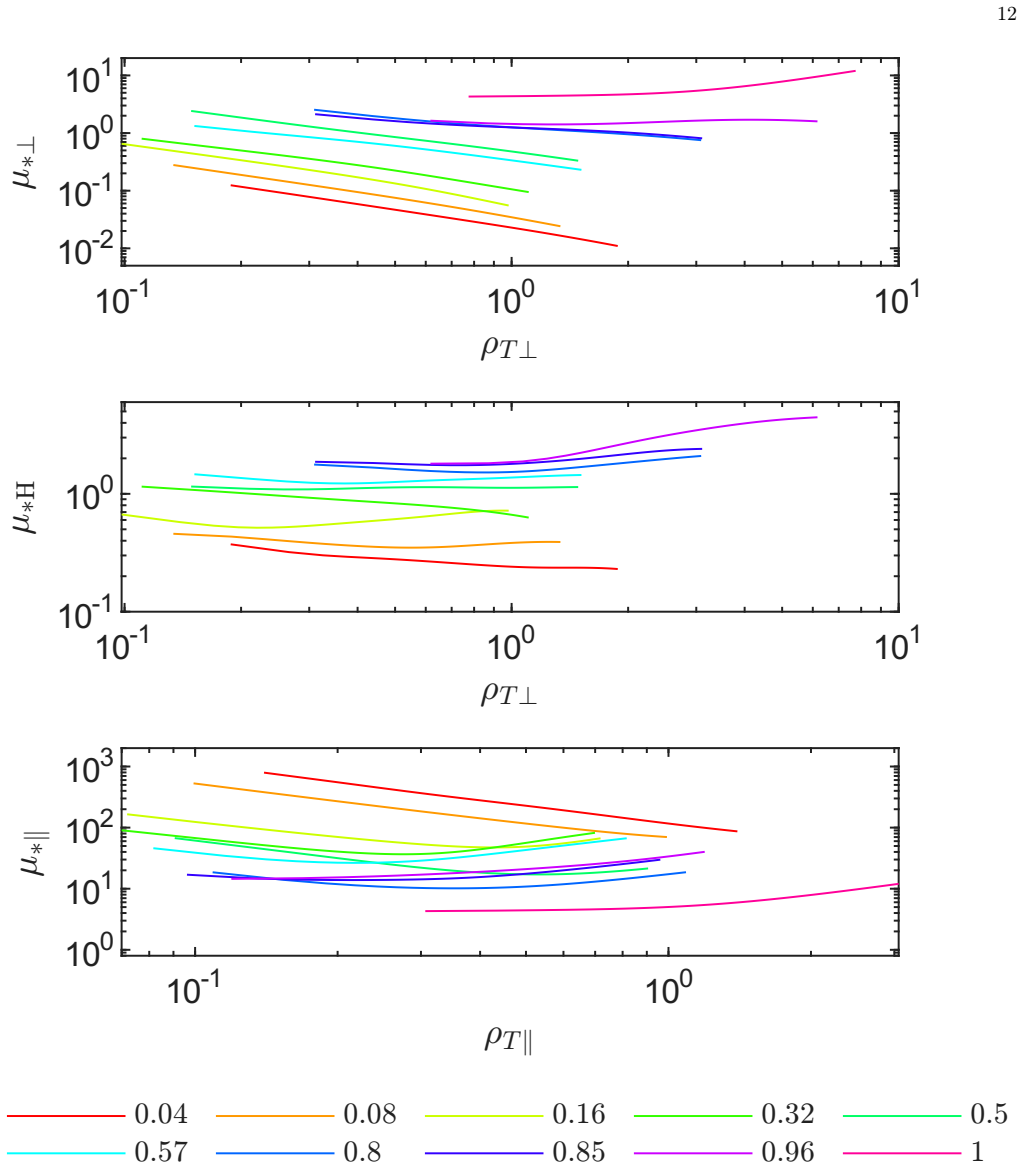
D. Ibscher, M. Lazar, and R. Schlickeiser, Physics of Plasmas19, 072116 (2012). 10 10-2 10-1 100 101 102 ;? 10-310-210-1100 5?=(rLv) 10-2 10-1 100 101 102 ;? 10-1 100 5H=(rLv) 10-2 10-1 100 101 ;k 100101102103104 5k=(rLv) 0.040.08 0.160.32 0.50.57 0.80.85 0.961 Figure 1. Dependencies of the components of the normalized diffusion tensorˆκon rigidityρfor di...
2012
discussion (0)
Sign in with ORCID, Apple, or X to comment. Anyone can read and Pith papers without signing in.