Recognition: unknown
Pretrained Model Representations as Acquisition Signals for Active Learning of MLIPs
Pith reviewed 2026-05-07 16:05 UTC · model grok-4.3
The pith
Pretrained latent spaces from machine learning interatomic potentials supply effective acquisition signals for active learning in reactive chemistry.
A machine-rendered reading of the paper's core claim, the machinery that carries it, and where it could break.
Core claim
Acquisition signals extracted directly from the latent space of a pretrained MLIP, using a finite-width neural tangent kernel and an activation kernel, outperform fixed-descriptor baselines, committee disagreement, and random acquisition. This approach reduces the data required to reach target performance levels by an average of 38% for energy errors and 28% for force errors on reactive-chemistry benchmarks. The pretrained representations also yield similarity spaces that better match model errors and preserve chemically meaningful structure.
What carries the argument
Finite-width neural tangent kernel and activation kernel built from hidden latent space features of a pretrained MLIP, used to measure representational similarity for selecting informative unlabeled points.
If this is right
- Active learning loops for MLIPs can run without training extra uncertainty estimators or maintaining model committees.
- Fewer quantum chemistry calculations are needed to reach given accuracy targets for both energies and forces.
- The geometry induced by pretraining aligns more closely with actual model residuals than fixed chemical descriptors do.
- Pretrained representations already encode chemically relevant similarities that support reliable data selection.
Where Pith is reading between the lines
- The same latent-space kernels could be tested for active learning in related tasks such as molecular dynamics sampling or property prediction.
- If the alignment between latent geometry and error persists across different pretraining datasets, the method might generalize beyond the specific benchmarks used here.
- One could examine whether mixing these kernels with other acquisition heuristics produces additive gains in data efficiency.
- The results hint that pretraining serves a dual role: improving base predictions and providing a ready-made uncertainty proxy for later fine-tuning stages.
Load-bearing premise
The latent space of a pretrained MLIP already contains the information necessary for effective acquisition without auxiliary uncertainty heads, Bayesian training, fine-tuning, or committee ensembles.
What would settle it
A new reactive chemistry benchmark in which the kernel acquisition methods require at least as much labeled data as random selection to reach the same energy and force error targets would falsify the central claim.
Figures







read the original abstract
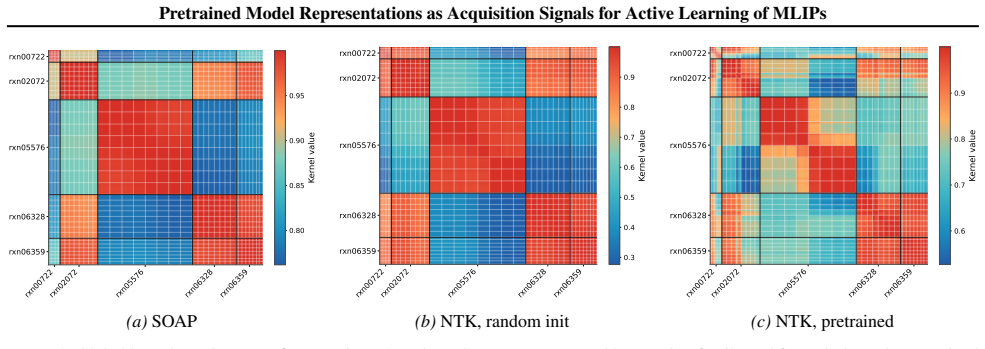
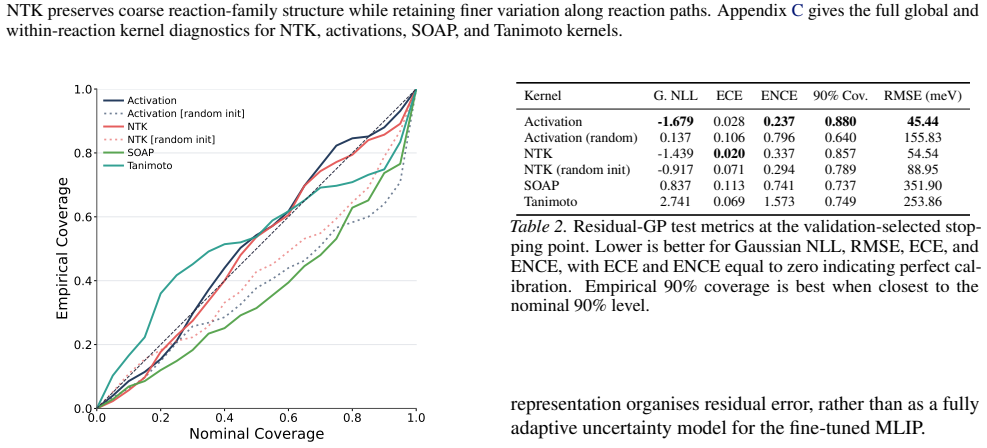
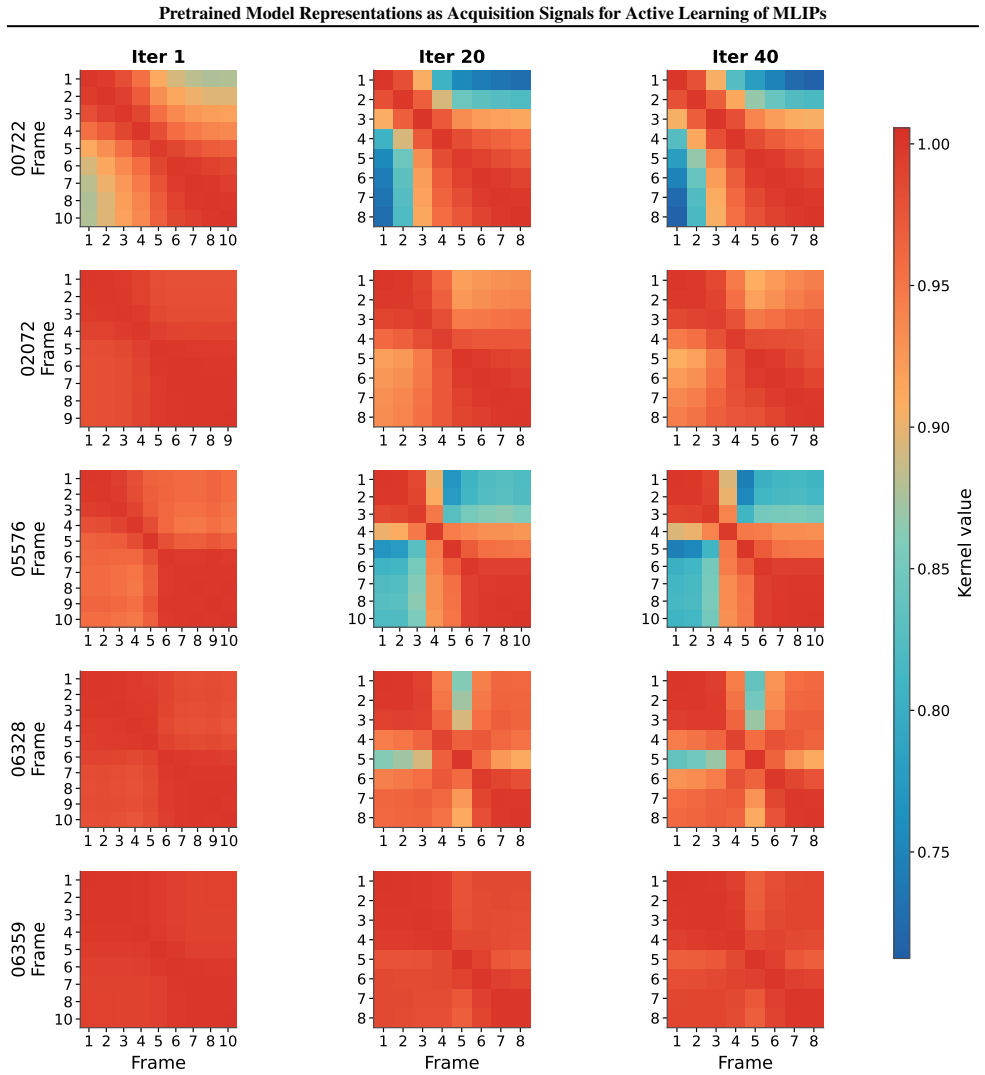
Training machine learning interatomic potentials (MLIPs) for reactive chemistry is often bottlenecked by the high cost of quantum chemical labels and the scarcity of transition state configurations in candidate pools. Active learning (AL) can mitigate these costs, but its effectiveness hinges on the acquisition rule. We investigate whether the latent space of a pretrained MLIP already contains the information necessary for effective acquisition, eliminating the need for auxiliary uncertainty heads, Bayesian training and fine-tuning, or committee ensembles. We introduce two acquisition signals derived directly from a pretrained MACE potential: a finite-width neural tangent kernel (NTK) and an activation kernel built from hidden latent space features. On reactive-chemistry benchmarks, both kernels consistently outperform fixed-descriptor baselines, committee disagreement, and random acquisition, reducing the data required to reach performance targets by an average of 38% for energy error and 28% for force error. We further show that the pretrained model induces similarity spaces that preserve chemically meaningful structure and provide more reliable residual uncertainty estimates than randomly initialised or fixed-descriptor-based kernels. Our results suggest that pretraining aligns latent-space geometry with model error, yielding a practical and sufficient acquisition signal for reactive MLIP fine-tuning.
Editorial analysis
A structured set of objections, weighed in public.
Referee Report
Summary. The manuscript claims that acquisition signals derived from the latent space of a pretrained MACE MLIP—a finite-width neural tangent kernel (NTK) and an activation kernel from hidden features—provide effective guidance for active learning when fine-tuning MLIPs on reactive chemistry tasks. These pretrained kernels are reported to outperform fixed-descriptor baselines, committee disagreement, and random acquisition, reducing the data required to reach target performance by an average of 38% for energy error and 28% for force error. The work further argues that pretraining aligns latent-space geometry with model error, yielding reliable residual uncertainty estimates without auxiliary uncertainty heads, Bayesian training, or ensembles.
Significance. If the empirical results hold under detailed scrutiny, the approach offers a practical simplification for active learning pipelines in MLIP development, especially in data-scarce reactive chemistry settings. By showing that representations from an existing pretrained model suffice for acquisition, it reduces the need for additional modeling overhead and provides evidence that pretraining captures chemically meaningful structure in the similarity space. This could accelerate iterative refinement of potentials while leveraging prior computational investment in large-scale pretraining.
major comments (1)
- Abstract: the central claim of consistent outperformance and specific average data reductions (38% energy, 28% force) is presented without naming the reactive-chemistry benchmarks, reporting the number of independent trials, error bars, or any statistical tests; this information is load-bearing for evaluating the reliability of the empirical demonstration.
minor comments (2)
- Methods section: provide explicit pseudocode or equations for computing the finite-width NTK and activation kernel from the fixed pretrained MACE features to ensure reproducibility and to clarify any normalization steps.
- Results section: include a table or figure caption that lists the exact benchmark datasets, target error thresholds, and baseline implementations so that the reported improvements can be directly compared and verified.
Simulated Author's Rebuttal
We thank the referee for their positive summary, recognition of the work's potential significance, and recommendation for minor revision. We address the single major comment below and will revise the manuscript accordingly.
read point-by-point responses
-
Referee: Abstract: the central claim of consistent outperformance and specific average data reductions (38% energy, 28% force) is presented without naming the reactive-chemistry benchmarks, reporting the number of independent trials, error bars, or any statistical tests; this information is load-bearing for evaluating the reliability of the empirical demonstration.
Authors: We agree that the abstract would benefit from these supporting details to allow immediate evaluation of the empirical claims. The specific reactive-chemistry benchmarks, number of independent trials, error bars, and statistical comparisons are already reported in the main text (Sections 4 and 5) and supplementary material. In the revised version we will condense this information into the abstract—naming the benchmarks, stating the trial count, adding error bars to the reported average reductions, and noting the statistical tests—while preserving the current word count and overall claims. This change strengthens presentation without altering results or conclusions. revision: yes
Circularity Check
No significant circularity; empirical comparison of pretrained kernels vs. baselines
full rationale
The paper presents an empirical study introducing NTK and activation kernels from a fixed pretrained MACE model as acquisition signals for active learning of MLIPs. It directly measures performance against fixed-descriptor baselines, committee disagreement, and random acquisition on reactive-chemistry benchmarks, reporting average data reductions without any mathematical derivation chain, self-definitional equations, fitted parameters renamed as predictions, or load-bearing self-citations. The central claim that pretrained latent spaces supply sufficient acquisition information is tested via explicit contrasts (including randomly initialized kernels) and remains falsifiable through the reported experiments, with no reduction of results to inputs by construction.
Axiom & Free-Parameter Ledger
axioms (1)
- domain assumption The latent space of a pretrained MLIP contains sufficient information for effective acquisition without auxiliary uncertainty mechanisms.
invented entities (2)
-
Finite-width neural tangent kernel acquisition signal
no independent evidence
-
Activation kernel from hidden latent space features
no independent evidence
Forward citations
Cited by 1 Pith paper
-
Force-Aware Neural Tangent Kernels for Scalable and Robust Active Learning of MLIPs
Force-aware NTKs and chunked acquisition enable scalable, robust active learning for MLIPs, achieving lowest energy and force errors on OC20 and remaining competitive on other benchmarks.
Reference graph
Works this paper leans on
-
[2]
Bartók, Risi Kondor, and Gábor Csányi
Bartók, A. P., Kondor, R., and Csányi, G. On representing chemical environments. Physical Review B, 87 0 (18): 0 184115, 2013. doi:10.1103/PhysRevB.87.184115
-
[3]
arXiv preprint arXiv:2401.00096 , year=
Batatia, I., Benner, P., Chiang, Y., Elena, A. M., Kovács, D. P., Riebesell, J., Advincula, X. R., Asta, M., Avaylon, M., et al. A foundation model for atomistic materials chemistry, 2023 a . URL https://arxiv.org/abs/2401.00096
-
[4]
Batatia, I., Kovács, D. P., Simm, G. N. C., Ortner, C., and Csányi, G. Mace: Higher order equivariant message passing neural networks for fast and accurate force fields, 2023 b . URL https://arxiv.org/abs/2206.07697
-
[5]
Schaaf, Ondrej Marsalek, and Christoph Schran
Beck, H., Simko, P., Schaaf, L. L., Marsalek, O., and Schran, C. Multi-head committees enable direct uncertainty prediction for atomistic foundation models. The Journal of Chemical Physics, 163 0 (23): 0 234103, 2025. doi:10.1063/5.0288994
-
[6]
Generalized neural-network representation of high-dimensional potential-energy surfaces
Behler, J. and Parrinello, M. Generalized neural-network representation of high-dimensional potential-energy surfaces. Physical Review Letters, 98 0 (14): 0 146401, 2007. doi:10.1103/PhysRevLett.98.146401
-
[7]
Brunken, C., Peltre, O., Chomet, H., Walewski, L., McAuliffe, M., Heyraud, V., Attias, S., Maarand, M., Khanfir, Y., Toledo, E., Falcioni, F., Bluntzer, M., Acosta-Gutiérrez, S., and Tilly, J. Machine learning interatomic potentials: library for efficient training, model development and simulation of molecular systems, 2025. URL https://arxiv.org/abs/2505.22397
-
[8]
Chen, C. and Ong, S. P. A universal graph deep learning interatomic potential for the periodic table. Nature Computational Science, 2: 0 718--728, 2022. doi:10.1038/s43588-022-00349-3
-
[9]
Blips: Bayesian learned interatomic potentials, 2026
Coscia, D., de Haan, P., and Welling, M. Blips: Bayesian learned interatomic potentials, 2026. URL https://arxiv.org/abs/2508.14022
-
[10]
Cui, T., Tang, C., Zhou, D., Wang, L., Zheng, Y., Wang, Y., Wang, L., Yang, W., Bai, L., and Ouyang, W. Online test-time adaptation for better generalization of interatomic potentials to out-of-distribution data. Nature Communications, 16: 0 1891, 2025. doi:10.1038/s41467-025-57101-4
-
[11]
Bartók, Gábor Csányi, and Michele Ceriotti
De, S., Bartók, A. P., Csányi, G., and Ceriotti, M. Machine learning unifies the modeling of materials and molecules. Science Advances, 3 0 (12): 0 e1701816, 2017. doi:10.1126/sciadv.1701816
-
[12]
Deng, B., Zhong, P., Jun, K., Riebesell, J., Han, K., Bartel, C. J., and Ceder, G. CHGNet as a pretrained universal neural network potential for charge-informed atomistic modelling. Nature Machine Intelligence, 5: 0 1031--1041, 2023. doi:10.1038/s42256-023-00716-3
-
[13]
Deng, B., Choi, Y., Zhong, P., Riebesell, J., Anand, S., Li, Z., Jun, K., Persson, K. A., and Ceder, G. Systematic softening in universal machine learning interatomic potentials. npj Computational Materials, 11: 0 9, 2025. doi:10.1038/s41524-024-01500-6
-
[17]
Himanen, L., J \"a ger, M. O. J., Morooka, E. V., Federici Canova, F., Ranawat, Y. S., Gao, D. Z., Rinke, P., and Foster, A. S. DScribe: Library of descriptors for machine learning in materials science . Computer Physics Communications, 247: 0 106949, 2020. ISSN 0010-4655. doi:10.1016/j.cpc.2019.106949. URL https://doi.org/10.1016/j.cpc.2019.106949
-
[18]
Ho, C. H., Ortner, C., and Wang, Y. Flexible uncertainty calibration for machine-learned interatomic potentials, 2025. URL https://arxiv.org/abs/2510.00721
-
[19]
A framework and benchmark for deep batch active learning for regression
Holzmüller, D., Zaverkin, V., Kästner, J., and Steinwart, I. A framework and benchmark for deep batch active learning for regression. Journal of Machine Learning Research, 24 0 (164): 0 1--81, 2023. URL https://www.jmlr.org/papers/v24/22-0937.html
2023
-
[21]
On-the-fly machine learning force field generation: Application to melting points
Jinnouchi, R., Karsai, F., and Kresse, G. On-the-fly machine learning force field generation: Application to melting points. Physical Review B, 100 0 (1): 0 014105, 2019. doi:10.1103/PhysRevB.100.014105
-
[24]
A., D'Souza, A., and Choyal, V
Khan, M. A., D'Souza, A., and Choyal, V. Active learning strategies for efficient machine-learned interatomic potentials across diverse material systems, 2026. URL https://arxiv.org/abs/2601.06916
-
[26]
Kulichenko, M., Barros, K., Lubbers, N., Li, Y. W., Messerly, R., Tretiak, S., Smith, J. S., and Nebgen, B. Uncertainty-driven dynamics for active learning of interatomic potentials. Nature Computational Science, 3: 0 230--239, 2023. doi:10.1038/s43588-023-00406-5
-
[29]
Levine, Muhammed Shuaibi, Evan Walter Clark Spotte-Smith, Michael G
Levine, D. S., Shuaibi, M., Spotte-Smith, E. W. C., Taylor, M. G., Hasyim, M. R., Michel, K., Batatia, I., Csányi, G., Dzamba, M., Eastman, P., Frey, N. C., Fu, X., Gharakhanyan, V., Krishnapriyan, A. S., Rackers, J. A., Raja, S., Rizvi, A., Rosen, A. S., Ulissi, Z., Vargas, S., Zitnick, C. L., Blau, S. M., and Wood, B. M. The open molecules 2025 (omol25)...
-
[30]
A critical review of machine learning interatomic potentials and hamiltonian
Li, Y., Zhang, X., Liu, M., and Shen, L. A critical review of machine learning interatomic potentials and hamiltonian. Journal of Materials Informatics, 5 0 (4), 2025. ISSN 2770-372X. doi:10.20517/jmi.2025.17. URL https://www.oaepublish.com/articles/jmi.2025.17
-
[32]
arXiv preprint arXiv:2504.06231 , year=
Neumann, M., Gin, J., Rhodes, B., Bennett, S., Li, Z., Choubisa, H., Hussey, A., and Godwin, J. Orb-v3: atomistic simulation at scale, 2025. URL https://arxiv.org/abs/2504.06231
-
[34]
Peterson, Rune Christensen, and Alireza Khorshidi
Peterson, A. A., Christensen, R., and Khorshidi, A. Addressing uncertainty in atomistic machine learning. Physical Chemistry Chemical Physics, 19: 0 10978--10985, 2017. doi:10.1039/C7CP00375G
-
[35]
Podryabinkin, E. V. and Shapeev, A. V. Active learning of linearly parametrized interatomic potentials. Computational Materials Science, 140: 0 171--180, 2017. doi:10.1016/j.commatsci.2017.08.031
-
[38]
Extended-connectivity fingerprints
Rogers, D. and Hahn, M. Extended-connectivity fingerprints. Journal of Chemical Information and Modeling, 50 0 (5): 0 742--754, 2010. doi:10.1021/ci100050t
-
[39]
Committee neural network potentials control generalization errors and enable active learning
Schran, C., Brezina, K., and Marsalek, O. Committee neural network potentials control generalization errors and enable active learning. The Journal of Chemical Physics, 153 0 (10): 0 104105, 2020. doi:10.1063/5.0016004
-
[42]
Smith, Ben Nebgen, Nicholas Lubbers, Olexandr Isayev, and Adrian E
Smith, J. S., Nebgen, B., Lubbers, N., Isayev, O., and Roitberg, A. E. Less is more: Sampling chemical space with active learning. The Journal of Chemical Physics, 148 0 (24): 0 241733, 2018. doi:10.1063/1.5023802
-
[46]
Torrisi, Simon Batzner, Yu Xie, Lixin Sun, Alexie M
Vandermause, J., Torrisi, S. B., Batzner, S., Xie, Y., Sun, L., Kolpak, A. M., and Kozinsky, B. On-the-fly active learning of interpretable Bayesian force fields for atomistic rare events. npj Computational Materials, 6: 0 20, 2020. doi:10.1038/s41524-020-0283-z
-
[49]
Wood, B. M., Dzamba, M., Fu, X., Gao, M., Shuaibi, M., Barroso-Luque, L., Abdelmaqsoud, K., Gharakhanyan, V., Kitchin, J. R., Levine, D. S., Michel, K., Sriram, A., Cohen, T., Das, A., Rizvi, A., Sahoo, S. J., Ulissi, Z. W., and Zitnick, C. L. Uma: A family of universal models for atoms, 2026. URL https://arxiv.org/abs/2506.23971
-
[50]
Exploring chemical and conformational spaces by batch mode deep active learning
Zaverkin, V., Holzmüller, D., Steinwart, I., and Kästner, J. Exploring chemical and conformational spaces by batch mode deep active learning. Digital Discovery, 1: 0 605--620, 2022. doi:10.1039/D2DD00034B
-
[51]
Uncertainty-biased molecular dynamics for learning uniformly accurate interatomic potentials
Zaverkin, V., Holzmüller, D., Christiansen, H., Errica, F., Alesiani, F., Takamoto, M., Niepert, M., and Kästner, J. Uncertainty-biased molecular dynamics for learning uniformly accurate interatomic potentials. npj Computational Materials, 10: 0 83, 2024. doi:10.1038/s41524-024-01254-1
-
[52]
Active learning of uniformly accurate interatomic potentials for materials simulation
Zhang, L., Lin, D.-Y., Wang, H., Car, R., and E, W. Active learning of uniformly accurate interatomic potentials for materials simulation. Physical Review Materials, 3 0 (2): 0 023804, 2019. doi:10.1103/PhysRevMaterials.3.023804
-
[54]
Fast uncertainty estimates in deep learning interatomic potentials
Zhu, A., Batzner, S., Musaelian, A., and Kozinsky, B. Fast uncertainty estimates in deep learning interatomic potentials. The Journal of Chemical Physics, 158 0 (16): 0 164111, 2023. doi:10.1063/5.0136574
-
[55]
Data curation for machine learning interatomic potentials by determinantal point processes, 2026
Zou, J. and Marzouk, Y. Data curation for machine learning interatomic potentials by determinantal point processes, 2026. URL https://arxiv.org/abs/2603.22160
-
[56]
Kohn, W. and Becke, A. D. and Parr, R. G. , title =. The Journal of Physical Chemistry , year =. doi:10.1021/jp960669l , url =
-
[57]
2023 , eprint=
MACE: Higher Order Equivariant Message Passing Neural Networks for Fast and Accurate Force Fields , author=. 2023 , eprint=
2023
-
[58]
2025 , eprint=
Machine Learning Interatomic Potentials: library for efficient training, model development and simulation of molecular systems , author=. 2025 , eprint=
2025
-
[59]
Guanjie Wang and Changrui Wang and Xuanguang Zhang and Zefeng Li and Jian Zhou and Zhimei Sun , keywords =. Machine learning interatomic potential: Bridge the gap between small-scale models and realistic device-scale simulations , journal =. 2024 , issn =. doi:https://doi.org/10.1016/j.isci.2024.109673 , url =
-
[60]
Quality of uncertainty estimates from neural network potential ensembles , volume=
Kahle, Leonid and Zipoli, Federico , year=. Quality of uncertainty estimates from neural network potential ensembles , volume=. Physical Review E , publisher=. doi:10.1103/physreve.105.015311 , number=
-
[61]
Journal of Materials Informatics , VOLUME =
Yifan Li and Xiuying Zhang and Mingkang Liu and Lei Shen , TITLE =. Journal of Materials Informatics , VOLUME =. 2025 , NUMBER =
2025
-
[62]
Jacobs, Ryan and Morgan, Dane and Attarian, Siamak and Meng, Jun and Shen, Chen and Wu, Zhenghao and Xie, Clare Yijia and Yang, Julia H. and Artrith, Nongnuch and Blaiszik, Ben and Ceder, Gerbrand and Choudhary, Kamal and Csanyi, Gabor and Cubuk, Ekin Dogus and Deng, Bowen and Drautz, Ralf and Fu, Xiang and Godwin, Jonathan and Honavar, Vasant and Isayev,...
-
[63]
Physical Review Letters , volume=
Gaussian Approximation Potentials: The Accuracy of Quantum Mechanics, without the Electrons , author=. Physical Review Letters , volume=. 2010 , doi=
2010
-
[64]
Physical Review Letters , volume=
Deep Potential Molecular Dynamics: A Scalable Model with the Accuracy of Quantum Mechanics , author=. Physical Review Letters , volume=. 2018 , doi=
2018
-
[65]
and Sauceda, Huziel E
Schütt, Kristof T. and Sauceda, Huziel E. and Kindermans, Pieter-Jan and Tkatchenko, Alexandre and Müller, Klaus-Robert , journal=. 2018 , doi=
2018
-
[66]
Physical Review B , volume=
Atomic cluster expansion for accurate and transferable interatomic potentials , author=. Physical Review B , volume=. 2019 , doi=
2019
-
[67]
and Kornbluth, Mordechai and Molinari, Nicola and Smidt, Tess E
Batzner, Simon and Musaelian, Albert and Sun, Lixin and Geiger, Mario and Mailoa, Jonathan P. and Kornbluth, Mordechai and Molinari, Nicola and Smidt, Tess E. and Kozinsky, Boris , journal=. 2022 , doi=
2022
-
[68]
Nature Communications , volume=
Learning local equivariant representations for large-scale atomistic dynamics , author=. Nature Communications , volume=. 2023 , doi=
2023
-
[69]
2026 , eprint=
UMA: A Family of Universal Models for Atoms , author=. 2026 , eprint=
2026
-
[70]
Nature Communications , year =
Mazitov, Arslan and Bigi, Filippo and Kellner, Matthias and Pegolo, Paolo and Tisi, Davide and Fraux, Guillaume and Pozdnyakov, Sergey and Loche, Philip and Ceriotti, Michele , title =. Nature Communications , year =. doi:10.1038/s41467-025-65662-7 , url =
-
[71]
Physical Review Letters , volume=
Generalized Neural-Network Representation of High-Dimensional Potential-Energy Surfaces , author=. Physical Review Letters , volume=. 2007 , doi=
2007
-
[72]
Physical Review B , volume=
On representing chemical environments , author=. Physical Review B , volume=. 2013 , doi=
2013
-
[73]
Science Advances , volume=
Machine learning unifies the modeling of materials and molecules , author=. Science Advances , volume=. 2017 , doi=
2017
-
[74]
Journal of Chemical Information and Modeling , volume=
Extended-Connectivity Fingerprints , author=. Journal of Chemical Information and Modeling , volume=. 2010 , doi=
2010
-
[75]
Chemical Reviews , year=
Data Generation for Machine Learning Interatomic Potentials and Beyond , author=. Chemical Reviews , year=
-
[76]
The Journal of Chemical Physics , volume=
Less is more: Sampling chemical space with active learning , author=. The Journal of Chemical Physics , volume=. 2018 , doi=
2018
-
[77]
Computational Materials Science , volume=
Active learning of linearly parametrized interatomic potentials , author=. Computational Materials Science , volume=. 2017 , doi=
2017
-
[78]
Physical Review B , volume=
On-the-fly machine learning force field generation: Application to melting points , author=. Physical Review B , volume=. 2019 , doi=
2019
-
[79]
and Batzner, Simon and Xie, Yu and Sun, Lixin and Kolpak, Alexie M
Vandermause, Jonathan and Torrisi, Steven B. and Batzner, Simon and Xie, Yu and Sun, Lixin and Kolpak, Alexie M. and Kozinsky, Boris , journal=. On-the-fly active learning of interpretable. 2020 , doi=
2020
-
[80]
Physical Review Materials , volume=
Active learning of uniformly accurate interatomic potentials for materials simulation , author=. Physical Review Materials , volume=. 2019 , doi=
2019
-
[81]
Bi, Jinghou and Xu, Yuanhao and Conrad, Felix and Wiemer, Hajo and Ihlenfeldt, Steffen , year =. A comprehensive benchmark of active learning strategies with AutoML for small-sample regression in materials science , volume =. Scientific Reports , publisher =. doi:10.1038/s41598-025-24613-4 , number =
-
[82]
Nature Computational Science , volume=
Uncertainty-driven dynamics for active learning of interatomic potentials , author=. Nature Computational Science , volume=. 2023 , doi=
2023
-
[83]
npj Computational Materials , volume=
De novo exploration and self-guided learning of potential-energy surfaces , author=. npj Computational Materials , volume=. 2019 , doi=
2019
-
[84]
The Journal of Chemical Physics , volume=
An entropy-maximization approach to automated training set generation for interatomic potentials , author=. The Journal of Chemical Physics , volume=. 2020 , doi=
2020
-
[85]
Digital Discovery , year=
Active learning meets metadynamics: automated workflow for reactive machine learning interatomic potentials , author=. Digital Discovery , year=
-
[86]
The Journal of Chemical Physics , volume=
Committee neural network potentials control generalization errors and enable active learning , author=. The Journal of Chemical Physics , volume=. 2020 , doi=
2020
-
[87]
Physical Chemistry Chemical Physics , volume=
Addressing uncertainty in atomistic machine learning , author=. Physical Chemistry Chemical Physics , volume=. 2017 , doi=
2017
-
[88]
The Journal of Chemical Physics , volume=
Fast uncertainty estimates in deep learning interatomic potentials , author=. The Journal of Chemical Physics , volume=. 2023 , doi=
2023
-
[89]
Machine Learning: Science and Technology , volume=
Uncertainty quantification by direct propagation of shallow ensembles , author=. Machine Learning: Science and Technology , volume=. 2024 , doi=
2024
-
[90]
The Journal of Chemical Physics , volume=
Multi-head committees enable direct uncertainty prediction for atomistic foundation models , author=. The Journal of Chemical Physics , volume=. 2025 , doi=
2025
-
[91]
Physical Review Materials , volume =
Ouyang, Xinjian and Wang, Zhilong and Jie, Xiao and Zhang, Feng and Zhang, Yanxing and Liu, Laijun and Wang, Dawei , title =. Physical Review Materials , volume =. 2024 , month = oct, publisher =. doi:10.1103/PhysRevMaterials.8.103804 , url =
-
[92]
2026 , eprint=
Cutting Through the Noise: On-the-fly Outlier Detection for Robust Training of Machine Learning Interatomic Potentials , author=. 2026 , eprint=
2026
-
[93]
2026 , eprint=
BLIPs: Bayesian Learned Interatomic Potentials , author=. 2026 , eprint=
2026
-
[94]
2025 , eprint=
Orb-v3: atomistic simulation at scale , author=. 2025 , eprint=
2025
-
[95]
Tan, Aik Rui and Urata, Shingo and Goldman, Samuel and Dietschreit, Johannes C. B. and Gómez-Bombarelli, Rafael , year=. Single-model uncertainty quantification in neural network potentials does not consistently outperform model ensembles , volume=. npj Computational Materials , publisher=. doi:10.1038/s41524-023-01180-8 , number=
-
[96]
Advances in Neural Information Processing Systems , year=
Neural Tangent Kernel: Convergence and Generalization in Neural Networks , author=. Advances in Neural Information Processing Systems , year=
-
[97]
Journal of Machine Learning Research , volume=
A Framework and Benchmark for Deep Batch Active Learning for Regression , author=. Journal of Machine Learning Research , volume=. 2023 , url=
2023
-
[98]
2023 , eprint=
Black-Box Batch Active Learning for Regression , author=. 2023 , eprint=
2023
-
[99]
Vazirani, Vijay V. , year =. k-Center , ISBN =. doi:10.1007/978-3-662-04565-7_5 , booktitle =
-
[100]
Rasmussen, Carl Edward and Williams, Christopher K. I. , year =. Gaussian Processes for Machine Learning , ISBN =. doi:10.7551/mitpress/3206.001.0001 , publisher =
-
[101]
Digital Discovery , volume=
Exploring chemical and conformational spaces by batch mode deep active learning , author=. Digital Discovery , volume=. 2022 , doi=
2022
-
[102]
Journal of Chemical Theory and Computation , year=
Enhanced Representation-Based Sampling for the Efficient Generation of Data Sets for Machine-Learned Interatomic Potentials , author=. Journal of Chemical Theory and Computation , year=
discussion (0)
Sign in with ORCID, Apple, or X to comment. Anyone can read and Pith papers without signing in.