Recognition: unknown
Geometry-controlled heat transport pathways and optimal heat transfer in differentially heated cavities
Pith reviewed 2026-05-07 13:35 UTC · model grok-4.3
The pith
Heat transfer in a differentially heated cavity is maximized when the large-scale circulation reaches a horizontal-to-vertical velocity ratio of approximately 0.45.
A machine-rendered reading of the paper's core claim, the machinery that carries it, and where it could break.
Core claim
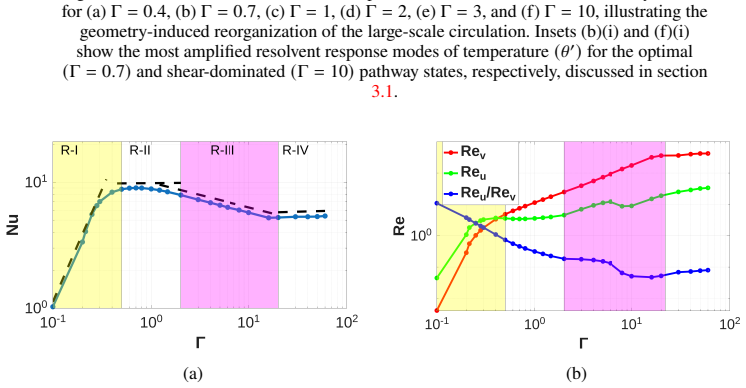
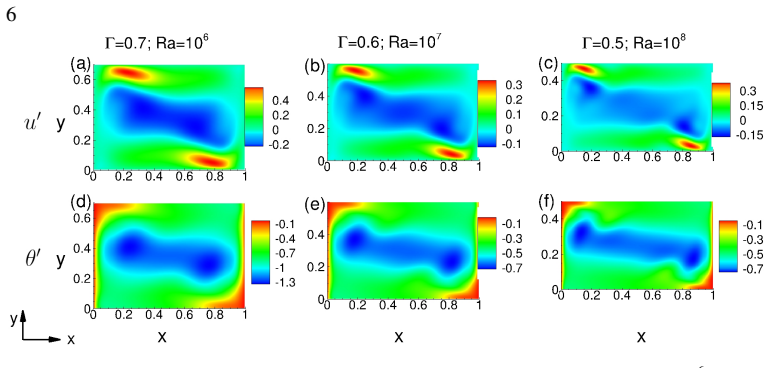
Across Rayleigh numbers from 10^6 to 10^8 at Prandtl number 0.7, the Nusselt number follows four power-law regimes as a function of aspect ratio Γ from 0.1 to 60. These regimes are produced by qualitative reorganizations of the large-scale circulation, tracked by the ratio of root-mean-square horizontal to vertical velocities. Heat transport reaches its maximum when this ratio equals approximately 0.45, a value that holds for all Rayleigh numbers tested; the corresponding optimal aspect ratio scales as Γ_opt ∼ Ra^{-0.19}. Resolvent analysis connects the optimum to stationary slender response modes while larger aspect ratios excite oscillatory shear-layer amplification.
What carries the argument
The anisotropy ratio of the large-scale circulation, defined as the ratio of Reynolds numbers based on horizontal and vertical velocities, which governs the transitions among the four observed heat-transport regimes as cavity aspect ratio varies.
If this is right
- Vertical confinement at small aspect ratios produces a horizontally dominant circulation that strongly increases heat transport.
- Intermediate aspect ratios create a stable circulation structure in which heat transport becomes nearly independent of further changes in shape.
- Larger aspect ratios stretch the circulation vertically, leading to shear-driven instabilities that steadily reduce heat transport toward an asymptotic limit.
- The optimal velocity ratio of 0.45 is independent of Rayleigh number within the studied range, permitting direct prediction of the best cavity shape from the scaling relation.
Where Pith is reading between the lines
- The scaling relation could be used to select cavity proportions for maximum efficiency in applications such as building insulation or electronic cooling without repeated full simulations.
- An analogous velocity-ratio measure might identify optimal geometries in other confined convection problems such as atmospheric layers or solar chimneys.
- Checking whether the 0.45 ratio remains optimal at Rayleigh numbers orders of magnitude higher or for fluids with different viscosity would test the generality of the reported balance.
- The link between optimal transport and stationary resolvent modes suggests that targeted forcing of those modes could maintain peak heat transfer even when geometry is fixed.
Load-bearing premise
That the ratio of horizontal to vertical flow speeds fully captures the reorganization of the large-scale circulation and that the four regimes and the optimal ratio persist outside the simulated range of Rayleigh and Prandtl numbers.
What would settle it
A simulation or experiment at Rayleigh number 10^9 or at a different Prandtl number that measures whether the peak heat transfer still occurs precisely at the horizontal-to-vertical velocity ratio of 0.45.
Figures




read the original abstract
We perform direct numerical simulations of natural convection in a differentially heated cavity over Rayleigh number $Ra=10^6$--$10^8$ at Prandtl number $Pr=0.7$, systematically varying the aspect ratio over $0.1 \leq \Gamma \leq 60$. Across this nearly three-decade range, the Nusselt number $Nu$ exhibits four distinct power-law regimes as a function of $\Gamma$, arising solely from geometric confinement. We show that these transport regimes are governed by qualitative changes in the anisotropy and structure of the large-scale circulation (LSC), quantified by the ratio of Reynolds numbers based on the root-mean-square horizontal and vertical velocities, $Re_u/Re_v$. For small $\Gamma$, vertical confinement promotes a horizontally dominant LSC and strong enhancement of heat transport. At intermediate aspect ratios, the circulation reorganizes into an efficient heat-carrying structure for which $Nu$ becomes nearly independent of $\Gamma$. At larger $\Gamma$, the LSC becomes increasingly vertically elongated and transitions to shear-driven dynamics associated with Kelvin--Helmholtz-type instability, leading to a progressive reduction in heat transport before approaching an asymptotic large-$\Gamma$ limit. A central result is that the heat flux is maximized when the circulation anisotropy satisfies $Re_u/Re_v \approx 0.45$, which remains robust across all Rayleigh numbers considered. The corresponding optimal aspect ratio follows the scaling $\Gamma_{\mathrm{opt}} \sim Ra^{-0.19}$. Resolvent analysis further reveals that optimal transport is associated with stationary, slender response modes, whereas larger $\Gamma$ results in oscillatory shear-layer amplification. These findings establish geometric confinement as the key control parameter governing transport pathways in differentially heated cavities and provide a predictive framework for geometry-driven heat-transfer optimization.
Editorial analysis
A structured set of objections, weighed in public.
Referee Report
Summary. The manuscript reports DNS of natural convection in differentially heated cavities at Ra = 10^6–10^8 and Pr = 0.7, with aspect ratio Γ varied over 0.1 ≤ Γ ≤ 60. It identifies four distinct power-law regimes in Nu(Γ) driven by geometric confinement and qualitative reorganizations of the large-scale circulation, quantified via the anisotropy ratio Re_u/Re_v. Heat transport is maximized at Re_u/Re_v ≈ 0.45 (robust across the simulated Ra), yielding the scaling Γ_opt ∼ Ra^{-0.19}. Resolvent analysis is used to link optimal transport to stationary slender response modes and larger-Γ behavior to oscillatory shear-layer amplification.
Significance. If the central claims hold, the work supplies a geometry-driven predictive framework for optimizing heat transfer in confined natural convection by tying transport regimes directly to LSC anisotropy. The combination of systematic DNS over nearly three decades in Γ with resolvent analysis provides mechanistic insight beyond purely empirical correlations. The reported robustness of the 0.45 anisotropy optimum across Ra is a potentially useful result for engineering design, though its generality rests on the limited Ra sampling.
major comments (2)
- [§4] §4 (optimal transport and scaling): The central claim that Re_u/Re_v ≈ 0.45 maximizes Nu and remains independent of Ra, together with the fitted exponent −0.19 in Γ_opt ∼ Ra^{-0.19}, is obtained from only three discrete Rayleigh numbers (10^6, 10^7, 10^8) and a finite set of Γ points. Without the raw Nu(Γ) curves, the precise procedure for locating each peak, or uncertainty estimates on Nu and Γ_opt, it is impossible to assess whether modest statistical fluctuations or interpolation choices could alter the reported constancy or the scaling exponent by ±0.05 or more.
- [§3.2] §3.2 (regime classification): The four power-law regimes in Nu(Γ) are stated to arise solely from changes in LSC anisotropy. The transition points between regimes appear to be identified by inspection of the anisotropy ratio and flow visualizations; a quantitative, reproducible criterion (e.g., thresholds on Re_u/Re_v combined with modal energy or shear-layer diagnostics) is needed to confirm that the regime boundaries are not sensitive to the particular Γ sampling or to secondary flow structures.
minor comments (2)
- [Methods] Methods: Grid resolution, statistical sampling times, and boundary-condition implementation details for the DNS should be stated explicitly (including any checks for grid convergence at the highest Ra).
- [Figures] Figure captions: Several figures showing Nu(Γ) and Re_u/Re_v would benefit from explicit indication of the identified regime boundaries and the location of each optimum.
Simulated Author's Rebuttal
We thank the referee for the constructive and detailed comments. We address each major point below, providing clarifications and indicating the specific revisions incorporated into the manuscript.
read point-by-point responses
-
Referee: [§4] §4 (optimal transport and scaling): The central claim that Re_u/Re_v ≈ 0.45 maximizes Nu and remains independent of Ra, together with the fitted exponent −0.19 in Γ_opt ∼ Ra^{-0.19}, is obtained from only three discrete Rayleigh numbers (10^6, 10^7, 10^8) and a finite set of Γ points. Without the raw Nu(Γ) curves, the precise procedure for locating each peak, or uncertainty estimates on Nu and Γ_opt, it is impossible to assess whether modest statistical fluctuations or interpolation choices could alter the reported constancy or the scaling exponent by ±0.05 or more.
Authors: We acknowledge that the scaling analysis relies on three Rayleigh numbers. The value Re_u/Re_v ≈ 0.45 corresponds to the anisotropy ratio at the Nu maximum for each Ra, identified by direct evaluation of the discrete Γ points without interpolation. In the revised manuscript we add a supplementary table containing the complete Nu(Γ) and Re_u/Re_v(Γ) datasets for all three Ra, together with the temporal standard deviations of Nu as uncertainty estimates. The peak locations are now explicitly stated as the Γ yielding the highest Nu within the sampled set. The exponent −0.19 is obtained from a least-squares fit in log-log space; we report the fit uncertainty as ±0.03 derived from the covariance matrix. While additional Ra values would further test generality, the observed constancy of the anisotropy optimum across the simulated range remains supported by the data. revision: partial
-
Referee: [§3.2] §3.2 (regime classification): The four power-law regimes in Nu(Γ) are stated to arise solely from changes in LSC anisotropy. The transition points between regimes appear to be identified by inspection of the anisotropy ratio and flow visualizations; a quantitative, reproducible criterion (e.g., thresholds on Re_u/Re_v combined with modal energy or shear-layer diagnostics) is needed to confirm that the regime boundaries are not sensitive to the particular Γ sampling or to secondary flow structures.
Authors: We agree that explicit quantitative criteria improve reproducibility. In the revised §3.2 we define the four regimes by the following thresholds on the anisotropy ratio together with a shear-layer diagnostic: regime I for Re_u/Re_v > 2.0 (horizontal dominance), regime II for 0.3 < Re_u/Re_v ≤ 2.0 (balanced efficient transport), regime III for 0.1 < Re_u/Re_v ≤ 0.3 (onset of vertical elongation), and regime IV for Re_u/Re_v ≤ 0.1 (shear-driven). The transition to regime IV is further marked by the resolvent gain of the leading oscillatory mode exceeding 10. These thresholds were selected from the observed structural changes and have been verified by recomputing the power-law exponents after shifting each boundary by ±10 % in Γ; the exponents change by less than 5 %, confirming robustness to sampling. revision: yes
Circularity Check
No circularity: central results are direct empirical observations from DNS and independent resolvent analysis
full rationale
The paper reports parametric DNS results for Nu(Γ) at three Ra values, computes the diagnostic ratio Re_u/Re_v from the simulated velocity fields, and observes that Nu peaks near Re_u/Re_v ≈ 0.45 with an empirical power-law fit for Γ_opt. These quantities are extracted from the data rather than derived from equations that presuppose the same ratio or scaling. Resolvent analysis supplies a separate linear-mechanism verification. No load-bearing step reduces by construction to a fitted input, self-citation, or definitional loop; the derivation chain remains self-contained against external simulation benchmarks.
Axiom & Free-Parameter Ledger
free parameters (2)
- optimal anisotropy ratio =
0.45
- scaling exponent for optimal aspect ratio =
-0.19
axioms (1)
- domain assumption Incompressible Navier-Stokes equations under the Boussinesq approximation govern the flow.
Reference graph
Works this paper leans on
-
[1]
, title =
Bejan, A. , title =. Journal of Fluid Mechanics , year =
-
[2]
Cormack, D. E. and Leal, L. G. and Imberger, J. , title =. Journal of Fluid Mechanics , year =
-
[3]
Cormack, D. E. and Leal, L. G. and Seinfeld, J. H. , title =. Journal of Fluid Mechanics , year =
-
[4]
, title =
Imberger, J. , title =. Journal of Fluid Mechanics , year =
-
[5]
, title =
Ostrach, S. , title =. Journal of Heat Transfer , year =
-
[6]
Frederick, R. L. and Valencia, A. , title =. International Communications in Heat and Mass Transfer , year =
-
[7]
Janssen, R. J. A. and Henkes, R. A. W. M. , title =. Journal of Fluid Mechanics , year =
-
[8]
Trias, F. X. and Soria, M. and Oliva, A. and P\'. Direct numerical simulations of two- and three-dimensional turbulent natural convection flows in a differentially heated cavity of aspect ratio 4 , journal =. 2007 , volume =
2007
-
[9]
Trias, F. X. and Gorobets, A. and Soria, M. and Oliva, A. , title =. International Journal of Heat and Mass Transfer , year =
-
[10]
Barhaghi, D. G. and Davidson, L. , title =. Physics of Fluids , year =
-
[11]
Xin, S. and. Direct numerical simulations of two-dimensional chaotic natural convection in a differentially heated cavity of aspect ratio 4 , journal =. 1995 , volume =
1995
-
[12]
1998 , volume =
From onset of unsteadiness to chaos in a differentially heated square cavity , journal =. 1998 , volume =
1998
-
[13]
Ng, C. S. and Ooi, A. and Lohse, D. and Chung, D. , title =. Journal of Fluid Mechanics , year =
-
[14]
Howland, C. J. and Ng, C. S. and Verzicco, R. and Lohse, D. , title =. Journal of Fluid Mechanics , year =
-
[15]
Shraiman, B. I. and Siggia, E. D. , title =. Physical Review A , year =
-
[16]
Reduced-order modeling of fully turbulent buoyancy-driven flows using the Green's function method , author =. Phys. Rev. Fluids , volume =. 2019 , month =. doi:10.1103/PhysRevFluids.4.013801 , url =
-
[17]
1986 , url=
TRANSITION TO UNSTEADY NATURAL CONVECTION OF AIR IN VERTICAL DIFFERENTIALLY HEATED CAVITIES: INFLUENCE OF THERMAL BOUNDARY CONDITIONS ON THE HORIZONTAL MALLS , author=. 1986 , url=
1986
-
[18]
Ravi, M. R. and Henkes, R. A. W. M. and Hoogendoorn, C. J. , year=. On the high-Rayleigh-number structure of steady laminar natural-convection flow in a square enclosure , volume=. doi:10.1017/S0022112094000522 , journal=
-
[19]
Flow of warm and cold winds in the atmosphere of the Earth , url =
-
[20]
Thermal convection in the mantle of the Earth , url =
-
[21]
Thermal convection inside the Sun , url =
-
[22]
Turbulence: The Legacy of A
Frisch, Uriel , year=. Turbulence: The Legacy of A. N. Kolmogorov , DOI=
-
[23]
S. B. Turbulent Flows , Publisher =
-
[24]
Venugopal
T. Venugopal. Statistical coherence of large-scale circulation in turbulent Rayleigh-Bénard convection , Pages =
-
[25]
2004 , publisher=
Turbulence: An Introduction for Scientists and Engineers , author=. 2004 , publisher=
2004
-
[26]
A first course in turbulence , Publisher =
H. A first course in turbulence , Publisher =
-
[27]
M. L. Fundamentals of Atmospheric Physics , Publisher =
-
[28]
Adrian Bejan , Title =
-
[29]
, Title =
Anderson, D., Tannehill, J.C., and Pletcher, R.H. , Title =. 2012 , url=
2012
-
[30]
Incropera , title =
F.P. Incropera , title =. 1999 , OPTkey =
1999
-
[31]
J. P. Johnston , title =. Int. J. Rot. Mach. , year =
-
[32]
van Wissen and M
R. van Wissen and M. Golombok and J. J. H. Brouwers , title =. AIChE Journal , year =
-
[33]
Holmes , title =
A. Holmes , title =. Transactions of the Geological Society of Glasgow , year =
-
[34]
Coltice and M
N. Coltice and M. G\'. A mantle convection perspective on global tectonics , journal =. 2017 , OPTkey =
2017
-
[35]
Marshall and F
J. Marshall and F. Schott , title =. Rev. Geophys. , year =
-
[36]
Hadley , title =
G. Hadley , title =. Phil. Trans. R. Soc. Lond. , year =
-
[37]
D. L. Hartmann and L. A. Moy and Q. Fu , title =. J. Climate , year =
-
[38]
Hassler and I
D. Hassler and I. Dammascha and P. Lemaire and P. Brekke and W. Curdt and H. Mason and J.-C. Vial and K. Wilhelm , title =. Science , year =
-
[39]
Miesch , title =
M.S. Miesch , title =. Solar Phys. , year =
-
[40]
Busse , title =
F.H. Busse , title =. Chaos , year =
-
[41]
Fausto Cattaneo and Thierry Emonet and Nigel Weiss , title =. doi:10.1086/374313 , url =
-
[42]
A. P. Ingersoll , title =. Science , year =
-
[43]
Rahmstorf , title =
S. Rahmstorf , title =. Climate Change , year =
-
[44]
The fluid mechanics of natural ventilation—displacement ventilation by buoyancy-driven flows assisted by wind , journal =. 1999 , issn =. doi:https://doi.org/10.1016/S0360-1323(98)00053-5 , url =
-
[45]
G. F. Davies , title =. Geophys. J. Int. , year =
-
[46]
W. J. Morgan , title =. AAPG Bull. , year =
-
[47]
D. L. Turcotte and E. R Oxburgh , title =. Ann. Rev. Fluid Mech. , year =
-
[48]
H. B\'. Les tourbillons cellulaires dans une nappe liquide. -. Journal de Physique Th\'. 1901 , OPTkey =
1901
-
[49]
On convection currents in a horizontal layer of fluid, when the higher temperature is on the under side , journal =
Lord. On convection currents in a horizontal layer of fluid, when the higher temperature is on the under side , journal =. 1916 , OPTkey =
1916
-
[50]
Jeffreys , title =
H. Jeffreys , title =. Philosophical Magazine and Journal of Science: Series 7 , year =
-
[51]
Jeffreys , title =
H. Jeffreys , title =. Proc. Royal Soc. Lond. A , year =
-
[52]
A. R. Low , title =. Proc. Royal Soc. Lond. A , year =
-
[53]
R. J. Schmidt and S. W. Milverton , title =. Proc. Royal Soc. Lond. A , year =
-
[54]
Dynamics of Spatio-Temporal Cellular Structures , author=
-
[55]
Large-scale flow generation in turbulent convection , Journal =
-
[56]
, title =
Smagorinsky, J. , title =. Monthly Weather Review , volume =. 1963 , doi =
1963
-
[57]
A dynamic subgrid-scale eddy viscosity model , journal =
Germano, M.,, U. A dynamic subgrid-scale eddy viscosity model , journal =. 1991 , doi =
1991
-
[58]
Canuto,V. M. and Dubovikov,M. S. and Dienstfrey,A. , title =. Physics of Fluids , volume =. 1997 , doi =
1997
-
[59]
and Domaradzki,J
Kimmel,Shari J. and Domaradzki,J. Andrzej , title =. Physics of Fluids , volume =. 2000 , doi =
2000
-
[60]
CARATI, DANIELE and WINCKELMANS, GRÉGOIRE S. and JEANMART, HERVÉ , year=. On the modelling of the subgrid-scale and filtered-scale stress tensors in large-eddy simulation , volume=. doi:10.1017/S0022112001004773 , journal=
-
[61]
, title =
De Stefano,Giuliano and Vasilyev,Oleg V. , title =. Physics of Fluids , volume =. 2002 , doi =
2002
-
[62]
and Moin,Parviz and You,Donghyun , title =
Bose,Sanjeeb T. and Moin,Parviz and You,Donghyun , title =. Physics of Fluids , volume =. 2010 , doi =
2010
-
[63]
Physics of Fluids , volume =
Soshi,Kawai and Larsson,Johan , title =. Physics of Fluids , volume =. 2012 , doi =
2012
-
[64]
Physics of Fluids , volume =
Choi,Haecheon and Moin,Parviz , title =. Physics of Fluids , volume =. 2012 , doi =
2012
-
[65]
Resolved and subgrid dynamics of
Togni, Riccardo and Cimarelli, Andrea and De Angelis, Elisabetta , year=. Resolved and subgrid dynamics of. doi:10.1017/jfm.2019.119 , journal=
-
[66]
Lord Rayleigh O.M. F.R.S. , title =. The London, Edinburgh, and Dublin Philosophical Magazine and Journal of Science , volume =. 1916 , publisher =
1916
-
[67]
, title =
Schmidt, E., and Beckmann, W. , title =. Forsch. Ingenieurwes. (Technische Mechanik und Thermodynamik) , year =
-
[68]
, title =
Prandtl, L. , title =. Beitr. Phys. Atmos. , year =
-
[69]
Taylor, G. I. , title =. Proceedings of the Royal Society A: Mathematical, Physical and Engineering Sciences , volume =. 1938 , doi =
1938
-
[70]
Saunders, O. A. and Tizard, Henry Thomas , title =. Proceedings of the Royal Society of London. Series A. Mathematical and Physical Sciences , volume =. 1939 , doi =
1939
-
[71]
On the inhibition of convection by a magnetic field , Volume =
S. On the inhibition of convection by a magnetic field , Volume =. Phil. Mag. , Month =
-
[72]
The instability of a layer of fluid heated below and subject to coriolis forces
S. The instability of a layer of fluid heated below and subject to coriolis forces. , Volume =. Proc. Roy. Soc. , Month =
-
[73]
A theoretical and experimental study of cellular convection in rotating fluids
Y. A theoretical and experimental study of cellular convection in rotating fluids. , Volume =. Tellus , Month =
-
[74]
Cellular convection with finite amplitude in a rotating fluid , Volume =
G. Cellular convection with finite amplitude in a rotating fluid , Volume =. J. Fluid Mech. , Month =
-
[75]
A. N. A refinement of previous hypotheses concerning the local structure of turbulence in a viscous incompressible fluid at high. J. Fluid Mech. , Month =
-
[76]
J. R. Herring , title =. Journal of Atmospheric Sciences , year =
-
[77]
and Somerscales, E
Dropkin, D. and Somerscales, E. , Journal =. Heat transfer by natural convection in liquids confined by two parallel plates which are inclined at various angles with respect to the horizontal , Volume =
-
[78]
Howard, L. N. , title=. Applied Mechanics , year=
-
[79]
Effect of a stabilizing gradient of solute on thermal convection , Volume =
G. Effect of a stabilizing gradient of solute on thermal convection , Volume =. J. Fluid Mech. , Month =
-
[80]
Malkus, W. V. R. and Chandrasekhar, Subrahmanyan , title =. Proceedings of the Royal Society of London. Series A. Mathematical and Physical Sciences , volume =. 1954 , doi =
1954
discussion (0)
Sign in with ORCID, Apple, or X to comment. Anyone can read and Pith papers without signing in.