Recognition: unknown
Quantum metrology of mixed states via purification
Pith reviewed 2026-05-07 16:24 UTC · model grok-4.3
The pith
Purification of mixed states with nuisance parameters on the environment reformulates the quantum and Holevo Cramér-Rao bounds and enables their asymptotic attainment via random channels and individual measurements.
A machine-rendered reading of the paper's core claim, the machinery that carries it, and where it could break.
Core claim
New formulations of the QCRB and HCRB are introduced via purification, showing that the values for any mixed state connect directly to those for its purification after nuisance parameters are placed on the environmental system; the same technique yields a method that asymptotically attains either the HCRB or twice the QCRB for arbitrary mixed states by means of random purification channels and individual measurements.
What carries the argument
Purification of the mixed state together with added nuisance parameters on the environment, which maps the original metrology problem onto an equivalent pure-state problem whose bounds can be evaluated and attained separately.
If this is right
- Any mixed-state metrology task can be reduced to a pure-state task with extra parameters whose bounds are already known or computable.
- Asymptotic optimality for the Holevo bound becomes achievable without collective measurements over multiple copies.
- The same random-channel construction also saturates twice the quantum Cramér-Rao bound for any mixed state.
- The reduction applies uniformly to multi-parameter estimation problems.
Where Pith is reading between the lines
- Experimental setups could replace complex joint detectors with simpler local ones plus randomized state preparation, lowering hardware requirements in quantum sensors.
- The technique may generalize to other quantum tasks where mixed states appear, such as channel estimation or state discrimination.
- Numerical or analytic computation of bounds for mixed states could be automated by first purifying and then solving the pure-state problem.
Load-bearing premise
The added nuisance parameters on the environment correctly reproduce the information content of the original mixed state without extra restrictions on the state or measurement.
What would settle it
A concrete mixed state and parameter set where the minimal mean-squared error achieved by the random-purification-plus-individual-measurement protocol lies strictly above twice the QCRB or fails to approach the HCRB in the large-copy limit.
Figures

read the original abstract
We introduce new formulations of the quantum Cram\'{e}r-Rao bound (QCRB) and the Holevo Cram\'{e}r-Rao bound (HCRB) in multi-parameter quantum metrology via purification, where we show their values for any mixed state are connected to that for its purification with nuisance parameters introduced on the environmental system. Using this technique, we develop a new method for asymptotically attaining either the HCRB or twice the QCRB for arbitrary mixed states using random purification channels and individual measurements.
Editorial analysis
A structured set of objections, weighed in public.
Referee Report
Summary. The paper introduces new formulations of the quantum Cramér-Rao bound (QCRB) and Holevo Cramér-Rao bound (HCRB) for multi-parameter quantum metrology of mixed states by relating them via purification to the corresponding bounds on a purified pure state, with nuisance parameters introduced on the environmental degrees of freedom. It further constructs a protocol based on random purification channels together with individual measurements that asymptotically attains either the HCRB or twice the QCRB for arbitrary mixed states.
Significance. If the derivations hold, the work offers a useful technical bridge between mixed-state and pure-state metrology bounds, potentially simplifying the analysis of fundamental precision limits for realistic noisy systems. The explicit construction of the random-channel protocol and the establishment of the bound equalities without internal contradictions constitute concrete strengths that could be adopted in subsequent studies of quantum sensing and parameter estimation.
minor comments (2)
- The notation for the nuisance parameters introduced on the environment could be made more uniform across sections to avoid occasional redefinition of symbols.
- A short remark on the computational cost of sampling the random purification channels would help readers assess practical implementability.
Simulated Author's Rebuttal
We thank the referee for their positive summary of our work and for recommending acceptance. We are pleased that the referee recognizes the value of the purification-based reformulations connecting mixed-state QCRB and HCRB to purified pure-state bounds, as well as the explicit random-channel protocol for asymptotic attainment.
Circularity Check
No significant circularity in derivation chain
full rationale
The paper derives new formulations of the QCRB and HCRB for mixed states by connecting them to those of a purification with added nuisance parameters on the environment, then constructs a protocol using random purification channels and individual measurements to asymptotically attain the HCRB or twice the QCRB. No load-bearing step reduces by construction to its own inputs: the purification link is a standard extension of quantum information techniques rather than a self-definitional fit, the attainability result follows from explicit channel constructions without renaming known results or smuggling ansatze via self-citation, and the central equalities are derived from first-principles bounds on the purified system. The argument is self-contained against external benchmarks in quantum metrology and does not rely on fitted parameters or unverified uniqueness theorems from the same author.
Axiom & Free-Parameter Ledger
axioms (2)
- standard math Any mixed quantum state admits a purification to a pure state on a larger Hilbert space
- domain assumption Nuisance parameters can be introduced on the environmental subsystem without altering the reduced-state metrology problem
Reference graph
Works this paper leans on
-
[1]
C. W. Helstrom, Minimum mean-squared error of es- timates in quantum statistics, Phys. Lett. A25, 101 (1967)
1967
-
[2]
C. W. Helstrom, The minimum variance of estimates in quantum signal detection, IEEE Trans. Inf. Theory14, 234 (1968)
1968
-
[3]
C. W. Helstrom,Quantum detection and estimation the- ory(Academic press, 1976)
1976
-
[4]
A. S. Holevo,Probabilistic and statistical aspects of quan- tum theory, Vol. 1 (Springer Science & Business Media, 2011)
2011
-
[5]
S. L. Braunstein and C. M. Caves, Statistical distance and the geometry of quantum states, Phys. Rev. Lett. 72, 3439 (1994). 6
1994
-
[6]
O. E. Barndorff-Nielsen and R. D. Gill, Fisher informa- tion in quantum statistics, J. Phys. A: Math. Gen.33, 4481 (2000)
2000
-
[7]
M. G. Paris, Quantum estimation for quantum technol- ogy, Int. J. Quantum Inf.7, 125 (2009)
2009
-
[8]
R. D. Gill and S. Massar, State estimation for large en- sembles, Physical Review A61, 042312 (2000)
2000
-
[9]
Demkowicz-Dobrzański, W
R. Demkowicz-Dobrzański, W. Górecki, and M. Guţă, Multi-parameter estimation beyond quantum fisher in- formation, Journal of Physics A: Mathematical and The- oretical53, 363001 (2020)
2020
-
[10]
J. Liu, H. Yuan, X.-M. Lu, and X. Wang, Quantum fisher information matrix and multiparameter estimation, J. Phys. A: Math. Theor.53, 023001 (2019)
2019
-
[11]
J. S. Sidhu and P. Kok, Geometric perspective on quan- tum parameter estimation, AVS Quantum Science2 (2020)
2020
-
[12]
L. O. Conlon, J. Suzuki, P. K. Lam, and S. M. As- sad, Efficient computation of the nagaoka–hayashi bound for multiparameter estimation with separable measure- ments, npj Quantum Information7, 110 (2021)
2021
-
[13]
S. Ragy, M. Jarzyna, and R. Demkowicz-Dobrzański, Compatibility in multiparameter quantum metrology, Physical Review A94, 052108 (2016)
2016
-
[14]
Kahn and M
J. Kahn and M. Guţă, Local asymptotic normality for finite dimensional quantum systems, Communications in Mathematical Physics289, 597 (2009)
2009
-
[15]
K.Yamagata, A.Fujiwara,andR.D.Gill,Quantumlocal asymptotic normality based on a new quantum likelihood ratio, The Annals of Statistics41, 2197 (2013)
2013
-
[16]
Y. Yang, G. Chiribella, and M. Hayashi, Attaining the ul- timate precision limit in quantum state estimation, Com- munications in Mathematical Physics368, 223 (2019)
2019
-
[17]
Albarelli, J
F. Albarelli, J. F. Friel, and A. Datta, Evaluating the holevo Cramér-Rao bound for multiparameter quantum metrology, Physical Review Letters123, 200503 (2019)
2019
-
[18]
M. Tsang, Approaching the ultimate limit of quan- tum multiparameter estimation by many-body physics, arXiv:2603.17955 (2026)
-
[19]
Matsumoto, A new approach to the Cramér-Rao-type bound of the pure-state model, Journal of Physics A: Mathematical and General35, 3111 (2002)
K. Matsumoto, A new approach to the Cramér-Rao-type bound of the pure-state model, Journal of Physics A: Mathematical and General35, 3111 (2002)
2002
-
[20]
Górecki, S
W. Górecki, S. Zhou, L. Jiang, and R. Demkowicz- Dobrzański, Optimal probes and error-correction schemes in multi-parameter quantum metrology, Quan- tum4, 288 (2020)
2020
-
[21]
Hayashi, Asymptotic estimation theory for a finite- dimensional pure state model, Journal of Physics A: Mathematical and General31, 4633 (1998)
M. Hayashi, Asymptotic estimation theory for a finite- dimensional pure state model, Journal of Physics A: Mathematical and General31, 4633 (1998)
1998
-
[22]
N. Li, C. Ferrie, J. A. Gross, A. Kalev, and C. M. Caves, Fisher-symmetric informationally complete mea- surements for pure states, Physical Review Letters116, 180402 (2016)
2016
-
[23]
Zhu and M
H. Zhu and M. Hayashi, Universally fisher-symmetric in- formationally complete measurements, Physical Review Letters120, 030404 (2018)
2018
-
[24]
Quantum Fisher information matrix via its classical counterpart from random measurements
J. Lu and K. Sha, Quantum fisher information matrix via its classical counterpart from random measurements, arXiv:2509.08196 (2025)
work page internal anchor Pith review Pith/arXiv arXiv 2025
-
[25]
E. Tang, J. Wright, and M. Zhandry, Conjugate queries can help, arXiv:2510.07622 (2025)
work page internal anchor Pith review arXiv 2025
-
[26]
F. Girardi, F. A. Mele, and L. Lami, Random purification channel made simple, arXiv:2511.23451 (2025)
-
[27]
M. Walter and F. Witteveen, A random purification channel for arbitrary symmetries with applications to fermions and bosons, arXiv:2512.15690 (2025)
-
[28]
In:arXiv:2511.15806 [quant-ph](2025)
A. Pelecanos, J. Spilecki, E. Tang, and J. Wright, Mixed state tomography reduces to pure state tomography, arXiv:2511.15806 (2025)
-
[29]
Bacon, I
D. Bacon, I. L. Chuang, and A. W. Harrow, Efficient quantum circuits for schur and clebsch-gordan trans- forms, Physical Review Letters97, 170502 (2006)
2006
-
[30]
A. Burchardt, J. Fei, D. Grinko, M. Larocca, M. Ozols, S. Timmerman, and V. Visnevskyi, High-dimensional quantum schur transforms, arXiv:2509.22640 (2025)
-
[31]
Fujiwara and H
A. Fujiwara and H. Imai, A fibre bundle over manifolds of quantum channels and its application to quantum statis- tics, J. Phys. A: Math. Theor.41, 255304 (2008)
2008
-
[32]
Demkowicz-Dobrzański and L
R. Demkowicz-Dobrzański and L. Maccone, Using entan- glement against noise in quantum metrology, Phys. Rev. Lett.113, 250801 (2014)
2014
-
[33]
Hayashi and Y
M. Hayashi and Y. Ouyang, Finding the optimal probe state for multiparameter quantum metrology using conic programming, npj Quantum Information10, 111 (2024)
2024
-
[34]
Zhou and L
S. Zhou and L. Jiang, Asymptotic theory of quantum channel estimation, PRX Quantum2, 010343 (2021)
2021
- [35]
- [36]
-
[37]
S. Yoshida, R. Niwa, and M. Murao, Random dilation superchannel, arXiv:2512.21260 (2025)
- [38]
-
[39]
C. R. Rao, C. R. Rao, M. Statistiker, C. R. Rao, and C. R. Rao,Linear statistical inference and its applica- tions, Vol. 2 (Wiley New York, 1973)
1973
-
[40]
S. M. Kay,Fundamentals of statistical signal processing: Volume I Estimation theory(Prentice-Hall, Inc., 1993)
1993
-
[41]
E. L. Lehmann and G. Casella,Theory of point estima- tion(Springer Science & Business Media, 2006)
2006
-
[42]
D. R. Cox,Inference and asymptotics(Routledge, 2017)
2017
-
[43]
Casella and R
G. Casella and R. L. Berger,Statistical inference, Vol. 2 (Duxbury Pacific Grove, CA, 2002)
2002
-
[44]
A. Pelecanos, J. Spilecki, and J. Wright, The debiased keyl’s algorithm: a new unbiased estimator for full state tomography, arXiv:2510.07788 (2025)
-
[45]
J.A.Tropp,User-friendlytailboundsforsumsofrandom matrices, Foundations of computational mathematics12, 389 (2012)
2012
-
[46]
See Supplemental Material for further proof details
-
[47]
Zhou and S
S. Zhou and S. Chen, Randomized measurements for multiparameter quantum metrology, PRX Quantum7, 010314 (2026)
2026
-
[48]
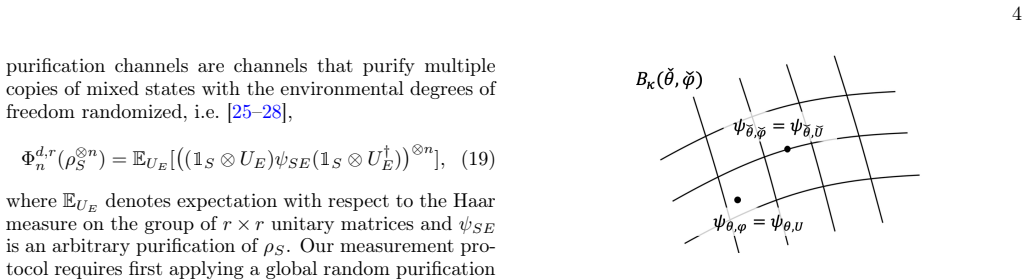
J. M. Lee,Introduction to Smooth Manifolds, 2nd ed. (Springer, 2012). 7 Appendix A: Justification of the parametrization step We use the following definitions from the main text. |ψθ,φ⟩:= rX j=1 p λj,θ |ej,θ⟩S exp −i r2−1X i=1 φiHi ˇU|j⟩ E ,(A1) |ψθ,U ⟩:= rX j=1 p λj,θ |ej,θ⟩S U|j⟩ E .(A2) |ψθ,φ⟩implicitly depends on ˇU. In this appendix, we assume...
2012
discussion (0)
Sign in with ORCID, Apple, or X to comment. Anyone can read and Pith papers without signing in.