Recognition: unknown
Synergistic Effects of Ocean Salinity and Planetary Obliquity Enhance Habitability of Cold Exo-Earths
Pith reviewed 2026-05-07 04:00 UTC · model grok-4.3
The pith
Ocean salinity and planetary obliquity together produce more varied and often more habitable climates for cold exo-Earths than either factor alone.
A machine-rendered reading of the paper's core claim, the machinery that carries it, and where it could break.
Core claim
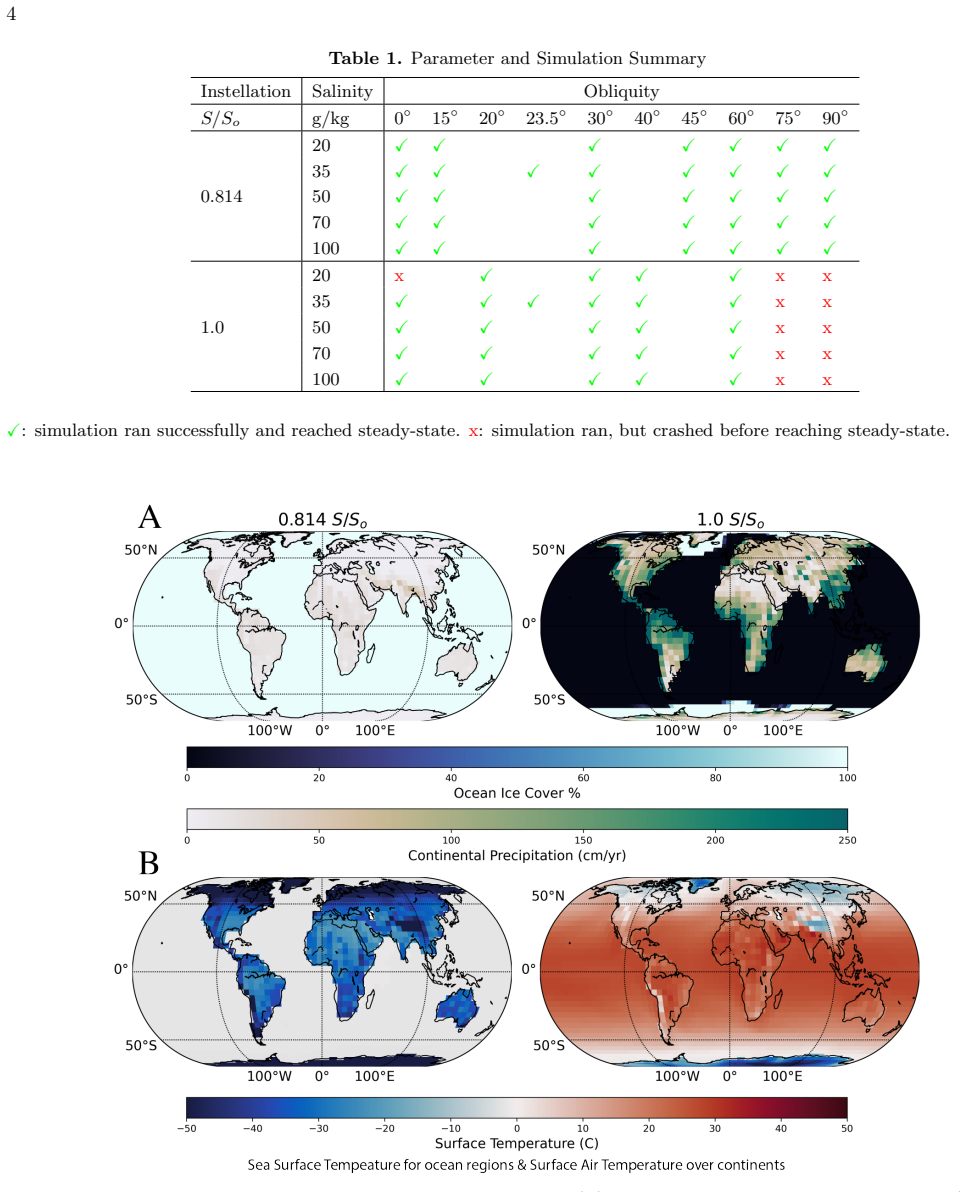
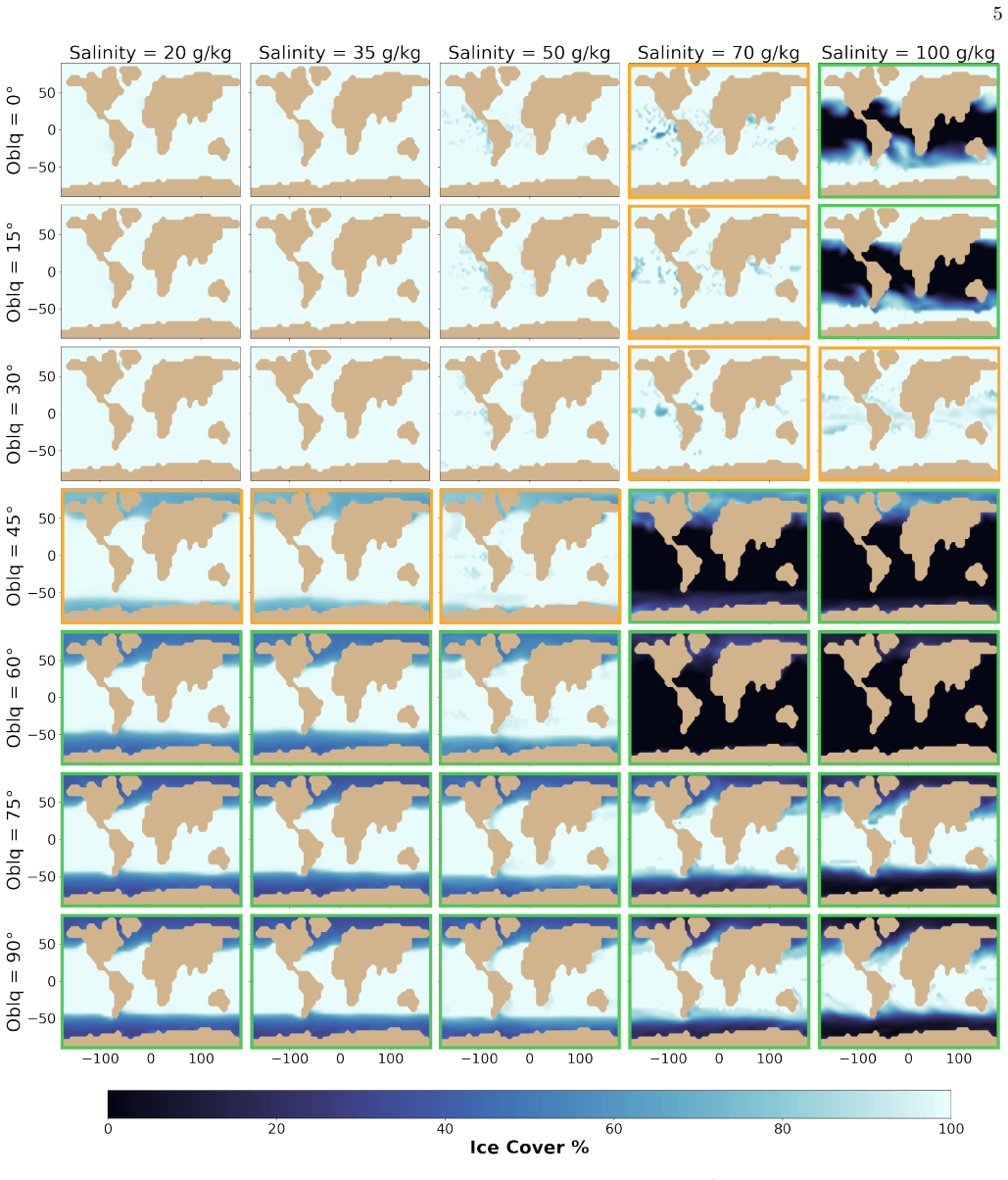
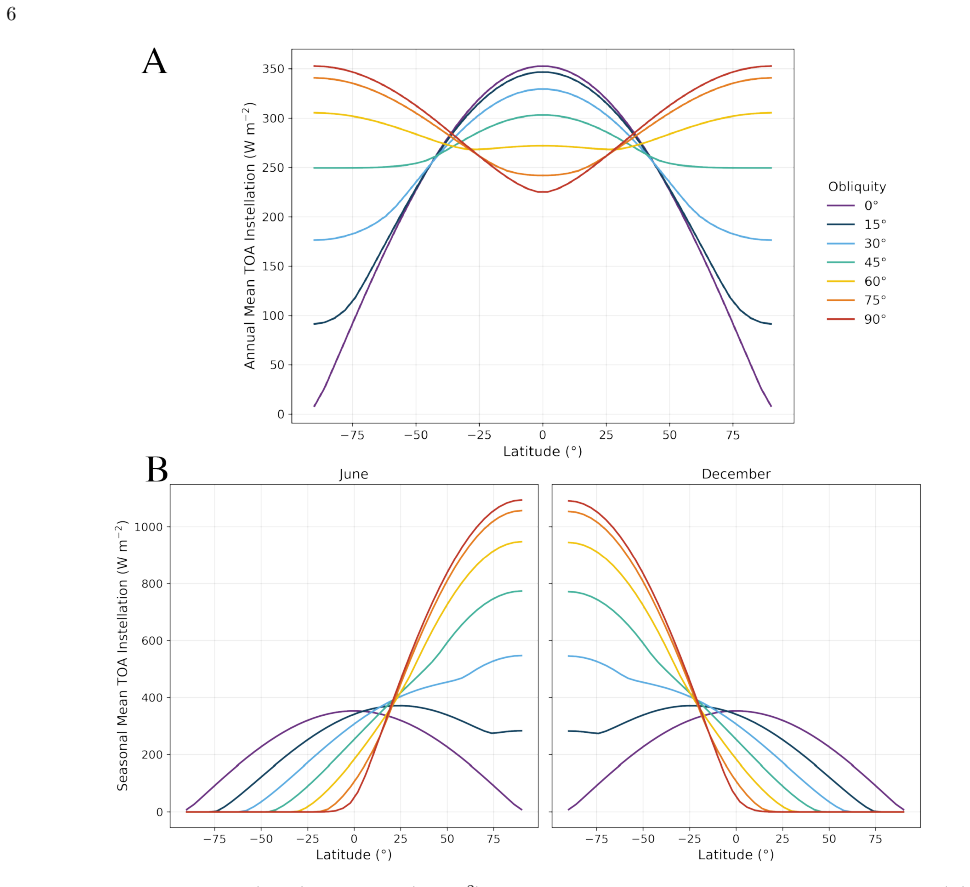
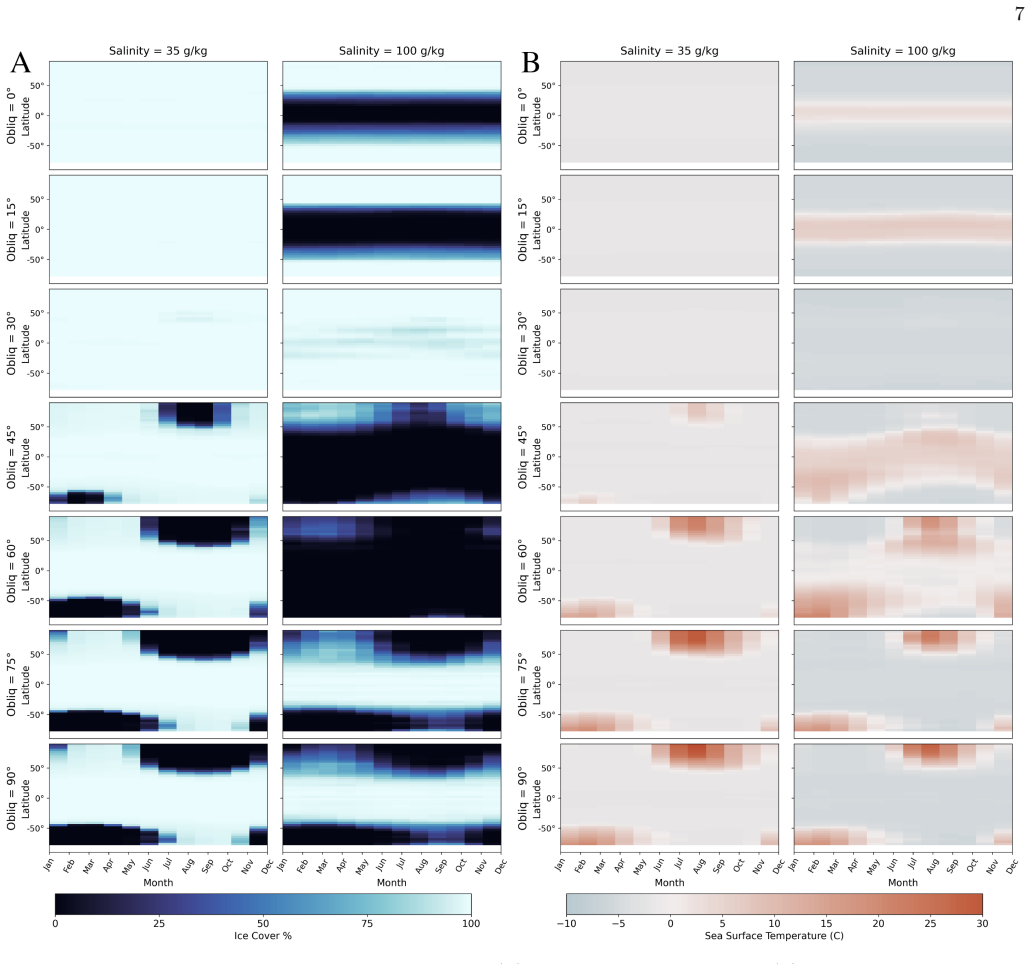
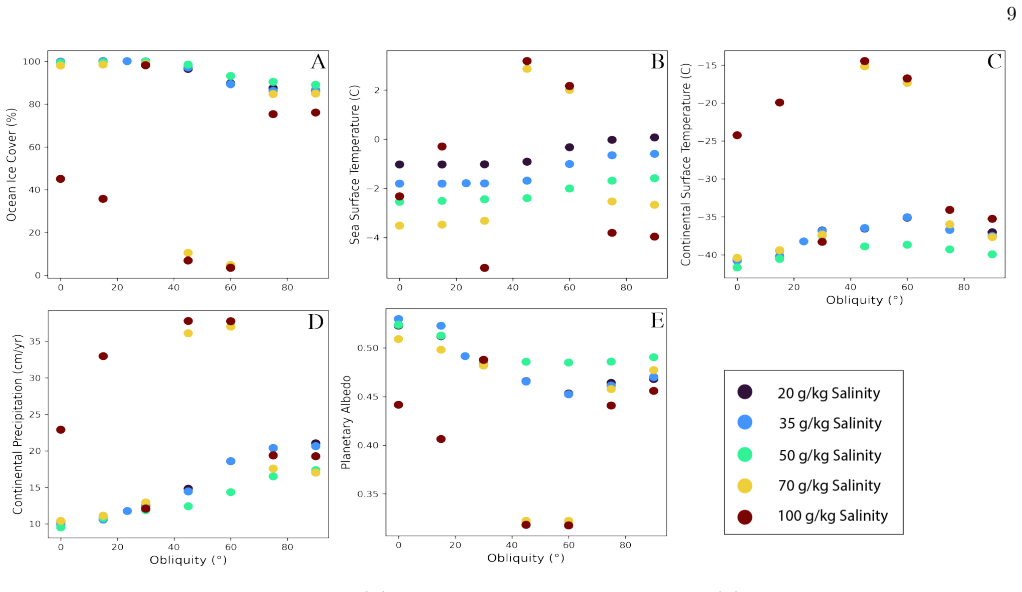
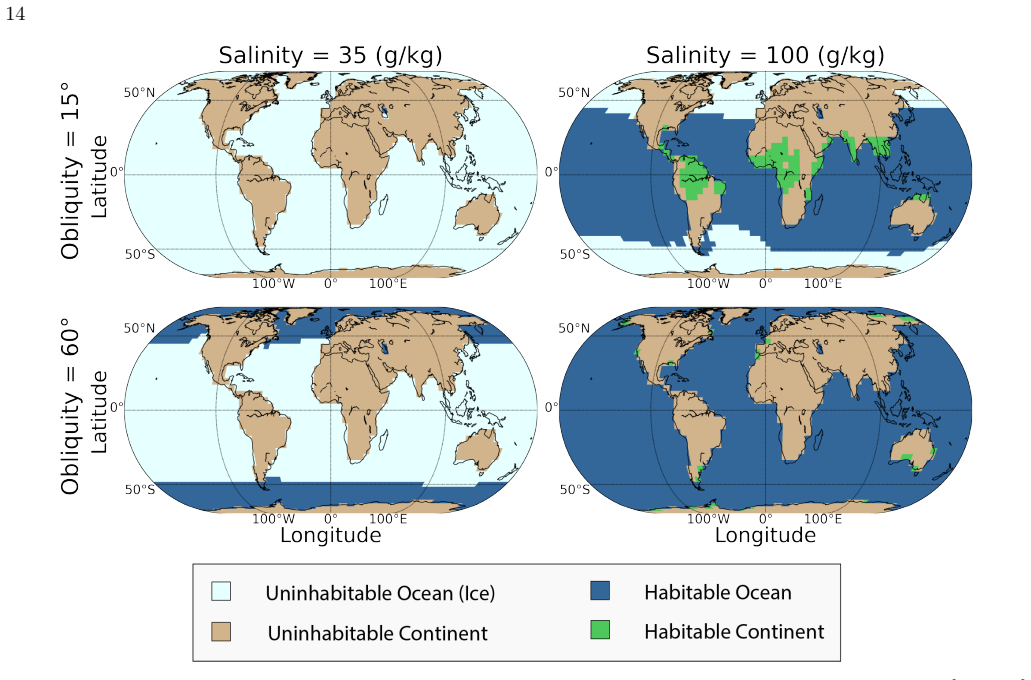
Salinity and obliquity have a greater combined impact on planetary climate than the sum of their effects in isolation. This synergy arises due to the ice-albedo feedback, producing distinct climate states that range from ice-free to globally glaciated while having the same initial atmospheric conditions and receiving the same instellation. Consequently, ocean salinity and planetary obliquity can together lead to divergent habitability outcomes for otherwise identical planetary scenarios and initial conditions, and they can jointly increase the planetary fractional habitability across oceans and continents, especially for cold exoplanets.
What carries the argument
The ice-albedo feedback loop, in which changes in ocean salinity (affecting freezing point and density-driven circulation) and obliquity (affecting seasonal sunlight distribution) both modify sea-ice extent, which in turn alters planetary reflectivity and temperature.
If this is right
- Planets receiving identical instellation can occupy ice-free, partially glaciated, or fully glaciated regimes solely due to differences in salinity and obliquity.
- Fractional habitability, measured across both ocean and land surfaces, can rise for cold planets when high salinity and high obliquity are combined.
- Divergent habitability outcomes become possible for otherwise identical planets that differ only in these two parameters.
- Studies of exoplanet climate and habitability must evaluate salinity and obliquity jointly rather than in isolation.
- The outer edge of the habitable zone may support more ice-free conditions than previously modeled when both factors are considered together.
Where Pith is reading between the lines
- Observational constraints on one variable could be used to narrow the plausible climate states produced by the other, aiding interpretation of future direct-imaging or transit data.
- Climate models that vary only one factor at a time risk underestimating the full range of possible surface conditions for a given instellation.
- The synergy implies that processes controlling ocean salinity on real exoplanets (such as water loss or volcanic outgassing) could indirectly affect habitability through their interaction with obliquity.
Load-bearing premise
The climate model's treatment of how salinity changes sea-ice formation and how that change couples to the ice-albedo feedback is accurate enough to represent real exoplanet conditions across the explored parameter range.
What would settle it
Direct measurement or inference of global ice coverage or mean surface temperature on a cold exoplanet whose ocean salinity and axial obliquity can be independently constrained, to test whether the observed state matches the model's synergistic prediction rather than a simple addition of separate salinity and obliquity runs.
Figures





read the original abstract
Past work has shown that ocean salinity and planetary obliquity both influence the climates of Earth-like exoplanets throughout the habitable zone of Sun-like stars. The effects of salinity and obliquity can be profound, with low vs. high salinity or obliquity resulting in distinct climate states in some scenarios. However, past work has considered salinity or obliquity in isolation and has not explored how each may modulate the effects of the other. We investigate how ocean salinity and planetary obliquity jointly impact climate and habitability using the ROCKE-3D coupled ocean-atmosphere general circulation model. We find that salinity and obliquity have a greater combined impact on planetary climate than the sum of their effects in isolation. This synergy between salinity and obliquity arises due to the ice-albedo feedback, producing distinct climate states that range from ice-free to globally glaciated while having same initial atmospheric conditions and receiving the same instellation. Consequently, ocean salinity and planetary obliquity can together lead to divergent habitability outcomes for otherwise identical planetary scenarios and initial conditions. Salinity and obliquity can jointly increase the planetary fractional habitability across oceans and continents, especially for cold exoplanets. Although neither ocean salinity nor planetary obliquity can be reliably predicted or observationally constrained, their synergistic effects must be considered in future studies of planetary climate and exoplanet observations, especially when characterizing planetary habitability.
Editorial analysis
A structured set of objections, weighed in public.
Referee Report
Summary. The manuscript uses the ROCKE-3D coupled ocean-atmosphere GCM to explore the joint effects of ocean salinity and planetary obliquity on the climates of cold Earth-like exoplanets at fixed low instellation. It reports that the two parameters interact synergistically through the ice-albedo feedback, producing a wider range of climate states (ice-free to globally glaciated) than would be expected from the sum of their isolated effects, with corresponding impacts on fractional habitability across oceans and land.
Significance. If the central result holds, the work is significant for exoplanet habitability assessments because it demonstrates non-additive, multi-parameter interactions that can shift planets between habitable and uninhabitable regimes under identical instellation. The forward-modeling approach with a physics-based GCM is a clear strength, as it avoids fitted parameters and directly simulates the mechanistic links between salinity-dependent freezing-point depression, ocean density, seasonal insolation from obliquity, and ice-albedo feedback. This provides a concrete example of how otherwise identical planets can diverge in climate outcome.
major comments (3)
- [Methods] Methods section: The study is based on a four-run matrix (low/high salinity × low/high obliquity) at a single cold instellation. No sensitivity tests are reported to sea-ice albedo, ocean mixing coefficients, brine-rejection parameterizations, or horizontal/vertical resolution. Because the claimed synergy is attributed entirely to the ice-albedo feedback, and because ROCKE-3D’s sea-ice and ocean closures are Earth-calibrated, the absence of these tests leaves open the possibility that the reported super-additive behavior is an artifact of the specific parameter choices rather than a robust physical outcome.
- [Results] Results section: The manuscript asserts that salinity and obliquity produce a 'greater combined impact' and 'distinct climate states' but does not provide quantitative measures of the synergy (e.g., the difference in global ice fraction or habitable area between the combined run and the arithmetic sum of the isolated runs) or any uncertainty estimates from the GCM integrations. Without these numbers or ensemble diagnostics, it is not possible to judge the magnitude or statistical robustness of the central claim.
- [Discussion] Discussion section: The attribution of the synergy exclusively to ice-albedo feedback is not isolated by diagnostic experiments (e.g., fixed-albedo runs or suppressed ocean heat transport). Other processes such as obliquity-driven changes in meridional circulation or salinity effects on atmospheric humidity could contribute; without such tests the causal mechanism remains plausible but unverified.
minor comments (3)
- [Abstract] Abstract: The abstract summarizes the findings qualitatively but reports no numerical values for ice coverage, surface temperature, or fractional habitability, making it difficult for readers to gauge the practical size of the reported synergy.
- [Figures] Figure captions: The captions for the climate-state figures should explicitly state the exact salinity (psu) and obliquity (degrees) values used for the 'low' and 'high' cases, as well as the instellation value, to allow direct reproduction.
- [Methods] Notation: The manuscript uses 'fractional habitability' without a clear definition or reference to how it is computed from the GCM output (e.g., temperature thresholds for liquid water on land vs. ocean).
Simulated Author's Rebuttal
We thank the referee for their constructive review and positive assessment of the work's significance. We address each major comment below with point-by-point responses. Where feasible, we will revise the manuscript to incorporate quantitative measures of synergy and clarifications on methods and mechanisms. We note limitations arising from computational constraints on additional simulations.
read point-by-point responses
-
Referee: Methods section: The study is based on a four-run matrix (low/high salinity × low/high obliquity) at a single cold instellation. No sensitivity tests are reported to sea-ice albedo, ocean mixing coefficients, brine-rejection parameterizations, or horizontal/vertical resolution. Because the claimed synergy is attributed entirely to the ice-albedo feedback, and because ROCKE-3D’s sea-ice and ocean closures are Earth-calibrated, the absence of these tests leaves open the possibility that the reported super-additive behavior is an artifact of the specific parameter choices rather than a robust physical outcome.
Authors: We acknowledge the value of sensitivity tests for confirming robustness. The ROCKE-3D parameters follow standard Earth-calibrated values used in prior exoplanet applications of the model. In revision, we will add a Methods subsection explaining these choices with references to existing sensitivity literature and explicitly noting the absence of dedicated tests as a limitation. This will clarify that the reported synergy is physically driven by salinity-dependent freezing point depression and ice-albedo feedback, while acknowledging that quantitative magnitudes could vary with parameter choices. revision: partial
-
Referee: Results section: The manuscript asserts that salinity and obliquity produce a 'greater combined impact' and 'distinct climate states' but does not provide quantitative measures of the synergy (e.g., the difference in global ice fraction or habitable area between the combined run and the arithmetic sum of the isolated runs) or any uncertainty estimates from the GCM integrations. Without these numbers or ensemble diagnostics, it is not possible to judge the magnitude or statistical robustness of the central claim.
Authors: We agree that explicit quantification will improve clarity. From the existing four simulations, we will compute and report the synergistic increment in global ice fraction and habitable area as (high-salinity/high-obliquity outcome) minus the sum of isolated high-salinity and high-obliquity effects relative to the low/low baseline. These numbers will be added to the Results section with supporting tables or figures. However, our study used single long integrations per case; we cannot provide ensemble-derived uncertainty estimates. We will state this limitation and identify ensemble diagnostics as future work. revision: partial
-
Referee: Discussion section: The attribution of the synergy exclusively to ice-albedo feedback is not isolated by diagnostic experiments (e.g., fixed-albedo runs or suppressed ocean heat transport). Other processes such as obliquity-driven changes in meridional circulation or salinity effects on atmospheric humidity could contribute; without such tests the causal mechanism remains plausible but unverified.
Authors: Our attribution rests on the direct correspondence between ice coverage changes, albedo increases, and the resulting temperature/habitability divergences in the simulations. In revision, we will augment the Discussion with additional diagnostics from the existing output, including seasonal ice maps and surface energy budget breakdowns, to strengthen the ice-albedo link. We will also discuss secondary roles of meridional circulation and humidity changes, showing they do not dominate the synergy in our results. Dedicated fixed-albedo or transport-suppression experiments would require new runs and are noted as valuable future extensions. revision: partial
- Full sensitivity tests to sea-ice albedo, ocean mixing coefficients, brine rejection, and resolution, as well as diagnostic experiments (fixed-albedo or suppressed heat transport runs) to isolate the ice-albedo feedback mechanism, because these require additional computationally expensive GCM simulations beyond the original four-run matrix.
- Ensemble-based uncertainty estimates or statistical robustness measures for the GCM results, since only single integrations were performed for each parameter combination.
Circularity Check
No circularity: results are direct outputs of forward GCM integrations
full rationale
The paper's central claim—that salinity and obliquity interact synergistically via ice-albedo feedback to produce distinct climate states—is obtained by executing a fixed set of ROCKE-3D simulations at one instellation value with four combinations of salinity and obliquity. No algebraic derivation, parameter fitting, or self-referential definition is present; the reported synergy is an emergent numerical outcome of the model's ocean, sea-ice, and radiation modules. No load-bearing self-citations, uniqueness theorems, or ansatzes imported from prior author work are invoked to force the result. The analysis is therefore self-contained and does not reduce any prediction to its inputs by construction.
Axiom & Free-Parameter Ledger
free parameters (2)
- Ocean salinity
- Planetary obliquity
axioms (2)
- domain assumption The ice-albedo feedback mechanism dominates the synergistic response in the climate model.
- domain assumption ROCKE-3D provides a realistic simulation of ocean-atmosphere-ice interactions under varying salinity and obliquity for Earth-like exoplanets.
Reference graph
Works this paper leans on
-
[1]
doi:10.1088/0004-637X/756/2/178 , eid =
Abbot, D. S., Cowan, N. B., & Ciesla, F. J. 2012, The Astrophysical Journal, 756, 178, doi: 10.1088/0004-637X/756/2/178
-
[2]
D., Millholland, S., & Laughlin, G
Adams, A. D., Millholland, S., & Laughlin, G. P. 2019, The Astronomical Journal, 158, 108, doi: 10.3847/1538-3881/ab2b35
-
[3]
2020, Chemical Geology, 548, 119625, doi: 10.1016/j.chemgeo.2020.119625
Albarede, F., Thibon, F., Blichert-Toft, J., & Tsikos, H. 2020, Chemical Geology, 548, 119625, doi: 10.1016/j.chemgeo.2020.119625
-
[4]
2014, Astrobiology, 14, 277, doi: 10.1089/ast.2013.1129
Armstrong, J., Barnes, R., Domagal-Goldman, S., et al. 2014, Astrobiology, 14, 277, doi: 10.1089/ast.2013.1129
-
[5]
2010, Cell Cycle, 9, 1528, doi: 10.4161/cc.9.8.11196
Gruenbaum, Y. 2010, Cell Cycle, 9, 1528, doi: 10.4161/cc.9.8.11196
-
[6]
Barnett, T. P. 1984, AMS Publications. https://journals.ametsoc.org/view/journals/mwre/112/ 2/1520-0493 1984 112 0303 lttist 2 0 co 2.xml
1984
-
[7]
Bates, N. R., Hansell, D. A., Carlson, C. A., & Gordon, L. I. 1998, Journal of Geophysical Research: Oceans, 103, 2883, doi: 10.1029/97JC02473
-
[8]
Batra, K., & Olson, S. L. 2024, The Astrophysical Journal Letters, 971, L11, doi: 10.3847/2041-8213/ad63a5
-
[9]
2014, Climate Research, 59, 1, doi: 10.3354/cr01204
Belda, M., Holtanov´ a, E., Halenka, T., & Kalvov´ a, J. 2014, Climate Research, 59, 1, doi: 10.3354/cr01204
-
[10]
1978, Journal of the Atmospheric Sciences, 35
Berger, A. 1978, Journal of the Atmospheric Sciences, 35. https://journals.ametsoc.org/view/journals/atsc/35/12/ 1520-0469 1978 035 2362 ltvodi 2 0 co 2.xml
1978
-
[11]
Cael, B. B., & Ferrari, R. 2017, Geophysical Research Letters, 44, 1886, doi: 10.1002/2016GL072223
-
[12]
Cary, S. C., McDonald, I. R., Barrett, J. E., & Cowan, D. A. 2010, Nature Reviews Microbiology, 8, 129, doi: 10.1038/nrmicro2281
-
[13]
S., & Cornillon, P
Casey, K. S., & Cornillon, P. 2001, AMS Publications. https://journals.ametsoc.org/view/journals/clim/14/18/ 1520-0442 2001 014 3801 garsst 2.0.co 2.xml
2001
-
[14]
Catling, D. C., & Zahnle, K. J. 2020, Science Advances, 6, eaax1420, doi: 10.1126/sciadv.aax1420
-
[15]
Farrell, R. L. 2013, Proceedings of the National Academy of Sciences, 110, 8990, doi: 10.1073/pnas.1300643110
-
[16]
Checlair, J. H., Olson, S. L., Jansen, M. F., & Abbot, D. S. 2019, The Astrophysical Journal Letters, 884, L46, doi: 10.3847/2041-8213/ab487d
-
[17]
2014, International Journal of Astrobiology, 13, 141, doi: 10.1017/S1473550413000438
Clarke, A. 2014, International Journal of Astrobiology, 13, 141, doi: 10.1017/S1473550413000438
-
[18]
2016, Astrobiology, 16, 89, doi: 10.1089/ast.2015.1295
Cockell, C., Bush, T., Bryce, C., et al. 2016, Astrobiology, 16, 89, doi: 10.1089/ast.2015.1295
-
[19]
Colose, C. M., Genio, A. D. D., & Way, M. J. 2019, The Astrophysical Journal, 884, 138, doi: 10.3847/1538-4357/ab4131
-
[20]
Colose, C. M., Haqq-Misra, J., Wolf, E. T., et al. 2021, The Astrophysical Journal, 921, 25, doi: 10.3847/1538-4357/ac135c
-
[21]
Cullum, J., Stevens, D. P., & Joshi, M. M. 2016, Proceedings of the National Academy of Sciences, 113, 4278, doi: 10.1073/pnas.1522034113
-
[22]
Part I: Wintertime Leading Mode
Curry, J. A., Schramm, J. L., & Ebert, E. E. 1995, Journal of Climate, 8, 240, doi: 10.1175/1520-0442(1995)008⟨0240:SIACFM⟩2.0.CO;2
-
[23]
1992, in Animal Life at Low Temperature, ed
Davenport, J. 1992, in Animal Life at Low Temperature, ed. J. Davenport (Dordrecht: Springer Netherlands), 139–153, doi: 10.1007/978-94-011-2344-0 6
-
[24]
2018, The Astronomical Journal, 155, 266, doi: 10.3847/1538-3881/aac214 Del Genio, A
Deitrick, R., Barnes, R., Bitz, C., et al. 2018, The Astronomical Journal, 155, 266, doi: 10.3847/1538-3881/aac214 Del Genio, A. D., Way, M. J., Amundsen, D. S., et al. 2019a, Astrobiology, 19, 99, doi: 10.1089/ast.2017.1760 Del Genio, A. D., Way, M. J., Kiang, N. Y., et al. 2019b, The Astrophysical Journal, 887, 197, doi: 10.3847/1538-4357/ab57fd
-
[25]
Walter, M. R., & Ward, C. R. 2017, Nature Communications, 8, 16149, doi: 10.1038/ncomms16149
-
[26]
T., Lyons, W
Doran, P. T., Lyons, W. B., & McKnight, D. M. 2010, Life in Antarctic Deserts and other Cold Dry Environments: Astrobiological Analogs (Cambridge University Press)
2010
-
[27]
Raymond, S. N. 2010, The Astrophysical Journal, 721, 1295, doi: 10.1088/0004-637X/721/2/1295
- [28]
-
[29]
Else, B. G. T., Papakyriakou, T. N., Asplin, M. G., et al. 2013, Global Biogeochemical Cycles, 27, 388, doi: 10.1002/gbc.20016
-
[30]
Else, B. G. T., Papakyriakou, T. N., Galley, R. J., et al. 2011, Journal of Geophysical Research: Oceans, 116, doi: 10.1029/2010JC006760 —. 2012, Journal of Geophysical Research: Oceans, 117, doi: 10.1029/2011JC007346
-
[31]
Ferreira, D., Marshall, J., O’Gorman, P. A., & Seager, S. 2014, Icarus, 243, 236, doi: 10.1016/j.icarus.2014.09.015
-
[32]
2011, Journal of Climate, 24, 992, doi: 10.1175/2010JCLI3580.1
Ferreira, D., Marshall, J., & Rose, B. 2011, Journal of Climate, 24, 992, doi: 10.1175/2010JCLI3580.1
-
[33]
Ferreira, D., Cessi, P., Coxall, H. K., et al. 2018, Annual Review of Earth and Planetary Sciences, 46, 327, doi: 10.1146/annurev-earth-082517-010045 25
-
[34]
2012, Reviews of Geophysics, 50, doi: 10.1029/2011RG000375
Feulner, G. 2012, Reviews of Geophysics, 50, doi: 10.1029/2011RG000375
-
[35]
Fofonoff, N. P., & Millard Jr, R. C. 1983, Unesco, doi: 10.25607/OBP-1450
-
[36]
1996, Journal of Geophysical Research: Oceans, 101, 14361, doi: 10.1029/96JC00629
Frouin, R., Schwindling, M., & Deschamps, P.-Y. 1996, Journal of Geophysical Research: Oceans, 101, 14361, doi: 10.1029/96JC00629
-
[37]
2018, Astrobiology, 18, 739, doi: 10.1089/ast.2017.1733
Fujii, Y., Angerhausen, D., Deitrick, R., et al. 2018, Astrobiology, 18, 739, doi: 10.1089/ast.2017.1733
-
[38]
2019, Earth System Dynamics, 10, 73, doi: 10.5194/esd-10-73-2019
Giorgi, F., Raffaele, F., & Coppola, E. 2019, Earth System Dynamics, 10, 73, doi: 10.5194/esd-10-73-2019
-
[39]
Gough, D. O. 1981, in Sol. Phys., ed. V. Domingo (Dordrecht: Springer Netherlands), 21–34, doi: 10.1007/978-94-010-9633-1 4
-
[40]
2018, Geophysical Research Letters, 45, 13,213, doi: 10.1029/2018GL080752 —
Guendelman, I., & Kaspi, Y. 2018, Geophysical Research Letters, 45, 13,213, doi: 10.1029/2018GL080752 —. 2019, The Astrophysical Journal, 881, 67, doi: 10.3847/1538-4357/ab2a06 —. 2022, AGU Advances, 3, e2022AV000684, doi: 10.1029/2022AV000684
-
[41]
2017, Science (New York, N.Y.), 355, 1069, doi: 10.1126/science.aal4151
Halevy, I., & Bachan, A. 2017, Science (New York, N.Y.), 355, 1069, doi: 10.1126/science.aal4151
-
[42]
Haug, G. H., & Tiedemann, R. 1998, Nature, 393, 673, doi: 10.1038/31447
-
[43]
W., Migdisov, A., Balukhovsky, A
Hay, W. W., Migdisov, A., Balukhovsky, A. N., et al. 2006,
2006
-
[44]
Palaeogeography, Palaeoclimatology, Palaeoecology, 240, 3, doi: 10.1016/j.palaeo.2006.03.044
-
[45]
He, F., Merrelli, A., L’Ecuyer, T. S., & Turnbull, M. C. 2022, The Astrophysical Journal, 933, 62, doi: 10.3847/1538-4357/ac6951
-
[46]
Holland, H. D. 1984, The Chemical Evolution of the Atmosphere and Oceans (Princeton University Press)
1984
-
[47]
2018, Nature Geoscience, 11, 665, doi: 10.1038/s41561-018-0190-9
Homann, M., Sansjofre, P., Van Zuilen, M., et al. 2018, Nature Geoscience, 11, 665, doi: 10.1038/s41561-018-0190-9
-
[48]
Hotinski, R. M., & Toggweiler, J. R. 2003, Paleoceanography, 18, doi: 10.1029/2001PA000730 Hou´ erou, H. N. L. 1992, Journal of Arid Environments, 22, 3, doi: 10.1016/S0140-1963(18)30653-0 H¨ oning, D., & Spohn, T. 2023, Astrobiology, 23, 372, doi: 10.1089/ast.2022.0070
-
[49]
Jansen, T., Scharf, C., Way, M., & Genio, A. D. 2019, The Astrophysical Journal, 875, 79, doi: 10.3847/1538-4357/ab113d
-
[50]
2023, The Astrophysical Journal, 944, 205, doi: 10.3847/1538-4357/acb81c
Jernigan, J., Lafleche, E., Burke, A., & Olson, S. 2023, The Astrophysical Journal, 944, 205, doi: 10.3847/1538-4357/acb81c
-
[51]
Johnson, B. W., Poulton, S. W., & Goldblatt, C. 2017, Nature Communications, 8, 1316, doi: 10.1038/s41467-017-01453-z
-
[52]
2012, Astrobiology, 12, 3, doi: 10.1089/ast.2011.0668
Joshi, M., & Haberle, R. 2012, Astrobiology, 12, 3, doi: 10.1089/ast.2011.0668
-
[53]
2017, Annual Review of Astronomy and Astrophysics, 55, 433, doi: 10.1146/annurev-astro-082214-122238
Kaltenegger, L. 2017, Annual Review of Astronomy and Astrophysics, 55, 433, doi: 10.1146/annurev-astro-082214-122238
-
[54]
2019, The Astrophysical Journal, 876, L1, doi: 10.3847/2041-8213/ab18a8
Kang, W. 2019, The Astrophysical Journal, 876, L1, doi: 10.3847/2041-8213/ab18a8
-
[55]
Kasting, J. F. 2010, Nature, 464, 687, doi: 10.1038/464687a
-
[56]
Kasting, J. F., Kopparapu, R., Ramirez, R. M., & Harman, C. E. 2014, Proceedings of the National Academy of Sciences, 111, 12641, doi: 10.1073/pnas.1309107110
-
[57]
Kasting, J. F., Whitmire, D. P., & Reynolds, R. T. 1993, Icarus, 101, 108, doi: 10.1006/icar.1993.1010
-
[58]
Kilic, C., Raible, C. C., & Stocker, T. F. 2017, The Astrophysical Journal, 844, 147, doi: 10.3847/1538-4357/aa7a03
-
[59]
Knauth, L. P. 1998, Nature, 395, 554, doi: 10.1038/26879 —. 2005, in Geobiology: Objectives, Concepts, Perspectives, ed. N. Noffke (Amsterdam: Elsevier), 53–69, doi: 10.1016/B978-0-444-52019-7.50007-3
-
[60]
Knauth, L. P., & Beeunas, M. A. 1986, Geochimica et Cosmochimica Acta, 50, 419, doi: 10.1016/0016-7037(86)90195-X
-
[61]
Kopparapu, R. K., Ramirez, R. M., SchottelKotte, J., et al. 2014, The Astrophysical Journal Letters, 787, L29, doi: 10.1088/2041-8205/787/2/L29
-
[62]
Kopparapu, R. K., Ramirez, R., Kasting, J. F., et al. 2013, The Astrophysical Journal, 765, 131, doi: 10.1088/0004-637X/765/2/131
-
[63]
Krissansen-Totton, J., Arney, G. N., & Catling, D. C. 2018, Proceedings of the National Academy of Sciences, 115, 4105, doi: 10.1073/pnas.1721296115 K¨ oppen, W. 2011, Meteorologische Zeitschrift, 351, doi: 10.1127/0941-2948/2011/105
-
[64]
2005, Water Resources Research, 41, doi: 10.1029/2005WR004084
Gavrieli, I. 2005, Water Resources Research, 41, doi: 10.1029/2005WR004084
-
[65]
2019, The Astronomical Journal, 157, 25, doi: 10.3847/1538-3881/aaf420
Lingam, M., & Loeb, A. 2019, The Astronomical Journal, 157, 25, doi: 10.3847/1538-3881/aaf420
-
[66]
Linsenmeier, M., Pascale, S., & Lucarini, V. 2015, Planetary and Space Science, 105, 43, doi: 10.1016/j.pss.2014.11.003
-
[67]
Lobo, A. H., & Bordoni, S. 2020, Icarus, 340, 113592, doi: 10.1016/j.icarus.2019.113592 —. 2022, Journal of Geophysical Research: Atmospheres, 127, e2021JD036003, doi: 10.1029/2021JD036003
-
[68]
Lobo, A. H., Shields, A. L., Palubski, I. Z., & Wolf, E. 2023, The Astrophysical Journal, 945, 161, doi: 10.3847/1538-4357/aca970 26
-
[69]
2014, Ocean Science, 10, 17, doi: 10.5194/os-10-17-2014
Schlosser, P. 2014, Ocean Science, 10, 17, doi: 10.5194/os-10-17-2014
-
[70]
Lunt, D. J., Valdes, P. J., Haywood, A., & Rutt, I. C. 2008, Climate Dynamics, 30, 1, doi: 10.1007/s00382-007-0265-6
-
[71]
Lustig-Yaeger, J., Meadows, V. S., Mendoza, G. T., et al. 2018, The Astronomical Journal, 156, 301, doi: 10.3847/1538-3881/aaed3a
-
[72]
2022, Monthly Notices of the Royal Astronomical Society, 513, 2761, doi: 10.1093/mnras/stac1040
Macdonald, E., Paradise, A., Menou, K., & Lee, C. 2022, Monthly Notices of the Royal Astronomical Society, 513, 2761, doi: 10.1093/mnras/stac1040
-
[73]
Marty, B., Avice, G., Bekaert, D. V., & Broadley, M. W. 2018, Comptes Rendus Geoscience, 350, 154, doi: 10.1016/j.crte.2017.12.002
-
[74]
Mor, Z., Assouline, S., Tanny, J., Lensky, I. M., & Lensky, N. G. 2018, Water Resources Research, 54, 1460, doi: 10.1002/2017WR021995
-
[75]
Munk, W., & Wunsch, C. 1998, Deep Sea Research Part I: Oceanographic Research Papers, 45, 1977, doi: 10.1016/S0967-0637(98)00070-3 M´ endez, A., Rivera-Valent´ ın, E. G., Schulze-Makuch, D., et al. 2021, Astrobiology, 21, 1017, doi: 10.1089/ast.2020.2342 National Academies of Sciences, Engineering, and Medicine. 2023, Pathways to Discovery in Astronomy an...
-
[76]
1973, Annual Review of Ecology and Systematics, 4, 25
Noy-Meir, I. 1973, Annual Review of Ecology and Systematics, 4, 25. https://www.jstor.org/stable/2096803
-
[77]
2022, Geophysical Research Letters, 49, e2021GL095748, doi: 10.1029/2021GL095748
Goldblatt, C. 2022, Geophysical Research Letters, 49, e2021GL095748, doi: 10.1029/2021GL095748
-
[78]
Olson, S. L., Jansen, M., & Abbot, D. S. 2020, The Astrophysical Journal, 895, 19, doi: 10.3847/1538-4357/ab88c9
-
[79]
Olson, S. L., Schwieterman, E. W., Reinhard, C. T., et al. 2018, The Astrophysical Journal, 858, L14, doi: 10.3847/2041-8213/aac171
-
[80]
2016, in Their World: A Diversity of Microbial Environments, ed
Oren, A. 2016, in Their World: A Diversity of Microbial Environments, ed. C. J. Hurst, Advances in Environmental Microbiology (Cham: Springer International Publishing), 301–339, doi: 10.1007/978-3-319-28071-4 8
discussion (0)
Sign in with ORCID, Apple, or X to comment. Anyone can read and Pith papers without signing in.