Recognition: 3 theorem links
· Lean TheoremPrecomputed Lens Transport Maps
Pith reviewed 2026-05-08 17:42 UTC · model grok-4.3
The pith
A precomputed lens model with wavelength inputs and Fresnel outputs uses a binary ray mask to improve accuracy near discontinuities while running an order of magnitude faster than brute-force ray tracing.
A machine-rendered reading of the paper's core claim, the machinery that carries it, and where it could break.
Core claim
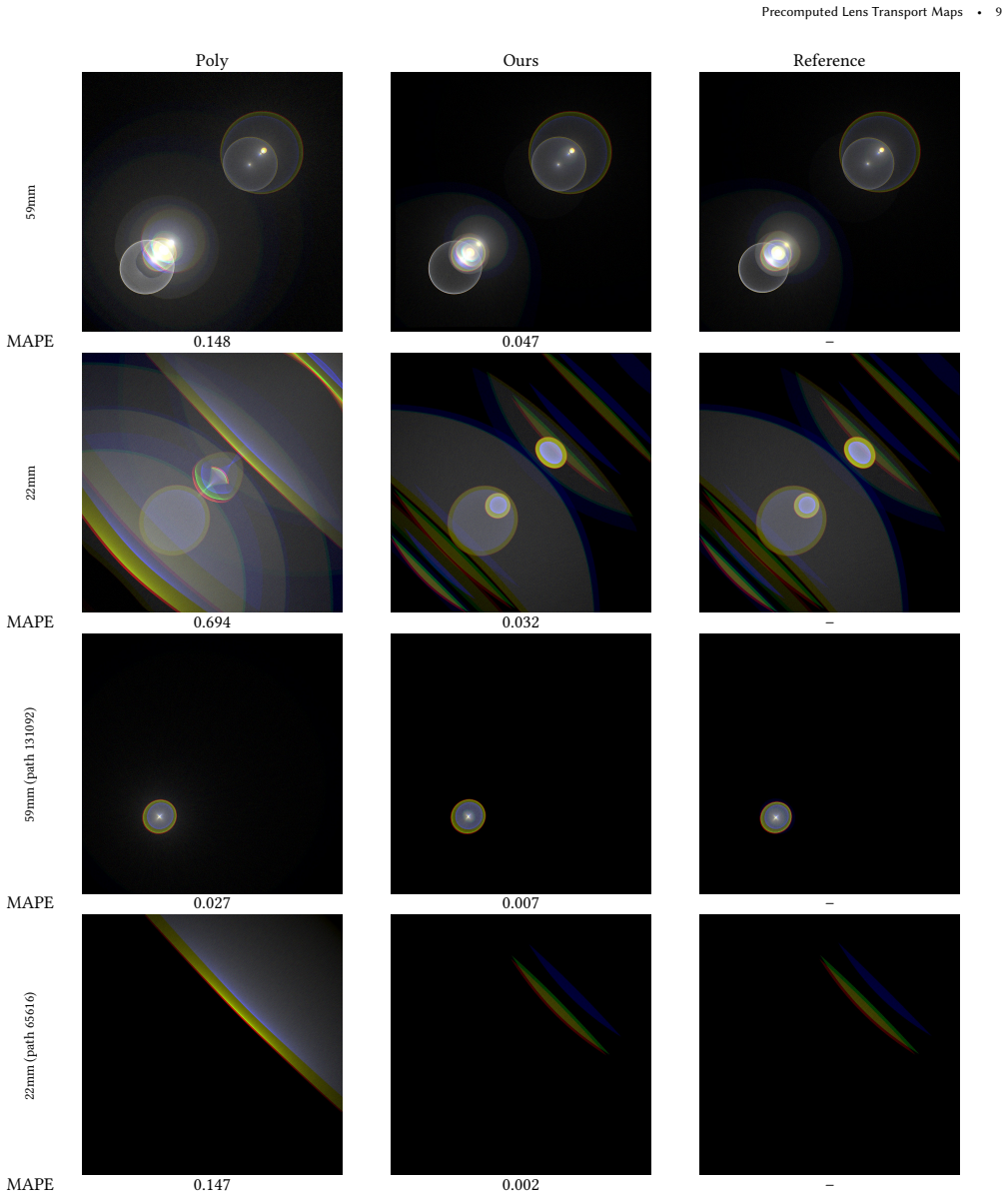
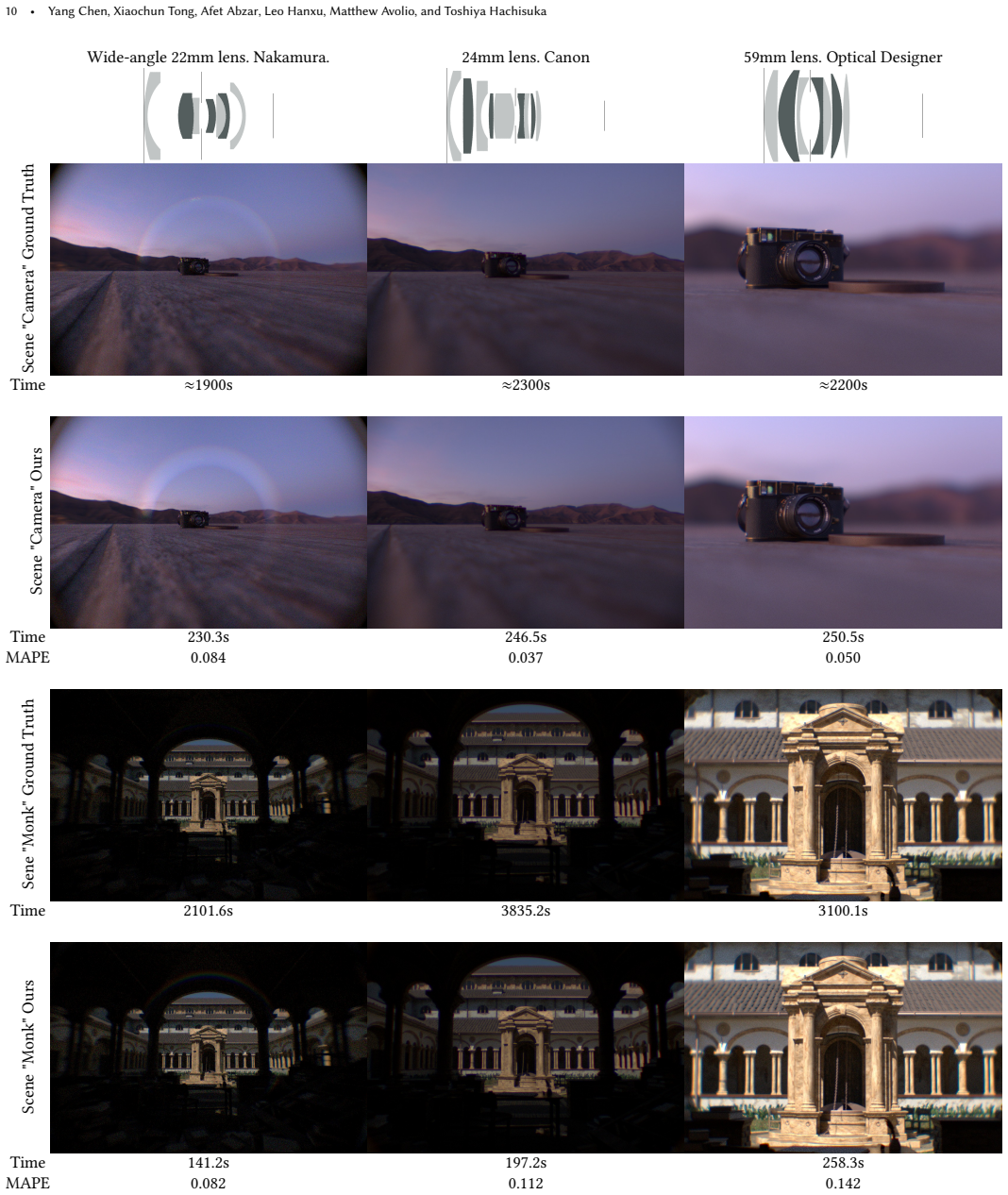
We introduce a precomputed lens model that combines wavelength-aware inputs with Fresnel intensity outputs. By classifying rays as valid or occluded via a binary mask in a factorized representation, our method focuses regression on unblocked rays, improving accuracy near discontinuities. Our model avoids per-wavelength approximations in polynomial models and explicitly predicts Fresnel coefficients to enable accurate lens simulation. Designed for static, rotationally symmetric systems under geometric optics, our model captures various lens effects such as chromatic aberration, coma, and lens flares.
What carries the argument
A factorized representation that pairs a continuous transport map with an explicit binary mask for ray validity, taking wavelength as input and emitting both ray direction and Fresnel throughput.
If this is right
- The model reproduces chromatic aberration, coma, and lens flares without separate per-wavelength networks.
- Fresnel coefficients are predicted directly, allowing internal reflections and flare to be simulated from the same map.
- Runtime cost stays an order of magnitude below full ray tracing while accuracy exceeds polynomial baselines.
- The representation works for any static rotationally symmetric lens once the transport map has been precomputed.
Where Pith is reading between the lines
- The same factorization could be applied to other optical elements such as prisms or mirrors whose ray paths also contain sharp occlusion boundaries.
- Because the mask is precomputed, the approach naturally supports baking multiple lens configurations into a single asset for use in real-time engines.
- If the precomputation grid is made adaptive, the method might extend to mildly asymmetric or zoom lenses without a full redesign.
Load-bearing premise
The assumption that separating ray validity into a binary mask allows the regression to focus on unblocked paths and thereby improves accuracy near discontinuities.
What would settle it
A controlled ablation that removes the binary mask while keeping every other network input and output the same, then measures whether error near occlusion boundaries increases or stays the same.
Figures




read the original abstract
Accurate real-time simulation of lens optics remains challenging due to the computational expense of full ray tracing and the limitations of existing approximations. The commonly used pinhole model and thin-lens model ignore many optical effects seen in real-world lens systems such as distortion and chromatic aberration. Prior polynomial models approximate a mapping between incident rays and exitant rays through a lens system per wavelength. Prior neural models improve the accuracy of this mapping and also capture wavelength-dependent variations (e.g., chromatic aberration) by integrating wavelength as an input to a unified neural network. Common to those prior models is that they omit Fresnel intensity throughput, precluding accurate simulation of internal reflections and lens flares. We introduce a precomputed lens model that combines wavelength-aware inputs with Fresnel intensity outputs. By classifying rays as valid or occluded via a binary mask in a factorized representation, our method focuses regression on unblocked rays, improving accuracy near discontinuities. Our model avoids per-wavelength approximations in polynomial models and explicitly predicts Fresnel coefficients to enable accurate lens simulation. Designed for static, rotationally symmetric systems under geometric optics, our model captures various lens effects such as chromatic aberration, coma, and lens flares. Our method achieves improved accuracy over polynomial baselines and is an order of magnitude faster than brute force ray tracing. Our method serves as a practical and scalable approach for simulating complex lens systems in applications requiring both accuracy and computational efficiency.
Editorial analysis
A structured set of objections, weighed in public.
Referee Report
Summary. The paper proposes a precomputed lens transport model for static, rotationally symmetric systems under geometric optics. It combines wavelength-aware inputs with Fresnel intensity outputs in a factorized representation that uses a binary mask to classify rays as valid or occluded, thereby focusing regression on unblocked paths. The method claims to capture effects including chromatic aberration, coma, and lens flares while achieving higher accuracy than polynomial baselines near discontinuities and running an order of magnitude faster than brute-force ray tracing.
Significance. If the quantitative accuracy and speed claims are substantiated with independent validation, the work would offer a practical middle ground between full ray tracing and existing approximations for real-time rendering pipelines that require Fresnel throughput and discontinuity handling. The explicit inclusion of Fresnel coefficients and the factorization strategy address documented limitations in prior polynomial and neural lens models.
major comments (3)
- [Abstract and §3] Abstract and §3 (factorized representation): The central accuracy claim rests on the binary mask focusing regression on unblocked rays to improve fidelity near discontinuities. The manuscript provides no quantitative evidence (e.g., error maps or ablation tables) that mask prediction avoids introducing new discontinuities or subspace leakage, especially at grazing angles or when Fresnel throughput is jointly predicted; without such data the improvement over standard wavelength-aware regressors cannot be verified.
- [Abstract and §4] Abstract and §4 (results): The abstract states 'improved accuracy over polynomial baselines' and 'an order of magnitude faster than brute force ray tracing' yet reports no numerical error metrics (RMSE, PSNR, or per-effect breakdowns), no validation datasets, and no implementation details. This absence makes it impossible to assess whether the reported gains are load-bearing or circular with the regression fitting process itself.
- [§3] §3 (precomputation): Because the model is regressed directly on ray-tracing data, any evaluation that re-uses the same ray-tracer for both training and testing risks circularity. The paper does not describe an independent test set or cross-validation protocol that would confirm generalization beyond the fitting data.
minor comments (2)
- [§3] Notation for the binary mask and factorized components is introduced without a clear diagram or equation reference, making the separation of valid/occluded subspaces difficult to follow on first reading.
- [§4] The manuscript should include a table comparing runtime and error against the specific polynomial and neural baselines cited in the introduction.
Simulated Author's Rebuttal
We thank the referee for the detailed and constructive feedback. The comments highlight important areas where additional quantitative validation and clarification will strengthen the manuscript. We address each major comment below and will incorporate the suggested revisions.
read point-by-point responses
-
Referee: [Abstract and §3] Abstract and §3 (factorized representation): The central accuracy claim rests on the binary mask focusing regression on unblocked rays to improve fidelity near discontinuities. The manuscript provides no quantitative evidence (e.g., error maps or ablation tables) that mask prediction avoids introducing new discontinuities or subspace leakage, especially at grazing angles or when Fresnel throughput is jointly predicted; without such data the improvement over standard wavelength-aware regressors cannot be verified.
Authors: We agree that quantitative evidence for the mask's contribution is necessary to fully support the accuracy claims. In the revised manuscript we will add ablation experiments and error maps that directly compare the factorized representation against a non-masked baseline. These will include targeted analysis at grazing angles and under joint Fresnel prediction, showing that the mask reduces discontinuity errors without introducing new artifacts or subspace leakage. revision: yes
-
Referee: [Abstract and §4] Abstract and §4 (results): The abstract states 'improved accuracy over polynomial baselines' and 'an order of magnitude faster than brute force ray tracing' yet reports no numerical error metrics (RMSE, PSNR, or per-effect breakdowns), no validation datasets, and no implementation details. This absence makes it impossible to assess whether the reported gains are load-bearing or circular with the regression fitting process itself.
Authors: We acknowledge that the current version lacks explicit numerical metrics and dataset details. The revised manuscript will include RMSE and PSNR tables for chromatic aberration, coma, and flare effects, results on held-out validation sets, and implementation specifics such as training/inference timings. These additions will allow independent assessment of the claimed accuracy and speed improvements. revision: yes
-
Referee: [§3] §3 (precomputation): Because the model is regressed directly on ray-tracing data, any evaluation that re-uses the same ray-tracer for both training and testing risks circularity. The paper does not describe an independent test set or cross-validation protocol that would confirm generalization beyond the fitting data.
Authors: We will revise §3 to explicitly describe the data pipeline, including generation of a separate held-out test set using distinct sampling parameters from the training rays. We will also document the cross-validation protocol used to verify generalization to unseen configurations, thereby addressing the circularity concern. revision: yes
Circularity Check
No significant circularity; precomputation is standard data-driven fitting with empirical validation.
full rationale
The paper describes a precomputed lens model trained via regression on ray-tracing data, using a factorized representation and binary mask to focus on valid rays. No derivation chain is claimed that reduces a 'prediction' or first-principles result to its own inputs by construction. Accuracy and speed claims are presented as empirical outcomes compared to polynomial baselines and brute-force tracing, not as self-referential fits. The binary mask is an explicit modeling choice whose effectiveness is asserted via improved accuracy near discontinuities, without evidence that the mask itself is derived from the regression target. This is a conventional supervised approximation pipeline with no load-bearing self-citation or self-definitional steps.
Axiom & Free-Parameter Ledger
free parameters (1)
- regression model parameters
axioms (2)
- domain assumption Geometric optics approximation is sufficient for the target lens systems
- domain assumption Lenses are static and rotationally symmetric
Reference graph
Works this paper leans on
-
[1]
Computer Graphics Forum , volume=
Sparse high-degree polynomials for wide-angle lenses , author=. Computer Graphics Forum , volume=. 2016 , organization=
2016
-
[2]
The Visual Computer , volume=
Adaptive sparse polynomial regression for camera lens simulation , author=. The Visual Computer , volume=. 2017 , publisher=
2017
-
[3]
The Lego Movie 2
Physically based lens flare rendering in" The Lego Movie 2" , author=. Proceedings of the 2019 Digital Production Symposium , pages=
2019
-
[4]
ACM SIGGRAPH 2024 Conference Papers , pages=
Aperture-Aware Lens Design , author=. ACM SIGGRAPH 2024 Conference Papers , pages=
2024
-
[5]
ACM Transactions on Graphics (TOG) , volume=
Differentiable compound optics and processing pipeline optimization for end-to-end camera design , author=. ACM Transactions on Graphics (TOG) , volume=. 2021 , publisher=
2021
-
[6]
Radiology , volume=
Point spread-function, line spread-function, and modulation transfer function: tools for the study of imaging systems , author=. Radiology , volume=. 1969 , publisher=
1969
-
[7]
The Visual Computer , pages=
Real-time ray transfer for lens flare rendering using sparse polynomials , author=. The Visual Computer , pages=. 2024 , publisher=
2024
-
[8]
Computer Graphics Forum , volume=
Practical real-time lens-flare rendering , author=. Computer Graphics Forum , volume=. 2013 , organization=
2013
-
[9]
Seminal Graphics Papers: Pushing the Boundaries, Volume 2 , pages=
Precomputed radiance transfer for real-time rendering in dynamic, low-frequency lighting environments , author=. Seminal Graphics Papers: Pushing the Boundaries, Volume 2 , pages=
-
[10]
Zheng, Shaokun and Zhou, Zhiqian and Chen, Xin and Yan, Difei and Zhang, Chuyan and Geng, Yuefeng and Gu, Yan and Xu, Kun , title =. 2022 , issue_date =. doi:10.1145/3550454.3555463 , journal =
-
[11]
Steinert, B. and Dammertz, H. and Hanika, J. and Lensch, H. P. A. , title =. Computer Graphics Forum , volume =. doi:https://doi.org/10.1111/j.1467-8659.2011.01851.x , url =. https://onlinelibrary.wiley.com/doi/pdf/10.1111/j.1467-8659.2011.01851.x , abstract =
-
[12]
M\"uller, Thomas , license =
-
[13]
Decomposition of binary images -
Tom. Decomposition of binary images -. Pattern Recognit. , volume =. 2012 , url =. doi:10.1016/J.PATCOG.2012.05.012 , timestamp =
-
[14]
In: IEEE/CVF Conference on Computer Vision and Pattern Recognition (CVPR)
Wenqi Xian and Aljaz Bozic and Noah Snavely and Christoph Lassner , title =. 2023 , url =. doi:10.1109/CVPR52729.2023.00815 , timestamp =
-
[15]
Hullin and Elmar Eisemann and Hans
Matthias B. Hullin and Elmar Eisemann and Hans. Physically-based real-time lens flare rendering , journal =. 2011 , url =. doi:10.1145/2010324.1965003 , timestamp =
-
[16]
Hullin and Johannes Hanika and Wolfgang Heidrich , title =
Matthias B. Hullin and Johannes Hanika and Wolfgang Heidrich , title =. Comput. Graph. Forum , volume =. 2012 , url =. doi:10.1111/J.1467-8659.2012.03132.X , timestamp =
-
[17]
Hyuntae Joo and Soonhyeon Kwon and Sangmin Lee and Elmar Eisemann and Sungkil Lee , title =. Comput. Graph. Forum , volume =. 2016 , url =. doi:10.1111/CGF.12953 , timestamp =
-
[18]
Efficient
Johannes Hanika and Carsten Dachsbacher , year = 2014, volume = 33, number =. Efficient. Computer Graphics Forum (Proceedings of Eurographics) , month =
2014
-
[19]
Craig E. Kolb and Don P. Mitchell and Pat Hanrahan , editor =. A realistic camera model for computer graphics , booktitle =. 1995 , url =. doi:10.1145/218380.218463 , timestamp =
-
[20]
2009 , pages =
Hachisuka, Toshiya and Jensen, Henrik Wann , title =. 2009 , pages =
2009
-
[21]
Differentiable Rendering using RGBXY Derivatives and Optimal Transport , author =. ACM Trans. Graph. , volume =. 2022 , issue_date =. doi:10.1145/3550454.3555479 , month =
-
[22]
Moroto, Yuji and Umetani, Nobuyuki , title =. 2022 , issue_date =. doi:10.1145/3550454.3555512 , journal =
-
[23]
ACM Transactions on Graphics (Proceedings of SIGGRAPH) , year =
Zackary Misso and Benedikt Bitterli and Iliyan Georgiev and Wojciech Jarosz , title =. ACM Transactions on Graphics (Proceedings of SIGGRAPH) , year =
-
[24]
XV. On a general method in dynamics; by which the study of the motions of all free systems of attracting or repelling points is reduced to the search and differentiation of one central relation, or characteristic function , author =. Philosophical transactions of the Royal Society of London , number =. 1834 , publisher =
-
[25]
Cauchy, Augustin , journal =. M
-
[26]
Proceedings of the London Mathematical Society , month =
Clifford , title =. Proceedings of the London Mathematical Society , month =. 1871 , publisher =
-
[27]
1903 , publisher =
The sub-mechanics of the universe , author =. 1903 , publisher =
1903
-
[28]
American Journal of Mathematics , year =
Discontinuous Solutions in Space Problems of the Calculus of Variations , author =. American Journal of Mathematics , year =
-
[29]
Physical Review , volume =
On dissipative systems and related variational principles , author =. Physical Review , volume =
-
[30]
Quarterly of applied mathematics , volume =
A method for the solution of certain non-linear problems in least squares , author =. Quarterly of applied mathematics , volume =
-
[31]
, number=
Schwartz, L. , number=. Th. 1950 , publisher=
1950
-
[32]
Sur l'impossibilit\'e de la multiplication des distributions , author =. C. R. Acad. Sci. Paris , year =
-
[33]
Journal of the Australian Mathematical Society , year =
Discontinuous solutions of variational problems , author =. Journal of the Australian Mathematical Society , year =
-
[34]
A Stochastic Approximation Method , volume =
Robbins, Herbert and Monro, Sutton , journal =. A Stochastic Approximation Method , volume =
-
[35]
Rosenbluth and Marshall N
Nicholas Metropolis and Arianna W. Rosenbluth and Marshall N. Rosenbluth and Augusta H. Teller and Edward Teller , title =. J. Chem. Phys. , volume =
-
[36]
Formulation of wave propagation in infinite media by normal coordinates with an application to diffraction , author =
-
[37]
Gunther Lange , title =
-
[38]
ARS Journal , volume =
Gradient theory of optimal flight paths , author =. ARS Journal , volume =
-
[39]
Keller , journal = JOSA, number =
Joseph B. Keller , journal = JOSA, number =. Geometrical Theory of Diffraction , volume =
-
[40]
Proceedings of the spring joint computer conference , pages =
A programming language , author =. Proceedings of the spring joint computer conference , pages =
-
[41]
1962 , institution =
The particle-in-cell method for numerical solution of problems in fluid dynamics , author =. 1962 , institution =
1962
-
[42]
Journal of the society for Industrial and Applied Mathematics , volume =
An algorithm for least-squares estimation of nonlinear parameters , author =. Journal of the society for Industrial and Applied Mathematics , volume =
-
[43]
Wengert, R. E. , title =. 1964 , pages =
1964
-
[44]
, title =
Sutherland, Ivan E. , title =. Proceedings of the SHARE Design Automation Workshop , year =
-
[45]
Techniques used in the
Woodcock, E and Murphy, T and Hemmings, P and Longworth, S , booktitle =. Techniques used in the
-
[46]
Coons, S. A. , title =. 1967 , publisher =
1967
-
[47]
Journal of Mathematical Analysis and Applications , volume =
On optimal control problems with discontinuities , author =. Journal of Mathematical Analysis and Applications , volume =. 1968 , publisher =
1968
-
[48]
1970 , publisher =
Optimal control theory: an introduction , author =. 1970 , publisher =
1970
-
[49]
The representation of the cumulative rounding error of an algorithm as a
Linnainmaa, Seppo , year =. The representation of the cumulative rounding error of an algorithm as a
-
[50]
Hastings, W. K. , journal = Biometrika, number =
-
[51]
The American Mathematical Monthly , volume =
Differentiation under the integral sign , author =. The American Mathematical Monthly , volume =. 1973 , publisher =
1973
-
[52]
Computer graphics and image processing , volume =
Determining lightness from an image , author =. Computer graphics and image processing , volume =
-
[53]
Proceedings of the IEEE , volume =
A uniform geometrical theory of diffraction for an edge in a perfectly conducting surface , author =. Proceedings of the IEEE , volume =
-
[54]
SIAM Journal on Numerical Analysis , volume =
Computational graphs and rounding error , author =. SIAM Journal on Numerical Analysis , volume =. 1974 , publisher =
1974
-
[55]
1974 , institution =
Geometric modeling for computer vision , author =. 1974 , institution =
1974
-
[56]
The psychology of computer vision , pages =
Obtaining shape from shading information , author =. The psychology of computer vision , pages =
-
[57]
Hunt, K. H. and Crossley, F. R. E. , title = ". Journal of Applied Mechanics , volume =
-
[58]
Proceedings of the Sagamore Computer Conference on Parallel Processing , year =
Lamport, Leslie , title =. Proceedings of the Sagamore Computer Conference on Parallel Processing , year =
-
[59]
1976 , publisher=
Hierarchical geometric models for visible surface algorithms , author =. 1976 , publisher=
1976
-
[60]
, title =
Max, Nelson L. , title =. 1976 , pages =
1976
-
[61]
D. Raj. Reddy , title =
-
[62]
1977 , publisher =
Hidden surface removal using polygon area sorting , author =. 1977 , publisher =
1977
-
[63]
1977 , publisher =
The aliasing problem in computer-generated shaded images , author =. 1977 , publisher =
1977
-
[64]
1978 , publisher =
Catmull, Edwin , title =. 1978 , publisher =
1978
-
[65]
1980 , pages =
Whitted, Turner , title =. 1980 , pages =
1980
-
[66]
1981 , publisher =
The Principles of Quantum Mechanics , author =. 1981 , publisher =
1981
-
[67]
, title =
Gupta, Satish and Sproull, Robert F. , title =. 1981 , publisher =
1981
-
[68]
The annals of Statistics , pages =
Estimation of the mean of a multivariate normal distribution , author =. The annals of Statistics , pages =
-
[69]
and Bolles, Robert C
Fischler, Martin A. and Bolles, Robert C. , title =. 1981 , pages =
1981
-
[70]
Artificial intelligence , volume =
Determining optical flow , author =. Artificial intelligence , volume =
-
[71]
1982 , publisher =
Ray tracing parametric patches , author =. 1982 , publisher =
1982
-
[72]
Impulse studies of double diffraction: A discrete
Medwin, Herman and Childs, Emily and Jebsen, Gary M , journal = JASMAN, volume =. Impulse studies of double diffraction: A discrete
-
[73]
, title =
Turkowski, K. , title =. 1982 , publisher =
1982
-
[74]
Chao, M. T. , Title =. 1982 , Pages =
1982
-
[75]
Cook, R. L. and Torrance, K. E. , title =. 1982 , pages =
1982
-
[76]
System modeling and optimization , pages =
Applications of advances in nonlinear sensitivity analysis , author =. System modeling and optimization , pages =. 1982 , publisher =
1982
-
[77]
1983 , publisher =
Williams, Lance , title =. 1983 , publisher =
1983
-
[78]
Computer Vision, Graphics, and Image Processing , volume =
Multilevel computational processes for visual surface reconstruction , author =. Computer Vision, Graphics, and Image Processing , volume =. 1983 , publisher =
1983
-
[79]
Doklady AN USSR , volume =
A method for unconstrained convex minimization problem with the rate of convergence O(1/k^2) , author =. Doklady AN USSR , volume =
-
[80]
1983 , publisher =
The analysis of linear partial differential operators I: Distribution theory and Fourier analysis , author =. 1983 , publisher =
1983
discussion (0)
Sign in with ORCID, Apple, or X to comment. Anyone can read and Pith papers without signing in.