Recognition: unknown
Quantum Dynamics: A Dilation-Based Approach
Pith reviewed 2026-05-09 20:23 UTC · model grok-4.3
The pith
Open quantum dynamics in finite dimensions can be modeled by dilating channel-valued curves to unitary evolution on a system-plus-environment space.
A machine-rendered reading of the paper's core claim, the machinery that carries it, and where it could break.
Core claim
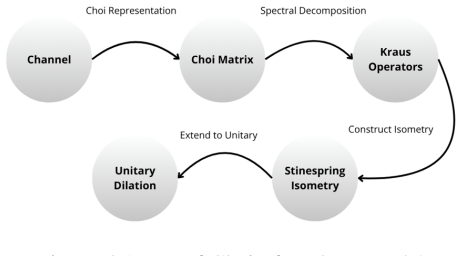
In the finite-dimensional setting, families of reduced dynamics expressed as channel-valued dynamical curves admit Stinespring dilations to unitary evolution on the original system tensor an ancillary environment. Exact dilation results hold for analytic dynamical curves while Lipschitz-continuous curves admit approximate finite-dimensional Stinespring dilations, and the construction can display singular behavior at t=0.
What carries the argument
Channel-valued dynamical curves and their Stinespring dilations, which embed the reduced channel evolution into unitary dynamics on an extended Hilbert space consisting of the system and an ancillary environment.
If this is right
- Analytic channel-valued dynamical curves admit exact finite-dimensional Stinespring dilations.
- Lipschitz-continuous channel-valued dynamical curves admit approximate finite-dimensional Stinespring dilations.
- Dilation constructions for such curves can exhibit singular behavior at the initial time t=0.
- The dilation perspective can lead to alternative formulations of problems in open quantum systems theory.
Where Pith is reading between the lines
- The finite-dimensional dilation results could guide the design of numerical simulations that explicitly include a small ancillary space.
- Singularities at t=0 in the dilation might correspond to initial system-environment correlations in concrete physical models.
- The framework suggests examining how properties of the dilating unitary family distinguish Markovian from non-Markovian reduced dynamics.
Load-bearing premise
The finite-dimensional setting and the exact and approximate Stinespring dilations for channel-valued curves capture the essential structure of open quantum dynamics without significant loss of generality.
What would settle it
An explicit Lipschitz-continuous channel-valued curve in finite dimensions that admits no sequence of approximate Stinespring dilations to unitary curves would falsify the approximation result.
Figures
read the original abstract
In the study of open quantum systems, one commonly describes the evolution of a system of interest through reduced dynamics, obtained by treating the environment indirectly rather than as a part of the full model. This thesis presents an expository account of an alternative, dilation-based viewpoint in the finite-dimensional setting, where a family of reduced dynamics is represented through unitary evolution on a larger system consisting of the original system together with an ancillary environment. After reviewing the reduced-dynamics perspective and the language of quantum channels, we formulate finite-dimensional quantum dynamics as channel-valued dynamical curves and use this framework to discuss Stinespring dilations of such curves. We then present exact dilation results for analytic dynamical curves, explain the singular behavior that can arise at t=0, and describe approximation results showing that Lipschitz-continuous dynamical curves admit approximate finite-dimensional Stinespring dilations. The thesis therefore provides a mathematically focused introduction to dilation-based modeling of quantum dynamics and argues that a change of perspective can lead to new ways of formulating problems in the theory of open quantum systems.
Editorial analysis
A structured set of objections, weighed in public.
Referee Report
Summary. The manuscript is an expository account of a dilation-based approach to modeling quantum dynamics for open systems in finite dimensions. It reviews the standard reduced-dynamics perspective and the language of quantum channels, formulates dynamics as channel-valued curves, states exact Stinespring dilation results for analytic curves (including singular behavior at t=0), and provides approximation results showing that Lipschitz-continuous curves admit approximate finite-dimensional Stinespring dilations. The central claim is that this viewpoint supplies a mathematically focused introduction and may suggest new problem formulations in open quantum systems theory.
Significance. If the stated dilation constructions hold, the work supplies a clear, self-contained review of standard finite-dimensional Stinespring theory applied to dynamical curves. Its modest claim of providing an alternative perspective is supported by the coherent sequence of constructions; the finite-dimensional exact and approximate results are standard tools that could indeed prompt reformulations of problems in open-system dynamics, though the restriction to finite dimensions is explicitly acknowledged and limits broader applicability.
minor comments (2)
- The abstract and introduction could more explicitly distinguish the exact dilation theorem for analytic curves from the approximation result for Lipschitz curves, perhaps by adding a short statement of the main theorems with their hypotheses.
- Notation for the channel-valued curve and the ancillary space dimension should be introduced once and used consistently; a small table summarizing the key objects (system Hilbert space, environment dimension, etc.) would improve readability.
Simulated Author's Rebuttal
We thank the referee for their positive assessment of the manuscript as a clear, self-contained review and for recommending acceptance. We appreciate the recognition that the finite-dimensional exact and approximate Stinespring results are standard tools that can prompt reformulations of problems in open quantum systems.
Circularity Check
Expository review with no circular derivations or load-bearing self-citations
full rationale
The manuscript is explicitly framed as an expository thesis reviewing reduced dynamics, quantum channels, and Stinespring dilations in finite dimensions. It formulates channel-valued curves and states exact/approximate dilation results for analytic and Lipschitz curves without introducing fitted parameters, new predictions that reduce to inputs by construction, or uniqueness theorems justified solely by self-citation. The modest central claim—that the dilation viewpoint supplies a focused introduction and may suggest new problem formulations—rests on standard mathematical constructions that are independent of the present work. No step in the described derivation chain reduces to a self-definition, renamed empirical pattern, or unverified self-citation chain.
Axiom & Free-Parameter Ledger
axioms (1)
- standard math Finite-dimensional quantum mechanics and the existence of Stinespring dilations for completely positive trace-preserving maps
Reference graph
Works this paper leans on
-
[1]
Breuer and F
H.-P. Breuer and F. Petruccione,The Theory of Open Quantum Systems, Oxford University Press, Oxford, 2002
2002
-
[2]
M. A. Nielsen and I. L. Chuang,Quantum Computation and Quantum Information, 10th Anniversary ed., Cambridge University Press, Cambridge, 2010
2010
-
[3]
Watrous,The Theory of Quantum Information, Cambridge University Press, Cambridge, 2018
J. Watrous,The Theory of Quantum Information, Cambridge University Press, Cambridge, 2018
2018
-
[4]
Kato,Perturbation Theory for Linear Operators, Classics in Mathematics, Springer, Berlin, Heidelberg, 1995
T. Kato,Perturbation Theory for Linear Operators, Classics in Mathematics, Springer, Berlin, Heidelberg, 1995
1995
-
[5]
H. M. Wiseman and G. J. Milburn,Quantum Measurement and Control, Cambridge University Press, Cambridge, 2010
2010
-
[6]
D. Manzano, “A short introduction to the Lindblad master equation,”AIP Advances10, 025106 (2020). doi:10.1063/1.5115323
-
[7]
Quantum simulations of dissipative dy- namics: time-dependence instead of size,
B. Dive, F. Mintert, and D. Burgarth, “Quantum simulations of dissipative dy- namics: time-dependence instead of size,”Physical Review A92, 032111 (2015). doi:10.1103/PhysRevA.92.032111
-
[8]
Control of Quantum Noise: On the Role of Dilations,
D. Burgarth, P. Facchi, and R. Hillier, “Control of Quantum Noise: On the Role of Dilations,” Annales Henri Poincar´e24, 325–347 (2023). doi:10.1007/s00023-022-01211-y
-
[9]
Quantum-Dynamical Semigroups and the Church of the Larger Hilbert Space,
F. vom Ende, “Quantum-Dynamical Semigroups and the Church of the Larger Hilbert Space,” Open Systems & Information Dynamics30, 2350003 (2023). doi:10.1142/S1230161223500038
-
[10]
Finite-Dimensional Stinespring Curves Can Approximate Any Dynamics,
F. vom Ende, “Finite-Dimensional Stinespring Curves Can Approximate Any Dynamics,” Open Systems & Information Dynamics31, 2450004 (2024). doi:10.1142/S1230161224500045 51
-
[11]
Completely Positive Dynamical Semigroups of N-Level Systems,
V. Gorini, A. Kossakowski, and E. C. G. Sudarshan, “Completely Positive Dynamical Semigroups of N-Level Systems,”Journal of Mathematical Physics17(5), 821–825 (1976). doi:10.1063/1.522979
-
[12]
On the generators of quantum dynamical sem igroups
G. Lindblad, “On the Generators of Quantum Dynamical Semigroups,”Communications in Mathematical Physics48(2), 119–130 (1976). doi:10.1007/BF01608499
-
[13]
22.51 Course Notes, Chapter 8: Open Quantum Systems,
P. Cappellaro, “22.51 Course Notes, Chapter 8: Open Quantum Systems,”MIT OpenCourse- Ware, 22.51 Quantum Theory of Radiation Interactions, Fall 2012. https://ocw.mit. edu/courses/22-51-quantum-theory-of-radiation-interactions-fall-2012/ resources/mit22_51f12_ch8/
2012
-
[14]
Lecture 6: Open quantum systems I: Kraus–Lindblad approach,
L. Sanchez-Palencia, “Lecture 6: Open quantum systems I: Kraus–Lindblad approach,” lecture notes forPhysics of Quantum Information, Master QLMN, 17 October 2025. https://atom-tweezers-io.org/wp-content/uploads/2025/10/ pqi2025-lecture6-open_quantum_systems.pdf
2025
-
[15]
M. Stefanini, A. A. Ziolkowska, D. Budker, U. Poschinger, F. Schmidt-Kaler, A. Browaeys, A. Imamoglu, D. Chang, and J. Marino, “Is Lindblad for me?”arXiv preprintarXiv:2506.22436 [quant-ph], 2025. 52 VITA Caleb A. Mickelson is passionate about making complex ideas easier to understand. Although he did not begin taking academics seriously until later in li...
work page internal anchor Pith review Pith/arXiv arXiv 2025
discussion (0)
Sign in with ORCID, Apple, or X to comment. Anyone can read and Pith papers without signing in.