Recognition: 3 theorem links
· Lean TheoremTunneling from an oscillating initial state in quantum mechanics
Pith reviewed 2026-05-08 18:25 UTC · model grok-4.3
The pith
A closed-form expression gives the tunneling probability current from general and oscillating initial states as a sum over resonant states computed to first subleading semiclassical order.
A machine-rendered reading of the paper's core claim, the machinery that carries it, and where it could break.
Core claim
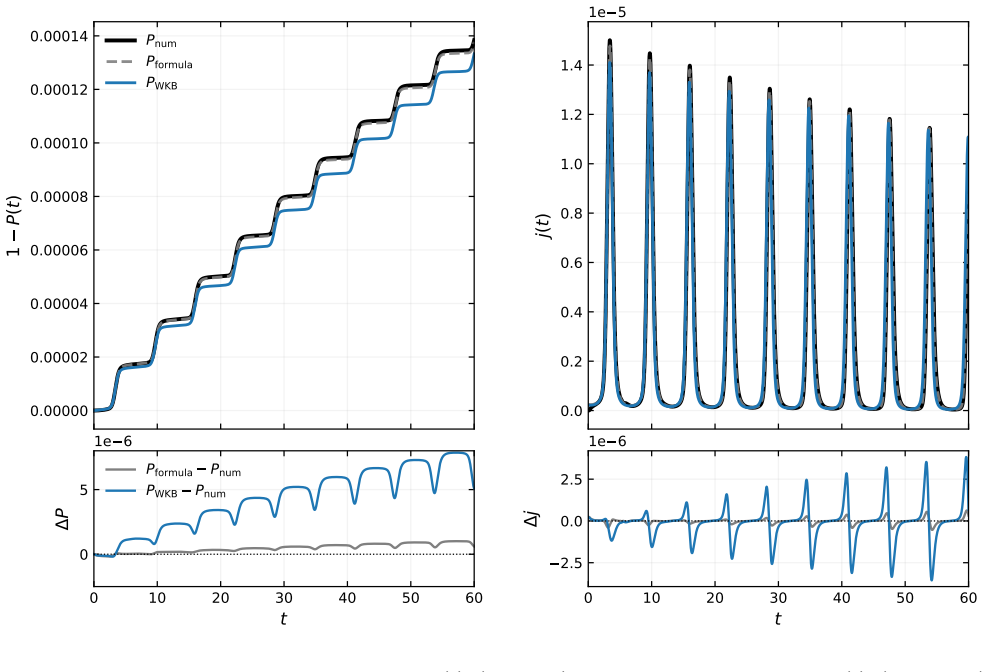
We study the decay of general initial states out of a metastable potential well in quantum mechanics. We provide a closed-form expression for the probability current that tunnels through the barrier in terms of the resonant states into which the initial state can be decomposed. All ingredients in the equation are computed analytically to first subleading order in the semiclassical limit. Specializing to a coherently-oscillating initial state, we derive an approximation to the time-dependent decay rate and demonstrate its accuracy by comparing it to a numerical solution of the Schrödinger equation.
What carries the argument
Decomposition of the initial state into resonant states whose complex energies and wavefunctions are computed to first subleading semiclassical order, yielding a closed-form expression for the tunneling probability current.
If this is right
- An explicit time-dependent decay rate follows for any coherently oscillating initial state.
- The tunneling current is expressed solely in terms of analytically available resonant-state data.
- The same expression applies to arbitrary initial states that admit a resonant decomposition.
- Accuracy holds to first subleading semiclassical order without requiring full numerical time evolution.
Where Pith is reading between the lines
- The resonant decomposition approach may extend to slowly varying time-dependent barriers outside the static metastable-well setting.
- Preparing particular oscillating states could allow experimental tuning of effective decay rates in quantum devices.
- Similar current expressions might appear in multi-dimensional or many-body tunneling problems once resonant modes are identified.
Load-bearing premise
The initial state admits a decomposition into resonant states whose complex energies and wavefunctions can be computed to the required semiclassical accuracy and whose higher-order corrections remain negligible for the times of interest.
What would settle it
Numerical solution of the time-dependent Schrödinger equation for a chosen oscillating initial state in a specific metastable potential, checked against the analytical current formula at times where the semiclassical expansion should be valid.
Figures


read the original abstract
We study the decay of general initial states out of a metastable potential well in quantum mechanics. We provide a closed-form expression for the probability current that tunnels through the barrier in terms of the resonant states into which the initial state can be decomposed. All ingredients in the equation are computed analytically to first subleading order in the semiclassical limit. Specializing to a coherently-oscillating initial state, we derive an approximation to the time-dependent decay rate and demonstrate its accuracy by comparing it to a numerical solution of the Schr\"odinger equation.
Editorial analysis
A structured set of objections, weighed in public.
Referee Report
Summary. The manuscript derives a closed-form expression for the probability current tunneling through a barrier from a general initial state in a metastable well, expressed via decomposition into resonant (Siegert) states with all quantities evaluated analytically to first subleading semiclassical order. Specializing to a coherently oscillating initial state, it obtains an approximation for the time-dependent decay rate and validates it by direct numerical comparison to the time-dependent Schrödinger equation.
Significance. If the central result holds, the work supplies an analytical tool for time-dependent tunneling from non-stationary states, extending semiclassical methods beyond stationary decay. Strengths include the parameter-free analytical expressions to subleading order and the concrete numerical validation for the oscillating case, which together support the utility of the resonant-state approach.
major comments (1)
- [Specialization to coherently-oscillating initial state] The section specializing to the coherently-oscillating initial state: the accuracy claim for the derived time-dependent decay rate rests on the resonant-state decomposition of the initial wave function being sufficiently complete and accurate inside the well. The manuscript does not report an explicit verification that the truncated sum over resonances reproduces the initial oscillating state to the same first-subleading semiclassical accuracy used for the complex energies and wave functions. Without this check, the error budget for the current expression remains uncontrolled, particularly given that resonant states are not square-integrable and completeness holds only in the rigged-Hilbert-space sense.
Simulated Author's Rebuttal
We thank the referee for their careful reading of the manuscript and for the positive overall assessment. We address the single major comment below and will revise the manuscript to incorporate the requested verification.
read point-by-point responses
-
Referee: The section specializing to the coherently-oscillating initial state: the accuracy claim for the derived time-dependent decay rate rests on the resonant-state decomposition of the initial wave function being sufficiently complete and accurate inside the well. The manuscript does not report an explicit verification that the truncated sum over resonances reproduces the initial oscillating state to the same first-subleading semiclassical accuracy used for the complex energies and wave functions. Without this check, the error budget for the current expression remains uncontrolled, particularly given that resonant states are not square-integrable and completeness holds only in the rigged-Hilbert-space sense.
Authors: We agree that an explicit verification of how accurately the truncated resonant-state sum reproduces the initial oscillating wave function inside the well would strengthen the error analysis. While the direct numerical comparison of the resulting tunneling current to the time-dependent Schrödinger equation already provides indirect support for the decomposition's adequacy, we will add in the revised manuscript a dedicated check: a plot and quantitative error measure (e.g., L2 difference inside the well) comparing the truncated sum (using the identical number of resonances employed for the decay-rate formula) against the exact initial state. This will be performed at the same semiclassical order used for the energies and wave functions, thereby controlling the error budget more explicitly. We note that the rigged-Hilbert-space framework is the standard setting in which the resonant-state expansion is known to be complete, and the added numerical test will demonstrate its practical convergence for the quantities of interest. revision: yes
Circularity Check
No significant circularity; derivation self-contained from TDSE and resonant expansion
full rationale
The paper derives the closed-form probability current directly from the time-dependent Schrödinger equation via resonant-state (Siegert) expansion, with all quantities evaluated analytically to first subleading semiclassical order. The specialization to the coherently oscillating initial state yields an approximate time-dependent decay rate that is then compared to an independent numerical solution of the Schrödinger equation. No load-bearing step reduces by construction to a fitted parameter, self-citation chain, or ansatz smuggled from prior work; the numerical benchmark supplies an external check outside the analytic expressions.
Axiom & Free-Parameter Ledger
axioms (2)
- domain assumption Any initial state in the well can be expanded in the resonant-state basis
- domain assumption Semiclassical expansion to first subleading order suffices for the resonant energies and wavefunctions
Lean theorems connected to this paper
-
Cost.FunctionalEquation / Foundation.AlphaDerivationExplicitwashburn_uniqueness_aczel (no parallel: paper's exponent is a classical action integral, not a φ-ladder rung) unclear?
unclearRelation between the paper passage and the cited Recognition theorem.
Γ_n = (1/(g_n t_n)) e^{-2 S_n/ℏ}, with S_n the WKB tunneling action
What do these tags mean?
- matches
- The paper's claim is directly supported by a theorem in the formal canon.
- supports
- The theorem supports part of the paper's argument, but the paper may add assumptions or extra steps.
- extends
- The paper goes beyond the formal theorem; the theorem is a base layer rather than the whole result.
- uses
- The paper appears to rely on the theorem as machinery.
- contradicts
- The paper's claim conflicts with a theorem or certificate in the canon.
- unclear
- Pith found a possible connection, but the passage is too broad, indirect, or ambiguous to say the theorem truly supports the claim.
Reference graph
Works this paper leans on
-
[1]
and Ghirardi, G
Fonda, L. and Ghirardi, G. C. and Rimini, A. , title =. Physics Reports , volume =. 1978 , doi =
1978
-
[2]
Soviet Phys. JETP , year =
Khalfin, S. A. , title = ". Soviet Phys. JETP , year = "1958", volume =
1958
-
[3]
Raczynska, K. and Urbanowski, K. Survival amplitude, instantaneous energy and decay rate of an unstable system: Analytical results. Acta Phys. Polon. B. 2018. doi:10.5506/APhysPolB.49.1683. arXiv:1802.01441
-
[4]
, title =
Kleban, Matthew and Norton, Cameron E. , title =. Phys. Rev. D , volume =. 2025 , doi =
2025
-
[5]
Journal of Cosmology and Astroparticle Physics , year =
Garriga, Jaume and Vilenkin, Alexander and Zhang, Jun , title =. Journal of Cosmology and Astroparticle Physics , year =. doi:10.1088/1475-7516/2016/02/064 , eprint =
-
[6]
Caldeira, A. O. and Leggett, A. J. , title =. Annals of Physics , volume =. 1983 , doi =
1983
-
[7]
Janssen, Oliver and Karlsson, Joel and Riccardi, Flavio and Varrone, Mattia. An ode to instantons. 2026. arXiv:2603.06575
-
[8]
Energy-Level Quantization in the Zero-Voltage State of a Current-Biased Josephson Junction , author =. Phys. Rev. Lett. , volume =. 1985 , month =. doi:10.1103/PhysRevLett.55.1543 , url =
-
[9]
1998 , publisher=
Quantum Mechanics , author=. 1998 , publisher=
1998
-
[10]
Capture of Slow Neutrons , author =. Phys. Rev. , volume =. 1936 , month =. doi:10.1103/PhysRev.49.519 , url =
-
[11]
1972 Semiclassical approximations in wave mechanics.Rep
Berry, Michael V. and Mount, K. E. Semiclassical approximations in wave mechanics. Rept. Prog. Phys. 1972. doi:10.1088/0034-4885/35/1/306
-
[12]
Landau, Lev Davidovich and Lifshits, E. M. Quantum Mechanics : Non-Relativistic Theory. 1991. doi:10.1016/C2013-0-02793-4
-
[13]
American Journal of Physics , volume =
Edison, Alex and Garg, Anupam , title =. American Journal of Physics , volume =. 2025 , month =. doi:10.1119/5.0236109 , url =
-
[14]
Experimental tests for the quantum behavior of a macroscopic degree of freedom: The phase difference across a Josephson junction , author =. Phys. Rev. B , volume =. 1987 , month =. doi:10.1103/PhysRevB.35.4682 , url =
-
[15]
Resonant states and their uses
Garc \' a-Calder \'o n, Gast \'o n and Peierls, Rudolf. Resonant states and their uses. Nucl. Phys. A. 1976. doi:10.1016/0375-9474(76)90554-6
-
[16]
Berggren , title =
T. Berggren , title =. Nucl. Phys. A , volume =
-
[17]
Tunneling in a time-dependent setting , volume=
Keski-Vakkuri, Esko and Kraus, Per , year=. Tunneling in a time-dependent setting , volume=. Physical Review D , publisher=. doi:10.1103/physrevd.54.7407 , number=
-
[18]
Y. B. Zel'dovich , title =. Sov. Phys. JETP , volume =
-
[19]
and Coleman, Sidney , title =
Callan, Curtis G. and Coleman, Sidney , title =. Phys. Rev. D , volume =. 1977 , doi =
1977
-
[20]
Coleman, Sidney , title =. Phys. Rev. D , volume =. 1977 , doi =
1977
-
[21]
Zeitschrift für Physik , volume =
Gamow, George , title =. Zeitschrift für Physik , volume =. 1928 , doi =
1928
-
[22]
Siegert, A. J. F. , title =. Physical Review , volume =. 1939 , doi =
1939
-
[23]
Steingasser, Thomas and Kaiser, David I. , year=. Toward quantum tunneling from excited states: Recovering imaginary-time instantons from a real-time analysis , volume=. Physical Review D , publisher=. doi:10.1103/physrevd.111.096009 , number=
-
[24]
Riss, U. V. and Meyer, H.-D. , title =. Journal of Physics B: Atomic, Molecular and Optical Physics , year =
-
[25]
Quantum tunneling from excited states in the steadyon picture
Lin, Joshua and Scheihing-Hitschfeld, Bruno and Steingasser, Thomas. Quantum tunneling from excited states in the steadyon picture. 2025. arXiv:2511.08670
-
[26]
Path integral predictions for pre-asymptotic false vacuum decay
Lin, Joshua and Scheihing-Hitschfeld, Bruno and Steingasser, Thomas. Path integral predictions for pre-asymptotic false vacuum decay. 2025. arXiv:2511.08669
-
[27]
Generalized escape paths for dynamical tunneling in QFT
Darm \'e , Luc and Jaeckel, Joerg and Lewicki, Marek. Generalized escape paths for dynamical tunneling in QFT. Phys. Rev. D. 2019. doi:10.1103/PhysRevD.100.096012. arXiv:1907.04865
discussion (0)
Sign in with ORCID, Apple, or X to comment. Anyone can read and Pith papers without signing in.