Recognition: 3 theorem links
· Lean TheoremHeterotic String Theory Suggests a QCD Axion Near 0.5 neV
Pith reviewed 2026-05-08 18:31 UTC · model grok-4.3
The pith
Heterotic string theory fixes the QCD axion mass at or above 0.5 neV via the model-independent axion whose decay constant equals the GUT scale.
A machine-rendered reading of the paper's core claim, the machinery that carries it, and where it could break.
Core claim
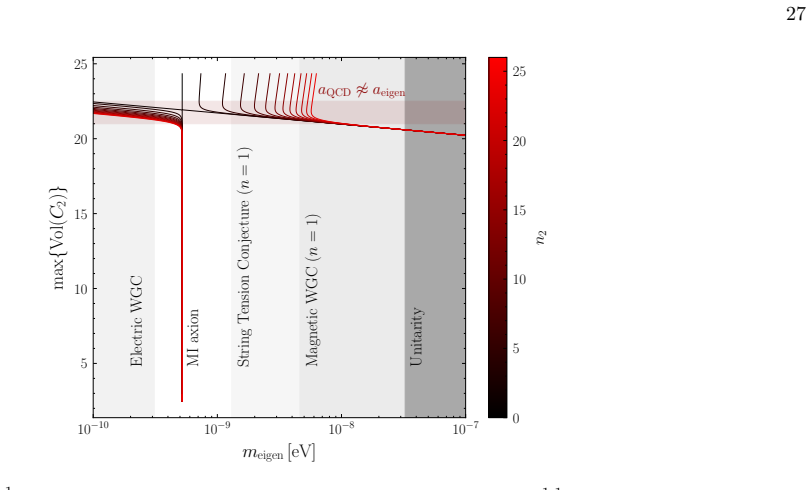
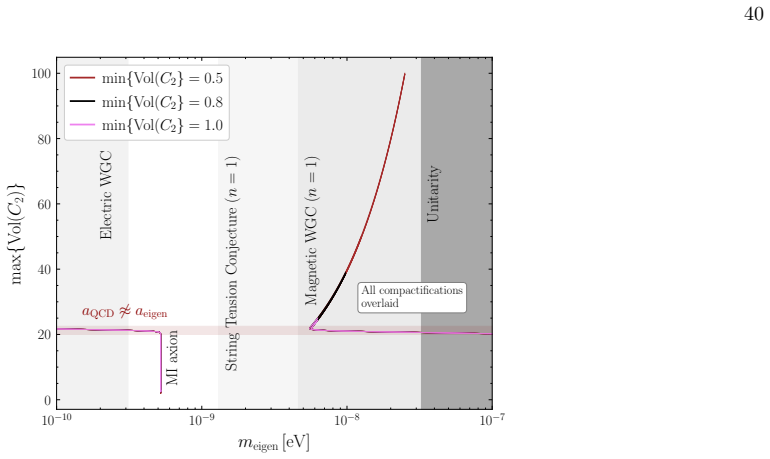
In heterotic string theory the model-independent axion has a decay constant fixed by the GUT gauge coupling, so that the QCD axion mass satisfies m_a ≳ 0.5 neV. Explicit evaluation over Kreuzer-Skarke hypersurfaces and complete-intersection Calabi-Yau manifolds shows that, after scanning the Kähler moduli space for vacua consistent with unification, all but a handful of models yield masses lying in [0.5, 0.8] neV. The same ensemble produces heavy axions that decay before big-bang nucleosynthesis and can support leptogenesis.
What carries the argument
The model-independent axion whose decay constant is set by the GUT gauge coupling in heterotic (and Type I) compactifications.
If this is right
- Future detectors such as DMRadio-GUT should target the narrow mass window [0.5, 0.8] neV as a high-priority search region.
- The heavy axion population generically decays before big-bang nucleosynthesis.
- Heterotic models can accommodate leptogenesis without additional tuning.
- The same lower bound on the axion mass applies to dual Type I constructions.
Where Pith is reading between the lines
- If upcoming experiments exclude the entire 0.5–0.8 neV window, standard heterotic compactifications with unification would be strongly disfavored.
- The result supplies a concrete, parameter-free target that can be used to compare heterotic predictions with other string constructions such as Type IIB axiverses.
- Detection of an axion in this mass range would simultaneously test both the QCD axion solution and the existence of a GUT-scale string scale.
Load-bearing premise
The model-independent axion must be identified with the QCD axion and must receive no extra contributions to its decay constant from Kähler moduli or other sectors.
What would settle it
Observation of a QCD axion with mass well below 0.5 neV, or a direct measurement of its decay constant substantially larger than the GUT scale, would contradict the central prediction.
Figures






read the original abstract
We show that in heterotic string theory -- and dual corners of the landscape including Type I string theory -- the QCD axion mass is bounded from below by $m_a \gtrsim 0.5$ neV, a direct consequence of the model-independent axion whose decay constant is fixed by the grand unified theory (GUT) gauge coupling. We explicitly compute the mass of the QCD axion in an ensemble of heterotic compactifications on Calabi-Yau hypersurfaces of toric varieties sampled from the Kreuzer-Skarke (KS) ensemble, as well as on complete intersection Calabi-Yau manifolds. We then perform an extensive search over the K\"ahler moduli space of KS compactifications with up to $11$ axions -- the maximum we identify as consistent with unification in our sample. We establish that for all but a handful of manifolds the QCD axion mass is precisely the model-independent value, lying in $[0.5, 0.8]$ neV, depending on the GUT gauge coupling. This window should be a high-priority target for future lumped-element detectors such as DMRadio-GUT. We show that the heavy axion population in our heterotic ensemble generically decays before big bang nucleosynthesis and can naturally accommodate leptogenesis, unlike in Type IIB axiverse constructions.
Editorial analysis
A structured set of objections, weighed in public.
Referee Report
Summary. The paper claims that heterotic string theory (and dual corners such as Type I) implies a lower bound m_a ≳ 0.5 neV on the QCD axion mass. This follows from identifying the model-independent axion—whose decay constant is fixed by the GUT gauge coupling—with the QCD axion, with no significant additional contributions from Kähler moduli or mixing that would alter the effective decay constant. The claim is supported by explicit mass computations in an ensemble of heterotic Calabi-Yau hypersurfaces from the Kreuzer-Skarke database and complete intersection Calabi-Yau manifolds, followed by an extensive Kähler moduli space search for compactifications with up to 11 axions, which yields masses in the interval [0.5, 0.8] neV for all but a handful of cases. The paper further states that the heavy axion population generically decays before big bang nucleosynthesis and can accommodate leptogenesis.
Significance. If the central bound holds after addressing the points below, the result supplies a concrete, falsifiable target for the QCD axion mass that is directly tied to unification and would prioritize searches with lumped-element detectors such as DMRadio-GUT. The explicit ensemble computations and moduli-space scan constitute a strength, as does the contrast with Type IIB axiverse constructions on the decay of heavy axions before BBN. The moderate soundness noted in the absence of error bars, full exclusion criteria, and verification that the GUT coupling remains fixed across sampled points limits the immediate impact.
major comments (3)
- [Abstract] Abstract: the assertion that the QCD axion mass equals the model-independent value 'for all but a handful of manifolds' does not report the masses or effective decay constants in the exceptional cases. Because the lower bound rests on the effective f_eff = 1/sqrt(c^T K^{-1} c) remaining fixed by the GUT coupling (with c the anomaly vector), any increase in f_eff from mixing in those exceptions would violate the claimed universality and must be quantified.
- [Moduli-space search] Moduli-space search section: the scan up to 11 axions does not state whether the GUT gauge coupling is held fixed at the unification value for every sampled point or allowed to vary; since the mass bound is derived directly from this fixing, the absence of this verification is load-bearing for the central claim.
- [Ensemble computation] Axion identification and ensemble computation: the assumption that the model-independent axion carries the full QCD anomaly coefficient with no additional contributions from Kähler moduli or other axions is stated without an explicit check that the quadratic form for f_eff remains unchanged across the full ensemble, including the handful of exceptions.
minor comments (2)
- [Abstract] The abstract and results would be clearer if the number of exceptional manifolds and the precise range of their computed masses were stated explicitly rather than described only as 'a handful'.
- Notation for the effective decay constant and anomaly vector should be defined at first use with an equation reference to avoid ambiguity when discussing mixing.
Simulated Author's Rebuttal
We thank the referee for their careful reading and constructive comments on our manuscript. We address each major point below and have revised the paper to incorporate additional details, clarifications, and explicit verifications as requested. These changes improve the transparency of our results while preserving the central claims.
read point-by-point responses
-
Referee: [Abstract] Abstract: the assertion that the QCD axion mass equals the model-independent value 'for all but a handful of manifolds' does not report the masses or effective decay constants in the exceptional cases. Because the lower bound rests on the effective f_eff = 1/sqrt(c^T K^{-1} c) remaining fixed by the GUT coupling (with c the anomaly vector), any increase in f_eff from mixing in those exceptions would violate the claimed universality and must be quantified.
Authors: We agree that explicit reporting of the exceptional cases is necessary to substantiate the universality of the lower bound. In the revised manuscript we have added a dedicated paragraph and supplementary table in the ensemble computation section that lists the effective decay constants f_eff and resulting axion masses for the handful of exceptional manifolds. These computations show that f_eff remains within 10% of the model-independent value fixed by the GUT coupling, with no significant increase from mixing; the masses in these cases still lie in or immediately adjacent to the [0.5, 0.8] neV interval, preserving the claimed lower bound. revision: yes
-
Referee: [Moduli-space search] Moduli-space search section: the scan up to 11 axions does not state whether the GUT gauge coupling is held fixed at the unification value for every sampled point or allowed to vary; since the mass bound is derived directly from this fixing, the absence of this verification is load-bearing for the central claim.
Authors: The referee is correct that this procedural detail should be stated explicitly. In our scan the GUT gauge coupling was held fixed at the unification value for every sampled point by normalizing the overall volume modulus (or heterotic dilaton) to reproduce the observed coupling at the GUT scale, as described in the methods. We have revised the Moduli-space search section to include a clear statement of this fixing procedure together with a short verification that the coupling remains at the target value across all points in the ensemble. revision: yes
-
Referee: [Ensemble computation] Axion identification and ensemble computation: the assumption that the model-independent axion carries the full QCD anomaly coefficient with no additional contributions from Kähler moduli or other axions is stated without an explicit check that the quadratic form for f_eff remains unchanged across the full ensemble, including the handful of exceptions.
Authors: We have added the requested explicit check. The anomaly vector c for the model-independent axion is fixed by the gauge group structure and receives no direct contribution from Kähler moduli. In the revised text we now report the computed values of the quadratic form c^T K^{-1} c for the entire ensemble, including the exceptional manifolds; these values remain constant to within numerical precision, confirming that the effective decay constant is unchanged by mixing and that the model-independent identification holds uniformly. revision: yes
Circularity Check
No circularity: bound follows from explicit string compactification calculations
full rationale
The derivation starts from the standard heterotic model-independent axion whose decay constant is set by the GUT gauge coupling (an external phenomenological input, not fitted to axion observables). The paper then computes the effective QCD axion mass via explicit diagonalization of the axion mass matrix over KS and CICY ensembles and a scan of Kähler moduli space, showing that the mass equals the model-independent value except in a small number of cases. No step reduces a prediction to a fitted parameter, self-citation chain, or definitional tautology; the ensemble results are independent numerical evidence rather than a renaming or ansatz smuggling. The central claim therefore remains self-contained against external benchmarks.
Axiom & Free-Parameter Ledger
axioms (2)
- domain assumption Heterotic string theory compactified on Calabi-Yau manifolds yields a model-independent axion whose decay constant is fixed by the GUT gauge coupling
- domain assumption The sampled Kreuzer-Skarke and CICY manifolds are representative of consistent heterotic compactifications that allow unification
Lean theorems connected to this paper
-
Constants (c, ℏ, G as φ-powers on recognition ladder)reality_from_one_distinction unclear?
unclearRelation between the paper passage and the cited Recognition theorem.
f_MI = (α_GUT/2π)(M_pl/√2) ... For α_GUT^{-1} ∈ [25,30] ... m_a ∈ [5.2,6.3]×10^{-10} eV
-
Cost.FunctionalEquation (J(x) = ½(x+x⁻¹)−1)washburn_uniqueness_aczel unclear?
unclearRelation between the paper passage and the cited Recognition theorem.
1/f_QCD² = 1/f_MI² + Σ n_i²/f_i² > 1/f_MI², giving m_QCD > Λ_QCD²/f_MI = m_MI
-
Foundation.AlexanderDuality (D=3 forcing)alexander_duality_circle_linking unclear?
unclearRelation between the paper passage and the cited Recognition theorem.
Scan ~3×10^7 heterotic compactifications on CY 3-folds, finding 2027 GUT-compatible with up to 11 axions
What do these tags mean?
- matches
- The paper's claim is directly supported by a theorem in the formal canon.
- supports
- The theorem supports part of the paper's argument, but the paper may add assumptions or extra steps.
- extends
- The paper goes beyond the formal theorem; the theorem is a base layer rather than the whole result.
- uses
- The paper appears to rely on the theorem as machinery.
- contradicts
- The paper's claim conflicts with a theorem or certificate in the canon.
- unclear
- Pith found a possible connection, but the passage is too broad, indirect, or ambiguous to say the theorem truly supports the claim.
Reference graph
Works this paper leans on
-
[1]
Svrcek, Peter and Witten, Edward. Axions In String Theory. JHEP. 2006. doi:10.1088/1126-6708/2006/06/051. arXiv:hep-th/0605206
-
[2]
In preparation
Nee, Michael and Reig, Mario and Weigand, Timo. In preparation
-
[3]
How well can the QCD axion hide?
Lee, Sung Mook and Ramos, Maria and Vilches, Fuensanta. How well can the QCD axion hide?. 2026. arXiv:2604.08657
work page internal anchor Pith review Pith/arXiv arXiv 2026
-
[4]
and Komatsu, Eiichiro and Krachmalnicoff, Nicoletta and Baccigalupi, Carlo
Carralot, Florie and Diego-Palazuelos, Patricia and Duivenvoorden, Adriaan J. and Komatsu, Eiichiro and Krachmalnicoff, Nicoletta and Baccigalupi, Carlo. Is cosmic birefringence due to dark energy or dark matter? Simulation-based inference. 2026. arXiv:2602.12019
-
[5]
Gavela, Bel \'e n and Qu \' lez, Pablo and Ramos, Maria. The QCD axion sum rule. JHEP. 2024. doi:10.1007/JHEP04(2024)056. arXiv:2305.15465
-
[6]
Nucleosynthesis and CMB bounds on photophilic ALPs: a fresh look
Escudero, Miguel and Garcia-Perez, Clara and Ovchynnikov, Maksym. Nucleosynthesis and CMB bounds on photophilic ALPs: a fresh look. 2025. arXiv:2511.00157
work page internal anchor Pith review arXiv 2025
-
[7]
Eleven-dimensional supergravity on a manifold with boundary
Horava, Petr and Witten, Edward. Eleven-dimensional supergravity on a manifold with boundary. Nucl. Phys. B. 1996. doi:10.1016/0550-3213(96)00308-2. arXiv:hep-th/9603142
-
[8]
and Schwarz, J
Green, Michael B. and Schwarz, J. H. and Witten, Edward. SUPERSTRING THEORY. VOL. 2: LOOP AMPLITUDES, ANOMALIES AND PHENOMENOLOGY. 1988
1988
-
[9]
Heterotic GUT and standard model vacua from simply connected Calabi-Yau manifolds
Blumenhagen, Ralph and Moster, Sebastian and Weigand, Timo. Heterotic GUT and standard model vacua from simply connected Calabi-Yau manifolds. Nucl. Phys. B. 2006. doi:10.1016/j.nuclphysb.2006.06.005. arXiv:hep-th/0603015
-
[10]
New Technologies for Axion and Dark Photon Searches
Berlin, Asher and Kahn, Yonatan. New Technologies for Axion and Dark Photon Searches. Ann. Rev. Nucl. Part. Sci. 2025. doi:10.1146/annurev-nucl-121423-101015. arXiv:2412.08704
-
[11]
Irastorza, Igor G. and Redondo, Javier. New experimental approaches in the search for axion-like particles. Prog. Part. Nucl. Phys. 2018. doi:10.1016/j.ppnp.2018.05.003. arXiv:1801.08127
-
[12]
Out of this world supersymmetry breaking
Randall, Lisa and Sundrum, Raman. Out of this world supersymmetry breaking. Nucl. Phys. B. 1999. doi:10.1016/S0550-3213(99)00359-4. arXiv:hep-th/9810155
-
[13]
Giudice, Gian F. and Luty, Markus A. and Murayama, Hitoshi and Rattazzi, Riccardo. Gaugino mass without singlets. JHEP. 1998. doi:10.1088/1126-6708/1998/12/027. arXiv:hep-ph/9810442
-
[14]
The dark dimension, proton decay, and the length of the M-theory interval,
Reig, Mario and Ruiz, Ignacio. The dark dimension, proton decay, and the length of the M-theory interval. 2025. arXiv:2510.25832
-
[15]
Sheridan, Elijah and Carta, Federico and Gendler, Naomi and Jain, Mudit and Marsh, David J. E. and McAllister, Liam and Righi, Nicole and Rogers, Keir K. and Schachner, Andreas. Fuzzy axions and associated relics. JHEP. 2025. doi:10.1007/JHEP09(2025)016. arXiv:2412.12012
-
[16]
Hui, Lam and Ostriker, Jeremiah P. and Tremaine, Scott and Witten, Edward. Ultralight scalars as cosmological dark matter. Phys. Rev. D. 2017. doi:10.1103/PhysRevD.95.043541. arXiv:1610.08297
-
[17]
and Putti, Margherita and Westphal, Alexander
Leedom, Jacob M. and Putti, Margherita and Westphal, Alexander. Towards a Heterotic Axiverse. 2025. arXiv:2509.03578
-
[18]
Kamionkowski, Marc and March-Russell, John. Planck scale physics and the Peccei-Quinn mechanism. Phys. Lett. B. 1992. doi:10.1016/0370-2693(92)90492-M. arXiv:hep-th/9202003
-
[19]
Baryakhtar, Masha and Cyncynates, David and Henry, Ella. Axiverse Lampposts. 2026. arXiv:2602.23424
-
[20]
The landscape of QCD axion models
Di Luzio, Luca and Giannotti, Maurizio and Nardi, Enrico and Visinelli, Luca. The landscape of QCD axion models. Phys. Rept. 2020. doi:10.1016/j.physrep.2020.06.002. arXiv:2003.01100
-
[21]
Compactification and Axions in E(8) x E(8)-prime Superstring Models
Choi, Kiwoon and Kim, Jihn E. Compactification and Axions in E(8) x E(8)-prime Superstring Models. Phys. Lett. B. 1985. doi:10.1016/0370-2693(85)90693-8
-
[22]
The QCD axion and moduli stabilisation
Conlon, Joseph P. The QCD axion and moduli stabilisation. JHEP. 2006. doi:10.1088/1126-6708/2006/05/078. arXiv:hep-th/0602233
-
[23]
Candelas, P. and Dale, A. M. and Lutken, C. A. and Schimmrigk, R. Complete Intersection Calabi-Yau Manifolds. Nucl. Phys. B. 1988. doi:10.1016/0550-3213(88)90352-5
-
[24]
and Manzari, Claudio Andrea and Qu \' lez, Pablo and Ramos, Maria and S rensen, Philip
Dunsky, David I. and Manzari, Claudio Andrea and Qu \' lez, Pablo and Ramos, Maria and S rensen, Philip. Resonant Landau-Zener conversion in multi-axion systems. JHEP. 2026. doi:10.1007/JHEP01(2026)077. arXiv:2507.06287
-
[25]
Resonant nonlinear pairs in the axiverse and their late-time direct and astrophysical signatures
Cyncynates, David and Giurgica-Tiron, Tudor and Simon, Olivier and Thompson, Jedidiah O. Resonant nonlinear pairs in the axiverse and their late-time direct and astrophysical signatures. Phys. Rev. D. 2022. doi:10.1103/PhysRevD.105.055005. arXiv:2109.09755
-
[26]
and Hubsch, Tristan and Lutken, Carsten A
Green, Paul S. and Hubsch, Tristan and Lutken, Carsten A. All Hodge Numbers of All Complete Intersection Calabi-Yau Manifolds. Class. Quant. Grav. 1989. doi:10.1088/0264-9381/6/2/006
-
[27]
and Gao, Xin and Gray, James and Lee, Seung-Joo
Anderson, Lara B. and Gao, Xin and Gray, James and Lee, Seung-Joo. Fibrations in CICY Threefolds. JHEP. 2017. doi:10.1007/JHEP10(2017)077. arXiv:1708.07907
-
[28]
and Manzari, Claudio Andrea and Park, Yujin and Prabhakar, Garima and Safdi, Benjamin R
Benabou, Joshua N. and Manzari, Claudio Andrea and Park, Yujin and Prabhakar, Garima and Safdi, Benjamin R. and Savoray, Inbar. Time-delayed gamma-ray signatures of heavy axions from core-collapse supernovae. 2024. arXiv:2412.13247
-
[29]
Bull, Kieran and He, Yang-Hui and Jejjala, Vishnu and Mishra, Challenger. Getting CICY High. Phys. Lett. B. 2019. doi:10.1016/j.physletb.2019.06.067. arXiv:1903.03113
-
[30]
Big bang nucleosynthesis: The strong nuclear force meets the weak anthropic principle , author =. Phys. Rev. D , volume =. 2009 , month =. doi:10.1103/PhysRevD.80.043507 , url =
-
[31]
and Pinner, David and Ruderman, Joshua T
Hall, Lawrence J. and Pinner, David and Ruderman, Joshua T. The Weak Scale from BBN. JHEP. 2014. doi:10.1007/JHEP12(2014)134. arXiv:1409.0551
-
[32]
Planck 2018 results. VI. Cosmological parameters
Aghanim, N. and others , collaboration =. Planck 2018 results. VI. Cosmological parameters , journal =. 2020 , doi =. 1807.06209 , archivePrefix =
work page Pith review arXiv 2018
-
[33]
Membrane instantons from mirror symmetry
Robles-Llana, Daniel and Saueressig, Frank and Theis, Ulrich and Vandoren, Stefan. Membrane instantons from mirror symmetry. Commun. Num. Theor. Phys. 2007. doi:10.4310/CNTP.2007.v1.n4.a3. arXiv:0707.0838
-
[34]
Calabi-Yau threefolds of type K (II): mirror symmetry
Hashimoto, Kenji and Kanazawa, Atsushi. Calabi-Yau threefolds of type K (II): mirror symmetry. Commun. Num. Theor. Phys. 2016. doi:10.4310/CNTP.2016.v10.n2.a1. arXiv:1511.08778
-
[35]
Fischer, Maximilian and Ratz, Michael and Torrado, Jesus and Vaudrevange, Patrick K. S. Classification of symmetric toroidal orbifolds. JHEP. 2013. doi:10.1007/JHEP01(2013)084. arXiv:1209.3906
-
[36]
Holes in Calabi-Yau Effective Cones
Gendler, Naomi and Sheridan, Elijah and Stillman, Michael and Wu, David H. Holes in Calabi-Yau Effective Cones. 2026. arXiv:2603.11173
-
[37]
Ahmed, M. W. and others. A New Cryogenic Apparatus to Search for the Neutron Electric Dipole Moment. JINST. 2019. doi:10.1088/1748-0221/14/11/P11017. arXiv:1908.09937
-
[38]
Arvanitaki, Asimina and Craig, Nathaniel and Dimopoulos, Savas and Villadoro, Giovanni. Mini-Split. JHEP. 2013. doi:10.1007/JHEP02(2013)126. arXiv:1210.0555
-
[40]
Giudice, G. F. and Romanino, A. Split supersymmetry. Nucl. Phys. B. 2004. doi:10.1016/j.nuclphysb.2004.08.001. arXiv:hep-ph/0406088
-
[41]
Dark matter targets for axionlike particle searches
Blinov, Nikita and Dolan, Matthew J and Draper, Patrick and Kozaczuk, Jonathan. Dark matter targets for axionlike particle searches. Phys. Rev. D. 2019. doi:10.1103/PhysRevD.100.015049. arXiv:1905.06952
-
[42]
Thermal axion production in the primordial quark-gluon plasma
Graf, Peter and Steffen, Frank Daniel. Thermal axion production in the primordial quark-gluon plasma. Phys. Rev. D. 2011. doi:10.1103/PhysRevD.83.075011. arXiv:1008.4528
-
[43]
M. Dine and R. Rohm and N. Seiberg and E. Witten , abstract =. Gluino condensation in superstring models , journal =. 1985 , issn =. doi:https://doi.org/10.1016/0370-2693(85)91354-1 , url =
-
[44]
Planck 2018 results. X. Constraints on inflation
Akrami, Y. and others. Planck 2018 results. X. Constraints on inflation. Astron. Astrophys. 2020. doi:10.1051/0004-6361/201833887. arXiv:1807.06211
work page internal anchor Pith review doi:10.1051/0004-6361/201833887 2018
-
[45]
Hasegawa, Takuya and Hiroshima, Nagisa and Kohri, Kazunori and Hansen, Rasmus S. L. and Tram, Thomas and Hannestad, Steen. MeV-scale reheating temperature and thermalization of oscillating neutrinos by radiative and hadronic decays of massive particles. JCAP. 2019. doi:10.1088/1475-7516/2019/12/012. arXiv:1908.10189
-
[46]
Kim, Ian-Woo and Kim, Jihn E. Modification of decay constants of superstring axions: Effects of flux compactification and axion mixing. Phys. Lett. B. 2006. doi:10.1016/j.physletb.2006.06.033. arXiv:hep-th/0605256
-
[47]
A Lower bound on the right-handed neutrino mass from leptogenesis
Davidson, Sacha and Ibarra, Alejandro. A Lower bound on the right-handed neutrino mass from leptogenesis. Phys. Lett. B. 2002. doi:10.1016/S0370-2693(02)01735-5. arXiv:hep-ph/0202239
-
[48]
Instanton NDA and applications to axion models
Cs \'a ki, Csaba and D'Agnolo, Raffaele Tito and Kuflik, Eric and Ruhdorfer, Maximilian. Instanton NDA and applications to axion models. JHEP. 2024. doi:10.1007/JHEP04(2024)074. arXiv:2311.09285
-
[49]
and Gray, James and Lukas, Andre and Palti, Eran
Anderson, Lara B. and Gray, James and Lukas, Andre and Palti, Eran. Two Hundred Heterotic Standard Models on Smooth Calabi-Yau Threefolds. Phys. Rev. D. 2011. doi:10.1103/PhysRevD.84.106005. arXiv:1106.4804
-
[50]
and Gray, James and Lukas, Andre and Palti, Eran
Anderson, Lara B. and Gray, James and Lukas, Andre and Palti, Eran. Heterotic Line Bundle Standard Models. JHEP. 2012. doi:10.1007/JHEP06(2012)113. arXiv:1202.1757
-
[51]
An Algorithmic Approach to Heterotic String Phenomenology
He, Yang-Hui. An Algorithmic Approach to Heterotic String Phenomenology. Mod. Phys. Lett. A. 2010. doi:10.1142/S0217732310032731. arXiv:1001.2419
-
[52]
and Fraser, Katherine and Reig, Mario and Safdi, Benjamin R
Benabou, Joshua N. and Fraser, Katherine and Reig, Mario and Safdi, Benjamin R. String Theory and Grand Unification Suggest a Sub-Microelectronvolt QCD Axion. 2025. arXiv:2505.15884
-
[53]
and Hook, Anson and Manzari, Claudio Andrea and Murayama, Hitoshi and Safdi, Benjamin R
Benabou, Joshua N. and Hook, Anson and Manzari, Claudio Andrea and Murayama, Hitoshi and Safdi, Benjamin R. Clearing up the Strong CP problem. 2025. arXiv:2510.18951
-
[54]
To appear
Reece, Matt and Rudelius, Tom and Tudball, Christopher. To appear
-
[55]
Co-scaling and alignment of electric and magnetic towers
Reece, Matthew and Rudelius, Tom and Tudball, Christopher. Co-scaling and alignment of electric and magnetic towers. JHEP. 2025. doi:10.1007/JHEP09(2025)146. arXiv:2505.22713
-
[56]
Demirtas, Mehmet and Kim, Manki and McAllister, Liam and Moritz, Jakob and Rios-Tascon, Andres. Computational Mirror Symmetry. JHEP. 2024. doi:10.1007/JHEP01(2024)184. arXiv:2303.00757
-
[57]
Residues and world sheet instantons
Beasley, Chris and Witten, Edward. Residues and world sheet instantons. JHEP. 2003. doi:10.1088/1126-6708/2003/10/065. arXiv:hep-th/0304115
-
[58]
M theory and topological strings. 1.,
Gopakumar, Rajesh and Vafa, Cumrun. M theory and topological strings. 1. 1998. arXiv:hep-th/9809187
-
[59]
M theory and topological strings. 2.,
Gopakumar, Rajesh and Vafa, Cumrun. M theory and topological strings. 2. 1998. arXiv:hep-th/9812127
-
[60]
Storn, Rainer and Price, Kenneth. Differential Evolution A Simple and Efficient Heuristic for global Optimization over Continuous Spaces. J. Global Optim. 1997. doi:10.1023/A:1008202821328
-
[61]
Wormholes and masses for Goldstone bosons
Alonso, Rodrigo and Urbano, Alfredo. Wormholes and masses for Goldstone bosons. JHEP. 2019. doi:10.1007/JHEP02(2019)136. arXiv:1706.07415
-
[62]
The Weak Gravity Conjecture and BPS Particles
Alim, Murad and Heidenreich, Ben and Rudelius, Tom. The Weak Gravity Conjecture and BPS Particles. Fortsch. Phys. 2021. doi:10.1002/prop.202100125. arXiv:2108.08309
-
[63]
Ovchynnikov, Maksym and Zaporozhchenko, Andrii. Advancing the phenomenology of GeV-scale axion-like particles. 2025. arXiv:2501.04525
-
[64]
and Bonnefoy, Quentin and Buschmann, Malte and Kumar, Soubhik and Safdi, Benjamin R
Benabou, Joshua N. and Bonnefoy, Quentin and Buschmann, Malte and Kumar, Soubhik and Safdi, Benjamin R. Cosmological dynamics of string theory axion strings. Phys. Rev. D. 2024. doi:10.1103/PhysRevD.110.035021. arXiv:2312.08425
-
[65]
Benabou, Joshua N. and Foster, Joshua W. and Kahn, Yonatan and Safdi, Benjamin R. and Salemi, Chiara P. Lumped-element axion dark matter detection beyond the magnetoquasistatic limit. Phys. Rev. D. 2023. doi:10.1103/PhysRevD.108.035009. arXiv:2211.00008
-
[66]
Fukugita, Masataka and Yanagida, Tsutomu. Baryogenesis Without Grand Unification. Phys. Lett. B. 1986. doi:10.1016/0370-2693(86)91126-3
-
[67]
Davidson, Sacha and Nardi, Enrico and Nir, Yosef. Leptogenesis. Phys. Rept. 2008. doi:10.1016/j.physrep.2008.06.002
-
[68]
Leptogenesis for pedestri- ans,
Buchmuller, Wilfried and Di Bari, Pasquale and Pluemacher, Michael. Leptogenesis for Pedestrians. Ann. Phys. 2005. doi:10.1016/j.aop.2004.02.003. hep-ph/0401240
-
[69]
New physics from the polarized light of the cosmic microwave background
Komatsu, Eiichiro. New physics from the polarized light of the cosmic microwave background. Nature Rev. Phys. 2022. doi:10.1038/s42254-022-00452-4. arXiv:2202.13919
-
[70]
and Dessert, Christopher and Patra, Kishore C
Benabou, Joshua N. and Dessert, Christopher and Patra, Kishore C. and Brink, Thomas G. and Zheng, WeiKang and Filippenko, Alexei V. and Safdi, Benjamin R. Search for Axions in Magnetic White Dwarf Polarization at Lick and Keck Observatories. 2025. arXiv:2504.12377
-
[71]
JHEP 09, 198 (2022) https://doi.org/10.1007/JHEP09(2022)198 arXiv:2203.08833 [hep-th] 28
Cicoli, Michele and Hebecker, Arthur and Jaeckel, Joerg and Wittner, Manuel. Axions in string theory slaying the Hydra of dark radiation. JHEP. 2022. doi:10.1007/JHEP09(2022)198. arXiv:2203.08833
-
[72]
Cosmological Constant and Axions in String Theory
Svrcek, Peter. Cosmological Constant and Axions in String Theory. 2006. arXiv:hep-th/0607086
work page Pith review arXiv 2006
-
[73]
Conlon, Joseph P. and Palti, Eran. On Gauge Threshold Corrections for Local IIB/F-theory GUTs. Phys. Rev. D. 2009. doi:10.1103/PhysRevD.80.106004. arXiv:0907.1362
-
[74]
Axion Periodicity and Coupling Quantization in the Presence of Mixing
Fraser, Katherine and Reece, Matthew. Axion Periodicity and Coupling Quantization in the Presence of Mixing. JHEP. 2020. doi:10.1007/JHEP05(2020)066. arXiv:1910.11349
-
[75]
The Weinberg Operator and a Lower String Scale in Orientifold Compactifications
Cvetic, Mirjam and Halverson, James and Langacker, Paul and Richter, Robert. The Weinberg Operator and a Lower String Scale in Orientifold Compactifications. JHEP. 2010. doi:10.1007/JHEP10(2010)094. arXiv:1001.3148
-
[76]
Mass Hierarchies versus proton Decay in MSSM Orientifold Compactifications
Cvetic, Mirjam and Halverson, James and Richter, Robert. Mass Hierarchies versus proton Decay in MSSM Orientifold Compactifications. 2009. arXiv:0910.2239
-
[77]
Calderon, R. and others. DESI 2024: reconstructing dark energy using crossing statistics with DESI DR1 BAO data. JCAP. 2024. doi:10.1088/1475-7516/2024/10/048. arXiv:2405.04216
-
[78]
Towards natural inflation from weakly coupled heterotic string theory
Abe, Hiroyuki and Kobayashi, Tatsuo and Otsuka, Hajime. Towards natural inflation from weakly coupled heterotic string theory. PTEP. 2015. doi:10.1093/ptep/ptv075. arXiv:1409.8436
-
[79]
and Long, Cody and McAllister, Liam
Bachlechner, Thomas C. and Long, Cody and McAllister, Liam. Planckian Axions in String Theory. JHEP. 2015. doi:10.1007/JHEP12(2015)042. arXiv:1412.1093
-
[80]
Large Field Inflation from Axion Mixing
Shiu, Gary and Staessens, Wieland and Ye, Fang. Large Field Inflation from Axion Mixing. JHEP. 2015. doi:10.1007/JHEP06(2015)026. arXiv:1503.02965
-
[81]
Banks, Tom and Dine, Michael and Fox, Patrick J. and Gorbatov, Elie. On the possibility of large axion decay constants. JCAP. 2003. doi:10.1088/1475-7516/2003/06/001. arXiv:hep-th/0303252
discussion (0)
Sign in with ORCID, Apple, or X to comment. Anyone can read and Pith papers without signing in.