Recognition: 3 theorem links
· Lean TheoremBoson Sampling with a reconfigurable 128 modes 3D integrated photonic circuit
Pith reviewed 2026-05-08 17:50 UTC · model grok-4.3
The pith
A 128-mode reconfigurable 3D photonic chip performs Boson Sampling with up to four photons and produces verifiable random numbers.
A machine-rendered reading of the paper's core claim, the machinery that carries it, and where it could break.
Core claim
We introduce an integrated, reconfigurable 3D photonic device with 128 modes for manipulation of single-photon quantum states (Qolossus 3D). Leveraging a continuously coupled architecture and thermo-optic programmability, the platform implements reconfigurable unitary transformations at unprecedented scale for integrated quantum optics. Exploiting indistinguishable single photons demultiplexed from a quantum dot source, we perform Boson Sampling across the large-dimensional chip and analyse the resulting output distributions for up to 4 photons. We then exploit it to demonstrate randomness generation via Boson Sampling. Agreement with theoretical predictions validates both the device's re
What carries the argument
The 128-mode reconfigurable 3D integrated photonic circuit (Qolossus 3D) that uses a continuously coupled waveguide architecture and thermo-optic phase shifters to realize programmable unitary transformations on photon states.
If this is right
- The device can execute reconfigurable unitary transformations on single-photon states at a scale of 128 modes.
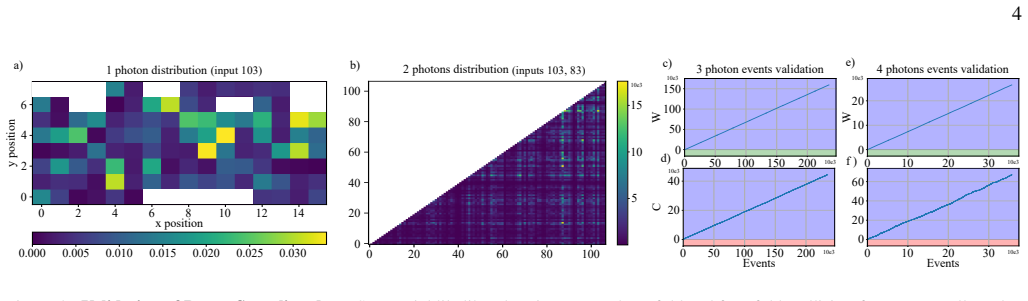
- Boson Sampling output distributions for up to four photons agree with theoretical predictions.
- The same platform can generate random numbers whose unpredictability follows from the hardness of Boson Sampling.
- The 3D integration and active control demonstrate stability and precise phase control suitable for further quantum information tasks.
Where Pith is reading between the lines
- The reconfigurability demonstrated here could allow the same chip to be reused for other linear-optical protocols beyond standard Boson Sampling.
- If the mode count and photon number can be increased while preserving indistinguishability, the platform would move closer to regimes where classical simulation becomes intractable.
- The 3D architecture may offer lower loss and crosstalk than planar equivalents, enabling even larger mode counts in future devices.
Load-bearing premise
The input photons remain sufficiently indistinguishable and the thermo-optic phase shifters realize the programmed unitary transformations with errors small enough that the observed output distributions still match the ideal Boson Sampling predictions.
What would settle it
If the measured output probability distributions for three- or four-photon inputs deviate from the theoretical Boson Sampling probabilities by more than the reported experimental uncertainty, the claim of successful large-scale reconfigurable operation would be falsified.
Figures



read the original abstract
Integrated quantum photonics has emerged as one of the leading platforms for scaling quantum information processing, offering compact, stable, and low-loss hardware with precise phase and mode control. Advances in integrated photonics architectures and active programmability now enable complex, high-dimensional transformations essential for quantum advantage tasks. We introduce an integrated, reconfigurable 3D photonic device with 128 modes for manipulation of single-photon quantum states (Qolossus 3D). Leveraging a continuously coupled architecture and thermo-optic programmability, the platform implements reconfigurable unitary transformations at unprecedented scale for integrated quantum optics. Exploiting indistinguishable single photons demultiplexed from a quantum dot source, we perform Boson Sampling across the large-dimensional chip and analyse the resulting output distributions for up to 4 photons. We then exploit it to demonstrate randomness generation via Boson Sampling. Agreement with theoretical predictions validates both the device's reconfigurable operation and the generation of random numbers. Our results highlight the scalability, stability, and precise control of integrated photonics for quantum information processing.
Editorial analysis
A structured set of objections, weighed in public.
Referee Report
Summary. The manuscript reports the development of a 128-mode reconfigurable 3D photonic integrated circuit (Qolossus 3D) based on a continuously coupled architecture with thermo-optic phase shifters for implementing programmable unitary transformations. Using single photons demultiplexed from a quantum-dot source, the authors conduct Boson Sampling experiments with 1 to 4 photons, compare the measured output photon distributions to ideal theoretical predictions, and utilize the results to demonstrate certified randomness generation. The agreement between experimental data and theory is presented as evidence for both the successful reconfigurable operation of the device and the validity of the randomness extraction.
Significance. This experimental demonstration of Boson Sampling on a large-scale reconfigurable integrated photonic platform at 128 modes is significant for the field of quantum information processing. It showcases the potential for scaling photonic quantum hardware while maintaining the ability to perform complex transformations and extract useful quantum resources like randomness. The integration of a quantum dot source further highlights a path toward fully integrated quantum photonic systems. Strengths include the scale of the device and the direct application to a quantum advantage task.
major comments (2)
- §4 (Boson Sampling results): The central claim of agreement with theoretical predictions for up to 4 photons is load-bearing for validating both reconfigurability and randomness generation, yet the manuscript provides no quantitative metrics (e.g., total variation distance, fidelity, or chi-squared statistics) with error bars derived from repeated measurements or loss characterization; this leaves the weakest assumption on photon indistinguishability and unitary fidelity untested at the level needed to support the conclusions.
- §5 (Randomness generation): The exploitation of Boson Sampling output distributions for randomness certification requires explicit description of the statistical test, sample size, and how experimental imperfections (loss, partial distinguishability) are folded into the min-entropy bound; without this, the claim that agreement validates randomness extraction cannot be fully assessed.
minor comments (3)
- Abstract: The statement of agreement with theory would be strengthened by a single quantitative figure (e.g., average fidelity or distance) even at the summary level.
- Figure captions and methods: Ensure all panels for different photon numbers include the number of experimental runs and the measured two-photon interference visibility used in the theoretical model.
- Notation: The definition of the implemented unitary in the continuously coupled architecture should be cross-referenced to the thermo-optic voltage-to-phase calibration curve for clarity.
Simulated Author's Rebuttal
We thank the referee for their positive assessment of our manuscript and for the constructive comments, which we address point by point below. We will incorporate the suggested quantitative metrics and clarifications in the revised version to strengthen the validation of our results.
read point-by-point responses
-
Referee: §4 (Boson Sampling results): The central claim of agreement with theoretical predictions for up to 4 photons is load-bearing for validating both reconfigurability and randomness generation, yet the manuscript provides no quantitative metrics (e.g., total variation distance, fidelity, or chi-squared statistics) with error bars derived from repeated measurements or loss characterization; this leaves the weakest assumption on photon indistinguishability and unitary fidelity untested at the level needed to support the conclusions.
Authors: We agree that quantitative metrics provide a more rigorous validation of the agreement between measured distributions and theoretical predictions. In the revised manuscript, we will include total variation distance and fidelity calculations between the experimental data and ideal Boson Sampling distributions for 1–4 photons, with error bars derived from repeated measurements. We will also integrate loss characterization results to quantify the effects on photon indistinguishability and unitary fidelity, thereby addressing the assumptions underlying our conclusions on reconfigurability. revision: yes
-
Referee: §5 (Randomness generation): The exploitation of Boson Sampling output distributions for randomness certification requires explicit description of the statistical test, sample size, and how experimental imperfections (loss, partial distinguishability) are folded into the min-entropy bound; without this, the claim that agreement validates randomness extraction cannot be fully assessed.
Authors: We will expand the description in §5 to explicitly detail the statistical test used for randomness certification, the sample sizes collected from the Boson Sampling experiments, and the precise manner in which experimental imperfections—including photon loss and partial distinguishability—are incorporated into the min-entropy bound. This addition will enable a complete evaluation of the certified randomness claims. revision: yes
Circularity Check
No significant circularity
full rationale
The manuscript is an experimental report on fabricating and operating a 128-mode reconfigurable 3D photonic circuit to implement Boson Sampling with up to four photons. All load-bearing claims consist of measured output statistics being compared to independently computed ideal Boson Sampling distributions; those theoretical distributions are standard and external to the present data set. No equation, fit, or self-citation is shown to define a quantity that is then re-presented as a prediction or uniqueness result derived from the same experiment. The derivation chain therefore remains self-contained and non-circular.
Axiom & Free-Parameter Ledger
free parameters (1)
- thermo-optic phase shifter voltages
axioms (1)
- domain assumption Photons from the quantum dot source are sufficiently indistinguishable for Boson Sampling statistics to apply
Reference graph
Works this paper leans on
-
[1]
Aggre- gating T trials forms a T×128 matrix of raw bits which constitutes our entropy source
that records whether each out- put mode clicked within the acquisition window. Aggre- gating T trials forms a T×128 matrix of raw bits which constitutes our entropy source. Since click probabilities can be mode-dependent (loss, detector efficiency, and coupling asymmetries), the raw matrix is not guaranteed to be unbi- ased or independent across rows/colu...
-
[2]
Quantum Glass-based Photonic Integrated Circuits
which includes 15 tests: the frequency (monobit) test, frequency test within a block, the runs test, test for the longest- run-of-ones in a block, the binary matrix rank test, the Discrete Fourier Transform (DFT) test, the non-overlapping template matching test, the overlapping template matching test, Mau- rer’s ”universal statistical” test, the linear co...
2022
-
[3]
J. Wang, F. Sciarrino, A. Laing, and M. G. Thompson, Nature Photonics14, 273 (2020)
2020
-
[4]
Pelucchi, G
E. Pelucchi, G. Fagas, I. Aharonovich, D. Englund, E. Figueroa, Q. Gong, H. Hannes, J. Liu, C.-Y . Lu, N. Matsuda, J.-W. Pan, F. Schreck, F. Sciarrino, C. Silberhorn, J. Wang, and K. D. J¨ons, Nature Reviews Physics4, 194–208 (2021)
2021
-
[5]
Giordani, F
T. Giordani, F. Hoch, G. Carvacho, N. Spagnolo, and F. Sciar- rino, La Rivista del Nuovo Cimento46, 71–103 (2023)
2023
-
[6]
Aaronson and A
S. Aaronson and A. Arkhipov, inProceedings of the Forty-Third Annual ACM Symposium on Theory of Computing, STOC ’11 (Association for Computing Machinery, New York, NY , USA,
-
[7]
D. J. Brod, E. F. Galv˜ao, A. Crespi, R. Osellame, N. Spagnolo, and F. Sciarrino, Advanced Photonics1, 034001 (2019)
2019
-
[8]
J. Huh, G. G. Guerreschi, B. Peropadre, J. R. McClean, and A. Aspuru-Guzik, Nat. Photon.9, 615 (2015)
2015
-
[9]
T. R. Bromley, J. M. Arrazola, S. Jahangiri, J. Izaac, N. Que- sada, A. D. Gran, M. Schuld, J. Swinarton, Z. Zabaneh, and N. Killoran, Quantum Sci. Technol.5, 034010 (2020)
2020
-
[10]
Chabaud, D
U. Chabaud, D. Markham, and A. Sohbi, Quantum5, 496 (2021)
2021
-
[11]
Edelman and N
A. Edelman and N. R. Rao, Acta Numerica14, 233–297 (2005)
2005
-
[12]
M. A. Broome, A. Fedrizzi, S. Rahimi-Keshari, J. Dove, S. Aaronson, T. C. Ralph, and A. G. White, Science339, 794 (2013)
2013
-
[13]
J. B. Spring, B. J. Metcalf, P. C. Humphreys, W. S. Kolthammer, X.-M. Jin, M. Barbieri, A. Datta, N. Thomas-Peter, N. K. Lang- ford, D. Kundys, J. C. Gates, B. J. Smith, P. G. R. Smith, and I. A. Walmsley, Science339, 798 (2013)
2013
-
[14]
Crespi, R
A. Crespi, R. Osellame, R. Ramponi, D. J. Brod, E. F. Galv˜ao, N. Spagnolo, C. Vitelli, E. Maiorino, P. Mataloni, and F. Sciar- rino, Nature Photonics7, 545 (2013)
2013
-
[15]
Tillmann, B
M. Tillmann, B. Daki´c, R. Heilmann, S. Nolte, A. Szameit, and P. Walther, Nature Photonics7, 540 (2013)
2013
-
[16]
J. C. Loredo, M. A. Broome, P. Hilaire, O. Gazzano, I. Sagnes, A. Lemaitre, M. P. Almeida, P. Senellart, and A. G. White, Phys. Rev. Lett.118, 130503 (2017). 7
2017
-
[17]
Y . He, X. Ding, Z.-E. Su, H.-L. Huang, J. Qin, C. Wang, S. Unsle- ber, C. Chen, H. Wang, Y .-M. He, X.-L. Wang, W.-J. Zhang, S.-J. Chen, C. Schneider, M. Kamp, L.-X. You, Z. Wang, S. H¨ofling, C.-Y . Lu, and J.-W. Pan, Phys. Rev. Lett.118, 190501 (2017)
2017
-
[18]
H. Wang, Y . He, Y .-H. Li, Z.-E. Su, B. Li, H.-L. Huang, X. Ding, M.-C. Chen, C. Liu, J. Qin, J.-P. Li, Y .-M. He, C. Schneider, M. Kamp, C.-Z. Peng, S. H ¨ofling, C.-Y . Lu, and J.-W. Pan, Nature Photonics11, 361 (2017)
2017
-
[19]
Zhong, Y
H.-S. Zhong, Y . Li, W. Li, L.-C. Peng, Z.-E. Su, Y . Hu, Y .-M. He, X. Ding, W. Zhang, H. Li, L. Zhang, Z. Wang, L. You, X.-L. Wang, X. Jiang, L. Li, Y .-A. Chen, N.-L. Liu, C.-Y . Lu, and J.-W. Pan, Phys. Rev. Lett.121, 250505 (2018)
2018
-
[20]
Arriola, S
A. Arriola, S. Gross, N. Jovanovic, N. Charles, P. G. Tuthill, S. M. Olaizola, A. Fuerbach, and M. J. Withford, Opt. Express 21, 2978 (2013)
2013
-
[21]
F. Hoch, S. Piacentini, T. Giordani, Z.-N. Tian, M. Iuliano, C. Es- posito, A. Camillini, G. Carvacho, F. Ceccarelli, N. Spagnolo, A. Crespi, F. Sciarrino, and R. Osellame, npj Quantum Informa- tion8, 55 (2022)
2022
-
[22]
Zhou, X.-W
W.-H. Zhou, X.-W. Wang, R.-J. Ren, Y .-X. Fu, Y .-J. Chang, X.-Y . Xu, H. Tang, and X.-M. Jin, Light: Science & Applications13, 296 (2024)
2024
-
[23]
Youssry, Y
A. Youssry, Y . Yang, R. J. Chapman, B. Haylock, F. Lenzini, M. Lobino, and A. Peruzzo, npj Quantum Information10, 9 (2024)
2024
-
[24]
Y . Yang, R. J. Chapman, B. Haylock, F. Lenzini, Y . N. Joglekar, M. Lobino, and A. Peruzzo, Nature Communications15, 50 (2024)
2024
-
[25]
Y . Yang, R. J. Chapman, A. Youssry, B. Haylock, F. Lenzini, M. Lobino, and A. Peruzzo, npj Quantum Information11, 19 (2025)
2025
-
[26]
Zhong, H
H.-S. Zhong, H. Wang, Y .-H. Deng, M.-C. Chen, L.-C. Peng, Y .-H. Luo, J. Qin, D. Wu, X. Ding, Y . Hu, P. Hu, X.-Y . Yang, W.-J. Zhang, H. Li, Y . Li, X. Jiang, L. Gan, G. Yang, L. You, Z. Wang, L. Li, N.-L. Liu, C.-Y . Lu, and J.-W. Pan, Science370, 1460–1463 (2020)
2020
-
[27]
Zhong, Y .-H
H.-S. Zhong, Y .-H. Deng, J. Qin, H. Wang, M.-C. Chen, L.-C. Peng, Y .-H. Luo, D. Wu, S.-Q. Gong, H. Su, Y . Hu, P. Hu, X.-Y . Yang, W.-J. Zhang, H. Li, Y . Li, X. Jiang, L. Gan, G. Yang, L. You, Z. Wang, L. Li, N.-L. Liu, J. J. Renema, C.-Y . Lu, and J.-W. Pan, Physical Review Letters127, 180502 (2021)
2021
-
[28]
L. S. Madsen, F. Laudenbach, M. F. Askarani, F. Rortais, T. Vin- cent, J. F. F. Bulmer, F. M. Miatto, L. Neuhaus, L. G. Helt, M. J. Collins, A. E. Lita, T. Gerrits, S. W. Nam, V . D. Vaidya, M. Menotti, I. Dhand, Z. Vernon, N. Quesada, and J. Lavoie, Nature606, 75–81 (2022)
2022
-
[29]
Deng, Y .-C
Y .-H. Deng, Y .-C. Gu, H.-L. Liu, S.-Q. Gong, H. Su, Z.-J. Zhang, H.-Y . Tang, M.-H. Jia, J.-M. Xu, M.-C. Chen, J. Qin, L.-C. Peng, J. Yan, Y . Hu, J. Huang, H. Li, Y . Li, Y . Chen, X. Jiang, L. Gan, G. Yang, L. You, L. Li, H.-S. Zhong, H. Wang, N.-L. Liu, J. J. Renema, C.-Y . Lu, and J.-W. Pan, Physical Review Letters131, 150601 (2023)
2023
-
[30]
Robust quantum computational advantage with programmable 3050- photon gaussian boson sampling,
H.-L. Liu, H. Su, S.-Q. Gong, Y .-C. Gu, H.-Y . Tang, M.-H. Jia, Q. Wei, Y . Song, D. Wang, M. Zheng, F. Chen, L. Li, S. Ren, X. Zhu, M. Wang, Y . Chen, Y . Liu, L. Song, P. Yang, J. Chen, H. An, L. Zhang, L. Gan, G. Yang, J.-M. Xu, Y .-M. He, H. Wang, H.-S. Zhong, M.-C. Chen, X. Jiang, L. Li, N.-L. Liu, Y .-H. Deng, X.-L. Su, Q. Zhang, C.-Y . Lu, and J.-...
-
[31]
R. B. Patel, T. Rudolph, and G. J. Pryde, Science Advances5, eaau6668 (2019)
2019
-
[32]
F. Hoch, T. Giordani, L. Castello, G. Carvacho, N. Spagnolo, F. Ceccarelli, C. Pentangelo, S. Piacentini, A. Crespi, R. Osel- lame, E. F. Galv˜ao, and F. Sciarrino, Nature Photonics19, 12–19 (2024)
2024
-
[33]
Rodari, F
G. Rodari, F. Hoch, A. Suprano, T. Giordani, E. Negro, G. Car- vacho, N. Spagnolo, E. F. Galv ˜ao, and F. Sciarrino, Science Advances10, eado6244 (2024)
2024
- [34]
-
[35]
J. Shi, T. Zhao, Y . Wang, C. Yu, Y . Lu, J. Wu, R. Shi, S. Zhang, S. Peng, and J. Wu, Advanced Quantum Technologies7, 2300179 (2024)
2024
-
[36]
Ange and M
J. Ange and M. A. Thornton, inQuantum Information Science, Sensing, and Computation XVII, V ol. 13451, edited by M. Hay- duk, M. L. Fanto, and C. M. T. Jr., International Society for Optics and Photonics (SPIE, 2025) p. 1345106
2025
-
[37]
Gisin, G
N. Gisin, G. Ribordy, W. Tittel, and H. Zbinden, Rev. Mod. Phys.74, 145 (2002)
2002
-
[38]
Pirandola, U
S. Pirandola, U. L. Andersen, L. Banchi, M. Berta, D. Bunandar, R. Colbeck, D. Englund, T. Gehring, C. Lupo, C. Ottaviani, J. L. Pereira, M. Razavi, J. S. Shaari, M. Tomamichel, V . C. Usenko, G. Vallone, P. Villoresi, and P. Wallden, Adv. Opt. Photon.12, 1012 (2020)
2020
-
[39]
Portmann and R
C. Portmann and R. Renner, Rev. Mod. Phys.94, 025008 (2022)
2022
-
[40]
Dubrov and Y
B. Dubrov and Y . Ishai, inProceedings of the Thirty-Eighth Annual ACM Symposium on Theory of Computing, STOC ’06 (Association for Computing Machinery, New York, NY , USA,
-
[41]
Zhuang, X
D. Zhuang, X. Zhang, S. Song, and S. Hooker, inProceedings of Machine Learning and Systems, V ol. 4, edited by D. Marculescu, Y . Chi, and C. Wu (2022) pp. 316–336
2022
-
[42]
Scardapane and D
S. Scardapane and D. Wang, WIREs Data Mining and Knowl- edge Discovery7, e1200 (2017)
2017
-
[43]
L. Li, M. Cai, T. Wang, Z. Tan, P. Huang, K. Wu, and G. Zeng, Photon. Res.12, 1379 (2024)
2024
-
[44]
F. Regazzoni, E. Amri, S. Burri, D. Rusca, H. Zbinden, and E. Charbon, “A high speed integrated quantum random num- ber generator with on-chip real-time randomness extraction,” (2021), arXiv:2102.06238 [quant-ph]
-
[45]
Abellan, W
C. Abellan, W. Amaya, D. Domenech, P. M. noz, J. Capmany, S. Longhi, M. W. Mitchell, and V . Pruneri, Optica3, 989 (2016)
2016
-
[46]
T. K. Para¨ıso, T. Roger, D. G. Marangon, I. De Marco, M. San- zaro, R. I. Woodward, J. F. Dynes, Z. Yuan, and A. J. Shields, Nature Photonics15, 850 (2021)
2021
-
[47]
B. Bai, J. Huang, G.-R. Qiao, Y .-Q. Nie, W. Tang, T. Chu, J. Zhang, and J.-W. Pan, Applied Physics Letters118, 264001 (2021)
2021
-
[48]
C. Bruynsteen, T. Gehring, C. Lupo, J. Bauwelinck, and X. Yin, PRX Quantum4, 010330 (2023), arXiv:2209.04339 [quant-ph]
-
[49]
D. G. Marangon, P. R. Smith, N. Walk, T. K. Para¨ıso, J. F. Dynes, V . Lovic, M. Sanzaro, T. Roger, I. De Marco, M. Lucamarini, Z. Yuan, and A. J. Shields, Nature Electronics7, 396–404 (2024)
2024
-
[50]
Aaronson and A
S. Aaronson and A. Arkhipov, Quantum Info. Comput.14, 1383–1423 (2014)
2014
-
[51]
Spagnolo, C
N. Spagnolo, C. Vitelli, M. Bentivegna, D. J. Brod, A. Crespi, F. Flamini, S. Giacomini, G. Milani, R. Ramponi, P. Mataloni, R. Osellame, E. F. Galv˜ao, and F. Sciarrino, Nature Photonics 8, 615–620 (2014)
2014
-
[52]
Elben, S
A. Elben, S. T. Flammia, H.-Y . Huang, R. Kueng, J. Preskill, B. Vermersch, and P. Zoller, Nature Reviews Physics5, 9–24 (2022)
2022
-
[53]
O. Lib, S. Liu, R. Shekel, Q. He, M. Huber, Y . Bromberg, and G. Vitagliano, Phys. Rev. Lett.134, 210202 (2025). 8
2025
-
[54]
A. Laing and J. L. O’Brien, “Super-stable tomography of any linear optical device,” (2012), arXiv:1208.2868 [quant-ph]
-
[55]
Bassham, A
L. Bassham, A. Rukhin, J. Soto, J. Nechvatal, M. Smid, E. Barker, S. Leigh, M. Levenson, M. Vangel, D. Banks,et al., A statistical test suite for random and pseudorandom number generators for cryptographic applications, Tech. Rep. (National Institute of Standards and Technology, 2008)
2008
-
[56]
Singh, G
D. Singh, G. Muraleedharan, B. Fu, C.-M. Cheng, N. Roussy Newton, P. P. Rohde, and G. K. Brennen, Quan- tum Science and Technology10, 025020 (2025)
2025
-
[57]
H. Dale, D. Jennings, and T. Rudolph, Nature communications 6, 8203 (2015)
2015
-
[58]
Jiang, J
J. Jiang, J. Zhang, and X. Sun, Phys. Rev. A97, 032303 (2018)
2018
-
[59]
Complexity and multi-functional variants of the quantum- to-quantum bernoulli factories,
F. Hoch, T. Giordani, G. Carvacho, N. Spagnolo, and F. Sciar- rino, “Complexity and multi-functional variants of the quantum- to-quantum bernoulli factories,” (2025), arXiv:2512.10810 [quant-ph]
-
[60]
Kashefi and A
E. Kashefi and A. Pappa, Cryptography1, 12 (2017)
2017
-
[61]
M. Yan, C. Huang, P. Bienstman, P. Tino, W. Lin, and J. Sun, Nature Communications15, 2056 (2024)
2056
discussion (0)
Sign in with ORCID, Apple, or X to comment. Anyone can read and Pith papers without signing in.