Recognition: 3 theorem links
· Lean TheoremLong Inflation Screens Euclidean-Wormhole Initial States
Pith reviewed 2026-05-08 17:46 UTC · model grok-4.3
The pith
Long inflation erases detectable traces of Euclidean wormhole initial states from the cosmic microwave background.
A machine-rendered reading of the paper's core claim, the machinery that carries it, and where it could break.
Core claim
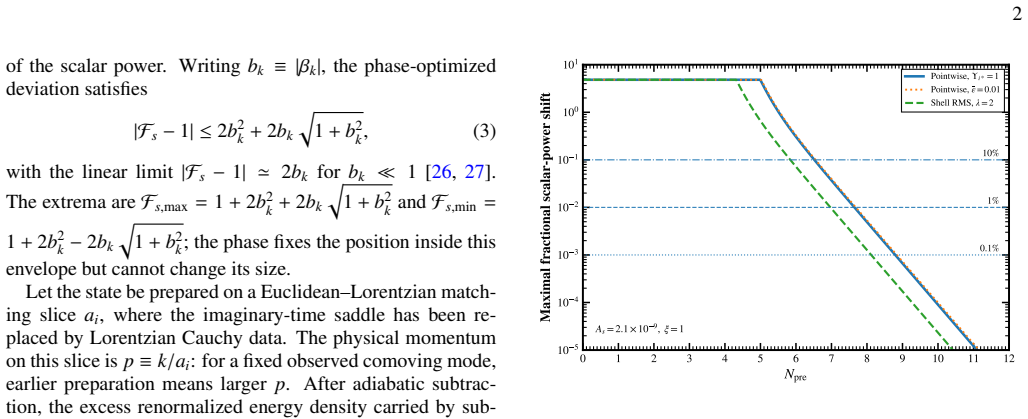
Euclidean wormholes can prepare inflation in non-Bunch-Davies initial states, but long Lorentzian expansion screens this memory from the CMB. We derive a visibility bound for Euclidean-matched Bogoliubov data: the pivot excitation satisfies |β_*| ≲ e^{-2N_pre}, and smooth Euclidean filters confine residual signatures to a comoving edge k_w = a_i M. Only near-minimal inflation, or an edge inside the observable window, leaves detectable scalar, tensor, and higher-point imprints. For longer inflation, wormhole-prepared perturbations are driven to the Bunch-Davies prediction. Euclidean memory therefore becomes a quantitative bound on inflationary duration, with direct targets in CMB polarization
What carries the argument
The visibility bound on the Bogoliubov coefficient β_* measuring deviation from the Bunch-Davies vacuum, exponentially suppressed by the number of pre-inflation e-folds.
If this is right
- Detectable imprints from wormhole initial states require inflation to be near its minimum duration.
- Any residual signatures are confined to one specific comoving scale set by the wormhole radius.
- These imprints would appear in scalar and tensor power spectra as well as higher-order correlations.
- The lack of such features in current data supplies a lower bound on the total length of inflation.
Where Pith is reading between the lines
- Future CMB polarization measurements at large angular scales offer a direct test of whether any wormhole-scale edge falls inside the observable window.
- The same screening logic could apply to other proposed non-standard initial conditions, turning their absence into a duration constraint.
- Large-scale structure surveys could search for the predicted scale-dependent deviations if the wormhole edge lies near the horizon scale today.
Load-bearing premise
Euclidean wormholes prepare specific non-Bunch-Davies initial states that can be matched via Bogoliubov coefficients to Lorentzian inflation, with smooth filters confining signatures to observable scales.
What would settle it
Detection of unsuppressed non-Bunch-Davies features in the CMB power spectrum or bispectrum at scales that should be exponentially screened by the known number of inflationary e-folds would contradict the screening claim.
Figures


read the original abstract
Euclidean wormholes can prepare inflation in non--Bunch--Davies initial states, but long Lorentzian expansion screens this memory from the CMB. We derive a visibility bound for Euclidean-matched Bogoliubov data: the pivot excitation satisfies $|\beta_*| \lesssim e^{-2N_{\rm pre}}$, and smooth Euclidean filters confine residual signatures to a comoving edge $k_w=a_iM$. Only near-minimal inflation, or an edge inside the observable window, leaves detectable scalar, tensor, and higher-point imprints. For longer inflation, wormhole-prepared perturbations are driven to the Bunch--Davies prediction. Euclidean memory therefore, becomes a quantitative bound on inflationary duration, with direct targets in CMB polarization and large-scale structure: the longer inflation lasts, the less of the wormhole remains on the sky.
Editorial analysis
A structured set of objections, weighed in public.
Referee Report
Summary. The manuscript claims that Euclidean wormholes can prepare inflation in non-Bunch-Davies initial states, but long Lorentzian expansion screens this memory from the CMB. It derives a visibility bound for Euclidean-matched Bogoliubov data: the pivot excitation satisfies |β_*| ≲ e^{-2N_pre}, and smooth Euclidean filters confine residual signatures to a comoving edge k_w = a_i M. Only near-minimal inflation, or an edge inside the observable window, leaves detectable scalar, tensor, and higher-point imprints; for longer inflation, wormhole-prepared perturbations are driven to the Bunch-Davies prediction, turning the absence of such signatures into a quantitative lower bound on inflationary duration with targets in CMB polarization and large-scale structure.
Significance. If the central derivation holds, the result strengthens the robustness of standard inflationary predictions against quantum-gravity initial conditions and supplies a concrete, falsifiable link between Euclidean wormhole geometries and observable cosmology. It converts the lack of non-Bunch-Davies features into a direct constraint on the total number of e-folds, offering specific observational handles in CMB B-modes and LSS bispectra.
major comments (2)
- [Derivation of the visibility bound (around Eq. for β_*)] The visibility bound |β_*| ≲ e^{-2N_pre} is expressed directly in terms of the pre-inflationary e-fold count N_pre. The manuscript must demonstrate explicitly (e.g., in the Bogoliubov-matching section) that this exponential suppression is an output of the Euclidean-to-Lorentzian matching and filter smoothness rather than an input assumption about the duration before the observable window begins.
- [Filter construction and mode matching] The comoving edge k_w = a_i M is stated to arise from smooth Euclidean filters, but the text should provide the explicit filter function and the resulting mode suppression to confirm that this scale lies outside the observable window for N_pre ≳ 10 and does not introduce additional free parameters.
minor comments (2)
- [Abstract] The abstract summarizes the bound cleanly but omits any reference to the section or equation number where the derivation appears; adding this would improve readability.
- [Notation and definitions] Notation for N_pre and the pivot scale should be defined at first use and used consistently; a short table of symbols would help.
Simulated Author's Rebuttal
We thank the referee for their positive assessment and constructive comments. The manuscript derives the visibility bound and filter scale from the Euclidean-to-Lorentzian matching; we address the requests for explicit demonstration below and will incorporate clarifications in the revised version.
read point-by-point responses
-
Referee: [Derivation of the visibility bound (around Eq. for β_*)] The visibility bound |β_*| ≲ e^{-2N_pre} is expressed directly in terms of the pre-inflationary e-fold count N_pre. The manuscript must demonstrate explicitly (e.g., in the Bogoliubov-matching section) that this exponential suppression is an output of the Euclidean-to-Lorentzian matching and filter smoothness rather than an input assumption about the duration before the observable window begins.
Authors: The bound is derived as an output of the matching. In the Bogoliubov section, the coefficients are obtained by integrating the Euclidean wormhole modes against the Lorentzian solutions across the filter; the resulting |β_*| acquires the factor e^{-2N_pre} from the exponential decay of the sub-horizon modes during the pre-inflationary expansion. This follows directly from the smoothness of the filter and the WKB suppression in the mode equation, without presupposing the value of N_pre. We will insert the intermediate steps of this integral in the revised manuscript to make the derivation fully explicit. revision: yes
-
Referee: [Filter construction and mode matching] The comoving edge k_w = a_i M is stated to arise from smooth Euclidean filters, but the text should provide the explicit filter function and the resulting mode suppression to confirm that this scale lies outside the observable window for N_pre ≳ 10 and does not introduce additional free parameters.
Authors: We agree that the explicit form strengthens clarity. The filter is the Gaussian F(k) = exp[−(k/(a_i M))^2], chosen to match the Euclidean wormhole regularity; the resulting Bogoliubov coefficients are exponentially suppressed for k ≫ a_i M. For N_pre ≳ 10 the comoving edge k_w is stretched by e^{N_pre} to scales far outside the observable window, with no additional parameters introduced beyond the geometric scale M fixed by the wormhole. We will add the explicit filter expression, the suppressed mode functions, and a brief calculation confirming the location of k_w in the revised text. revision: yes
Circularity Check
No significant circularity; derivation is self-contained from standard inflationary dynamics.
full rationale
The claimed visibility bound |β_*| ≲ e^{-2N_pre} and edge k_w = a_i M are derived from Bogoliubov matching of Euclidean wormhole states to Lorentzian inflation followed by the exponential stretching of modes during expansion. This is a direct consequence of the mode evolution equations under the given assumptions and does not reduce any output quantity to a fitted input or self-citation by construction. N_pre enters as the duration parameter whose effect is being quantified, not as a hidden fit; the screening to Bunch-Davies is the expected outcome once the matching and filter smoothness are granted. No self-definitional, fitted-prediction, or uniqueness-imported steps appear in the abstract or described chain.
Axiom & Free-Parameter Ledger
Lean theorems connected to this paper
-
IndisputableMonolith.Cost (J = ½(x+x⁻¹)−1)washburn_uniqueness_aczel unclear?
unclearRelation between the paper passage and the cited Recognition theorem.
We derive a visibility bound for Euclidean-matched Bogoliubov data: the pivot excitation satisfies |β_*| ≲ e^{-2N_pre}, and smooth Euclidean filters confine residual signatures to a comoving edge k_w = a_i M.
-
IndisputableMonolith.Foundation.BranchSelectionbranch_selection (free family parameter ν, c — RS forbids such freedom in calibrated cost) unclear?
unclearRelation between the paper passage and the cited Recognition theorem.
β(p) = β_0 e^{iθ_0} exp[−(p/M)^ν], ν > 0, which interpolates between exponential, Gaussian, and super-Gaussian damping.
-
IndisputableMonolith.Foundation.Breath1024 (8-tick / φ-ladder spacings)n/a — paper's e-fold counter is not an RS tick orbit unclear?
unclearRelation between the paper passage and the cited Recognition theorem.
k_w ≡ a_i M = k_* (M/H_*) e^{-N_pre}; for N_pre exceeding ln(M/H_*) + O(1) the pivot is screened.
What do these tags mean?
- matches
- The paper's claim is directly supported by a theorem in the formal canon.
- supports
- The theorem supports part of the paper's argument, but the paper may add assumptions or extra steps.
- extends
- The paper goes beyond the formal theorem; the theorem is a base layer rather than the whole result.
- uses
- The paper appears to rely on the theorem as machinery.
- contradicts
- The paper's claim conflicts with a theorem or certificate in the canon.
- unclear
- Pith found a possible connection, but the passage is too broad, indirect, or ambiguous to say the theorem truly supports the claim.
Reference graph
Works this paper leans on
-
[1]
A. H. Guth, The Inflationary Universe: A Possible Solution to the Horizon and Flatness Problems, Phys. Rev. D23, 347 (1981)
1981
-
[2]
V . F. Mukhanov and G. V . Chibisov, Quantum Fluctuations and a Nonsingular Universe, JETP Lett.33, 532 (1981)
1981
-
[3]
P. Chen, K.-N. Lin, W.-C. Lin, and D.-h. Yeom, Possible origin ofα-vacua as the initial state of the Universe, Phys. Rev. D111, 083520 (2025), arXiv:2404.15450 [gr-qc]
- [4]
-
[5]
P. Betzios and O. Papadoulaki, Inflationary Cosmology from Anti-de Sitter Wormholes, Phys. Rev. Lett.133, 021501 (2024), arXiv:2403.17046 [hep-th]. 5
-
[6]
Prepare inflationary universe via the Euclidean charged wormhole,
Q.-Y . Lan and Y .-S. Piao, Prepare inflationary universe via the Euclidean charged wormhole, arXiv preprint (2024), arXiv:2411.13844 [gr-qc]
-
[7]
P. Betzios, I. D. Gialamas, and O. Papadoulaki, Magnetic anti–de Sitter wormholes as seeds for Higgs inflation, Phys. Rev. D111, 123542 (2025), arXiv:2412.03639 [hep-th]
-
[8]
G. Lavrelashvili and J.-L. Lehners, Nucleating an Inflationary Universe: Euclidean Wormholes and their No-Boundary Limit, arXiv preprint (2026), arXiv:2603.11003 [hep-th]
-
[9]
K. Goldstein and D. A. Lowe, A Note on alpha vacua and in- teracting field theory in de Sitter space, Nucl. Phys. B669, 325 (2003), arXiv:hep-th/0302050
-
[10]
H. Collins, R. Holman, and M. R. Martin, The Fate of the alpha vacuum, Phys. Rev. D68, 124012 (2003), arXiv:hep- th/0306028
-
[11]
H. Collins and R. Holman, Taming the alpha vacuum, Phys. Rev. D70, 084019 (2004), arXiv:hep-th/0312143
- [12]
-
[13]
R. Brunetti, K. Fredenhagen, and S. Hollands, A Remark on alpha vacua for quantum field theories on de Sitter space, JHEP 05(05), 063, arXiv:hep-th/0503022
-
[14]
Parker and S
L. Parker and S. A. Fulling, Quantized matter fields and the avoidance of singularities in general relativity, Phys. Rev. D7, 2357 (1973)
1973
-
[15]
N. D. Birrell and P. C. W. Davies,Quantum Fields in Curved Space, Cambridge Monographs on Mathematical Physics (Cambridge University Press, Cambridge, UK, 1982)
1982
- [16]
-
[17]
J. Martin and R. H. Brandenberger, The TransPlanckian prob- lem of inflationary cosmology, Phys. Rev. D63, 123501 (2001), arXiv:hep-th/0005209
-
[18]
R. Easther, B. R. Greene, W. H. Kinney, and G. Shiu, A Generic estimate of transPlanckian modifications to the pri- mordial power spectrum in inflation, Phys. Rev. D66, 023518 (2002), arXiv:hep-th/0204129
- [19]
-
[20]
N. Kaloper, M. Kleban, A. Lawrence, S. Shenker, and L. Susskind, Initial conditions for inflation, JHEP11(11), 037, arXiv:hep-th/0209231
-
[21]
K. Goldstein and D. A. Lowe, Initial state effects on the cosmic microwave background and transPlanckian physics, Phys. Rev. D67, 063502 (2003), arXiv:hep-th/0208167
-
[22]
M. Porrati, Effective field theory approach to cosmological ini- tial conditions: Self-consistency bounds and non-Gaussianities, in13th International Seminar on High-Energy Physics: Quarks 2004(2004) arXiv:hep-th/0409210
work page internal anchor Pith review arXiv 2004
-
[23]
Enhanced Non-Gaussianity from Excited Initial States
R. Holman and A. J. Tolley, Enhanced Non-Gaussianity from Excited Initial States, JCAP05(05), 001, arXiv:0710.1302 [hep-th]
-
[24]
R. O’Connell and R. Holman, Initial Conditions in the Ef- fective Field Theory of Inflation, arXiv preprint (2011), arXiv:1109.1562 [hep-th]
- [25]
-
[26]
S. Kundu, Inflation with General Initial Conditions for Scalar Perturbations, JCAP02(02), 005, arXiv:1110.4688 [astro- ph.CO]
-
[27]
A. Aravind, D. Lorshbough, and S. Paban, Non-Gaussianity from Excited Initial Inflationary States, JHEP07(07), 076, arXiv:1303.1440 [hep-th]
- [28]
- [29]
-
[30]
Ganc, Calculating the local-type fNL for slow-roll infla- tion with a non-vacuum initial state, Phys
J. Ganc, Calculating the local-type fNL for slow-roll infla- tion with a non-vacuum initial state, Phys. Rev. D84, 063514 (2011), arXiv:1104.0244 [astro-ph.CO]
-
[31]
R. Flauger, D. Green, and R. A. Porto, On squeezed lim- its in single-field inflation. Part I, JCAP08(08), 032, arXiv:1303.1430 [hep-th]
-
[32]
Kanno,Nonclassical primordial gravitational waves from the initial entangled state,Phys
S. Kanno, Nonclassical primordial gravitational waves from the initial entangled state, Phys. Rev. D100, 123536 (2019), arXiv:1905.06800 [hep-th]
-
[33]
S. Kanno and M. Sasaki, Graviton non-gaussianity inα- vacuum, JHEP08(08), 210, arXiv:2206.03667 [hep-th]
- [34]
- [35]
-
[36]
D. Ghosh and F. Ullah, Cosmological cutting rules for Bogoli- ubov initial states: any mass and spin, JCAP09(09), 016, arXiv:2502.05630 [hep-th]
-
[37]
S. Maity, ACT-ing on inflation: Implications of non bunch- Davies initial condition and reheating on single-field slow roll models, Phys. Lett. B870, 139913 (2025), arXiv:2505.10534 [astro-ph.CO]
work page internal anchor Pith review Pith/arXiv arXiv 2025
-
[38]
T. S. Bunch and P. C. W. Davies, Quantum Field Theory in de Sitter Space: Renormalization by Point Splitting, Proc. Roy. Soc. Lond. A360, 117 (1978)
1978
-
[39]
Allen, Vacuum States in de Sitter Space, Phys
B. Allen, Vacuum States in de Sitter Space, Phys. Rev. D32, 3136 (1985)
1985
-
[40]
Planck 2018 results. X. Constraints on inflation
Y . Akramiet al.(Planck), Planck 2018 results. X. Con- straints on inflation, Astron. Astrophys.641, A10 (2020), arXiv:1807.06211 [astro-ph.CO]
work page internal anchor Pith review arXiv 2018
-
[41]
J. Ganc and E. Komatsu, Scale-dependent bias of galaxies and mu-type distortion of the cosmic microwave background spectrum from single-field inflation with a modified initial state, Phys. Rev. D86, 023518 (2012), arXiv:1204.4241 [astro- ph.CO]
- [42]
-
[43]
N. Schöneberg, M. Lucca, and D. C. Hooper, Constraining the inflationary potential with spectral distortions, JCAP03(03), 036, arXiv:2010.07814 [astro-ph.CO]
- [44]
- [45]
-
[46]
Swampland distance conjecture, inflation andα-attractors,
M. Scalisi and I. Valenzuela, Swampland distance con- jecture, inflation andα-attractors, JHEP08(08), 160, arXiv:1812.07558 [hep-th]. 6 SUPPLEMENTAL MATERIAL: LONG INFLATION SCREENS EUCLIDEAN-WORMHOLE INITIAL STATES This Supplemental Material gives the Euclidean matching construction, the finite-energy screening bounds used in the Letter, and the formulas...
discussion (0)
Sign in with ORCID, Apple, or X to comment. Anyone can read and Pith papers without signing in.