Recognition: 3 theorem links
Overview of the New Hubble Spectroscopic Legacy Archive
Pith reviewed 2026-05-08 18:25 UTC · model grok-4.3
The pith
The Hubble Spectroscopic Legacy Archive automatically generates coadded spectra for every target observed with COS and STIS.
A machine-rendered reading of the paper's core claim, the machinery that carries it, and where it could break.
Core claim
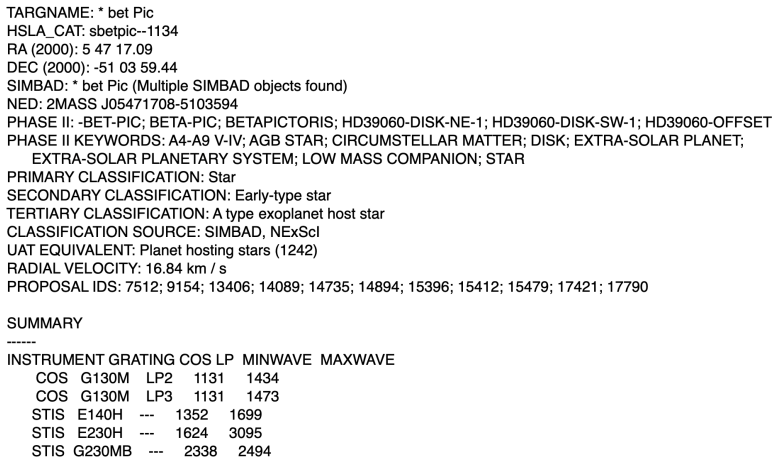
The HSLA automatically produces coadded spectra for individual targets from COS and STIS data over the instruments' lifetimes, grouping observations by coordinates with proper motion accounting, classifying them via SIMBAD, NED and Phase II proposals, and creating mode-specific coadds along with an abutting full-range spectrum for each target.
What carries the argument
The coaddition engine that groups observations into targets using coordinate matching and proper motion corrections, then generates one coadd per observing mode with lifetime-position splits for COS FUV and an abutting combined spectrum.
If this is right
- Coadded spectra are generated and updated automatically as new data arrive.
- Each target gets a metadata file containing key information for searches.
- The coadding code is released publicly for users to adapt in special cases.
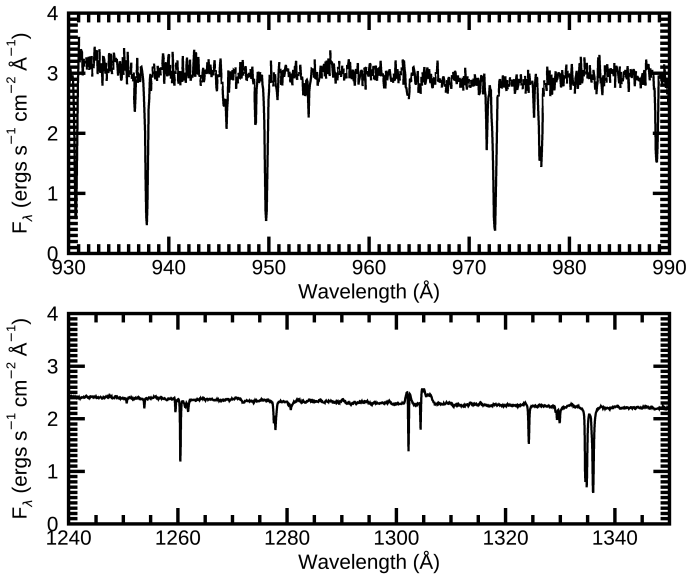
- A single spectrum spanning all observed wavelengths is created by abutting selected modes.
Where Pith is reading between the lines
- This could make it easier for astronomers to study time-variable phenomena or weak features by using the combined data directly.
- Similar legacy archives for other instruments might follow the same model of automatic coaddition and metadata provision.
- The public tools open the door for community-driven improvements to the coaddition algorithms.
- Researchers studying objects with multiple observations could discover inconsistencies in the automatic groupings that manual review might miss.
Load-bearing premise
Automatic target identification via coordinates, proper-motion corrections, SIMBAD, NED, and Phase II proposals will correctly group observations and assign classifications without significant mismatches or missing data.
What would settle it
A verification where a significant fraction of targets have coadded spectra that fail to match the expected combination from their individual input observations due to grouping errors.
Figures






read the original abstract
The new Hubble Spectroscopic Legacy Archive (HSLA) provides coadded spectra of individual targets that have been observed with the Cosmic Origins Spectrograph (COS) and the Space Telescope Imaging Spectrograph (STIS) over their operating lifetime. HSLA uses data available in the Mikulski Archive for Space Telescopes (MAST). It automatically produces coadds whenever new data become publicly available or when there is newly recalibrated data. HSLA defines individual targets by their associated coordinates, accounting for proper motions, and uses SIMBAD, NED and the Phase II observing proposals to obtain astronomical classifications for each object. Coadded spectra are produced for each observing mode. In the case of COS far-ultraviolet observations there is one coadded spectrum for each lifetime position (LP). Additionally, a spectrum spanning the entire wavelength range covered by the observations is produced by abutting the spectra from a selection of individual modes. For each individual target, HSLA also provides a human-readable metadata file with key information that can be used in searches or for further exploration of the data. The HSLA project also makes the code used for coadding spectra publicly available along with several other tools (using Jupyter notebooks) for custom coaddition required in special cases. In this report we will describe the main components of HSLA and provide a brief description of how the data and metadata can be accessed.
Editorial analysis
A structured set of objections, weighed in public.
Referee Report
Summary. The manuscript provides an overview of the Hubble Spectroscopic Legacy Archive (HSLA), which automatically generates coadded spectra for individual targets observed with COS and STIS using publicly available data from the Mikulski Archive for Space Telescopes (MAST). Targets are defined via coordinates with proper-motion corrections and classified using SIMBAD, NED, and Phase II proposals. Coadds are produced per observing mode (with separate handling for each COS FUV lifetime position), a broad-wavelength spectrum is formed by abutting selected modes, and human-readable metadata files are supplied for each target. The coaddition code and Jupyter notebooks for custom processing are released publicly.
Significance. If the described automated workflow operates as outlined, HSLA constitutes a useful public data product that consolidates multi-epoch UV spectroscopy from Hubble, lowering the barrier for users to access combined spectra. The release of the coaddition code and notebooks is a clear strength, supporting reproducibility and enabling community-driven extensions. The paper's descriptive nature means the automatic target-grouping procedure is presented as the implemented method rather than a claim of zero mismatches; therefore the reader's noted concern about potential identification errors does not undermine the central claim of the archive's existence and basic operation.
minor comments (2)
- [Coaddition procedure] The description of how individual mode spectra are selected and abutted to form the full-wavelength coverage spectrum lacks technical specifics (e.g., overlap region handling, normalization, or wavelength stitching algorithm). Adding a short paragraph or pseudocode would improve clarity without altering the overview character of the paper.
- [Overview of data holdings] No quantitative summary (e.g., total number of targets, spectra, or coadds produced to date) is provided. A simple table or sentence giving scale would help readers gauge the archive's current scope.
Simulated Author's Rebuttal
We thank the referee for their careful reading of the manuscript and for the positive assessment of the Hubble Spectroscopic Legacy Archive (HSLA) as a useful public data product. The referee's summary accurately reflects the scope and implementation of the archive. We note the recommendation for minor revision and will incorporate any editorial improvements in the revised version.
Circularity Check
Descriptive overview with no derivations or predictions
full rationale
The paper is a factual description of the HSLA data product and its implementation for coadding COS/STIS spectra from MAST. It details coordinate-based target grouping, metadata sources (SIMBAD/NED/Phase II), and coaddition procedures without any equations, fitted parameters, model predictions, or claims that reduce to self-defined quantities. No derivation chain exists to inspect for circularity; the content is self-contained as an archive overview.
Axiom & Free-Parameter Ledger
Reference graph
Works this paper leans on
-
[1]
2024 COS Instrument Science Report 2024-01(v2)
Debes, J., et al. 2024 COS Instrument Science Report 2024-01(v2)
2024
-
[2]
2018, ApJS, 236, 24F
Frey, K., & Accomazzi, A. 2018, ApJS, 236, 24F
2018
-
[3]
Joyce, S. R. G., Barstow, M. A., Holberg, J. B., et al. 2018, MNRAS, 481, 2361
2018
-
[4]
T., & Farihi, J
Koester, D., G¨ansicke, B. T., & Farihi, J. 2014, A&a, 566, A34
2014
-
[5]
et al., 2017, COS Instrument Science Report 2017-4
Peeples, M. et al., 2017, COS Instrument Science Report 2017-4
2017
-
[6]
D., Weinberger, A
Roberge, A., Feldman, P. D., Weinberger, A. J., et al. 2006, Nature, 441, 724
2006
-
[7]
2025 ApJ, 985, 109
Roman-Duval, J., et al. 2025 ApJ, 985, 109
2025
-
[8]
A., Kerr, R., Lecavelier des Etangs, A., et al
Wilson, P. A., Kerr, R., Lecavelier des Etangs, A., et al. 2019, A&A, 621, A121
2019
-
[9]
A., Lecavelier des Etangs, A., Vidal-Madjar, A., et al
Wilson, P. A., Lecavelier des Etangs, A., Vidal-Madjar, A., et al. 2017, A&A, 599, A75
2017
-
[10]
2007, ApJ, 671, 872 Instrument Science Report COS 2025-18(v1) Page 35
Zuckerman, B., Koester, D., Melis, C., et al. 2007, ApJ, 671, 872 Instrument Science Report COS 2025-18(v1) Page 35
2007
discussion (0)
Sign in with ORCID, Apple, or X to comment. Anyone can read and Pith papers without signing in.