Recognition: unknown
Characterisation of a triple-species {}⁸7Rb/ {}⁸5Rb/ {}¹33Cs magneto-optical trap
Pith reviewed 2026-05-08 17:32 UTC · model grok-4.3
The pith
A triple-species magneto-optical trap simultaneously holds 10^8 atoms each of 85Rb, 87Rb and 133Cs with only minor interspecies losses.
A machine-rendered reading of the paper's core claim, the machinery that carries it, and where it could break.
Core claim
Simultaneous trapping and cooling of 85Rb, 87Rb and 133Cs is demonstrated in a single MOT, where measured two-body interspecies trap-loss coefficients for the Rb-Cs pairs produce less than 7 percent variation in trapped atom number, no losses occur between the two Rb isotopes, and each species reaches 10^8 atoms.
What carries the argument
The triple-species magneto-optical trap whose performance is set by the two-body interspecies loss coefficients between rubidium and cesium.
If this is right
- The trap supports future multi-species atom interferometry using three different atomic species at once.
- The all-fiber laser architecture provides a compact and robust platform for operating the triple MOT.
- Quantified Rb-Cs loss rates give a concrete design constraint for similar multi-species traps.
- Absence of losses between 85Rb and 87Rb shows that certain isotope pairs can be co-trapped without penalty.
Where Pith is reading between the lines
- Comparable low-loss conditions may exist for other combinations of alkali atoms, allowing similar triple traps to be built.
- Placing three species in one trap opens the possibility of simultaneous interferometric measurements that compare or combine signals from different atoms.
- Direct tests inside an atom-interferometer sequence would check whether the reported loss rates remain valid under the exact conditions of those experiments.
Load-bearing premise
The measured loss coefficients stay the same when the trap is used at the densities or in the operating modes needed for applications such as atom interferometry.
What would settle it
Running the trap at higher atom numbers or inside an interferometry sequence and finding atom losses substantially larger than those predicted from the reported coefficients.
Figures




read the original abstract
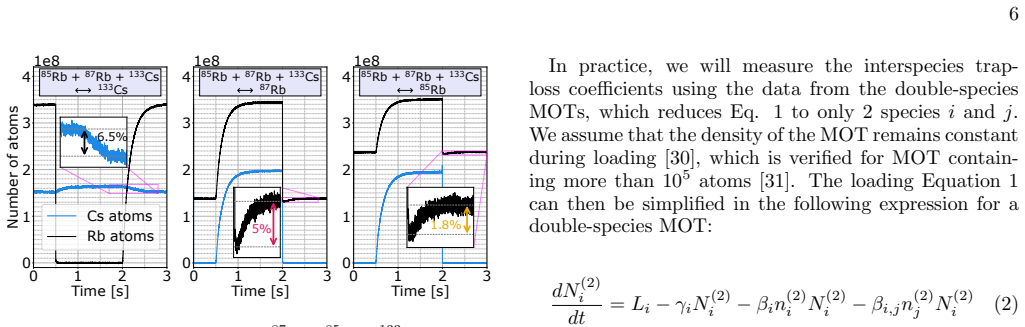
We present the simultaneous trapping and cooling of ${}^{85}$Rb, ${}^{87}$Rb and ${}^{133}$Cs in a triple-species magneto-optical trap (MOT). This demonstration is obtained using an all-fibre compact and robust laser system based on telecom 1.5 $\mu$m and 2 $\mu$m technologies. We characterise the two-body interspecies losses in the double and triple-species MOT. We calculate the two-body interspecies trap-loss coefficient for the ${}^{85}$Rb/${}^{133}$Cs and the ${}^{87}$Rb/${}^{133}$Cs pairs, representing a variation of less than 7% in atom number. No losses are observed between ${}^{85}$Rb and ${}^{87}$Rb in our experimental conditions. We find that interspecies interactions inside the triple-species MOT do not prevent trapping and cooling 10$^{8}$ atoms for each species, making our system suitable for future applications such as multi-species atom interferometry.
Editorial analysis
A structured set of objections, weighed in public.
Referee Report
Summary. The paper claims to demonstrate the simultaneous trapping and cooling of 85Rb, 87Rb, and 133Cs in a triple-species magneto-optical trap using a compact all-fiber laser system based on telecom technologies. The authors characterize two-body interspecies losses, calculating trap-loss coefficients for the 85Rb/133Cs and 87Rb/133Cs pairs that result in less than 7% atom-number variation, report no observable losses between the two Rb isotopes, and achieve 10^8 atoms per species. They conclude that interspecies interactions do not prevent high atom numbers in this configuration, making the system suitable for applications such as multi-species atom interferometry.
Significance. If the measurements hold, this work provides a practical demonstration of a high-atom-number triple-species MOT, which is a valuable step toward multi-species atom interferometry for differential measurements in precision sensing and fundamental physics tests. The compact telecom-based laser system is a notable engineering strength that could facilitate portable or robust implementations. Explicit credit is given for the experimental extraction of specific interspecies loss coefficients, which supply useful benchmarks for modeling cold-atom interactions.
major comments (2)
- [Results on loss coefficients] Results section on loss characterization: The central claim that interspecies interactions cause <7% atom-number variation rests on the calculated two-body loss coefficients β for Rb-Cs pairs, derived from atom-number decay curves. However, the manuscript provides neither the explicit rate equation used (e.g., dN_i/dt = ... - β ∫ n_i n_j dV), the fitting procedure, nor tabulated β values with uncertainties or raw decay data. This omission prevents assessment of potential systematics such as density inhomogeneities or post-selection effects and is load-bearing for the claim that losses are negligible.
- [Discussion and conclusions] Discussion and conclusions: The statement that the system is suitable for multi-species atom interferometry assumes the measured β values remain representative under the altered laser intensities, detunings, and magnetic gradients typical of interferometry sequences (e.g., sub-Doppler cooling phases). Since β depends on relative velocities and excited-state fractions set by these parameters, and no additional data or scaling analysis is provided for those conditions, the extrapolation to 10^8-atom performance in the target application is unsupported.
minor comments (3)
- [Abstract] The abstract refers to calculating the trap-loss coefficient, yet the main text does not display the governing rate equation or any derived expression for β, reducing clarity for readers attempting to reproduce the analysis.
- [Experimental setup] Experimental methods would be strengthened by explicit description of the atom-number calibration (fluorescence vs. absorption) and how background-gas or single-species loss contributions are subtracted when extracting interspecies β.
- [Figures] Figure captions for loading and decay curves should include error bars, the specific laser parameters for each trace, and clear distinction between single-species and multi-species data sets.
Simulated Author's Rebuttal
We thank the referee for their careful reading of our manuscript and for the constructive comments. We address each major point below and will revise the manuscript to improve clarity and completeness.
read point-by-point responses
-
Referee: Results section on loss characterization: The central claim that interspecies interactions cause <7% atom-number variation rests on the calculated two-body loss coefficients β for Rb-Cs pairs, derived from atom-number decay curves. However, the manuscript provides neither the explicit rate equation used (e.g., dN_i/dt = ... - β ∫ n_i n_j dV), the fitting procedure, nor tabulated β values with uncertainties or raw decay data. This omission prevents assessment of potential systematics such as density inhomogeneities or post-selection effects and is load-bearing for the claim that losses are negligible.
Authors: We agree that the loss-coefficient analysis requires more explicit documentation. In the revised manuscript we will insert the full rate equations used for the two-body loss terms, describe the fitting procedure (including how average densities were obtained from fluorescence images), provide tabulated β values with statistical uncertainties for the 85Rb-133Cs and 87Rb-133Cs pairs, and include representative raw atom-number decay curves. These additions will allow readers to evaluate possible systematics. The extracted coefficients remain consistent with the stated <7 % atom-number variation under our MOT conditions. revision: yes
-
Referee: Discussion and conclusions: The statement that the system is suitable for multi-species atom interferometry assumes the measured β values remain representative under the altered laser intensities, detunings, and magnetic gradients typical of interferometry sequences (e.g., sub-Doppler cooling phases). Since β depends on relative velocities and excited-state fractions set by these parameters, and no additional data or scaling analysis is provided for those conditions, the extrapolation to 10^8-atom performance in the target application is unsupported.
Authors: We acknowledge that β can depend on the precise laser and magnetic-field parameters. Our MOT loading conditions were deliberately chosen to be close to those used for subsequent interferometry sequences, and the measured losses already permit 10^8 atoms per species. In the revision we will add a short paragraph discussing the expected parametric dependence of β (drawing on published results for similar Rb-Cs mixtures) and will qualify the concluding statement to note that dedicated measurements under interferometry-specific detunings and intensities would be valuable for quantitative predictions. The present data nonetheless demonstrate that interspecies losses do not preclude high atom numbers in the triple-species MOT. revision: partial
Circularity Check
No circularity: direct experimental measurements of loss rates from decay data
full rationale
The paper is an experimental characterization of a triple-species MOT. Atom numbers and two-body loss coefficients are extracted from measured fluorescence decay curves under the reported laser parameters and magnetic gradients. The central claim (interspecies interactions do not prevent 10^8 atoms per species) follows directly from these observations in the demonstrated configuration. No derivation, ansatz, or uniqueness theorem is invoked that reduces to a self-referential fit or prior self-citation; the loss coefficients are not renamed predictions but fitted parameters from independent data. The work is self-contained against external benchmarks (observed atom numbers and decay rates).
Axiom & Free-Parameter Ledger
axioms (1)
- domain assumption Two-body loss rates can be extracted from observed atom-number decay curves under the assumption of constant trap volume and temperature.
Reference graph
Works this paper leans on
-
[1]
It allows for independent monitoring of Rb and Cs
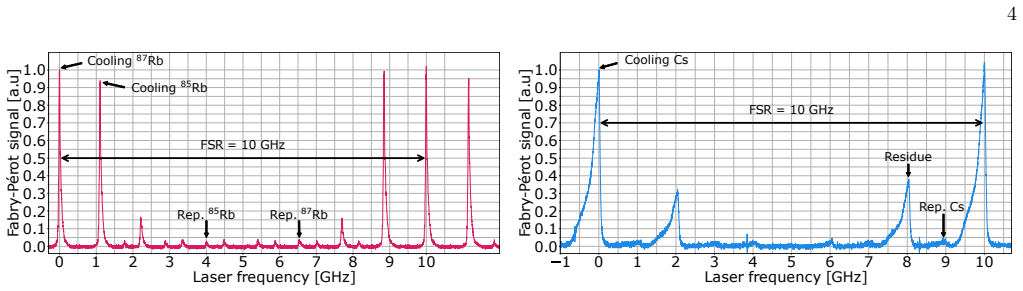
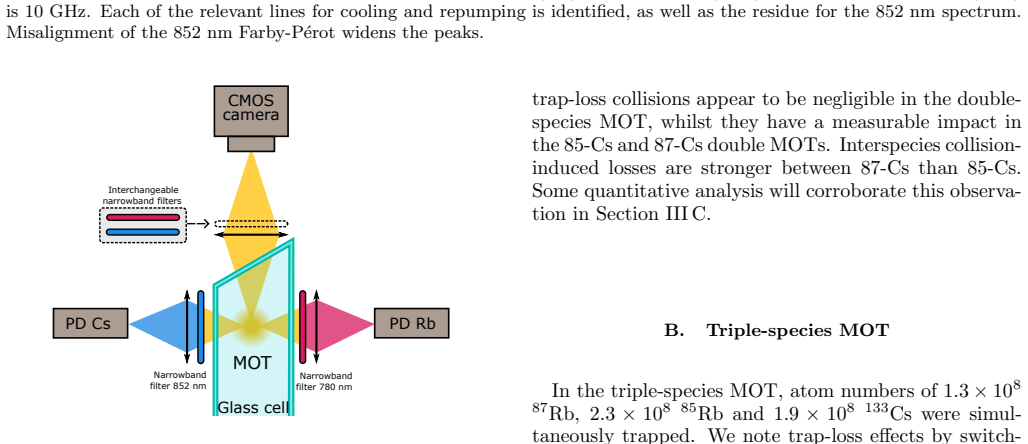
The fluorescence of the MOT is captured using a pair of photodiodes on opposite sides of the vacuum cell, with each having its own narrow band±5 nm filter at 780 nm and 852 nm, respectively. It allows for independent monitoring of Rb and Cs. The fluorescence spectrum of 85Rb and 87Rb being a few GHz apart, we are not able to discriminate between the fluor...
-
[2]
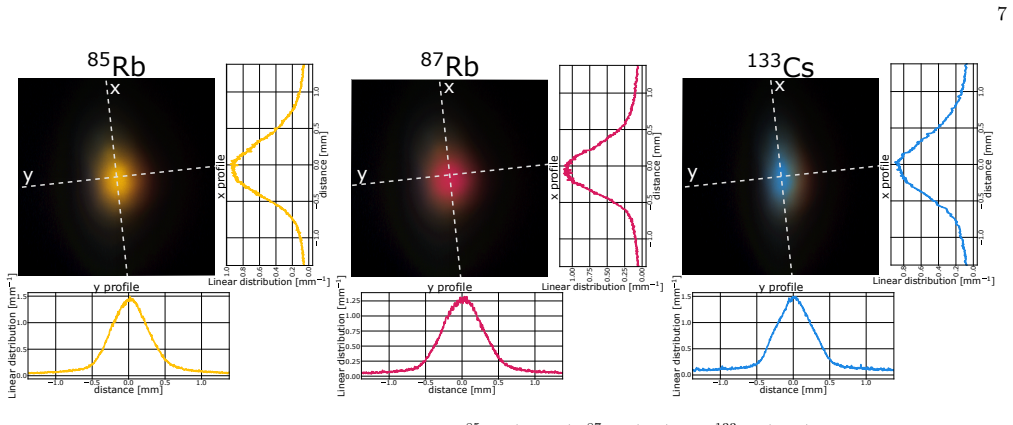
The density n(2) j of atomsjin the double-species MOT, which can be evaluated with the CMOS camera and the number of atoms
Consequently, one can arrange the expressions of the number of atoms in the single MOTN (1) i ∞ and in the double MOTN (2) i ∞ , and obtain the following expression ofβ i,j: βi,j = 1 n(2) j τ (1) i N (1) i ∞ N (2) i ∞ −1 ! (4) Equation 2 and thus 4 is valid under the assumption that the overlap of the clouds of both species is 1, which is validated from t...
-
[3]
T. P. Softley, Cold and ultracold molecules in the twen- ties, Proceedings of the Royal Society A: Mathematical, Physical and Engineering Sciences479, 20220806 (2023), https://royalsocietypublishing.org/rspa/article- pdf/doi/10.1098/rspa.2022.0806/1227633/rspa.2022.0806.pdf
work page doi:10.1098/rspa.2022.0806/1227633/rspa.2022.0806.pdf 2023
-
[4]
Aggarwal, H
The NL-eEDM collaboration, P. Aggarwal, H. L. Beth- lem, A. Borschevsky, M. Denis, K. Esajas, P. A. B. Haase, Y. Hao, S. Hoekstra, K. Jungmann, T. B. Meijknecht, M. C. Mooij, R. G. E. Timmermans, W. Ubachs, L. Will- mann, and A. Zapara, Measuring the electric dipole mo- ment of the electron in BaF, The European Physical Journal D72, 197 (2018)
2018
-
[5]
J. Lim, J. R. Almond, M. A. Trigatzis, J. A. Devlin, N. J. Fitch, B. E. Sauer, M. R. Tarbutt, and E. A. Hinds, Laser cooled ybf molecules for measuring the electron’s electric dipole moment, Phys. Rev. Lett.120, 123201 (2018)
2018
-
[6]
S. L. Cornish, M. R. Tarbutt, and K. R. A. Hazzard, Quantum computation and quantum simulation with ul- tracold molecules, Nature Physics20, 730 (2024)
2024
-
[7]
S. Fray, C. A. Diez, T. W. H¨ ansch, and M. Weitz, Atomic interferometer with amplitude gratings of light and its applications to atom based tests of the equivalence prin- ciple, Phys. Rev. Lett.93, 240404 (2004)
2004
-
[8]
Bonnin, N
A. Bonnin, N. Zahzam, Y. Bidel, and A. Bresson, Simul- taneous dual-species matter-wave accelerometer, Phys. Rev. A88, 043615 (2013)
2013
-
[9]
Tarallo, T
M. Tarallo, T. Mazzoni, N. Poli, D. Sutyrin, X. Zhang, and G. Tino, Test of Einstein Equivalence Principle for 0-Spin and Half-Integer-Spin Atoms: Search for Spin- Gravity Coupling Effects, Physical Review Letters113, 023005 (2014)
2014
-
[10]
Schlippert, J
D. Schlippert, J. Hartwig, H. Albers, L. Richardson, C. Schubert, A. Roura, W. Schleich, W. Ertmer, and E. Rasel, Quantum Test of the Universality of Free Fall, Physical Review Letters112, 203002 (2014)
2014
-
[11]
L. Zhou, S. Long, B. Tang, X. Chen, F. Gao, W. Peng, W. Duan, J. Zhong, Z. Xiong, J. Wang, Y. Zhang, and M. Zhan, Test of equivalence principle at 10 −8 level by a dual-species double-diffraction raman atom interferome- ter, Phys. Rev. Lett.115, 013004 (2015)
2015
-
[12]
B. Barrett, G. Condon, L. Chichet, L. Antoni-Micollier, R. Arguel, M. Rabault, C. Pelluet, V. Jarlaud, A. Lan- dragin, P. Bouyer, and B. Battelier, Testing the Univer- sality of Free Fall using correlated$ˆ{39}$K –$ˆ{87}$Rb interferometers, AVS Quantum Science4, 014401 (2022), arXiv:2110.13273 [physics]
-
[13]
Anderlini, E
M. Anderlini, E. Courtade, M. Cristiani, D. Cossart, D. Ciampini, C. Sias, O. Morsch, and E. Arimondo, Sym- pathetic cooling and collisional properties of a Rb−Cs mixture, Phys. Rev. A71, 061401 (2005)
2005
-
[14]
Bloch, M
I. Bloch, M. Greiner, O. Mandel, T. W. H¨ ansch, and T. Esslinger, Sympathetic cooling of 85Rb and 87Rb, Phys. Rev. A64, 021402 (2001)
2001
-
[15]
Taglieber, A.-C
M. Taglieber, A.-C. Voigt, F. Henkel, S. Fray, T. W. H¨ ansch, and K. Dieckmann, Simultaneous magneto- optical trapping of three atomic species, Phys. Rev. A 73, 011402 (2006)
2006
-
[16]
E. R. Elliott, D. C. Aveline, N. P. Bigelow, P. Boegel, S. Botsi, E. Charron, J. P. D’Incao, P. Engels, T. Estram- pes, N. Gaaloul, J. R. Kellogg, J. M. Kohel, N. E. Lay, N. Lundblad, M. Meister, M. E. Mossman, G. M¨ uller, H. M¨ uller, K. Oudrhiri, L. E. Phillips, A. Pichery, E. M. 9 Rasel, C. A. Sackett, M. Sbroscia, W. P. Schleich, R. J. Thompson, and ...
2023
-
[17]
Guena, P
J. Guena, P. Rosenbusch, P. Laurent, M. Abgrall, D. Rovera, G. Santarelli, M. E. Tobar, S. Bize, and A. Clairon, Demonstration of a dual alkali rb/cs fountain clock, IEEE Transactions on Ultrasonics, Ferroelectrics, and Frequency Control57, 647 (2010)
2010
-
[18]
Witkowski, B
M. Witkowski, B. Nag´ orny, R. Munoz-Rodriguez, R. Ciury lo, P. S. ˙Zuchowski, S. Bilicki, M. Piotrowski, P. Morzy´ nski, and M. Zawada, Dual Hg-Rb magneto- optical trap, Optics Express25, 3165 (2017)
2017
-
[19]
Anand, C
S. Anand, C. E. Bradley, R. White, V. Ramesh, K. Singh, and H. Bernien, A dual-species Rydberg array, Nature Physics20, 1744 (2024)
2024
-
[20]
J. N. Tinsley, S. Bandarupally, M. Chiarotti, S. Manzoor, M. Sacco, and N. Poli, Toward a dual-species atom inter- ferometer with cadmium and strontium, AVS Quantum Science6, 014411 (2024)
2024
-
[21]
A. Bonnin, C. Diboune, N. Zahzam, Y. Bidel, M. Cadoret, and A. Bresson, New concepts of iner- tial measurements with multi-species atom interferom- etry, Applied Physics B124, 10.1007/s00340-018-7051-5 (2018)
-
[22]
D. Savoie, M. Altorio, B. Fang, L. A. Sidorenkov, R. Geiger, and A. Landragin, Interleaved atom interferometry for high-sensitivity inertial mea- surements, Science Advances4, eaau7948 (2018), https://www.science.org/doi/pdf/10.1126/sciadv.aau7948
-
[23]
Barrett, P
B. Barrett, P. Cheiney, B. Battelier, F. Napolitano, and P. Bouyer, Multidimensional atom optics and interferom- etry, Phys. Rev. Lett.122, 043604 (2019)
2019
-
[24]
Dutta, D
I. Dutta, D. Savoie, B. Fang, B. Venon, C. L. Gar- rido Alzar, R. Geiger, and A. Landragin, Continuous cold-atom inertial sensor with 1 nrad/sec rotation sta- bility, Phys. Rev. Lett.116, 183003 (2016)
2016
-
[26]
Freier, M
C. Freier, M. Hauth, V. Schkolnik, B. Leykauf, M. Schilling, H. Wziontek, H.-G. Scherneck, J. M¨ uller, and A. Peters, Mobile quantum gravity sensor with un- precedented stability, Journal of Physics: Conference Se- ries723, 012050 (2016)
2016
-
[27]
Diboune, N
C. Diboune, N. Zahzam, Y. Bidel, M. Cadoret, and A. Bresson, Multi-line fiber laser system for cesium and rubidium atom interferometry, Opt. Express25, 16898 (2017), publisher: Optica Publishing Group
2017
-
[28]
L. Xu, M. Li, Z. Yu, Z. Liu, J. Duan, F. Wang, F. Zhao, and X. Liu, Dual atom ( 87 Rb-133 Cs) grating magneto- optical trap, Optics Express33, 6160 (2025)
2025
-
[29]
Carraz, F
O. Carraz, F. Lienhart, R. Charri` ere, M. Cadoret, N. Za- hzam, Y. Bidel, and A. Bresson, Compact and robust laser system for onboard atom interferometry, Applied Physics B97, 405 (2009)
2009
-
[30]
Antoni-Micollier, M
L. Antoni-Micollier, M. Viteau, B. Battelier, B. Cadier, D. Comparat, B. Desruelle, G. Guiraud, E. Pinsard, M. Reveillard, S. Rota-Rodrigo, G. Stern, N. Traynor, and G. Santarelli, Watt-level narrow-linewidth fibered laser source at 852 nm for fib application, Opt. Lett.43, 3937 (2018)
2018
-
[31]
Dutta, A
S. Dutta, A. Altaf, J. Lorenz, D. S. Elliott, and Y. P. Chen, Interspecies collision-induced losses in a dual species 7 Li–85 Rb magneto-optical trap, Journal of Physics B: Atomic, Molecular and Optical Physics47, 105301 (2014)
2014
-
[32]
M. W. Mancini, A. R. L. Caires, G. D. Telles, V. S. Bag- nato, and L. G. Marcassa, Trap loss rate for heteronuclear cold collisions in two species magneto-optical trap, The European Physical Journal D30, 105 (2004)
2004
-
[33]
C. G. Townsend, N. H. Edwards, C. J. Cooper, K. P. Zetie, C. J. Foot, A. M. Steane, P. Szriftgiser, H. Perrin, and J. Dalibard, Phase-space density in the magneto- optical trap, Phys. Rev. A52, 1423 (1995)
1995
-
[34]
Ji, J.-Z
Z.-H. Ji, J.-Z. Wu, H.-S. Zhang, T.-F. Meng, J. Ma, L.-R. Wang, Y.-T. Zhao, L.-T. Xiao, and S.-T. Jia, Investiga- tion of cold collision in a Rb–Cs magneto-optical trap, Journal of Physics B: Atomic, Molecular and Optical Physics44, 025202 (2011)
2011
-
[35]
M. E. Holmes, M. Tscherneck, P. A. Quinto-Su, and N. P. Bigelow, Isotopic difference in the heteronuclear loss rate in a two-species surface trap, Phys. Rev. A69, 063408 (2004)
2004
-
[36]
M. L. Harris, P. Tierney, and S. L. Cornish, Magnetic trapping of a cold Rb–Cs atomic mixture, Journal of Physics B: Atomic, Molecular and Optical Physics41, 035303 (2008)
2008
-
[37]
S¨ uptitz, G
W. S¨ uptitz, G. Wokurka, F. Strauch, P. Kohns, and W. Ertmer, Simultaneous cooling and trapping of ˆ85Rb and ˆ87Rb in a magneto-optical trap, Optics Letters19, 1571 (1994)
1994
-
[38]
Weiner, V
J. Weiner, V. S. Bagnato, S. Zilio, and P. S. Julienne, Experiments and theory in cold and ultracold collisions, Reviews of Modern Physics71, 1 (1999)
1999
-
[39]
Vigu´ e, Possibility of applying laser-cooling techniques to the observation of collective quantum effects, Phys
J. Vigu´ e, Possibility of applying laser-cooling techniques to the observation of collective quantum effects, Phys. Rev. A34, 4476 (1986)
1986
-
[40]
G. D. Telles, W. Garcia, L. G. Marcassa, V. S. Bagnato, D. Ciampini, M. Fazzi, J. H. M¨ uller, D. Wilkowski, and E. Arimondo, Trap loss in a two-species Rb-Cs magneto- optical trap, Physical Review A63, 033406 (2001)
2001
-
[41]
M. S. Santos, P. Nussenzveig, A. Antunes, P. S. P. Car- dona, and V. S. Bagnato, Hyperfine-changing collision measurements in trap loss for mixed species in a magneto- optical trap, Physical Review A60, 3892 (1999)
1999
-
[42]
S. D. Gensemer, V. Sanchez-Villicana, K. Y. N. Tan, T. T. Grove, and P. L. Gould, Trap-loss collisions of 85 Rb and 87 Rb : Dependence on trap parameters, Physical Review A56, 4055 (1997)
1997
-
[43]
H. W. Cho, D. J. McCarron, D. L. Jenkin, M. P. K¨ oppinger, and S. L. Cornish, A high phase-space density mixture of 87rb and 133cs: towards ultracold heteronu- clear molecules, The European Physical Journal D65, 125–131 (2011)
2011
-
[44]
Spethmann, F
N. Spethmann, F. Kindermann, S. John, C. Weber, D. Meschede, and A. Widera, Dynamics of single neu- tral impurity atoms immersed in an ultracold gas, Phys. Rev. Lett.109, 235301 (2012)
2012
-
[45]
Peters, K
A. Peters, K. Y. Chung, and S. Chu, High-precision grav- ity measurements using atom interferometry, Metrologia 38, 25 (2001)
2001
-
[46]
Sortais, S
Y. Sortais, S. Bize, C. Nicolas, A. Clairon, C. Salomon, and C. Williams, Cold collision frequency shifts in a 87Rb atomic fountain, Phys. Rev. Lett.85, 3117 (2000)
2000
-
[47]
Gibble and S
K. Gibble and S. Chu, Laser-cooled cs frequency standard and a measurement of the frequency shift due to ultracold 10 collisions, Phys. Rev. Lett.70, 1771 (1993)
1993
discussion (0)
Sign in with ORCID, Apple, or X to comment. Anyone can read and Pith papers without signing in.