Recognition: unknown
Taming Additive Systematics via Redshift-Bin-Optimized Star-Galaxy Separation
Pith reviewed 2026-05-08 17:39 UTC · model grok-4.3
The pith
Redshift-bin-optimized color cuts remove 1.3-5.5% stellar contamination from DES lens samples by exploiting distinct color-space regions.
A machine-rendered reading of the paper's core claim, the machinery that carries it, and where it could break.
Core claim
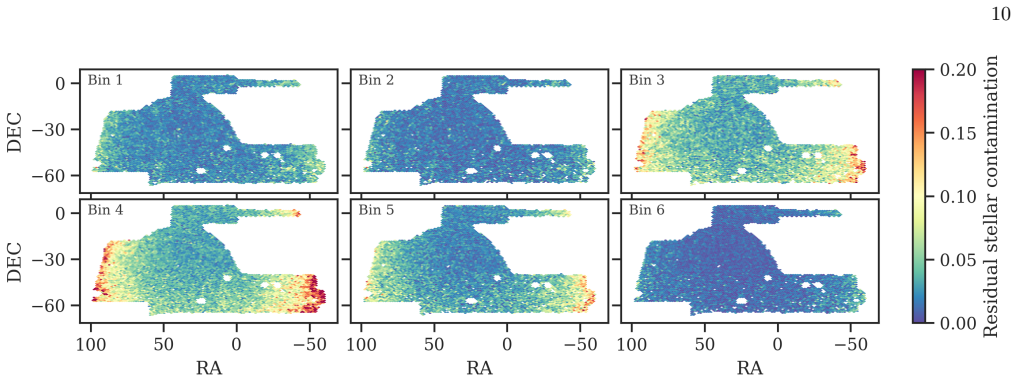
The central claim is that photometric galaxy samples selected for cosmological inference occupy different regions of color space than the broader photometric dataset on which standard star-galaxy cuts are defined, so per-redshift-bin optimization of color cuts can more cleanly excise stellar contamination. When combined with an optimal weighting scheme, this joint mitigation of additive and multiplicative effects occurs directly at the map level. Applied to the DES Y3 MagLim sample using forced unWISE NIR photometry via DECaLS DR9 cross-matching, the method identifies and removes residual stellar contamination ranging from 1.3% to 5.5% across redshift bins.
What carries the argument
Redshift-bin-optimized color cuts that exploit the distinct color-space occupancy of cosmology-selected galaxies versus the full photometric sample
If this is right
- Residual stellar contamination in the DES Y3 MagLim lens sample, which varies from 1.3% to 5.5% across redshift bins, can be identified and removed at the map level.
- The color-cut approach complements morphological star-galaxy separators by avoiding direct dependence on PSF and blending systematics.
- An optimal weighting scheme applied together with the cuts jointly controls additive and multiplicative contamination in the observed density field.
- Stellar contamination that varies across the survey footprint can be mitigated without uniform masking that discards usable area.
Where Pith is reading between the lines
- The method could be adapted to deeper or wider surveys by incorporating additional photometric bands to further separate populations in color space.
- Footprint-dependent contamination patterns suggest that adding spatial variation to the bin-optimized cuts might yield further reductions in bias.
- This selection-aware cleaning indicates that generic catalog-level star-galaxy cuts may be suboptimal for any probe that applies its own redshift or color selections.
Load-bearing premise
The color-space regions of the cosmology-selected galaxies in each redshift bin are distinct enough from stars to permit cuts that remove contamination without removing real galaxies or creating new selection biases.
What would settle it
If applying the optimized per-bin cuts leaves the measured additive systematics in the clustering or lensing signals unchanged, or if spectroscopic follow-up shows that removed objects are not stars while retained galaxies are disproportionately lost in some bins.
Figures




read the original abstract
Contamination from stars in the galaxy samples of large-scale structure surveys can bias cosmological constraints if not tightly controlled. This is especially true for lens samples used for galaxy clustering and galaxy-galaxy lensing probes, where contamination is a primary source of additive systematics. We propose an improved approach to star-galaxy separation and an optimal weighting scheme to jointly mitigate additive and multiplicative contamination of the density field at the map level. Our star-galaxy separation approach exploits the fact that photometric galaxy samples used for cosmological inference populate different regions of color-space than the full photometric dataset on which star-galaxy cuts are typically applied, and therefore optimizes star-galaxy separation for the galaxy samples in each redshift bin. This serves as a complementary approach to morphological star-galaxy separators, which can have complicated dependencies on PSF and blending systematics. We demonstrate the method using the Dark Energy Survey Y3 MagLim lens sample, for which we obtain forced NIR unWISE photometry via cross-matching with DECaLS DR9 to define redshift-bin-optimized color cuts. We identify and remove residual stellar contamination in the DES Y3 lens sample, which varies strongly across redshift bins ($1.3-5.5\%$) and across the footprint.
Editorial analysis
A structured set of objections, weighed in public.
Referee Report
Summary. The manuscript proposes a redshift-bin-optimized star-galaxy separation method that exploits the distinct color-space regions occupied by photometric galaxy samples used for cosmological inference, as opposed to the full photometric dataset. Applied to the DES Y3 MagLim lens sample via cross-matching with DECaLS DR9 to obtain forced NIR unWISE photometry, the approach defines per-bin color cuts to remove residual stellar contamination reported at levels of 1.3–5.5% that vary across redshift bins and the survey footprint. It further introduces an optimal weighting scheme to jointly mitigate additive and multiplicative contamination of the density field at the map level, serving as a complement to morphological separators.
Significance. If the central claims hold after validation, the method offers a practical, data-driven complement to morphological star-galaxy separation for controlling additive systematics in galaxy clustering and galaxy-galaxy lensing analyses, which is critical for unbiased cosmological constraints from large-scale structure surveys. The per-bin optimization is a clear strength, as it tailors cuts to the specific color properties of the cosmology-selected samples rather than applying uniform cuts to the parent catalog. The demonstration on real DES Y3 data provides concrete contamination percentages, though the overall significance would be enhanced by reproducible code or explicit falsifiable tests of completeness.
major comments (2)
- [Abstract] Abstract: the claim that residual contamination was identified and removed with quoted percentages (1.3–5.5%) is presented without quantitative validation such as error budgets, completeness fractions after the DECaLS-forced NIR cuts, or direct comparisons to baseline color or morphological methods; this is load-bearing for the central claim of taming additive systematics.
- [Demonstration on DES Y3 MagLim] Demonstration on DES Y3 MagLim: the optimization is performed on the already-selected MagLim sample, yet the manuscript does not report tests showing that the bin-dependent cuts do not preferentially remove objects near color-space boundaries in a manner that correlates with redshift or local density and thereby alters the effective n(z) or galaxy bias beyond what the weighting scheme can capture.
minor comments (2)
- The description of how the optimal weighting scheme jointly addresses additive and multiplicative effects would benefit from an explicit equation or algorithmic outline to improve clarity and reproducibility.
- The variation of contamination across the footprint is noted but would be clearer with reference to a specific figure or table showing the spatial distribution.
Simulated Author's Rebuttal
We thank the referee for their careful reading and constructive comments, which have helped us identify areas where the manuscript can be strengthened. We address each major comment point by point below, outlining the revisions we will make.
read point-by-point responses
-
Referee: [Abstract] Abstract: the claim that residual contamination was identified and removed with quoted percentages (1.3–5.5%) is presented without quantitative validation such as error budgets, completeness fractions after the DECaLS-forced NIR cuts, or direct comparisons to baseline color or morphological methods; this is load-bearing for the central claim of taming additive systematics.
Authors: We agree that the abstract would benefit from additional quantitative context to support the reported contamination levels. The manuscript body (Sections 3 and 4) describes the DECaLS DR9 cross-match, forced unWISE photometry, and per-bin color-cut optimization in detail, including how the 1.3–5.5% residual stellar fractions were measured via the cross-match. However, to make this validation more explicit and load-bearing, we will revise the abstract to reference the validation approach and add a dedicated paragraph in Section 4 providing error budgets on the contamination fractions, completeness and purity estimates after the NIR cuts, and direct comparisons to standard morphological and color-based separators. These additions will include quantitative metrics such as the fraction of stars removed versus galaxies retained. revision: yes
-
Referee: [Demonstration on DES Y3 MagLim] Demonstration on DES Y3 MagLim: the optimization is performed on the already-selected MagLim sample, yet the manuscript does not report tests showing that the bin-dependent cuts do not preferentially remove objects near color-space boundaries in a manner that correlates with redshift or local density and thereby alters the effective n(z) or galaxy bias beyond what the weighting scheme can capture.
Authors: The referee correctly identifies that the cuts are optimized directly on the MagLim sample. This is intentional, as the method exploits the fact that the cosmology-selected sample occupies distinct color-space regions compared to the full photometric catalog. To address concerns about potential preferential removal near boundaries that could correlate with redshift or density, we will add new tests in the revised Section 4: (i) direct before/after comparisons of the effective n(z) in each bin, (ii) checks for spatial correlations between removed objects and local density or footprint position, and (iii) verification that any residual shifts in galaxy bias are absorbed by the optimal weighting scheme. These tests will quantify whether the cuts introduce biases beyond what the weighting mitigates. revision: yes
Circularity Check
No significant circularity detected in derivation chain
full rationale
The paper presents a data-driven method for redshift-bin-optimized star-galaxy separation that relies on external cross-matching with DECaLS DR9 catalogs to obtain forced NIR photometry and define color cuts tailored to the DES Y3 MagLim sample in each bin. This approach does not reduce any claimed result to a fitted parameter by construction, nor does it invoke self-definitional equations, load-bearing self-citations, or ansatzes smuggled from prior author work. The optimization exploits observed differences in color-space occupancy between cosmology-selected galaxies and the parent photometric sample, with contamination levels measured directly from the data (1.3-5.5% varying by bin). The derivation remains self-contained against external benchmarks and independent catalogs, with no steps where a prediction or uniqueness claim collapses to the input by definition.
Axiom & Free-Parameter Ledger
free parameters (1)
- redshift-bin color-cut boundaries
axioms (1)
- domain assumption Photometric galaxy samples used for cosmology occupy distinct color-space regions from the full photometric dataset and from stars in each redshift bin.
Reference graph
Works this paper leans on
-
[1]
the wrong integral constraint
A constant multiplicative suppression of the galaxy two point function due to including spurious addi- tive contaminants when computing the normaliza- tion, i.e. the wrong integral constraint. This is a known effect, see e.g. [28–30] who show the impact of residual stellar contamination in the sample, in the limit that such contamination is uniform across...
-
[2]
Multiplicative systematics contribute a coupling term that is multiplicative with the true overden- sity. As shown in [15], this effectively imprints a spatially-dependentvariancein the observed over- density field in the pattern of the given systematic, which propagates to any higher N-point functions of the field, such as the last coupling term in Eq. 3...
-
[3]
them to that computed on the catalog with no stellar contamination.5 Fig
using different sets of galaxy weights and compare 4 Even with this relatively large contamination rate of 5%, we have an average number of ¯nstar ≈16.3 deg −2 such that even though our stellar template traces the mean number of stars across the footprint, scales below∼0.25 ◦ (corresponding toNSIDE≳256) are dominated by Poisson noise. them to that compute...
-
[4]
ˆηadd has been estimated by e.g
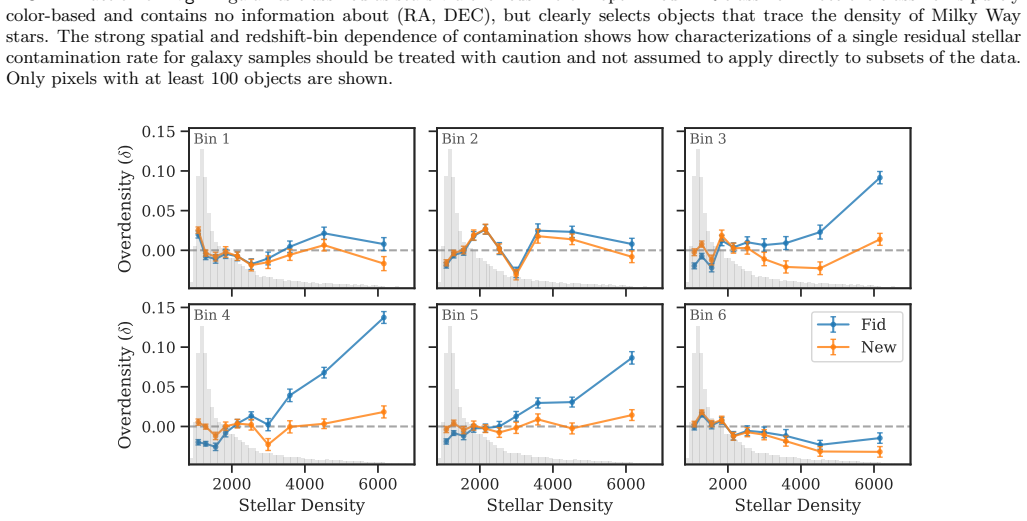
An independent estimate of the fractional contami- nationη add is required. ˆηadd has been estimated by e.g. using deep fields that contain more data [29], simulated source injection [44, 45], or extrapolat- ing observed trends ofN gal against stellar density to where the latter is zero [46, 47]. Each of these has their own challenges; stellar contaminati...
-
[5]
ˆfadd and ˆfmult are both typically obtained by re- gressing the observed overdensity against spatial templates, such that if a multiplicative and additive systematic both have thesamespatial template (as is the case with stellar contamination and obscura- tion), then more complex methods are required to break the degeneracy as in e.g. [23–25]
-
[6]
forced photometry
Systematic templates are only approximate tracers of the true systematic, such that corrections will always be approximate. While a template com- 7 prised for e.g. Gaia star density will remove the mean dependence on stellar density, it can’t correct for the Poisson residuals, or fluctuations below the resolution at which its computed. Furthermore, it ass...
-
[7]
defined a single linear separation in the (r−z,z−W1) plane, similar to the approach in SDSS wherein a linear cut in (r−i,r−W1) was used [63]. While effective, a global cut applied to the full sample is suboptimal — galaxies are already grouped into different redshift bins according to their color (via theirDNF-inferredZMEAN), which means that objects in e...
2000
-
[8]
organized randoms
is that the bin-optimized cuts have reduced potential for introducing angular systematics. Each cut applied to the sample creates a sharp boundary in color space that presents an additional way for photometric errors to translate into variations in observed galaxy density as objects move in and out of the selection. Locally, the response of the galaxy cou...
- [9]
-
[10]
J. T. A. de Jong, G. A. Verdoes Kleijn, K. H. Kuijken, and E. A. Valentijn, The Kilo-Degree Survey, Experi- mental Astronomy35, 25 (2013), arXiv:1206.1254 [astro- ph.CO]
work page Pith review arXiv 2013
- [11]
-
[12]
ˇZ. Ivezi´ c, S. M. Kahn, J. A. Tyson, B. Abel, E. Acosta, et al., LSST: From Science Drivers to Reference Design and Anticipated Data Products, ApJ873, 111 (2019), arXiv:0805.2366 [astro-ph]
-
[13]
Euclid Collaboration (Euclid), Euclid: I. Overview of the Euclid mission, A&A697, A1 (2025), arXiv:2405.13491 [astro-ph.CO]
-
[14]
Takada and B
M. Takada and B. Jain, The three-point correlation func- tion in cosmology, Monthly Notices of the Royal Astro- nomical Society340, 580–608 (2003)
2003
-
[15]
M. Schmittfull, T. Baldauf, and U. Seljak, Near optimal bispectrum estimators for large-scale structure, Physical Review D91, 10.1103/physrevd.91.043530 (2015)
-
[16]
Banerjee and T
A. Banerjee and T. Abel, Nearest neighbour distribu- tions: New statistical measures for cosmological cluster- ing, Monthly Notices of the Royal Astronomical Society 500, 5479–5499 (2020)
2020
-
[17]
A. M. Dizgah, H. Lee, M. Schmittfull, and C. Dvorkin, Capturing non-gaussianity of the large-scale structure with weighted skew-spectra, Journal of Cosmology and Astroparticle Physics2020(04), 011–011
-
[18]
White, A marked correlation function for constrain- ing modified gravity models, Journal of Cosmology and Astroparticle Physics2016(11), 057–057
M. White, A marked correlation function for constrain- ing modified gravity models, Journal of Cosmology and Astroparticle Physics2016(11), 057–057
-
[19]
F. Yin, L. Xiao, W. Du, Z. Jiang, Z. Min,et al., En- hancing cosmological constraints by two-dimensionalβ- cosmic-web weighted angular correlation functions, Re- search in Astronomy and Astrophysics25, 075022 (2025)
2025
-
[20]
Cheng, Y.-S
S. Cheng, Y.-S. Ting, B. M´ enard, and J. Bruna, A new approach to observational cosmology using the scattering transform, Monthly Notices of the Royal Astronomical Society499, 5902–5914 (2020)
2020
-
[22]
Huterer, C
D. Huterer, C. E. Cunha, and W. Fang, Calibra- tion errors unleashed: effects on cosmological parame- ters and requirements for large-scale structure surveys, Monthly Notices of the Royal Astronomical Society432, 2945–2961 (2013)
2013
-
[23]
N. Weaverdyck and D. Huterer, Mitigating contamina- tion in LSS surveys: a comparison of methods, Mon. Not. Roy. Astron. Soc.503, 5061 (2021), arXiv:2007.14499 [astro-ph.CO]
-
[24]
Kitanidis, M
E. Kitanidis, M. White, Y. Feng, D. Schlegel, J. Guy, et al., Imaging systematics and clustering of desi main targets, Monthly Notices of the Royal Astronomical So- ciety496, 2262–2291 (2020)
2020
-
[25]
Rodríguez-Monroyet al., MNRAS511, 2665 (2022), arXiv:2105.13540 [astro-ph.CO]
M. Rodr´ ıguez-Monroyet al.(DES), Dark Energy Survey Year 3 results: galaxy clustering and systematics treat- ment for lens galaxy samples, Mon. Not. Roy. Astron. Soc.511, 2665 (2022), arXiv:2105.13540 [astro-ph.CO]
-
[26]
Rezaie, A
M. Rezaie, A. J. Ross, H.-J. Seo, H. Kong, A. Porredon, et al., ”local primordial non-gaussianity from the large- scale clustering of photometric desi luminous red galax- ies”, Monthly Notices of the Royal Astronomical Society 532, 1902–1928 (2024)
1902
-
[27]
Z. Yan, A. H. Wright, N. Elisa Chisari, C. Georgiou, S. Joudaki,et al., Kids-legacy: Angular galaxy clustering from deep surveys with complex selection effects, Astron- omy &; Astrophysics694, A259 (2025)
2025
-
[28]
N. Weaverdyck, M. Rodr´ ıguez-Monroy, J. Elvin-Poole, I. Sevilla-Noarbe, A. Porredon,et al., Dark energy survey year 6 results: Maglim++ lens sample selection and mea- surements of galaxy clustering (2026), arXiv:2601.14484 [astro-ph.CO]
-
[29]
M. Rodr´ ıguez-Monroy, N. Weaverdyck, J. Elvin-Poole, I. Sevilla-Noarbe, A. C. Rosell,et al., Dark energy sur- vey year 6 results: improved mitigation of spatially varying observational systematics with masking (2025), arXiv:2509.07943 [astro-ph.CO]
-
[30]
D. L. Shafer and D. Huterer, Multiplicative errors in the galaxy power spectrum: self-calibration of un- known photometric systematics for precision cosmology, Monthly Notices of the Royal Astronomical Society447, 2961–2969 (2015)
2015
-
[31]
Xavier, M
H. Xavier, M. Costa-Duarte, A. Balaguera-Antol´ ınez, and M. Bilicki, All-sky angular power spectra from cleaned wise×supercosmos galaxy number counts, Jour- nal of Cosmology and Astroparticle Physics2019(08), 037–037
-
[32]
F. Berlfein, R. Mandelbaum, S. Dodelson, and C. Schafer, Joint inference of multiplicative and additive systematics in galaxy density fluctuations and clustering measurements, Mon. Not. Roy. Astron. Soc.531, 4954 (2024), arXiv:2401.12293 [astro-ph.CO]
-
[33]
C. Hern´ andez-Monteagudo, G. Aric` o, J. Chaves- Montero, L. R. Abramo, P. Arnalte-Mur,et al., The j-plus collaboration. additive versus multiplicative sys- tematics in surveys of the large scale structure of the universe, The Open Journal of Astrophysics8, 10.33232/001c.142148 (2025)
-
[34]
A. J. Ross, S. Ho, A. J. Cuesta, R. Tojeiro, W. J. Percival, et al., Ameliorating systematic uncertainties in the angu- lar clustering of galaxies: a study using the sdss-iii: Ame- liorating systematic uncertainties in w(θ), Monthly No- tices of the Royal Astronomical Society417, 1350–1373 (2011)
2011
-
[35]
Kalus, W
B. Kalus, W. J. Percival, D. J. Bacon, E.-M. Mueller, L. Samushia,et al., A map-based method for eliminating systematic modes from galaxy clustering power spectra with application to boss, Monthly Notices of the Royal Astronomical Society482, 453–470 (2018)
2018
-
[36]
Crocce, J
M. Crocce, J. Carretero, A. H. Bauer, A. J. Ross, I. Sevilla-Noarbe,et al., Galaxy clustering, photometric redshifts and diagnosis of systematics in the des science verification data, Monthly Notices of the Royal Astro- nomical Society455, 4301–4324 (2015). 16
2015
-
[37]
Nicola, D
A. Nicola, D. Alonso, J. S´ anchez, A. Slosar, H. Awan, et al., Tomographic galaxy clustering with the subaru hyper suprime-cam first year public data release, Jour- nal of Cosmology and Astroparticle Physics2020(03), 044–044
-
[38]
Krolewski, S
A. Krolewski, S. Ferraro, E. F. Schlafly, and M. White, unwise tomography of planck cmb lensing, Journal of Cosmology and Astroparticle Physics2020(05), 047–047
-
[39]
Elsner, B
F. Elsner, B. Leistedt, and H. V. Peiris, Unbiased pseudo- cl power spectrum estimation with mode projection, Monthly Notices of the Royal Astronomical Society465, 1847–1855 (2016)
2016
-
[40]
Alonso, J
D. Alonso, J. Sanchez, and A. Slosar, A unified pseudo-cl framework, Monthly Notices of the Royal Astronomical Society484, 4127–4151 (2019)
2019
-
[41]
T. Cornish, D. Alonso, B. Leistedt, and K. Wolz, System- atics mitigation for catalogue-based angular power spec- tra, Monthly Notices of the Royal Astronomical Society 547, 10.1093/mnras/stag360 (2026)
- [42]
-
[43]
C. B. Morrison and H. Hildebrandt, Mitigating system- atic errors in angular correlation function measurements from wide field surveys, Monthly Notices of the Royal Astronomical Society454, 3121–3133 (2015)
2015
-
[45]
Cawthon, J
R. Cawthon, J. Elvin-Poole, A. Porredon, M. Crocce, G. Giannini,et al., Dark energy survey year 3 results: cal- ibration of lens sample redshift distributions using clus- tering redshifts with boss/eboss, Monthly Notices of the Royal Astronomical Society513, 5517–5539 (2022)
2022
-
[46]
2022, PhRvD, 106, 103530, doi: 10.1103/PhysRevD.106.103530
A. Porredon, M. Crocce, J. Elvin-Poole, R. Cawthon, G. Giannini,et al., Dark energy survey year 3 re- sults: Cosmological constraints from galaxy clustering and galaxy-galaxy lensing using the maglim lens sample, Physical Review D106, 10.1103/physrevd.106.103530 (2022)
-
[47]
Ram´ ırez-P´ erez, J
C. Ram´ ırez-P´ erez, J. Sanchez, D. Alonso, and A. Font- Ribera, Colore: fast cosmological realisations over large volumes with multiple tracers, Journal of Cosmology and Astroparticle Physics2022(05), 002
-
[48]
K. M. Gorskiet al., Healpix: A framework for high- resolution discretization and fast analysis of data dis- tributed on the sphere, ApJ622, 759–771 (2005)
2005
-
[49]
Jarvis, G
M. Jarvis, G. Bernstein, and B. Jain, The skewness of the aperture mass statistic, Monthly Notices of the Royal Astronomical Society352, 338–352 (2004)
2004
-
[50]
S. D. Landy and A. S. Szalay, Bias and Variance of An- gular Correlation Functions, ApJ412, 64 (1993)
1993
-
[51]
F. G. Mohammad and W. J. Percival, Creating jackknife and bootstrap estimates of the covariance matrix for the two-point correlation function, Monthly Notices of the Royal Astronomical Society514, 1289–1301 (2022)
2022
-
[52]
Yamamoto, M
M. Yamamoto, M. R. Becker, E. Sheldon, M. Jarvis, R. A. Gruendl,et al., Dark energy survey year 6 results: cell-based coadds and metadetection weak lensing shape catalogue, Monthly Notices of the Royal Astronomical Society543, 4156–4186 (2025)
2025
-
[53]
D. Anbajagane, M. Tabbutt, J. Beas-Gonzalez, B. Yanny, S. Everett,et al., Dark energy survey year 6 re- sults: Synthetic-source injection across the full sur- vey using balrog, The Open Journal of Astrophysics8, 10.33232/001c.138627 (2025)
-
[54]
Crocce, A
M. Crocce, A. J. Ross, I. Sevilla-Noarbe, E. Gaztanaga, J. Elvin-Poole,et al., Dark energy survey year 1 results: galaxy sample for bao measurement, Monthly Notices of the Royal Astronomical Society482, 2807–2822 (2018)
2018
-
[55]
A. C. Rosell, M. Rodriguez-Monroy, M. Crocce, J. Elvin- Poole, A. Porredon,et al., Dark energy survey year 3 results: galaxy sample for bao measurement, Monthly Notices of the Royal Astronomical Society509, 778–799 (2021)
2021
-
[56]
A. Porredon, M. Crocce, P. Fosalba, J. Elvin-Poole, A. Carnero Rosell,et al., Dark Energy Survey Year 3 re- sults: Optimizing the lens sample in a combined galaxy clustering and galaxy-galaxy lensing analysis, PRD103, 043503 (2021), arXiv:2011.03411 [astro-ph.CO]
- [57]
-
[58]
S. Pandey, E. Krause, J. DeRose, N. MacCrann, B. Jain, et al., Dark energy survey year 3 results: Constraints on cosmological parameters and galaxy-bias models from galaxy clustering and galaxy-galaxy lensing using the redmagic sample, Physical Review D106, 10.1103/phys- revd.106.043520 (2022)
-
[59]
DNF - Galaxy photometric redshift by Directional Neighbourhood Fitting
J. De Vicente, E. S´ anchez, and I. Sevilla-Noarbe, DNF - Galaxy photometric redshift by Directional Neighbourhood Fitting, MNRAS459, 3078 (2016), arXiv:1511.07623 [astro-ph.CO]
work page Pith review arXiv 2016
-
[60]
Sevilla-Noarbe, K
I. Sevilla-Noarbe, K. Bechtol, M. Carrasco Kind, A. Carnero Rosell, M. R. Becker,et al., Dark energy survey year 3 results: Photometric data set for cosmol- ogy, The Astrophysical Journal Supplement Series254, 24 (2021)
2021
-
[61]
R. Zhou, B. Dey, J. A. Newman, D. J. Eisenstein, K. Dawson,et al., Target selection and validation of desi luminous red galaxies, The Astronomical Journal165, 58 (2023)
2023
-
[62]
Sawicki, The 1.6 micron bump as a photometric redshift indicator, The Astronomical Journal124, 3050 (2002)
M. Sawicki, The 1.6 micron bump as a photometric redshift indicator, The Astronomical Journal124, 3050 (2002)
2002
-
[63]
Cabayol, I
L. Cabayol, I. Sevilla-Noarbe, E. Fern´ andez, J. Carretero, M. Eriksen,et al., The pau survey: star–galaxy classifi- cation with multi narrow-band data, Monthly Notices of the Royal Astronomical Society483, 529–539 (2018)
2018
-
[64]
Zhang, G
S. Zhang, G. Fang, J. Song, R. Li, Y. Gu,et al., Prepara- tion for csst: Star-galaxy classification using a rotation- ally invariant supervised machine learning method, Re- search in Astronomy and Astrophysics24, 095012 (2024)
2024
-
[65]
H. Aihara, Y. AlSayyad, M. Ando, R. Armstrong, J. Bosch,et al., Second data release of the hyper suprime- cam subaru strategic program, Publications of the As- tronomical Society of Japan71, 10.1093/pasj/psz103 (2019)
- [66]
-
[67]
E. L. Wright, P. R. M. Eisenhardt, A. K. Mainzer, M. E. Ressler, R. M. Cutri,et al., The Wide-field 17 Infrared Survey Explorer (WISE): Mission Description and Initial On-orbit Performance, AJ140, 1868 (2010), arXiv:1008.0031 [astro-ph.IM]
work page internal anchor Pith review arXiv 2010
-
[68]
Overview of the DESI Legacy Imaging Surveys
A. Deyet al.(DESI), Overview of the DESI Legacy Imaging Surveys, Astron. J.157, 168 (2019), arXiv:1804.08657 [astro-ph.IM]
work page Pith review arXiv 2019
-
[69]
D. Lang, D. W. Hogg, and D. J. Schlegel, Wise pho- tometry for 400 million sdss sources, The Astronomical Journal151, 36 (2016)
2016
-
[70]
R. Zhouet al.(DESI), Target Selection and Validation of DESI Luminous Red Galaxies, Astron. J.165, 58 (2023), arXiv:2208.08515 [astro-ph.CO]
-
[71]
Prakash, T
A. Prakash, T. C. Licquia, J. A. Newman, A. J. Ross, A. D. Myers,et al., The sdss-iv extended baryon oscil- lation spectroscopic survey: Luminous red galaxy target selection, The Astrophysical Journal Supplement Series 224, 34 (2016)
2016
-
[72]
Aihara, Y
H. Aihara, Y. AlSayyad, M. Ando, R. Armstrong, J. Bosch,et al., Third data release of the hyper suprime- cam subaru strategic program, Publications of the Astro- nomical Society of Japan74, 247–272 (2022)
2022
-
[73]
X. Li, H. Miyatake, W. Luo, S. More, M. Oguri, et al., The three-year shear catalog of the subaru hyper suprime-cam ssp survey, Publications of the Astronomi- cal Society of Japan74, 421–459 (2022)
2022
-
[74]
D. Lang, D. W. Hogg, and D. Mykytyn, The Trac- tor: Probabilistic astronomical source detection and measurement, Astrophysics Source Code Library, record ascl:1604.008 (2016), ascl:1604.008
2016
-
[75]
J. Mena-Fern´ andez, M. Rodr´ ıguez-Monroy, S. Avila, A. Porredon, K. C. Chan,et al., Dark energy survey: Galaxy sample for the baryonic acoustic oscillation mea- surement from the final dataset, Physical Review D110, 10.1103/physrevd.110.063514 (2024)
- [76]
-
[77]
Jones, T
E. Jones, T. Oliphant, P. Peterson,et al., SciPy: Open source scientific tools for Python (2001), [Online; ac- cessed 2019]
2001
-
[78]
T. E. Oliphant,A guide to NumPy(Trelgol Publishing, USA, 2006)
2006
-
[79]
T. P. Robitailleet al.(Astropy), Astropy: A Community Python Package for Astronomy, Astron. Astrophys.558, A33 (2013), arXiv:1307.6212 [astro-ph.IM]
work page Pith review arXiv 2013
-
[80]
A. M. Price-Whelanet al., The Astropy Project: Build- ing an Open-science Project and Status of the v2.0 Core Package, Astron. J.156, 123 (2018), arXiv:1801.02634
work page Pith review arXiv 2018
-
[81]
J. D. Hunter, Matplotlib: A 2D Graphics Environment, Computing in Science & Engineering9, 90 (2007)
2007
-
[82]
Johnston, A
H. Johnston, A. H. Wright, B. Joachimi, M. Bilicki, N. Elisa Chisari,et al., Organised randoms: Learning and correcting for systematic galaxy clustering patterns in kids using self-organising maps, Astronomy & Astro- physics648, A98 (2021)
2021
discussion (0)
Sign in with ORCID, Apple, or X to comment. Anyone can read and Pith papers without signing in.