Recognition: unknown
Indications for New Higgs Bosons
Pith reviewed 2026-05-08 17:35 UTC · model grok-4.3
The pith
LHC excesses point to new Higgs bosons at 95 GeV and 152 GeV, with the heavier one fitting an SU(2) triplet scalar.
A machine-rendered reading of the paper's core claim, the machinery that carries it, and where it could break.
Core claim
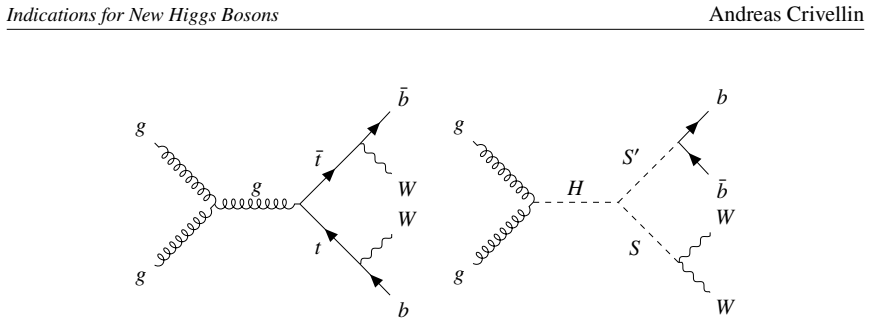
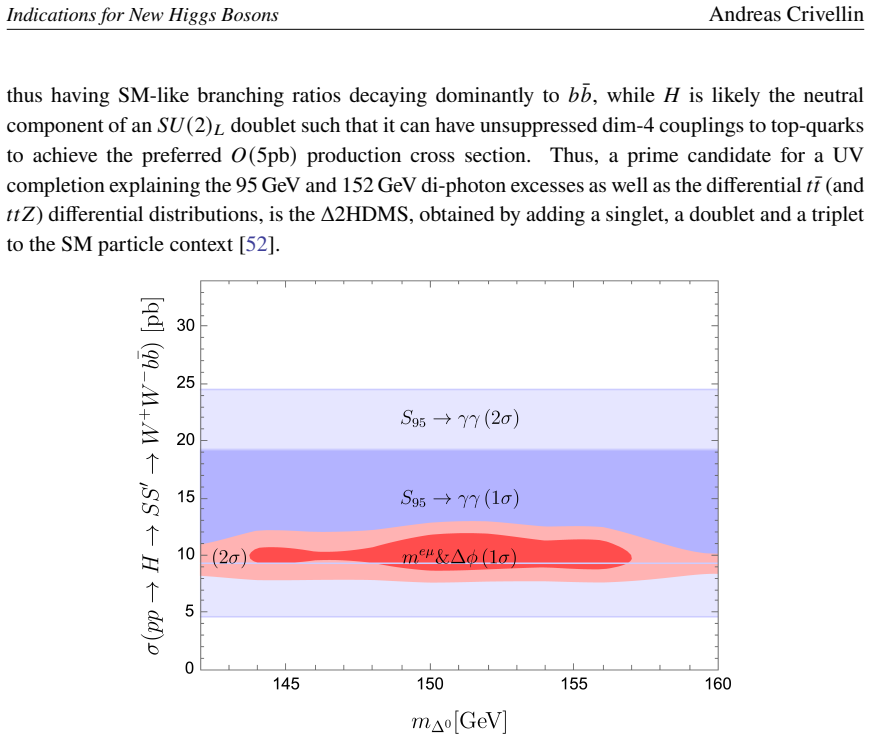
Current LHC data contains indications for new scalar bosons with masses of approximately 95 GeV and 152 GeV. The 152 GeV state is dominantly produced in association with leptons, b-jets and missing energy, consistent with Drell-Yan production of an SU(2)_L triplet scalar with hypercharge Y=0. This same particle is predicted to decay via H± to WZ after being produced in t to H± b, a channel that current measurements prefer over the Standard Model alone and that may explain tensions in top-quark distributions.
What carries the argument
An SU(2)_L triplet scalar with hypercharge Y=0, produced via Drell-Yan and decaying to WZ after arising from t to H± b.
If this is right
- The triplet model predicts t to H± b with H± to WZ, a signature that current data already favors over pure Standard Model expectations.
- This new decay mode can contaminate differential top-quark distributions and account for the observed tensions with Standard Model predictions.
- The 95 GeV candidate, whose production mechanism remains unclear, could belong to the same extended scalar sector that addresses other Standard Model shortcomings.
Where Pith is reading between the lines
- Confirmation would motivate dedicated searches for the triplet scalar in associated production with leptons and jets at higher luminosities.
- The same scalar sector could be tested by measuring the branching ratio of the 152 GeV state into other final states such as WW or ZZ.
- Reinterpretation of existing top-pair samples for the specific H± to WZ signature offers a near-term way to test the contamination hypothesis without new data.
Load-bearing premise
The observed excesses in the diphoton channel and the weaker-than-expected limits in other modes are caused by real new scalar particles rather than statistical fluctuations or background misestimation.
What would settle it
If future LHC data in the diphoton channel at 95 GeV and 152 GeV shows the excesses to be consistent with background-only expectations, or if dedicated searches for t to H± b with H± to WZ find no excess beyond Standard Model ttZ, the indications would be ruled out.
Figures


read the original abstract
After the Higgs discovery, the question of whether particles beyond those of the Standard Model exist is more pressing than ever. In this context, the scalar sector is particularly promising, since it lies at the core of the internal problems of the Standard Model, while extensions of it allow us to resolve them and can provide explanations for Dark matter, non-zero neutrino masses, inflation etc. In these proceedings, we review the indications for new Higgs bosons at the electroweak scale with masses of $\approx$95 GeV and $\approx$152 GeV. These excesses are most significant in the di-photon channel but are supported by weaker-than-expected limits in other decay modes. While for the 95 GeV candidate the production mechanism is mostly unknown, the (hypothetical) 152 GeV Higgs is dominantly produced in association with leptons, $(b)$ jets and missing energy, pointing towards the Drell-Yan production of an $SU(2)_L$ triplet with $Y=0$. Interestingly, this model predicts $t\to H^\pm b$ with $H^\pm\to WZ$, which resembles the signature of $t\bar{t}Z$ production in the Standard Model and is in fact preferred by current data. Finally, we investigate the possibility that the significant tensions between the Standard Model predictions and the measurements in differential top-quark distributions are due to contamination from new physics involving both the 152 GeV and the 95 GeV scalar.
Editorial analysis
A structured set of objections, weighed in public.
Referee Report
Summary. The manuscript reviews indications for new Higgs bosons at approximately 95 GeV and 152 GeV from existing LHC data, primarily di-photon excesses supported by weaker-than-expected limits in other channels. It proposes that the 152 GeV state is an SU(2)_L triplet scalar with Y=0 produced via Drell-Yan, and explores how this plus the 95 GeV scalar could explain tensions in top-quark differential distributions through t to H± b, H± to WZ contamination.
Significance. If substantiated, these indications would point to BSM scalar physics at the electroweak scale, with the triplet model offering concrete predictions for production and decays that could be tested at the LHC. The link to top-quark anomalies provides a potential unifying explanation. However, the significance is limited by reliance on post-hoc interpretation of published excesses without new data or rigorous statistical synthesis.
major comments (3)
- Abstract: The assertion of 'indications' for new Higgs bosons rests on di-photon excesses at 95 and 152 GeV without any reported local/global significances, p-values, or look-elsewhere corrections. This leaves the step from excess to particle indication unquantified and vulnerable to background or fluctuation interpretations.
- Section discussing the 152 GeV candidate: The SU(2)_L triplet Y=0 assignment is motivated by matching the associated production with leptons, (b) jets and missing energy, but this creates circularity because the production mode is selected to fit the same excesses used to identify the candidate, without independent cross-validation or alternative models tested.
- Section on top-quark distribution tensions: The claim that the new scalars contaminate top measurements via t to H± b with H± to WZ and are 'preferred by current data' lacks a quantitative statistical comparison (e.g., chi-squared or likelihood ratio) to the SM hypothesis or an assessment of selection biases from fitting the model to the excesses first.
minor comments (2)
- Abstract: The phrase 'weaker-than-expected limits in other decay modes' should specify the channels and cite the exact LHC analyses referenced.
- Notation: The hypercharge assignment Y=0 for the triplet could be defined more explicitly with the full quantum numbers to avoid ambiguity in the model description.
Simulated Author's Rebuttal
We thank the referee for the careful reading of our manuscript and the constructive comments provided. We address each major comment in turn below, proposing revisions where they strengthen the presentation without altering the core content of this review of existing indications.
read point-by-point responses
-
Referee: Abstract: The assertion of 'indications' for new Higgs bosons rests on di-photon excesses at 95 and 152 GeV without any reported local/global significances, p-values, or look-elsewhere corrections. This leaves the step from excess to particle indication unquantified and vulnerable to background or fluctuation interpretations.
Authors: We agree that the manuscript would benefit from explicitly referencing the significances reported in the original experimental publications. We will revise the abstract and introduction to include the local significances (approximately 3σ in the di-photon channel for the 95 GeV excess and 2–3σ for the 152 GeV candidate, as published by ATLAS and CMS) and note that global significances are not always provided in these searches due to the look-elsewhere effect. This clarifies the indicative nature of the excesses while remaining faithful to the published data. revision: yes
-
Referee: Section discussing the 152 GeV candidate: The SU(2)_L triplet Y=0 assignment is motivated by matching the associated production with leptons, (b) jets and missing energy, but this creates circularity because the production mode is selected to fit the same excesses used to identify the candidate, without independent cross-validation or alternative models tested.
Authors: The triplet assignment follows directly from the observed event topologies in the excesses, which feature associated leptons, jets, and missing energy consistent with Drell-Yan production of a neutral Y=0 triplet. This is a standard model-building approach rather than circular reasoning. To address the concern, we will add a short discussion of why singlet or doublet alternatives fit the associated production signatures less naturally, thereby providing some independent motivation and highlighting testable predictions for future data. revision: partial
-
Referee: Section on top-quark distribution tensions: The claim that the new scalars contaminate top measurements via t to H± b with H± to WZ and are 'preferred by current data' lacks a quantitative statistical comparison (e.g., chi-squared or likelihood ratio) to the SM hypothesis or an assessment of selection biases from fitting the model to the excesses first.
Authors: We acknowledge that the current phrasing is qualitative and that a dedicated statistical comparison lies beyond the scope of this proceedings paper. We will revise the relevant section to present the possible contamination as a suggestive explanation for the observed tensions, remove the claim that it is 'preferred by current data', and explicitly state that a full likelihood analysis accounting for selection biases would be required in future work. revision: yes
Circularity Check
No significant circularity; claims rest on external LHC excesses and model interpretation without self-referential reduction.
full rationale
The paper reviews reported di-photon excesses at ~95 and ~152 GeV from external LHC analyses, selects an SU(2)_L triplet model for the 152 GeV state because its Drell-Yan production signature matches the observed associated production with leptons/jets/MET, and then checks whether the model's additional t→H±b, H±→WZ decay can alleviate top-quark distribution tensions. No equations, fitted parameters, or self-citations are shown to make any 'prediction' equivalent to the input data by construction. The model choice is data-motivated but the subsequent consistency checks with top distributions constitute an independent test rather than a tautology. The derivation chain therefore remains self-contained against external benchmarks.
Axiom & Free-Parameter Ledger
free parameters (1)
- masses of the new scalars
axioms (2)
- domain assumption The Standard Model is the correct low-energy theory except for the addition of these new scalars.
- ad hoc to paper The excesses are not due to background mismodeling or statistical fluctuation.
invented entities (2)
-
SU(2)_L triplet scalar with Y=0 at 152 GeV
no independent evidence
-
95 GeV scalar
no independent evidence
Reference graph
Works this paper leans on
-
[1]
R. L. Workmanet al.[Particle Data Group], PTEP2022(2022), 083C01
2022
-
[2]
G. Aadet al.[ATLAS], Phys. Lett. B716(2012), 1-29 [arXiv:1207.7214 [hep-ex]]
work page internal anchor Pith review arXiv 2012
-
[3]
Observation of a new boson at a mass of 125 GeV with the CMS experiment at the LHC
S. Chatrchyanet al.[CMS], Phys. Lett. B716(2012), 30-61 [arXiv:1207.7235 [hep-ex]]
work page Pith review arXiv 2012
-
[4]
A. D. Sakharov, Pisma Zh. Eksp. Teor. Fiz.5(1967), 32-35
1967
-
[5]
G.Degrassi,S.DiVita,J.Elias-Miro,J.R.Espinosa,G.F.Giudice,G.IsidoriandA.Strumia, JHEP08(2012), 098 [arXiv:1205.6497 [hep-ph]]
work page Pith review arXiv 2012
-
[6]
V. A. Kuzmin, V. A. Rubakov and M. E. Shaposhnikov, Phys. Lett. B155(1985), 36
1985
-
[7]
Schechter and J
J. Schechter and J. W. F. Valle, Phys. Rev. D22(1980), 2227
1980
-
[8]
6 (2024) 294 [arXiv:2309.03870]
A. Crivellin and B. Mellado, Nature Rev. Phys.6(2024) no.5, 294-309 [arXiv:2309.03870 [hep-ph]]
-
[9]
J. M. Langford [ATLAS and CMS], PoSLHCP2020(2021), 136
2021
-
[10]
[ATLAS], ATLAS-CONF-2021-053
2021
-
[11]
Barateet al.[LEP Working Group for Higgs boson searches, ALEPH, DELPHI, L3 and OPAL], Phys
R. Barateet al.[LEP Working Group for Higgs boson searches, ALEPH, DELPHI, L3 and OPAL], Phys. Lett. B565(2003), 61-75 [arXiv:hep-ex/0306033 [hep-ex]]
-
[12]
[CMS], CMS-PAS-HIG-20-002
-
[13]
[ATLAS], ATLAS-CONF-2023-035
2023
-
[14]
Tumasyanet al.[CMS], JHEP07(2023), 073 [arXiv:2208.02717 [hep-ex]]
A. Tumasyanet al.[CMS], JHEP07(2023), 073 [arXiv:2208.02717 [hep-ex]]
-
[15]
Aadet al.[ATLAS], JHEP08(2022), 175 [arXiv:2201.08269 [hep-ex]]
G. Aadet al.[ATLAS], JHEP08(2022), 175 [arXiv:2201.08269 [hep-ex]]
-
[16]
A. Tumasyanet al.[CMS], Eur. Phys. J. C83(2023) no.7, 667 [arXiv:2206.09466 [hep-ex]]
-
[17]
G. Aadet al.[ATLAS], Phys. Rev. D108(2023), 032005 [arXiv:2207.00338 [hep-ex]]
-
[18]
G. Coloretti, A. Crivellin, S. Bhattacharya and B. Mellado, Phys. Rev. D108(2023) no.3, 035026 [arXiv:2302.07276 [hep-ph]]. 8 Indications for New Higgs BosonsAndreas Crivellin
-
[19]
S. Bhattacharya, G. Coloretti, A. Crivellin, S. E. Dahbi, Y. Fang, M. Kumar and B. Mellado, [arXiv:2306.17209 [hep-ph]]
-
[20]
O.Fischer,B.Mellado,S.Antusch,E.Bagnaschi,S.Banerjee,G.Beck,B.Belfatto,M.Bellis, Z. Berezhiani and M. Blanke,et al.Eur. Phys. J. C82(2022) no.8, 665 [arXiv:2109.06065 [hep-ph]]
-
[21]
S. von Buddenbrock, N. Chakrabarty, A. S. Cornell, D. Kar, M. Kumar, T. Mandal, B. Mel- lado, B. Mukhopadhyaya, R. G. Reed and X. Ruan, Eur. Phys. J. C76(2016) no.10, 580 [arXiv:1606.01674 [hep-ph]]
-
[22]
S. von Buddenbrock, A. S. Cornell, A. Fadol, M. Kumar, B. Mellado and X. Ruan, J. Phys. G 45(2018) no.11, 115003 [arXiv:1711.07874 [hep-ph]]
-
[23]
S. Buddenbrock, A. S. Cornell, Y. Fang, A. Fadol Mohammed, M. Kumar, B. Mellado and K. G. Tomiwa, JHEP10(2019), 157 [arXiv:1901.05300 [hep-ph]]
-
[24]
S. von Buddenbrock, R. Ruiz and B. Mellado, Phys. Lett. B811(2020), 135964 [arXiv:2009.00032 [hep-ph]]
-
[25]
A. Crivellin, Y. Fang, O. Fischer, S. Bhattacharya, M. Kumar, E. Malwa, B. Mellado, N.Rapheeha,X.RuanandQ.Sha,Phys.Rev.D108(2023)no.11,115031[arXiv:2109.02650 [hep-ph]]
-
[26]
[ATLAS], ATLAS-CONF-2020-026
2020
- [27]
-
[28]
Aadet al.[ATLAS], JHEP10(2021), 013 [arXiv:2104.13240 [hep-ex]]
G. Aadet al.[ATLAS], JHEP10(2021), 013 [arXiv:2104.13240 [hep-ex]]
- [29]
- [30]
- [31]
- [32]
-
[33]
Aadet al.[ATLAS], JHEP07(2023), 176 [arXiv:2301.10486 [hep-ex]]
G. Aadet al.[ATLAS], JHEP07(2023), 176 [arXiv:2301.10486 [hep-ex]]
-
[34]
Aadet al.[ATLAS], JHEP08(2024), 164 [arXiv:2405.20040 [hep-ex]]
G. Aadet al.[ATLAS], JHEP08(2024), 164 [arXiv:2405.20040 [hep-ex]]
-
[35]
S. Bhattacharya, B. Lieberman, M. Kumar, A. Crivellin, Y. Fang, R. Mazini and B. Mellado, [arXiv:2503.16245 [hep-ph]]
-
[36]
P. Fileviez Perez, H. H. Patel, M. J. Ramsey-Musolf and K. Wang, Phys. Rev. D79(2009), 055024 [arXiv:0811.3957 [hep-ph]]
-
[37]
S. Banik and A. Crivellin, JHEP10(2024), 203 [arXiv:2407.06267 [hep-ph]]. 9 Indications for New Higgs BosonsAndreas Crivellin
-
[38]
J. Butterworth, J. Heeck, S. H. Jeon, O. Mattelaer and R. Ruiz, Phys. Rev. D107(2023) no.7, 075020 [arXiv:2210.13496 [hep-ph]]
-
[39]
Hayrapetyanet al.[CMS], JHEP02(2025), 177 [arXiv:2410.23475 [hep-ex]]
A. Hayrapetyanet al.[CMS], JHEP02(2025), 177 [arXiv:2410.23475 [hep-ex]]
-
[40]
Aadet al.[ATLAS], JHEP07(2024), 163 [arXiv:2312.04450 [hep-ex]]
G. Aadet al.[ATLAS], JHEP07(2024), 163 [arXiv:2312.04450 [hep-ex]]
-
[41]
S.Ashanujjaman,A.Crivellin,S.P.MaharathyandB.Mellado,[arXiv:2509.07094[hep-ph]]
work page internal anchor Pith review Pith/arXiv arXiv
-
[42]
G. Aadet al.[ATLAS], Eur. Phys. J. C85(2025) no.2, 153 [arXiv:2407.10096 [hep-ex]]
-
[43]
G. Aadet al.[ATLAS], Phys. Rev. D111(2025) no.7, 072006 [arXiv:2412.17584 [hep-ex]]
-
[44]
Amorosoet al.[LHC-TeV MW Working Group], Eur
S. Amorosoet al.[LHC-TeV MW Working Group], Eur. Phys. J. C84(2024) no.5, 451 [arXiv:2308.09417 [hep-ex]]
-
[45]
Navaset al.[Particle Data Group], Phys
S. Navaset al.[Particle Data Group], Phys. Rev. D110(2024) no.3, 030001
2024
-
[46]
A. Tumasyanet al.[CMS], Phys. Rev. D108(2023) no.1, 012011 [arXiv:2207.02254 [hep- ex]]
- [47]
-
[48]
Aadet al.[ATLAS], JHEP07(2023), 141 [arXiv:2303.15340 [hep-ex]]
G. Aadet al.[ATLAS], JHEP07(2023), 141 [arXiv:2303.15340 [hep-ex]]
-
[49]
127(2021) no.6, 062001 [arXiv:2012.14267 [hep-ph]]
J.Mazzitelli,P.F.Monni,P.Nason,E.Re,M.WiesemannandG.Zanderighi,Phys.Rev.Lett. 127(2021) no.6, 062001 [arXiv:2012.14267 [hep-ph]]
- [50]
- [51]
-
[52]
G. Coloretti, A. Crivellin and B. Mellado, Phys. Rev. D110(2024) no.7, 073001 [arXiv:2312.17314 [hep-ph]]
- [53]
discussion (0)
Sign in with ORCID, Apple, or X to comment. Anyone can read and Pith papers without signing in.