Recognition: unknown
Transition from Zonal Flows to Streamer like structures and associated edge Fluctuations
Pith reviewed 2026-05-08 17:38 UTC · model grok-4.3
The pith
Increasing ion-neutral collision frequency transitions plasma turbulence from zonal-flow dominated to streamer-dominated states.
A machine-rendered reading of the paper's core claim, the machinery that carries it, and where it could break.
Core claim
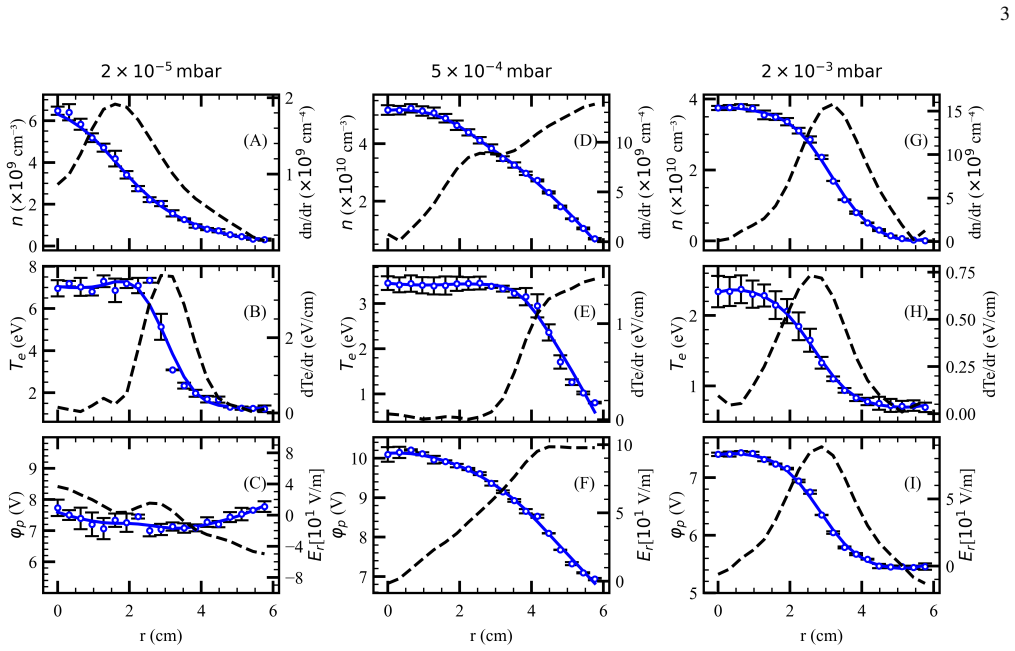
In experiments on a linear magnetized plasma column, raising the neutral gas pressure from 2 x 10^-5 mbar to 2 x 10^-3 mbar reduces collisional damping differences and drives a sequence of states: zonal-flow dominated turbulence at low pressure, a coexistence regime with streamers appearing via mediator-mediated nonlinear coupling at intermediate pressure, and streamer-dominated turbulence at high pressure where zonal flows are strongly damped. In each state the edge fluctuations shift accordingly from coherent symmetric oscillations to intermittent asymmetric ones carrying enhanced low-frequency power and larger spatial scales capable of convective transport.
What carries the argument
Ion-neutral collision frequency, which selectively damps zonal flows more than streamers and thereby controls the nonlinear coupling pathways between drift modes.
If this is right
- Zonal flows can be selectively excited or suppressed by lowering collisionality to reduce their damping.
- Streamers can be promoted by raising collisionality to damp zonal flows while allowing nonlinear drift-mode coupling.
- Edge transport can be regulated by switching between coherent symmetric fluctuations and intermittent asymmetric ones.
- The transition sequence provides a route to control the balance between zonal-flow suppression of turbulence and streamer-driven convective losses.
Where Pith is reading between the lines
- The same collision-frequency control might be tested in toroidal devices where zonal flows and streamers compete in the edge.
- If the mediator mode identified at intermediate collisionality can be externally driven, it could offer an additional knob for steering the transition.
- Mapping the exact pressure thresholds in different magnetic geometries would reveal how the control knob scales with field strength or device size.
Load-bearing premise
That ion-neutral collision frequency is the dominant isolated control parameter and that other plasma quantities remain sufficiently constant over the reported pressure range so that structural changes can be attributed to collisional damping alone.
What would settle it
An experiment that varies ion-neutral collision frequency while holding density, temperature, and magnetic field fixed and records whether the zonal-flow to streamer transition still occurs at the reported pressure thresholds.
Figures





read the original abstract
We report experimental observations of a controlled transition from a zonal-flow (ZF) dominated regime to a coexistence regime of ZFs and streamers, and finally to a streamer-dominated state in a linear magnetized plasma column. The controlling parameter is the ion-neutral collision frequency. At low collisionality (2 x 10^-5 mbar), the plasma turbulence is dominated by coherent ZFs (600-700 Hz) that are nonlinearly driven by drift-wave fluctuations. With increasing collisionality (5 x 10^-4 mbar), the ZF growth is reduced and streamers emerge through nonlinear coupling of neighboring drift modes mediated by a mediator mode. At high collisionality (2 x 10^-3 mbar), ZFs are strongly damped and the turbulence becomes streamer-dominated. For each of these turbulent states, the corresponding edge fluctuations transition from coherent, symmetric to intermittent, asymmetric fluctuations with enhanced low-frequency content and larger spatial scales that can result in convective transport. Our results demonstrate the possibility of selective excitation of ZFs and streamers by regulating their collisional damping and establish the ion-neutral collision frequency as an effective control knob for regulating turbulent structures and edge transport in magnetized plasmas.
Editorial analysis
A structured set of objections, weighed in public.
Referee Report
Summary. The manuscript reports experimental observations in a linear magnetized plasma column of a controlled transition from zonal-flow (ZF) dominated turbulence to a coexistence regime and finally to streamer-dominated turbulence as neutral pressure (and thus ion-neutral collision frequency) is increased from 2×10^{-5} mbar to 2×10^{-3} mbar. At low collisionality, coherent ZFs at 600-700 Hz are nonlinearly driven by drift waves; at intermediate collisionality, streamers emerge via nonlinear coupling of drift modes; at high collisionality, ZFs are damped and turbulence becomes streamer-dominated, with edge fluctuations shifting from coherent/symmetric to intermittent/asymmetric with enhanced low-frequency content.
Significance. If the attribution to collisional damping holds, the work demonstrates selective excitation of ZFs versus streamers via a tunable parameter and provides experimental evidence for nonlinear mode interactions in drift-wave turbulence. This offers a potential control mechanism for edge transport in magnetized plasmas and supplies data that could benchmark theoretical models of zonal flow damping and streamer formation.
major comments (1)
- [Experimental setup and results sections] The central claim that ion-neutral collision frequency is the effective and isolated control knob for the ZF-to-streamer transition (abstract and conclusion) requires that plasma density, temperature, and density gradients remain effectively constant across the reported pressure range. The manuscript states the neutral pressures but supplies no measurements, time traces, or statements confirming that these quantities were monitored and held fixed while pressure was varied; without this isolation, secondary effects cannot be ruled out as contributors to the observed regime changes.
Simulated Author's Rebuttal
We thank the referee for their careful reading of the manuscript and for highlighting this important point about parameter isolation. We address the concern directly below and will revise the manuscript accordingly to make the experimental controls more explicit.
read point-by-point responses
-
Referee: The central claim that ion-neutral collision frequency is the effective and isolated control knob for the ZF-to-streamer transition (abstract and conclusion) requires that plasma density, temperature, and density gradients remain effectively constant across the reported pressure range. The manuscript states the neutral pressures but supplies no measurements, time traces, or statements confirming that these quantities were monitored and held fixed while pressure was varied; without this isolation, secondary effects cannot be ruled out as contributors to the observed regime changes.
Authors: We agree that explicit confirmation of constant plasma parameters is necessary to isolate the role of ion-neutral collisions. In the linear plasma device, neutral pressure was varied by controlled gas injection while discharge current, magnetic field strength, and pumping speed were held fixed. Langmuir probe data acquired at each pressure setting show that the time-averaged plasma density and electron temperature changed by less than 15 % and the radial density gradient scale length remained within 10 % across the full range (2×10^{-5} to 2×10^{-3} mbar). We will add a dedicated paragraph and a supporting table (or inset in an existing figure) in the Experimental Setup section that reports these average values together with a brief statement that the primary plasma parameters were monitored and remained effectively constant. This revision will directly address the referee’s concern and strengthen the claim that collisionality is the dominant control parameter. The observed nonlinear mode couplings and the selective damping of zonal flows remain consistent with the expected dependence on ion-neutral collision frequency. revision: yes
Circularity Check
No circularity: purely experimental attribution with no derivation chain
full rationale
The manuscript reports laboratory observations of ZF-to-streamer transitions obtained by scanning neutral pressure in a linear magnetized plasma device. No equations, ansatzes, or uniqueness theorems are invoked; the central claim is an empirical correlation between measured collision frequency (inferred from pressure) and the observed change in fluctuation spectra and transport. Because the work contains no mathematical derivation that could reduce a prediction to its own inputs by construction, and because the attribution rests on direct, falsifiable measurements rather than self-citation or fitted parameters renamed as predictions, the analysis is self-contained.
Axiom & Free-Parameter Ledger
axioms (1)
- domain assumption Standard assumptions of plasma fluid theory for drift-wave turbulence and nonlinear coupling to zonal flows and streamers.
Reference graph
Works this paper leans on
-
[1]
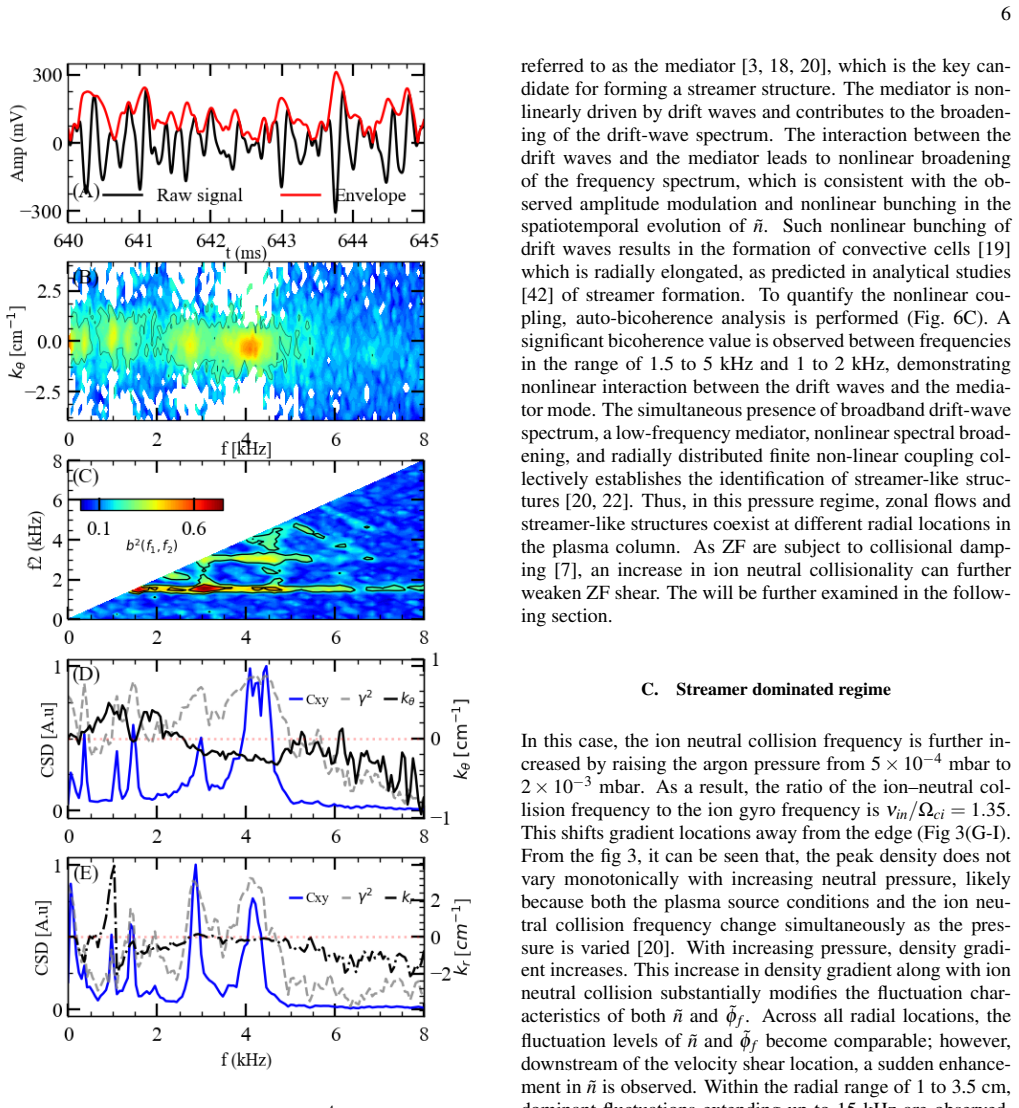
To quantify the nonlinear cou- pling, auto-bicoherence analysis is performed (Fig
of streamer formation. To quantify the nonlinear cou- pling, auto-bicoherence analysis is performed (Fig. 6C). A significant bicoherence value is observed between frequencies in the range of 1.5 to 5 kHz and 1 to 2 kHz, demonstrating nonlinear interaction between the drift waves and the media- tor mode. The simultaneous presence of broadband drift-wave sp...
-
[2]
Horton, Reviews of Modern Physics71, 735 (1999)
W. Horton, Reviews of Modern Physics71, 735 (1999)
1999
-
[3]
Holland, J
C. Holland, J. Yu, A. James, D. Nishijima, M. Shimada, N. Taheri, and G. Tynan, Physical review letters96, 195002 (2006)
2006
-
[4]
Kasuya, M
N. Kasuya, M. Yagi, K. Itoh, and S.-I. Itoh, Physics of Plasmas 15(2008)
2008
-
[5]
Fujisawa, K
A. Fujisawa, K. Itoh, H. Iguchi, K. Matsuoka, S. Okamura, A. Shimizu, T. Minami, Y . Yoshimura, K. Nagaoka, C. Taka- hashi,et al., Physical review letters93, 165002 (2004)
2004
-
[6]
Tynan, C
G. Tynan, C. Holland, J. Yu, A. James, D. Nishijima, M. Shi- mada, and N. Taheri, Plasma physics and controlled fusion48, S51 (2006)
2006
-
[7]
Terry, Reviews of Modern Physics72, 109 (2000)
P. Terry, Reviews of Modern Physics72, 109 (2000)
2000
-
[8]
Diamond, S.-I
P. Diamond, S.-I. Itoh, K. Itoh, and T. Hahm, (2004)
2004
-
[9]
Itoh, S.-I
K. Itoh, S.-I. Itoh, P. Diamond, T. Hahm, A. Fujisawa, G. Tynan, M. Yagi, and Y . Nagashima, Physics of plasmas13(2006)
2006
-
[10]
Diamond and Y .-B
P. Diamond and Y .-B. Kim, Physics of Fluids B: Plasma Physics 3, 1626 (1991)
1991
-
[11]
Kobayashi, O
S. Kobayashi, O. D. Gürcan, and P. H. Diamond, Physics of Plasmas22(2015)
2015
-
[12]
Morel, O
P. Morel, O. D. Gürcan, and V . Berionni, Plasma Physics and Controlled Fusion56, 015002 (2014)
2014
-
[13]
Diamond, A
P. Diamond, A. Hasegawa, and K. Mima, Plasma Physics and Controlled Fusion53, 124001 (2011)
2011
-
[14]
Fujisawa, Nuclear Fusion49, 013001 (2008)
A. Fujisawa, Nuclear Fusion49, 013001 (2008)
2008
-
[15]
G. R. McKee, R. J. Fonck, M. Jakubowski, K. H. Burrell, K. Hallatschek, R. A. Moyer, D. L. Rudakov, W. Nevins, G. D. Porter, P. Schoch,et al., Physics of Plasmas10, 1712 (2003)
2003
-
[16]
Sokolov, X
V . Sokolov, X. Wei, A. Sen, and K. Avinash, Plasma physics and controlled fusion48, S111 (2006)
2006
-
[17]
H. Shen, T. Lan, Z. Chen, D. Kong, H. Zhao, J. Wu, X. Sun, A. Liu, J. Xie, H. Li,et al., Physics of Plasmas23(2016)
2016
-
[18]
G. Xu, V . Naulin, W. Fundamenski, C. Hidalgo, J. Alonso, C. Silva, B. Goncalves, A. H. Nielsen, J. Juul Rasmussen, S. Krasheninnikov,et al., Nuclear Fusion49, 092002 (2009)
2009
-
[19]
Kasuya, M
N. Kasuya, M. Yagi, K. Itoh, and S.-I. Itoh, Nuclear Fusion50, 054003 (2010)
2010
-
[20]
Yamada, S.-I
T. Yamada, S.-I. Itoh, S. Inagaki, Y . Nagashima, N. Kasuya, K. Kamataki, H. Arakawa, T. Kobayashi, M. Yagi, A. Fujisawa, et al., Physical review letters105, 225002 (2010)
2010
-
[21]
Kobayashi, S
T. Kobayashi, S. Inagaki, M. Sasaki, Y . Kosuga, H. Arakawa, F. Kin, T. Yamada, Y . Nagashima, N. Kasuya, A. Fujisawa, et al., Plasma and Fusion Research12, 1401019 (2017)
2017
-
[22]
Yamada, S.-I
T. Yamada, S.-I. Itoh, T. Maruta, N. Kasuya, Y . Nagashima, S. Shinohara, K. Terasaka, M. Yagi, S. Inagaki, Y . Kawai,et al., Nature physics4, 721 (2008)
2008
-
[23]
F. Kin, A. Fujisawa, K. Itoh, Y . Kosuga, M. Sasaki, S. Ina- gaki, Y . Nagashima, T. Yamada, N. Kasuya, K. Yamasaki,et al., Physics of Plasmas26(2019)
2019
-
[24]
Hamada, T
Y . Hamada, T. Watari, A. Nishizawa, K. Narihara, Y . Kawa- sumi, T. Ido, M. Kojima, K. Toi, and J.-I. Group), Physical review letters96, 115003 (2006)
2006
-
[25]
Ghizzo, D
A. Ghizzo, D. Del Sarto, X. Garbet, and Y . Sarazin, Physics of Plasmas17(2010)
2010
-
[26]
S. Bose, P. Chattopadhyay, J. Ghosh, S. Sengupta, Y . Saxena, and R. Pal, Journal of Plasma Physics81, 345810203 (2015)
2015
-
[27]
S. Bose, M. Kaur, P. K. Chattopadhyay, J. Ghosh, and Y . C. Saxena, Review of Scientific Instruments86, 063501 (2015)
2015
-
[28]
R. Roy, T. Karmakar, L. Lachhvani, P. Chattopadhyay, A. Sen, and S. Bose, Physics of Plasmas32(2025)
2025
-
[29]
R. Roy, T. Karmakar, L. Lachhvani, B. Khodiyar, P. Chattopad- hyay, and A. Sen, Physics of Plasmas32(2025)
2025
-
[30]
Perks, S
C. Perks, S. Mordijck, T. Carter, B. Van Compernolle, S. Vin- cena, G. Rossi, and D. Schaffner, Journal of Plasma Physics 88, 905880405 (2022). 10
2022
-
[31]
Oldenbürger, S
S. Oldenbürger, S. Inagaki, T. Kobayashi, H. Arakawa, N. Ohyama, K. Kawashima, Y . Tobimatsu, A. Fujisawa, K. Itoh, and S. Itoh, Plasma Physics and Controlled Fusion54, 055002 (2012)
2012
-
[32]
Smith, E
D. Smith, E. Powers, and G. Caldwell, IEEE Transactions on Plasma Science2, 261 (2007)
2007
-
[33]
R. Roy, R. Sugandhi, M. Kumar, and P. K. Chattopadhyay, Fusion Engineering and Design193, 113849 (2023)
2023
-
[34]
Patel, R
J. Patel, R. Roy, K. Doshi, T. Karmakar, I. Mansuri, M. Bhan- darkar, K. Mahajan, and P. Chattopadhyay, Review of Scientific Instruments96(2025)
2025
-
[35]
Biglari, P
H. Biglari, P. Diamond, and P. Terry, Physics of Fluids B: Plasma Physics2, 1 (1990)
1990
-
[36]
Chakraborty Thakur, R
S. Chakraborty Thakur, R. Hong, and G. R. Tynan, Review of Scientific Instruments89(2018)
2018
-
[37]
Jassby, The Physics of Fluids15, 1590 (1972)
D. Jassby, The Physics of Fluids15, 1590 (1972)
1972
-
[38]
Schröder, O
C. Schröder, O. Grulke, T. Klinger, and V . Naulin, Physics of plasmas12(2005)
2005
-
[39]
Brochard, E
F. Brochard, E. Gravier, and G. Bonhomme, Physics of plasmas 12(2005)
2005
-
[40]
Y . C. Kim and E. J. Powers, IEEE transactions on plasma sci- ence7, 120 (2007)
2007
-
[41]
Nagashima, S.-I
Y . Nagashima, S.-I. Itoh, S. Shinohara, M. Fukao, A. Fujisawa, K. Terasaka, Y . Kawai, N. Kasuya, G. R. Tynan, P. H. Diamond, et al., Journal of the Physical Society of Japan77, 114501 (2008)
2008
-
[42]
Karmakar, R
T. Karmakar, R. Roy, L. Lachhvani, R. Daniel, B. Khodiyar, P. Chattopadhyay, and A. Sen, Nuclear Fusion (2026)
2026
-
[43]
Nozaki, T
K. Nozaki, T. Taniuti, and K. Watanabe, Journal of the Physical Society of Japan46, 991 (1979)
1979
-
[44]
B. Liu, J. Goree, T. Flanagan, A. Sen, S. K. Tiwari, G. Ganguli, and C. Crabtree, Physics of Plasmas25(2018)
2018
-
[45]
Kim and P
E.-j. Kim and P. Diamond, Physics of Plasmas9, 4530 (2002)
2002
-
[46]
F. Kin, K. Itoh, T. Bando, K. Shinohara, N. Oyama, M. Yoshida, K. Kamiya, and S. Sumida, Nuclear Fusion63, 016015 (2023)
2023
-
[47]
R. Hong, T. Rhodes, P. Diamond, Y . Ren, L. Zeng, X. Jian, K. Barada, G. Wang, and W. Peebles, Nuclear Fusion63, 104001 (2023)
2023
-
[48]
M. J. Choi, H. Jhang, J.-M. Kwon, J. Chung, M. Woo, L. Qi, S. Ko, T.-S. Hahm, H. K. Park, H.-S. Kim,et al., Nuclear Fu- sion59, 086027 (2019)
2019
-
[49]
Cheng, J
J. Cheng, J. Dong, K. Itoh, S.-I. Itoh, L. Yan, J. Xu, M. Jiang, Z. Huang, K. Zhao, Z. Shi,et al., Nuclear Fusion60, 046021 (2020)
2020
-
[50]
G. S. Xu, V . Naulin, W. Fundamenski, J. J. Rasmussen, A. H. Nielsen, and B. N. Wan, Physics of Plasmas17, 022501 (2010)
2010
discussion (0)
Sign in with ORCID, Apple, or X to comment. Anyone can read and Pith papers without signing in.