Recognition: unknown
Polyamorphism in Glassy Network Materials
Pith reviewed 2026-05-08 17:27 UTC · model grok-4.3
The pith
A simple model of network liquids, tuned to match water, shows the liquid-liquid phase transition near the glass transition proceeds via nanonucleation with tiny domains and nonclassical kinetics.
A machine-rendered reading of the paper's core claim, the machinery that carries it, and where it could break.
Core claim
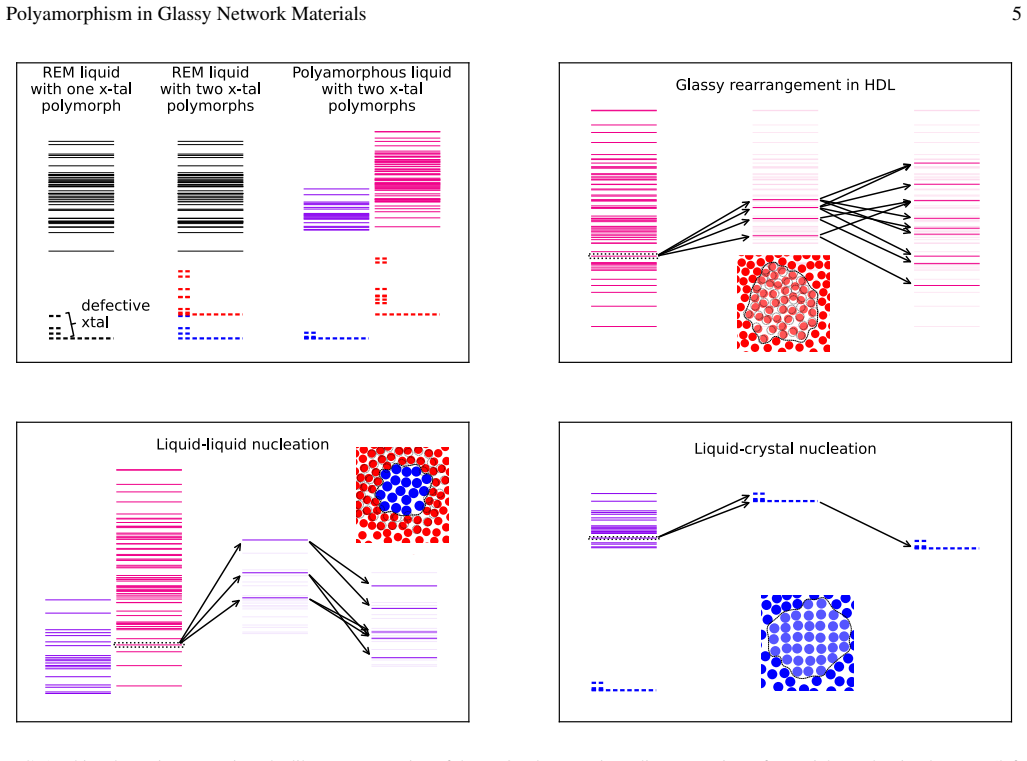
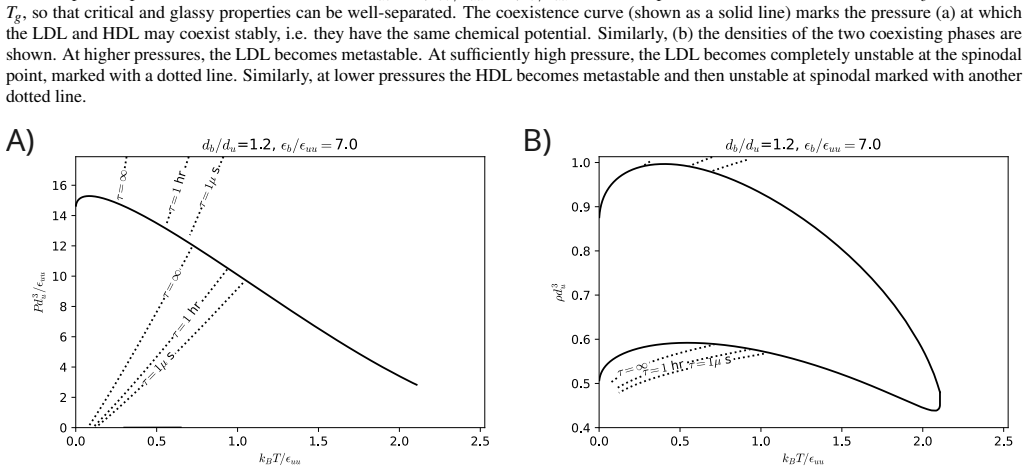
When the model parameters are tuned to produce a phase diagram resembling that of water, the liquid-liquid phase transformation near the glass transition temperature occurs via nanonucleation. This produces extremely small domain sizes and nonclassical nucleation kinetics.
What carries the argument
The microscopic potential balancing bonded and nonbonded ordering that generates the polyamorphic liquid-liquid transition, together with glass transition theory that determines how glassy dynamics modify the nucleation process.
If this is right
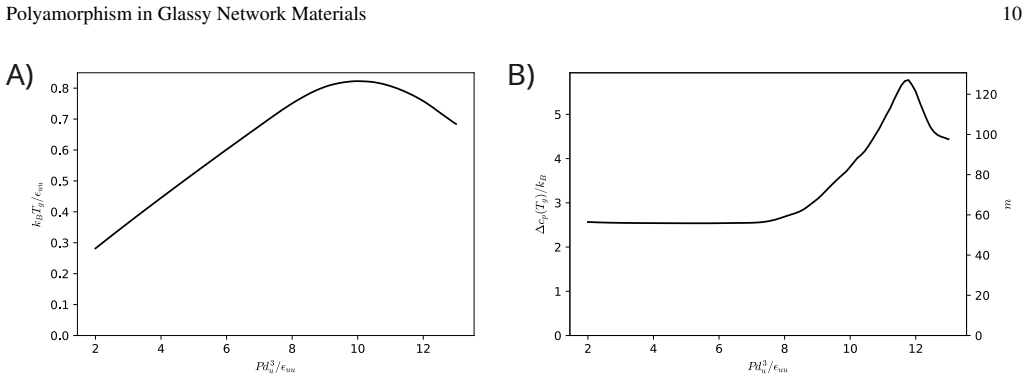
- Thermodynamic anomalies such as a density maximum correspond to anomalies in the temperature dependence of glassy relaxation rates.
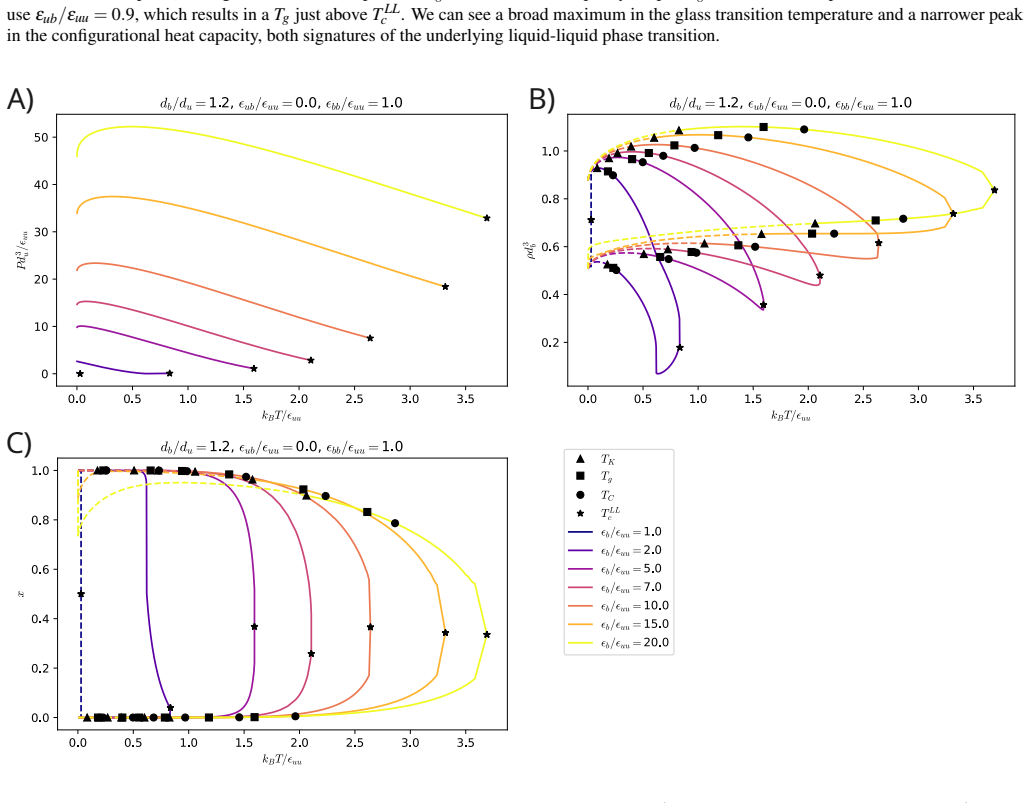
- The position of the liquid-liquid transition relative to the glass transition can be shifted by changing microscopic parameters in the potential.
- Glassy dynamics suppress classical nucleation and force the transition to occur through much smaller domains than expected without glassiness.
- Polyamorphism can be made experimentally accessible by placing the transition either well above or well below the glass transition.
Where Pith is reading between the lines
- This mechanism could account for why clear signs of a second liquid phase remain hard to detect in supercooled water.
- The same small-domain nucleation might appear in other network glasses such as silica or chalcogenides when their transitions lie near their glass temperatures.
- Varying the model parameters further could predict measurable changes in specific heat or viscosity that accompany the nanonucleation process.
Load-bearing premise
The tuned microscopic model captures the essential competition between bonded and nonbonded ordering in real network liquids and that glass transition theory applies without major changes to describe the kinetics and nucleation.
What would settle it
Direct measurement or simulation of domain sizes during the liquid-liquid transition in a network liquid held near its glass transition temperature, showing domains much larger than the nanoscale sizes predicted by the model.
Figures






read the original abstract
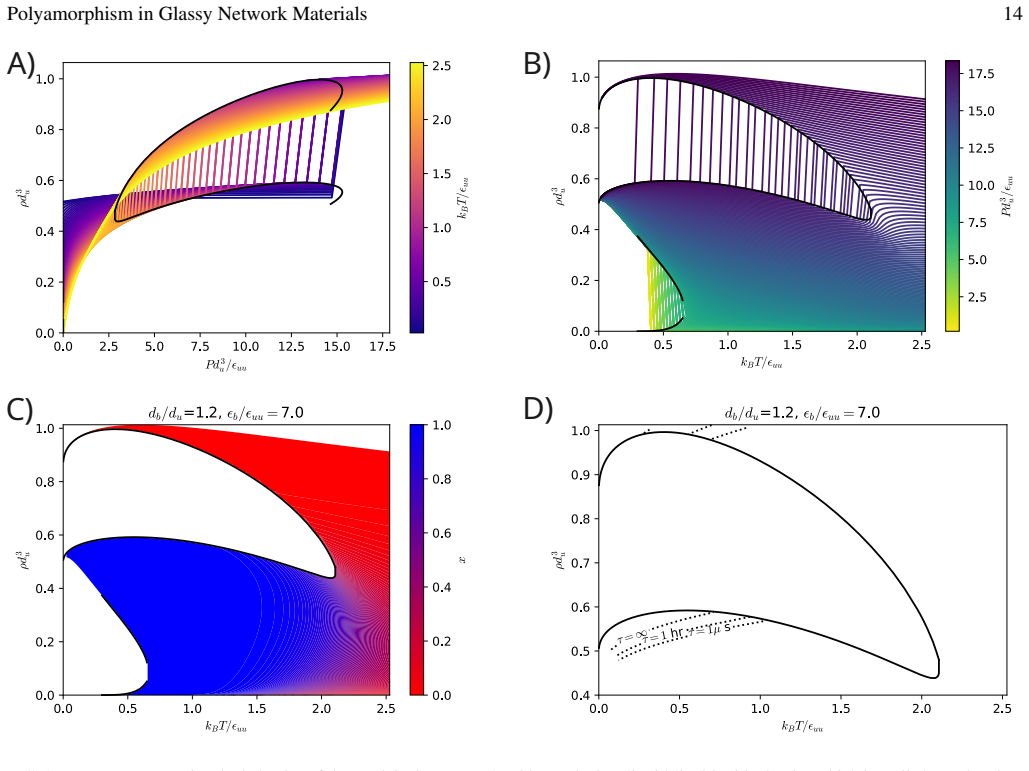
One dramatic feature of network liquids is the emergence at low temperatures and high pressures of polyamorphism, where multiple distinct liquid phases are accessed in a single material. Polyamorphism can arise from the competition between distinct local inherent structures corresponding to bonded and nonbonded ordering. Thermal bond breaking thus can lead to a phase transition often accompanied by thermodynamic anomalies away from the transition itself, such as the familiar density maximum in water at atmospheric pressure and $4^\circ$ C. Water exhibits network interactions in the form of hydrogen bonding between water molecules. The polyamorphic transition in water, however, is difficult to study due to the rapid crystallization of supercooled water and due to glassy effects at low temperatures. In the present work, we propose a simple microscopic model where the glassy and thermodynamic properties are both calculated directly from the microscopic potentials. The model contains a liquid-liquid phase transition, which, after tuning the microscopic parameters, may be located either above, near, or below the glass transition. By applying the Random First Order Transition theory of the glass transition to this simple microscopic model, we shine light on the interplay of polyamorphism and glassy properties in network liquids. We show the connection between the thermodynamic water-like anomalies and corresponding anomalies in the glassy kinetics. The analysis unveils key details on the way glassy dynamics modifies the phase transition kinetics. When the parameters of the model are tuned to produce a phase diagram resembling that of water, the liquid-liquid phase transformation near $T_g$ occurs via ``nanonucleation'', resulting in extremely small domains sizes and nonclassical nucleation kinetics which are predicted from the RFOT theory.
Editorial analysis
A structured set of objections, weighed in public.
Referee Report
Summary. The manuscript proposes a simple microscopic model for network liquids exhibiting polyamorphism from competition between bonded and nonbonded local ordering. Thermodynamic and glassy properties are stated to be calculated directly from the microscopic potentials. Model parameters are tuned so that the liquid-liquid phase transition (LLPT) lies above, near, or below the glass transition temperature Tg. Application of Random First Order Transition (RFOT) theory is used to link thermodynamic anomalies to kinetic ones and to predict that, for water-like tuning, the LLPT near Tg proceeds via nanonucleation, producing extremely small domain sizes and nonclassical nucleation kinetics.
Significance. If the central claims hold, the work would provide a useful theoretical connection between polyamorphism and glassy dynamics in network-forming materials, with implications for understanding anomalies in water and similar liquids. The direct computation from potentials and the derivation of nonclassical nucleation via RFOT are positive features. However, the parameter tuning to match a water-like diagram limits predictive power, and the assumption that standard RFOT applies without modification to the tuned model requires stronger justification to establish the claimed domain sizes and kinetics as robust predictions.
major comments (2)
- [Abstract] Abstract: The assertion that the LLPT near Tg 'occurs via nanonucleation' with 'extremely small domain sizes and nonclassical nucleation kinetics which are predicted from the RFOT theory' is obtained by inserting tuned parameters into unmodified RFOT expressions for the mosaic length scale and barrier. The text does not show that the configurational entropy drop or the surface tension term in the RFOT nucleation barrier have been recomputed from the microscopic potentials rather than assumed unchanged by the additional ordering channel.
- [Abstract] Abstract: Parameters are tuned to produce a phase diagram resembling that of water before the nanonucleation prediction is stated. This makes the location of the LLPT relative to Tg a fitted input rather than an output, so that the claimed sub-nm domains and modified kinetics depend on the chosen transition position and introduce moderate circularity in the argument.
minor comments (1)
- [Abstract] The abstract would be clearer if it briefly identified the form of the microscopic potentials (e.g., the functional form of the bonded and nonbonded interactions) rather than referring only to 'the microscopic potentials.'
Simulated Author's Rebuttal
We thank the referee for their thorough review and constructive comments. We address the major comments point by point below, providing clarifications on our calculations and agreeing to revisions that strengthen the presentation without altering the core results.
read point-by-point responses
-
Referee: The assertion that the LLPT near Tg 'occurs via nanonucleation' with 'extremely small domain sizes and nonclassical nucleation kinetics which are predicted from the RFOT theory' is obtained by inserting tuned parameters into unmodified RFOT expressions for the mosaic length scale and barrier. The text does not show that the configurational entropy drop or the surface tension term in the RFOT nucleation barrier have been recomputed from the microscopic potentials rather than assumed unchanged by the additional ordering channel.
Authors: We appreciate this observation. The configurational entropy drop is computed directly from the microscopic potentials through the model's enumeration of inherent structures and free-energy calculations, as outlined in the thermodynamic analysis sections. The surface tension term in the RFOT barrier is likewise obtained from the potential-derived mismatch penalty between bonded and nonbonded local orderings. We acknowledge that the manuscript could make these derivations more explicit in the abstract and main text to avoid any impression of unmodified insertion. In the revision we will add a concise paragraph detailing how both quantities are evaluated from the potentials for the polyamorphic case, confirming that the additional ordering channel is incorporated via the entropy term while the surface contribution remains consistent with the base RFOT framework. revision: partial
-
Referee: Parameters are tuned to produce a phase diagram resembling that of water before the nanonucleation prediction is stated. This makes the location of the LLPT relative to Tg a fitted input rather than an output, so that the claimed sub-nm domains and modified kinetics depend on the chosen transition position and introduce moderate circularity in the argument.
Authors: The tuning of microscopic parameters is an intentional capability of the model, enabling systematic exploration of LLPT positions above, near, or below Tg. For the water-like regime we select parameters that place the LLPT near Tg, after which RFOT theory yields the nanonucleation prediction as a direct consequence of the resulting mosaic length scale and barrier. This is not circular: the phase diagram is an output of the microscopic potentials, and the kinetic features follow from applying RFOT to that diagram. We agree, however, that the abstract should more clearly frame the result as a theoretical prediction for tuned network liquids rather than a universal claim. We will revise the abstract and introduction accordingly to emphasize the model's exploratory nature and the robustness of the nanonucleation outcome when the LLPT lies near Tg. revision: partial
Circularity Check
Tuned LLPT location near Tg followed by standard RFOT application yields nanonucleation as dependent outcome
specific steps
-
fitted input called prediction
[Abstract]
"When the parameters of the model are tuned to produce a phase diagram resembling that of water, the liquid-liquid phase transformation near Tg occurs via ``nanonucleation'', resulting in extremely small domains sizes and nonclassical nucleation kinetics which are predicted from the RFOT theory."
The relative position of the LLPT to Tg is fixed by parameter tuning to match water. The nanonucleation, sub-nm domains, and nonclassical kinetics are then obtained by direct substitution of those tuned parameters into standard RFOT expressions for mosaic length and barrier; the 'prediction' is therefore statistically forced by the tuning choice rather than derived anew from the microscopic potentials.
full rationale
The paper tunes microscopic model parameters to achieve a water-resembling phase diagram with the liquid-liquid phase transition (LLPT) positioned near Tg. It then applies unmodified RFOT formulas to obtain the nucleation mechanism, domain sizes, and nonclassical kinetics. This matches the 'fitted input called prediction' pattern because the claimed small domains and modified kinetics are direct consequences of the tuning choice (placing LLPT near Tg where RFOT length scales are small) rather than an independent first-principles computation of barriers or correlators from the potentials. The thermodynamic phase diagram itself is computed from the model, providing some independent content, but the headline kinetic prediction rests on the tuned location plus the assumption that RFOT applies without modification. No self-definitional equations, uniqueness theorems, or ansatz smuggling are exhibited in the provided text. Self-citation of RFOT is present but not load-bearing in a way that reduces the derivation to unverified prior claims. This yields moderate circularity (score 5) without full equivalence to inputs.
Axiom & Free-Parameter Ledger
free parameters (1)
- microscopic interaction parameters
axioms (2)
- domain assumption Random First Order Transition theory accurately describes the glassy dynamics and nucleation kinetics in the model
- domain assumption The simple model captures the essential physics of polyamorphism via competition between bonded and nonbonded ordering
invented entities (1)
-
nanonucleation
no independent evidence
Reference graph
Works this paper leans on
-
[1]
Rowlinson, J. S. and Widom, B. , month = apr, year =. Molecular
-
[2]
Physica A: Statistical Mechanics and its Applications , author =
Nucleation kinetics in phase transformations with spatially correlated nuclei , volume =. Physica A: Statistical Mechanics and its Applications , author =. 2025 , keywords =. doi:10.1016/j.physa.2025.130882 , abstract =
-
[3]
Verma, Lakshmanji and Dill, Ken A. , month = aug, year =. Statistical. Journal of Chemical Theory and Computation , publisher =. doi:10.1021/acs.jctc.5c00949 , abstract =
-
[4]
International Journal of Materials Research (formerly Zeitschrift fuer Metallkunde) , author =
Cooling conditions for the generation of bulk metallic glasses by droplet deposition , volume =. International Journal of Materials Research (formerly Zeitschrift fuer Metallkunde) , author =. 2012 , pages =. doi:10.3139/146.110802 , abstract =
-
[5]
The Journal of Chemical Physics , author =
Communication:. The Journal of Chemical Physics , author =. 2012 , pages =. doi:10.1063/1.3681292 , abstract =
-
[6]
Kirkpatrick, R James , year =. Crystal. American Mineralogist , publisher =
-
[7]
and Hernández-Rojas, Javier and Mortenson, Paul N
Middleton, Thomas F. and Hernández-Rojas, Javier and Mortenson, Paul N. and Wales, David J. , month = oct, year =. Crystals of binary. Physical Review B , publisher =. doi:10.1103/PhysRevB.64.184201 , abstract =
-
[8]
Wang, Li-Min and Velikov, V. and Angell, C. A. , month = dec, year =. Direct determination of kinetic fragility indices of glassforming liquids by differential scanning calorimetry:. The Journal of Chemical Physics , publisher =. doi:10.1063/1.1517607 , abstract =
-
[9]
The Journal of Physical Chemistry , author =
Stability-limit conjecture. The Journal of Physical Chemistry , author =. 1982 , pages =. doi:10.1021/j100395a030 , language =
-
[10]
The Journal of Chemical Physics , author =
Free. The Journal of Chemical Physics , author =. 1959 , pages =. doi:10.1063/1.1730447 , abstract =
-
[11]
Unger, Chris and Klein, W. , month = mar, year =. Nucleation theory near the classical spinodal , volume =. Physical Review B , publisher =. doi:10.1103/PhysRevB.29.2698 , abstract =
-
[12]
Ito, Kaori and Moynihan, Cornelius T. and Angell, C. Austen , month = apr, year =. Thermodynamic determination of fragility in liquids and a fragile-to-strong liquid transition in water , volume =. Nature , publisher =. doi:10.1038/19042 , abstract =
-
[13]
The Journal of Physical Chemistry , author =
Water. The Journal of Physical Chemistry , author =. 1993 , pages =. doi:10.1021/j100126a005 , language =
-
[14]
Journal of Physics: Condensed Matter , author =
Density minimum and liquid–liquid phase transition , volume =. Journal of Physics: Condensed Matter , author =. 2005 , pages =. doi:10.1088/0953-8984/17/43/L01 , abstract =
-
[15]
Velikov, V. and Borick, S. and Angell, C. A. , month = dec, year =. The. Science , publisher =. doi:10.1126/science.1061757 , abstract =
-
[16]
Proceedings of the National Academy of Sciences , author =
Direct observation of liquid–liquid phase coexistence in deeply supercooled water using an accurate polarizable multipole model , volume =. Proceedings of the National Academy of Sciences , author =. 2026 , pages =. doi:10.1073/pnas.2526573123 , abstract =
-
[17]
Novikov, V. N. and Sokolov, A. P. , month = mar, year =. Universality of the dynamic crossover in glass-forming liquids:. Physical Review E , publisher =. doi:10.1103/PhysRevE.67.031507 , abstract =
-
[18]
The Journal of Chemical Physics , author =
Liquid-liquid transition in. The Journal of Chemical Physics , author =. 2012 , pages =. doi:10.1063/1.4769126 , abstract =
-
[19]
Dimensional study of the caging order parameter at the glass transition , volume =
Charbonneau, Patrick and Ikeda, Atsushi and Parisi, Giorgio and Zamponi, Francesco , month = aug, year =. Dimensional study of the caging order parameter at the glass transition , volume =. Proceedings of the National Academy of Sciences , publisher =. doi:10.1073/pnas.1211825109 , abstract =
-
[20]
Journal of Physics: Condensed Matter , author =
A simple physical model of liquid - glass transition: intrinsic fluctuating interactions and random fields hidden in glass-forming liquids , volume =. Journal of Physics: Condensed Matter , author =. 1998 , pages =. doi:10.1088/0953-8984/10/14/001 , abstract =
-
[21]
CHAU, P.-L. and HARDWICK, A. J. , month = feb, year =. A new order parameter for tetrahedral configurations , volume =. Molecular Physics , publisher =. doi:10.1080/002689798169195 , abstract =
-
[22]
Journal of the American Ceramic Society , author =
Electron. Journal of the American Ceramic Society , author =. 1959 , note =. doi:10.1111/j.1151-2916.1959.tb13579.x , abstract =
-
[23]
Mishima, O. and Calvert, L. D. and Whalley, E. , month = aug, year =. ‘. Nature , publisher =. doi:10.1038/310393a0 , abstract =
-
[24]
Proceedings of the Royal Society of London
The crystal structure of ice at low temperatures , volume =. Proceedings of the Royal Society of London. A. Mathematical and Physical Sciences , author =. 1935 , pages =. doi:10.1098/rspa.1935.0229 , abstract =
-
[25]
McMILLAN, J. A. and Los, S. C. , month = may, year =. Vitreous. Nature , publisher =. doi:10.1038/206806a0 , language =
-
[26]
The Journal of Chemical Physics , author =
Liquid water in the domain of cubic crystalline ice. The Journal of Chemical Physics , author =. 1997 , pages =. doi:10.1063/1.474468 , abstract =
-
[27]
Journal of Applied Physics , author =
New method for vitrifying water and other liquids by rapid cooling of their aerosols , volume =. Journal of Applied Physics , author =. 1985 , pages =. doi:10.1063/1.336179 , abstract =
-
[28]
Gallo, Paola and Amann-Winkel, Katrin and Angell, Charles Austen and Anisimov, Mikhail Alexeevich and Caupin, Frédéric and Chakravarty, Charusita and Lascaris, Erik and Loerting, Thomas and Panagiotopoulos, Athanassios Zois and Russo, John and Sellberg, Jonas Alexander and Stanley, Harry Eugene and Tanaka, Hajime and Vega, Carlos and Xu, Limei and Petters...
-
[29]
and Sciortino, Francesco and Essmann, Ulrich and Stanley, H
Poole, Peter H. and Sciortino, Francesco and Essmann, Ulrich and Stanley, H. Eugene , month = nov, year =. Phase behaviour of metastable water , volume =. Nature , publisher =. doi:10.1038/360324a0 , abstract =
-
[30]
Smith, W. R. and Henderson, D. J. and Leonard, P. J. and Barker, J. A. and Grundke, E. W. , month = jan, year =. Fortran codes for the correlation functions of hard sphere fluids , volume =. Molecular Physics , publisher =. doi:10.1080/00268970701628423 , abstract =
-
[31]
The Journal of Chemical Physics , author =
Improved simulation of liquid water by molecular dynamics , volume =. The Journal of Chemical Physics , author =. 1974 , pages =. doi:10.1063/1.1681229 , abstract =
-
[32]
Grundke, E.W. and Henderson, D. , month = aug, year =. Distribution functions of multi-component fluid mixtures of hard spheres , volume =. Molecular Physics , publisher =. doi:10.1080/00268977200101431 , abstract =
-
[33]
The Journal of Chemical Physics , author =
Rate of. The Journal of Chemical Physics , author =. 1949 , pages =. doi:10.1063/1.1747055 , abstract =
-
[34]
The Journal of Chemical Physics , author =
Glass. The Journal of Chemical Physics , author =. 1967 , pages =. doi:10.1063/1.1840842 , abstract =
-
[35]
Sur le mélange des gaz , volume =. Compt. Rendus , author =. 1898 , pages =
-
[36]
The Journal of Chemical Physics , author =
Two-state thermodynamics of the. The Journal of Chemical Physics , author =. 2014 , pages =. doi:10.1063/1.4867287 , abstract =
-
[37]
The Journal of Physical Chemistry Letters , author =
Compressibility. The Journal of Physical Chemistry Letters , author =. 2017 , pages =. doi:10.1021/acs.jpclett.7b02563 , language =
-
[38]
Singularity-free interpretation of the thermodynamics of supercooled water , volume =. Physical Review E , author =. 1996 , pages =. doi:10.1103/PhysRevE.53.6144 , language =
-
[39]
Journal of Applied Physics , author =
Formation of. Journal of Applied Physics , author =. 1950 , pages =. doi:10.1063/1.1699435 , abstract =
-
[40]
The Journal of Chemical Physics , author =
Computer generation of dense polydisperse sphere packings , volume =. The Journal of Chemical Physics , author =. 2002 , pages =. doi:10.1063/1.1511510 , abstract =
-
[41]
Packing of crystalline structures of binary hard spheres:. Physical Review E , author =. doi:10.1103/PhysRevE.76.041304 , number =
-
[42]
The Journal of Chemical Physics , author =
Equation of. The Journal of Chemical Physics , author =. 1962 , pages =. doi:10.1063/1.1733163 , abstract =
-
[43]
The Journal of Chemical Physics , author =
Bonding and the dynamics of glassy network liquids , volume =. The Journal of Chemical Physics , author =. 2025 , pages =. doi:10.1063/5.0278713 , abstract =
-
[44]
Angell, C. Austen , month = jun, year =. Annual Review of Physical Chemistry , publisher =. doi:10.1146/annurev.physchem.55.091602.094156 , abstract =
-
[45]
Micoulaut, M. , month = mar, year =. Concepts and applications of rigidity in non-crystalline solids: a review on new developments and directions , volume =. Advances in Physics: X , publisher =. doi:10.1080/23746149.2016.1161498 , abstract =
-
[46]
Stillinger, Frank H. and Weber, Thomas A. , month = apr, year =. Computer simulation of local order in condensed phases of silicon , volume =. Physical Review B , publisher =. doi:10.1103/PhysRevB.31.5262 , abstract =
-
[47]
Molinero, Valeria and Moore, Emily B. , month = apr, year =. Water. The Journal of Physical Chemistry B , publisher =. doi:10.1021/jp805227c , abstract =
-
[48]
Sciortino, F. and Kob, W. and Tartaglia, P. , month = oct, year =. Inherent. Physical Review Letters , publisher =. doi:10.1103/PhysRevLett.83.3214 , abstract =
-
[49]
Journal of Physics D: Applied Physics , author =
Thermal expansion of reference materials: copper, silica and silicon , volume =. Journal of Physics D: Applied Physics , author =. 1973 , pages =. doi:10.1088/0022-3727/6/17/313 , abstract =
-
[50]
Journal of Geophysical Research: Solid Earth , author =
Lindemann. Journal of Geophysical Research: Solid Earth , author =. 1984 , note =. doi:10.1029/JB089iB09p07821 , abstract =
-
[51]
The Journal of Chemical Physics , author =
Equilibrium. The Journal of Chemical Physics , author =. 1971 , pages =. doi:10.1063/1.1675048 , abstract =
-
[52]
The Journal of Chemical Physics , author =
The equation of state of polyamorphic germania glass:. The Journal of Chemical Physics , author =. 1995 , pages =. doi:10.1063/1.469122 , abstract =
-
[53]
Physical Review Letters , author =
Direct. Physical Review Letters , author =. 2001 , pages =. doi:10.1103/PhysRevLett.87.195501 , language =
-
[54]
An apparently first-order transition between two amorphous phases of ice induced by pressure , volume =. Nature , author =. 1985 , pages =. doi:10.1038/314076a0 , language =
-
[55]
Journal of the American Ceramic Society , author =
Properties and. Journal of the American Ceramic Society , author =. 1974 , note =. doi:10.1111/j.1151-2916.1974.tb10860.x , abstract =
-
[56]
Alderman, Oliver L. G. and Hannon, Alex C. and Feller, Steve and Beanland, Richard and Holland, Diane , month = may, year =. The. The Journal of Physical Chemistry C , publisher =. doi:10.1021/acs.jpcc.6b12372 , abstract =
-
[57]
The Journal of Chemical Physics , author =
Microscopic calculation of the free energy cost for activated transport in glass-forming liquids , volume =. The Journal of Chemical Physics , author =. 2013 , pages =. doi:10.1063/1.4790399 , abstract =
-
[58]
Journal of Non-Crystalline Solids , author =
The density of alkali silicate glasses over wide compositional ranges , volume =. Journal of Non-Crystalline Solids , author =. 1998 , pages =. doi:10.1016/S0022-3093(98)00740-6 , abstract =
-
[59]
The Journal of Physical Chemistry , author =
Heat capacity of water at extremes of supercooling and superheating , volume =. The Journal of Physical Chemistry , author =. 1982 , pages =. doi:10.1021/j100395a032 , language =
-
[60]
Angell, C. A. and Kanno, H. , month = sep, year =. Density. Science , publisher =. doi:10.1126/science.193.4258.1121 , abstract =
-
[61]
General view of a liquid-liquid phase transition , volume =
Tanaka, Hajime , month = nov, year =. General view of a liquid-liquid phase transition , volume =. Physical Review E , publisher =. doi:10.1103/PhysRevE.62.6968 , abstract =
-
[62]
Brüning, R. and Levelut, C. and Faivre, A. and LeParc, R. and Simon, J.-P. and Bley, F. and Hazemann, J.-L. , month = mar, year =. Characterization of the glass transition in vitreous silica by temperature scanning small-angle. Europhysics Letters , publisher =. doi:10.1209/epl/i2004-10481-1 , abstract =
-
[63]
Illustrations of the dynamical theory of gases , author =
-
[64]
Franzese, Giancarlo and Malescio, Gianpietro and Skibinsky, Anna and Buldyrev, Sergey V. and Stanley, H. Eugene , month = feb, year =. Generic mechanism for generating a liquid–liquid phase transition , volume =. Nature , publisher =. doi:10.1038/35055514 , abstract =
-
[65]
Exact theory of dense amorphous hard spheres in high dimension
Charbonneau, Patrick and Kurchan, Jorge and Parisi, Giorgio and Urbani, Pierfrancesco and Zamponi, Francesco , month = oct, year =. Exact theory of dense amorphous hard spheres in high dimension. Journal of Statistical Mechanics: Theory and Experiment , publisher =. doi:10.1088/1742-5468/2014/10/P10009 , abstract =
-
[66]
Kurchan, Jorge and Parisi, Giorgio and Urbani, Pierfrancesco and Zamponi, Francesco , month = oct, year =. Exact. The Journal of Physical Chemistry B , publisher =. doi:10.1021/jp402235d , abstract =
-
[67]
Exact theory of dense amorphous hard spheres in high dimension
Kurchan, Jorge and Parisi, Giorgio and Zamponi, Francesco , month = oct, year =. Exact theory of dense amorphous hard spheres in high dimension. Journal of Statistical Mechanics: Theory and Experiment , publisher =. doi:10.1088/1742-5468/2012/10/P10012 , abstract =
-
[68]
Reviews of Geophysics , author =
Silicate melts:. Reviews of Geophysics , author =. 1997 , note =. doi:10.1029/96RG03263 , abstract =
-
[69]
Journal of Physics: Condensed Matter , author =
Topologically disordered systems at the glass transition , volume =. Journal of Physics: Condensed Matter , author =. 2006 , pages =. doi:10.1088/0953-8984/18/50/007 , abstract =
-
[70]
Journal of the American Ceramic Society , author =
Low-. Journal of the American Ceramic Society , author =. 1949 , note =. doi:10.1111/j.1151-2916.1949.tb18952.x , abstract =
-
[71]
Mézard, Marc and Parisi, Giorgio , month = jan, year =. Thermodynamics of. Physical Review Letters , publisher =. doi:10.1103/PhysRevLett.82.747 , abstract =
-
[72]
Lubchenko, Vassiliy and Wolynes, Peter G. , month = oct, year =. Intrinsic. Physical Review Letters , publisher =. doi:10.1103/PhysRevLett.87.195901 , abstract =
-
[73]
Goldstein, Martin , month = nov, year =. Viscous. The Journal of Chemical Physics , publisher =. doi:10.1063/1.1672587 , number =
-
[74]
Wilson, Kenneth G. , month = oct, year =. The renormalization group:. Reviews of Modern Physics , publisher =. doi:10.1103/RevModPhys.47.773 , abstract =
-
[75]
Tatsumisago, M. and Halfpap, B. L. and Green, J. L. and Lindsay, S. M. and Angell, C. A. , month = mar, year =. Fragility of. Physical Review Letters , publisher =. doi:10.1103/PhysRevLett.64.1549 , abstract =
-
[76]
Relaxation and physical aging in network glasses: a review , volume =
Micoulaut, Matthieu , month = may, year =. Relaxation and physical aging in network glasses: a review , volume =. Reports on Progress in Physics , publisher =. doi:10.1088/0034-4885/79/6/066504 , abstract =
-
[77]
Biroli, Giulio and Bouchaud, Jean-Philippe , month = aug, year =. The. doi:10.48550/arXiv.2208.05866 , abstract =
-
[78]
Journal of Statistical Mechanics: Theory and Experiment , author =
First steps of a nucleation theory in disordered systems , volume =. Journal of Statistical Mechanics: Theory and Experiment , author =. 2005 , pages =. doi:10.1088/1742-5468/2005/04/P04001 , abstract =
-
[79]
Testing theories of the glass transition with the same liquid, but many kinetic rules , url =
Gavazzoni, Cristina and Brito, Carolina and Wyart, Matthieu , month = jul, year =. Testing theories of the glass transition with the same liquid, but many kinetic rules , url =. doi:10.48550/arXiv.2308.00196 , abstract =
-
[80]
Proceedings of the National Academy of Sciences , author =
Understanding cytoskeletal avalanches using mechanical stability analysis , volume =. Proceedings of the National Academy of Sciences , author =. 2021 , pages =. doi:10.1073/pnas.2110239118 , abstract =
discussion (0)
Sign in with ORCID, Apple, or X to comment. Anyone can read and Pith papers without signing in.