Recognition: 2 theorem links
· Lean TheoremGradient Flow Structure and Quantitative Dynamics of Multi-Head Self-Attention
Pith reviewed 2026-05-11 00:52 UTC · model grok-4.3
The pith
Under suitable conditions on score matrices, multi-head self-attention admits a non-decreasing energy functional along its gradient flow dynamics.
A machine-rendered reading of the paper's core claim, the machinery that carries it, and where it could break.
Core claim
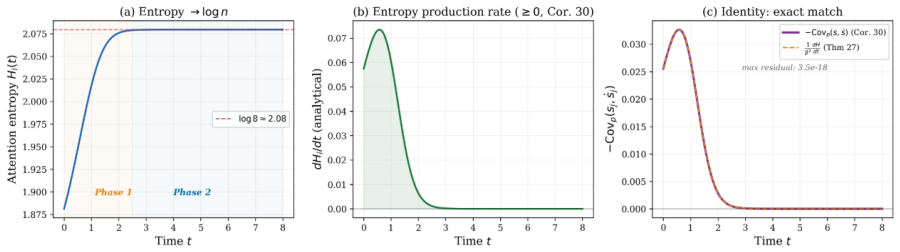
Under suitable conditions on the score matrices that eliminate radial shadow terms, the natural multi-head energy functional is non-decreasing along both flat and spherical dynamics. In the scalar-head regime with equiangular token configurations the paper derives a closed-form critical inverse temperature governing clustering, establishes super-additive clustering rates for heterogeneous heads, and proves an entropy production identity under which attention entropy increases monotonically as clustering progresses.
What carries the argument
The multi-head energy functional whose monotonicity is obstructed by radial shadow terms, which are projections of each head's output onto token directions.
If this is right
- Tokens form clusters as the multi-head energy increases toward equilibrium.
- A closed-form expression exists for the critical inverse temperature that triggers clustering in equiangular scalar-head cases.
- Heterogeneous heads produce super-additive clustering rates compared with homogeneous ones.
- Linearized ReLU attention and softmax attention display distinct clustering timescales.
- Attention entropy grows monotonically to its equilibrium value as clustering advances.
Where Pith is reading between the lines
- The monotonicity framework might be used to certify stability of new attention variants before training.
- Quantitative clustering times could help predict when transformers begin to memorize or overfit during optimization.
- The entropy production identity may connect to information-theoretic analyses of representation collapse in deeper networks.
Load-bearing premise
Suitable conditions on the score matrices exist that remove radial shadow terms and allow the energy functional to be non-decreasing.
What would settle it
A concrete simulation or calculation in which the multi-head energy decreases along the dynamics despite the score matrices satisfying the paper's sufficient conditions for monotonicity.
Figures



read the original abstract
Transformer self-attention can be interpreted as a gradient flow on the unit sphere, in which tokens evolve under softmax interaction potentials and tend to form clusters. While prior work has established clustering behavior for single-head attention, the multi-head setting remains less understood due to geometric interference between heads, which invalidates standard monotonicity arguments. In this work, we develop a theoretical framework for multi-head self-attention dynamics and resolve several open questions. We show that, under suitable conditions on the score matrices, a natural multi-head energy functional is non-decreasing along both flat and spherical dynamics. We identify the key obstruction to per-head monotonicity as radial shadow terms, which are projections of each head's output onto token directions, persisting even under orthogonality assumptions. We introduce a sufficient condition ensuring monotonicity and establish robustness to approximate orthogonality. In a simplified scalar-head regime with equiangular token configurations, we derive a closed-form expression for the critical inverse temperature governing clustering behavior, and show that heterogeneous heads exhibit super-additive clustering rates. In this regime, we also prove a separation in clustering time between ReLU and softmax attention in the linearized dynamics. Finally, we establish an entropy production identity and show that attention entropy increases monotonically toward equilibrium as clustering progresses. Our results provide a unified perspective on the dynamics of multi-head attention and clarify the mechanisms underlying clustering and stability in transformer models.
Editorial analysis
A structured set of objections, weighed in public.
Referee Report
Summary. The paper develops a theoretical framework for multi-head self-attention in transformers, viewing token evolution as gradient flow on the unit sphere under softmax potentials. It claims that under suitable conditions on the score matrices, a natural multi-head energy functional is non-decreasing along both flat and spherical dynamics; identifies radial shadow terms (projections of head outputs onto token directions) as the obstruction to per-head monotonicity; supplies a sufficient condition for monotonicity together with robustness under approximate orthogonality. In a simplified scalar-head regime restricted to equiangular token configurations, it derives a closed-form critical inverse temperature governing clustering, shows super-additive clustering rates for heterogeneous heads, establishes a separation in clustering time between ReLU and softmax in the linearized dynamics, and proves an entropy production identity under which attention entropy increases monotonically toward equilibrium.
Significance. If the central claims hold, the work supplies a unified geometric perspective on multi-head attention that resolves interference issues left open by single-head analyses. The closed-form critical temperature, super-additivity result, and entropy production identity constitute concrete quantitative strengths that yield falsifiable predictions on clustering rates and stability; these are load-bearing contributions that could guide both theoretical understanding and practical transformer design. The conditional character of the monotonicity theorem, however, restricts immediate generality.
major comments (2)
- [Abstract] Abstract and the section introducing the multi-head energy: the non-decreasing property is asserted only under 'suitable conditions' on the score matrices that cancel radial shadow terms. The manuscript supplies a sufficient condition and proves robustness to approximate orthogonality, yet provides no verification that typical learned or random score matrices satisfy the condition, nor that the flow itself preserves it. This renders the central monotonicity claim conditional and limits its resolution of the geometric interference problem for generic multi-head attention.
- [Simplified scalar-head regime] The simplified scalar-head regime with equiangular token configurations: the closed-form critical inverse temperature and the separation between ReLU and softmax clustering times are derived under this restrictive assumption. The paper does not address stability of these expressions under perturbations away from equiangularity or under the full multi-head dynamics, weakening the quantitative claims.
minor comments (1)
- Notation for the score matrices and radial shadow projections could be introduced with an explicit equation or diagram in the early sections to improve readability for readers unfamiliar with the geometric setup.
Simulated Author's Rebuttal
We thank the referee for the careful reading and constructive feedback on our manuscript. The comments correctly identify the conditional nature of the monotonicity result and the scope of the simplified regime. We address each major comment point by point below, indicating where revisions will be made to improve clarity and transparency without altering the core contributions.
read point-by-point responses
-
Referee: [Abstract] Abstract and the section introducing the multi-head energy: the non-decreasing property is asserted only under 'suitable conditions' on the score matrices that cancel radial shadow terms. The manuscript supplies a sufficient condition and proves robustness to approximate orthogonality, yet provides no verification that typical learned or random score matrices satisfy the condition, nor that the flow itself preserves it. This renders the central monotonicity claim conditional and limits its resolution of the geometric interference problem for generic multi-head attention.
Authors: We agree that the non-decreasing property of the multi-head energy is established under a sufficient condition on the score matrices that cancels the radial shadow terms, as explicitly stated in the abstract and the relevant theorem. The manuscript derives this condition, identifies the radial shadows as the obstruction, and proves robustness under approximate orthogonality. However, we did not verify whether typical learned or random score matrices satisfy the condition, nor prove that the dynamics preserve it. In the revised version, we will add a dedicated remark in the discussion section clarifying that the result is conditional on this sufficient condition, noting the open question of its prevalence in practice, and suggesting that post-training checks could be performed. This preserves the framework's value in resolving interference when the condition holds while being fully transparent about its scope. revision: partial
-
Referee: [Simplified scalar-head regime] The simplified scalar-head regime with equiangular token configurations: the closed-form critical inverse temperature and the separation between ReLU and softmax clustering times are derived under this restrictive assumption. The paper does not address stability of these expressions under perturbations away from equiangularity or under the full multi-head dynamics, weakening the quantitative claims.
Authors: The closed-form critical inverse temperature, the ReLU-softmax separation in clustering times, super-additivity for heterogeneous heads, and the entropy production identity are all derived specifically within the simplified scalar-head regime under equiangular token configurations. This assumption enables exact solvability and yields concrete quantitative predictions. The general multi-head energy framework and monotonicity results are developed separately and do not rely on equiangularity. We acknowledge that we have not analyzed the stability of these expressions under perturbations away from equiangularity or their extension to the full multi-head dynamics. In the revision, we will insert a paragraph in the simplified-regime section explicitly stating the restrictive nature of the assumption, its role in obtaining closed forms, and that the results serve as exact benchmarks for this case, with stability under perturbations left for future work. revision: partial
Circularity Check
No significant circularity; derivations are conditional on explicit assumptions without reduction to inputs
full rationale
The paper establishes non-decreasing multi-head energy along gradient flows by introducing a sufficient condition on score matrices that cancels radial shadow terms, then proves the result directly from the energy functional and dynamics equations. In the scalar-head regime it derives a closed-form critical inverse temperature from the linearized system under equiangular configurations. These steps are self-contained mathematical arguments from the stated gradient-flow structure and do not rely on self-definitional loops, fitted parameters renamed as predictions, or load-bearing self-citations. The assumptions are declared up front and the claims are explicitly conditional, which is standard non-circular practice.
Axiom & Free-Parameter Ledger
axioms (2)
- domain assumption Self-attention tokens evolve under softmax interaction potentials on the unit sphere
- standard math Gradient flows admit monotonicity arguments when energy functionals are non-decreasing
Lean theorems connected to this paper
-
IndisputableMonolith/Constants.leanphi_golden_ratio echoesFor H=2, the threshold is c*(2)=(√5−1)/2=1/φ, the reciprocal of the golden ratio. ... β*=1/(2α) ln [c*(H)²(n−1)/(1−c*(H)²)] (Theorem 19)
-
IndisputableMonolith/Cost/FunctionalEquation.leanwashburn_uniqueness_aczel echoesdE_multi/dt = (1/n) Σ_i ∥ẋ_i∥² ≥ 0 (Theorem 11); per-head monotonicity under Radial Dominance (Theorem 17)
Reference graph
Works this paper leans on
-
[1]
Ambrosio, N
L. Ambrosio, N. Gigli, and G. Savaré.Gradient Flows in Metric Spaces and in the Space of Probability Measures. Birkhäuser, 2005
2005
-
[2]
J. L. Ba, J. R. Kiros, and G. E. Hinton. Layer normalization. arXiv:1607.06450, 2016
work page internal anchor Pith review Pith/arXiv arXiv 2016
-
[3]
Bruno, F
G. Bruno, F. Pasqualotto, and A. Agazzi. Emergence of meta-stable clustering in mean-field transformers. InICLR, 2025
2025
-
[4]
S. Chen, Z. Lin, Y. Polyanskiy, and P. Rigollet. Quantitative clustering in mean-field transformer models. arXiv:2504.14697, 2025. 19
work page internal anchor Pith review arXiv 2025
-
[5]
S. Chen, Z. Lin, Y. Polyanskiy, and P. Rigollet. Critical attention scaling in long-context transformers. InICLR, 2026
2026
-
[6]
Z. Chen, Y. Polyanskiy, and P. Rigollet. Clustering with Wasserstein–Fisher–Rao gradient flows. InNeurIPS Workshop, 2025
2025
-
[7]
C. Criscitiello, Q. Rebjock, A. D. McRae, and N. Boumal. Synchronization on circles and spheres with nonlinear interactions. arXiv:2405.18273, 2024
-
[8]
Dynamic metastability in the self-attention model.arXiv preprint arXiv:2410.06833, 2024
B. Geshkovski, H. Koubbi, Y. Polyanskiy, and P. Rigollet. Dynamic metastability in the self-attention model. arXiv:2410.06833, 2024
-
[9]
B. Geshkovski, C. Letrouit, Y. Polyanskiy, and P. Rigollet. The emergence of clusters in self-attention dynamics. InNeurIPS, 2023. arXiv:2305.05465
-
[10]
A mathematical perspective on transformers.arXiv preprint arXiv:2312.10794, 2023
B. Geshkovski, C. Letrouit, Y. Polyanskiy, and P. Rigollet. A mathematical perspective on transformers.Bulletin of the American Mathematical Society, 62(3):427–479, 2025. arXiv:2312.10794
- [11]
-
[12]
Karagodin, S
N. Karagodin, S. Ge, Y. Polyanskiy, and P. Rigollet. Normalization in attention dynamics. InNeurIPS, 2025
2025
-
[13]
Karagodin, Y
N. Karagodin, Y. Polyanskiy, and P. Rigollet. Clustering in causal attention masking. In NeurIPS, 2024
2024
-
[14]
Kuramoto
Y. Kuramoto. Self-entrainment of a population of coupled non-linear oscillators. InInter- national Symposium on Mathematical Problems in Theoretical Physics, 1975
1975
-
[15]
Synchronization of mean-field models on the circle.arXiv preprint arXiv:2507.22857, 2025
Y. Polyanskiy, P. Rigollet, and A. Yao. Synchronization of mean-field models on the circle. arXiv:2507.22857, 2025
-
[16]
The Mean-Field Dynamics of Transformers.arXiv preprint arXiv:2512.01868, 2025
P. Rigollet. The mean-field dynamics of transformers. arXiv:2512.01868, 2025
- [17]
-
[18]
Tomihari and R
A. Tomihari and R. Karakida. Recurrent self-attention dynamics: An energy-agnostic perspective from Jacobians. InNeurIPS, 2025
2025
-
[19]
Vaswani, N
A. Vaswani, N. Shazeer, N. Parmar, J. Uszkoreit, L. Jones, A. N. Gomez, Ł. Kaiser, and I. Polosukhin. Attention is all you need. InNeurIPS, 2017
2017
-
[20]
Replacing soft- max with ReLU in Vision Transformers,
M. Wortsman, J. Lee, J. Gilmer, and S. Kornblith. Replacing softmax with ReLU in vision transformers. arXiv:2309.08586, 2023
-
[21]
S. Zhai, T. Likhomanenko, E. Littwin, D. Busbridge, J. Ramapuram, Y. Zhang, J. Gu, and J. M. Susskind. Stabilizing transformer training by preventing attention entropy collapse. InICML, 2023. 20
2023
discussion (0)
Sign in with ORCID, Apple, or X to comment. Anyone can read and Pith papers without signing in.