Recognition: unknown
Nuclear Charge Radii of Sr Isotopes: Reevaluation based on Transition Frequency Measurements in the 5s-5p-4d manifold in Sr^+
Pith reviewed 2026-05-08 17:13 UTC · model grok-4.3
The pith
Nuclear charge radii of Sr isotopes above N=50 depend strongly on the extraction method used.
A machine-rendered reading of the paper's core claim, the machinery that carries it, and where it could break.
Core claim
High-precision quasi-simultaneous collinear and anticollinear laser spectroscopy on the 5s-5p and 4d-5p transitions in naturally abundant Sr+ isotopes yields absolute frequencies accurate to 600 kHz and isotope shifts to 200 kHz. A King-plot analysis of the data from all stable isotopes gives a field-shift ratio F_D2/F_D1 = 1.004(5) that lies inside the theoretically allowed range. When the same isotope-shift data are processed with different standard techniques—purely experimental King plots versus state-of-the-art ab initio calculations—the extracted nuclear charge radii in the region above N=50 change by amounts larger than the quoted uncertainties.
What carries the argument
King-plot analysis applied to measured isotope shifts from multiple transitions in the 5s-5p-4d manifold, used to separate field-shift and mass-shift contributions and thereby determine nuclear charge radii.
Load-bearing premise
The compared techniques for separating field and mass shifts have no significant unaccounted systematic effects.
What would settle it
An independent measurement of the charge-radius difference between 88Sr and 90Sr, for example from muonic-atom X-ray spectroscopy or elastic electron scattering, that matches the radii from one method but deviates from the other by more than the reported uncertainties.
Figures
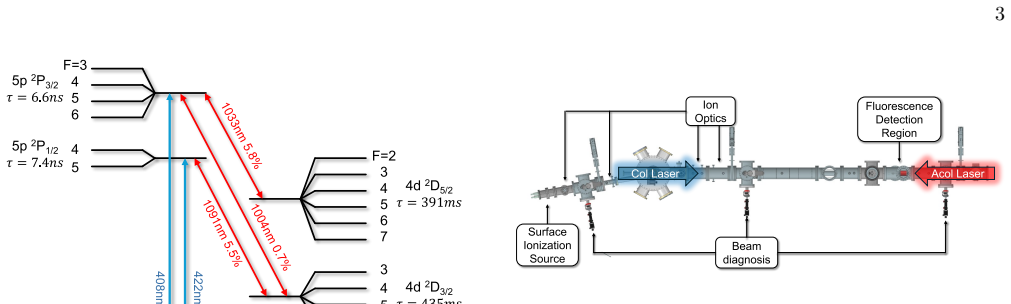


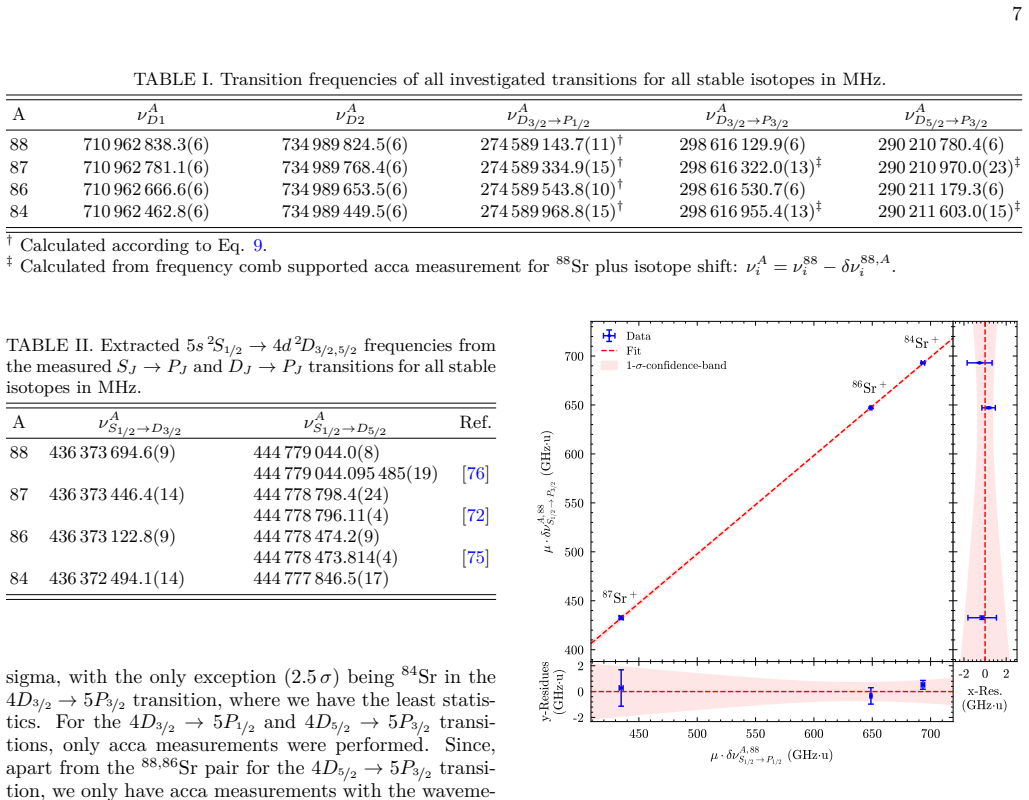
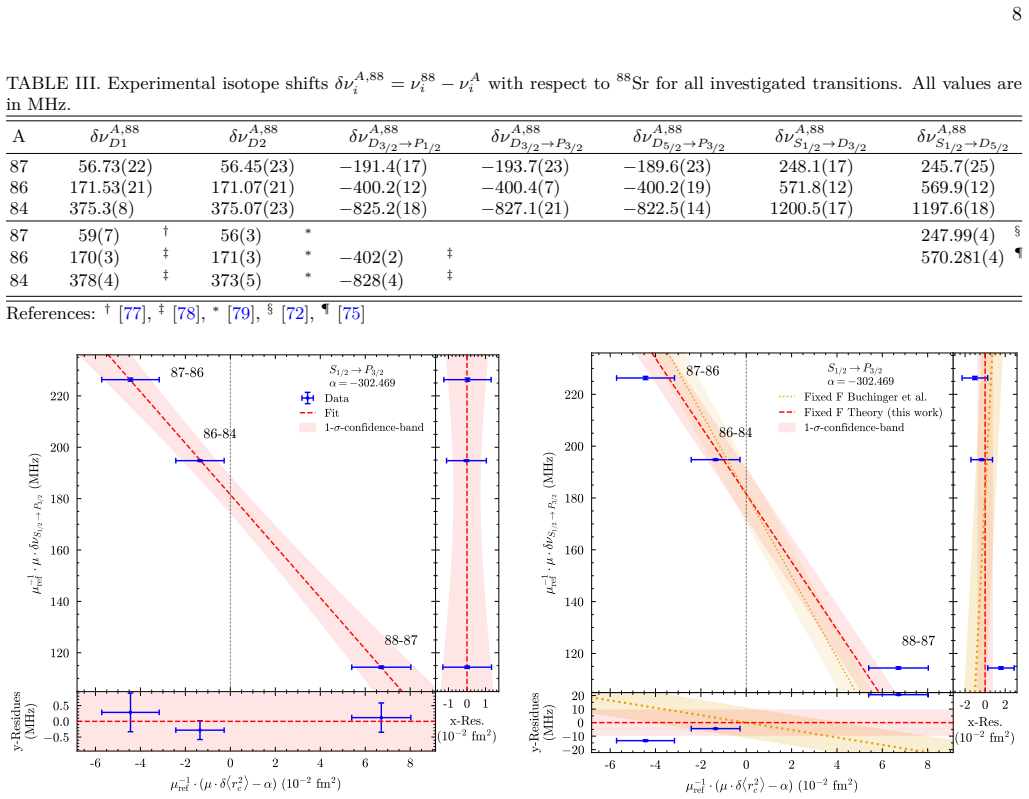

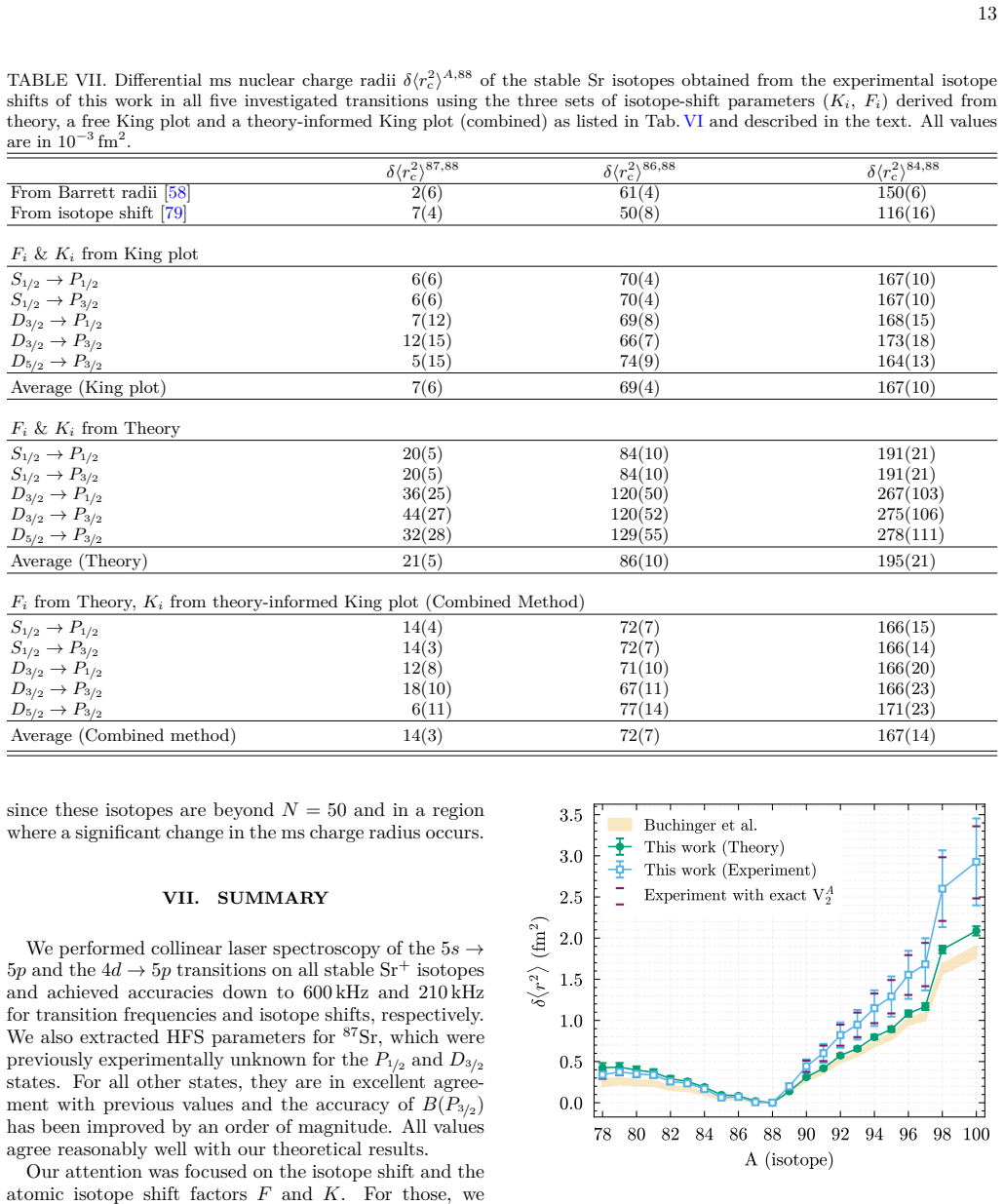


read the original abstract
High-precision quasi-simultaneous collinear/anticollinear laser spectroscopy was performed to measure the $5s$ $^2S_{1/2}\rightarrow 5p$ $^2P_{1/2}$ (D1), the $5s$ $^2S_{1/2}\rightarrow 5p$ $^2P_{3/2}$ (D2), and the three $4d\rightarrow 5p$ transitions in naturally abundant Sr$^+$ isotopes. For absolute transition frequencies, an accuracy of up to 600 kHz was achieved, while common-mode rejection allowed us to extract isotope shifts with uncertainties down to a level of 200 kHz, one order of magnitude better than previously achieved. The uncertainties of the hyperfine-structure coefficients for $^{87}$Sr of the $5p$ states and the $4d$ $^2D_{3/2}$ levels are also improved. A King plot analysis yielded a field-shift ratio of the D2 and D1 lines of $F_\text{D2}/F_\text{D1}=1.004(5)$, which lies within the theoretically allowed region and can be used as a benchmark for atomic structure theory calculations. We use the information from all stable isotopes in the investigated transitions to compare field-shift and mass-shift constants obtained by various techniques regularly used in the literature, ranging from King-plots with purely experimental input to ab initio atomic structure calculations by state-of-the-art theory. We show that in the region above $N=50$, the charge radii are strongly dependent on the approach being used.
Editorial analysis
A structured set of objections, weighed in public.
Referee Report
Summary. The manuscript reports high-precision collinear/anticollinear laser spectroscopy measurements of the D1, D2, and 4d-5p transitions in naturally abundant Sr+ isotopes, achieving absolute transition frequencies accurate to 600 kHz and isotope shifts to 200 kHz. It improves hyperfine coefficients for 87Sr, presents a King-plot analysis yielding F_D2/F_D1 = 1.004(5), and compares field- and mass-shift constants extracted via purely experimental King plots versus ab initio atomic calculations, concluding that derived nuclear charge radii for isotopes with N > 50 depend strongly on the chosen approach.
Significance. If the reported method dependence holds after accounting for possible systematics, the work supplies improved experimental benchmarks for atomic theory in the Sr+ system and demonstrates that nuclear charge radius extractions in the N > 50 region can vary substantially depending on how field and mass shifts are separated, with implications for nuclear structure studies near the N=50 shell closure.
major comments (2)
- [King plot analysis and method comparison (abstract and associated results section)] The central claim that charge radii above N=50 are strongly method-dependent rests on the accuracy of field- and mass-shift separation to better than the 200 kHz isotope-shift precision. With only four stable isotopes (including odd 87Sr) available for the King-plot fits, the linearity assumption has limited statistical leverage to detect or exclude higher-order effects or nuclear-structure-dependent corrections that may differ between even and odd isotopes; any residual bias would propagate directly into the constants used for the N>50 reevaluation. This issue is load-bearing for the comparison between experimental King plots and ab initio methods.
- [Experimental results and data analysis sections] The manuscript reports achieved accuracies (600 kHz absolute, 200 kHz shifts) and improved hyperfine coefficients but does not provide full data tables, complete error budgets, or explicit checks for post-hoc selections in the method comparison. Without these, independent verification of whether the observed dependence exceeds plausible unaccounted systematics is not possible from the presented material.
minor comments (2)
- [King plot analysis] Notation for the field-shift ratio F_D2/F_D1 should be defined explicitly at first use with reference to the underlying King-plot equation.
- [Abstract and discussion] The abstract states that the ratio 'lies within the theoretically allowed region' but does not cite the specific theoretical bounds or calculations used for this statement.
Simulated Author's Rebuttal
We thank the referee for the careful reading and constructive comments on our manuscript. We address each major comment point-by-point below, providing clarifications and indicating where revisions will be made to improve the presentation and verifiability of our results.
read point-by-point responses
-
Referee: [King plot analysis and method comparison (abstract and associated results section)] The central claim that charge radii above N=50 are strongly method-dependent rests on the accuracy of field- and mass-shift separation to better than the 200 kHz isotope-shift precision. With only four stable isotopes (including odd 87Sr) available for the King-plot fits, the linearity assumption has limited statistical leverage to detect or exclude higher-order effects or nuclear-structure-dependent corrections that may differ between even and odd isotopes; any residual bias would propagate directly into the constants used for the N>50 reevaluation. This issue is load-bearing for the comparison between experimental King plots and ab initio methods.
Authors: We acknowledge that the limited number of stable Sr isotopes inherently restricts the statistical power of the King-plot analysis. However, the measured isotope shifts for the four isotopes (84,86,87,88Sr) exhibit excellent linearity across all transitions, with Pearson correlation coefficients >0.9999 and reduced chi-squared values consistent with unity (we will add these fit statistics explicitly in the revised results section). The inclusion of the odd isotope 87Sr, with its hyperfine structure fully resolved and accounted for in the shift extraction, does not introduce detectable deviations from the even-isotope trend within our 200 kHz precision. While we agree that additional (unstable) isotopes would allow stronger tests for higher-order or nuclear-structure-dependent corrections, the observed differences in extracted charge radii for N>50 between King-plot and ab initio approaches exceed the propagated uncertainties from our fits. We will expand the discussion to explicitly address the leverage limitations and their implications for the method dependence. revision: partial
-
Referee: [Experimental results and data analysis sections] The manuscript reports achieved accuracies (600 kHz absolute, 200 kHz shifts) and improved hyperfine coefficients but does not provide full data tables, complete error budgets, or explicit checks for post-hoc selections in the method comparison. Without these, independent verification of whether the observed dependence exceeds plausible unaccounted systematics is not possible from the presented material.
Authors: We agree that the original manuscript would benefit from greater transparency in the data and analysis. In the revised version, we will add full tables of all measured absolute transition frequencies and isotope shifts (including individual run data where relevant), a complete error budget separating statistical and systematic contributions (e.g., frequency calibration, residual Doppler effects, magnetic field inhomogeneities), and explicit checks such as King-plot linearity tests with/without 87Sr and sensitivity analyses excluding individual data points. These additions will allow readers to verify that the reported method dependence in the N>50 charge radii is not attributable to unaccounted systematics or post-hoc selections. revision: yes
Circularity Check
No significant circularity; derivation uses independent measurements and external benchmarks
full rationale
The paper's core chain begins with new experimental transition frequencies and isotope shifts measured to 200 kHz precision on the stable Sr+ isotopes. These data are fed directly into a King-plot analysis to extract the field-shift ratio F_D2/F_D1 = 1.004(5) and to compare field- and mass-shift constants obtained via purely experimental King plots versus ab initio atomic calculations. The claimed strong dependence of charge radii above N=50 on the chosen extraction method follows from applying those independently derived constants to the same set of measured isotope shifts; no step equates a derived quantity to its own input by construction, renames a fit as a prediction, or relies on a load-bearing self-citation whose validity is presupposed. The ab initio constants are treated as an external theoretical benchmark rather than a self-referential ansatz, and the experimental input remains the sole source of the observed discrepancy.
Axiom & Free-Parameter Ledger
axioms (2)
- domain assumption King-plot analysis accurately separates field-shift and mass-shift contributions using linear relations between isotope shifts of different transitions
- domain assumption Ab initio atomic structure calculations provide reliable field-shift and mass-shift constants independent of the experimental data
Reference graph
Works this paper leans on
-
[1]
[79] Exp. Theo. 78 893(12) 0 .24(4) 0.33(4) 0.43(6) 79 865(10) 0 .26(4) 0.37(4) 0.43(5) 80 782(11) 0 .24(3) 0.35(3) 0.40(4) 81 710(9) 0 .23(3) 0.33(3) 0.37(4) 82 574(10) 0 .18(2) 0.25(2) 0.29(3) 83 495(6) 0 .16(2) 0.232(19) 0 .26(3) 83m 456(7) 0 .13(2) 0.193(19) 0 .23(3) 84 373(5) 0 .116(16) 0 .165(15) 0 .19(2) 85 216(5) 0 .048(12) 0 .062(15) 0 .094(16) 8...
2023
-
[2]
E. U. Condon and G. H. Shortley, The theory of atomic spectra (Cambridge University Press, Cambridge, 1935)
1935
-
[3]
Campbell, I
P. Campbell, I. D. Moore, and M. R. Pearson, Laser spectroscopy for nuclear structure physics, Prog. Part. Nucl. Phys. 86, 127 (2016)
2016
-
[4]
X. F. Yang, S. J. Wang, S. G. Wilkins, and R. F. Garcia Ruiz, Laser spectroscopy for the study of exotic nuclei, Prog. Part. Nucl. Phys. 129, 104005 (2023)
2023
-
[5]
Ewald, W
G. Ewald, W. Nörtershäuser, A. Dax, S. Götte, R. Kirchner, H.-J. Kluge, T. Kühl, R. Sanchez, A. Wo- jtaszek, B. A. Bushaw, G. W. F. Drake, Z.-C. Yan, and C. Zimmermann, Nuclear charge radii of 8,9Li de- termined by laser spectroscopy, Phys. Rev. Lett. 93, 113002 (2004)
2004
-
[6]
Sánchez, W
R. Sánchez, W. Nörtershäuser, G. Ewald, D. Albers, J. Behr, P. Bricault, B. A. Bushaw, A. Dax, J. Dilling, M. Dombsky, G. W. F. Drake, S. Götte, R. Kirchner, H.-J. Kluge, T. Kühl, J. Lassen, C. D. P. Levy, M. R. Pearson, E. J. Prime, V. Ryjkov, A. Wojtaszek, Z.- C. Yan, and C. Zimmermann, Nuclear charge radii of 9,11Li: The influence of halo neutrons, Phy...
2006
-
[7]
Huber, F
G. Huber, F. Touchard, S. Büttgenbach, C. Thibault, R. Klapisch, H. T. Duong, S. Liberman, J. Pinard, J. L. Vialle, P. Juncar, and P. Jacquinot, Spins, mag- netic moments, and isotope shifts of 21–31Na by high- 15 resolution laser spectroscopy of the atomic D1 line, Phys. Rev. C 18, 2342 (1978)
1978
-
[8]
J. Bonn, W. Klempt, R. Neugart, E. W. Otten, and B. Schinzler, Hyperfine structure and isotope shifts of neutron-rich 138–142Cs, Z. Phys. A 289, 227 (1979)
1979
-
[9]
Kreim, M
K. Kreim, M. L. Bissell, J. Papuga, K. Blaum, M. de Rydt, R. F. Garcia Ruiz, S. Goriely, H. Heylen, M. Kowalska, R. Neugart, G. Neyens, W. Nörter- shäuser, M. M. Rajabali, R. Sánchez Alarcón, H. H. Stroke, and D. T. Yordanov, Nuclear charge radii of potassium isotopes beyond N = 28, Phys. Lett. B 731, 97 (2014)
2014
-
[10]
Koszorús, X
Á. Koszorús, X. F. Yang, W. G. Jiang, S. J. Novario, S. W. Bai, J. Billowes, C. L. Binnersley, M. L. Bissell, T. E. Cocolios, B. S. Cooper, R. P. de Groote, A. Ek- ström, K. T. Flanagan, C. Forssén, S. Franchoo, R. F. Garcia Ruiz, F. P. Gustafsson, G. Hagen, G. R. Jansen, A. Kanellakopoulos, M. Kortelainen, W. Nazarewicz, G. Neyens, T. Papenbrock, P.-G. R...
2021
-
[11]
Thibault, F
C. Thibault, F. Touchard, S. Büttgenbach, R. Klapisch, M. de Saint Simon, H. T. Duong, P. Jacquinot, P. Jun- car, S. Liberman, P. Pillet, J. Pinard, J. L. Vialle, A. Pesnelle, and G. Huber, Hyperfine structure and iso- tope shift of the D2 line of 76–98Rb and some of their isomers, Phys. Rev. C 23, 2720 (1981)
1981
-
[12]
Schinzler, W
B. Schinzler, W. Klempt, S. L. Kaufman, H. Lochmann, G. Moruzzi, R. Neugart, E. W. Otten, J. Bonn, L. von Reisky, and K. P. C. Spath, Collinear laser spectroscopy of neutron-rich Cs isotopes at an on-line mass separator, Phys. Lett. B 79, 209 (1978)
1978
-
[13]
E. Mané, A. Voss, J. A. Behr, J. Billowes, T. Brun- ner, F. Buchinger, J. E. Crawford, J. Dilling, S. Ette- nauer, C. D. P. Levy, O. Shelbaya, and M. R. Pearson, First experimental determination of the charge radius of 74Rb and its application in tests of the unitarity of the cabibbo–kobayashi–maskawa matrix, Phys. Rev. Lett. 107, 212502 (2011)
2011
-
[14]
A. Coc, C. Thibault, F. Touchard, H. T. Duong, P. Jun- car, S. Liberman, J. Pinard, J. Lerme, J. L. Vialle, S. Buettgenbach, A. C. Mueller, and A. Pesnelle, Hy- perfine structures and isotope shifts of 207–213,220–228Fr; possible evidence of octupolar deformation, Phys. Lett. B 163, 66 (1985)
1985
-
[15]
Collister, G
R. Collister, G. Gwinner, M. Tandecki, J. A. Behr, M. R. Pearson, J. Zhang, L. A. Orozco, S. Aubin, E. Gomez, and FrPNC Collaboration, Isotope shifts in francium isotopes 206–213Fr and 221Fr, Phys. Rev. A 90, 052502 (2014)
2014
-
[16]
K. M. Lynch, J. Billowes, M. L. Bissell, I. Budinčević, T. E. Cocolios, R. P. de Groote, S. de Schepper, V. N. Fedosseev, K. T. Flanagan, S. Franchoo, R. F. Garcia Ruiz, H. Heylen, B. A. Marsh, G. Neyens, T. J. Proc- ter, R. E. Rossel, S. Rothe, I. Strashnov, H. H. Stroke, and K. D. A. Wendt, Decay-assisted laser spectroscopy of neutron-deficient francium...
2014
-
[17]
Nörtershäuser, D
W. Nörtershäuser, D. Tiedemann, M. Zakova, Z. And- jelkovic, K. Blaum, M. L. Bissell, R. Cazan, G. W. F. Drake, C. Geppert, M. Kowalska, J. Krämer, A. Krieger, R. Neugart, R. Sanchez, F. Schmidt-Kaler, Z.-C. Yan, D. T. Yordanov, and C. Zimmermann, Nu- clear charge radii of 7,9,10Be and the one-neutron halo nucleus 11Be, Phys. Rev. Lett. 102, 062503 (2009)
2009
-
[18]
Krieger, K
A. Krieger, K. Blaum, M. L. Bissell, N. Frömmgen, C. Geppert, M. Hammen, K. Kreim, M. Kowalska, J. Krämer, T. Neff, R. Neugart, G. Neyens, W. Nörter- shäuser, C. Novotny, R. Sanchez, and D. T. Yordanov, Nuclear charge radius of 12Be, Phys. Rev. Lett. 108, 142501 (2012)
2012
-
[19]
D. T. Yordanov, M. L. Bissell, K. Blaum, M. de Rydt, C. Geppert, M. Kowalska, J. Krämer, K. Kreim, A. Krieger, P. Lievens, T. Neff, R. Neugart, G. Neyens, W. Nörtershäuser, R. Sanchez, and P. Vingerhoets, Nu- clear charge radii of 21–32Mg, Phys. Rev. Lett. 108, 042504 (2012)
2012
-
[20]
Mårtensson-Pendrill, A
A.-M. Mårtensson-Pendrill, A. Ynnerman, H. Warston, L. Vermeeren, R. E. Silverans, A. Klein, R. Neugart, C. Schulz, and P. Lievens, Isotope shifts and nuclear charge radii in singly ionized 40–48Ca, Phys. Rev. A 45, 4675 (1992)
1992
-
[21]
R. F. Garcia Ruiz, M. L. Bissell, K. Blaum, A. Ekström, N. Frommgen, G. Hagen, M. Hammen, K. Hebeler, J. D. Holt, G. R. Jansen, M. Kowalska, K. Kreim, W. Nazarewicz, R. Neugart, G. Neyens, W. Nörter- shäuser, T. Papenbrock, J. Papuga, A. Schwenk, J. Si- monis, K. A. Wendt, and D. T. Yordanov, Unexpectedly large charge radii of neutron-rich calcium isotope...
2016
-
[22]
A. J. Miller, K. Minamisono, A. Klose, D. Garand, C. Kujawa, J. D. Lantis, Y. Liu, B. Maaß, P. F. Man- tica, W. Nazarewicz, W. Nörtershäuser, S. V. Pineda, P. G. Reinhard, D. M. Rossi, F. Sommer, C. Sum- ithrarachchi, A. Teigelhöfer, and J. Watkins, Proton su- perfluidity and charge radii in proton-rich calcium iso- topes, Nat. Phys. 15, 432 (2019)
2019
-
[23]
A. C. Mueller, F. Buchinger, W. Klempt, E. W. Otten, R. Neugart, C. Ekström, and J. Heinemeier, Spins, mo- ments and charge radii of barium isotopes in the range 122–146Ba determined by collinear fast-beam laser spec- troscopy, Nucl. Phys. A 403, 234 (1983)
1983
-
[24]
Buchinger, R
F. Buchinger, R. Corriveau, E. B. Ramsay, D. Berdichevsky, and D. W. L. Sprung, Influence of the N = 50 shell closure on mean square charge radii of Sr, Phys. Rev. C 32, 2058 (1985)
2058
-
[25]
S. A. Ahmad, W. Klempt, R. Neugart, E. W. Otten, K. Wendt, and C. Ekström, Determination of nuclear spins and moments in a series of radium isotopes, Phys. Lett. B 133, 47 (1983)
1983
-
[26]
S. A. Ahmad, W. Klempt, R. Neugart, E. W. Otten, P. G. Reinhard, G. Ulm, and K. Wendt, Mean square charge radii of radium isotopes and octupole deforma- tion in the 220–228Ra region, Nucl. Phys. A 483, 244 (1988)
1988
-
[27]
Arnold, J
E. Arnold, J. Bonn, R. Gegenwart, W. Neu, R. Neu- gart, E. W. Otten, G. Ulm, K. Wendt, and ISOLDE Collaboration, Nuclear spin and magnetic moment of 11Li, Phys. Lett. B 197, 311 (1987)
1987
-
[28]
Neyens, M
G. Neyens, M. Kowalska, D. Yordanov, K. Blaum, P. Himpe, P. Lievens, S. Mallion, R. Neugart, N. Ver- meulen, Y. Utsuno, and T. Otsuka, Measurement of the spin and magnetic moment of 31Mg: evidence for a strongly deformed intruder ground state, Phys. Rev. Lett. 94, 022501 (2005)
2005
-
[29]
Papuga, M
J. Papuga, M. L. Bissell, K. Kreim, K. Blaum, B. A. 16 Brown, M. de Rydt, R. F. Garcia Ruiz, H. Heylen, M. Kowalska, R. Neugart, G. Neyens, W. Nörter- shäuser, T. Otsuka, M. M. Rajabali, R. Sánchez, Y. Ut- suno, and D. T. Yordanov, Spins and magnetic moments of 49,51K: establishing the 1/2+ and 3/2+ level ordering beyond N = 28, Phys. Rev. Lett. 110, 1725...
2013
-
[30]
Geithner, S
W. Geithner, S. Kappertz, M. Keim, P. Lievens, R. Neu- gart, L. Vermeeren, S. Wilbert, V. N. Fedoseyev, U. Köster, V. I. Mishin, V. Sebastian, and ISOLDE Collaboration, Measurement of the magnetic moment of the one-neutron halo nucleus 11Be, Phys. Rev. Lett. 83, 3792 (1999)
1999
-
[31]
Takamine, M
A. Takamine, M. Wada, K. Okada, T. Sonoda, P. Schury, T. Nakamura, Y. Kanai, T. Kubo, I. Katayama, S. Ohtani, H. Wollnik, and H. A. Schuessler, Hyperfine structure constant of the neu- tron halo nucleus 11Be+, Phys. Rev. Lett. 112, 162502 (2014)
2014
-
[32]
is- land of inversion
D. Yordanov, From 27Mg to 33Mg: transition to the “is- land of inversion” , Ph.D. thesis, Katholieke Universiteit Leuven, Leuven (2007)
2007
-
[33]
Arnold, J
E. Arnold, J. Bonn, A. Klein, R. Neugart, M. Neuroth, E. W. Otten, P. Lievens, H. Reich, W. Widdra, and ISOLDE Collaboration, Quadrupole moment of 11Li, Phys. Lett. B 281, 16 (1992)
1992
-
[35]
M. A. Bouchiat, J. Guena, and L. Pottier, Atomic parity violation measurements in the highly forbidden 6S1/2– 7S1/2 caesium transition. I. theoretical analysis, proce- dure and apparatus, J. Phys. (Paris) 46, 1897 (1985)
1985
-
[36]
M. A. Bouchiat, J. Guena, and L. Pottier, Atomic parity violation measurements in the highly forbidden 6S1/2– 7S1/2 caesium transition. II. analysis and control of sys- tematic effects, J. Phys. (Paris) 47, 1175 (1986)
1986
-
[37]
C. S. Wood, S. C. Bennett, D. Cho, B. P. Masterson, J. L. Roberts, C. E. Tanner, and C. E. Wieman, Mea- surement of parity nonconservation and an anapole mo- ment in cesium, Science 275, 1759 (1997)
1997
-
[38]
S. C. Bennett and C. E. Wieman, Measurement of the 6S–7S transition polarizability in atomic cesium and an improved test of the standard model, Phys. Rev. Lett. 83, 889 (1999)
1999
-
[39]
M. A. Bouchiat and C. Bouchiat, Parity violation in atoms, Rep. Prog. Phys. 60, 1351 (1997)
1997
-
[40]
V. A. Dzuba, J. C. Berengut, V. V. Flambaum, and B. Roberts, Revisiting parity nonconservation in ce- sium, Phys. Rev. Lett. 109, 203003 (2012)
2012
-
[41]
G. Toh, A. Damitz, C. E. Tanner, W. R. Johnson, and D. S. Elliott, Determination of the scalar and vector polarizabilities of the cesium 6s 2S1/2–7s 2S1/2 transi- tion and implications for atomic parity nonconservation, Phys. Rev. Lett. 123, 073002 (2019)
2019
-
[42]
H. B. Tran Tan, D. Xiao, and A. Derevianko, Reeval- uation of stark-induced transition polarizabilities in ce- sium, Phys. Rev. A 108, 022808 (2023)
2023
-
[43]
Sanamyan, B
G. Sanamyan, B. M. Roberts, and J. S. M. Ginges, Em- pirical determination of the bohr–weisskopf effect in ce- sium and improved tests of precision atomic theory in searches for new physics, Phys. Rev. Lett. 130, 053001 (2023)
2023
-
[44]
J. C. Berengut, D. Budker, C. Delaunay, V. V. Flam- baum, C. Frugiuele, E. Fuchs, C. Grojean, R. Harnik, R. Ozeri, G. Perez, and Y. Soreq, Probing new long- range interactions by isotope shift spectroscopy, Phys. Rev. Lett. 120, 091801 (2018)
2018
-
[45]
Door, C.-H
M. Door, C.-H. Yeh, M. Heinz, F. Kirk, C. Lyu, T. Miyagi, J. C. Berengut, J. Bieroń, K. Blaum, L. S. Dreissen, S. Eliseev, P. Filianin, M. Filzinger, E. Fuchs, H. A. Fürst, G. Gaigalas, Z. Harman, J. Herkenhoff, N. Huntemann, C. H. Keitel, K. Kromer, D. Lange, A. Rischka, C. Schweiger, A. Schwenk, N. Shimizu, and T. E. Mehlstäubler, Probing new bosons and...
2025
-
[46]
Munro-Laylim, V
P. Munro-Laylim, V. A. Dzuba, and V. V. Flambaum, Nuclear polarization and the contributions of relativis- tic effects to king plot nonlinearity, Phys. Rev. A 105, 042814 (2022)
2022
-
[47]
Miyake, N
H. Miyake, N. C. Pisenti, P. K. Elgee, A. Sitaram, and G. K. Campbell, Isotope-shift spectroscopy of the 1S0– 3P1 and 1S0–3P0 transitions in strontium, Phys. Rev. Research 1, 033113 (2019)
2019
-
[48]
Steinel, H
M. Steinel, H. Shao, M. Filzinger, B. Lipphardt, M. Brinkmann, A. Didier, T. E. Mehlstäubler, T. Lind- vall, E. Peik, and N. Huntemann, Evaluation of a 88Sr+ optical clock with a direct measurement of the black- body radiation shift and determination of the clock fre- quency, Phys. Rev. Lett. 131, 083002 (2023)
2023
-
[49]
Manovitz, Y
T. Manovitz, Y. Shapira, L. Gazit, N. Akerman, and R. Ozeri, Trapped-ion quantum computer with robust entangling gates and quantum coherent feedback, PRX Quantum 3, 010347 (2022)
2022
-
[50]
K. Jung, Y. Iwata, M. Miyabe, K. Yamamoto, T. Yonezu, I. Wakaida, and S. Hasegawa, Laser cool- ing and imaging of individual radioactive 90Sr+ ions, Phys. Rev. A 96, 043424 (2017)
2017
-
[51]
K. Jung, K. Yamamoto, Y. Yamamoto, M. Miyabe, I. Wakaida, and S. Hasegawa, All-diode-laser cooling of Sr + isotope ions for analytical applications, Jpn. J. Appl. Phys. 56, 062401 (2017)
2017
-
[52]
Wendt, G
K. Wendt, G. K. Bhowmick, B. A. Bushaw, G. Her- rmann, J. V. Kratz, J. Lantzsch, P. Müller, W. Nörter- shäuser, E.-W. Otten, R. Schwalbach, U.-A. Seibert, N. Trautmann, and A. Waldek, Rapid trace analysis of 89,90Sr in environmental samples by collinear laser res- onance ionization mass spectrometry, Radiochim. Acta 79, 183 (1997)
1997
-
[53]
B. A. Bushaw and W. Nörtershäuser, Resonance ioniza- tion spectroscopy of stable strontium isotopes and 90Sr via 5s2 1 S0 → 5s5p 1P1 → 5s5d 1D2 → 5s11f 1F3 → Sr+, Eur. Phys. J. D 55, 1679 (2000)
2000
-
[54]
Lu and K
Z.-T. Lu and K. D. A. Wendt, Laser-based methods for ultrasensitive trace-isotope analyses, Rev. Sci. Instrum. 74, 1169 (2003)
2003
-
[55]
Wendt, S
K. Wendt, S. A. Ahmad, C. Ekström, W. Klempt, R. Neugart, and E. W. Otten, Hyperfine structure and isotope shift of the neutron-rich barium isotopes 139–146Ba and 148Ba, Z. Phys. A 329, 407 (1988)
1988
-
[56]
Imgram, K
P. Imgram, K. König, J. Krämer, T. Ratajczyk, R. A. Müller, A. Surzhykov, and W. Nörtershäuser, Collinear laser spectroscopy at ion-trap accuracy: transition fre- quencies and isotope shifts in the 6s 2S1/2–6p 2P1/2,3/2 transitions in Ba +, Phys. Rev. A 99, 012511 (2019) . 17
2019
-
[57]
C. Shi, F. Gebert, C. Gorges, S. Kaufmann, W. Nörter- shäuser, B. K. Sahoo, A. Surzhykov, V. A. Yerokhin, J. C. Berengut, F. Wolf, J. C. Heip, and P. O. Schmidt, Unexpectedly large difference of the electron density at the nucleus in the 4p 2P1/2,3/2 fine-structure doublet of Ca+, Appl. Phys. B 123, 2 (2016)
2016
-
[58]
Müller, K
P. Müller, K. König, P. Imgram, J. Krämer, and W. Nörtershäuser, Collinear laser spectroscopy of Ca +: solving the field-shift puzzle of the 4s 2S1/2–4p 2P1/2,3/2 transitions, Phys. Rev. Research 2, 043351 (2020)
2020
-
[59]
Fricke and K
G. Fricke and K. Heilig, Nuclear charge radii , Elemen- tary Particles, Nuclei and Atoms, Vol. 20 (Springer, Berlin, Heidelberg, 2004)
2004
-
[60]
Wendt, S
K. Wendt, S. A. Ahmad, F. Buchinger, A. C. Mueller, R. Neugart, and E. W. Otten, Relativistic J-dependence of the isotope shift in the 6s–6p doublet of Ba II, Z. Phys. A 318, 125 (1984)
1984
-
[61]
S. L. Kaufman, High-resolution laser spectroscopy in fast beams, Opt. Commun. 17, 309 (1976)
1976
-
[62]
König, J
K. König, J. Krämer, C. Geppert, P. Imgram, B. Maaß, T. Ratajczyk, and W. Nörtershäuser, A new collinear apparatus for laser spectroscopy and applied science (COALA), Rev. Sci. Instrum. 91, 081301 (2020)
2020
-
[63]
Imgram, K
P. Imgram, K. König, B. Maaß, P. Müller, and W. Nörtershäuser, Collinear laser spectroscopy of highly charged ions produced with an electron-beam ion source, Phys. Rev. A 108, 062809 (2023)
2023
-
[64]
König, F
K. König, F. Köhler, J. Palmes, H. Badura, A. Dock- ery, K. Minamisono, J. Meisner, P. Müller, W. Nörter- shäuser, and S. Passon, High voltage determination and stabilization for collinear laser spectroscopy applica- tions, Rev. Sci. Instrum. 95, 083307 (2024)
2024
-
[65]
Nörtershäuser, K
W. Nörtershäuser, K. Blaum, K. Icker, P. Müller, A. Schmitt, K. Wendt, and B. Wiche, Isotope shifts and hyperfine structure in transitions in calcium II, Eur. Phys. J. D 2, 33 (1998)
1998
-
[66]
Likforman, V
J.-P. Likforman, V. Tugayé, S. Guibal, and L. Guidoni, Precision measurement of the branching fractions of the 5p 2P1/2 state in 88Sr+ with a single ion in a microfab- ricated surface trap, Phys. Rev. A 93, 052507 (2016)
2016
-
[67]
Zhang, M
H. Zhang, M. Gutierrez, G. H. Low, R. Rines, J. Stuart, T. Wu, and I. Chuang, Iterative precision measurement of branching ratios applied to 5P states in 88Sr+, New J. Phys. 18, 123021 (2016)
2016
-
[68]
Kretzschmar, S
M. Kretzschmar, S. Götte, G. Ewald, K. M. Knaak, K. D. A. Wendt, and H. J. Kluge, Influence of the ther- mal motion on the line shape and position of resonances in collinear fast beam laser spectroscopy, Appl. Phys. B 79, 623 (2004)
2004
-
[69]
Virtanen, R
P. Virtanen, R. Gommers, T. E. Oliphant, M. Haber- land, T. Reddy, D. Cournapeau, E. Burovski, P. Pe- terson, W. Weckesser, J. Bright, S. J. van der Walt, M. Brett, J. Wilson, K. J. Millman, N. Mayorov, A. R. J. Nelson, E. Jones, R. Kern, E. Larson, C. J. Carey, İ. Polat, Y. Feng, E. W. Moore, J. Vander- Plas, D. Laxalde, J. Perktold, R. Cimrman, I. Henri...
2020
-
[70]
E. H. Pinnington, R. W. Berends, and M. Lumsden, Studies of laser-induced fluorescence in fast beams of Sr+ and Ba + ions, J. Phys. B: At. Mol. Opt. Phys. 28, 2095 (1995)
2095
-
[71]
Letchumanan, M
V. Letchumanan, M. A. Wilson, P. Gill, and A. G. Sin- clair, Lifetime measurement of the metastable 4d 2D5/2 state in 88Sr+ using a single trapped ion, Phys. Rev. A 72, 012509 (2005)
2005
-
[72]
Biémont, J
E. Biémont, J. Lidberg, S. Mannervik, L.-O. Norlin, P. Royen, A. Schmitt, W. Shi, and X. Tordoir, Lifetimes of metastable states in Sr II, Eur. Phys. J. D 11, 355 (2000)
2000
-
[73]
G. P. Barwood, K. Gao, P. Gill, G. Huang, and H. A. Klein, Observation of the hyperfine structure of the 2 2S1/2–2 2D5/2 transition in 87Sr+, Phys. Rev. A 67, 013402 (2003)
2003
-
[74]
König, P
K. König, P. Imgram, J. Krämer, B. Maaß, K. Mohr, T. Ratajczyk, F. Sommer, and W. Nörtershäuser, On the performance of wavelength meters: Part 2— frequency-comb-based characterization for more accu- rate absolute wavelength determinations, Appl. Phys. B 126, 86 (2020)
2020
-
[75]
H. S. Margolis, G. Huang, G. P. Barwood, S. N. Lea, H. A. Klein, W. R. C. Rowley, P. Gill, and R. S. Windeler, Absolute frequency measurement of the 674- nm 88Sr+ clock transition using a femtosecond optical frequency comb, Phys. Rev. A 67, 032501 (2003)
2003
-
[76]
W. E. Lybarger, J. C. Berengut, and J. Chiaverini, Pre- cision measurement of the 5 2S1/2–4 2D5/2 quadrupole transition isotope shift between 88Sr+ and 86Sr+, Phys. Rev. A 83, 052509 (2011)
2011
-
[77]
B. Jian, J. Bernard, M. Gertsvolf, and P. Dubé, Im- proved absolute frequency measurement of the stron- tium ion clock using a GPS link to the SI second, Metrologia 60, 015007 (2023)
2023
-
[78]
Borghs, P
G. Borghs, P. De Bisschop, M. Van Hove, and R. E. Silverans, Hyperfine interactions in the alkaline-earth Sr ions by collinear fast beam laser spectroscopy, Hyperfine Interact. 15, 177 (1983)
1983
-
[79]
Dubost, R
B. Dubost, R. Dubessy, B. Szymanski, S. Guibal, J.- P. Likforman, and L. Guidoni, Isotope shifts of natural Sr+ measured by laser fluorescence in a sympathetically cooled coulomb crystal, Phys. Rev. A 89, 032504 (2014)
2014
-
[80]
Buchinger, E
F. Buchinger, E. B. Ramsay, E. Arnold, W. Neu, R. Neugart, K. Wendt, R. E. Silverans, P. Lievens, L. Vermeeren, D. Berdichevsky, R. Fleming, D. W. L. Sprung, and G. Ulm, Systematics of nuclear ground state properties in 78–100Sr by laser spectroscopy, Phys. Rev. C 41, 2883 (1990)
1990
-
[81]
D. York, N. M. Evensen, M. L. Martínez, and J. de Basabe Delgado, Unified equations for the slope, inter- cept, and standard errors of the best straight line, Am. J. Phys. 72, 367 (2004)
2004
discussion (0)
Sign in with ORCID, Apple, or X to comment. Anyone can read and Pith papers without signing in.