Recognition: unknown
An extended ab initio theory of the V_{B}^- center in hBN: excited states, Jahn-Teller distortion, and pressure dependence
Pith reviewed 2026-05-08 17:11 UTC · model grok-4.3
The pith
CASSCF-NEVPT2 calculations clarify the excited states, Jahn-Teller effects, and pressure dependence of the boron vacancy center in hBN.
A machine-rendered reading of the paper's core claim, the machinery that carries it, and where it could break.
Core claim
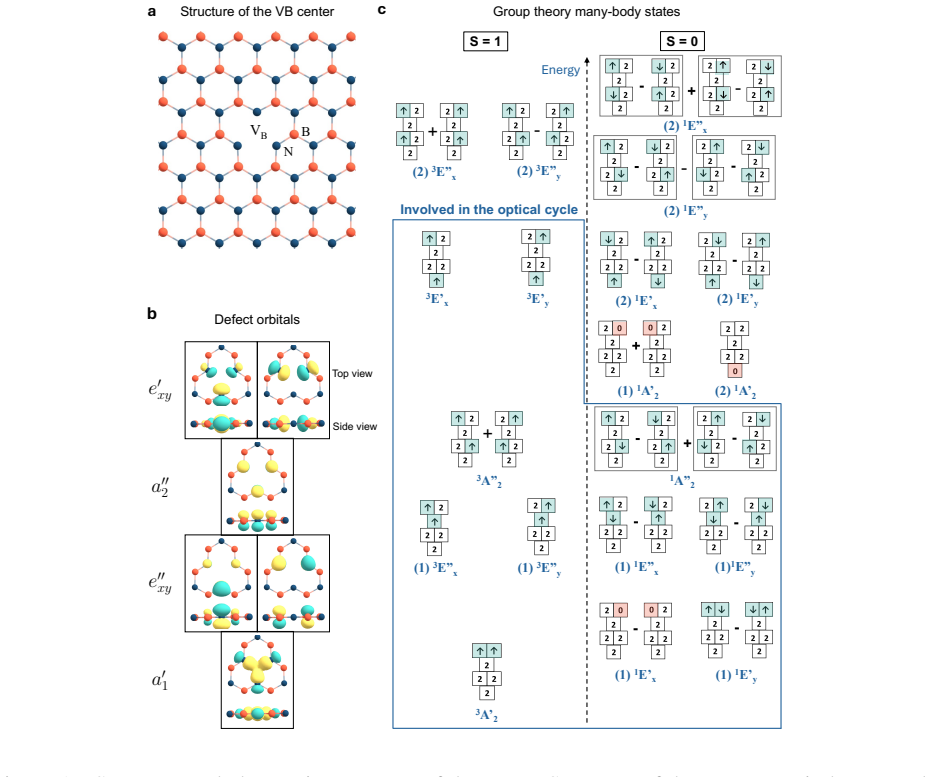
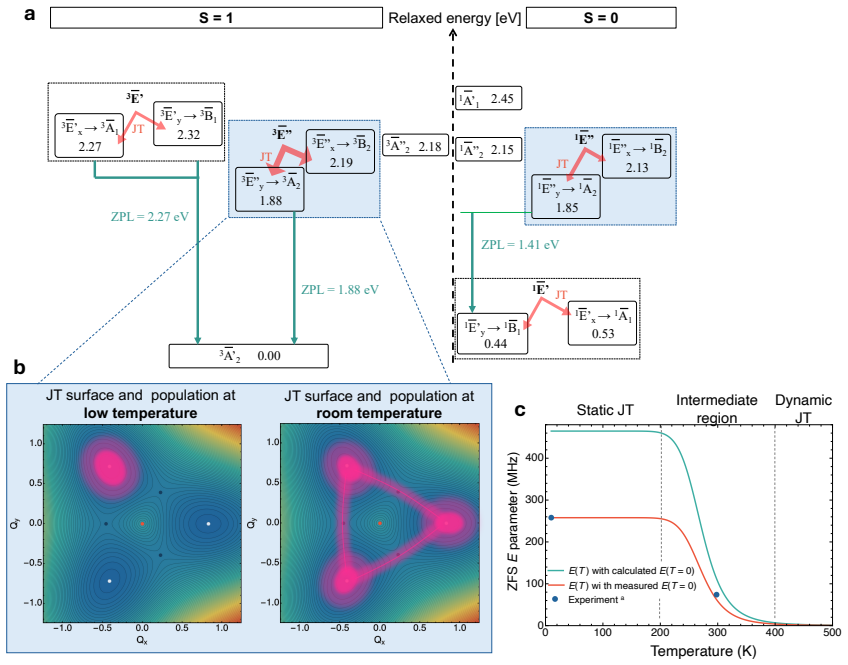
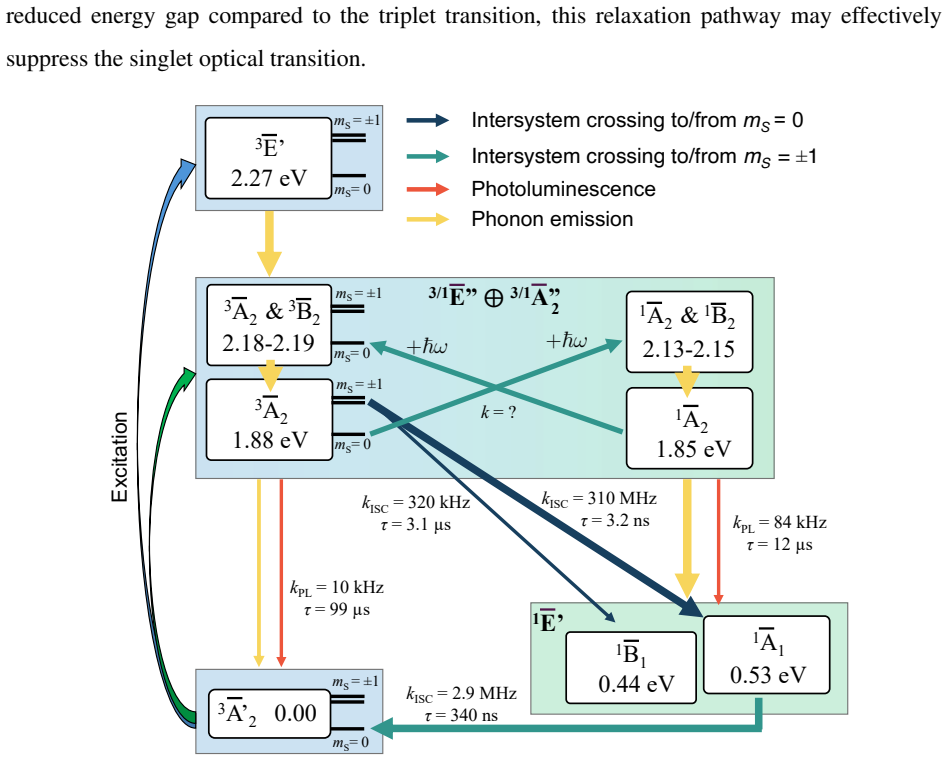
Using the CASSCF-NEVPT2 wave-function method, the energetics, structural relaxation, and transition rates of the V_B^- center are modeled, with a thorough analysis of the excited state fine structure, pseudo Jahn-Teller effects, singlet-triplet quasi-degeneracies, photoluminescence parameters, intersystem crossing pathways, and stress-dependence of the fine structure and decay parameters.
What carries the argument
The CASSCF-NEVPT2 high-level wave-function method, which accounts for strong electron correlation in the excited states of the V_B^- center to compute fine structure, distortions, and pressure shifts.
If this is right
- Clarifies the fundamental behavior of the V_B^- center in hBN.
- Establishes the theoretical foundation for advancing the V_B^- center's readout for integrated 2D quantum sensors.
- Provides quantitative predictions for the pressure dependence of ODMR parameters and decay rates.
- Identifies key intersystem crossing pathways and pseudo Jahn-Teller distortions affecting the optical cycle.
Where Pith is reading between the lines
- These predictions could be used to optimize the performance of hBN-based quantum sensors by applying controlled pressure or strain.
- The detailed mapping of excited states may help in designing protocols to enhance signal contrast in ODMR measurements.
- Similar methods could be applied to other defects in 2D materials to build a general theory for their spin and optical properties.
Load-bearing premise
The CASSCF-NEVPT2 method is assumed to capture the strongly correlated excited states and intersystem crossing pathways with sufficient accuracy for quantitative predictions of ODMR parameters and pressure shifts.
What would settle it
An experimental measurement of the ODMR resonance frequency or photoluminescence spectrum under varying pressure that deviates significantly from the calculated pressure shifts and fine structure would falsify the model's quantitative accuracy.
Figures
read the original abstract
Ensembles of negatively charged boron vacancy (V$_{\text{B}}^-$) centers in hexagonal boron nitride (hBN) have emerged as a two-dimensional spin qubit system interfaced with optics to advance nanoscale quantum sensing. However, a comprehensive description of its optically detected magnetic resonance (ODMR) signal remains challenging due to the strongly correlated nature of the excited electronic states involved in its optical cycle. In this work, we model the energetics, structural relaxation, and transition rates of the V$_{\text{B}}^-$ center using a high-level wave-function-based electron correlation method (CASSCF-NEVPT2). We provide a thorough analysis of the excited state fine structure and pseudo Jahn-Teller effects, singlet-triplet quasi-degeneracies, photoluminescence parameters, intersystem crossing pathways, and stress-dependence of the fine structure and decay parameters. Our findings not only clarify the fundamental behavior of the V$_{\text{B}}^-$ center in hBN but also establish the theoretical foundation for advancing the V$_{\text{B}}^-$ center's readout for integrated 2D quantum sensors.
Editorial analysis
A structured set of objections, weighed in public.
Referee Report
Summary. The manuscript applies the CASSCF-NEVPT2 wave-function method to the negatively charged boron vacancy (V_B^-) defect in hBN. It computes ground- and excited-state energetics, structural relaxations under Jahn-Teller distortion, fine-structure splittings, singlet-triplet quasi-degeneracies, photoluminescence and intersystem-crossing rates, and the pressure dependence of these quantities, with the aim of clarifying the ODMR optical cycle and providing a theoretical basis for 2D quantum-sensor readout.
Significance. If the reported parameters are shown to be converged, the work supplies a detailed first-principles map of the V_B^- optical cycle that is currently missing from the literature. The use of a high-level multireference method is well-motivated for the strongly correlated excited states, and the explicit treatment of pressure dependence is practically useful for sensor design. These strengths would elevate the paper above existing DFT-based studies once numerical robustness is demonstrated.
major comments (1)
- [Computational Methodology] Computational Methodology (or equivalent section describing the CASSCF-NEVPT2 setup): No active-space enlargement or supercell-size convergence tests are reported for the key observables (singlet-triplet gaps, zero-field splitting D, intersystem-crossing rates, and dD/dP coefficients). These quantities are known to be sensitive to both the choice of correlated orbitals and the periodic cell size; without explicit checks that the quoted values remain stable to within the precision needed for ODMR predictions, the quantitative claims lack load-bearing support.
minor comments (2)
- [Abstract] Abstract: The claim that the calculations 'clarify the fundamental behavior' is not accompanied by any numerical values or direct comparison to measured ODMR spectra; a brief quantitative highlight would strengthen the summary.
- Notation for the excited-state manifold: Consistent labeling of the singlet and triplet states (e.g., ^1E, ^3A_2) across text, figures, and tables would improve readability.
Simulated Author's Rebuttal
We thank the referee for their careful reading of the manuscript and for the constructive comments on the computational methodology. We address the major comment point by point below.
read point-by-point responses
-
Referee: [Computational Methodology] Computational Methodology (or equivalent section describing the CASSCF-NEVPT2 setup): No active-space enlargement or supercell-size convergence tests are reported for the key observables (singlet-triplet gaps, zero-field splitting D, intersystem-crossing rates, and dD/dP coefficients). These quantities are known to be sensitive to both the choice of correlated orbitals and the periodic cell size; without explicit checks that the quoted values remain stable to within the precision needed for ODMR predictions, the quantitative claims lack load-bearing support.
Authors: We agree that the lack of explicit convergence tests for active-space size and supercell dimensions represents a genuine limitation in the current version and weakens the support for the quantitative predictions. The active space was selected on the basis of natural-orbital occupations and prior literature on the V_B^- defect, while the supercell size was chosen to converge ground-state properties; however, dedicated enlargement tests for the excited-state observables were not performed or reported. In the revised manuscript we will add a dedicated subsection to the Computational Methodology section that presents active-space enlargement tests (CAS(10,10) to CAS(12,12) and CAS(14,14)) and supercell-size tests (5×5 to 7×7) for the singlet-triplet gaps, zero-field splitting D, intersystem-crossing rates, and dD/dP coefficients. These additional data will be used to quantify the numerical stability of the reported values and to justify the original choices. We therefore accept the referee’s assessment on this point. revision: yes
Circularity Check
No circularity: first-principles CASSCF-NEVPT2 computation of defect properties
full rationale
The paper computes excited-state energetics, Jahn-Teller distortions, fine-structure parameters, intersystem crossing rates, and pressure derivatives directly from CASSCF-NEVPT2 wave functions on periodic supercells. No target observables (ODMR splittings, decay rates, or dD/dP) are used to fit any parameter; all quantities are obtained as outputs of the electronic-structure method under stated active-space and supercell choices. The derivation chain therefore consists of standard ab initio steps whose results are independent of the final predictions they are compared against.
Axiom & Free-Parameter Ledger
axioms (1)
- domain assumption CASSCF-NEVPT2 captures the relevant electron correlation and excited-state energetics of the V_B^- center
Reference graph
Works this paper leans on
-
[1]
R.et al.Quantum computing with defects.PNAS107, 8513–8518 (2010)
Weber, J. R.et al.Quantum computing with defects.PNAS107, 8513–8518 (2010). URL http://www.pnas.org/content/107/19/8513.abstract
2010
-
[2]
URLhttps://www.nature.com/articles/ s41578-021-00306-y
Wolfowicz, G.et al.Quantum guidelines for solid-state spin defects.Nature Reviews Materials1–20 (2021). URLhttps://www.nature.com/articles/ s41578-021-00306-y
2021
-
[4]
Esmann, M., Wein, S. C. & Ant ´on-Solanas, C. Solid-state single-photon sources: Re- cent advances for novel quantum materials.Advanced Functional Materials34, 2315936 (2024). URLhttps://advanced.onlinelibrary.wiley.com/doi/abs/10. 1002/adfm.202315936.https://advanced.onlinelibrary.wiley.com/ doi/pdf/10.1002/adfm.202315936
-
[5]
W., Manson, N
Doherty, M. W., Manson, N. B., Delaney, P. & Hollenberg, L. C. L. The negatively charged nitrogen-vacancy centre in diamond: the electronic solution.New Journal of Physics13, 025019 (2011). URLhttp://stacks.iop.org/1367-2630/13/i=2/a=025019. 24
2011
-
[6]
URLhttps://doi.org/10.1088/ 0034-4885/77/5/056503
Rondin, L.et al.Magnetometry with nitrogen-vacancy defects in diamond.Reports on Progress in Physics77, 056503 (2014). URLhttps://doi.org/10.1088/ 0034-4885/77/5/056503
2014
-
[7]
URLhttps://www.nature.com/articles/ s42254-024-00775-4
Rovny, J.et al.Nanoscale diamond quantum sensors for many-body physics.Nature Reviews Physics6, 753–768 (2024). URLhttps://www.nature.com/articles/ s42254-024-00775-4
2024
-
[8]
Physical Review Letters114, 017601
Romach, Y .et al.Spectroscopy of surface-induced noise using shallow spins in diamond. Physical Review Letters114, 017601. URLhttps://link.aps.org/doi/10.1103/ PhysRevLett.114.017601
-
[9]
URLhttps: //link.aps.org/doi/10.1103/PhysRevX.9.031052
Sangtawesin, S.et al.Origins of diamond surface noise probed by correlating single-spin measurements with surface spectroscopy.Physical Review X9, 031052 (2019). URLhttps: //link.aps.org/doi/10.1103/PhysRevX.9.031052
-
[10]
T., Bray, K., Ford, M
Tran, T. T., Bray, K., Ford, M. J., Toth, M. & Aharonovich, I. Quantum emission from hexagonal boron nitride monolayers.Nature Nanotechnology11, 37–41 (2016). URL https://www.nature.com/articles/nnano.2015.242
2016
-
[11]
URLhttps://www.science.org/doi/ abs/10.1126/sciadv.abf3630.https://www.science.org/doi/pdf/10
Gottscholl, A.et al.Room temperature coherent control of spin defects in hexagonal boron nitride.Science Advances7, eabf3630 (2021). URLhttps://www.science.org/doi/ abs/10.1126/sciadv.abf3630.https://www.science.org/doi/pdf/10. 1126/sciadv.abf3630
work page doi:10.1126/sciadv.abf3630.https://www.science.org/doi/pdf/10 2021
-
[12]
URLhttps://www.nature.com/ articles/s41563-021-00979-4
Chejanovsky, N.et al.Single-spin resonance in a van der waals embedded paramagnetic defect.Nature Materials20, 1079–1084 (2021). URLhttps://www.nature.com/ articles/s41563-021-00979-4
2021
-
[13]
L.et al.Room-temperature optically detected magnetic resonance of single defects in hexagonal boron nitride.Nature Communications13, 618 (2022)
Stern, H. L.et al.Room-temperature optically detected magnetic resonance of single defects in hexagonal boron nitride.Nature Communications13, 618 (2022). URLhttps://www. nature.com/articles/s41467-022-28169-z. 25
2022
-
[14]
URLhttps://www.nature.com/articles/ s41586-025-09258-7
Gao, X.et al.Single nuclear spin detection and control in a van der waals mate- rial.Nature643, 943–949 (2025). URLhttps://www.nature.com/articles/ s41586-025-09258-7
2025
-
[15]
O.et al.A charge transfer mechanism for optically addressable solid-state spin pairs.Nature Physics21, 1981–1987 (2025)
Robertson, I. O.et al.A charge transfer mechanism for optically addressable solid-state spin pairs.Nature Physics21, 1981–1987 (2025). URLhttps://www.nature.com/ articles/s41567-025-03091-5
1981
-
[16]
URLhttp://dx.doi.org/ 10.1038/s41563-025-02458-6
Whitefield, B.et al.Narrowband quantum emitters in hexagonal boron nitride with optically addressable spins.Nature Materials25, 412–419 (2026). URLhttp://dx.doi.org/ 10.1038/s41563-025-02458-6
-
[17]
Quantum sensors go flat.Nature Physics17, 1074–1075 (2021)
Tetienne, J.-P. Quantum sensors go flat.Nature Physics17, 1074–1075 (2021). URLhttp: //dx.doi.org/10.1038/s41567-021-01338-5
-
[18]
J.et al.Quantum microscopy with van der waals heterostructures.Nature Physics 19, 87–91 (2022)
Healey, A. J.et al.Quantum microscopy with van der waals heterostructures.Nature Physics 19, 87–91 (2022). URLhttp://dx.doi.org/10.1038/s41567-022-01815-5
-
[19]
URLhttp://dx.doi.org/10
Iv ´ady, V .et al.Ab initio theory of the negatively charged boron vacancy qubit in hexagonal boron nitride.npj Computational Materials6(2020). URLhttp://dx.doi.org/10. 1038/s41524-020-0305-x
2020
-
[20]
Gottscholl, A.et al.Initialization and read-out of intrinsic spin defects in a van der waals crystal at room temperature.Nature Materials19, 540–545 (2020). URLhttp://dx. doi.org/10.1038/s41563-020-0619-6
-
[21]
URLhttps://www
Gottscholl, A.et al.Spin defects in hBN as promising temperature, pressure and magnetic field quantum sensors.Nature Communications12, 4480 (2021). URLhttps://www. nature.com/articles/s41467-021-24725-1
2021
-
[22]
Gao, X.et al.High-contrast plasmonic-enhanced shallow spin defects in hexagonal boron nitride for quantum sensing.Nano Letters21, 7708–7714 (2021). URLhttps://doi. org/10.1021/acs.nanolett.1c02495. 26
-
[23]
Lyu, X.et al.Strain quantum sensing with spin defects in hexagonal boron nitride.Nano Letters22, 6553–6559 (2022). URLhttps://doi.org/10.1021/acs.nanolett. 2c01722
-
[24]
Daly, D. M.et al.Prospects for ultralow-mass nuclear magnetic resonance using spin defects in hexagonal boron nitride (2025). URLhttp://arxiv.org/abs/2505.00383.2505. 00383[quant-ph]
-
[25]
Quantum sensing with a spin ensemble in a two-dimensional material
Biswas, S.et al.Quantum sensing with a spin ensemble in a two-dimensional material (2025). URLhttp://arxiv.org/abs/2509.08984.2509.08984[quant-ph]
work page internal anchor Pith review Pith/arXiv arXiv 2025
-
[26]
Attaccalite, C., Bockstedte, M., Marini, A., Rubio, A. & Wirtz, L. Coupling of excitons and defect states in boron-nitride nanostructures.Phys. Rev. B83, 144115 (2011). URL https://link.aps.org/doi/10.1103/PhysRevB.83.144115
-
[27]
A.et al.First-principles investigation of quantum emission from hbn de- fects.Nanoscale9, 13575–13582 (2017)
Tawfik, S. A.et al.First-principles investigation of quantum emission from hbn de- fects.Nanoscale9, 13575–13582 (2017). URLhttp://dx.doi.org/10.1039/ C7NR04270A
2017
-
[28]
Abdi, M., Chou, J.-P., Gali, A. & Plenio, M. B. Color centers in hexagonal boron ni- tride monolayers: A group theory and ab initio analysis.ACS Photonics5, 1967–1976 (2018). URLhttps://doi.org/10.1021/acsphotonics.7b01442.https: //doi.org/10.1021/acsphotonics.7b01442
-
[29]
Weston, L., Wickramaratne, D., Mackoit, M., Alkauskas, A. & Van de Walle, C. G. Na- tive point defects and impurities in hexagonal boron nitride.Physical Review B97, 214104. URLhttps://link.aps.org/doi/10.1103/PhysRevB.97.214104. Publisher: American Physical Society
-
[30]
S., Reimers, J
Sajid, A., Thygesen, K. S., Reimers, J. R. & Ford, M. J. Edge effects on optically detected magnetic resonance of vacancy defects in hexagonal boron nitride.Communications Physics3, 1–8 (2020). URLhttps://www.nature.com/articles/s42005-020-00416-z. 27
2020
-
[31]
Reimers, J. R.et al.Photoluminescence, photophysics, and photochemistry of the v − b defect in hexagonal boron nitride.Physical Review B102, 144105 (2020). URLhttps://link. aps.org/doi/10.1103/PhysRevB.102.144105
-
[32]
Journal of Chemical Theory and Computation , issn =
Barcza, G.et al.Dmrg on top of plane-wave kohn–sham orbitals: A case study of defected boron nitride.Journal of Chemical Theory and Computation17, 1143–1154 (2021). URL https://doi.org/10.1021/acs.jctc.0c00809. PMID: 33435672,https:// doi.org/10.1021/acs.jctc.0c00809
-
[33]
Reimers, J. R., Sajid, A., Kobayashi, R. & Ford, M. J. Understanding and calibrating density-functional-theory calculations describing the energy and spectroscopy of defect sites in hexagonal boron nitride.Journal of Chemical Theory and Computation14, 1602–1613 (2018). URLhttps://doi.org/10.1021/acs.jctc.7b01072.https://doi. org/10.1021/acs.jctc.7b01072
-
[34]
& Barcza, G
Benedek, Z., Ganyecz, A., Pershin, A., Iv ´ady, V . & Barcza, G. Accurate and convergent energetics of color centers by wavefunction theory.npj Computational Materials11, 346 (2025). URLhttps://www.nature.com/articles/s41524-025-01813-0
2025
-
[35]
Luu, M. T.et al.Identifying high-energy electronic states of nv- centers in diamond.Applied Physics Letters126, 234001 (2025). URLhttps://doi.org/10.1063/5.0268247
-
[36]
URLhttp://dx.doi.org/10
Mathur, N.et al.Excited-state spin-resonance spectroscopy of VB − defect centers in hexag- onal boron nitride.Nature Communications13(2022). URLhttp://dx.doi.org/10. 1038/s41467-022-30772-z
2022
-
[37]
Geng, J.et al.Deformation-driven enhancement of spin defect emission in hexagonal boron ni- tride.ACS Nano20, 3510–3518 (2026). URLhttps://doi.org/10.1021/acsnano. 5c15247. PMID: 41540844,https://doi.org/10.1021/acsnano.5c15247
-
[38]
Libbi, F., de Melo, P. M. M., Zanolli, Z., Verstraete, M. J. & Marzari, N. Phonon-assisted luminescence in defect centers from many-body perturbation theory.Physical Review Letters 28 128, 167401. URLhttps://link.aps.org/doi/10.1103/PhysRevLett.128. 167401. Publisher: American Physical Society
-
[39]
Whitefield, B., Toth, M., Aharonovich, I., Tetienne, J.-P. & Kianinia, M. Magnetic field sen- sitivity optimization of negatively charged boron vacancy defects in hBN.Advanced Quan- tum Technologiesn/a, 2300118 (2023). URLhttps://onlinelibrary.wiley.com/ doi/abs/10.1002/qute.202300118
-
[40]
URL https://pubs.acs.org/doi/10.1021/acs.nanolett.1c04366
Baber, S.et al.Excited state spectroscopy of boron vacancy defects in hexagonal boron nitride using time-resolved optically detected magnetic resonance.Nano Letters22, 461–467. URL https://pubs.acs.org/doi/10.1021/acs.nanolett.1c04366
-
[41]
URLhttps://link.aps.org/ doi/10.1103/PhysRevB.110.014104
Clua-Provost, T.et al.Spin-dependent photodynamics of boron-vacancy centers in hexagonal boron nitride.Physical Review B110, 014104 (2024). URLhttps://link.aps.org/ doi/10.1103/PhysRevB.110.014104
-
[42]
Qian, C.et al.Unveiling the zero-phonon line of the boron vacancy center by cavity-enhanced emission.Nano Letters22, 5137–5142 (2022). URLhttps://doi.org/10.1021/ acs.nanolett.2c00739. PMID: 35758596,https://doi.org/10.1021/acs. nanolett.2c00739
work page doi:10.1021/acs 2022
-
[43]
npj Computational Materials10, 184 (2024)
Babar, R.et al.Low-symmetry vacancy-related spin qubit in hexagonal boron nitride. npj Computational Materials10, 184 (2024). URLhttps://www.nature.com/ articles/s41524-024-01361-z
2024
-
[44]
Durand, A.et al.Optically active spin defects in few-layer thick hexagonal boron nitride. Phys. Rev. Lett.131, 116902 (2023). URLhttps://link.aps.org/doi/10.1103/ PhysRevLett.131.116902
2023
-
[45]
URLhttp: //dx.doi.org/10.1103/PhysRevMaterials.9.056203
Carbone, A.et al.Quantifying the creation of negatively charged boron vacancies in he- ion irradiated hexagonal boron nitride.Physical Review Materials9(2025). URLhttp: //dx.doi.org/10.1103/PhysRevMaterials.9.056203. 29
-
[46]
Udvarhelyi, P.et al.A planar defect spin sensor in a two-dimensional material susceptible to strain and electric fields.npj Computational Materials9(2023). URLhttp://dx.doi. org/10.1038/s41524-023-01111-7
-
[47]
URL http://dx.doi.org/10.1038/s41467-025-63580-2
Mu, Z.et al.Magnetic imaging under high pressure with a spin-based quantum sensor integrated in a van der waals heterostructure.Nature Communications16(2025). URL http://dx.doi.org/10.1038/s41467-025-63580-2
-
[48]
Bosak, A.et al.Elasticity of hexagonal boron nitride: Inelastic x-ray scattering measure- ments.Phys. Rev. B73, 041402 (2006). URLhttps://link.aps.org/doi/10. 1103/PhysRevB.73.041402
2006
-
[49]
O.The Complete Active Space Self-Consistent Field Method And Its Appli- cations in Electronic Structure Calculations, 399–445 (John Wiley and Sons, Ltd, New York, 1987)
Roos, B. O.The Complete Active Space Self-Consistent Field Method And Its Appli- cations in Electronic Structure Calculations, 399–445 (John Wiley and Sons, Ltd, New York, 1987). URLhttps://onlinelibrary.wiley.com/doi/abs/10.1002/ 9780470142943.ch7
1987
-
[50]
Olsen, J. The casscf method: A perspective and commentary.International Journal of Quan- tum Chemistry111, 3267–3272 (2011). URLhttps://onlinelibrary.wiley.com/ doi/abs/10.1002/qua.23107.https://onlinelibrary.wiley.com/doi/ pdf/10.1002/qua.23107
work page doi:10.1002/qua.23107.https://onlinelibrary.wiley.com/doi/ 2011
-
[51]
Kollmar, C., Sivalingam, K., Helmich-Paris, B., Angeli, C. & Neese, F. A perturbation-based super-ci approach for the orbital optimization of a casscf wave function.Journal of Com- putational Chemistry40, 1463–1470 (2019). URLhttps://onlinelibrary.wiley. com/doi/abs/10.1002/jcc.25801
-
[52]
Angeli, C., Cimiraglia, R. & Malrieu, J.-P. n-electron valence state perturbation theory: A spinless formulation and an efficient implementation of the strongly contracted and of the partially contracted variants.The Journal of Chemical Physics117, 9138–9153 (2002). URLhttps://doi.org/10.1063/1.1515317.https://doi.org/10.1063/ 1.1515317. 30
work page doi:10.1063/1.1515317.https://doi.org/10.1063/ 2002
-
[53]
Angeli, C., Cimiraglia, R., Evangelisti, S., Leininger, T. & Malrieu, J.-P. Introduction of n-electron valence states for multireference perturbation theory.The Journal of Chemical Physics114, 10252–10264 (2001). URLhttps://doi.org/10.1063/1.1361246. https://doi.org/10.1063/1.1361246
-
[54]
Angeli, C., Pastore, M. & Cimiraglia, R. New perspectives in multireference perturbation theory: the n-electron valence state approach.Theoretical Chemistry Accounts117, 743–754 (2007). URLhttps://doi.org/10.1007/s00214-006-0207-0
-
[55]
Guo, Y ., Sivalingam, K. & Neese, F. Approximations of density matrices in N-electron va- lence state second-order perturbation theory (NEVPT2). I. Revisiting the NEVPT2 construc- tion.The Journal of Chemical Physics154, 214111 (2021). URLhttps://doi.org/10. 1063/5.0051211.https://pubs.aip.org/aip/jcp/article-pdf/doi/ 10.1063/5.0051211/16673662/214111_1_o...
work page doi:10.1063/5.0051211/16673662/214111_1_online.pdf 2021
-
[56]
APL Photonics 6(7), 070804 (2021) https://doi.org/10.1063/5
Kollmar, C., Sivalingam, K., Guo, Y . & Neese, F. An efficient implementation of the NEVPT2 and CASPT2 methods avoiding higher-order density matrices.The Journal of Chemical Physics155, 234104 (2021). URLhttps://doi.org/10.1063/5. 0072129.https://pubs.aip.org/aip/jcp/article-pdf/doi/10.1063/ 5.0072129/16704053/234104_1_online.pdf
work page doi:10.1063/5 2021
-
[57]
WIREs Computational Molecular Science , author =
Neese, F. Software update: The orca program system—version 6.0.WIREs Computa- tional Molecular Science15, e70019 (2025). URLhttps://wires.onlinelibrary. wiley.com/doi/abs/10.1002/wcms.70019. E70019 CMS-1186.R1,https:// wires.onlinelibrary.wiley.com/doi/pdf/10.1002/wcms.70019
-
[58]
Dunning, T. H. Gaussian basis sets for use in correlated molecular calculations. i. the atoms boron through neon and hydrogen.The Journal of Chemical Physics90, 1007–1023 (1989). URLhttps://doi.org/10.1063/1.456153.https://doi.org/10. 1063/1.456153. 31
-
[59]
& Becker, U
Neese, F., Wennmohs, F., Hansen, A. & Becker, U. Efficient, approximate and par- allel hartree–fock and hybrid dft calculations. a ‘chain-of-spheres’ algorithm for the hartree–fock exchange.Chemical Physics356, 98–109 (2009). URLhttps://www. sciencedirect.com/science/article/pii/S0301010408005089
2009
-
[60]
Accurate coulomb-fitting basis sets for h to rn.Phys
Weigend, F. Accurate coulomb-fitting basis sets for h to rn.Phys. Chem. Chem. Phys.8, 1057–1065 (2006). URLhttp://dx.doi.org/10.1039/B515623H
-
[61]
Weigend, F., K ¨ohn, A. & H ¨attig, C. Efficient use of the correlation consistent basis sets in resolution of the identity MP2 calculations.The Journal of Chemical Physics116, 3175–3183 (2002). URLhttps://doi.org/10.1063/1.1445115.https://pubs.aip. org/aip/jcp/article-pdf/116/8/3175/19300676/3175_1_online.pdf
-
[62]
Generalized Kepler problems. I. Without magnetic charges
Roemelt, M., Maganas, D., DeBeer, S. & Neese, F. A combined DFT and re- stricted open-shell configuration interaction method including spin-orbit coupling: Ap- plication to transition metal L-edge X-ray absorption spectroscopy.The Journal of Chemical Physics138, 204101 (2013). URLhttps://doi.org/10.1063/1. 4804607.https://pubs.aip.org/aip/jcp/article-pdf/...
work page doi:10.1063/1 2013
discussion (0)
Sign in with ORCID, Apple, or X to comment. Anyone can read and Pith papers without signing in.