Recognition: unknown
Comment on "The elusive fluid-and-crystal coexistence state in simulations of monodisperse, hard-sphere colloids"
Pith reviewed 2026-05-08 17:19 UTC · model grok-4.3
The pith
Simulations of monodisperse hard spheres can achieve spontaneous fluid-to-crystal coexistence using standard methods.
A machine-rendered reading of the paper's core claim, the machinery that carries it, and where it could break.
Core claim
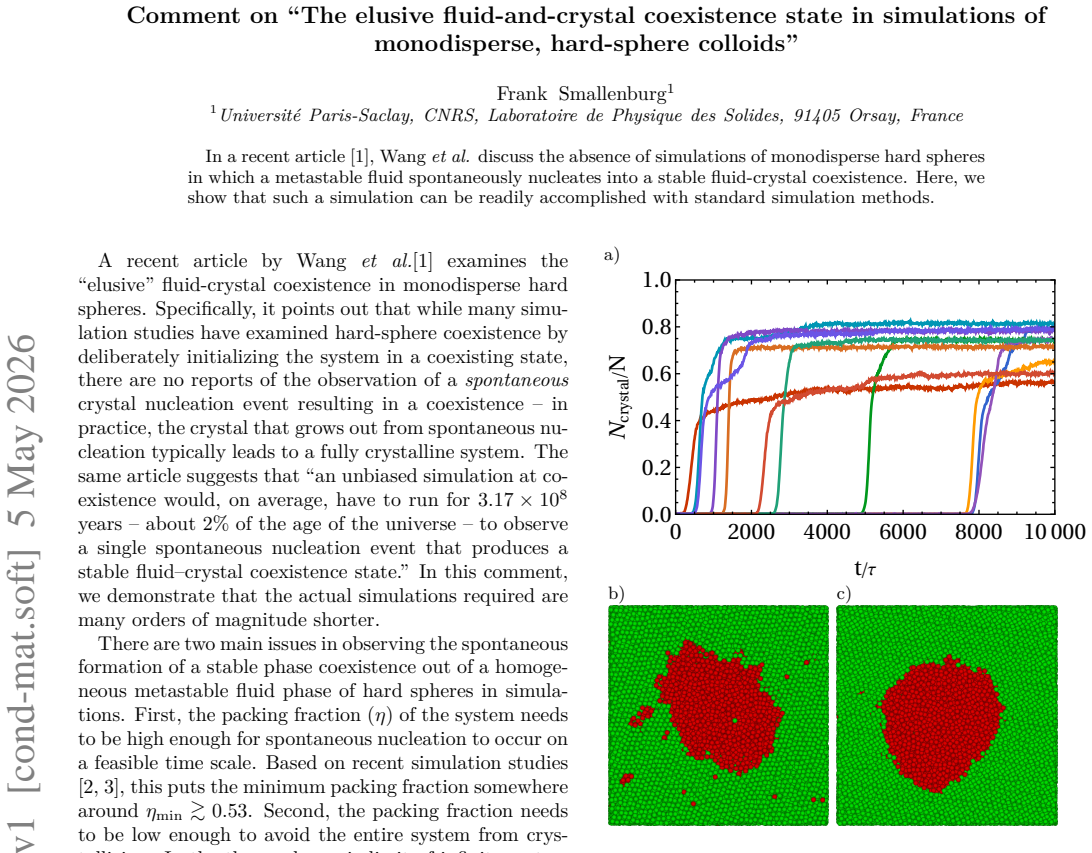
By applying standard simulation methods to monodisperse hard spheres, the authors observe a metastable fluid spontaneously nucleating into a stable fluid-crystal coexistence state, showing that such a state can be readily achieved without specialized techniques.
What carries the argument
Standard molecular dynamics or Monte Carlo simulations of hard-sphere particles that permit natural nucleation events over sufficient time and system size.
If this is right
- Fluid-crystal coexistence in hard-sphere systems becomes directly simulatable with conventional tools.
- Previous reports of absence may result from inadequate run lengths or system sizes in simulations.
- Research on colloidal phase behavior can proceed with standard methods rather than seeking rare events.
- Verification of simulation protocols is key to reproducing nucleation phenomena.
Where Pith is reading between the lines
- The original work's inability to observe nucleation might stem from particular choices in equilibration or boundary conditions not shared here.
- This finding could encourage re-examination of other 'elusive' states in particle simulations using baseline methods.
- Extensions might include testing the same setup with slight polydispersity to see effects on nucleation rates.
Load-bearing premise
That the implementation of standard simulation methods in this comment uses parameters and protocols close enough to the original paper's attempts so that the observed nucleation is not due to unmentioned differences.
What would settle it
Running the exact simulation protocol from the original paper on comparable hardware and failing to see nucleation despite long times, or successfully reproducing it with the comment's details.
Figures

read the original abstract
In a recent article [J. G. Wang, U. Dhumal, M. E. Zakhari, and R. N. Zia, AIChE Journal 72, e70275 (2026).], the authors discuss the absence of simulations of monodisperse hard spheres in which a metastable fluid spontaneously nucleates into a stable fluid-crystal coexistence. Here, we show that such a simulation can be readily accomplished with standard simulation methods.
Editorial analysis
A structured set of objections, weighed in public.
Referee Report
Summary. This comment paper asserts that the metastable fluid-to-fluid-crystal coexistence state in monodisperse hard-sphere colloids, reported as absent in simulations by Wang et al. (AIChE J. 72, e70275, 2026), can in fact be observed spontaneously using standard simulation methods.
Significance. If the result holds with matching protocols, it would provide a direct counterexample showing that nucleation is observable under conventional conditions, thereby challenging the original claim of elusiveness and reinforcing the applicability of standard hard-sphere simulation techniques for studying phase coexistence.
major comments (1)
- [Main text] The central claim that nucleation 'can be readily accomplished with standard simulation methods' is load-bearing but unsupported by any explicit protocol details, results, or comparisons. No system size, packing fraction, initialization method, integrator, or order-parameter diagnostics are provided to demonstrate that the observed nucleation occurs under conditions equivalent to those in Wang et al. where it was found elusive.
Simulated Author's Rebuttal
We appreciate the referee's detailed review and recommendation for major revision. The key issue identified is the absence of specific simulation protocol information in our manuscript, which we will rectify in the revised version.
read point-by-point responses
-
Referee: The central claim that nucleation 'can be readily accomplished with standard simulation methods' is load-bearing but unsupported by any explicit protocol details, results, or comparisons. No system size, packing fraction, initialization method, integrator, or order-parameter diagnostics are provided to demonstrate that the observed nucleation occurs under conditions equivalent to those in Wang et al. where it was found elusive.
Authors: We agree with the referee that the current manuscript does not include explicit details of the simulation protocol, which limits the ability to verify the conditions. As this is a short comment paper, we omitted these for brevity. In the revised manuscript, we will add a new paragraph or section providing the full protocol: system size, packing fraction, initialization method (e.g., from a fluid configuration at the target density), the event-driven dynamics used, and the order parameters employed to detect crystal nucleation. We will also include a direct comparison showing that our conditions match those in the Wang et al. study where nucleation was reported as elusive. This will support our claim that standard methods suffice and allow readers to reproduce the result. revision: yes
Circularity Check
No circularity; direct demonstration via standard methods
full rationale
The paper is a short comment asserting that metastable fluid-to-crystal nucleation in monodisperse hard spheres is observable with standard simulation techniques. It contains no derivations, equations, parameter fits, or self-referential logic that reduces a claimed result to its own inputs. The central claim rests on the existence of the simulation itself rather than any constructed equivalence or load-bearing self-citation. No patterns from the enumerated circularity types are present.
Axiom & Free-Parameter Ledger
Reference graph
Works this paper leans on
-
[1]
Efficient event-driven simulations of hard spheres , author=. Eur. Phys. J. E , volume=. 2022 , publisher=
2022
-
[2]
Journal of Physics: Condensed Matter , year=
Pseudo hard-sphere viscosities from equilibrium Molecular Dynamics , author=. Journal of Physics: Condensed Matter , year=
-
[3]
Physical Chemistry Chemical Physics , volume=
Thermodynamic and dynamical properties of the hard sphere system revisited by molecular dynamics simulation , author=. Physical Chemistry Chemical Physics , volume=. 2019 , publisher=
2019
-
[4]
Molecular Physics , volume=
Shear viscosity of pseudo hard-spheres , author=. Molecular Physics , volume=. 2020 , publisher=
2020
-
[5]
2017 , publisher=
Computer simulation of liquids , author=. 2017 , publisher=
2017
-
[6]
Studies in molecular dynamics. VIII. The transport coefficients for a hard-sphere fluid , author=. J. Chem. Phys. , volume=. 1970 , publisher=
1970
-
[7]
A. P. Thompson and H. M. Aktulga and R. Berger and D. S. Bolintineanu and W. M. Brown and P. S. Crozier and P. J. in 't Veld and A. Kohlmeyer and S. G. Moore and T. D. Nguyen and R. Shan and M. J. Stevens and J. Tranchida and C. Trott and S. J. Plimpton. LAMMPS - a flexible simulation tool for particle-based materials modeling at the atomic, meso, and con...
-
[8]
Molecular Physics , volume=
Transport coefficients of hard sphere fluids , author=. Molecular Physics , volume=. 2003 , publisher=
2003
-
[9]
Using the second virial coefficient as physical criterion to map the hard-sphere potential onto a continuous potential , author=. J. Chem. Phys. , volume=. 2018 , publisher=
2018
-
[10]
AIChE Journal , volume=
The elusive fluid-and-crystal coexistence state in simulations of monodisperse, hard-sphere colloids , author=. AIChE Journal , volume=. 2026 , publisher=
2026
-
[11]
Hard sphere crystal nucleation rates: Reconciliation of simulation and experiment , author=. Phys. Rev. Lett. , volume=. 2022 , publisher=
2022
-
[12]
arXiv preprint arXiv:2512.20300 , year=
Local composition fluctuations act as precursors for crystal nucleation in polydisperse hard spheres , author=. arXiv preprint arXiv:2512.20300 , year=
-
[13]
A simple and accurate method to determine fluid--crystal phase boundaries from direct coexistence simulations , author=. J. Chem. Phys. , volume=. 2024 , publisher=
2024
-
[14]
Nucleation and cavitation of spherical, cylindrical, and slablike droplets and bubbles in small systems , author=. J. Chem. Phys. , volume=. 2006 , publisher=
2006
-
[15]
Numerical evidence for bcc ordering at the surface of a critical fcc nucleus , author=. Phys. Rev. Lett. , volume=. 1995 , publisher=
1995
-
[16]
A parameter-free, solid-angle based, nearest-neighbor algorithm , author=. J. Chem. Phys. , pages=. 2012 , publisher=
2012
-
[17]
Accurate determination of crystal structures based on averaged local bond order parameters , author=. J. Chem. Phys. , volume=. 2008 , publisher=
2008
discussion (0)
Sign in with ORCID, Apple, or X to comment. Anyone can read and Pith papers without signing in.