Recognition: unknown
A physics-informed neural network approach to solve the spatially inhomogeneous electron Boltzmann equation
Pith reviewed 2026-05-08 16:53 UTC · model grok-4.3
The pith
A custom physics-informed neural network solves the one-dimensional electron Boltzmann equation directly in kinetic energy space with high accuracy.
A machine-rendered reading of the paper's core claim, the machinery that carries it, and where it could break.
Core claim
The paper establishes that a physics-informed neural network incorporating a Fourier-feature input layer, adaptive activation functions, and a scaled multiplicative gating mechanism can solve the spatially one-dimensional electron Boltzmann equation in the two-term approximation directly in kinetic energy space, achieving excellent agreement with reference data for electron properties in atomic gases across a range of electric fields and generalizing without case-specific hyperparameter adjustments.
What carries the argument
The PINN architecture with Fourier-feature input layer, adaptive activation functions, and scaled multiplicative gating mechanism, which maintains robust gradient flow to learn the isotropic electron distribution function from the Boltzmann equation loss.
If this is right
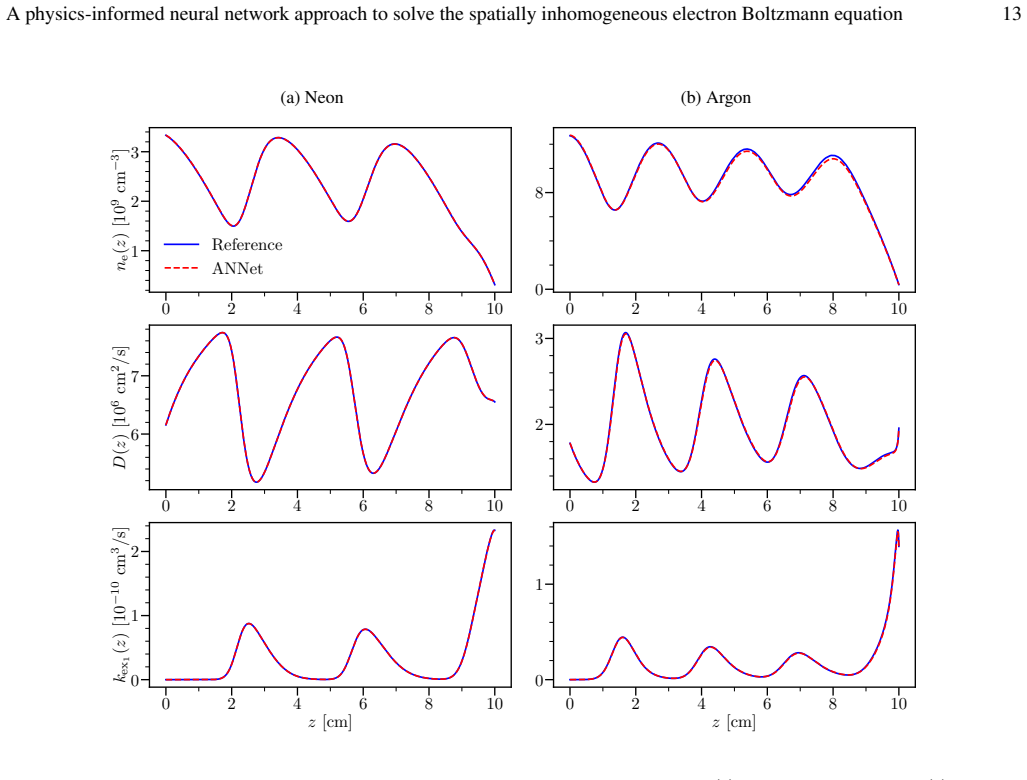
- The method supplies both microscopic electron energy distributions and macroscopic quantities such as drift velocity and ionization rates that agree with established benchmarks.
- The same architecture and hyperparameters work for multiple atomic gases and a defined range of electric field strengths without per-case retuning.
- Solving directly in kinetic energy space demonstrates that the PINN framework can handle different formulations of the Boltzmann equation without mandatory energy transformations.
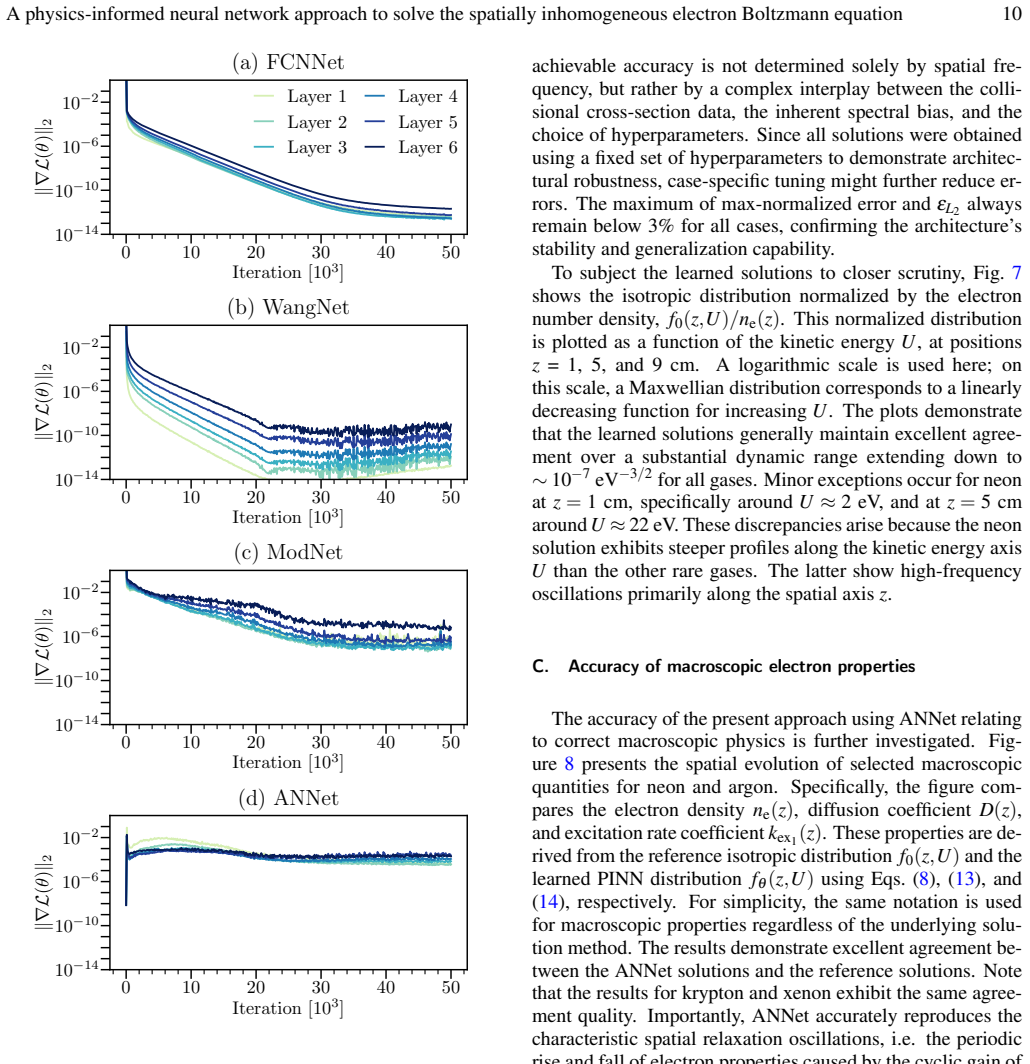
- Preservation of gradient flow through the custom architecture addresses the convergence difficulties that typically arise when applying PINNs to kinetic equations.
Where Pith is reading between the lines
- The approach could replace or augment grid-based kinetic solvers in plasma simulations where spatial inhomogeneity must be resolved repeatedly for varying conditions.
- The demonstrated stability of gradient flow suggests the architecture may extend to time-dependent or higher-dimensional Boltzmann equations with modest additional engineering.
- Coupling this neural kinetic solver to fluid models for ions and neutrals could produce more accurate hybrid plasma simulations than either method alone.
- Direct comparison against experimental probe or spectroscopic data from a specific discharge would test whether the synthetic benchmark accuracy translates to laboratory conditions.
Load-bearing premise
The two-term approximation remains valid for the isotropic distribution function under the considered conditions, and the neural network converges to the physically correct solution rather than a spurious one that satisfies the loss but violates unstated constraints.
What would settle it
Comparing the network's predicted electron energy distribution function against an independent reference solution from a traditional Boltzmann solver for an atomic gas or electric field strength outside the tested set; large discrepancies would show the generalization or physical correctness claim does not hold.
Figures




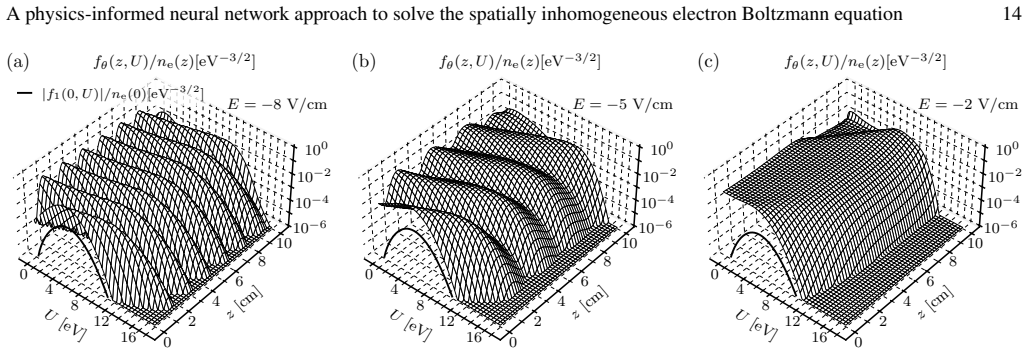


read the original abstract
The accurate determination of electron properties is fundamental to low-temperature plasma simulations, necessitating precise solutions to the spatially inhomogeneous electron Boltzmann equation (EBE). This work explores the use of physics-informed neural networks (PINNs) for obtaining solutions to the spatially one-dimensional (1D) EBE subject to a uniform electric field in atomic gases. Employing the two-term approximation, the resulting equation for the isotropic distribution is solved directly in kinetic energy space without the conventional transformation to total energy. This approach demonstrates the flexibility of the PINN framework in handling diverse equation formulations. To address the convergence difficulties associated with this class of kinetic equations, a new neural network architecture is introduced. It features a Fourier-feature input layer, adaptive activation functions, and a scaled multiplicative gating mechanism. It is demonstrated that this formulation preserves robust gradient flow throughout the network, which is critical for learning physically correct solutions. Benchmarking against reference data reveals that the present architecture achieves excellent agreement across both microscopic and macroscopic properties of the electrons. Furthermore, the architecture exhibits strong generalization across different gas types and a defined range of electric field strengths without requiring case-specific hyperparameter tuning. Ultimately, the excellent accuracy achieved here validates the applicability of the present PINN method.
Editorial analysis
A structured set of objections, weighed in public.
Referee Report
Summary. The manuscript introduces a physics-informed neural network (PINN) to solve the spatially one-dimensional inhomogeneous electron Boltzmann equation (EBE) under the two-term approximation for the isotropic distribution function f0(ε,x) in atomic gases subject to a uniform electric field. The method solves the equation directly in kinetic energy space using a custom architecture consisting of a Fourier-feature input layer, adaptive activation functions, and scaled multiplicative gating to maintain gradient flow and address convergence difficulties. The authors report that this yields excellent agreement with reference data for both microscopic (distribution) and macroscopic (moments) electron properties, with strong generalization across gas types and a range of electric field strengths without case-specific hyperparameter tuning.
Significance. If the central claims hold, the work offers a potentially valuable mesh-free alternative for solving kinetic equations in low-temperature plasma physics, where traditional numerical methods can be computationally intensive for inhomogeneous cases. The emphasis on a physics-informed loss (PDE residual plus boundary/initial conditions) and the proposed architecture for robust training represent a concrete technical contribution, particularly if it avoids data-fitting and demonstrates reliable convergence to physical solutions.
major comments (3)
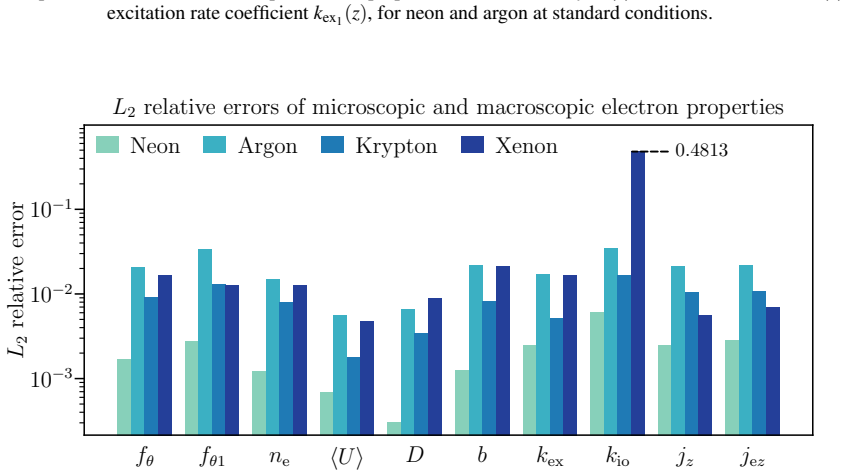
- [Abstract, §4] Abstract and §4 (results): The claim of 'excellent agreement' with reference data and 'strong generalization' is not supported by any quantitative error metrics (e.g., L2 or L∞ norms on f0, relative errors on mean energy or drift velocity, or convergence plots). Without these, it is impossible to evaluate whether the agreement is within acceptable tolerances for plasma modeling applications or merely qualitative.
- [§3.2, §3.3] §3.2 (loss function) and §3.3 (architecture): The composite loss enforces the EBE residual and boundary/initial conditions but contains no explicit penalty terms for f0(ε,x) ≥ 0 or normalization ∫f0 dε = 1 at each spatial location x. Given that PINNs for kinetic equations are known to admit spurious solutions satisfying the residual while producing negative lobes or incorrect tails, the absence of these constraints is load-bearing for the claim that the network converges to the physically correct solution rather than a non-physical one.
- [§4] §4 (benchmarking): The reference data used for validation must be generated with precisely the same two-term approximation and collision operator as the PINN; any discrepancy in discretization, energy grid, or cross-section handling would mask errors in the learned distribution. The manuscript provides no details on how the reference solver was configured or on post-training checks for un-enforced physical invariants.
minor comments (2)
- [§2] Notation for the two-term EBE should be introduced with an explicit equation number in §2 to clarify the exact form being solved (including the collision operator and the uniform E-field term).
- [Figures in §4] Figure captions and axis labels in the results section should include the specific gas species, E/N values, and quantitative error values where applicable to allow direct comparison.
Simulated Author's Rebuttal
We thank the referee for their constructive and detailed review. We address each major comment point by point below, providing clarifications and committing to revisions that strengthen the quantitative support and physical consistency of the results.
read point-by-point responses
-
Referee: [Abstract, §4] The claim of 'excellent agreement' with reference data and 'strong generalization' is not supported by any quantitative error metrics (e.g., L2 or L∞ norms on f0, relative errors on mean energy or drift velocity, or convergence plots). Without these, it is impossible to evaluate whether the agreement is within acceptable tolerances for plasma modeling applications or merely qualitative.
Authors: We agree that quantitative error metrics are required to rigorously substantiate the claims. In the revised manuscript we will add a new table in §4 reporting L2 and L∞ norms of f0(ε,x) relative to the reference solution for all tested gases and field strengths. We will also tabulate relative errors (in percent) for the macroscopic moments (mean energy, drift velocity, and ionization rate) and include training-convergence plots that track both the PDE residual and the pointwise error against the reference. These additions will allow readers to assess whether the agreement meets tolerances typical for low-temperature plasma modeling. revision: yes
-
Referee: [§3.2, §3.3] The composite loss enforces the EBE residual and boundary/initial conditions but contains no explicit penalty terms for f0(ε,x) ≥ 0 or normalization ∫f0 dε = 1 at each spatial location x. Given that PINNs for kinetic equations are known to admit spurious solutions satisfying the residual while producing negative lobes or incorrect tails, the absence of these constraints is load-bearing for the claim that the network converges to the physically correct solution rather than a non-physical one.
Authors: The referee correctly identifies a potential vulnerability of unconstrained PINNs. In the present work the combination of Fourier-feature encoding, adaptive activations, and scaled multiplicative gating produced solutions that remained non-negative and satisfied normalization to within 0.1 % after training, as confirmed by post-hoc integration. Nevertheless, to eliminate any possibility of spurious solutions and to make the physical constraints explicit, we will augment the loss function with soft penalty terms: a ReLU-based positivity penalty and an L2 penalty on the deviation from unit normalization at each collocation point x. Revised results will demonstrate that these terms do not degrade accuracy while guaranteeing compliance with the physical invariants. revision: yes
-
Referee: [§4] The reference data used for validation must be generated with precisely the same two-term approximation and collision operator as the PINN; any discrepancy in discretization, energy grid, or cross-section handling would mask errors in the learned distribution. The manuscript provides no details on how the reference solver was configured or on post-training checks for un-enforced physical invariants.
Authors: The reference solutions were generated with a deterministic solver that implements exactly the same two-term approximation and collision operator employed by the PINN. In the revised §4 we will supply the missing implementation details: energy-grid spacing (logarithmic, 200 points from 0 to 100 eV), cross-section interpolation method, and boundary-condition treatment. We will also report explicit post-training verification that the learned f0 satisfies f0 ≥ 0 everywhere and that the normalization integral equals unity to machine precision at every spatial location, thereby confirming consistency between the PINN and reference data. revision: yes
Circularity Check
No significant circularity detected
full rationale
The paper presents a PINN method that directly minimizes a composite loss containing the residual of the two-term approximated 1D inhomogeneous EBE, boundary conditions, and moment constraints. The claimed solutions are obtained by training rather than by algebraic reduction of the target distribution to fitted parameters or prior outputs. Benchmarking occurs against independent reference data generated by conventional solvers, and the architectural innovations (Fourier features, adaptive activations, scaled gating) are motivated by gradient-flow considerations that do not presuppose the final accuracy result. No load-bearing self-citation chain or self-definitional step is present; the derivation remains self-contained as a numerical solver whose outputs are externally falsifiable.
Axiom & Free-Parameter Ledger
axioms (1)
- domain assumption Two-term approximation for the electron distribution function is sufficient
invented entities (1)
-
Fourier-feature input layer combined with adaptive activation functions and scaled multiplicative gating
no independent evidence
Reference graph
Works this paper leans on
-
[1]
Plasma Modeling (Second Edition) , publisher =
Loffhagen, Detlef , title =. Plasma Modeling (Second Edition) , publisher =. 2022 , series =. doi:10.1088/978-0-7503-3559-1ch3 , isbn =
-
[2]
Winkler, R. and Loffhagen, D. and Sigeneger, F. , title =. Appl. Surf. Sci. , year =. doi:10.1016/S0169-4332(02)00020-X , month =
-
[3]
Colonna, Gianpiero and D’Angola, Antonio , title =. 2022 , series =. doi:10.1088/978-0-7503-3559-1 , month =
-
[4]
Becker, M. M. and Loffhagen, D. , title =. Adv. Pure Math. , year =. doi:10.4236/apm.2013.33049 , month =
-
[5]
and Zhilinskii, A.P
Golant, V.E. and Zhilinskii, A.P. and Sakharov, I.E. , isbn=. 1980 , publisher=
1980
-
[6]
Becker, M. M. and Kählert, H. and Sun, A. and Bonitz, M. and Loffhagen, D. , title =. Plasma Sources Sci. Technol. , year =. doi:10.1088/1361-6595/aa5cce , month =
-
[7]
Jovanović, Aleksandar P and Loffhagen, Detlef and Becker, Markus M , title =. Plasma Sources Sci. Technol. , year =. doi:10.1088/1361-6595/acc54b , publisher =
-
[8]
Learning phrase representations using RNN encoder-decoder for statistical machine translation,
Cho, Kyunghyun and van Merrienboer, Bart and Gulcehre, Caglar and Bahdanau, Dzmitry and Bougares, Fethi and Schwenk, Holger and Bengio, Yoshua , title =. Proceedings of the 2014 Conference on Empirical Methods in Natural Language Processing (. 2014 , pages =. doi:10.3115/v1/D14-1179 , month =
-
[9]
Raissi, Maziar and Yazdani, Alireza and Karniadakis, George Em , title =. Science , year =. doi:10.1126/science.aaw4741 , month =
-
[10]
Sigeneger, F and Winkler, R , title =. Phys. Rev. E , year =. doi:10.1103/physreve.52.3281 , month =
-
[11]
Huang, Ziyu and Dong, Chuanfei and Wang, Liang , title =. Proc. Natl. Acad. Sci. U.S.A. , year =. doi:10.1073/pnas.2419073122 , month =
-
[12]
Li, Zongyi and Zheng, Hongkai and Kovachki, Nikola and Jin, David and Chen, Haoxuan and Liu, Burigede and Azizzadenesheli, Kamyar and Anandkumar, Anima , title =. 2024 , volume =. doi:10.1145/3648506 , month =
-
[13]
Understanding and Mitigating Gradient Flow Pathologies in Physics-Informed Neural Networks
Wang, Sifan and Teng, Yujun and Perdikaris, Paris , title =. 2021 , volume =. doi:10.1137/20M1318043 , month =
-
[14]
Hu, Zheyuan and Shukla, Khemraj and Karniadakis, George Em and Kawaguchi, Kenji , title =. Neural Netw. , year =. doi:10.1016/j.neunet.2024.106369 , month =
-
[15]
Sirignano, Justin and Spiliopoulos, Konstantinos , title =. J. Comput. Phys. , year =. doi:10.1016/j.jcp.2018.08.029 , month =
-
[16]
doi: 10.1038/s41586-021-03819-2
Jumper, John and Evans, Richard and Pritzel, Alexander and Green, Tim and Figurnov, Michael and Ronneberger, Olaf and Tunyasuvunakool, Kathryn and Bates, Russ and Žídek, Augustin and Potapenko, Anna and Bridgland, Alex and Meyer, Clemens and Kohl, Simon A A and Ballard, Andrew J and Cowie, Andrew and Romera-Paredes, Bernardino and Nikolov, Stanislav and J...
-
[17]
Baker, Nathan and Alexander, Frank and Bremer, Timo and Hagberg, Aric and Kevrekidis, Yannis and Najm, Habib and Parashar, Manish and Patra, Abani and Sethian, James and Wild, Stefan and Willcox, Karen and Lee, Steven , title =. 2019 , institution =. doi:10.2172/1478744 , month =
-
[18]
Allis, William P. , title =. Phys. Rev. A , year =. doi:10.1103/PhysRevA.26.1704 , month =
-
[19]
Bernstein, Ira B. and Holstein, T. , title =. Phys. Rev. , year =. doi:10.1103/PhysRev.94.1475 , month =
-
[20]
Kim, Jin Seok and Denpoh, Kazuki and Kawaguchi, Satoru and Satoh, Kohki and Matsukuma, Masaaki , title =. J. Phys. D: Appl. Phys. , year =. doi:10.1088/1361-6463/accbcf , month =
-
[21]
Kawaguchi, S. and Takahashi, K. and Ohkama, H. and Satoh, K. , title =. Plasma Sources Sci. Technol. , year =. doi:10.1088/1361-6595/ab6074 , month =
-
[22]
Kortshagen, U. , title =. J. Phys. D: Appl. Phys. , year =. doi:10.1088/0022-3727/26/8/012 , month =
-
[23]
Winkler, R. and Dilonardo, M. and Capitelli, M. and Wilhelm, J. , title =. Plasma Chem. Plasma Process. , year =. doi:10.1007/BF01016003 , month =
-
[24]
, title =
Tsendin, Lev D. , title =. Sov. Phys. –. 1974 , volume =
1974
-
[25]
and Lichtenberg, Allan J
Lieberman, Michael A. and Lichtenberg, Allan J. , title =. 2005 , doi =
2005
-
[26]
Salman and Becker, Markus M
Anirudh, Rushil and Archibald, Rick and Asif, M. Salman and Becker, Markus M. and Benkadda, Sadruddin and Bremer, Peer-Timo and Budé, Rick H. S. and Chang, C. S. and Chen, Lei and Churchill, R. M. and Citrin, Jonathan and Gaffney, Jim A and Gainaru, Ana and Gekelman, Walter and Gibbs, Tom and Hamaguchi, Satoshi and Hill, Christian and Humbird, Kelli and J...
2022
-
[27]
Approximation capabilities of multilayer feedforward networks , journal =
Hornik, Kurt , title =. Neural Netw. , year =. doi:10.1016/0893-6080(91)90009-T , month =
-
[28]
Multilayer feedforward networks are universal approximators , journal =
Hornik, Kurt and Stinchcombe, Maxwell and White, Halbert , title =. Neural Netw. , year =. doi:10.1016/0893-6080(89)90020-8 , month =
-
[29]
Wang, Sifan and Wang, Hanwen and Perdikaris, Paris , title =. Sci. Adv. , year =. doi:10.1126/sciadv.abi8605 , month =
-
[30]
Lu, Lu and Jin, Pengzhan and Pang, Guofei and Zhang, Zhongqiang and Karniadakis, George Em , title =. Nat Mach Intell , year =. doi:10.1038/s42256-021-00302-5 , month =
-
[31]
Lu, Lu and Meng, Xuhui and Mao, Zhiping and Karniadakis, George Em , title =. 2021 , volume =. doi:10.1137/19M1274067 , month =
-
[32]
Karniadakis, George Em and Kevrekidis, Ioannis G and Lu, Lu and Perdikaris, Paris and Wang, Sifan and Yang, Liu , title =. Nat. Rev. Phys. , year =. doi:10.1038/s42254-021-00314-5 , month =
-
[33]
Raissi, M and Perdikaris, P and Karniadakis, G E , title =. J. Comput. Phys. , year =. doi:10.1016/j.jcp.2018.10.045 , month =
-
[34]
IEEE Transactions on Neural Networks 9(5), 987–1000 (1998) https://doi.org/10.1109/72.712178
Lagaris, I E and Likas, A and Fotiadis, D I , title =. 1998 , volume =. doi:10.1109/72.712178 , month =
-
[35]
Kawaguchi, Satoru and Murakami, Tomoyuki , title =. Jpn. J. Appl. Phys. , year =. doi:10.35848/1347-4065/ac7afb , month =
-
[36]
Dyatko, N. A. and Kochetov, I. V. and Ochkin, V. N. , title =. Plasma Sources Sci. Technol. , year =. doi:10.1088/1361-6595/abc412 , month =
-
[37]
Adamovich, I and Agarwal, S and Ahedo, E and Alves, L L and Baalrud, S and Babaeva, N and Bogaerts, A and Bourdon, A and Bruggeman, P J and Canal, C and Choi, E H and Coulombe, S and Donkó, Z and Graves, D B and Hamaguchi, S and Hegemann, D and Hori, M and Kim, H-H and Kroesen, G M W and Kushner, M J and Laricchiuta, A and Li, X and Magin, T E and Mededov...
-
[38]
Rapp, Donald and Englander‐Golden, Paula , title =. J. Chem. Phys. , year =. doi:10.1063/1.1696957 , month =
-
[39]
Adamovich, I. and Baalrud, S. D. and Bogaerts, A. and Bruggeman, P. J. and Cappelli, M. and Colombo, V. and Czarnetzki, U. and Ebert, U. and Eden, J. G. and Favia, P. and Graves, D. B. and Hamaguchi, S. and Hieftje, G. and Hori, M. and Kaganovich, I. D. and Kortshagen, U. and Kushner, M. J. and Mason, N. J. and Mazouffre, S. and Mededovic Thagard, S. and ...
-
[40]
Grubert, G. K. and Loffhagen, D. , title =. J. Phys. D: Appl. Phys. , year =. doi:10.1088/0022-3727/47/2/025204 , month =
-
[41]
Loffhagen, D. , title =. Plasma Chem. Plasma Process. , year =. doi:10.1007/s11090-005-4997-y , month =
-
[42]
Arslanbekov, Robert R. and Kudryavtsev, Anatoly A. , title =. Phys. Rev. E , year =. doi:10.1103/PhysRevE.58.7785 , month =
-
[43]
Kortshagen, U. and Busch, C. and Tsendin, L. D. , title =. Plasma Sources Sci. Technol. , year =. doi:10.1088/0963-0252/5/1/001 , month =
-
[44]
Godyak, V. A. and Piejak, R. B. and Alexandrovich, B. M. , title =. Plasma Sources Sci. Technol. , year =. doi:10.1088/0963-0252/1/1/006 , month =
-
[45]
Grubert, G. K. and Becker, M. M. and Loffhagen, D. , title =. Phys. Rev. E , year =. doi:10.1103/PhysRevE.80.036405 , month =
-
[46]
Gorchakov, Sergey and Uhrlandt, Dirk and Hebert, Michael J. and Kortshagen, Uwe , title =. Phys. Rev. E , year =. doi:10.1103/PhysRevE.73.056402 , month =
-
[47]
Hagelaar, G. J. M. and Pitchford, L. C. , title =. Plasma Sources Sci. Technol. , year =. doi:10.1088/0963-0252/14/4/011 , month =
-
[48]
Loffhagen, D. and Sigeneger, F. and Winkler, R. , title =. J. Phys. D: Appl. Phys. , year =. doi:10.1088/0022-3727/35/14/319 , month =
-
[49]
Loffhagen, D. and Winkler, R. and Donkó, Z. , title =. Eur. Phys. J. 2002 , volume =. doi:10.1051/epjap:2002040 , month =
-
[50]
Sigeneger, F. and Sukhinin, G. I. and Winkler, R. , title =. Plasma Chem. Plasma Process. , year =. doi:10.1023/A:1006973911319 , month =
-
[51]
Sigeneger, F. and Winkler, R. , title =. 1999 , volume =. doi:10.1109/27.799801 , month =
-
[52]
Sigeneger, F. and Golubovskii, Yu. B. and Porokhova, I. A. and Winkler, R. , title =. Plasma Chem. Plasma Process. , year =. doi:10.1023/A:1021694231064 , month =
-
[53]
Leyh, H. and Loffhagen, D. and Winkler, R. , title =. Comput. Phys. Commun. , year =. doi:10.1016/S0010-4655(98)00062-9 , month =
-
[54]
Winkler, R. and Petrov, G. and Sigeneger, F. and Uhrlandt, D. , title =. Plasma Sources Sci. Technol. , year =. doi:10.1088/0963-0252/6/2/005 , month =
-
[55]
Sigeneger, F. and Winkler, R. , title =. Contrib. Plasma Phys. , year =. doi:10.1002/ctpp.2150360503 , month =
-
[56]
Tsendin, L D , title =. Plasma Sources Sci. Technol. , year =. doi:10.1088/0963-0252/4/2/004 , month =
-
[57]
, title =
Hayashi, M. , title =. Plasma. 1992 , pages =
1992
-
[58]
Fon, W. C. and Berrington, K. A. and Hibbert, A. , title =. J. Phys. B: At. Mol. Phys. , year =. doi:10.1088/0022-3700/14/2/014 , month =
-
[59]
Mitroy, Jim , title =. Aust. J. Phys. , year =. doi:10.1071/PH900019 , month =
-
[60]
Specht, L. T. and Lawton, S. A. and DeTemple, T. A. , title =. J. Appl. Phys. , year =. doi:10.1063/1.327395 , month =
-
[61]
de Heer, F. J. and Jansen, R. H. J. and van der Kaay, W. , title =. J. Phys. B: At. Mol. Phys. , year =. doi:10.1088/0022-3700/12/6/016 , month =
-
[62]
Wetzel, RC and Baiocchi, FA and Hayes, TR and Freund, RS , title =. Phys. Rev. A , year =. doi:10.1103/physreva.35.559 , month =
-
[63]
Sin Fai Lam, L. T. , title =. J. Phys. B: At. Mol. Phys. , year =. doi:10.1088/0022-3700/15/1/020 , month =
-
[64]
Puech, V. and Mizzi, S. , title =. J. Phys. D: Appl. Phys. , year =. doi:10.1088/0022-3727/24/11/011 , month =
-
[65]
Gergs, Tobias and Mussenbrock, Thomas and Trieschmann, Jan , title =. J. Phys. D: Appl. Phys. , year =. doi:10.1088/1361-6463/acc07e , month =
-
[66]
Trieschmann, Jan and Vialetto, Luca and Gergs, Tobias , title =. J. Micro/Nanopattern. Mats. Metro. , year =. doi:10.1117/1.JMM.22.4.041504 , month =
-
[67]
Baydin, At. J. Mach. Learn. Res. , month = jan, pages =. 2017 , issue_date =
2017
-
[68]
Proceedings of the 34th International Conference on Neural Information Processing Systems , articleno =
Cranmer, Miles and Sanchez-Gonzalez, Alvaro and Battaglia, Peter and Xu, Rui and Cranmer, Kyle and Spergel, David and Ho, Shirley , title =. Proceedings of the 34th International Conference on Neural Information Processing Systems , articleno =. 2020 , isbn =
2020
-
[69]
and Gholami, Amir and Zhe, Shandian and Kirby, Robert M
Krishnapriyan, Aditi S. and Gholami, Amir and Zhe, Shandian and Kirby, Robert M. and Mahoney, Michael W. , title =. Proceedings of the 35th International Conference on Neural Information Processing Systems , articleno =. 2021 , isbn =
2021
-
[70]
2019 , volume =
Rahaman, Nasim and Baratin, Aristide and Arpit, Devansh and Draxler, Felix and Lin, Min and Hamprecht, Fred and Bengio, Yoshua and Courville, Aaron , booktitle =. 2019 , volume =
2019
-
[71]
and Mildenhall, Ben and Fridovich-Keil, Sara and Raghavan, Nithin and Singhal, Utkarsh and Ramamoorthi, Ravi and Barron, Jonathan T
Tancik, Matthew and Srinivasan, Pratul P. and Mildenhall, Ben and Fridovich-Keil, Sara and Raghavan, Nithin and Singhal, Utkarsh and Ramamoorthi, Ravi and Barron, Jonathan T. and Ng, Ren , title =. 2020 , isbn =
2020
-
[72]
2023 , publisher =
Daw, Arka and Bu, Jie and Wang, Sifan and Perdikaris, Paris and Karpatne, Anuj , title =. 2023 , publisher =
2023
-
[73]
Solving Nonlinear and High-Dimensional Partial Differential Equations via Deep Learning
Ali Al-Aradi and Adolfo Correia and Danilo Naiff and Gabriel Jardim and Yuri Saporito , year=. 1811.08782 , archivePrefix=
-
[74]
and Kaiser,
Vaswani, Ashish and Shazeer, Noam and Parmar, Niki and Uszkoreit, Jakob and Jones, Llion and Gomez, Aidan N. and Kaiser,. Attention is all you need , year =. Proceedings of the 31st International Conference on Neural Information Processing Systems , pages =
-
[75]
2010 , volume =
Glorot, Xavier and Bengio, Yoshua , booktitle =. 2010 , volume =
2010
-
[76]
and Ba, Jimmy , title =
Kingma, Diederik P. and Ba, Jimmy , title =. International Conference on Learning Representations (ICLR) , year =
-
[77]
Proceedings of the 33rd International Conference on Neural Information Processing Systems , articleno =
Paszke, Adam and Gross, Sam and Massa, Francisco and Lerer, Adam and Bradbury, James and Chanan, Gregory and Killeen, Trevor and Lin, Zeming and Gimelshein, Natalia and Antiga, Luca and Desmaison, Alban and K\". Proceedings of the 33rd International Conference on Neural Information Processing Systems , articleno =. 2019 , publisher =
2019
-
[78]
Hayashi, M , title =
-
[79]
and Kawaguchi, Kenji and Em Karniadakis, George , title =
Jagtap, Ameya D. and Kawaguchi, Kenji and Em Karniadakis, George , title =. Proc. R. Soc. A. , volume =. 2020 , month =
2020
-
[80]
doi:10.1088/0022-3727/16/4/018 , year =
M Hayashi , title =. doi:10.1088/0022-3727/16/4/018 , year =
discussion (0)
Sign in with ORCID, Apple, or X to comment. Anyone can read and Pith papers without signing in.