Recognition: unknown
Macromolecular tribology at flowing solid/liquid interfaces
Pith reviewed 2026-05-08 16:41 UTC · model grok-4.3
The pith
Hydrophobic surfaces induce mixed friction in adsorbed polymer chains, with wall rubbing plus flow dragging via slippage.
A machine-rendered reading of the paper's core claim, the machinery that carries it, and where it could break.
Core claim
The central claim is that hydrophobic surfaces produce a mixed macromolecular friction regime in which the adsorbed chain rubs on the solid wall while being continuously dragged by the near-surface hydrodynamic flow through interfacial slippage. Equilibrium and out-of-equilibrium transport measurements together disentangle the frictional interactions with the solid surface and the interfacial liquid, and reveal a broad distribution of friction coefficients for individual chains that arises from conformational heterogeneities with sluggish reorganization timescales.
What carries the argument
Wide-field single-molecule microscopy of fluorescently tagged PEG adsorbates combined with microfluidic flow, allowing direct comparison of equilibrium diffusion modes and flow-induced transport on hydrophilic versus hydrophobic surfaces to extract per-chain friction coefficients.
If this is right
- On hydrophobic surfaces the adsorbed chain experiences simultaneous solid-wall rubbing and continuous liquid drag enabled by interfacial slippage.
- Equilibrium diffusion and flow-driven transport can be analyzed together to separate surface and liquid frictional contributions at the molecular level.
- Individual chains display a wide range of friction coefficients that persist because conformational reorganization is slow.
- Surface hydrophobicity switches the transport from heterogeneous non-Brownian flights on glass to bidimensional Brownian motion on self-assembled monolayers.
- Population-averaged friction masks underlying single-chain heterogeneity arising from conformation.
Where Pith is reading between the lines
- The single-molecule method could be applied to other macromolecules such as proteins or DNA to map how flow modulates their interfacial friction.
- Tuning surface hydrophobicity might allow engineering of friction distributions for microfluidic separation or lubrication uses.
- Slow conformational memory suggests that interfacial friction models need to incorporate history dependence beyond steady-state averages.
- Similar mixed-friction behavior may occur in related soft-matter systems such as colloids or lipid vesicles at flowing boundaries.
Load-bearing premise
Fluorescent tagging leaves the native adsorption and frictional dynamics of the PEG chains unchanged, and the observed broad distribution of friction coefficients originates specifically from conformational heterogeneities rather than labeling artifacts or surface defects.
What would settle it
A measurement showing that labeled and unlabeled chains display identical equilibrium and flowing dynamics, or a narrow friction-coefficient distribution when conformational freedom is limited by using shorter or stiffer chains.
Figures




read the original abstract
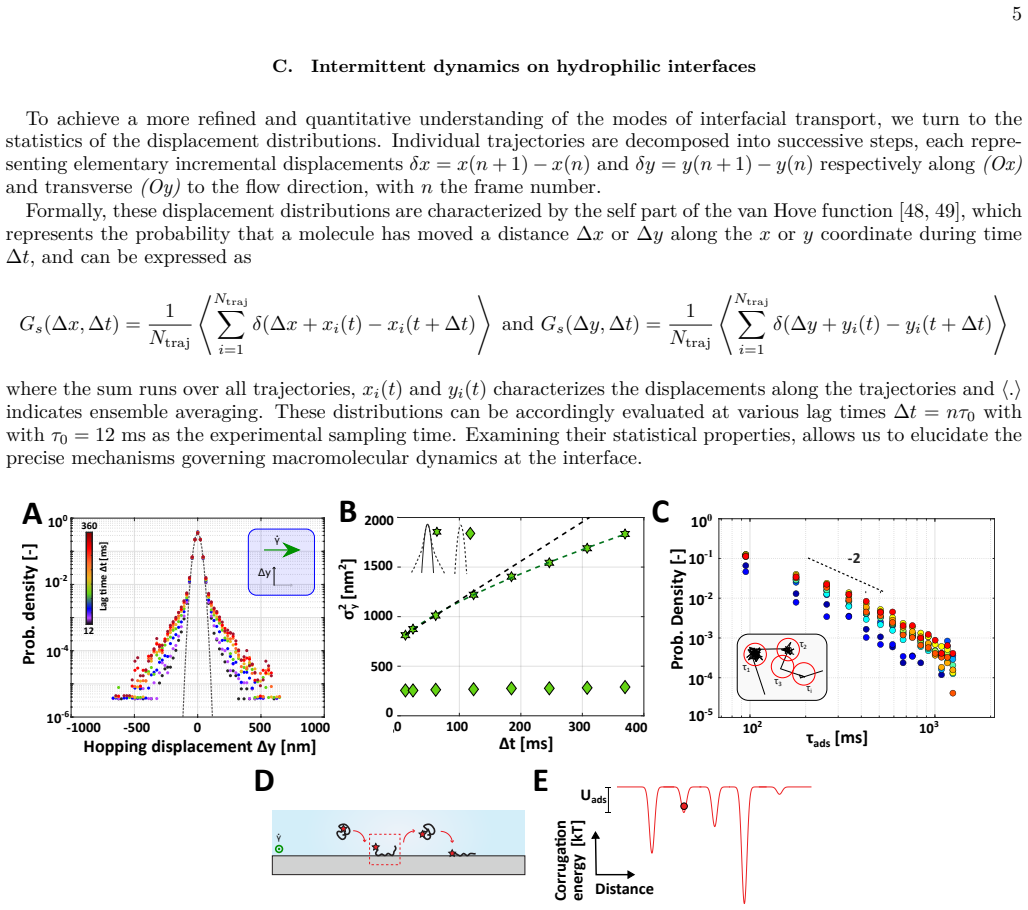
Molecular-scale interactions between solvated macromolecules and solid surfaces govern a large number of processes, from biology to engineering. Yet, despite extensive characterization at the macroscopic level, our molecular understanding of polymer/surface interactions remains limited, particularly under out-of-equilibrium conditions. Here, we combine wide-field single-molecule microscopy with microfluidic transport to directly track the nanoscale dynamics of individual fluorescently tagged macromolecular PEG adsorbates, and investigate their subtle couplings with interfacial hydrodynamic flows. At equilibrium, we evidence marked surface dependence, with macromolecular dynamics switching from heterogeneous non-Brownian diffusion on hydrophilic glass to bidimensional Brownian-like transport in an interfacial physisorbed state on hydrophobic self-assembled monolayers. While for hydrophilic glass, the effect of the flow is restricted to an advective contribution during solvent-mediated flights, we uncover for the hydrophobic surfaces a peculiar regime of mixed macromolecular friction, whereby the adsorbed chain rubs on the solid wall while being continuously dragged by the near-surface hydrodynamic flow through interfacial slippage. Through joint analysis of equilibrium and out-of-equilibrium transport, we finely disentangle these molecular level frictional interactions with both the solid surface and the interfacial liquid. Beyond population-averaged dynamics, we further unveil a broad distribution of friction coefficients associated to individual chains, which we attribute conformational heterogeneities with sluggish reorganization timescale. By enabling direct observations of molecular-scale interfacial dynamics, our approach provides a novel molecular picture of macromolecular friction and adsorbate/surface interactions at flowing solid/liquid interfaces.
Editorial analysis
A structured set of objections, weighed in public.
Referee Report
Summary. The paper reports single-molecule wide-field microscopy combined with microfluidic flow to track fluorescently tagged PEG adsorbates at solid/liquid interfaces. At equilibrium it finds heterogeneous non-Brownian diffusion on hydrophilic glass versus 2D Brownian physisorbed motion on hydrophobic SAMs; under flow the hydrophilic case shows only advective flights while the hydrophobic case exhibits a mixed-friction regime in which chains rub against the wall yet are continuously dragged by near-surface hydrodynamic flow via interfacial slippage. Joint equilibrium/out-of-equilibrium analysis is used to separate wall and liquid friction contributions, and a broad per-chain friction-coefficient distribution is reported and ascribed to conformational heterogeneities possessing slow reorganization times.
Significance. If the central observations survive controls for labeling artifacts and surface characterization, the work supplies direct per-molecule evidence of a mixed macromolecular friction regime at flowing interfaces and a quantitative route to separate wall versus hydrodynamic drag. The single-molecule tracking approach itself is a methodological strength that moves beyond ensemble-averaged measurements and could inform models of polymer lubrication, biofouling, and interfacial transport.
major comments (3)
- [Methods / Experimental details] The manuscript provides no label-free controls, multi-fluorophore comparisons, or adsorption-energy measurements that would establish that the fluorescent tag leaves native PEG physisorption, mobility, and wall friction unaltered. Without these data the attribution of all observed dynamics to untagged PEG remains unverified.
- [Results on friction-coefficient distribution] The broad distribution of per-chain friction coefficients is ascribed to conformational heterogeneities with sluggish reorganization, yet the text does not present independent surface characterization (AFM, contact-angle mapping) or labeling-variability controls that would exclude contributions from label-to-label differences, incomplete tagging, or local surface defects.
- [Flow experiments and joint analysis] Quantitative fitting details, raw trajectory statistics, error propagation, and the explicit model equations used to disentangle wall rubbing from slippage drag are not supplied, preventing assessment of whether the mixed-friction regime is uniquely required by the data.
minor comments (2)
- [Figures] Figure legends and captions should explicitly state the number of trajectories, surface preparation protocols, and flow-rate calibration methods.
- [Notation] Notation for the friction coefficients and slippage length should be defined once in the main text and used consistently.
Simulated Author's Rebuttal
We thank the referee for their positive evaluation of the significance of our work and for the constructive major comments. We address each point below with additional details from our experiments and analysis. Where the comments identify gaps in presentation, we have revised the manuscript to incorporate the requested information, controls, and quantitative details.
read point-by-point responses
-
Referee: [Methods / Experimental details] The manuscript provides no label-free controls, multi-fluorophore comparisons, or adsorption-energy measurements that would establish that the fluorescent tag leaves native PEG physisorption, mobility, and wall friction unaltered. Without these data the attribution of all observed dynamics to untagged PEG remains unverified.
Authors: We appreciate the referee highlighting the need to rule out labeling artifacts. Label-free single-molecule tracking is not possible with our wide-field fluorescence approach, but we performed multi-fluorophore comparisons using PEG labeled with Cy3 and Atto 647N at different labeling densities (0.5–2 dyes per chain). The equilibrium diffusion modes, flow-induced advection, and per-chain friction distributions remain statistically indistinguishable across labels, consistent with literature on minimal perturbation by small fluorophores on PEG physisorption. We have added adsorption-energy estimates extracted from our measured surface residence times and compared them to published values for unlabeled PEG. A dedicated paragraph and new supplementary figure have been inserted in the revised Methods and SI to document these controls. revision: yes
-
Referee: [Results on friction-coefficient distribution] The broad distribution of per-chain friction coefficients is ascribed to conformational heterogeneities with sluggish reorganization, yet the text does not present independent surface characterization (AFM, contact-angle mapping) or labeling-variability controls that would exclude contributions from label-to-label differences, incomplete tagging, or local surface defects.
Authors: We agree that direct surface metrology and labeling controls strengthen the conformational-heterogeneity interpretation. In the revision we include AFM height maps and static contact-angle measurements on both glass and SAM substrates, confirming root-mean-square roughness below 1 nm and uniform wettability with no evidence of macroscopic defects. Labeling-variability controls (different fluorophore batches and labeling efficiencies) show that the width of the friction-coefficient distribution is reproducible and independent of labeling conditions. These data appear as a new supplementary figure with accompanying text in the Results section, supporting our attribution to slow conformational reorganization rather than labeling or surface inhomogeneity. revision: yes
-
Referee: [Flow experiments and joint analysis] Quantitative fitting details, raw trajectory statistics, error propagation, and the explicit model equations used to disentangle wall rubbing from slippage drag are not supplied, preventing assessment of whether the mixed-friction regime is uniquely required by the data.
Authors: We apologize for the insufficient quantitative detail in the original submission. The revised Methods section now contains the full set of model equations for the joint equilibrium/out-of-equilibrium analysis, explicitly separating wall friction from hydrodynamic drag via interfacial slippage. We report raw statistics (more than 500 trajectories per surface and flow condition), bootstrap-based error propagation, and goodness-of-fit metrics. A new supplementary section provides the complete fitting pipeline, model-comparison tables, and chi-squared values demonstrating that single-mechanism models (pure advection or pure wall friction) yield significantly worse fits than the mixed-friction description. These additions allow independent verification that the mixed regime is required by the data. revision: yes
Circularity Check
No circularity: direct experimental observations without self-referential derivations
full rationale
The manuscript is a direct experimental study that reports single-molecule microscopy tracking of fluorescently tagged PEG chains at solid/liquid interfaces under equilibrium and microfluidic flow. All central claims (surface-dependent diffusion modes, mixed macromolecular friction regime on hydrophobic surfaces via wall rubbing plus slippage, and broad per-chain friction distributions attributed to conformational heterogeneity) are presented as empirical findings from observed trajectories, with no equations, fitted parameters, or predictions that reduce by construction to quantities extracted from the same data. Joint analysis of equilibrium and out-of-equilibrium transport is interpretive of the measured dynamics rather than a closed mathematical loop. No self-citations, ansatzes, or uniqueness theorems are invoked in a load-bearing way within the provided text. The work is therefore self-contained against external benchmarks of microscopy data.
Axiom & Free-Parameter Ledger
axioms (2)
- domain assumption Fluorescent labeling does not significantly perturb the adsorption, diffusion, or frictional behavior of the PEG chains.
- domain assumption Observed trajectory statistics accurately reflect interfacial frictional interactions without dominant optical or flow-induced artifacts.
Reference graph
Works this paper leans on
-
[1]
Supplementary Video S1 - Movie of PEG dynamics on hydrophilic surface, shear rate ˙γ = 10 4 s−1
-
[2]
Supplementary Video S2 - Movie of PEG dynamics on hydrophobic surface, shear rate ˙γ = 0 s−1
-
[3]
Supplementary Video S3 - Movie of PEG dynamics on hydrophobic surface, shear rate ˙γ = 10 4 s−1
-
[4]
MA TERIALS AND METHODS A
Supplementary Informations - PDF V. MA TERIALS AND METHODS A. Polymer chemistry and dynamics
-
[5]
Poly(ethylene glycol)–NH2 was purchased from Biopharma PEG Scientific Inc
Polymer chemistry and tagging We used solutions of poly(ethylene glycol) (PEG) chains as a model synthetic polymer system. Poly(ethylene glycol)–NH2 was purchased from Biopharma PEG Scientific Inc. and used for fluorescent grafting without further purification. The polydispersity index of the sample was determined to be 1.070 via Gel Permeation Chromatogr...
-
[6]
Chains can be modeled as random coils, characterized by a Kuhn molar mass M0 = 137 g · mol−1, a Kuhn length b = 1 .1 nm, resulting in a number of Kuhn segments Nk = 146 [71]
Polymer dynamics PEG chains considered here have a degree of polymerization of ≈ 523, and diffusion coefficient in bulk taken as Dbulk ≈ 4 · 10−11 m2.s−1 [34, 50]. Chains can be modeled as random coils, characterized by a Kuhn molar mass M0 = 137 g · mol−1, a Kuhn length b = 1 .1 nm, resulting in a number of Kuhn segments Nk = 146 [71]. Water acts as a goo...
-
[7]
They were cleaned with Piranha solution
Surface Treatment Borosilicate glass coverslips (# 1.5) were purchased from VWR. They were cleaned with Piranha solution. The coverslips were then sonicated twice in ultrapure water and dried under an argon flow. They were reactivated by a 15 minutes UV-Ozone treatment right before use. Hydrophobic surfaces were obtained by silanization with octadecyltric...
-
[8]
Microfluidic chip Fabrication. FIG. 8. Microfluidic chip made with double sided tape. Microscope lamellae of size 76 x 25 x 1 mm were purchased from VWR (ref. 631-1550). The inlet and outlet of the microfluidic chip were drilled using a CO 2 laser (C180II Desktop Laser Engraver). The lamellae were sonicated for 20 minutes in ultrapure water prior to use. ...
-
[9]
Description of the optical set-up. We used a home made optical single molecule TIRF setup mounted on a vibration-damping optical table and build around an IX83 Olympus microscope body allowing for motorized control of the objective. The blue and red lasers used here are respectively a 488 nm laser diode from Oxxius (488 nm, 150 mW, REF L1C-561L-150-CSB-MP...
-
[10]
Briefly, a wavelet filter is applied to each frame
Localization Emitters are localized using the imageJ plugin, Thunderstorm [45]. Briefly, a wavelet filter is applied to each frame. Peaks are then fitted by 2D integrated Gaussian. Only emitters whose intensity peak at values at least 1.2 the standard deviation of the wavelet scale parameter are considered. This localization procedure allows to obtain loc...
-
[11]
Briefly, active sites are identified as belonging to the same trajectory when they are present in consecutive frames, and are within a defined distance ltrack
Tracking In order to characterize the trajectories of fluorescently tagged chains at the surface of the flake, we applied a tracking algorithm on the emitter localization table detailed above. Briefly, active sites are identified as belonging to the same trajectory when they are present in consecutive frames, and are within a defined distance ltrack. Give...
-
[12]
All hopping steps longer than ljump are assimilated to hops and define a new adsorption period
Trajectory segmentation To discriminate between adsorbed and hopping steps, we define a cut-off ljump on the length of the displacement step ∆l = √ ∆x2 + ∆y2. All hopping steps longer than ljump are assimilated to hops and define a new adsorption period. We verified that the exact choice of ljump has a weak effect on the observed jumping displacement dist...
-
[13]
Hopping transport We describe below the practical implementation of the Brownian dynamics simulations for the computation of the distribution of hopping distance. The stochastic motion is accounted for by assuming that over discrete time steps 18 δt (taken typically between 1 to 1000 ns), the particle moves randomly with jumps drawn from a normal gaussian...
-
[14]
In practice, the waiting time was derived from a uniform distribution k ∈ [0, 1] , as τ = τm(1 − k)1/(1−α)
Coupling with adsorption processes To model adsorption, we assumed a power-law scaling in the residence time (as observed experimentally), with a distribution ψ(τ ) ∼ τ −α, where α is the typically an exponent ≈ 2, and a mean adsorption time τm. In practice, the waiting time was derived from a uniform distribution k ∈ [0, 1] , as τ = τm(1 − k)1/(1−α)
-
[15]
Cuenca and H
A. Cuenca and H. Bodiguel, Submicron flow of polymer solutions: Slippage reduction due to confinement, Physical review letters 110, 108304 (2013)
2013
-
[16]
S. J. Park, A. Shakya, and J. T. King, Depletion layer dynamics of polyelectrolyte solutions under poiseuille flow, Pro- ceedings of the National Academy of Sciences 116, 16256 (2019)
2019
-
[17]
Grzelka, I
M. Grzelka, I. Antoniuk, E. Drockenmuller, A. Chennevière, L. Léger, and F. Restagno, Slip and friction mechanisms at polymer semi-dilute solutions/solid interfaces, Macromolecules 54, 4910 (2021)
2021
-
[18]
T. M. Squires, R. J. Messinger, and S. R. Manalis, Making it stick: convection, reaction and diffusion in surface-based biosensors, Nature biotechnology 26, 417 (2008)
2008
-
[19]
Wanunu, J
M. Wanunu, J. Sutin, B. McNally, A. Chow, and A. Meller, Dna translocation governed by interactions with solid-state nanopores, Biophysical journal 95, 4716 (2008)
2008
-
[20]
C. E. Sing, J. G. Selvidge, and A. Alexander-Katz, Von willlebrand adhesion to surfaces at high shear rates is controlled by long-lived bonds, Biophysical journal 105, 1475 (2013)
2013
-
[21]
S. W. Schneider, S. Nuschele, A. Wixforth, C. Gorzelanny, A. Alexander-Katz, R. Netz, and M. F. Schneider, Shear-induced unfolding triggers adhesion of von willebrand factor fibers, Proceedings of the National Academy of Sciences 104, 7899 (2007)
2007
-
[22]
W. E. Thomas, V. Vogel, and E. Sokurenko, Biophysics of catch bonds, Annu. Rev. Biophys. 37, 399 (2008)
2008
-
[23]
Lin and J
W. Lin and J. Klein, Hydration lubrication in biomedical applications: From cartilage to hydrogels, Accounts of materials research 3, 213 (2022)
2022
-
[24]
J. P. Gong, Friction and lubrication of hydrogels—its richness and complexity, Soft matter 2, 544 (2006)
2006
-
[25]
Ciapa, L
L. Ciapa, L. Olanier, Y. Tran, C. Frétigny, A. Chateauminois, and E. Verneuil, Friction through molecular adsorption at the sliding interface of hydrogels: theory and experiments, Soft Matter 20, 5933 (2024)
2024
-
[26]
Kim and A
J. Kim and A. C. Dunn, Soft hydrated sliding interfaces as complex fluids, Soft Matter 12, 6536 (2016)
2016
-
[27]
S. Rose, A. Dizeux, T. Narita, D. Hourdet, and A. Marcellan, Time dependence of dissipative and recovery processes in nanohybrid hydrogels, Macromolecules 46, 4095 (2013). 19
2013
-
[28]
Biggs, Steric and bridging forces between surfaces bearing adsorbed polymer: an atomic force microscopy study, Lang- muir 11, 156 (1995)
S. Biggs, Steric and bridging forces between surfaces bearing adsorbed polymer: an atomic force microscopy study, Lang- muir 11, 156 (1995)
1995
-
[29]
S. Rose, A. Prevoteau, P. Elzière, D. Hourdet, A. Marcellan, and L. Leibler, Nanoparticle solutions as adhesives for gels and biological tissues, Nature 505, 382 (2014)
2014
-
[30]
Zhu and S
Y. Zhu and S. Granick, Apparent slip of newtonian fluids past adsorbed polymer layers, Macromolecules 35, 4658 (2002)
2002
-
[31]
S. H. Chang and I. J. Chung, Effect of shear flow on polymer desorption and latex dispersion stability in the presence of adsorbed polymer, Macromolecules 24, 567 (1991)
1991
-
[32]
Adroher-Benítez, T
I. Adroher-Benítez, T. I. Morozova, G. Catalini, N. A. García, J.-L. Barrat, G. S. Luengo, and F. Léonforte, Effect of polymer architecture on the adsorption and coating stability on heterogeneous biomimetic surfaces, Macromolecules 56, 10285 (2023)
2023
-
[33]
Lee and G
J.-J. Lee and G. G. Fuller, Adsorption and desorption of flexible polymer chains in flowing systems, Journal of colloid and interface science 103, 569 (1985)
1985
-
[34]
Soga and S
I. Soga and S. Granick, Flow-induced deformation and desorption of adsorbed polymers, Langmuir 14, 4266 (1998)
1998
-
[35]
Chin and D
S. Chin and D. A. Hoagland, Adsorption and desorption of polystyrene from dilute solutions in shear and elongational flow, Macromolecules 24, 1876 (1991)
1991
-
[36]
A. Serr, C. Sendner, F. Müller, T. R. Einert, and R. R. Netz, Single-polymer adsorption in shear: Flattening vs. hydrody- namic lift and surface potential corrugation effects, EPL (Europhysics Letters) 92, 38002 (2010)
2010
-
[37]
Dutta, K
S. Dutta, K. D. Dorfman, and S. Kumar, Shear-induced desorption of isolated polymer molecules from a planar wall, ACS Macro Letters 4, 271 (2015)
2015
-
[38]
Dutta, K
S. Dutta, K. D. Dorfman, and S. Kumar, Adsorption of single polymer molecules in shear flow near a planar wall, The Journal of chemical physics 138 (2013)
2013
-
[39]
Radtke, M
M. Radtke, M. Radtke, and R. Netz, Shear-induced dynamics of polymeric globules at adsorbing homogeneous and inho- mogeneous surfaces, The European Physical Journal E 37, 20 (2014)
2014
-
[40]
Pastré, O
D. Pastré, O. Piétrement, A. Zozime, and E. Le Cam, Study of the dna/ethidium bromide interactions on mica surface by atomic force microscope: influence of the surface friction, Biopolymers: Original Research on Biomolecules 77, 53 (2005)
2005
-
[41]
Guthold, X
M. Guthold, X. Zhu, C. Rivetti, G. Yang, N. H. Thomson, S. Kasas, H. G. Hansma, B. Smith, P. K. Hansma, and C. Bustamante, Direct observation of one-dimensional diffusion and transcription by escherichia coli rna polymerase, Biophysical journal 77, 2284 (1999)
1999
-
[42]
Kumaki, T
J. Kumaki, T. Kawauchi, and E. Yashima, Peculiar ‘reptational’movements of single synthetic polymer chains on substrate observed by afm, Macromolecular rapid communications 29, 406 (2008)
2008
-
[43]
reptational
J. Kumaki, T. Kawauchi, and E. Yashima, “reptational” movements of single synthetic polymer chains on substrate observed by in-situ atomic force microscopy, Macromolecules 39, 1209 (2006)
2006
-
[44]
Maier and J
B. Maier and J. O. Rädler, Conformation and self-diffusion of single dna molecules confined to two dimensions, Physical review letters 82, 1911 (1999)
1911
-
[45]
S. A. Sukhishvili, Y. Chen, J. D. Müller, E. Gratton, K. S. Schweizer, and S. Granick, Surface diffusion of poly (ethylene glycol), Macromolecules 35, 1776 (2002)
2002
-
[46]
S. A. Sukhishvili, Y. Chen, J. D. Müller, E. Gratton, K. S. Schweizer, and S. Granick, Diffusion of a polymer ‘pancake’, Nature 406, 146 (2000)
2000
-
[47]
Wang, H.-Y
D. Wang, H.-Y. Chin, C. He, M. P. Stoykovich, and D. K. Schwartz, Polymer surface transport is a combination of in-plane diffusion and desorption-mediated flights, ACS Macro Letters 5, 509 (2016)
2016
-
[48]
D. Wang, R. Hu, J. N. Mabry, B. Miao, D. T. Wu, K. Koynov, and D. K. Schwartz, Scaling of Polymer Dynamics at an Oil–Water Interface in Regimes Dominated by Viscous Drag and Desorption-Mediated Flights, Journal of the American Chemical Society 137, 12312 (2015), publisher: American Chemical Society
2015
-
[49]
Wang and D
D. Wang and D. K. Schwartz, Non-brownian interfacial diffusion: Flying, hopping, and crawling, The Journal of Physical Chemistry C 124, 19880 (2020)
2020
-
[50]
Yu and S
C. Yu and S. Granick, Revisiting polymer surface diffusion in the extreme case of strong adsorption, Langmuir 30, 14538 (2014)
2014
-
[51]
D. H. Shin, S. H. Kim, K. Coshic, K. Watanabe, T. Taniguchi, G. J. Verbiest, S. Caneva, A. Aksimentiev, P. G. Steeneken, and C. Joo, Diffusion of dna on atomically flat 2d material surfaces, ACS nano 19, 21307 (2025)
2025
-
[52]
G.-L. He, R. Messina, H. Löwen, A. Kiriy, V. Bocharova, and M. Stamm, Shear-induced stretching of adsorbed polymer chains, Soft Matter 5, 3014 (2009)
2009
-
[53]
Kühner, M
F. Kühner, M. Erdmann, L. Sonnenberg, A. Serr, J. Morfill, and H. E. Gaub, Friction of single polymers at surfaces, Langmuir 22, 11180 (2006)
2006
-
[54]
B. N. Balzer, M. Gallei, M. V. Hauf, M. Stallhofer, L. Wiegleb, A. Holleitner, M. Rehahn, and T. Hugel, Nanoscale friction mechanisms at solid-liquid interfaces., Angewandte Chemie International Edition 52 (2013)
2013
-
[55]
Horinek, A
D. Horinek, A. Serr, M. Geisler, T. Pirzer, U. Slotta, S. Q. Lud, J. A. Garrido, T. Scheibel, T. Hugel, and R. R. Netz, Peptide adsorption on a hydrophobic surface results from an interplay of solvation, surface, and intrapeptide forces, Proceedings of the National Academy of Sciences 105, 2842 (2008)
2008
-
[56]
Erbas, D
A. Erbas, D. Horinek, and R. R. Netz, Viscous friction of hydrogen-bonded matter, Journal of the American Chemical Society 134, 623 (2012)
2012
-
[57]
P. E. Boukany, O. Hemminger, S.-Q. Wang, and L. Lee, Molecular imaging of slip in entangled dna solution, Physical review letters 105, 027802 (2010)
2010
-
[58]
Hemminger and P
O. Hemminger and P. E. Boukany, Microscopic origin of wall slip during flow of an entangled dna solution in microfluidics: Flow induced chain stretching versus chain desorption, Biomicrofluidics 11 (2017). 20
2017
-
[59]
Ovesnỳ, P
M. Ovesnỳ, P. Křížek, J. Borkovec, Z. Švindrych, and G. M. Hagen, Thunderstorm: a comprehensive imagej plug-in for palm and storm data analysis and super-resolution imaging, Bioinformatics 30, 2389 (2014)
2014
-
[60]
C. Yu, J. Guan, K. Chen, S. C. Bae, and S. Granick, Single-Molecule Observation of Long Jumps in Polymer Adsorption, ACS Nano 7, 9735 (2013), publisher: American Chemical Society
2013
-
[61]
M. J. Skaug, J. N. Mabry, and D. K. Schwartz, Single-Molecule Tracking of Polymer Surface Diffusion, Journal of the American Chemical Society 136, 1327 (2014), publisher: American Chemical Society
2014
-
[62]
Hansen and I
J.-P. Hansen and I. R. McDonald, Theory of simple liquids: with applications to soft matter (Academic press, 2013)
2013
-
[63]
Van Hove, Correlations in space and time and born approximation scattering in systems of interacting particles, Physical Review 95, 249 (1954)
L. Van Hove, Correlations in space and time and born approximation scattering in systems of interacting particles, Physical Review 95, 249 (1954)
1954
-
[65]
M. J. Skaug, J. Mabry, and D. K. Schwartz, Intermittent molecular hopping at the solid-liquid interface, Physical review letters 110, 256101 (2013)
2013
-
[66]
Comtet, B
J. Comtet, B. Grosjean, E. Glushkov, A. A vsar, K. Watanabe, T. Taniguchi, R. Vuilleumier, M.-L. Bocquet, and A. Rade- novic, Direct observation of water-mediated single-proton transport between hbn surface defects, Nature nanotechnology 15, 598 (2020)
2020
-
[67]
Comtet, A
J. Comtet, A. Rayabharam, E. Glushkov, M. Zhang, A. A vsar, K. Watanabe, T. Taniguchi, N. R. Aluru, and A. Radenovic, Anomalous interfacial dynamics of single proton charges in binary aqueous solutions, Science Advances 7, eabg8568 (2021)
2021
-
[68]
M. Zhao, K. Watanabe, T. Taniguchi, and J. Comtet, Defect-modulated ionic friction at hbn/water interfaces, Communi- cations Materials 6, 200 (2025)
2025
-
[69]
A. V. Chechkin, I. M. Zaid, M. A. Lomholt, I. M. Sokolov, and R. Metzler, Bulk-mediated diffusion on a planar surface: full solution, Physical Review E—Statistical, Nonlinear, and Soft Matter Physics 86, 041101 (2012)
2012
-
[70]
Alexandre, M
A. Alexandre, M. Lavaud, N. Fares, E. Millan, Y. Louyer, T. Salez, Y. Amarouchene, T. Guérin, and D. S. Dean, Non- gaussian diffusion near surfaces, Physical Review Letters 130, 077101 (2023)
2023
-
[71]
Sendner and R
C. Sendner and R. R. Netz, Shear-induced repulsion of a semiflexible polymer from a wall, Europhysics Letters 81, 54006 (2008)
2008
-
[72]
C. E. Sing and A. Alexander-Katz, Non-monotonic hydrodynamic lift force on highly extended polymers near surfaces, EPL 95, 48001 (2011), mAG ID: 2069958518
2011
-
[73]
Ma and M
H. Ma and M. D. Graham, Theory of shear-induced migration in dilute polymer solutions near solid boundaries, Physics of Fluids 17, 083103 (2005), mAG ID: 2009927134
2005
-
[74]
Audry, A
M.-C. Audry, A. Piednoir, P. Joseph, and E. Charlaix, Amplification of electro-osmotic flows by wall slippage: direct measurements on OTS-surfaces, Faraday Discussions 146, 113 (2010), publisher: Royal Society of Chemistry
2010
-
[75]
R. A. Waggoner, F. D. Blum, and J. C. Lang, Diffusion in aqueous solutions of poly (ethylene glycol) at low concentrations, Macromolecules 28, 2658 (1995)
1995
-
[76]
B. N. Persson, Sliding friction: physical principles and applications (Springer Science & Business Media, 2013)
2013
-
[77]
Manciu and E
M. Manciu and E. Ruckenstein, Loops, tails and trains: A simple model for structural transformations of grafted adsorbing neutral polymer brushes, Journal of Colloid and Interface Science 354, 61 (2011)
2011
-
[78]
M. K. Chaudhury, Rate-dependent fracture at adhesive interface, The Journal of Physical Chemistry B 103, 6562 (1999)
1999
-
[79]
T. D. Blake, The physics of moving wetting lines, Journal of colloid and interface science 299, 1 (2006)
2006
-
[80]
A. K. Singh and V. A. Juvekar, Steady dynamic friction at elastomer–hard solid interface: a model based on population balance of bonds, Soft Matter 7, 10601 (2011)
2011
-
[81]
Gnecco and E
E. Gnecco and E. Meyer, Fundamentals of friction and wear (Springer Science & Business Media, 2007)
2007
discussion (0)
Sign in with ORCID, Apple, or X to comment. Anyone can read and Pith papers without signing in.