Recognition: unknown
Pattern Formation and Stick-Slip Dynamics in Binary Particle Assemblies with Rotating Drives
Pith reviewed 2026-05-08 16:35 UTC · model grok-4.3
The pith
In binary repulsive particle systems, rotating drives induce frequency-dependent pattern formation with abrupt transport switches between stripes, jams, and fluids.
A machine-rendered reading of the paper's core claim, the machinery that carries it, and where it could break.
Core claim
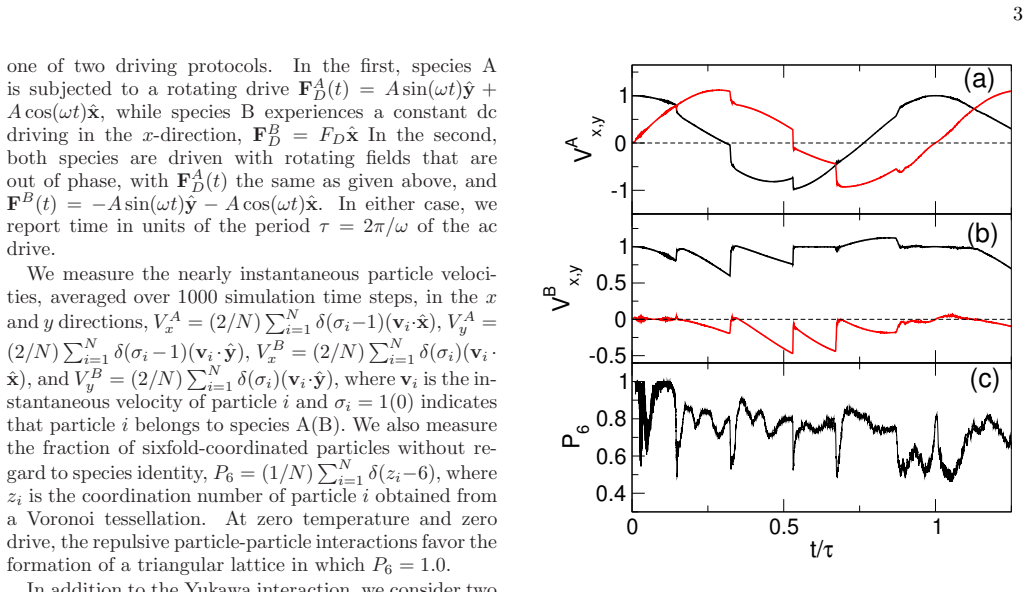
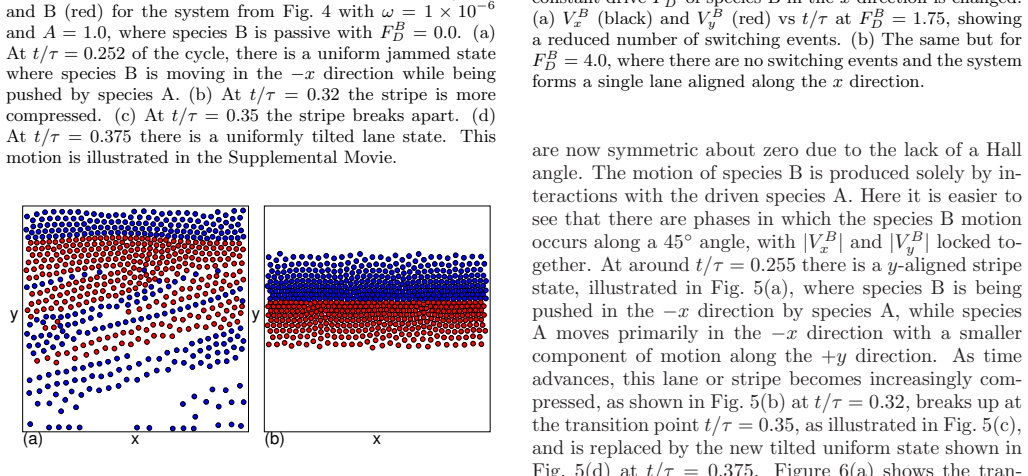
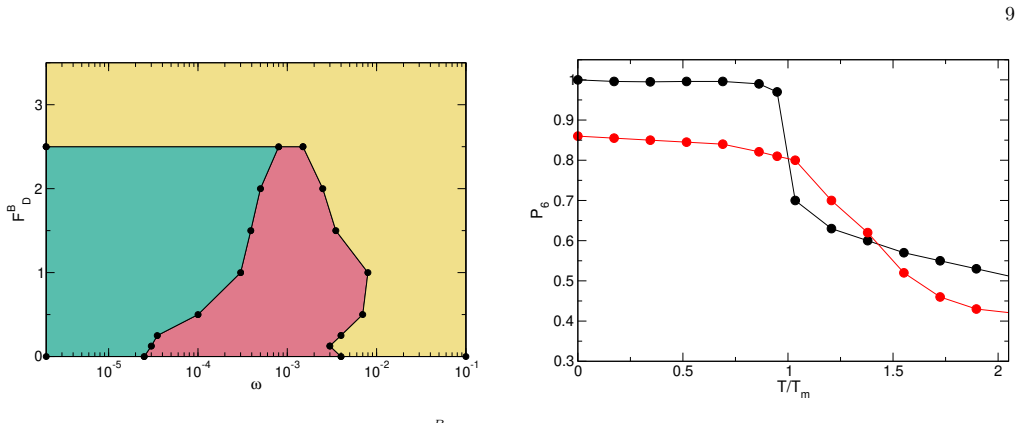
In a binary system of particles with repulsive interactions, where one species is driven by a rotating drive and the other is subjected either to a constant drive in a fixed direction or to a rotating drive that is out of phase with the first species, varying the rotation frequency induces order-disorder transitions and pattern forming states such as density-modulated stripes, partially jammed states, phase separated fluids, and mixed fluids. At low frequencies the system switches between pattern-forming phase-separated lanes similar to oppositely driven colloids, with lanes aligning to the net rotation direction and corresponding abrupt jumps in transport curves and changes in topological.
What carries the argument
The competition between rotating drive frequencies and interparticle repulsions that produces laning, phase separation, and frequency-dependent order-disorder switching.
If this is right
- Low rotation frequencies produce aligned lanes with abrupt transport jumps at transitions.
- Intermediate frequencies fluidize the system and eliminate laning while high frequencies restore patterned flow when orbits shrink below particle spacing.
- Finite temperature reduces global switching but preserves local density enhancements leading to recrystallization.
- The pattern switching persists for different screened repulsive interaction potentials.
Where Pith is reading between the lines
- Real-time control of rotation frequency could enable dynamic reconfiguration of particle flows for sorting or mixing in soft matter devices.
- The stick-slip transport jumps suggest connections to friction and clogging phenomena in other driven granular systems.
- Similar frequency-tuned patterning might appear in active matter where propulsion directions are rotated.
Load-bearing premise
The idealized repulsive interaction potentials and drive protocols capture the dominant physics in the absence of hydrodynamic interactions or untested thermal fluctuation regimes.
What would settle it
An experiment with colloidal particles under controlled rotating fields would falsify the claim if no abrupt transport jumps or pattern switches are observed at the frequencies where simulations predict order-disorder transitions.
Figures






read the original abstract
We numerically examine a binary system of particles with repulsive interactions, where one species is driven by a rotating drive and the other is subjected either to a constant drive in a fixed direction or to a rotating drive that is out of phase with the first species. As a function of rotation frequency, we find a variety of order-disorder transitions and pattern forming states, including density-modulated stripes, partially jammed states, phase separated fluids, and mixed fluids. When one species has a constant drive and the drive on the other species is rotated at low frequencies, the system switches between different pattern forming phase-separated lanes including density-modulated stripes and partially jammed states, similar to what is observed for oppositely driven colloids. The lanes tend to align with the net direction of rotation, resulting in a series of order-disorder switching transitions. The transport curves show abrupt jumps up or down at the transitions, which also correspond with changes in the topological order. We find similar switching transitions when both species rotate out of phase with each other. For intermediate driving frequencies, the system becomes increasingly fluid-like and the laning behavior is lost. At high frequencies, however, the system can again exhibit patterned flow when the rotation orbits become smaller than the average spacing between particles. The switching is reduced when a finite temperature is included, but even for temperatures at which the uniform equilibrium bulk system is liquid, the partially jammed state can generate local density enhancements that lead to recrystallization. We demonstrate the pattern switching behavior for systems with different screened repulsive interaction potentials.
Editorial analysis
A structured set of objections, weighed in public.
Referee Report
Summary. The manuscript reports molecular dynamics simulations of a binary repulsive particle system in which one species experiences a rotating drive while the second is driven either by a constant force or by a rotating drive with a phase offset. As a function of rotation frequency the simulations exhibit a sequence of order-disorder transitions that produce density-modulated stripes, partially jammed states, phase-separated fluids and mixed fluids. These transitions are accompanied by abrupt jumps in transport curves and changes in topological order parameters; the same qualitative switching persists across several screened repulsive potentials and, to a reduced extent, at finite temperature where jammed regions can still induce local recrystallization.
Significance. If the numerical observations are robust, the work extends the literature on lane formation and non-equilibrium patterning from constant-drive colloidal mixtures to rotating-drive protocols. The re-entrant appearance of patterns at high frequency (when orbital radii fall below inter-particle spacing) and the persistence of jammed states above the bulk melting temperature are potentially useful for understanding frequency-tunable assembly in active or driven soft matter.
major comments (2)
- The abstract and main text provide no information on the integration algorithm, time step, number of particles, box size, or averaging protocol used to obtain the transport curves and order-parameter data. These details are required to judge whether the reported frequency-dependent jumps and pattern switches are converged and statistically reliable.
- The statement that 'the partially jammed state can generate local density enhancements that lead to recrystallization' at temperatures where the uniform bulk system is liquid is presented without a quantitative reference to the melting temperature or supporting plots of local density or order-parameter profiles; this weakens the finite-temperature claim.
minor comments (2)
- The title highlights 'Stick-Slip Dynamics' yet the abstract and reported diagnostics focus on pattern formation and transport jumps; a brief clarification of how the observed switching corresponds to stick-slip behavior would improve readability.
- Figure captions should explicitly list the rotation frequencies, drive amplitudes, and phase offsets corresponding to each snapshot or curve so that readers can map visuals directly to the described transitions.
Simulated Author's Rebuttal
We thank the referee for the positive evaluation of our work and for the constructive comments on methodological details and the finite-temperature analysis. We address each major comment below and have prepared revisions to strengthen the manuscript.
read point-by-point responses
-
Referee: The abstract and main text provide no information on the integration algorithm, time step, number of particles, box size, or averaging protocol used to obtain the transport curves and order-parameter data. These details are required to judge whether the reported frequency-dependent jumps and pattern switches are converged and statistically reliable.
Authors: We agree that these simulation parameters are essential for evaluating the robustness of the reported transitions. In the revised manuscript we will insert a dedicated Methods section that specifies the molecular-dynamics integration algorithm, the integration time step, the total particle number, the periodic-box dimensions, and the averaging procedure (including the number of independent runs and the time window used) for all transport curves and order parameters. These additions will allow readers to confirm convergence of the frequency-dependent jumps and pattern switches. revision: yes
-
Referee: The statement that 'the partially jammed state can generate local density enhancements that lead to recrystallization' at temperatures where the uniform bulk system is liquid is presented without a quantitative reference to the melting temperature or supporting plots of local density or order-parameter profiles; this weakens the finite-temperature claim.
Authors: We acknowledge that the finite-temperature claim would benefit from quantitative support. In the revised manuscript we will report the bulk melting temperature obtained from separate equilibrium simulations of the uniform system and will add figures showing local density profiles together with spatially resolved order-parameter maps. These data will demonstrate that the jammed regions produce local density enhancements and recrystallization at temperatures above the bulk melting point. revision: yes
Circularity Check
No significant circularity in simulation-based claims
full rationale
The manuscript reports direct numerical observations from molecular-dynamics simulations of a binary repulsive particle system under specified rotating-drive protocols. All reported transitions, patterns, and transport features are generated by integrating the equations of motion for varying control parameters (rotation frequency, phase, temperature, and interaction screening length). No closed-form derivations, parameter fits renamed as predictions, or load-bearing self-citations appear in the provided text; the central claims are explicitly about the behavior of the chosen model rather than an external mapping or uniqueness theorem. The absence of any reduction of results to their own inputs by construction places the work in the normal non-circular category for simulation studies.
Axiom & Free-Parameter Ledger
free parameters (2)
- rotation frequency
- drive amplitude and phase offset
axioms (2)
- domain assumption Particles interact via screened repulsive potentials
- domain assumption Overdamped or inertial particle dynamics under external drives
Reference graph
Works this paper leans on
-
[1]
53 ≤ t/τ ≤ 0. 67. Over this same interval of time, V A y switches from positive to negative values. In Fig. 3(a) we illustrate the particle configurations just after t/τ = 0. 53 where the system is temporarily disordered and is in the process of forming a laned state aligned along the x direc- tion. Although this newly formed lane state is aligned in x, th...
-
[2]
C. J. Olson Reichhardt, C. Reichhardt, and A. R. Bishop, Structural transitions, melting, and intermediate phases for stripe- and clump-forming systems, Phys. Rev. E 82, 041502 (2010)
2010
-
[3]
Q. Meng, C. N. Varney, H. Fangohr, and E. Babaev, Phase diagrams of vortex matter with multi-scale inter- vortex interactions in layered superconductors, J. Phys.: Condens. Matter 29, 035602 (2017)
2017
-
[4]
X. B. Xu, T. Tang, Z. H. Wang, X. N. Xu, G. Y. Fang, and M. Gu, Nonequilibrium pattern formation in circu- larly confined two-dimensional systems with competing interactions, Phys. Rev. E 103, 012604 (2021)
2021
-
[5]
Hooshanginejad, J.-W
A. Hooshanginejad, J.-W. Barotta, V. Spradlin, G. Pucci, R. Hunt, and D. M. Harris, Interactions and pattern formation in a macroscopic magnetocapillary salr system of mermaid cereal, Nature Commun. 15, 5466 (2024)
2024
-
[6]
Seul and R
M. Seul and R. Wolfe, Evolution of disorder in magnetic stripe domains. I. Transverse instabilities and disclina- tion unbinding in lamellar patterns, Phys. Rev. A 46, 7519 (1992)
1992
-
[7]
Malescio and G
G. Malescio and G. Pellicane, Stripe phases from isotropic repulsive interactions, Nature Mater. 2, 97 (2003). 15
2003
-
[8]
Massana-Cid, D
H. Massana-Cid, D. Levis, R. Josue Hernandez, I. Pago- nabarraga, and P. . Tierno, Arrested phase separation in chiral fluids of colloidal spinners, Phys. Rev. Research 3, L04201 (2021)
2021
-
[9]
Katzmeier, B
F. Katzmeier, B. Altaner, J. List, U. Gerland, and F. . Simmel, Emergence of colloidal patterns in ac electric fields, Phys. Rev. Lett. 128, 058002 (2022)
2022
-
[10]
McDermott, C
D. McDermott, C. J. O. Reichhardt, and C. Reichhardt, Stripe systems with competing interactions on quasi-one dimensional periodic substrates, Soft Matter 10, 6332 (2014)
2014
-
[11]
Reichhardt and C
C. Reichhardt and C. J. O. Reichhardt, Depinning and nonequilibrium dynamic phases of particle assemblies driven over random and ordered substrates: a review, Rep. Prog. Phys. 80, 026501 (2017)
2017
-
[12]
Dzubiella, G
J. Dzubiella, G. P. Hoffmann, and H. L¨ owen, Lane for- mation in colloidal mixtures driven by an external field, Phys. Rev. E 65, 021402 (2002)
2002
-
[13]
Rex and H
M. Rex and H. L¨ owen, Lane formation in oppositely charged colloids driven by an electric field: Chaining and two-dimensional crystallization, Phys. Rev. E 75, 051402 (2007)
2007
-
[14]
Glanz and H
T. Glanz and H. L¨ owen, The nature of the laning tran- sition in two dimensions, J. Phys: Condens. Matter 24, 464114 (2012)
2012
-
[15]
Wysocki and H
A. Wysocki and H. L¨ owen, Oscillatory driven colloidal binary mixtures: Axial segregation versus laning, Phys. Rev. E 79, 041408 (2009)
2009
-
[16]
Vissers, A
T. Vissers, A. van Blaaderen, and A. Imhof, Band forma- tion in mixtures of oppositely charged colloids driven by an ac electric field, Phys. Rev. Lett. 106, 228303 (2011)
2011
-
[17]
Li, Y.-L
B. Li, Y.-L. Wang, G. Shi, Y. Gao, X. Shi, C. E. Wood- ward, and J. Forsman, Phase transitions of oppositely charged colloidal particles driven by alternating current electric field, ACS Nano 15, 2363 (2021)
2021
-
[18]
Tierno, R
P. Tierno, R. Muruganathan, and T. M. Fischer, Vis- coelasticity of dynamically self-assembled paramagnetic colloidal clusters, Phys. Rev. Lett. 98, 028301 (2007)
2007
-
[19]
B. C. van Zuiden, J. Paulose, W. T. M. Irvine, D. Bar- tolo, and V. Vitelli, Spatiotemporal order and emergent edge currents in active spinner materials, Proc. Natl. Acad. Sci. (USA) 113, 12919 (2016)
2016
-
[20]
M. Han, J. Yan, S. Granick, and E. Luijten, Effective temperature concept evaluated in an active colloid mix- ture, Proc. Natl. Acad. Sci. (USA) 114, 7513 (2017)
2017
-
[21]
Reichhardt and C
C. Reichhardt and C. J. O. Reichhardt, Reversibility, pattern formation, and edge transport in active chiral and passive disk mixtures, J. Chem. Phys. 150, 064905 (2019)
2019
-
[22]
C. J. O. Reichhardt and C. Reichhardt, Disordering, clus- tering, and laning transitions in particle systems with dispersion in the Magnus term, Phys. Rev. E 99, 012606 (2019)
2019
-
[23]
Chakrabarti, J
J. Chakrabarti, J. Dzubiella, and H. L¨ owen, Reentrance effect in the lane formation of driven colloids, Phys. Rev. E 70, 012401 (2004)
2004
-
[24]
Ikeda, H
M. Ikeda, H. Wada, and H. Hayakawa, Instabilities and turbulence-like dynamics in an oppositely driven binary particle mixture, EPL 99, 68005 (2012)
2012
-
[25]
Klymko, P
K. Klymko, P. L. Geissler, and S. Whitelam, Microscopic origin and macroscopic implications of lane formation in mixtures of oppositely driven particles, Phys. Rev. E 94, 022608 (2016)
2016
-
[26]
Poncet, O
A. Poncet, O. B´ enichou, V. D´ emery, and G. Oshanin, Universal long ranged correlations in driven binary mix- tures, Phys. Rev. Lett. 118, 118002 (2017)
2017
-
[27]
Glanz, R
T. Glanz, R. Wittkowski, and H. L¨ owen, Symmetry breaking in clogging for oppositely driven particles, Phys . Rev. E 94, 052606 (2016)
2016
-
[28]
Reichhardt and C
C. Reichhardt and C. J. O. Reichhardt, Velocity force curves, laning, and jamming for oppositely driven disk systems, Soft Matter 14, 490 (2018)
2018
-
[29]
Helbing, I
D. Helbing, I. J. Farkas, and T. Vicsek, Freezing by heat- ing in a driven mesoscopic system, Phys. Rev. Lett. 84, 1240 (2000)
2000
-
[30]
Bain and D
N. Bain and D. Bartolo, Critical mingling and universal correlations in model binary active liquids, Nature Com- mun. 8, 15969 (2017)
2017
-
[31]
H. Yu, K. Thijssen, and R. L. Jack, Perpendicular and parallel phase separation in two-species driven diffusive lattice gases, Phys. Rev. E 106, 024129 (2022)
2022
-
[32]
Yu and R
H. Yu and R. L. Jack, Competition between lanes and transient jammed clusters in driven binary mixtures, Phys. Rev. E 109, 024123 (2024)
2024
-
[33]
Reichhardt and C
C. Reichhardt and C. J. O. Reichhardt, Cooperative be- havior and pattern formation in mixtures of driven and nondriven colloidal assemblies, Phys. Rev. E 74, 011403 (2006)
2006
-
[34]
Kogler and S
F. Kogler and S. H. L. Klapp, Lane formation in a system of dipolar microswimmers, EPL 110, 10004 (2015)
2015
-
[35]
C. W. W¨ achtler, F. Kogler, and S. H. L. Klapp, Lane formation in a driven attractive fluid, Phys. Rev. E 94, 052603 (2016)
2016
-
[36]
C. Reichhardt and C. J. O. Reichhardt, Hysteresis, lan- ing, and negative drag in binary systems with opposite and perpendicular driving, arXiv:2512.13925 (2026)
-
[37]
M. E. Leunissen, C. G. Christova, A. P. Hynninen, C. P. Royall, A. I. Campbell, A. Imhof, M. Dijkstra, R. van Roij, and A. van Blaaderen, Ionic colloidal crystals of oppositely charged particles, Nature (London) 437, 235 (2005)
2005
-
[38]
K. R. S¨ utterlin, A. Wysocki, A. V. Ivlev, C. R¨ ath, H. M. Thomas, M. Rubin-Zuzic, W. J. Goedheer, V. E. Fortov, A. M. Lipaev, V. I. Molotkov, O. F. Petrov, G. E. Mor- fill, and H. L¨ owen, Dynamics of lane formation in driven binary complex plasmas, Phys. Rev. Lett. 102, 085003 (2009)
2009
-
[39]
Isele, K
M. Isele, K. Hofmann, A. Erbe, P. Leiderer, and P. Nielaba, Lane formation of colloidal particles driven in parallel by gravity, Phys. Rev. E 108, 034607 (2023)
2023
-
[40]
Reichhardt, J
C. Reichhardt, J. Thibault, S. Papanikolaou, and C. J. O. Reichhardt, Laning and clustering transitions in driven binary active matter systems, Phys. Rev. E 98, 022603 (2018)
2018
-
[41]
Khelfa, R
B. Khelfa, R. Korbmacher, A. Schadschneider, and A. Tordeux, Heterogeneity-induced lane and band for- mation in self-driven particle systems, Sci. Rep. 12, 4768 (2022)
2022
-
[42]
Feliciani and K
C. Feliciani and K. Nishinari, Empirical analysis of the lane formation process in bidirectional pedestrian flow, Phys. Rev. E 94, 032304 (2016)
2016
-
[43]
K. A. Bacik, B. S. Bacik, and T. Rogers, Lane nucleation in complex active flows, Science 379, 923 (2023)
2023
-
[44]
N. P. Vizarim, J. C. B. Souza, C. J. O. Reichhardt, C. Reichhardt, P. A. Venegas, and F. B´ eron, Skyrmion- skyrmionium phase separation and laning transitions via spin-orbit torque currents, Phys. Rev. B 111, 214438 16 (2025)
2025
-
[45]
J. F. Neto and C. C. d. S. Silva, Mesoscale phase separation of skyrmion-vortex matter in chiral-magnet– superconductor heterostructures, Phys. Rev. Lett. 128, 057001 (2022)
2022
-
[46]
Zarenia, D
M. Zarenia, D. Neilson, and F. M. Peeters, Inhomoge- neous phases in coupled electron-hole bilayer graphene sheets: Charge density waves and coupled Wigner crys- tals, Sci. Rep. 7, 11510 (2017)
2017
-
[47]
Y. Zhou, J. Sung, E. Brutschea, I. Esterlis, Y. Wang, G. Scuri, R. J. Gelly, H. Heo, T. Taniguchi, K. Watan- abe, G. Zar´ and, M. D. Lukin, P. Kim, E. Demler, and H. Park, Bilayer Wigner crystals in a transition metal dichalcogenide heterostructure, Nature (London) 595, 48 (2021)
2021
-
[48]
T. A. Vezirov and S. H. L. Klapp, Nonequilibrium dy- namics of a confined colloidal bilayer in a planar shear flow, Phys. Rev. E 88, 052307 (2013)
2013
-
[49]
Lekner, Summation of Coulomb fields in computer- simulated disordered-systems, Physica A 176, 485 (1991)
J. Lekner, Summation of Coulomb fields in computer- simulated disordered-systems, Physica A 176, 485 (1991)
1991
-
[50]
Grønbech-Jensen, Lekner summation of long range interactions in periodic systems, Int
N. Grønbech-Jensen, Lekner summation of long range interactions in periodic systems, Int. J. Mod. Phys. C 8, 1287 (1997)
1997
-
[51]
Reichhardt and C
C. Reichhardt and C. J. O. Reichhardt, Nonlinear dy- namics, avalanches, and noise for driven Wigner crystals, Phys. Rev. B 106, 235417 (2022)
2022
-
[52]
Reichhardt and C
C. Reichhardt and C. J. O. Reichhardt, Directional lock- ing and hysteresis in stripe- and bubble-forming systems on one-dimensional periodic substrates with a rotating drive, Phys. Rev. E 111, 054119 (2025)
2025
-
[53]
Reichhardt and C
C. Reichhardt and C. J. O. Reichhardt, Active microrhe- ology, Hall effect, and jamming in chiral fluids, Phys. Rev. E 100, 012604 (2019)
2019
-
[54]
Rothen and P
F. Rothen and P. Piera´ nski, Mechanical equilibrium of conformal crystals, Phys. Rev. E 53, 2828 (1996)
1996
-
[55]
R. M. Menezes and C. C. de Souza Silva, Conformal vor- tex crystals, Sci. Rep. 7, 12766 (2017)
2017
-
[56]
J. C. Bellizotti Souza, N. P. Vizarim, C. J. O. Reichhardt, C. Reichhardt, and P. A. Venegas, Spontaneous skyrmion conformal lattice and transverse motion during dc and ac compression, New J. Phys. 25, 053020 (2023)
2023
-
[57]
Ben-David, S
O. Ben-David, S. M. Rubinstein, and J. Fineberg, Slip- stick and the evolution of frictional strength, Nature 463, 76 (2010)
2010
-
[58]
P. Tian, D. Tao, W. Yin, X. Zhang, Y. Meng, and Y. Tian, Creep to inertia dominated stick-slip behavior in sliding friction modulated by tilted non-uniform loading, Sci. Rep. 6, 33730 (2016)
2016
discussion (0)
Sign in with ORCID, Apple, or X to comment. Anyone can read and Pith papers without signing in.