Recognition: unknown
Observation of the charmless purely baryonic decay mathinner{Λ⁰_b\!to Λ p overline{p}}
Pith reviewed 2026-05-08 16:46 UTC · model grok-4.3
The pith
The LHCb experiment observes the charmless baryonic decay Lambda_b to Lambda p p-bar for the first time at 5.1 sigma.
A machine-rendered reading of the paper's core claim, the machinery that carries it, and where it could break.
Core claim
The decay mode Λ_b^0 → Λ p p-bar is observed for the first time in a sample of 6 fb^{-1} of 13 TeV pp collisions collected by LHCb. After applying a selection to remove intermediate resonances with m(h h-bar) < 2.85 GeV, a signal yield is extracted with 5.1σ significance. The ratio of branching fractions to the reference mode Λ_b^0 → Λ K^+ K^- is determined to be (5.1 ± 1.3 ± 0.3) × 10^{-2}.
What carries the argument
Normalization of the signal yield to the topologically similar reference decay Λ_b^0 → Λ K^+ K^-, combined with an invariant mass cut on the companion hadron pair to exclude charmonium resonances.
If this is right
- The measured relative branching fraction of (5.1 ± 1.3 ± 0.3) × 10^{-2} quantifies the rate of this new decay channel.
- The result establishes the accessibility of charmless purely baryonic final states in bottom baryon decays.
- The observation with the given significance confirms that the signal can be separated from background in the current dataset.
- The invariant mass requirement successfully isolates the non-resonant component in both the signal and reference modes.
Where Pith is reading between the lines
- This measurement supplies a new benchmark that can be compared against predictions from effective theories of baryon weak decays.
- Larger datasets could enable studies of the decay dynamics such as angular distributions or potential asymmetries.
- The technique of normalizing to a similar mode while applying a resonance veto may extend to searches for related three-body baryonic decays.
Load-bearing premise
The analysis assumes that the relative reconstruction efficiencies between the signal and reference modes are accurately modeled and that the m(h h-bar) < 2.85 GeV cut fully removes intermediate resonance contributions without introducing bias in the yield extraction.
What would settle it
A fit to the invariant mass distribution of the Lambda p p-bar candidates yielding a signal consistent with zero within statistical uncertainties after all selections would show that the claimed 5.1 sigma observation does not hold.
Figures


read the original abstract
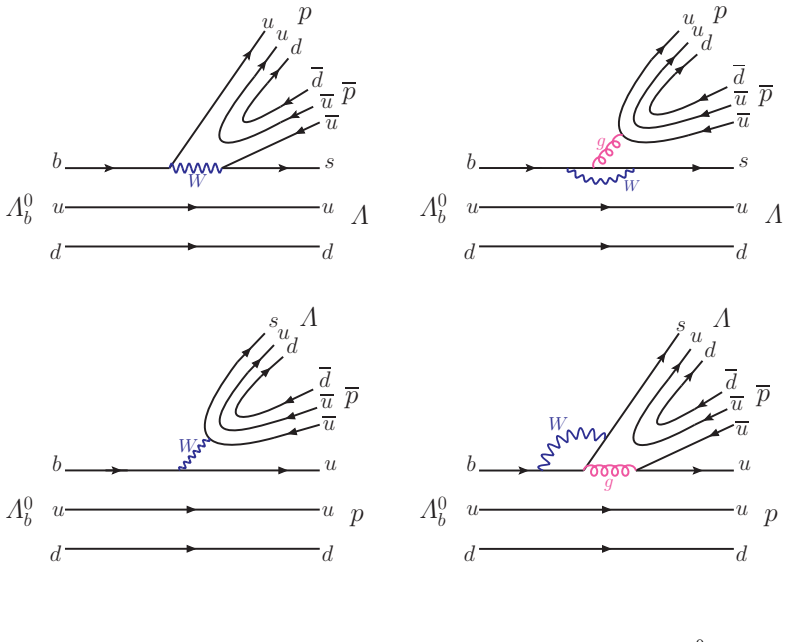
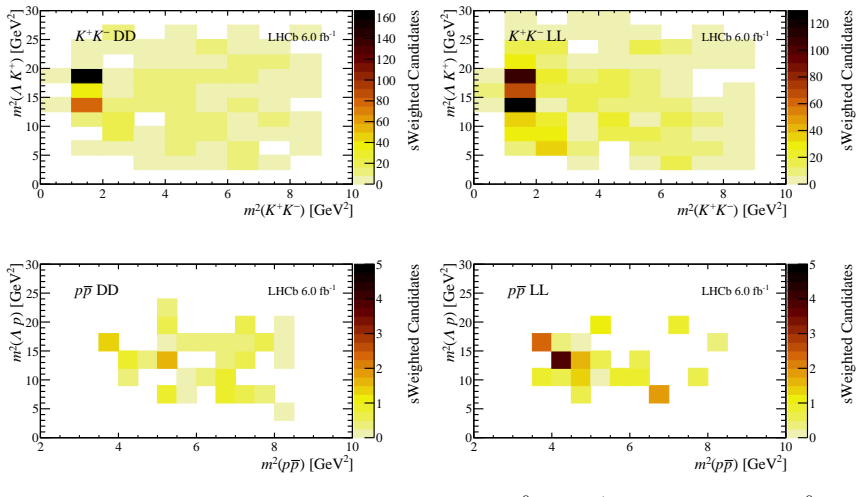
A search for the charmless purely baryonic decay $\mathinner{\mathit{\Lambda}^0_b\!\to \mathit{\Lambda} p \overline{p}}$ is performed using proton-proton collision data recorded by the LHCb experiment at a centre-of-mass energy of $\sqrt{s}=13\,\text{TeV}$ and corresponding to an integrated luminosity of $6.0\,\text{fb}^{-1}$. The signal decay is observed with a significance of 5.1 standard deviations. Its branching fraction is measured for the first time, relative to that of the topologically similar decay $\mathinner{\mathit{\Lambda}^0_b\!\to \mathit{\Lambda} K^+ K^-}$. Contributions from intermediate charmonium resonances decaying to the $p \overline{p}$ and $K^+ K^-$ final states are explicitly excluded with a requirement on the invariant mass of the companion hadron system, $m(h\bar{h}) < 2.85\,\text{GeV}$, where $h$ stands for a proton or a charged kaon. The relative branching fraction is found to be $$ \frac{B(\mathinner{\mathit{\Lambda}^0_b\!\to \mathit{\Lambda} p \overline{p}})}{B(\mathinner{\mathit{\Lambda}^0_b\!\to \mathit{\Lambda} K^+ K^-})} = (5.1 \pm 1.3_{\text{(stat)}} \pm 0.3_{\text{(syst)}}) \times 10^{-2} \,. $$
Editorial analysis
A structured set of objections, weighed in public.
Referee Report
Summary. The paper reports the first observation of the charmless purely baryonic decay Λ_b^0 → Λ p p-bar in 6 fb^{-1} of LHCb pp collision data at √s=13 TeV. The signal is extracted with 5.1σ significance after a m(h h-bar)<2.85 GeV cut to remove charmonium resonances, and the branching fraction is measured for the first time relative to the topologically similar reference mode Λ_b^0 → Λ K^+ K^-, giving the ratio (5.1 ± 1.3(stat) ± 0.3(syst)) × 10^{-2}.
Significance. If the central result holds, this constitutes the first observation of a purely baryonic charmless Λ_b decay and supplies a new benchmark for non-leptonic baryon decay models. The relative measurement to a similar final state is a methodological strength that cancels many common experimental uncertainties, and the explicit resonance veto is a clear improvement over earlier inclusive searches. The data-driven yield extraction and separate stat/syst reporting are also positive.
major comments (1)
- [Abstract (relative branching fraction result)] The quoted relative branching fraction is obtained from the ratio of fitted yields multiplied by the inverse of the efficiency ratio between the p p-bar and K^+ K^- modes. Because the final states differ in particle species, any mismatch between data and simulation in proton versus kaon tracking, PID, or material-interaction modeling (especially after the m(h h-bar)<2.85 GeV cut) directly scales the central value. The 0.3 systematic uncertainty may not fully capture this if the ratio is taken solely from simulation without additional data-driven validation or cross-checks.
Simulated Author's Rebuttal
We thank the referee for their positive summary and for raising this important point on the treatment of the efficiency ratio. We address the major comment below and have revised the manuscript to improve clarity on this aspect.
read point-by-point responses
-
Referee: The quoted relative branching fraction is obtained from the ratio of fitted yields multiplied by the inverse of the efficiency ratio between the p p-bar and K^+ K^- modes. Because the final states differ in particle species, any mismatch between data and simulation in proton versus kaon tracking, PID, or material-interaction modeling (especially after the m(h h-bar)<2.85 GeV cut) directly scales the central value. The 0.3 systematic uncertainty may not fully capture this if the ratio is taken solely from simulation without additional data-driven validation or cross-checks.
Authors: We agree that particle-species differences require explicit validation. The efficiency ratio is computed from simulation but incorporates data-driven corrections: proton and kaon PID efficiencies are determined from control samples in data (Λ → pπ− decays for protons and D*+ → D0(K−π+)π+ decays for kaons), while tracking and material-interaction efficiencies are calibrated using data-driven methods that account for the detector geometry and the m(h h-bar) < 2.85 GeV requirement. These corrections are applied identically to both modes. The quoted 0.3 systematic uncertainty is obtained by varying the PID and tracking correction factors within their measured uncertainties and by comparing alternative simulation tunes; it therefore already incorporates the dominant sources of mismatch. To make this explicit, we have added a short clarifying sentence in the results section and updated the systematic-uncertainty paragraph. We believe this addresses the concern without altering the central value or quoted uncertainty. revision: partial
Circularity Check
No circularity in experimental branching-fraction measurement
full rationale
The paper reports a data-driven observation and relative branching-fraction measurement extracted from LHCb pp collision data via standard event selection, invariant-mass fitting, and efficiency correction from simulation. The central result is the ratio of observed yields scaled by the inverse efficiency ratio between signal and reference modes; this quantity is obtained directly from the data and Monte Carlo samples and does not reduce by construction to any fitted parameter, self-citation, or prior ansatz within the paper. No load-bearing step matches any of the enumerated circularity patterns, and the analysis remains self-contained against external benchmarks.
Axiom & Free-Parameter Ledger
free parameters (1)
- signal and background yields in the fit
axioms (2)
- domain assumption Relative efficiencies between signal and reference modes are correctly simulated and corrected for data-simulation differences.
- domain assumption The m(h h-bar) < 2.85 GeV requirement removes all resonant contributions without signal loss or bias.
Reference graph
Works this paper leans on
-
[1]
Navaset al.,Review of particle physics, Phys
Particle Data Group, S. Navaset al.,Review of particle physics, Phys. Rev.D110 (2024) 030001
2024
-
[2]
Aaijet al.,Observation of charmless baryonic decays B0 (s)→p ph+h′−, Phys
LHCb collaboration, R. Aaijet al.,Observation of charmless baryonic decays B0 (s)→p ph+h′−, Phys. Rev.D96(2017) 051103,arXiv:1704.08497
-
[3]
Aaijet al.,First observation of the rare purely baryonic decay B0 →p p, Phys
LHCb collaboration, R. Aaijet al.,First observation of the rare purely baryonic decay B0 →p p, Phys. Rev. Lett.119(2017) 232001,arXiv:1709.01156. 13
-
[4]
Aaijet al.,Measurement of the branching fractions B(B0 → pppp)and B(B0 s →p ppp), Phys
LHCb collaboration, R. Aaijet al.,Measurement of the branching fractions B(B0 → pppp)and B(B0 s →p ppp), Phys. Rev. Lett.131(2023) 091901, arXiv:2211.08847
-
[5]
Aaijet al.,First observation of the charmless baryonic decay B+ → Λppp, Phys
LHCb collaboration, R. Aaijet al.,First observation of the charmless baryonic decay B+ → Λppp, Phys. Rev. Lett.135(2025) 261901,arXiv:2508.16259
-
[6]
LHCb collaboration, R. Aaijet al.,First observation of the B0 s →Λ + c Λ− c decay and evidence for the B0 →Λ + c Λ− c decay, Phys. Rev. Lett.136(2026) 061802, arXiv:2511.20476
- [7]
- [8]
-
[9]
C.-Q. Geng and C. Han,Purely Baryonic Weak Decays of Heavy Baryons in Skyrme Model,arXiv:2603.12735
-
[10]
Aaijet al.,Observation of the decay Λ0 b →Λ + c ppπ−, Phys
LHCb collaboration, R. Aaijet al.,Observation of the decay Λ0 b →Λ + c ppπ−, Phys. Lett.B784(2018) 101,arXiv:1804.09617
-
[11]
LHCb collaboration, R. Aaijet al.,Observations of Λ0 b →ΛK +π− and Λ0 b →ΛK +K − decays and searches for other Λ0 b and Ξ0 b decays to Λh+h− final states, JHEP05 (2016) 081,arXiv:1603.00413
-
[12]
LHCb collaboration, A. A. Alves Jr.et al.,The LHCb detector at the LHC, JINST3 (2008) S08005 LHCb-DP-2008-001
2008
-
[13]
Aaijet al.,LHCb detector performance, Int
LHCb collaboration, R. Aaijet al.,LHCb detector performance, Int. J. Mod. Phys. A30(2015) 1530022,arXiv:1412.6352
-
[14]
Aaijet al.,Performance of the LHCb Vertex Locator, JINST9(2014) P09007, arXiv:1405.7808
R. Aaijet al.,Performance of the LHCb Vertex Locator, JINST9(2014) P09007, arXiv:1405.7808
-
[15]
P. d’Argentet al.,Improved performance of the LHCb Outer Tracker in LHC Run 2, JINST12(2017) P11016,arXiv:1708.00819
-
[16]
Adinolfi et al., Performance of the LHCb RICH detector at the LHC , Eur
M. Adinolfiet al.,Performance of the LHCb RICH detector at the LHC, Eur. Phys. J.C73(2013) 2431,arXiv:1211.6759
- [17]
-
[18]
Aaijet al.,The LHCb trigger and its performance in 2011, JINST8(2013) P04022, arXiv:1211.3055
R. Aaijet al.,The LHCb trigger and its performance in 2011, JINST8(2013) P04022, arXiv:1211.3055
-
[19]
N. Grieseret al.,The LHCb stripping project: Sustainable legacy data processing for high-energy physics, Comput. Softw. Big. Sci.9(2025) 21,arXiv:2509.05294. 14
-
[20]
A Brief Introduction to PYTHIA 8.1
T. Sj¨ ostrand, S. Mrenna, and P. Skands,A brief introduction to PYTHIA 8.1, Comput. Phys. Commun.178(2008) 852, arXiv:0710.3820; T. Sj¨ ostrand, S. Mrenna, and P. Skands,PYTHIA 6.4 physics and manual, JHEP05(2006) 026, arXiv:hep-ph/0603175
work page internal anchor Pith review arXiv 2008
-
[21]
Belyaevet al.,Handling of the generation of primary events in Gauss, the LHCb simulation framework, J
I. Belyaevet al.,Handling of the generation of primary events in Gauss, the LHCb simulation framework, J. Phys. Conf. Ser.331(2011) 032047
2011
-
[22]
D. J. Lange,The EvtGen particle decay simulation package, Nucl. Instrum. Meth. A462(2001) 152
2001
-
[23]
N. Davidson, T. Przedzinski, and Z. Was,PHOTOS interface in C++: Technical and physics documentation, Comput. Phys. Commun.199(2016) 86, arXiv:1011.0937
-
[24]
Allisonet al.,Geant4 developments and applications, IEEE Trans
Geant4 collaboration, J. Allisonet al.,Geant4 developments and applications, IEEE Trans. Nucl. Sci.53(2006) 270; Geant4 collaboration, S. Agostinelliet al.,Geant4: A simulation toolkit, Nucl. Instrum. Meth.A506(2003) 250
2006
-
[25]
Clemencicet al.,The LHCb simulation application, Gauss: Design, evolution and experience, J
M. Clemencicet al.,The LHCb simulation application, Gauss: Design, evolution and experience, J. Phys. Conf. Ser.331(2011) 032023
2011
-
[26]
Brun and F
R. Brun and F. Rademakers,ROOT – An object oriented data analysis framework, Nucl. Instrum. Meth.A389(1997) 81
1997
-
[27]
Koppenburg,Reconstruction and analysis software environ- ment of LHCb, Nucl
LHCb collaboration, P. Koppenburg,Reconstruction and analysis software environ- ment of LHCb, Nucl. Phys. B Proc. Suppl.156(2006) 213
2006
-
[28]
Tsaregorodtsevet al.,DIRAC3: The new generation of the LHCb grid software, J
A. Tsaregorodtsevet al.,DIRAC3: The new generation of the LHCb grid software, J. Phys. Conf. Ser.219(2010) 062029
2010
-
[29]
The RooFit toolkit for data modeling
W. Verkerke and D. P. Kirkby,The RooFit toolkit for data modeling, eConfC0303241 (2003) MOLT007,arXiv:physics/0306116
work page Pith review arXiv 2003
-
[30]
Aubertet al.,Amplitude analysis of the decay B± →π ±π±π∓, Phys
BaBar collaboration, B. Aubertet al.,Amplitude analysis of the decay B± →π ±π±π∓, Phys. Rev.D72(2005) 052002,arXiv:hep-ex/0507025
- [31]
-
[32]
XGBoost: A Scalable Tree Boosting System
T. Chen and C. Guestrin,XGBoost: A scalable tree boosting system, inProceedings of the 22nd ACM SIGKDD International Conference on Knowledge Discovery and Data Mining, KDD ’16, (New York, NY, USA), 785–794, ACM, 2016, arXiv:1603.02754
work page Pith review arXiv 2016
-
[33]
Chen and C
T. Chen and C. Guestrin,xgboost, https://github.com/dmlc/xgboost
-
[34]
R. Aaijet al.,Selection and processing of calibration samples to measure the particle identification performance of the LHCb experiment in Run 2, Eur. Phys. J. Tech. Instr.6(2019) 1,arXiv:1803.00824
-
[35]
Sensitivity of searches for new signals and its optimization
G. Punzi,Sensitivity of searches for new signals and its optimization, eConfC030908 (2003) MODT002,arXiv:physics/0308063. 15
work page Pith review arXiv 2003
-
[36]
LHCb collaboration, R. Aaijet al.,Measurement of the track reconstruction efficiency at LHCb, JINST10(2015) P02007,arXiv:1408.1251
-
[37]
M. Pivk and F. R. Le Diberder,sPlot: A statistical tool to unfold data distributions, Nucl. Instrum. Meth.A555(2005) 356,arXiv:physics/0402083
-
[38]
Skwarnicki,A study of the radiative cascade transitions between the Upsilon-prime and Upsilon resonances, PhD thesis, Institute of Nuclear Physics, Krakow, 1986, DESY-F31-86-02
T. Skwarnicki,A study of the radiative cascade transitions between the Upsilon-prime and Upsilon resonances, PhD thesis, Institute of Nuclear Physics, Krakow, 1986, DESY-F31-86-02
1986
-
[39]
D. Mart´ ınez Santos and F. Dupertuis,Mass distributions marginalized over per-event errors, Nucl. Instrum. Meth.A764(2014) 150,arXiv:1312.5000. 16 LHCb collaboration R. Aaij38 , M. Abdelfatah 69, A.S.W. Abdelmotteleb 57 , C. Abellan Beteta 51 , F. Abudin´ en59 , T. Ackernley61 , A.A. Adefisoye69 , B. Adeva47 , M. Adinolfi55 , P. Adlarson87,42 , C. Agapop...
discussion (0)
Sign in with ORCID, Apple, or X to comment. Anyone can read and Pith papers without signing in.