Recognition: unknown
Neutrino Flavor Transformation in Collapsing Supermassive Objects
Pith reviewed 2026-05-08 16:38 UTC · model grok-4.3
The pith
Neutrinos from collapsing supermassive stars swap flavors inside the object via MSW resonances depending on mass hierarchy.
A machine-rendered reading of the paper's core claim, the machinery that carries it, and where it could break.
Core claim
In collapsing supermassive stars the thermal neutrino production yields a 5-to-1 ratio of nu_e bar nu_e pairs to nu_mu,tau bar nu_mu,tau pairs. The run of density through these objects creates MSW resonances at the atmospheric Delta m squared scale of about 2.4 times 10 to the minus 3 eV squared. Adiabatic flavor transformation through the resonances therefore swaps nu_e fluxes with nu_mu,tau in the normal mass hierarchy and bar nu_e fluxes with bar nu_mu,tau in the inverted hierarchy.
What carries the argument
Mikheyev-Smirnov-Wolfenstein resonances for the atmospheric neutrino mass splitting that occur inside the collapsing supermassive configuration.
Load-bearing premise
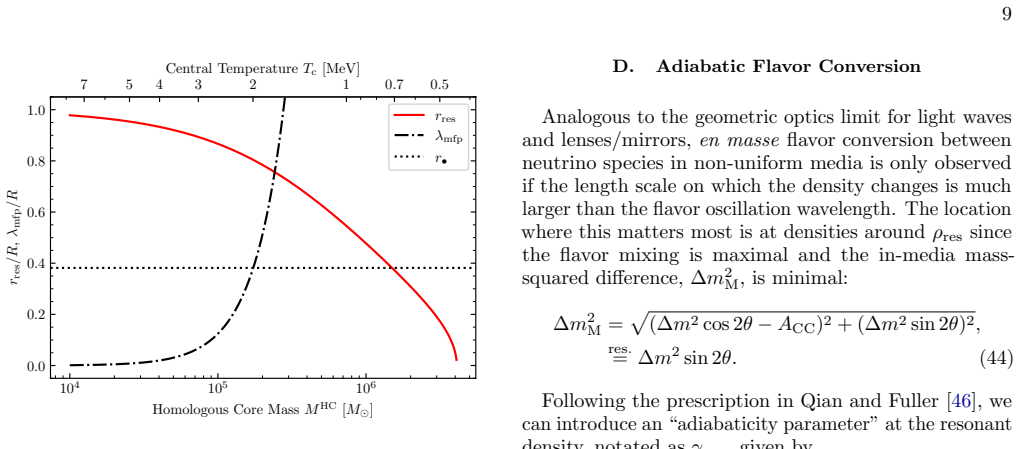
The density profile in these collapsing objects places the MSW resonance layer at a location where neutrinos have the right energies to encounter it before escaping.
What would settle it
A detected neutrino signal from a supermassive star collapse that preserves the original 5-to-1 electron to non-electron flavor ratio without any swapping would show the resonances do not produce the claimed adiabatic transformations.
Figures
read the original abstract
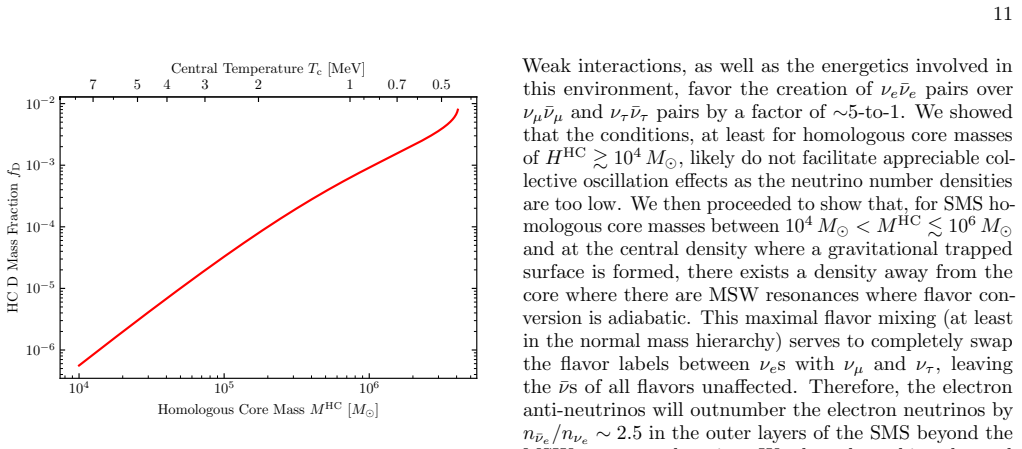
The collapse of supermassive stars (SMSs, $M\gtrsim10^4\,M_\odot$) to black holes is accompanied by a prodigious flux of neutrinos of all flavors. These are produced thermally via $e^\pm$ annihilations, mostly in the core and just before gravitational trapped surface formation. There, the ratio of fluxes for $\nu_e\bar{\nu}_e$-pairs to $\nu_{\mu}\bar{\nu}_{\mu}/\nu_{\tau}\bar{\nu}_{\tau}$-pairs is $\sim$\,5-to-1. This is because at SMS temperature scales, $\nu_e\bar{\nu}_e$ pairs have both charged and neutral current production channels, whereas $\nu_{\mu}\bar{\nu}_{\mu}/\nu_{\tau}\bar{\nu}_{\tau}$-pairs only have neutral current production channels. We point out that the typical energies of these neutrinos, and the run of density in collapsing radiation-dominated supermassive configurations, leads to Mikheyev-Smirnov-Wolfenstein (MSW) resonances inside these objects for the atmospheric neutrino mass splitting scale, $\Delta m^2_\mathrm{atm.}\sim2.4\times10^{-3}$ eV$^2$. In the normal neutrino mass hierarchy, adiabatic flavor transformation through the MSW resonances would then swap the fluxes $\nu_e\leftrightharpoons\nu_{\mu,\tau}$, whereas, in the inverted neutrino mass hierarchy, the anti-neutrino fluxes are swapped, $\bar{\nu}_e\leftrightharpoons\bar{\nu}_{\mu,\tau}$. We also examine the prospects for collective neutrino flavor oscillations in these environments. Implications for flavor oscillation's effects on neutrino energy deposition and neutrino-induced nucleosynthesis in the SMS's outer layers are examined, as are prospects for detections of SMS collapses through various means.
Editorial analysis
A structured set of objections, weighed in public.
Referee Report
Summary. The paper claims that neutrinos produced thermally via e+e- annihilation during the collapse of supermassive stars (M ≳ 10^4 M_⊙) to black holes experience MSW resonances for the atmospheric mass splitting Δm²_atm ≈ 2.4×10^{-3} eV² inside the object, owing to typical neutrino energies and the density profile in radiation-dominated configurations. This leads to adiabatic flavor swaps (ν_e ↔ ν_μ,τ in normal hierarchy; ν̄_e ↔ ν̄_μ,τ in inverted hierarchy), altering the initial ~5:1 flux ratio between electron and muon/tau pairs. The work also considers collective oscillations and discusses implications for neutrino energy deposition, nucleosynthesis in outer layers, and detection prospects.
Significance. This is a novel application of established MSW resonance physics to the context of SMS collapse, correctly noting the distinct production channels for ν_e ν̄_e versus ν_μ,τ ν̄_μ,τ pairs and the potential for hierarchy-dependent flux swaps. If the resonances are confirmed to lie inside the object and satisfy adiabaticity, the result could affect predictions for neutrino-driven nucleosynthesis and energy transport in these events. The proposal is conceptually straightforward and internally consistent with standard neutrino oscillation formalism, but its significance remains provisional until quantitative checks are provided.
major comments (2)
- [Abstract] Abstract and introductory discussion of MSW resonances: the central assertion that typical energies from thermal e+e- annihilation and the density run in collapsing radiation-dominated SMS place the atmospheric resonance inside the object is stated qualitatively but without explicit computation of the resonance electron density n_e,res = (Δm²_atm cos 2θ)/(2√2 G_F E) or direct comparison against the central density and radial profile. This verification is load-bearing for the claim of adiabatic transformations occurring within the collapsing configuration.
- [Section on collective oscillations and adiabaticity] Discussion of adiabaticity and collective oscillations: the adiabaticity criterion is invoked to conclude full flavor swaps, yet no evaluation is given of the density gradient scale height relative to the resonance width or the vacuum oscillation length at the relevant energies; likewise, the examination of collective effects lacks quantitative estimates of the neutrino density or self-interaction potential in the core region. Both are required to substantiate the flux-swap conclusions.
minor comments (2)
- [Abstract] The notation for flavor swaps alternates between symbolic arrows and text descriptions; consistent use of standard symbols (e.g., ν_e ↔ ν_μ,τ) throughout would improve clarity.
- [Introduction] A brief reference to the standard MSW resonance condition derivation (e.g., the original Mikheyev-Smirnov or Wolfenstein papers) would help anchor the application for readers unfamiliar with the astrophysical context.
Simulated Author's Rebuttal
We thank the referee for the careful and constructive review of our manuscript on neutrino flavor transformations during the collapse of supermassive stars. The comments highlight important areas where quantitative support can strengthen the presentation of the MSW resonance claims and the treatment of adiabaticity and collective effects. We address each major comment below and will revise the manuscript to incorporate the requested calculations and estimates.
read point-by-point responses
-
Referee: [Abstract] Abstract and introductory discussion of MSW resonances: the central assertion that typical energies from thermal e+e- annihilation and the density run in collapsing radiation-dominated SMS place the atmospheric resonance inside the object is stated qualitatively but without explicit computation of the resonance electron density n_e,res = (Δm²_atm cos 2θ)/(2√2 G_F E) or direct comparison against the central density and radial profile. This verification is load-bearing for the claim of adiabatic transformations occurring within the collapsing configuration.
Authors: We agree that the manuscript would benefit from an explicit computation of the resonance density to make the placement of the MSW resonance inside the collapsing configuration fully transparent. In the revised manuscript we will insert a short calculation in the introduction (or a new methods subsection) that evaluates n_{e,res} using the provided formula with representative neutrino energies E ≈ 10–20 MeV from thermal e⁺e⁻ annihilation and the radiation-dominated density profile. We will then compare this value directly to the central and radial densities encountered during collapse, confirming that the resonance lies well within the object for the atmospheric mass splitting. revision: yes
-
Referee: [Section on collective oscillations and adiabaticity] Discussion of adiabaticity and collective oscillations: the adiabaticity criterion is invoked to conclude full flavor swaps, yet no evaluation is given of the density gradient scale height relative to the resonance width or the vacuum oscillation length at the relevant energies; likewise, the examination of collective effects lacks quantitative estimates of the neutrino density or self-interaction potential in the core region. Both are required to substantiate the flux-swap conclusions.
Authors: We acknowledge that a quantitative check of the adiabaticity condition is needed to support the conclusion of complete flavor swaps. In revision we will add an explicit evaluation of the adiabaticity parameter by comparing the local density scale height (derived from the radiation-dominated profile) to the resonance width and the vacuum oscillation length at the relevant energies. For collective oscillations we will include order-of-magnitude estimates of the core neutrino number density (based on the thermal production rates given in the paper) and the corresponding self-interaction potential μ ≈ √2 G_F n_ν, showing that it remains sub-dominant to the matter potential at the resonance location. A full time-dependent numerical simulation of collective effects lies beyond the scope of the present work. revision: partial
Circularity Check
No significant circularity identified
full rationale
The paper applies the standard MSW resonance condition sqrt(2) G_F n_e = (Delta m^2 / 2E) cos 2 theta and adiabaticity criteria to the density run and typical neutrino energies (from e+e- annihilation) in radiation-dominated SMS collapse. The 5:1 flux ratio follows directly from known production channels (charged+neutral current for nu_e pairs, neutral only for mu/tau). No parameters are fitted to the output, no self-citations are load-bearing for the central claim, and the hierarchy-dependent swaps are direct consequences of the resonance locations rather than self-definition or renaming. The derivation is self-contained against external benchmarks.
Axiom & Free-Parameter Ledger
axioms (2)
- domain assumption MSW resonance condition is met for atmospheric mass splitting given typical neutrino energies and collapsing density profile
- domain assumption Neutrino production via e+e- annihilation yields ~5:1 flux ratio for electron vs muon/tau pairs at SMS temperatures
Reference graph
Works this paper leans on
-
[1]
D. J. Mortlocket al., Nature474, 616–619 (2011)
2011
-
[2]
B. P. Venemanset al., The Astrophysical Journal779, 24 (2013)
2013
-
[3]
Wuet al., Nature518, 512–515 (2015)
X.-B. Wuet al., Nature518, 512–515 (2015)
2015
-
[4]
Ba˜ nadoset al., Nature553, 473–476 (2017)
E. Ba˜ nadoset al., Nature553, 473–476 (2017)
2017
-
[5]
A. D. Gouldinget al., The Astrophysical Journal Letters 955, L24 (2023)
2023
-
[6]
Bogd´ anet al., Nature Astronomy8, 1 (2023)
´A. Bogd´ anet al., Nature Astronomy8, 1 (2023)
2023
-
[7]
Freese, P
K. Freese, P. Gondolo, and D. Spolyar, AIP Conference Proceedings990, 42 (2008)
2008
-
[8]
C. Ilie, J. Paulin, and K. Freese, Proceedings of the Na- tional Academy of Sciences120, e2305762120 (2023)
2023
- [9]
-
[10]
K. S. Kehrer and G. M. Fuller, Phys. Rev. D110, 083035 (2024)
2024
- [11]
-
[12]
Hoyle and W
F. Hoyle and W. A. Fowler, Monthly Notices of the Royal Astronomical Society125, 169 (1962)
1962
-
[13]
Iben, Jr., The Astrophysical Journal138, 1090 (1963)
I. Iben, Jr., The Astrophysical Journal138, 1090 (1963)
1963
-
[14]
W. A. Fowler, Rev. Mod. Phys.36, 545 (1964)
1964
-
[15]
G. M. Fuller, S. E. Woosley, and T. A. Weaver, The Astrophysical Journal307, 675 (1986)
1986
-
[16]
Chandrasekhar, The Astrophysical Journal140, 417 (1964)
S. Chandrasekhar, The Astrophysical Journal140, 417 (1964)
1964
-
[17]
R. P. Feynman, F. B. Morinigo (ed.), and W. G. Wagner (ed.),Feynman Lectures on Gravitation(ABP, 2003)
2003
-
[18]
G. M. Fuller and X. Shi, The Astrophysical Journal487, L25 (1997)
1997
-
[19]
P. J. Schinder, D. N. Schramm, P. J. Wiita, S. H. Margolis, and D. L. Tubbs, The Astrophysical Journal313, 531 (1987)
1987
-
[20]
Shi and G
X. Shi and G. M. Fuller, The Astrophysical Journal503, 307 (1998)
1998
-
[21]
Giunti and C
C. Giunti and C. W. Kim,Fundamentals of Neutrino Physics and Astrophysics(Oxford University Press, 2007)
2007
-
[22]
S. L. Shapiro and S. A. Teukolsky,Black Holes, White Dwarfs and Neutron Stars, The Physics of Compact Ob- jects(Wiley-Interscience, 1983)
1983
-
[23]
Navaset al.(Particle Data Group), Phys
S. Navaset al.(Particle Data Group), Phys. Rev. D110, 13 030001 (2024)
2024
-
[24]
G. M. Fuller and B. S. Meyer, Astrophys. J.453, 792 (1995)
1995
-
[25]
G. M. Fuller, Astrophys. J.252, 741 (1982)
1982
-
[26]
W. A. Fowler and F. Hoyle, The Astrophysical Journal Supplement9, 201 (1964)
1964
-
[27]
S. P. Butler, A. R. Lima, T. W. Baumgarte, and S. L. Shapiro, Monthly Notices of the Royal Astronomical So- ciety477, 3694 (2018)
2018
-
[28]
Linke, J
F. Linke, J. A. Font, H.-T. Janka, E. M¨ uller, and P. Pa- padopoulos, A&A376, 568 (2001)
2001
- [29]
- [30]
- [31]
- [32]
-
[33]
I. Tamborra and S. Shalgar, Ann. Rev. Nucl. Part. Sci. 71, 165 (2021), arXiv:2011.01948 [astro-ph.HE]
-
[34]
L. Johns, S. Richers, and M.-R. Wu, Annual Review of Nuclear and Particle Science 10.1146/annurev-nucl- 121423-100853 (2025), arXiv:2503.05959 [astro-ph.HE]
- [35]
-
[36]
B. Dasgupta, Physical Review Letters128, 081102 (2022), arXiv:2110.00192 [hep-ph]
-
[37]
B. Dasgupta and D. Mukherjee, Physical Review D (2025), arXiv:2505.03886 [hep-ph]
-
[38]
S. Hannestad, G. G. Raffelt, G. Sigl, and Y. Y. Y. Wong, Phys. Rev. D74, 105010 (2006), [Erratum: Phys.Rev.D 76, 029901 (2007)], arXiv:astro-ph/0608695
-
[39]
I. Padilla-Gay, H.-H. Chen, S. Abbar, M.-R. Wu, and Z. Xiong, Phys. Rev. D112, 043039 (2025), arXiv:2505.11588 [astro-ph.HE]
-
[40]
G. Raffelt, S. Sarikas, and D. de Sousa Seixas, Phys. Rev. Lett.111, 091101 (2013), [Erratum: Phys.Rev.Lett. 113, 239903 (2014)], arXiv:1305.7140 [hep-ph]
-
[41]
L. Johns, arXiv e-prints , arXiv:2104.11369 (2021), arXiv:2104.11369 [hep-ph]
-
[42]
I. Padilla-Gay, I. Tamborra, and G. G. Raffelt, Phys. Rev. D106, 103031 (2022), arXiv:2209.11235 [hep-ph]
- [43]
- [44]
- [45]
-
[46]
Qian and G
Y.-Z. Qian and G. M. Fuller, Phys. Rev. D51, 1479 (1995)
1995
-
[47]
W. C. Haxton, Phys. Rev. D35, 2352 (1987)
1987
-
[48]
Balantekin and G
A. Balantekin and G. Fuller, Physics Letters B471, 195 (1999)
1999
-
[49]
D. O. Caldwell, G. M. Fuller, and Y.-Z. Qian, Phys. Rev. D61, 123005 (2000)
2000
-
[50]
D. D. Clayton,Principles of Stellar Evolution and Nucle- osynthesis(The University of Chicago Press, 1983)
1983
-
[51]
G. S. Bisnovatyi-Kogan, The Astrophysical Journal497, 559 (1998)
1998
-
[52]
G. C. McLaughlin and G. M. Fuller, The Astrophysical Journal456, 71 (1996)
1996
-
[53]
Haemmerl´ e, Astron
L. Haemmerl´ e, Astron. Astrophys.689, A202 (2024)
2024
-
[54]
Perez and B
F. Perez and B. E. Granger, Computing in Science and Engineering9, 21 (2007)
2007
-
[55]
Kluyveret al., inPositioning and Power in Aca- demic Publishing: Players, Agents and Agendas, edited by F
T. Kluyveret al., inPositioning and Power in Aca- demic Publishing: Players, Agents and Agendas, edited by F. Loizides and B. Schmidt (IOS Press, 2016) pp. 87 – 90
2016
-
[56]
J. D. Hunter, Computing in Science & Engineering9, 90 (2007)
2007
-
[57]
C. R. Harriset al., Nature585, 357 (2020)
2020
-
[58]
Van Rossum and F
G. Van Rossum and F. L. Drake,Python 3 Reference Manual(CreateSpace, Scotts Valley, CA, 2009)
2009
-
[59]
Virtanenet al., Nature Methods17, 261 (2020)
P. Virtanenet al., Nature Methods17, 261 (2020)
2020
-
[60]
Gommerset al., scipy/scipy: Scipy 1.14.1 (2024)
R. Gommerset al., scipy/scipy: Scipy 1.14.1 (2024)
2024
-
[61]
Wolfram Research, Inc., Mathematica, Version 14.2, Champaign, IL, 2024
2024
-
[62]
T. Wagg and F. S. Broekgaarden, arXiv e-prints , arXiv:2406.04405 (2024), arXiv:2406.04405 [astro-ph.IM]
-
[63]
T. Wagg, F. Broekgaarden, and K. G¨ ultekin, Tomwagg/software-citation-station: v1.2 (2024)
2024
discussion (0)
Sign in with ORCID, Apple, or X to comment. Anyone can read and Pith papers without signing in.