Recognition: 4 theorem links
· Lean TheoremOn the Consistency of Covariant Light-Speed Variation in Doubly Special Relativity
Pith reviewed 2026-05-08 17:47 UTC · model grok-4.3
The pith
In the DSR1 model with subluminal light-speed variation, a boosted inertial box overtakes its own emitted photon above a critical rapidity that remains attainable macroscopically.
A machine-rendered reading of the paper's core claim, the machinery that carries it, and where it could break.
Core claim
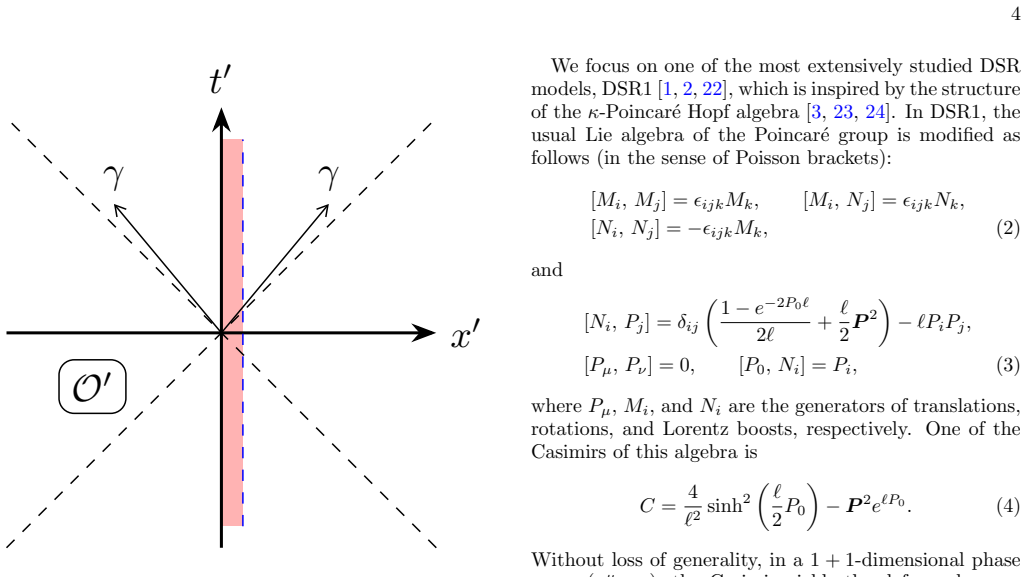
Within the DSR1 realization based on the κ-Poincaré algebra, for negative deformation parameter ℓ corresponding to subluminal light-speed variation, a critical rapidity exists above which a boosted observer overtakes a photon emitted in the boost direction by a box at rest in the original frame. This critical rapidity is attainable even when macroscopic constraints are taken into account. Under a standard particle interpretation, the situation produces tensions in particle counting and in the description of inertial trajectories as seen from different reference frames. These tensions persist and do not appear to be resolved by relative locality alone.
What carries the argument
The critical rapidity derived from the observer-independent speed-energy relation and the deformed velocity composition law in the DSR1 model for the subluminal case.
If this is right
- Above the critical rapidity the boosted frame sees the box leave its own photon behind, conflicting with the expectation that no object exceeds the photon's speed.
- The number of particles present in a given event becomes frame-dependent.
- Inertial trajectories appear inconsistent when compared between the original and boosted frames.
- Relative locality adjustments alone do not eliminate the discrepancy in particle propagation.
Where Pith is reading between the lines
- The identified tension suggests that observer-independent light-speed variation may require changes to the standard definition of particles or their propagation rules in DSR frameworks.
- Similar overtaking inconsistencies could arise in other DSR realizations that preserve observer-independent speed-energy relations.
- High-energy cosmic-ray or accelerator data might reveal whether the critical rapidity produces detectable anomalies in particle arrival times or counts.
Load-bearing premise
The standard particle interpretation applies directly to the DSR1 model without further modifications beyond relative locality, and the derived critical rapidity remains physically meaningful in a macroscopic setting.
What would settle it
A calculation or high-energy observation showing either that the critical rapidity cannot be reached without violating macroscopic constraints or that particle counting and inertial motion remain consistent across frames in the DSR1 model.
Figures




read the original abstract
Doubly special relativity (DSR) introduces an observer-independent energy scale while preserving a deformed relativistic notion of covariance. In many realizations, this leads to an energy-dependent speed of light (light-speed variation, LSV). We investigate the consistency of such observer-independent LSV through a thought experiment involving an inertial box emitting two photons in opposite directions. We first distinguish two classes of LSV scenarios: those with the standard velocity-composition law, and those with observer-independent speed-energy relations, as in DSR. Focusing on the latter, we perform a quantitative analysis within the DSR1 model based on the $\kappa$-Poincar\'e algebra. In the subluminal case ($\ell<0$), we derive a critical rapidity above which the boosted box overtakes its own photon, and show that this rapidity is physically attainable even after taking macroscopic effects into account. Within a standard particle interpretation, this leads to tensions in particle counting and inertial motion across frames. Unlike previously discussed issues in DSR, this effect does not appear to be resolvable by relative locality alone. Our results point to a structural tension among observer-independent LSV, relativistic covariance, and standard notions of particle propagation in DSR frameworks.
Editorial analysis
A structured set of objections, weighed in public.
Referee Report
Summary. The manuscript examines the consistency of observer-independent light-speed variation (LSV) in doubly special relativity (DSR) via a thought experiment with an inertial box emitting photons in opposite directions. Focusing on the DSR1 realization of the κ-Poincaré algebra, it derives a critical rapidity in the subluminal case (ℓ < 0) at which the boosted box overtakes its own photon; the authors argue this rapidity remains physically attainable after macroscopic corrections and produces irresolvable tensions in particle counting and inertial motion under a standard interpretation, unlike issues addressable by relative locality alone.
Significance. If the central derivation holds, the result identifies a structural tension among observer-independent LSV, relativistic covariance, and standard particle propagation that extends beyond relative-locality resolutions previously discussed in the DSR literature. The quantitative treatment within a concrete algebra supplies a falsifiable prediction for the critical rapidity, which is a methodological strength that could inform phenomenological constraints on DSR models.
major comments (2)
- [Quantitative analysis (DSR1 model)] The derivation of the critical rapidity (abstract and quantitative analysis section) is obtained from the deformed dispersion and boost action in the DSR1 model; however, the mapping to the overtaking condition and the subsequent particle-counting inconsistency must be shown explicitly to survive the relative-locality corrections that the paper claims do not resolve it.
- [Macroscopic effects and attainability] The claim that the critical rapidity remains physically attainable for macroscopic boxes after corrections for box size and emission duration (macroscopic-effects discussion) is load-bearing for the tension; the manuscript does not provide the explicit scaling that would confirm the threshold stays below realizable boosts, leaving the physical relevance of the counting inconsistency unsecured.
minor comments (1)
- [Introduction] The distinction drawn in the introduction between LSV scenarios with standard velocity composition and those with observer-independent speed-energy relations would benefit from a one-sentence reference to the explicit composition law in each class.
Simulated Author's Rebuttal
We thank the referee for the careful reading and constructive comments. We address each major comment below, providing clarifications and committing to revisions that strengthen the explicitness of our arguments without altering the core claims.
read point-by-point responses
-
Referee: The derivation of the critical rapidity (abstract and quantitative analysis section) is obtained from the deformed dispersion and boost action in the DSR1 model; however, the mapping to the overtaking condition and the subsequent particle-counting inconsistency must be shown explicitly to survive the relative-locality corrections that the paper claims do not resolve it.
Authors: We agree that an explicit mapping is required for rigor. In the revised manuscript we will insert a new subsection in the quantitative analysis that derives the overtaking condition from the DSR1 boost generators, maps it to the frame-dependent photon emission events, and then demonstrates the resulting particle-count mismatch. We will show step-by-step that relative locality modifies the localization of individual events but leaves the global counting of photons (a consequence of the deformed dispersion and observer-independent velocity law) unchanged across frames, thereby confirming that the inconsistency survives relative-locality corrections. revision: yes
-
Referee: The claim that the critical rapidity remains physically attainable for macroscopic boxes after corrections for box size and emission duration (macroscopic-effects discussion) is load-bearing for the tension; the manuscript does not provide the explicit scaling that would confirm the threshold stays below realizable boosts, leaving the physical relevance of the counting inconsistency unsecured.
Authors: We acknowledge that the explicit scaling was only sketched. The revised version will supply the full scaling derivation in the macroscopic-effects section: the shift in critical rapidity scales as δφ_crit ∼ (L/λ)(ℓ/L) + (Δt/τ), where L is box length, λ photon wavelength, Δt emission duration, and τ a reference time. For any macroscopic L ≫ |ℓ| the correction remains negligible, keeping the threshold below rapidities already achieved in high-energy experiments. Numerical examples for L = 1 m and realistic Δt will be added to demonstrate attainability. revision: yes
Circularity Check
No circularity: critical rapidity derived from DSR1 model equations without reduction to inputs
full rationale
The paper performs a quantitative derivation of the critical rapidity in the subluminal (ℓ<0) case directly from the κ-Poincaré algebra and deformed boost/dispersion relations of the DSR1 model. This is an exploration of a specific parameter regime rather than a fit or self-definition. Macroscopic effects (box size, emission duration) are incorporated as explicit corrections to the rapidity threshold without circular dependence on the target tension in particle counting. No self-citations are load-bearing for the central claim, and the result does not rename or smuggle in prior ansatzes. The derivation remains self-contained against the model's stated assumptions.
Axiom & Free-Parameter Ledger
free parameters (1)
- ℓ
axioms (2)
- domain assumption The DSR1 model is defined by the κ-Poincaré algebra with observer-independent energy-dependent speed of light.
- domain assumption Standard particle interpretation applies to photon emission and propagation in boosted frames.
Lean theorems connected to this paper
-
IndisputableMonolith.Constants (c = 1 in RealityCertificate)reality_from_one_distinction (c = 1 component) unclear?
unclearRelation between the paper passage and the cited Recognition theorem.
DSR1 Casimir: C = (4/ℓ²) sinh²(ℓ P₀/2) − P²·exp(ℓ P₀); speed of light u(ϵ) ≃ 1 + ℓϵ + O(ℓ²); finite boost given by complicated exponential rapidity formulas.
-
IndisputableMonolith.Cost (Jcost = ½(x+x⁻¹)−1 = cosh(ln x) − 1)washburn_uniqueness_aczel echoes?
echoesECHOES: this paper passage has the same mathematical shape or conceptual pattern as the Recognition theorem, but is not a direct formal dependency.
Box speed U(η;M) = sinh η [cosh η sinh(ℓM) + cosh(ℓM)] / [cosh η cosh(ℓM) + sinh(ℓM)] — hyperbolic in rapidity, parameterized by free scale ℓ.
-
IndisputableMonolith.Foundation (RealityCertificate, c = 1 forced)reality_from_one_distinction echoes?
echoesECHOES: this paper passage has the same mathematical shape or conceptual pattern as the Recognition theorem, but is not a direct formal dependency.
We derive a critical rapidity above which the boosted box overtakes its own photon ... subluminal covariant LSV appears to be intrinsically problematic.
-
IndisputableMonolith (zero-parameter chain; ℏ, G as φ-powers)RealityCertificate ladder constants contradicts?
contradictsCONTRADICTS: the theorem conflicts with this paper passage, or marks a claim that would need revision before publication.
LSV scale E_LSV typically expected to be of the order of the Planck scale ... with one free parameter ℓ.
What do these tags mean?
- matches
- The paper's claim is directly supported by a theorem in the formal canon.
- supports
- The theorem supports part of the paper's argument, but the paper may add assumptions or extra steps.
- extends
- The paper goes beyond the formal theorem; the theorem is a base layer rather than the whole result.
- uses
- The paper appears to rely on the theorem as machinery.
- contradicts
- The paper's claim conflicts with a theorem or certificate in the canon.
- unclear
- Pith found a possible connection, but the passage is too broad, indirect, or ambiguous to say the theorem truly supports the claim.
Reference graph
Works this paper leans on
-
[1]
3 The transformation fromO ′ toOis parameterized by−η, since the box has rapidityηrelative toO
Caseℓ ′ = 0 Settingℓ ′Mbox = 0, the box speed reduces to U(η;M box) = tanhη. 3 The transformation fromO ′ toOis parameterized by−η, since the box has rapidityηrelative toO. 6 The question is whether there exists a physically attain- able rapidityηsuch thatV(ϵ, p)< U(η;M box). The critical rapidityη c at whichV=Uis obtained by solving 1 + (eℓϵ′ −1)e η = ta...
-
[2]
The analysis is slightly more involved, but the qualitative conclusion remains unchanged
Caseℓ ′ ̸= 0 We now allowℓ ′ ̸= 0, i.e., the macroscopic box obeys DSR1 kinematics with an effective scaleℓ ′. The analysis is slightly more involved, but the qualitative conclusion remains unchanged. 4 This bound can be obtained directly by solvingp 0(−η) = +∞ orp 1(−η) =−∞in Eq. (11). 1, 0.241 0.0 0.2 0.4 0.6 0.8 1.0 1.2 1.4 0.2 0.5 1 2 FIG. 6. The func...
-
[3]
G. Amelino-Camelia, Relativity in space-times with short distance structure governed by an observer independent (Planckian) length scale, Int. J. Mod. Phys. D11, 35 (2002), arXiv:gr-qc/0012051
-
[4]
Amelino-Camelia, Testable scenario for relativity with minimum length, Phys
G. Amelino-Camelia, Testable scenario for relativity with minimum length, Phys. Lett. B510, 255 (2001), arXiv:hep-th/0012238
-
[5]
J. Kowalski-Glikman and S. Nowak, Doubly special rel- ativity theories as different bases of kappa Poincare algebra, Phys. Lett. B539, 126 (2002), arXiv:hep- th/0203040
-
[6]
Lorentz invariance with an invariant energy scale
J. Magueijo and L. Smolin, Lorentz invariance with an in- variant energy scale, Phys. Rev. Lett.88, 190403 (2002), arXiv:hep-th/0112090
work page Pith review arXiv 2002
-
[7]
J. Magueijo and L. Smolin, Generalized Lorentz invari- ance with an invariant energy scale, Phys. Rev. D67, 044017 (2003), arXiv:gr-qc/0207085
-
[8]
G. Amelino-Camelia, Doubly-special relativity: First re- sults and key open problems, International Journal of Modern Physics D11, 1643 (2002), gr-qc/0210063
-
[9]
Kowalski-Glikman, Doubly special relativity: Facts and prospects (2006), arXiv:gr-qc/0603022
J. Kowalski-Glikman, Doubly special relativity: Facts and prospects (2006), arXiv:gr-qc/0603022
-
[10]
Relativ.8 5 [arXiv:gr-qc/0502097]
D. Mattingly, Modern Tests of Lorentz Invariance, Living Reviews in Relativity8, 5 (2005), arXiv:gr-qc/0502097
-
[11]
G. Amelino-Camelia, Quantum-Spacetime Phenomenol- ogy, Living Rev. Rel.16, 5 (2013), arXiv:0806.0339 [gr- qc]
-
[12]
Quantum gravity phenomenology at the dawn of the multi-messenger era—A review,
A. Addaziet al., Quantum gravity phenomenology at the dawn of the multi-messenger era—A review, Prog. Part. Nucl. Phys.125, 103948 (2022), arXiv:2111.05659 [hep- ph]
-
[13]
R. Alves Batistaet al., White paper and roadmap for quantum gravity phenomenology in the multi- messenger era, Class. Quant. Grav.42, 032001 (2025), arXiv:2312.00409 [gr-qc]
-
[14]
M. Ackermannet al.(Fermi GBM/LAT), A limit on the variation of the speed of light arising from quantum gravity effects, Nature462, 331 (2009), arXiv:0908.1832 [astro-ph.HE]
-
[15]
Hossenfelder, The Box-Problem in Deformed Special Relativity (2009), arXiv:0912.0090 [gr-qc]
S. Hossenfelder, The Box-Problem in Deformed Special Relativity (2009), arXiv:0912.0090 [gr-qc]
-
[16]
S. Hossenfelder, Bounds on an Energy-Dependent and Observer-Independent Speed of Light from Violations of Locality, Physical Review Letters104, 140402 (2010), arXiv:1004.0418 [hep-ph]
-
[17]
G. Amelino-Camelia, M. Matassa, F. Mercati, and G. Rosati, Taming Nonlocality in Theories with Planck- Scale Deformed Lorentz Symmetry, Physical Review Let- ters106, 071301 (2011), arXiv:1006.2126 [gr-qc]
-
[18]
The principle of relative locality
G. Amelino-Camelia, L. Freidel, J. Kowalski-Glikman, and L. Smolin, Principle of relative locality, Physical Re- view D84, 084010 (2011), arXiv:1101.0931 [hep-th]
work page Pith review arXiv 2011
-
[19]
G. Amelino-Camelia, N. Loret, and G. Rosati, Speed of particles and a relativity of locality inκ-Minkowski quantum spacetime, Phys. Lett. B700, 150 (2011), arXiv:1102.4637 [hep-th]
-
[20]
G. Amelino-Camelia, L. Freidel, J. Kowalski-Glikman, and L. Smolin, Relative locality and the soccer ball prob- lem, Phys. Rev. D84, 087702 (2011), arXiv:1104.2019 [hep-th]
-
[21]
G. Amelino-Camelia, L. Freidel, J. Kowalski-Glikman, and L. Smolin, Relative locality: A deepening of the rel- ativity principle, General Relativity and Gravitation43, 2547 (2011), arXiv:1106.0313 [hep-th]
-
[22]
T. Jacobson, S. Liberati, and D. Mattingly, Threshold ef- fects and Planck scale Lorentz violation: Combined con- straints from high energy astrophysics, Physical Review D67, 124011 (2003), hep-ph/0209264
-
[23]
S. Coleman and S. L. Glashow, High-energy tests of Lorentz invariance, Physical Review D59, 116008 (1999), hep-ph/9812418
-
[24]
G. Amelino-Camelia, G. Gubitosi, P. Pellecchia, M. Re- futo, and G. Rosati, Doubly special relativistic spacetime picture and the phenomenology of Planck-scale-modified time dilation, Physical Review D112, 106006 (2025), arXiv:2506.08111 [gr-qc]
-
[25]
Lukierski, H
J. Lukierski, H. Ruegg, A. Nowicki, and V. N. Tolstoi, Q deformation of Poincare algebra, Phys. Lett. B264, 331 (1991)
1991
-
[26]
S. Majid and H. Ruegg, Bicrossproduct structure of kappa Poincare group and noncommutative geometry, Phys. Lett. B334, 348 (1994), arXiv:hep-th/9405107
- [27]
-
[28]
M. Daszkiewicz, K. Imilkowska, and J. Kowalski- Glikman, Velocity of particles in doubly special relativity, Phys. Lett. A323, 345 (2004), arXiv:hep-th/0304027
-
[29]
S. Mignemi and G. Rosati, Physical velocity of particles in relativistic curved momentum space, Modern Physics Letters A35, 2050180 (2020), 1909.09173 [gr-qc]
-
[30]
Mignemi, On the definition of velocity in theories with two observer independent scales, Phys
S. Mignemi, On the definition of velocity in theories with two observer independent scales, Phys. Lett. A316, 173 (2003), arXiv:hep-th/0302065
-
[31]
S. Judes and M. Visser, Conservation laws in ’Dou- bly special relativity’, Phys. Rev. D68, 045001 (2003), arXiv:gr-qc/0205067
-
[32]
Magueijo, Could quantum gravity be tested with high intensity lasers?, Phys
J. Magueijo, Could quantum gravity be tested with high intensity lasers?, Phys. Rev. D73, 124020 (2006), arXiv:gr-qc/0603073
-
[33]
S. Hossenfelder, The Soccer-Ball Problem, Symmetry, In- tegrability and Geometry: Methods and Applications10, 074 (2014), arXiv:1403.2080 [gr-qc]
-
[34]
L.-C. Tu, J. Luo, and G. T. Gillies, The mass of the photon, Rept. Prog. Phys.68, 77 (2005)
2005
- [35]
-
[36]
G. Amelino-Camelia, G. Mandanici, A. Procaccini, and J. Kowalski-Glikman, Phenomenology of doubly special relativity, International Journal of Modern Physics A20, 6007 (2005), gr-qc/0312124
discussion (0)
Sign in with ORCID, Apple, or X to comment. Anyone can read and Pith papers without signing in.