Recognition: unknown
Beyond the α model: scaling the wind-driven accretion rate in protoplanetary disks using systematic non-ideal magnetohydrodynamical simulations
Pith reviewed 2026-05-08 17:06 UTC · model grok-4.3
The pith
Non-ideal MHD simulations with a super-box-scale diffusion scheme produce power-law scalings that predict wind-driven accretion rates in protoplanetary disks from local quantities like plasma beta and active-layer thickness, without an α
A machine-rendered reading of the paper's core claim, the machinery that carries it, and where it could break.
Core claim
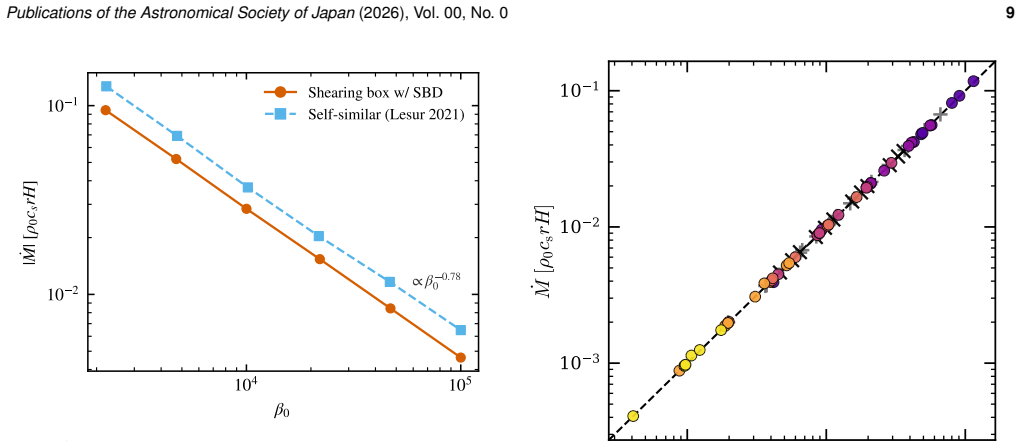
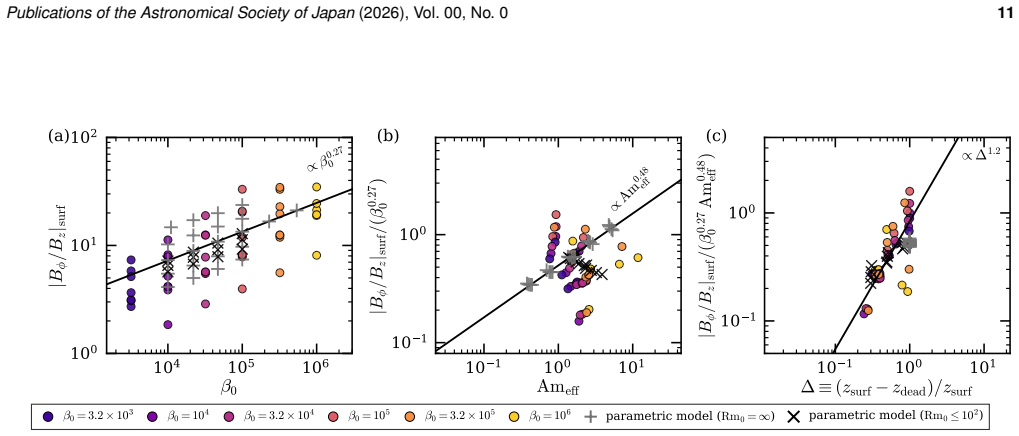
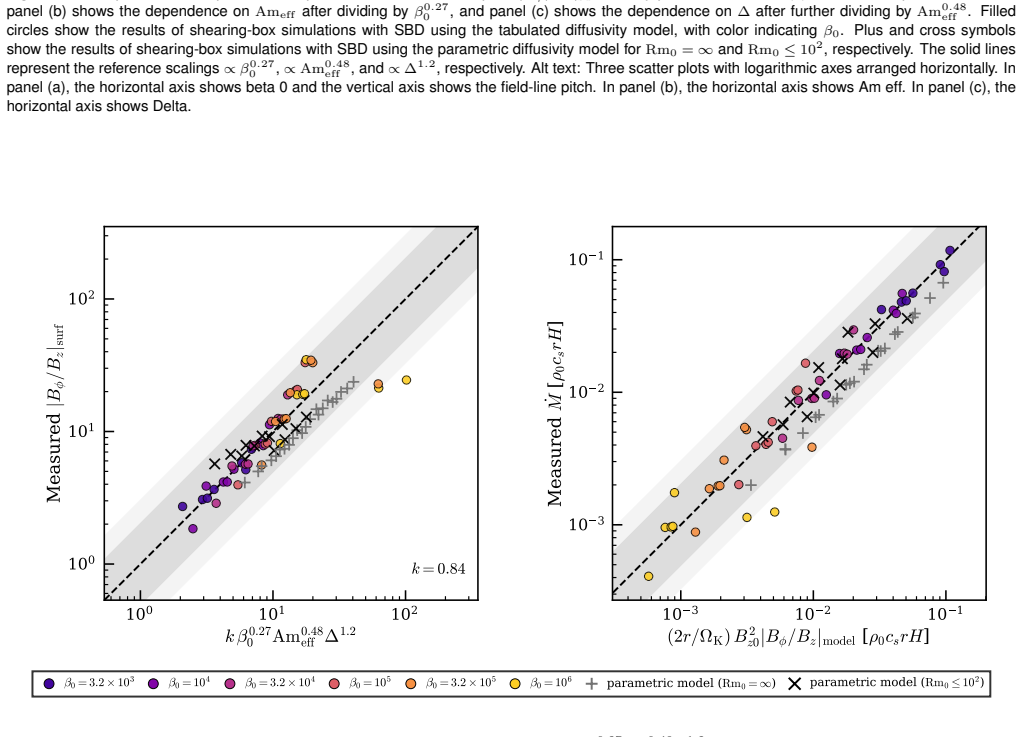
The surface field-line pitch and mass accretion rate follow power-law scalings with the midplane plasma beta, an effective ambipolar Elsasser number, and the normalized thickness of the magnetically active layer. These relations reproduce the numerical results to within a factor of 2-3 across the explored parameter space and, in most cases, to within a factor of 2. They provide a framework for predicting the mass accretion rate from local disk physical quantities without invoking an α parameter.
What carries the argument
The super-box-scale diffusion scheme that damps horizontally averaged horizontal magnetic fields to preserve field-line symmetry for global wind-driven accretion, together with the derived power-law scalings in midplane plasma beta, effective ambipolar Elsasser number, and active-layer thickness.
If this is right
- Accretion rates become predictable from local midplane conditions and ionization state without tunable α
- Disk evolution calculations can use these scalings to evolve surface density and radius self-consistently
- Accretion variability with dust-to-gas ratio and radius emerges naturally from the same relations
- The scalings remain valid across more than two orders of magnitude in surface density and magnetic field strength
Where Pith is reading between the lines
- The relations could be inserted into one-dimensional viscous evolution codes to replace constant-α assumptions and produce faster global models
- Extending the same parameter survey to include grain growth or radial drift would test whether the scalings still hold when dust dynamics affect ionization
- Direct comparison of the predicted pitch angles with polarized emission maps could provide an observational test of the active-layer thickness
Load-bearing premise
The super-box-scale diffusion scheme maintains the required field-line symmetry for global wind-driven accretion over hundreds of orbits without altering the underlying accretion physics.
What would settle it
Global MHD simulations of the same disk conditions that produce accretion rates deviating by more than a factor of three from the power-law predictions based on local plasma beta, Elsasser number, and active-layer thickness.
Figures





read the original abstract
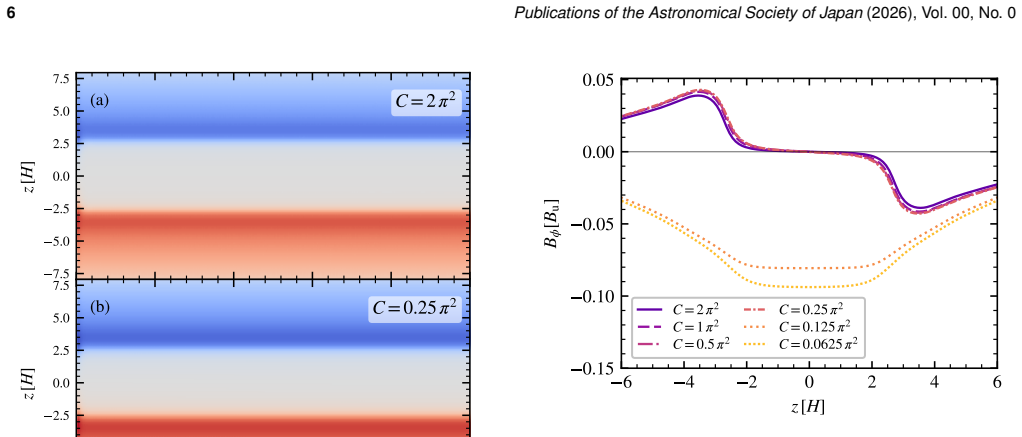
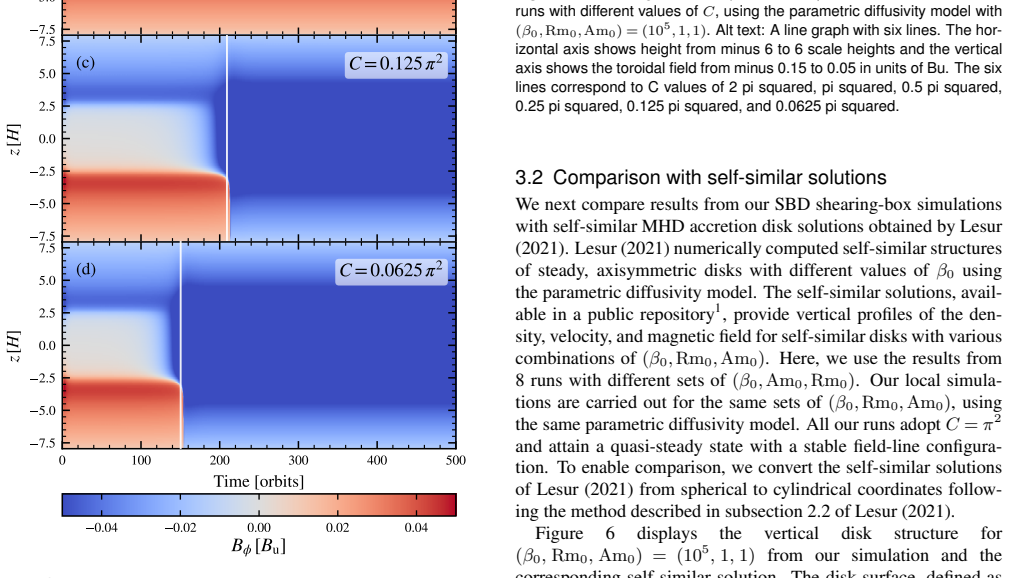
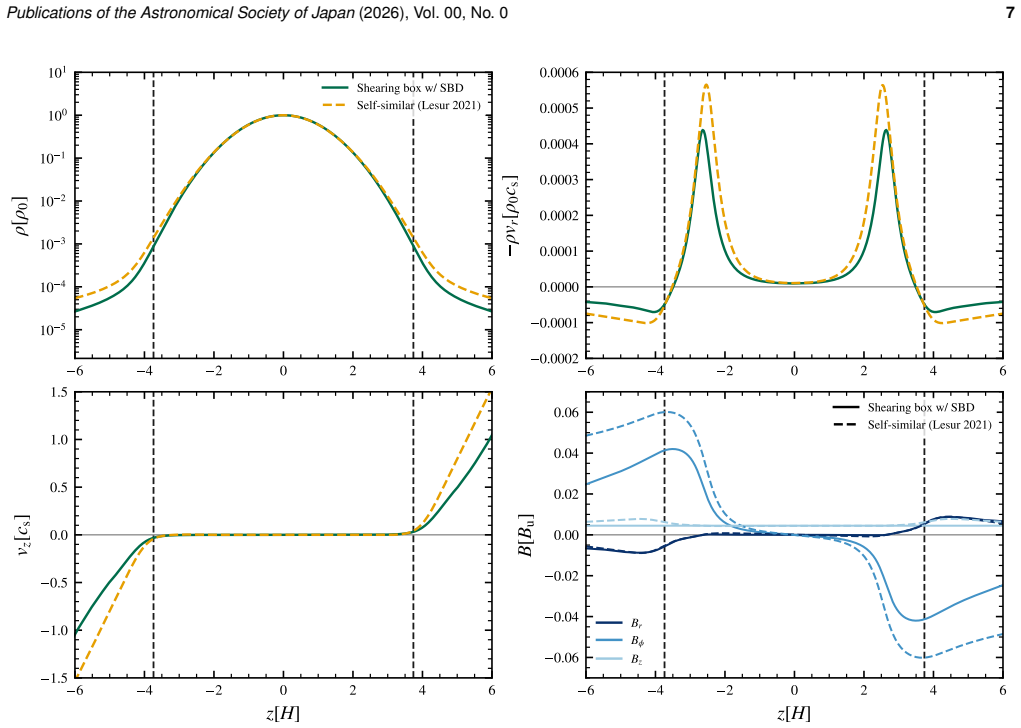
Magnetically driven mass accretion in protoplanetary disks plays a crucial role in understanding disk evolution and planet formation. However, the $\alpha$ prescription lacks a direct connection to physical processes, and no systematic scaling law yet exists for the accretion rate as a function of disk quantities. While local shearing-box simulations offer a powerful approach to analyzing accretion structure at low computational cost, they suffer from a problem: the toroidal magnetic field generated by Keplerian shear accumulates within the computational domain, disrupting a geometry consistent with global wind-driven accretion. In this study, we introduce the super-box-scale diffusion (SBD) scheme into non-ideal MHD shearing-box simulations. The SBD scheme continuously damps the horizontally averaged horizontal magnetic field components, thereby mitigating this problem and maintaining the field-line symmetry required for global wind-driven accretion for more than 500 orbital periods. Comparison with self-similar solutions supports the SBD method, with the vertical structure and plasma-beta dependence of the accretion rate agreeing to within 23--28\%. We then conduct a parameter survey of 46 cases using a magnetic diffusivity table constructed from ionization equilibrium calculations, covering disk radius, surface density, magnetic field strength, and dust-to-gas ratio. We find that the surface field-line pitch and mass accretion rate follow power-law scalings with the midplane plasma beta, an effective ambipolar Elsasser number, and the normalized thickness of the magnetically active layer. These relations reproduce the numerical results to within a factor of 2--3 across the explored parameter space and, in most cases, to within a factor of 2. They provide a framework for predicting the mass accretion rate from local disk physical quantities without invoking an $\alpha$ parameter.
Editorial analysis
A structured set of objections, weighed in public.
Referee Report
Summary. The manuscript introduces a super-box-scale diffusion (SBD) scheme in non-ideal MHD shearing-box simulations to damp horizontally averaged horizontal magnetic fields, thereby preventing toroidal field accumulation and sustaining field-line symmetry consistent with global wind-driven accretion for >500 orbits. The SBD method is validated against self-similar solutions, showing 23-28% agreement in vertical structure and plasma-beta dependence of the accretion rate. A survey of 46 simulations is then performed using a magnetic diffusivity table from ionization equilibrium calculations, varying disk radius, surface density, field strength, and dust-to-gas ratio. Power-law scalings are derived for the surface field-line pitch and mass accretion rate in terms of midplane plasma beta, an effective ambipolar Elsasser number, and the normalized thickness of the magnetically active layer; these relations are reported to reproduce the simulation results within a factor of 2-3 (and often within 2).
Significance. If the SBD scheme can be shown to preserve the correct wind-driven accretion physics without introducing systematic artifacts and if the derived scalings can be demonstrated to have predictive power beyond the fitted 46-run ensemble, the work would offer a concrete framework for estimating accretion rates directly from local disk quantities. This would be a useful step toward replacing the ad-hoc alpha prescription in evolutionary models. The systematic parameter survey with realistic ionization tables is a methodological strength.
major comments (2)
- [Abstract and validation section] Abstract and validation section: The reported 23-28% agreement with self-similar solutions is stated without specifying the exact quantities compared (e.g., vertical profiles of accretion rate, field pitch, or beta dependence), the precise metric used, error bars, or whether the comparison holds for the ionization-table runs. Because this validation is the primary support for the SBD scheme's fidelity, the lack of detail makes it impossible to assess whether the damping preserves the global-like wind physics across the surveyed parameter space.
- [Parameter survey and scaling section] Parameter survey and scaling section: The power-law scalings for field-line pitch and accretion rate are fitted directly to the same 46 simulations against which their accuracy (factor of 2-3 reproduction) is then claimed. No cross-validation, hold-out tests, or comparisons to independent runs are described, so the reproduction is expected by construction and does not yet demonstrate that the relations are predictive for regimes outside the explored grid.
Simulated Author's Rebuttal
We thank the referee for their constructive and detailed review, which has helped us improve the clarity and rigor of the manuscript. We address each major comment point by point below and indicate the revisions made.
read point-by-point responses
-
Referee: [Abstract and validation section] Abstract and validation section: The reported 23-28% agreement with self-similar solutions is stated without specifying the exact quantities compared (e.g., vertical profiles of accretion rate, field pitch, or beta dependence), the precise metric used, error bars, or whether the comparison holds for the ionization-table runs. Because this validation is the primary support for the SBD scheme's fidelity, the lack of detail makes it impossible to assess whether the damping preserves the global-like wind physics across the surveyed parameter space.
Authors: We agree that the abstract and validation section would benefit from additional specificity to allow readers to fully evaluate the SBD scheme. The 23-28% agreement quantifies the average relative difference in the vertically integrated accretion rate and in the slope of the accretion-rate versus midplane plasma-beta relation, with the vertical structure compared via profiles of the accretion rate and magnetic field pitch angle. The metric is the time-averaged relative deviation over the quasi-steady phase (orbits 300-500), with uncertainties from the standard deviation of the temporal fluctuations. This comparison was performed on the self-similar test cases; we have added a sentence confirming that the same level of agreement is recovered for the ionization-equilibrium runs within the surveyed parameter space. The revised manuscript expands the validation section with these details and includes an additional figure showing the compared vertical profiles. revision: yes
-
Referee: [Parameter survey and scaling section] Parameter survey and scaling section: The power-law scalings for field-line pitch and accretion rate are fitted directly to the same 46 simulations against which their accuracy (factor of 2-3 reproduction) is then claimed. No cross-validation, hold-out tests, or comparisons to independent runs are described, so the reproduction is expected by construction and does not yet demonstrate that the relations are predictive for regimes outside the explored grid.
Authors: We acknowledge the validity of this observation: the power-law coefficients were obtained by fitting the entire 46-run ensemble, and the reported factor-of-2-3 accuracy is therefore assessed on the training data. This is standard practice for deriving empirical scalings from a finite simulation survey, but it does not constitute an independent test of predictive power. In the revised manuscript we have added an explicit description of the fitting procedure (including the functional form, the least-squares method, and the resulting chi-squared values), together with a clear statement of the domain of applicability. We also include a caveat noting that extrapolation beyond the explored ranges of radius, surface density, field strength, and dust-to-gas ratio has not been validated and would require additional simulations. We believe these changes address the concern without overclaiming generality. revision: partial
Circularity Check
Power-law scalings fitted to 46 simulations presented as predictive framework for accretion rates
specific steps
-
fitted input called prediction
[Abstract]
"We find that the surface field-line pitch and mass accretion rate follow power-law scalings with the midplane plasma beta, an effective ambipolar Elsasser number, and the normalized thickness of the magnetically active layer. These relations reproduce the numerical results to within a factor of 2--3 across the explored parameter space and, in most cases, to within a factor of 2. They provide a framework for predicting the mass accretion rate from local disk physical quantities without invoking an α parameter."
The scalings are extracted by fitting the 46 simulation cases; the statement that they 'reproduce the numerical results' therefore describes the fit quality rather than an independent prediction or derivation from external principles.
full rationale
The paper's strongest claim is a set of power-law relations for surface field-line pitch and mass accretion rate in terms of midplane plasma beta, effective ambipolar Elsasser number, and active-layer thickness. These relations are obtained by analyzing the outcomes of the identical 46 non-ideal MHD runs that constitute the parameter survey. Agreement to within factor 2-3 is therefore expected by construction of the fit. The SBD scheme itself is new and validated only against self-similar solutions (23-28 percent), but that validation does not render the subsequent empirical scalings independent. The result is useful interpolation within the surveyed space but reduces to a fitted description of the input data rather than a first-principles derivation.
Axiom & Free-Parameter Ledger
free parameters (1)
- exponents in the power-law scalings
axioms (1)
- domain assumption Magnetic diffusivity values from ionization equilibrium calculations accurately represent the disk conditions across the surveyed parameter space
invented entities (1)
-
super-box-scale diffusion (SBD) scheme
no independent evidence
Reference graph
Works this paper leans on
-
[1]
Steady-state accretion in magnetized protoplanetary disks. , keywords =. doi:10.1051/0004-6361/202141689 , archivePrefix =. 2110.05639 , primaryClass =
-
[2]
Athena: A New Code for Astrophysical MHD. , keywords =. doi:10.1086/588755 , archivePrefix =. 0804.0402 , primaryClass =
-
[3]
Dead zones as safe havens for planetesimals: influence of disc mass and external magnetic field. , keywords =. doi:10.1111/j.1365-2966.2012.20701.x , archivePrefix =. 1202.0771 , primaryClass =
-
[4]
Wind-driven Accretion in Protoplanetary Disks. I. Suppression of the Magnetorotational Instability and Launching of the Magnetocentrifugal Wind. , keywords =. doi:10.1088/0004-637X/769/1/76 , archivePrefix =. 1301.0318 , primaryClass =
-
[5]
2017, ApJ, 845, 75, doi: 10.3847/1538-4357/aa7dda
Global Simulations of the Inner Regions of Protoplanetary Disks with Comprehensive Disk Microphysics. , keywords =. doi:10.3847/1538-4357/aa7dda , archivePrefix =. 1707.00729 , primaryClass =
-
[6]
Global simulations of protoplanetary disks with net magnetic flux. I. Non-ideal MHD case. , keywords =. doi:10.1051/0004-6361/201630056 , archivePrefix =. 1612.00883 , primaryClass =
-
[7]
arXiv , author =:1501.05431 , journal =
Global Simulations of Protoplanetary Disks With Ohmic Resistivity and Ambipolar Diffusion. , keywords =. doi:10.1088/0004-637X/801/2/84 , archivePrefix =. 1501.05431 , primaryClass =
-
[8]
2019, Monthly Notices of the Royal Astronomical Society, 484, 107, doi: 10.1093/mnras/sty3502
The formation of rings and gaps in wind-launching non-ideal MHD discs: three-dimensional simulations. , keywords =. doi:10.1093/mnras/sty3502 , archivePrefix =. 1810.02234 , primaryClass =
-
[9]
2020, Astronomy & Astrophysics, 639, A95, doi: 10.1051/0004-6361/201937418
Ring formation and dust dynamics in wind-driven protoplanetary discs: global simulations. , keywords =. doi:10.1051/0004-6361/201937418 , archivePrefix =. 2006.01194 , primaryClass =
-
[10]
Dead Zone Accretion Flows in Protostellar Disks. , keywords =. doi:10.1086/589540 , archivePrefix =. 0804.2916 , primaryClass =
-
[11]
Astronomy & Astrophysics , author =
Systematic description of wind-driven protoplanetary discs. , keywords =. doi:10.1051/0004-6361/202040109 , archivePrefix =. 2101.10349 , primaryClass =
-
[12]
Magnetic outflows from turbulent accretion disks. I. Vertical structure and secular evolution. , keywords =. doi:10.1051/0004-6361/202039322 , archivePrefix =. 2011.14782 , primaryClass =
-
[13]
The formation of rings and gaps in magnetically coupled disc-wind systems: ambipolar diffusion and reconnection. , keywords =. doi:10.1093/mnras/sty717 , archivePrefix =. 1712.06217 , primaryClass =
-
[14]
Spontaneous ring formation in wind-emitting accretion discs. , keywords =. doi:10.1051/0004-6361/201834813 , archivePrefix =. 1904.07910 , primaryClass =
-
[15]
The evolution of viscous discs and the origin of the nebular variables. , year = 1974, month = sep, volume =. doi:10.1093/mnras/168.3.603 , adsurl =
-
[16]
2016, ARA&A, 54, 135, doi: 10.1146/annurev-astro-081915-023347
Accretion onto Pre-Main-Sequence Stars. , year = 2016, month = sep, volume =. doi:10.1146/annurev-astro-081915-023347 , adsurl =
-
[17]
Protoplanetary Disks and Their Evolution. , keywords =. doi:10.1146/annurev-astro-081710-102548 , archivePrefix =. 1103.0556 , primaryClass =
-
[18]
Protostars and Planets VI , year = 2014, editor =
Dust Evolution in Protoplanetary Disks. Protostars and Planets VI , year = 2014, editor =. doi:10.2458/azu_uapress_9780816531240-ch015 , archivePrefix =. 1402.1354 , primaryClass =
-
[19]
Demographics of Young Stars and their Protoplanetary Disks: Lessons Learned on Disk Evolution and its Connection to Planet Formation. Protostars and Planets VII , year = 2023, editor =. doi:10.48550/arXiv.2203.09930 , archivePrefix =. 2203.09930 , primaryClass =
-
[20]
Observational appearance
Black holes in binary systems. Observational appearance. , year = 1973, month = jan, volume =
1973
-
[21]
Hydromagnetic flows from accretion disks and the production of radio jets. , keywords =. doi:10.1093/mnras/199.4.883 , adsurl =
-
[22]
Self-similar Models of Magnetized Accretion Disks. , keywords =. doi:10.1086/167585 , adsurl =
-
[23]
A Powerful Local Shear Instability in Weakly Magnetized Disks. I. Linear Analysis. , keywords =. doi:10.1086/170270 , adsurl =
-
[24]
Magnetorotational Instability in Protoplanetary Disks. II. Ionization State and Unstable Regions. , keywords =. doi:10.1086/317075 , archivePrefix =. astro-ph/0005464 , primaryClass =
-
[25]
Magnetic fields in protoplanetary disks. , keywords =. doi:10.1007/s10509-007-9575-8 , archivePrefix =. 0704.0970 , primaryClass =
-
[26]
Protostars and Planets VI , year = 2014, editor =
Transport and Accretion in Planet-Forming Disks. Protostars and Planets VI , year = 2014, editor =. doi:10.2458/azu_uapress_9780816531240-ch018 , archivePrefix =. 1401.7306 , primaryClass =
-
[27]
The combined influence of Ohmic, Hall, and ambipolar diffusion on dead zones
Thanatology in protoplanetary discs. The combined influence of Ohmic, Hall, and ambipolar diffusion on dead zones. , keywords =. doi:10.1051/0004-6361/201423660 , archivePrefix =. 1402.4133 , primaryClass =
-
[28]
Turbulence in the Outer Regions of Protoplanetary Disks. II. Strong Accretion Driven by a Vertical Magnetic Field. , keywords =. doi:10.1088/0004-637X/775/1/73 , archivePrefix =. 1306.3222 , primaryClass =
-
[29]
Global Hydromagnetic Simulations of Protoplanetary Disks with Stellar Irradiation and Simplified Thermochemistry. , keywords =. doi:10.3847/1538-4357/ab91b7 , archivePrefix =. 2005.03431 , primaryClass =
-
[30]
Monthly Notices of the Royal Astronomical Society , author =
Secular evolution of MHD wind-driven discs: analytical solutions in the expanded -framework. , keywords =. doi:10.1093/mnras/stab3442 , archivePrefix =. 2111.10145 , primaryClass =
-
[31]
Formation and evolution of carbonaceous asteroid Ryugu: Direct evidence from returned samples. Science , keywords =. doi:10.1126/science.abn8671 , adsurl =
-
[32]
History of the solar nebula from meteorite paleomagnetism. Science Advances , keywords =. doi:10.1126/sciadv.aba5967 , archivePrefix =. 2103.02011 , primaryClass =
-
[33]
Magnetic field dragging in accretion discs. , keywords =. doi:10.1093/mnras/267.2.235 , adsurl =
-
[34]
Radial Transport of Large-scale Magnetic Fields in Accretion Disks. I. Steady Solutions and an Upper Limit on the Vertical Field Strength. , keywords =. doi:10.1088/0004-637X/785/2/127 , archivePrefix =. 1310.7446 , primaryClass =
-
[35]
Radial Transport of Large-scale Magnetic Fields in Accretion Disks. II. Relaxation to Steady States. , keywords =. doi:10.1088/0004-637X/797/2/132 , archivePrefix =. 1310.7380 , primaryClass =
-
[36]
doi:10.1093/mnras/stu532 , eprint =
Global evolution of the magnetic field in a thin disc and its consequences for protoplanetary systems. , keywords =. doi:10.1093/mnras/stu532 , archivePrefix =. 1403.3732 , primaryClass =
-
[37]
Hall Effect-Mediated Magnetic Flux Transport in Protoplanetary Disks. , keywords =. doi:10.3847/1538-4357/836/1/46 , archivePrefix =. 1612.03912 , primaryClass =
-
[38]
2025, Nature Astronomy, 9, 526, doi: 10.1038/s41550-024-02454-x
Observationally derived magnetic field strength and 3D components in the HD 142527 disk. Nature Astronomy , keywords =. doi:10.1038/s41550-024-02454-x , archivePrefix =. 2502.06030 , primaryClass =
-
[39]
Temperature Structure in the Inner Regions of Protoplanetary Disks: Inefficient Accretion Heating Controlled by Nonideal Magnetohydrodynamics. , keywords =. doi:10.3847/1538-4357/ab0022 , archivePrefix =. 1901.06921 , primaryClass =
-
[40]
Global Simulations of Protoplanetary Disk Outflows with Coupled Non-ideal Magnetohydrodynamics and Consistent Thermochemistry. , keywords =. doi:10.3847/1538-4357/ab06fd , archivePrefix =. 1810.12330 , primaryClass =
-
[41]
2023, in Astronomical Society of the Pacific Conference Series, Vol
Hydro-, Magnetohydro-, and Dust-Gas Dynamics of Protoplanetary Disks. Protostars and Planets VII , year = 2023, editor =. doi:10.48550/arXiv.2203.09821 , archivePrefix =. 2203.09821 , primaryClass =
-
[42]
Global three-dimensional simulations of outer protoplanetary discs with ambipolar diffusion. , keywords =. doi:10.1093/mnras/stab2220 , archivePrefix =. 2106.10167 , primaryClass =
-
[43]
Magnetohydrodynamics in a cylindrical shearing box. , keywords =. doi:10.1093/pasj/psz082 , archivePrefix =. 1904.05032 , primaryClass =
-
[44]
MHD in a Cylindrical Shearing Box. II. Intermittent Bursts and Substructures in MRI Turbulence. , keywords =. doi:10.3847/1538-4357/acfb88 , archivePrefix =. 2305.12112 , primaryClass =
-
[45]
Evolution of protoplanetary discs with magnetically driven disc winds. , keywords =. doi:10.1051/0004-6361/201628955 , archivePrefix =. 1609.00437 , primaryClass =
-
[46]
Hall-effect-Controlled Gas Dynamics in Protoplanetary Disks. I. Wind Solutions at the Inner Disk. , keywords =. doi:10.1088/0004-637X/791/2/137 , archivePrefix =. 1402.7102 , primaryClass =
-
[47]
Dynamics near the inner dead-zone edges in a proprotoplanetary disk. , keywords =. doi:10.1093/pasj/psae036 , archivePrefix =. 2401.03733 , primaryClass =
-
[48]
Local Three-dimensional Magnetohydrodynamic Simulations of Accretion Disks. , keywords =. doi:10.1086/175311 , adsurl =
-
[49]
The Astrophysical Journal , author =
Layered Accretion in T Tauri Disks. , keywords =. doi:10.1086/176735 , adsurl =
-
[50]
Disk Winds Driven by Magnetorotational Instability and Dispersal of Protoplanetary Disks. , keywords =. doi:10.1088/0004-637X/691/1/L49 , archivePrefix =. 0812.0844 , primaryClass =
-
[51]
Magnetic self-organization in Hall-dominated magnetorotational turbulence. , keywords =. doi:10.1093/mnras/stt1171 , archivePrefix =. 1306.5887 , primaryClass =
-
[52]
Electron Heating in Magnetorotational Instability: Implications for Turbulence Strength in the Outer Regions of Protoplanetary Disks. , keywords =. doi:10.3847/0004-637X/817/1/52 , archivePrefix =. 1505.04896 , primaryClass =
-
[53]
Modeling Magnetorotational Turbulence in Protoplanetary Disks with Dead Zones. , keywords =. doi:10.1088/0004-637X/742/2/65 , archivePrefix =. 1108.4892 , primaryClass =
-
[54]
Dust settling and rings in the outer regions of protoplanetary discs subject to ambipolar diffusion. , keywords =. doi:10.1051/0004-6361/201833212 , archivePrefix =. 1805.00458 , primaryClass =
-
[55]
Magnetically driven accretion in protoplanetary discs. , keywords =. doi:10.1093/mnras/stv2070 , archivePrefix =. 1508.00904 , primaryClass =
-
[56]
Effect of Ambipolar Diffusion on the Nonlinear Evolution of Magnetorotational Instability in Weakly Ionized Disks. , keywords =. doi:10.1088/0004-637X/736/2/144 , archivePrefix =. 1103.1380 , primaryClass =
-
[57]
The Effect of Resistivity on the Nonlinear Stage of the Magnetorotational Instability in Accretion Disks. , keywords =. doi:10.1086/308338 , archivePrefix =. astro-ph/0001164 , primaryClass =
-
[58]
Magnetized Accretion-Ejection Structures: 2.5-dimensional Magnetohydrodynamic Simulations of Continuous Ideal Jet Launching from Resistive Accretion Disks. , keywords =. doi:10.1086/344340 , archivePrefix =. astro-ph/0208459 , primaryClass =
-
[59]
arXiv , author =:1310.6745 , journal =
Two Timescale Dispersal of Magnetized Protoplanetary Disks. , keywords =. doi:10.1088/2041-8205/778/1/L14 , archivePrefix =. 1310.6745 , primaryClass =
-
[60]
arXiv , author =:1603.00484 , journal =
Towards a Global Evolutionary Model of Protoplanetary Disks. , keywords =. doi:10.3847/0004-637X/821/2/80 , archivePrefix =. 1603.00484 , primaryClass =
-
[61]
doi:10.3847/1538-4357/aa7d55 , eid =
Magnetically Induced Disk Winds and Transport in the HL Tau Disk. , keywords =. doi:10.3847/1538-4357/aa7d55 , archivePrefix =. 1706.09565 , primaryClass =
-
[62]
The Astrophysical Journal , author =
An Analytic Model for an Evolving Protoplanetary Disk with a Disk Wind. , keywords =. doi:10.3847/1538-4357/ab2537 , adsurl =
-
[63]
Fluxes of Energetic Particles and the Ionization Rate in Very Dense Interstellar Clouds. , keywords =. doi:10.1093/pasj/33.4.617 , adsurl =
-
[64]
Progress of Theoretical Physics Supplement , author =
Structure of the Solar Nebula, Growth and Decay of Magnetic Fields and Effects of Magnetic and Turbulent Viscosities on the Nebula. Progress of Theoretical Physics Supplement , year = 1981, month = jan, volume =. doi:10.1143/PTPS.70.35 , adsurl =
-
[65]
Journal of Geophysical Research (Planets) , keywords =
Characteristics of Natural Remanence Records in Fine-Grained Particles Returned From Asteroid Ryugu. Journal of Geophysical Research (Planets) , keywords =. doi:10.1029/2025JE009265 , archivePrefix =. 2602.20806 , primaryClass =
-
[66]
Surface Layer Accretion in Conventional and Transitional Disks Driven by Far-ultraviolet Ionization. , keywords =. doi:10.1088/0004-637X/735/1/8 , archivePrefix =. 1104.2320 , primaryClass =
-
[67]
A Radially Resolved Magnetic Field Threading the Disk of TW Hya. , keywords =. doi:10.3847/2041-8213/adff4d , archivePrefix =. 2509.09450 , primaryClass =
-
[68]
Three-dimensional Magnetohydrodynamical Simulations of Vertically Stratified Accretion Disks. , keywords =. doi:10.1086/177280 , adsurl =
-
[69]
Radiative Nonideal Magnetohydrodynamic Simulations of Inner Protoplanetary Disks: Temperature Structures, Asymmetric Winds, and Episodic Surface Accretion. , keywords =. doi:10.3847/1538-4357/adf8d7 , archivePrefix =. 2508.03624 , primaryClass =
-
[70]
2011, MNRAS, 418, 467, doi: 10.1111/j.1365-2966.2011.19497.x
Hall diffusion and the magnetorotational instability in protoplanetary discs. , keywords =. doi:10.1111/j.1365-2966.2011.20022.x , archivePrefix =. 1103.3562 , primaryClass =
-
[71]
On the linear stability of weakly ionized, magnetized planar shear flows. , keywords =. doi:10.1111/j.1365-2966.2008.12928.x , archivePrefix =. 0801.0974 , primaryClass =
-
[72]
Linear Analysis of the Hall Effect in Protostellar Disks. , keywords =. doi:10.1086/320452 , archivePrefix =. astro-ph/0010229 , primaryClass =
-
[73]
The Balbus-Hawley instability in weakly ionized discs. , keywords =. doi:10.1046/j.1365-8711.1999.02670.x , archivePrefix =. astro-ph/9809349 , primaryClass =
-
[74]
Wind-driven Accretion in Protoplanetary Disks. II. Radial Dependence and Global Picture. , keywords =. doi:10.1088/0004-637X/772/2/96 , archivePrefix =. 1305.7232 , primaryClass =
discussion (0)
Sign in with ORCID, Apple, or X to comment. Anyone can read and Pith papers without signing in.