Recognition: unknown
CoherentRaster: Efficient 3D Gaussian Splatting for Light Field Displays
Pith reviewed 2026-05-08 17:05 UTC · model grok-4.3
The pith
CoherentRaster achieves real-time light field rendering by reusing attributes across views and remapping subpixels in 3D Gaussian Splatting.
A machine-rendered reading of the paper's core claim, the machinery that carries it, and where it could break.
Core claim
The paper presents CoherentRaster as a 3D Gaussian Splatting framework for light field displays that performs subpixel-level rasterization. It applies Cross-view Coherent Attribute Reuse to remove redundant computation across neighboring viewpoints and View-coherent Remapping to recover warp-level memory efficiency lost to the interlaced subpixel layout, yielding an efficient pipeline for real-time high-quality light field synthesis on consumer-grade hardware.
What carries the argument
Cross-view Coherent Attribute Reuse combined with View-coherent Remapping, which together cut duplicate work and restore GPU memory efficiency during subpixel-level rasterization of interlaced views.
Load-bearing premise
Cross-view Coherent Attribute Reuse and View-coherent Remapping can eliminate redundant computation and restore memory efficiency without introducing noticeable artifacts or quality loss in the interlaced subpixel layout.
What would settle it
A benchmark comparison on standard light field test scenes that measures either frame times exceeding real-time rates or measurable drops in image quality metrics relative to a full non-optimized 3D Gaussian Splatting baseline.
Figures

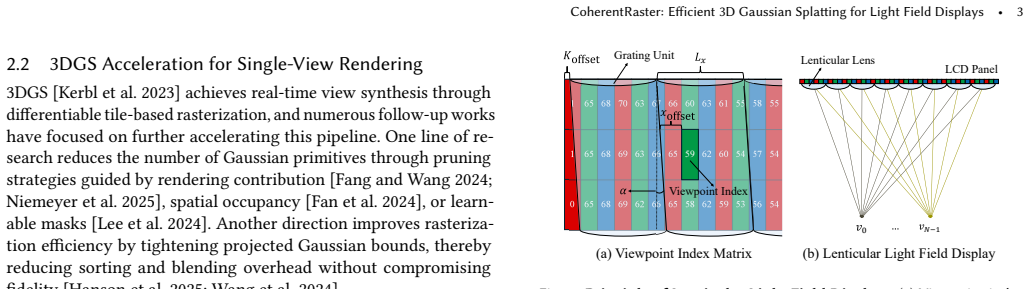


read the original abstract
Light field displays (LFDs) require rendering an interlaced image that encodes many view-dependent observations. This multi-view requirement introduces substantial computational overhead, making real-time rendering difficult to achieve. While 3D Gaussian Splatting (3DGS) is efficient for single-view rendering on 2D displays, directly extending it to LFDs is computationally expensive. Moreover, prior accelerations either suffer from GPU inefficiency under spatially incoherent subpixel layouts or rely on computationally heavy multi-plane intermediates. In this paper, we propose CoherentRaster, a 3DGS-based light field rendering framework that performs subpixel-level rasterization. Our method employs Cross-view Coherent Attribute Reuse to eliminate redundant computation across neighboring viewpoints and applies View-coherent Remapping to restore warp-level memory efficiency degraded by the interlaced subpixel layout. Together, CoherentRaster provides an efficient pipeline for real-time, high-quality light field synthesis on consumer-grade hardware.
Editorial analysis
A structured set of objections, weighed in public.
Referee Report
Summary. The paper introduces CoherentRaster, a 3D Gaussian Splatting framework for light field displays that performs subpixel-level rasterization. It employs Cross-view Coherent Attribute Reuse to eliminate redundant computation across neighboring viewpoints and View-coherent Remapping to restore warp-level memory efficiency under interlaced subpixel layouts, with the central claim being an efficient pipeline for real-time, high-quality light field synthesis on consumer-grade hardware.
Significance. If the performance and quality claims hold, the work would be significant for extending efficient 3DGS techniques to practical light field display applications, directly targeting multi-view overhead without relying on heavy multi-plane intermediates. The coherence-based optimizations represent a targeted and parameter-free extension of existing 3DGS methods.
major comments (1)
- [§4] §4 (Experimental Results): the central performance claim of real-time high-quality rendering lacks supporting quantitative benchmarks, FPS measurements, error metrics, or baseline comparisons in the provided evaluation, which is load-bearing for validating that the proposed reuse and remapping techniques deliver the stated efficiency without quality loss.
Simulated Author's Rebuttal
We thank the referee for the constructive review and the minor revision recommendation. The single major comment highlights a valid gap in the experimental validation, which we will address directly in the revised manuscript.
read point-by-point responses
-
Referee: [§4] §4 (Experimental Results): the central performance claim of real-time high-quality rendering lacks supporting quantitative benchmarks, FPS measurements, error metrics, or baseline comparisons in the provided evaluation, which is load-bearing for validating that the proposed reuse and remapping techniques deliver the stated efficiency without quality loss.
Authors: We agree that the current §4 relies primarily on qualitative demonstrations and does not yet provide the quantitative evidence needed to fully support the real-time and quality claims. In the revised version we will add: (1) FPS measurements on consumer hardware (RTX 3060/4090 class GPUs) for representative light-field resolutions and view counts; (2) PSNR/SSIM/LPIPS error metrics against ground-truth multi-view renderings; and (3) direct runtime and quality comparisons against a naïve multi-view 3DGS baseline as well as prior light-field acceleration techniques. These additions will quantify the gains from Cross-view Coherent Attribute Reuse and View-coherent Remapping while confirming that quality is preserved. revision: yes
Circularity Check
No significant circularity detected in derivation chain
full rationale
The paper describes CoherentRaster as a direct engineering extension of 3D Gaussian Splatting, introducing Cross-view Coherent Attribute Reuse and View-coherent Remapping to address specific computational and memory issues in light field display rendering. No equations or steps in the abstract or method overview reduce by construction to self-definitions, fitted parameters renamed as predictions, or load-bearing self-citations. The central efficiency claims rest on the proposed coherence optimizations applied to the interlaced subpixel layout, which are independent of the input data and prior results by the paper's own presentation. This is the typical non-circular case for a systems paper proposing targeted optimizations.
Axiom & Free-Parameter Ledger
Reference graph
Works this paper leans on
-
[1]
3D Gaussian Splatting for Real-Time Radiance Field Rendering , journal =
Kerbl, Bernhard and Kopanas, Georgios and Leimk. 3D Gaussian Splatting for Real-Time Radiance Field Rendering , journal =. 2023 , url =
2023
-
[2]
Proceedings Visualization, 2001
Ewa volume splatting , author=. Proceedings Visualization, 2001. VIS'01. , pages=. 2001 , organization=
2001
-
[3]
Proceedings of the Computer Vision and Pattern Recognition Conference (CVPR) , month =
Hanson, Alex and Tu, Allen and Lin, Geng and Singla, Vasu and Zwicker, Matthias and Goldstein, Tom , title =. Proceedings of the Computer Vision and Pattern Recognition Conference (CVPR) , month =. 2025 , pages =
2025
-
[4]
Proceedings of the IEEE/CVF conference on computer vision and pattern recognition , pages=
Pulsar: Efficient sphere-based neural rendering , author=. Proceedings of the IEEE/CVF conference on computer vision and pattern recognition , pages=
-
[5]
Displays , volume=
Virtual stereo content rendering technology review for light-field display , author=. Displays , volume=. 2023 , publisher=
2023
-
[6]
ACM Transactions on Graphics (TOG) , volume=
DirectL: Efficient Radiance Fields Rendering for 3D Light Field Displays , author=. ACM Transactions on Graphics (TOG) , volume=. 2024 , publisher=
2024
-
[7]
Communications of the ACM , volume=
Nerf: Representing scenes as neural radiance fields for view synthesis , author=. Communications of the ACM , volume=. 2021 , publisher=
2021
-
[8]
ACM transactions on graphics (TOG) , volume=
Instant neural graphics primitives with a multiresolution hash encoding , author=. ACM transactions on graphics (TOG) , volume=. 2022 , publisher=
2022
-
[9]
Proceedings of the IEEE/CVF international conference on computer vision , pages=
Baking neural radiance fields for real-time view synthesis , author=. Proceedings of the IEEE/CVF international conference on computer vision , pages=
-
[10]
Looking Glass Factory Official Website , year =
-
[11]
Leia Official Website , year =
-
[12]
Spatial Reality Display by Sony , year =
-
[13]
arXiv preprint arXiv:2508.18540 , year=
Real-time 3D Visualization of Radiance Fields on Light Field Displays , author=. arXiv preprint arXiv:2508.18540 , year=
-
[14]
Optics Express , volume=
Text-driven light-field content editing for three-dimensional light-field display based on Gaussian splatting , author=. Optics Express , volume=. 2025 , publisher=
2025
-
[15]
Stereoscopic Displays and Virtual Reality Systems VI , volume=
Image preparation for 3D LCD , author=. Stereoscopic Displays and Virtual Reality Systems VI , volume=. 1999 , organization=
1999
-
[16]
SIGGRAPH Asia 2024 Conference Papers , pages=
Adr-gaussian: Accelerating gaussian splatting with adaptive radius , author=. SIGGRAPH Asia 2024 Conference Papers , pages=
2024
-
[17]
Optics Express , volume=
Dense-view synthesis for three-dimensional light-field display based on unsupervised learning , author=. Optics Express , volume=. 2019 , publisher=
2019
-
[18]
Optics Communications , volume=
Dense view synthesis for three-dimensional light-field display based on scene geometric reconstruction , author=. Optics Communications , volume=. 2022 , publisher=
2022
-
[19]
Proceedings of the IEEE/CVF Conference on Computer Vision and Pattern Recognition , pages=
Voodoo 3d: Volumetric portrait disentanglement for one-shot 3d head reenactment , author=. Proceedings of the IEEE/CVF Conference on Computer Vision and Pattern Recognition , pages=
-
[20]
Optics Express , volume=
Orthoscopic elemental image synthesis for 3D light field display using lens design software and real-world captured neural radiance field , author=. Optics Express , volume=. 2024 , publisher=
2024
-
[21]
Journal of Machine Learning Research , volume=
gsplat: An open-source library for Gaussian splatting , author=. Journal of Machine Learning Research , volume=
-
[22]
ACM SIGGRAPH 2023 Conference Proceedings , series =
Nerfstudio: A Modular Framework for Neural Radiance Field Development , author =. ACM SIGGRAPH 2023 Conference Proceedings , series =
2023
-
[23]
Proceedings of the IEEE/CVF conference on computer vision and pattern recognition , pages=
Mip-nerf 360: Unbounded anti-aliased neural radiance fields , author=. Proceedings of the IEEE/CVF conference on computer vision and pattern recognition , pages=
-
[24]
Zirui Wang and Shangzhe Wu and Weidi Xie and Min Chen and Victor Adrian Prisacariu , journal=. Ne
-
[25]
Proceedings of the IEEE/CVF conference on computer vision and pattern recognition , pages=
Nerf in the wild: Neural radiance fields for unconstrained photo collections , author=. Proceedings of the IEEE/CVF conference on computer vision and pattern recognition , pages=
-
[26]
IEEE Transactions on Pattern Analysis and Machine Intelligence , year=
Ref-nerf: Structured view-dependent appearance for neural radiance fields , author=. IEEE Transactions on Pattern Analysis and Machine Intelligence , year=
-
[27]
Proceedings of the IEEE/CVF Conference on Computer Vision and Pattern Recognition , pages=
Compact 3d gaussian representation for radiance field , author=. Proceedings of the IEEE/CVF Conference on Computer Vision and Pattern Recognition , pages=
-
[28]
Advances in neural information processing systems , volume=
Lightgaussian: Unbounded 3d gaussian compression with 15x reduction and 200+ fps , author=. Advances in neural information processing systems , volume=
-
[29]
2025 International Conference on 3D Vision (3DV) , pages=
Radsplat: Radiance field-informed gaussian splatting for robust real-time rendering with 900+ fps , author=. 2025 International Conference on 3D Vision (3DV) , pages=. 2025 , organization=
2025
-
[30]
European Conference on Computer Vision , pages=
Mini-splatting: Representing scenes with a constrained number of gaussians , author=. European Conference on Computer Vision , pages=. 2024 , organization=
2024
-
[31]
Advances in Neural Information Processing Systems , volume=
3d gaussian splatting as markov chain monte carlo , author=. Advances in Neural Information Processing Systems , volume=
-
[32]
Proceedings of the IEEE conference on computer vision and pattern recognition , pages=
The unreasonable effectiveness of deep features as a perceptual metric , author=. Proceedings of the IEEE conference on computer vision and pattern recognition , pages=
-
[33]
ACM Transactions on Graphics (TOG) , volume=
Stopthepop: Sorted gaussian splatting for view-consistent real-time rendering , author=. ACM Transactions on Graphics (TOG) , volume=. 2024 , publisher=
2024
-
[34]
Proceedings of the 23rd Annual Conference on Computer Graphics and Interactive Techniques , pages =
Levoy, Marc and Hanrahan, Pat , title =. Proceedings of the 23rd Annual Conference on Computer Graphics and Interactive Techniques , pages =. 1996 , isbn =. doi:10.1145/237170.237199 , abstract =
-
[35]
and Grzeszczuk, Radek and Szeliski, Richard and Cohen, Michael F
Gortler, Steven J. and Grzeszczuk, Radek and Szeliski, Richard and Cohen, Michael F. , title =. Proceedings of the 23rd Annual Conference on Computer Graphics and Interactive Techniques , pages =. 1996 , isbn =. doi:10.1145/237170.237200 , abstract =
-
[36]
Stereoscopic displays and virtual reality systems XI , volume=
Depth-image-based rendering (DIBR), compression, and transmission for a new approach on 3D-TV , author=. Stereoscopic displays and virtual reality systems XI , volume=. 2004 , organization=
2004
-
[37]
Proceedings of the 25th annual conference on Computer graphics and interactive techniques , pages=
Layered depth images , author=. Proceedings of the 25th annual conference on Computer graphics and interactive techniques , pages=
-
[38]
Zhou, Tinghui and Tucker, Richard and Flynn, John and Fyffe, Graham and Snavely, Noah , title =. ACM Trans. Graph. , month = jul, articleno =. 2018 , issue_date =. doi:10.1145/3197517.3201323 , abstract =
discussion (0)
Sign in with ORCID, Apple, or X to comment. Anyone can read and Pith papers without signing in.