Topology-Aware Two-Stage Federated Learning via Proxy Models for Sub-THz Heterogeneous LEO Communications
Pith reviewed 2026-05-08 16:34 UTC · model grok-4.3
The pith
A two-stage federated learning framework with proxy models and high-altitude platforms overcomes staleness and heterogeneity in LEO satellite networks.
A machine-rendered reading of the paper's core claim, the machinery that carries it, and where it could break.
Core claim
The authors claim that a topology-aware two-stage federated learning framework, built on a high-altitude platform assisted sub-THz physical architecture and proxy models for heterogeneous resources, enables dynamic partitioning of LEO satellites into localized groups. Within each group, satellites perform asynchronous aggregation at their associated high-altitude platform to tolerate computational delays without penalizing faster nodes, after which a synchronous inter-group aggregation occurs among all high-altitude platforms at the ground station to bound maximum staleness and ensure stable global convergence. Numerical results show this delivers test accuracies of 86.59% to 90.57%, outperh
What carries the argument
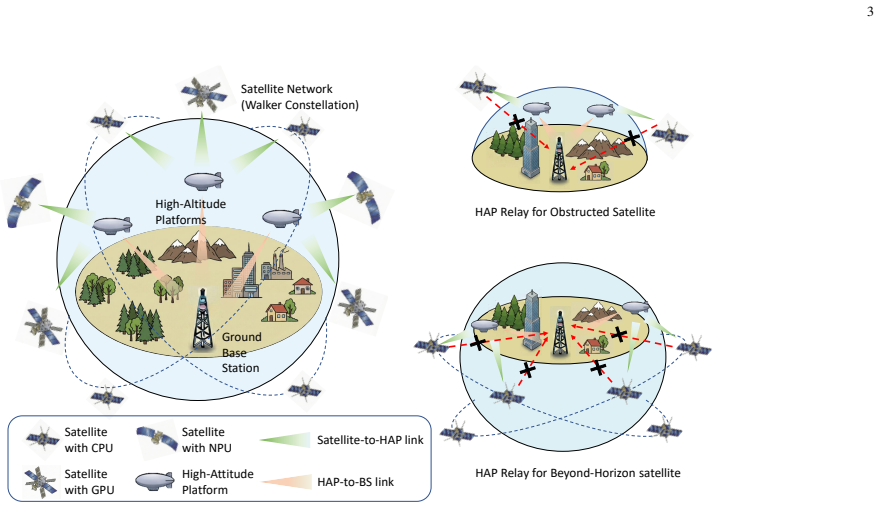
The topology-aware two-stage aggregation mechanism, which dynamically partitions LEO satellites into localized groups based on transient high-altitude platform coverage to enable asynchronous intra-group aggregation at the platforms and synchronous inter-group aggregation at the ground station.
If this is right
- Satellites within the same high-altitude platform coverage perform asynchronous aggregation that tolerates varying compute speeds without delaying faster nodes.
- The synchronous inter-group step at the ground station places a strict upper limit on model staleness across the constellation.
- Proxy models allow satellites with different architectures to contribute knowledge without requiring uniform model designs.
- Contact windows are lengthened and bandwidth is increased, permitting more training iterations per orbit.
- Overall convergence approaches the performance of an ideal always-connected heterogeneous system.
Where Pith is reading between the lines
- The staged aggregation pattern could apply to other intermittently connected systems such as vehicle fleets or drone swarms where connectivity changes rapidly.
- Proxy models open a route for federated learning across hardware generations that would otherwise be incompatible due to differing model sizes or layer counts.
- If orbital tracking supports reliable dynamic grouping, federated learning could become a built-in capability for on-board intelligence in future satellite constellations.
Load-bearing premise
High-altitude platforms and sub-terahertz links can be deployed in practice to extend satellite contact windows enough to support meaningful training, and satellites can be dynamically grouped by their transient coverage under real orbital dynamics.
What would settle it
A controlled test that disables the high-altitude platform layer or replaces dynamic grouping with static partitions and checks whether accuracy falls below 80 percent or convergence speedup disappears.
Figures


read the original abstract
Federated learning (FL) has emerged as a promising distributed training paradigm for Low Earth Orbit (LEO) networks by significantly reducing communication overhead. However, its deployment faces critical challenges, e.g., topology-induced model staleness, short contact windows, and unaddressed computing heterogeneity. To address these issues, a topology-aware two-stage FL framework is proposed in this paper. First, a multi-layer physical architecture utilizing high-altitude platforms (HAPs) and Sub-THz communications is designed to extend satellite-ground contact windows and enlarge available bandwidth. Second, a proxy-model-based approach is adopted to fully utilize heterogeneous resources and enable architecture-agnostic knowledge aggregation. Finally, building upon these foundations, a topology-aware two-stage aggregation mechanism is proposed as the central algorithmic design to overcome the topology-induced staleness. The mechanism dynamically partitions LEO satellites into localized groups based on their transient HAP coverage. Within each group, LEO satellites perform asynchronous aggregation at their associated HAP to naturally tolerate computational delays without penalizing faster nodes. Subsequently, a synchronous inter-group aggregation is executed among all HAPs at the Ground Station (GS) to strictly bound the maximum staleness and guarantee stable global convergence. Numerical results demonstrate the proposed framework extends contact windows and achieves 86.59%--90.57% test accuracy, outperforming the state-of-the-art heterogeneous baseline by 16.26\%--19.80\%. Furthermore, it achieves a 1.5x to 2.2x convergence speedup, which closely approaches the ideal upper bound.
Editorial analysis
A structured set of objections, weighed in public.
Referee Report
Summary. The manuscript proposes a topology-aware two-stage federated learning framework for Sub-THz heterogeneous LEO satellite networks. It introduces a multi-layer physical architecture with high-altitude platforms (HAPs) and Sub-THz links to extend contact windows and bandwidth, employs proxy models to handle computing heterogeneity in an architecture-agnostic manner, and presents a two-stage aggregation scheme (asynchronous intra-group aggregation at HAPs to tolerate delays, followed by synchronous inter-group aggregation at the ground station to bound staleness). Numerical simulations claim contact-window extension along with 86.59%–90.57% test accuracy, 16.26%–19.80% gains over a heterogeneous baseline, and 1.5×–2.2× convergence speedup approaching an ideal upper bound.
Significance. If the physical assumptions hold, the work could meaningfully advance practical FL deployment in LEO constellations by directly addressing topology-induced staleness, short contact times, and device heterogeneity through the two-stage mechanism and proxy models. The simulation-based comparisons against external baselines provide concrete evidence of potential gains in accuracy and speed, and the dynamic HAP-based grouping offers a topology-aware solution that could generalize to other satellite FL settings.
major comments (2)
- [Abstract / Numerical Results] Abstract and Numerical Results section: The headline performance claims (86.59%–90.57% accuracy, 16.26%–19.80% improvement, 1.5×–2.2× speedup) are obtained under a simulated multi-layer architecture that assumes HAP/Sub-THz links materially extend contact windows and enable stable transient partitioning of LEO satellites. No orbital ephemeris validation, sensitivity analysis to realistic station-keeping limits, or Sub-THz propagation constraints are supplied, so the staleness-bounding guarantees and reported gains are conditional on unverified extensions that may not materialize in actual LEO dynamics.
- [Proxy Model Approach] Proxy-model approach section: The proxy models are presented as the key enabler for heterogeneous resource utilization and architecture-agnostic aggregation, yet the manuscript provides no analysis of their training overhead, update frequency, or impact on the overall communication budget, leaving open whether they preserve the claimed efficiency advantages under the short contact windows.
minor comments (2)
- [Abstract] Abstract: The specific state-of-the-art heterogeneous baseline(s) used for comparison are not named, and no simulation parameters (e.g., number of satellites, HAP altitude, Sub-THz bandwidth, number of Monte Carlo trials) are supplied, which should be added for reproducibility.
- [Numerical Results] Numerical Results: Convergence plots and accuracy tables would benefit from explicit inclusion of the ideal upper-bound curve and error bars or confidence intervals to allow direct visual assessment of how closely the proposed method approaches the bound.
Simulated Author's Rebuttal
We thank the referee for the constructive feedback and positive evaluation of the work's potential significance. We address each major comment below with clarifications and indicate revisions to be incorporated in the updated manuscript.
read point-by-point responses
-
Referee: [Abstract / Numerical Results] Abstract and Numerical Results section: The headline performance claims (86.59%–90.57% accuracy, 16.26%–19.80% improvement, 1.5×–2.2× speedup) are obtained under a simulated multi-layer architecture that assumes HAP/Sub-THz links materially extend contact windows and enable stable transient partitioning of LEO satellites. No orbital ephemeris validation, sensitivity analysis to realistic station-keeping limits, or Sub-THz propagation constraints are supplied, so the staleness-bounding guarantees and reported gains are conditional on unverified extensions that may not materialize in actual LEO dynamics.
Authors: The reported performance figures are obtained from simulations conducted under the proposed multi-layer architecture, which is explicitly designed to leverage HAPs and Sub-THz links for contact-window extension and topology-aware grouping. The two-stage aggregation provides staleness bounds conditional on this topology. We agree that the manuscript would be strengthened by explicitly discussing the underlying assumptions. In the revision, we will add a new subsection in the Numerical Results or Discussion section that addresses orbital dynamics considerations, includes a sensitivity analysis to variations in contact-window duration and station-keeping perturbations, and references relevant Sub-THz propagation models. This will better contextualize the conditional nature of the gains without altering the core claims. revision: yes
-
Referee: [Proxy Model Approach] Proxy-model approach section: The proxy models are presented as the key enabler for heterogeneous resource utilization and architecture-agnostic aggregation, yet the manuscript provides no analysis of their training overhead, update frequency, or impact on the overall communication budget, leaving open whether they preserve the claimed efficiency advantages under the short contact windows.
Authors: Proxy models are introduced as compact, architecture-agnostic intermediaries that enable knowledge aggregation across heterogeneous devices while minimizing direct model exchanges. We acknowledge that the current manuscript lacks a dedicated quantitative breakdown of their overhead. In the revised version, we will expand the Proxy Model Approach section to include an analysis of proxy training cost, specify the update frequency (tied to inter-group aggregation intervals), and provide additional numerical results or calculations demonstrating that the incremental communication and computation overhead remains small relative to the baseline FL exchanges. This will confirm that the efficiency advantages, including convergence speedup, are preserved within the short contact windows of the LEO setting. revision: yes
Circularity Check
No significant circularity in derivation or claims.
full rationale
The paper proposes a new two-stage FL architecture and aggregation mechanism to address LEO topology issues, then reports simulation outcomes (accuracy, speedup) as comparative results against external heterogeneous baselines. No equations or steps reduce by construction to fitted inputs, self-definitions, or self-citation chains; the numerical gains are not tautological but arise from independent simulation runs under the stated assumptions. The design choices (HAP partitioning, proxy models, async/synchronous stages) are presented as solutions to listed challenges rather than being justified solely by prior self-work or renamed known results. This is a standard non-circular proposal-plus-simulation structure.
Axiom & Free-Parameter Ledger
axioms (1)
- domain assumption Multi-layer architecture with HAPs and Sub-THz communications extends contact windows and enlarges bandwidth sufficiently for the FL framework.
invented entities (1)
-
proxy models
no independent evidence
Reference graph
Works this paper leans on
-
[1]
6G wireless communications: Vision and potential techniques,
P. Yang, Y . Xiao, M. Xiao, and S. Li, “6G wireless communications: Vision and potential techniques,”IEEE Network, vol. 33, no. 4, pp. 70– 75, 2019. 13
work page 2019
-
[2]
S. Dang, O. Amin, B. Shihada, and M.-S. Alouini, “What should 6G be?,”Nature Electronics, vol. 3, no. 1, pp. 20–29, 2020
work page 2020
-
[3]
Q. Fang, Z. Zhai, S. Yu, Q. Wu, X. Gong, and X. Chen, “Olive branch learning: A topology-aware federated learning framework for space-air-ground integrated network,”IEEE Transactions on Wireless Communications, vol. 22, no. 7, pp. 4534–4551, 2022
work page 2022
-
[4]
Z. Zhai, Q. Wu, S. Yu, R. Li, F. Zhang, and X. Chen, “FedLEO: An offloading-assisted decentralized federated learning framework for low earth orbit satellite networks,”IEEE Transactions on Mobile Computing, vol. 23, no. 5, pp. 5260–5279, 2023
work page 2023
-
[5]
UA V-assisted emergency networks in disasters,
N. Zhao, W. Lu, M. Sheng, Y . Chen, J. Tang, F. R. Yu, and K.-K. Wong, “UA V-assisted emergency networks in disasters,”IEEE Wireless Communications, vol. 26, no. 1, pp. 45–51, 2019
work page 2019
-
[6]
Millimeter-wave full-duplex UA V relay: Joint positioning, beamform- ing, and power control,
L. Zhu, J. Zhang, Z. Xiao, X. Cao, X.-G. Xia, and R. Schober, “Millimeter-wave full-duplex UA V relay: Joint positioning, beamform- ing, and power control,”IEEE Journal on Selected Areas in Communi- cations, vol. 38, no. 9, pp. 2057–2073, 2020
work page 2057
-
[7]
The digital divide in canada and the role of LEO satellites in bridging the gap,
T. Ahmmed, A. Alidadi, Z. Zhang, A. U. Chaudhry, and H. Yanikomeroglu, “The digital divide in canada and the role of LEO satellites in bridging the gap,”IEEE Communications Magazine, vol. 60, no. 6, pp. 24–30, 2022
work page 2022
-
[8]
Robust task scheduling for delay-aware iot applications in civil aircraft-augmented sagin,
Q. Chen, W. Meng, S. Han, C. Li, and H.-H. Chen, “Robust task scheduling for delay-aware iot applications in civil aircraft-augmented sagin,”IEEE Transactions on Communications, vol. 70, no. 8, pp. 5368– 5385, 2022
work page 2022
-
[9]
Accelerating handover in mobile satellite network,
J. Wu, S. Su, X. Wang, J. Zhang, and Y . Gao, “Accelerating handover in mobile satellite network,” inProc. of IEEE Conference on Computer Communications (INFOCOM), pp. 531–540, IEEE, 2024
work page 2024
-
[10]
Graph learning for multi-satellite based spectrum sensing,
H. Yuan, Z. Chen, Z. Lin, J. Peng, Z. Fang, Y . Zhong, Z. Song, X. Wang, and Y . Gao, “Graph learning for multi-satellite based spectrum sensing,” in2023 IEEE 23rd International Conference on Communication Tech- nology (ICCT), pp. 1112–1116, IEEE, 2023
work page 2023
-
[11]
Joint communication and radar sensing for terahertz space-air-ground integrated networks (SAGIN),
C. Han, W. Gao, C. Yang, M. Peng, and W. Zhang, “Joint communication and radar sensing for terahertz space-air-ground integrated networks (SAGIN),”IEEE Wireless Communications, pp. 1–8, 2025
work page 2025
-
[12]
Terahertz aerospace communications: enabling technologies and future directions,
W. Gao, C. Han, Y . Chen, Y . He, and W. Zhang, “Terahertz aerospace communications: enabling technologies and future directions,”Science China Information Sciences, vol. 68, no. 12, p. 220302:1–220302:12, 2025
work page 2025
-
[13]
FCC looks to unleash more spectrum for satellite spectrum abundance,
Federal Communications Commission (FCC), “FCC looks to unleash more spectrum for satellite spectrum abundance,” Notice of Proposed Rulemaking FCC-25-29, FCC, May 2025
work page 2025
-
[14]
R. Liu, A. Liu, Z. Qu, and N. N. Xiong, “An UA V-enabled intelligent connected transportation system with 6G communications for internet of vehicles,”IEEE Transactions on Intelligent Transportation Systems, vol. 24, no. 2, pp. 2045–2059, 2021
work page 2045
-
[15]
A novel non- stationary 6G UA V channel model for maritime communications,
Y . Liu, C.-X. Wang, H. Chang, Y . He, and J. Bian, “A novel non- stationary 6G UA V channel model for maritime communications,”IEEE Journal on Selected Areas in Communications, vol. 39, no. 10, pp. 2992– 3005, 2021
work page 2021
-
[16]
J. Huang, T. Yu, X. Zhu, F. Yang, X. Lai, O. Alfarraj, and K. Yu, “Energy efficiency maximization in UA V-assisted intelligent autonomous trans- port system for 6G networks with energy harvesting,”IEEE Transactions on Intelligent Transportation Systems, vol. 26, no. 10, pp. 17212–17222, 2025
work page 2025
-
[17]
Edge artificial intelligence for 6G: Vision, enabling technologies, and applications,
K. B. Letaief, Y . Shi, J. Lu, and J. Lu, “Edge artificial intelligence for 6G: Vision, enabling technologies, and applications,”IEEE journal on selected areas in communications, vol. 40, no. 1, pp. 5–36, 2021
work page 2021
-
[18]
RF-based human activity recognition using signal adapted convolutional neural network,
Z. Chen, C. Cai, T. Zheng, J. Luo, J. Xiong, and X. Wang, “RF-based human activity recognition using signal adapted convolutional neural network,”IEEE Transactions on Mobile Computing, vol. 22, no. 1, pp. 487–499, 2021
work page 2021
-
[19]
J. So, K. Hsieh, B. Arzani, S. Noghabi, S. Avestimehr, and R. Chandra, “Fedspace: An efficient federated learning framework at satellites and ground stations,”arXiv preprint arXiv:2202.01267, 2022
-
[20]
L2D2: Low latency distributed downlink for LEO satellites,
D. Vasisht, J. Shenoy, and R. Chandra, “L2D2: Low latency distributed downlink for LEO satellites,” inProc of the ACM Special Interest Group on Data Communication (SIGCOMM), pp. 151–164, 2021
work page 2021
-
[21]
Communication-efficient learning of deep networks from decentralized data,
B. McMahan, E. Moore, D. Ramage, S. Hampson, and B. A. y Arcas, “Communication-efficient learning of deep networks from decentralized data,” inProc. of International Conference on Artificial Intelligence and Statistics, pp. 1273–1282, 2017
work page 2017
-
[22]
A joint learning and communications framework for federated learning over wireless networks,
M. Chen, Z. Yang, W. Saad, C. Yin, H. V . Poor, and S. Cui, “A joint learning and communications framework for federated learning over wireless networks,”IEEE transactions on wireless communications, vol. 20, no. 1, pp. 269–283, 2020
work page 2020
-
[23]
J. Xu and H. Wang, “Client selection and bandwidth allocation in wireless federated learning networks: A long-term perspective,”IEEE Transactions on Wireless Communications, vol. 20, no. 2, pp. 1188– 1200, 2020
work page 2020
-
[24]
Asynchronous federated optimization,
C. Xie, S. Koyejo, and I. Gupta, “Asynchronous federated optimization,” arXiv preprint arXiv:1903.03934, 2019
-
[25]
Federated learning: Challenges, methods, and future directions,
T. Li, A. K. Sahu, A. Talwalkar, and V . Smith, “Federated learning: Challenges, methods, and future directions,”IEEE signal processing magazine, vol. 37, no. 3, pp. 50–60, 2020
work page 2020
-
[26]
M. Elmahallawy, T. Luo, and K. Ramadan, “Communication-efficient federated learning for LEO constellations integrated with haps using hy- brid noma-ofdm,”IEEE Journal on Selected Areas in Communications, vol. 42, no. 5, pp. 1097–1114, 2024
work page 2024
-
[27]
M. Elmahallawy and T. Luo, “AsyncFLEO: Asynchronous federated learning for LEO satellite constellations with high-altitude platforms,” in 2022 IEEE International Conference on Big Data (Big Data), pp. 5478– 5487, IEEE, 2022
work page 2022
-
[28]
Scheduling for ground-assisted federated learning in LEO satellite constellations,
N. Razmi, B. Matthiesen, A. Dekorsy, and P. Popovski, “Scheduling for ground-assisted federated learning in LEO satellite constellations,” in2022 30th European Signal Processing Conference (EUSIPCO), pp. 1102–1106, IEEE, 2022
work page 2022
-
[29]
FedSN: A fed- erated learning framework over heterogeneous LEO satellite networks,
Z. Lin, Z. Chen, Z. Fang, X. Chen, X. Wang, and Y . Gao, “FedSN: A fed- erated learning framework over heterogeneous LEO satellite networks,” IEEE Transactions on Mobile Computing, vol. 24, no. 3, pp. 1293–1307, 2025
work page 2025
-
[30]
L. Xie, M. Lin, T. Luan, C. Li, Y . Fang, Q. Shen, and Z. Wu, “MH- pFLID: model heterogeneous personalized federated learning via injec- tion and distillation for medical data analysis,” inProc. of International Conference on Machine Learning (ICML), pp. 54561–54575, 2024
work page 2024
-
[31]
Mergenet: Knowledge migration across heterogeneous models, tasks, and modalities,
K. Li, T. Zhan, K. Fu, S. Zhang, K. Kuang, J. Li, Z. Zhao, F. Wu, and F. Wu, “Mergenet: Knowledge migration across heterogeneous models, tasks, and modalities,” inProc of the Association for the Advancement of Artificial Intelligence Conference (AAAI), vol. 39, pp. 4824–4832, 2025
work page 2025
-
[32]
An efficient LEO global navigation constel- lation design based on walker constellation,
Y . Wei, H. Li, and X. Du, “An efficient LEO global navigation constel- lation design based on walker constellation,” in2020 IEEE Computing, Communications and IoT Applications (ComComAp), pp. 1–6, IEEE, 2020
work page 2020
-
[33]
Multi-objective optimization design of LEO satellite con- stellations for communication [d],
Y . Mo, “Multi-objective optimization design of LEO satellite con- stellations for communication [d],”National University of Defense Technology, 2016
work page 2016
-
[34]
Channel modeling and performance analysis of airplane-satellite tera- hertz band communications,
J. Kokkoniemi, J. M. Jornet, V . Petrov, Y . Koucheryavy, and M. Juntti, “Channel modeling and performance analysis of airplane-satellite tera- hertz band communications,”IEEE Transactions on Vehicular Technol- ogy, vol. 70, no. 3, pp. 2047–2061, 2021
work page 2047
-
[35]
A. Masihi, P. Testolina, and J. M. Jornet, “Terahertz vs. Optical for inter-satellite links: A comparative analysis of pointing errors and system performance,” inProc of IEEE International Conference on Communications Workshops (ICC Workshops), pp. 964–970, 2025
work page 2025
-
[36]
Analysis of scintillation effects in terahertz band satellite communications for 6G and beyond,
S. Aliaga, V . Petrov, T. Singh, M. Alavirad, M. Repeta, M. Healy, and J. M. Jornet, “Analysis of scintillation effects in terahertz band satellite communications for 6G and beyond,” inProc of IEEE Consumer Communications and Networking Conference (CCNC), pp. 1–6, 2025
work page 2025
-
[37]
Distilling the Knowledge in a Neural Network
G. Hinton, O. Vinyals, and J. Dean, “Distilling the knowledge in a neural network,”arXiv preprint arXiv:1503.02531, 2015
work page internal anchor Pith review arXiv 2015
-
[38]
Knowledge distillation: A good teacher is patient and consistent,
L. Beyer, X. Zhai, A. Royer, L. Markeeva, R. Anil, and A. Kolesnikov, “Knowledge distillation: A good teacher is patient and consistent,” in Proc of the IEEE/CVF conference on computer vision and pattern recognition (CVPR), pp. 10925–10934, 2022
work page 2022
-
[39]
P. Helber, B. Bischke, A. Dengel, and D. Borth, “Introducing eurosat: A novel dataset and deep learning benchmark for land use and land cover classification,” inProc of IEEE International Geoscience and Remote Sensing Symposium (IGARSS), pp. 204–207, 2018
work page 2018
discussion (0)
Sign in with ORCID, Apple, or X to comment. Anyone can read and Pith papers without signing in.