Recognition: 3 theorem links
· Lean TheoremSingle-photon scattering by a giant molecule asymmetrically coupled to parallel waveguides
Pith reviewed 2026-05-08 18:16 UTC · model grok-4.3
The pith
By tailoring decay-rate asymmetry and detuning in a giant molecule coupled to parallel waveguides, single-photon transfer can be optimized and made fully deterministic under chiral coupling.
A machine-rendered reading of the paper's core claim, the machinery that carries it, and where it could break.
Core claim
A giant molecule composed of two frequency-detuned giant atoms coupled to two parallel waveguides via multiple connection points shows resonance splitting in transmission and reflection spectra due to the competition between coherent atom-atom coupling and decay rates. Tailoring the asymmetry of the decay rates and the atomic detuning engineers photon-path interference to optimize transfer between the waveguides, and under chiral coupling conditions this interference realizes fully deterministic routing. In the non-Markovian regime, retardation effects reshape the spectra, drive transitions between weak- and strong-coupling regimes, and for long time delays generate multiple resonances and a
What carries the argument
Asymmetric decay rates and atomic detuning that produce photon-path interference, augmented by non-Markovian retardation effects that reshape spectra and regime transitions.
Load-bearing premise
The atoms stay in the single-excitation manifold and the waveguides support only linear propagation without extra loss or dispersion beyond the modeled retardation.
What would settle it
Measure transmission and reflection spectra while varying the decay-rate asymmetry, atomic detuning, and time delays to check whether the predicted resonance splitting, merging, deterministic routing, or multiple resonances appear exactly as described.
Figures



read the original abstract
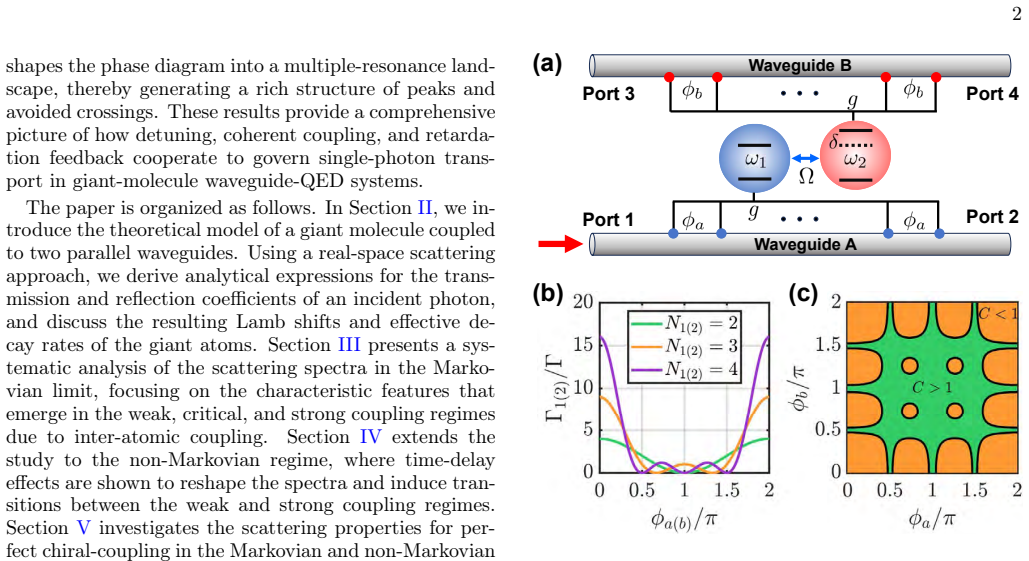
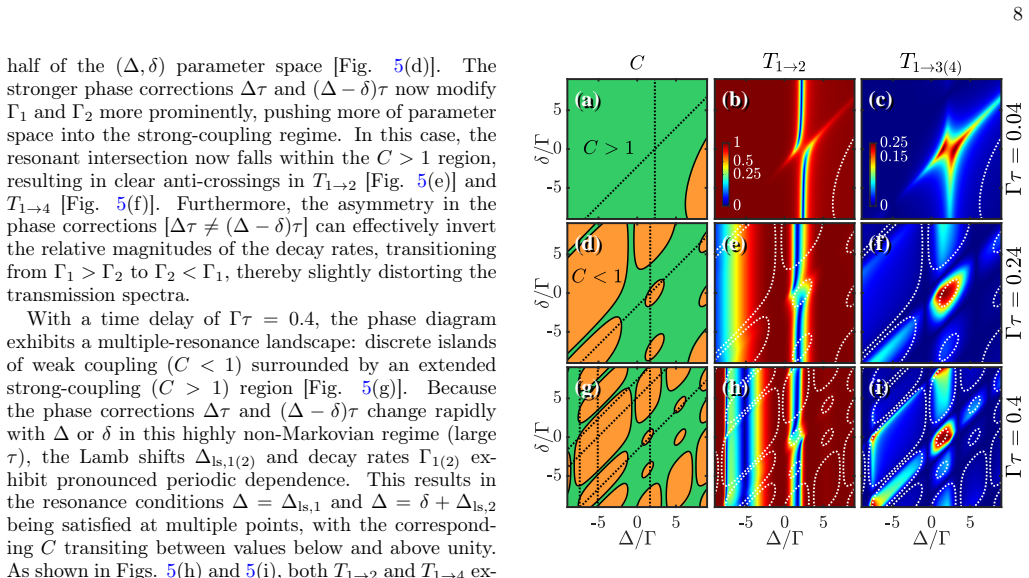
We investigate single-photon scattering in a waveguide-QED setup, where a giant molecule composed of two frequency-detuned giant atoms is coupled to two parallel waveguides via multiple connection points. The competition between coherent atom--atom coupling and the effective decay rates dictates the splitting of a single resonance into a doublet in the transmission (reflection) spectra. By tailoring the asymmetry of the decay rates and the atomic detuning, one can engineer photon-path interference to optimize the transfer between waveguides; under chiral coupling conditions, this interference can be further harnessed to realize fully deterministic routing. In the non-Markovian regime, retardation effects can reshape the spectra and actively drive transitions between the weak- and strong-coupling regimes, converting an unsplit Markovian resonance into a clearly separated doublet, or conversely merging a split doublet back into a single resonance. For sufficiently long time delays, it further generates multiple resonances and avoided crossings, enriching the spectral response. Our results demonstrate how atomic detuning, decay-rate asymmetry, and non-Markovian retardation cooperate to provide versatile, interference-based control over single-photon routing in multi-port quantum networks.
Editorial analysis
A structured set of objections, weighed in public.
Referee Report
Summary. The manuscript develops a theoretical model for single-photon scattering by a giant molecule formed from two frequency-detuned giant atoms coupled asymmetrically to two parallel waveguides at multiple points. It derives transmission and reflection amplitudes and claims that tailoring decay-rate asymmetry together with atomic detuning engineers photon-path interference to optimize inter-waveguide transfer; under ideal chiral coupling this interference yields fully deterministic routing. In the non-Markovian regime, retardation is shown to reshape spectra, driving transitions between weak- and strong-coupling regimes, converting unsplit resonances into doublets or merging doublets, and generating multiple resonances with avoided crossings for long delays.
Significance. If the analytic scattering solutions and the non-Markovian spectral predictions are correct, the work supplies a concrete interference-based mechanism for routing single photons in multi-port waveguide networks, extending giant-atom waveguide QED to asymmetric and retarded regimes. The parameter-free character of the chiral-routing limit and the explicit mapping of retardation-induced regime transitions constitute clear strengths that could guide future experiments.
major comments (2)
- [Abstract and chiral-coupling derivation (likely §3–4)] Abstract and the chiral-coupling derivation (likely §3–4): the assertion of 'fully deterministic routing' is obtained only in the exact chiral limit (one propagation direction per connection point has vanishing decay rate). No sensitivity analysis or scaling of routing fidelity with chiral asymmetry parameter is supplied; any finite mismatch reintroduces backscattering that prevents unit efficiency, rendering the central routing claim load-bearing on an unquantified idealization.
- [Non-Markovian regime section (likely §5)] Non-Markovian regime section (likely §5, equations for retarded Green functions): the statements that retardation 'actively drives transitions' between weak- and strong-coupling regimes or 'converts an unsplit Markovian resonance into a clearly separated doublet' are presented without explicit thresholds on the delay time τ relative to the decay rates Γ or the detuning Δ. Without these quantitative boundaries it is unclear whether the reported spectral reshaping is generic or confined to narrow parameter windows.
minor comments (2)
- [Model section] Model section: the single-excitation manifold assumption is stated but the range of validity (maximum photon number or intensity) is not bounded; a brief inequality relating input amplitude to the collective decay rates would clarify the regime of applicability.
- [Figure captions] Figure captions: several transmission spectra lack explicit labels distinguishing Markovian from retarded curves and do not list the precise values of the asymmetry parameter and delay time used; this reduces immediate reproducibility.
Simulated Author's Rebuttal
We thank the referee for their careful reading of the manuscript and for the constructive comments, which help clarify the scope and limitations of our results. We address each major point below and indicate the revisions we will make to the manuscript.
read point-by-point responses
-
Referee: Abstract and the chiral-coupling derivation (likely §3–4): the assertion of 'fully deterministic routing' is obtained only in the exact chiral limit (one propagation direction per connection point has vanishing decay rate). No sensitivity analysis or scaling of routing fidelity with chiral asymmetry parameter is supplied; any finite mismatch reintroduces backscattering that prevents unit efficiency, rendering the central routing claim load-bearing on an unquantified idealization.
Authors: We agree that fully deterministic routing holds strictly in the exact chiral limit, where one propagation direction per connection point has vanishing decay rate, as derived from the scattering amplitudes in the relevant sections and conditioned in the abstract. The analytic expressions confirm unit-efficiency transfer via perfect destructive interference in the unwanted channels under this idealization. We acknowledge that the manuscript does not quantify the degradation for finite chiral asymmetry. In the revised version we will add a concise discussion (with a brief scaling argument or illustrative plot) showing how the routing fidelity scales with a small mismatch parameter ε in the decay rates Γ(1±ε), demonstrating that efficiency remains high for small ε but drops as backscattering reappears. This will make the idealization explicit without altering the central claim. revision: yes
-
Referee: Non-Markovian regime section (likely §5): the statements that retardation 'actively drives transitions' between weak- and strong-coupling regimes or 'converts an unsplit Markovian resonance into a clearly separated doublet' are presented without explicit thresholds on the delay time τ relative to the decay rates Γ or the detuning Δ. Without these quantitative boundaries it is unclear whether the reported spectral reshaping is generic or confined to narrow parameter windows.
Authors: We thank the referee for highlighting the need for quantitative boundaries. The non-Markovian spectra are obtained from the poles of the retarded Green functions, which depend on the dimensionless combinations τΓ and τΔ. The Markovian regime corresponds to τΓ ≪ 1 (and τΔ ≪ 1), where retardation is negligible and resonances remain unsplit or follow the Markovian doublet structure. Regime transitions and the conversion of unsplit resonances into doublets (or merging of doublets) occur when τΓ or τΔ becomes order-1 or larger, with multiple avoided crossings appearing for τΓ ≳ 2–3. We will revise the non-Markovian section to state these thresholds explicitly, referencing the relevant equations and indicating the parameter windows in which the described reshaping is observed. This will clarify that the effects are generic once the retardation time exceeds the inverse decay and detuning scales. revision: yes
Circularity Check
No significant circularity; derivation follows from scattering equations under explicit assumptions
full rationale
The paper solves the single-photon scattering problem for a giant molecule coupled to parallel waveguides, deriving spectra and routing from the model Hamiltonian and boundary conditions. Claims about interference engineering, deterministic routing under chiral coupling, and non-Markovian retardation effects arise directly from the time-delayed equations and parameter choices (detuning, decay asymmetry). No fitted inputs are relabeled as predictions, no self-citations form load-bearing uniqueness arguments, and no ansatz is smuggled via prior work. The central results remain independent of the target claims once the waveguide-QED assumptions are granted.
Axiom & Free-Parameter Ledger
Lean theorems connected to this paper
-
IndisputableMonolith.CostJcost (J(x)=½(x+x⁻¹)−1) unclearthe cooperativity parameter C = Ω²/(Γ_1 Γ_2) ... weak (C<1), critical (C=1), and strong (C>1) coupling
-
IndisputableMonolith.Foundation.AlexanderDualityalexander_duality_circle_linking unclearΓ_{1(2)} = Γ sin²[½ N_{1(2)} φ_{a(b)}] / sin²[½ φ_{a(b)}] ... Δ_{ls,1(2)} = Γ (N sin φ − sin Nφ)/(1−cos φ)
-
IndisputableMonolith.Foundation.BranchSelectionbranch_selection unclearunder chiral coupling conditions, this interference can be further harnessed to realize fully deterministic routing
Reference graph
Works this paper leans on
-
[1]
X. Gu, A. F. Kockum, A. Miranowicz, Y.-x. Liu, and F. Nori, Phys. Rep.718-719, 1 (2017)
2017
-
[2]
D. Roy, C. M. Wilson, and O. Firstenberg, Rev. Mod. Phys.89, 021001 (2017)
2017
-
[3]
A. S. Sheremet, M. I. Petrov, I. V. Iorsh, A. V. Poshakin- skiy, and A. N. Poddubny, Rev. Mod. Phys.95, 015002 (2023)
2023
-
[4]
I.-C. Hoi, C. M. Wilson, G. Johansson, T. Palomaki, B. Peropadre, and P. Delsing, Phys. Rev. Lett.107, 073601 (2011)
2011
-
[5]
I.-C. Hoi, T. Palomaki, J. Lindkvist, G. Johansson, P. Delsing, and C. M. Wilson, Phys. Rev. Lett.108, 263601 (2012)
2012
-
[6]
I.-C. Hoi, C. M. Wilson, G. Johansson, J. Lindkvist, B. Peropadre, T. Palomaki, and P. Delsing, New J. Phys. 15, 025011 (2013)
2013
-
[7]
N. M. Sundaresan, Y. Liu, D. Sadri, L. J. Szőcs, D. L. Underwood, M. Malekakhlagh, H. E. Türeci, and A. A. Houck, Phys. Rev. X5, 021035 (2015)
2015
-
[8]
Wehner, D
S. Wehner, D. Elkouss, and R. Hanson, Science362, eaam9288 (2018)
2018
-
[9]
Duan and C
L.-M. Duan and C. Monroe, Rev. Mod. Phys.82, 1209 (2010)
2010
-
[10]
H. J. Kimble, Nature (London)453, 1023 (2008)
2008
-
[11]
Roy, Phys
D. Roy, Phys. Rev. Lett.106, 053601 (2011)
2011
-
[12]
Reiserer and G
A. Reiserer and G. Rempe, Rev. Mod. Phys.87, 1379 (2015)
2015
-
[13]
R. Uppu, L. Midolo, X. Zhou, J. Carolan, and P. Lodahl, Nat. Nanotechnolog.16, 1308 (2021)
2021
-
[14]
Neumeier, M
L. Neumeier, M. Leib, and M. J. Hartmann, Phys. Rev. Lett.111, 063601 (2013)
2013
-
[15]
Shen and S
J.-T. Shen and S. Fan, Phys. Rev. A76, 062709 (2007)
2007
-
[16]
Goban, C.-L
A. Goban, C.-L. Hung, J. D. Hood, S.-P. Yu, J. A. Mu- niz, O. Painter, and H. J. Kimble, Phys. Rev. Lett.115, 063601 (2015)
2015
-
[17]
Lalumière, B
K. Lalumière, B. C. Sanders, A. F. van Loo, A. Fe- dorov, A. Wallraff, and A. Blais, Phys. Rev. A88, 043806 (2013)
2013
-
[18]
M. V. Gustafsson, T. Aref, A. F. Kockum, M. K. Ek- ström, G. Johansson, and P. Delsing, Science346, 207 (2014)
2014
-
[19]
Lett.124, 240402 (2020)
G.Andersson, M.K.Ekström,andP.Delsing,Phys.Rev. Lett.124, 240402 (2020)
2020
-
[20]
L. Guo, A. Grimsmo, A. F. Kockum, M. Pletyukhov, and G. Johansson, Phys. Rev. A95, 053821 (2017)
2017
-
[21]
Andersson, B
G. Andersson, B. Suri, L. Guo, T. Aref, and P. Delsing, Nat. Phys.15, 1123 (2019)
2019
-
[22]
Wang, Y.-P
Z.-Q. Wang, Y.-P. Wang, J. Yao, R.-C. Shen, W.-J. Wu, J. Qian, J. Li, S.-Y. Zhu, and J. Q. You, Nat. Commun. 13, 7580 (2022). 11
2022
-
[23]
Astafiev, A
O. Astafiev, A. M. Zagoskin, A. A. Abdumalikov, Y. A. Pashkin, T. Yamamoto, K. Inomata, Y. Nakamura, and J. S. Tsai, Science327, 840 (2010)
2010
-
[24]
A. F. van Loo, A. Fedorov, K. Lalumière, B. C. Sanders, A. Blais, and A. Wallraff, Science342, 1494 (2013)
2013
-
[25]
Liu and A
Y. Liu and A. A. Houck, Nat. Phys.13, 48 (2017)
2017
-
[26]
Zheng, X.-W
J.-C. Zheng, X.-W. Zheng, X.-L. Hei, Y.-F. Qiao, X.-Y. Yao, X.-F. Pan, Y.-M. Ren, X.-W. Huo, and P.-B. Li, Phys. Rev. A111, 043717 (2025)
2025
-
[27]
Wang, Y.-J
H. Wang, Y.-J. Zhao, H.-C. Sun, X.-W. Xu, Y. Li, Y. Zheng, Q. Liu, and R. Li, Phys. Rev. A109, 012601 (2024)
2024
-
[28]
Zheng, D
H. Zheng, D. J. Gauthier, and H. U. Baranger, Phys. Rev. A82, 063816 (2010)
2010
-
[29]
X. Wang, T. Liu, A. F. Kockum, H.-R. Li, and F. Nori, Phys. Rev. Lett.126, 043602 (2021)
2021
-
[30]
K. H. Lim, W.-K. Mok, and L.-C. Kwek, Phys. Rev. A 107, 023716 (2023)
2023
-
[31]
Frisk Kockum, P
A. Frisk Kockum, P. Delsing, and G. Johansson, Phys. Rev. A90, 013837 (2014)
2014
-
[32]
Manenti, A
R. Manenti, A. F. Kockum, A. Patterson, T. Behrle, J. Rahamim, G. Tancredi, F. Nori, and P. J. Leek, Nat. Commun.8, 975 (2017)
2017
-
[33]
Kannan, M
B. Kannan, M. J. Ruckriegel, D. L. Campbell, A. Frisk Kockum, J. Braumüller, D. K. Kim, M. Kjaer- gaard, P. Krantz, A. Melville, B. M. Niedzielski, A. Vep- säläinen, R. Winik, J. L. Yoder, F. Nori, T. P. Orlando, S. Gustavsson, and W. D. Oliver, Nature (London)583, 775 (2020)
2020
-
[34]
A. F. Kockum, inInternational Symposium on Mathe- matics, Quantum Theory, and Cryptography, edited by T.Takagi, M.Wakayama, K.Tanaka, N.Kunihiro, K.Ki- moto, and Y. Ikematsu (Springer, Singapore, 2021) pp. 125–146
2021
-
[35]
A. M. Vadiraj, A. Ask, T. G. McConkey, I. Nsanzineza, C. W. S. Chang, A. F. Kockum, and C. M. Wilson, Phys. Rev. A103, 023710 (2021)
2021
-
[36]
Soro and A
A. Soro and A. F. Kockum, Phys. Rev. A105, 023712 (2022)
2022
-
[37]
Cilluffo, A
D. Cilluffo, A. Carollo, S. Lorenzo, J. A. Gross, G. M. Palma, and F. Ciccarello, Phys. Rev. Res.2, 043070 (2020)
2020
-
[38]
S. Guo, Y. Wang, T. Purdy, and J. Taylor, Phys. Rev. A 102, 033706 (2020)
2020
-
[39]
Yin, W.-B
X.-L. Yin, W.-B. Luo, and J.-Q. Liao, Phys. Rev. A106, 063703 (2022)
2022
-
[40]
Q.-Y. Qiu, Y. Wu, and X.-Y. Lü, Sci. China Phys. Mech. Astron.66, 224212 (2023)
2023
-
[41]
Mahmoodian, G
S. Mahmoodian, G. Calajó, D. E. Chang, K. Hammerer, and A. S. Sørensen, Phys. Rev. X10, 031011 (2020)
2020
-
[42]
Bello, G
M. Bello, G. Platero, J. I. Cirac, and A. González-Tudela, Sci. Adv.5, eaaw0297 (2019)
2019
-
[43]
W. Z. Jia and M. T. Yu, Opt. Express32, 9495 (2024)
2024
-
[44]
M. Weng, H. Yu, and Z. Wang, Phys. Rev. A111, 053711 (2025)
2025
-
[45]
Y. Yang, G. Sun, J. Li, J. Lu, and L. Zhou, Phys. Rev. A111, 013707 (2025)
2025
-
[46]
G. Sun, Y. Yang, J. Li, J. Lu, and L. Zhou, Phys. Rev. A111, 033701 (2025)
2025
-
[47]
A. F. Kockum, G. Johansson, and F. Nori, Phys. Rev. Lett.120, 140404 (2018)
2018
-
[48]
Forn-Díaz, J
P. Forn-Díaz, J. J. García-Ripoll, B. Peropadre, J.-L. Or- giazzi, M. A. Yurtalan, R. Belyansky, C. M. Wilson, and A. Lupascu, Nat. Phys.13, 39 (2017)
2017
-
[49]
Carollo, D
A. Carollo, D. Cilluffo, and F. Ciccarello, Phys. Rev. Res. 2, 043184 (2020)
2020
-
[50]
L. Du, L. Guo, and Y. Li, Phys. Rev. A107, 023705 (2023)
2023
-
[51]
L. Du, L. Guo, Y. Zhang, and A. F. Kockum, Phys. Rev. Res.5, L042040 (2023)
2023
-
[52]
M.Pompili, S.L.N.Hermans, S.Baier, H.K.C.Beukers, P. C. Humphreys, R. N. Schouten, R. F. L. Vermeulen, M. J. Tiggelman, L. dos Santos Martins, B. Dirkse, S. Wehner, and R. Hanson, Science372, 259 (2021)
2021
-
[53]
Sipahigil, R
A. Sipahigil, R. E. Evans, D. D. Sukachev, M. J. Bu- rek, J. Borregaard, M. K. Bhaskar, C. T. Nguyen, J. L. Pacheco, H. A. Atikian, C. Meuwly, R. M. Camacho, F. Jelezko, E. Bielejec, H. Park, M. Lončar, and M. D. Lukin, Science354, 847 (2016)
2016
-
[54]
Yin and J.-Q
X.-L. Yin and J.-Q. Liao, Phys. Rev. A108, 023728 (2023)
2023
-
[55]
Luo, X.-L
W.-B. Luo, X.-L. Yin, and J.-Q. Liao, Adv. Quantum Techno.7, 2400030 (2024)
2024
-
[56]
L. Du, X. Wang, A. F. Kockum, and J. Splettstoesser, Phys. Rev. Lett.135, 223601 (2025)
2025
-
[57]
Q. Y. Cai and W. Z. Jia, Phys. Rev. A104, 033710 (2021)
2021
-
[58]
Y.-T. Chen, L. Du, L. Guo, Z. Wang, Y. Zhang, Y. Li, and J.-H. Wu, Commun. Phys.5, 215 (2022)
2022
-
[59]
Du and Y
L. Du and Y. Li, Phys. Rev. A104, 023712 (2021)
2021
-
[60]
W. Gu, T. Li, Y. Tian, Z. Yi, and G.-x. Li, Phys. Rev. A110, 033707 (2024)
2024
-
[61]
W. Zhao, Y. Zhang, and Z. Wang, Front. Phys.17, 42506 (2022)
2022
-
[62]
Zhu, X.-L
H. Zhu, X.-L. Yin, and J.-Q. Liao, Phys. Rev. A111, 023711 (2025)
2025
-
[63]
S. L. Feng and W. Z. Jia, Phys. Rev. A104, 063712 (2021)
2021
-
[64]
Y. P. Peng and W. Z. Jia, Phys. Rev. A108, 043709 (2023)
2023
-
[65]
Li, Z.-Q
S.-Y. Li, Z.-Q. Zhang, L. Du, Y. Li, and H. Wu, Phys. Rev. A109, 063703 (2024)
2024
-
[66]
Kannan, A
B. Kannan, A. Almanakly, Y. Sung, A. Di Paolo, D. A. Rower, J. Braumüller, A. Melville, B. M. Niedziel- ski, A. Karamlou, K. Serniak, A. Vepsäläinen, M. E. Schwartz, J. L. Yoder, R. Winik, J. Wang, T. P. Or- lando, S. Gustavsson, J. A. Grover, and W. D. Oliver, Nat. Phys.19, 394 (2023)
2023
-
[67]
Y. Chen, C. Neill, P. Roushan, N. Leung, M. Fang, R. Barends, J. Kelly, B. Campbell, Z. Chen, B. Chiaro, A. Dunsworth, E. Jeffrey, A. Megrant, J. Y. Mu- tus, P. J. J. O’Malley, C. M. Quintana, D. Sank, A. Vainsencher, J. Wenner, T. C. White, M. R. Geller, A. N. Cleland, and J. M. Martinis, Phys. Rev. Lett.113, 220502 (2014)
2014
-
[68]
Almanakly, B
A. Almanakly, B. Yankelevich, M. Hays, B. Kannan, R. Assouly, A. Greene, M. Gingras, B. M. Niedzielski, H. Stickler, M. E. Schwartz, K. Serniak, J. Wang, T. P. Orlando, S. Gustavsson, J. A. Grover, and W. D. Oliver, Nat. Phys.21, 825 (2025)
2025
-
[69]
Yin, Y.-H
X.-L. Yin, Y.-H. Liu, J.-F. Huang, and J.-Q. Liao, Phys. Rev. A106, 013715 (2022)
2022
-
[70]
Zhou, X.-L
J. Zhou, X.-L. Yin, and J.-Q. Liao, Phys. Rev. A107, 063703 (2023)
2023
-
[71]
Bao and Z
D. Bao and Z. Lin, Opt. Express32, 26470 (2024)
2024
-
[72]
Zheng, X.-L
J.-C. Zheng, X.-L. Dong, J.-Q. Chen, X.-L. Hei, X.-F. Pan, X.-Y. Yao, Y.-M. Ren, Y.-F. Qiao, and P.-B. Li, Phys. Rev. A109, 063709 (2024). 12
2024
-
[73]
J.-A. Sun, Y. Wang, and W.-A. Li, Phys. Rev. A112, 033703 (2025)
2025
-
[74]
A giant atom with modulated transition fre- quency,
R.-Y. Gong, Z.-Y. He, C.-H. Yu, G.-F. Zhang, F. Nori, and Z.-L. Xiang, arXiv:2411.19307
-
[75]
Du, Y.-T
L. Du, Y.-T. Chen, and Y. Li, Phys. Rev. Res.3, 043226 (2021)
2021
-
[76]
S. R. Sathyamoorthy, L. Tornberg, A. F. Kockum, B. Q. Baragiola, J. Combes, C. M. Wilson, T. M. Stace, and G. Johansson, Phys. Rev. Lett.112, 093601 (2014)
2014
-
[77]
Chow, and J
D.C.McKay, S.Filipp, A.Mezzacapo, E.Magesan, J.M. Chow, and J. M. Gambetta, Phys. Rev. Appl.6, 064007 (2016)
2016
-
[78]
Stehlik, D
J. Stehlik, D. M. Zajac, D. L. Underwood, T. Phung, J. Blair, S. Carnevale, D. Klaus, G. A. Keefe, A. Carniol, M. Kumph, M. Steffen, and O. E. Dial, Phys. Rev. Lett. 127, 080505 (2021)
2021
-
[79]
K. M. Sliwa, M. Hatridge, A. Narla, S. Shankar, L. Frun- zio, R. J. Schoelkopf, and M. H. Devoret, Phys. Rev. X 5, 041020 (2015)
2015
-
[80]
B. J. Chapman, E. I. Rosenthal, J. Kerckhoff, B. A. Moores, L. R. Vale, J. A. B. Mates, G. C. Hilton, K. La- lumière, A. Blais, and K. W. Lehnert, Phys. Rev. X7, 041043 (2017)
2017
discussion (0)
Sign in with ORCID, Apple, or X to comment. Anyone can read and Pith papers without signing in.