Recognition: unknown
On Electropolymerized Fingerprints and their Potential for Identification and Encryption
Pith reviewed 2026-05-08 16:55 UTC · model grok-4.3
The pith
Electropolymerization of conducting polymers produces stochastic patterns characteristic of the solution's chemical content.
A machine-rendered reading of the paper's core claim, the machinery that carries it, and where it could break.
Core claim
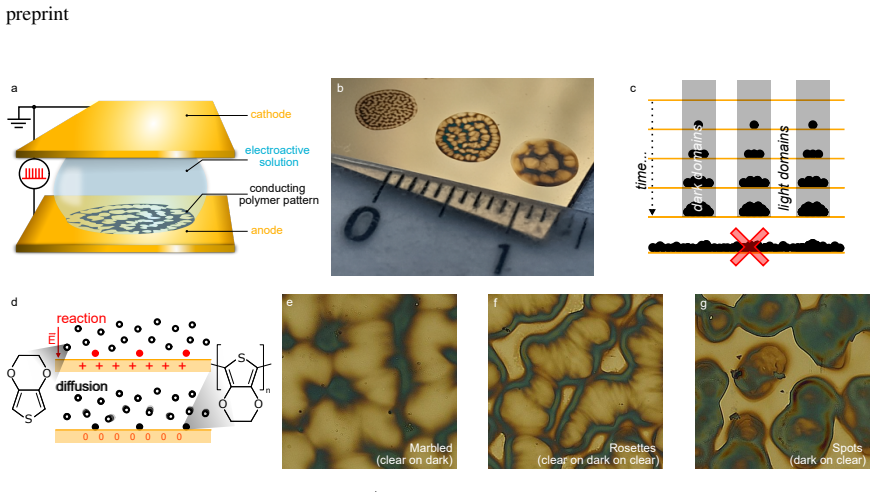
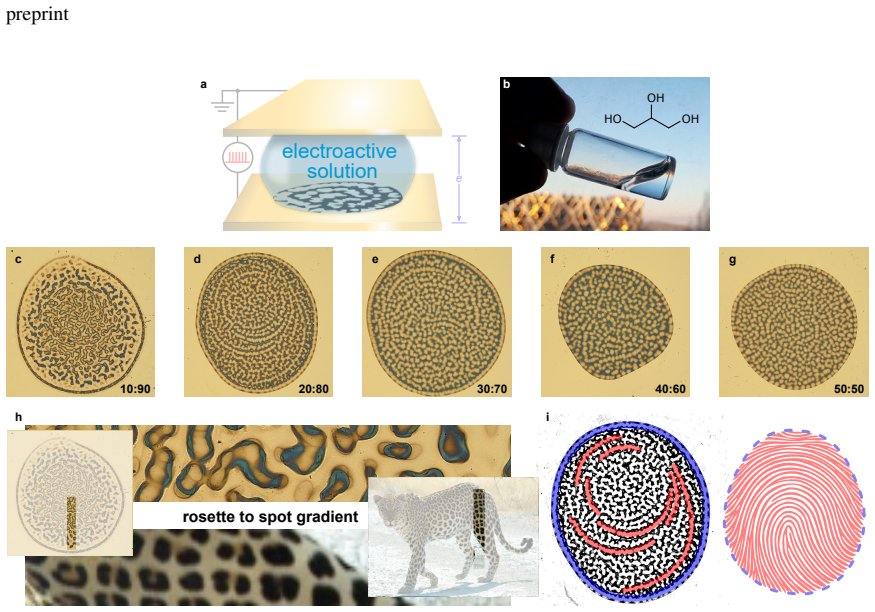
The 1D morphogenesis of conducting polymer dendrites on wires translates on 2D surfaces to highly heterogeneous coatings of dark spots, rosettes or marbled patterns. Despite their inherent stochasticity, these patterns are characteristic of the physical conditions they grew in, and particularly of the chemical content of the electroactive solution used for their electropolymerization. A statistical study demonstrates that these patterns could be used as fingerprints to physically tag the identity of a solution within a specific class.
What carries the argument
The 2D translation of 1D conducting polymer dendrite growth into heterogeneous surface coatings with optical, electrical, and chemical contrast
If this is right
- Patterns can identify the identity of a solution within a specific class using statistical methods.
- The process allows generation of personal tags on glass slides or micro-chips.
- Physically-encrypted personal information can be engraved for various applications.
- This provides a low-cost technology exploiting the balance between control and stochasticity.
Where Pith is reading between the lines
- Combining the different contrasts could enable verification through multiple independent channels for higher security.
- Similar stochastic pattern generation might apply to other electrochemical or physical deposition methods for new tagging systems.
- The approach mirrors biological pattern formation, potentially inspiring hybrid bio-inspired identification tech.
Load-bearing premise
The patterns' stochasticity does not erase their connection to specific chemical conditions enough to prevent reliable statistical identification.
What would settle it
An experiment where patterns from two different solutions in the same class are statistically indistinguishable, or where repeated runs with the same solution produce non-matching patterns, would disprove the fingerprinting capability.
Figures




read the original abstract
While human technology is ruled by determinism, biological systems exploit a subtle balance of control and stochasticity. This balance, evident in the morphogenesis of textural patterns imprinted on leaves, fur or skin can help hierarchize organisms both as a representative of their species and as unique individuals. In this study, we identified that, by exploiting electrochemistry, it is possible to generate such versatile but specific textures, to imprint patterns of a conducting polymer on a conducting substrate. It is shown that the 1D morphogenesis of conducting polymer dendrites on wires translates, on 2D surfaces, as highly heterogeneous coatings of dark spots, rosettes or marbled patterns. Despite their inherent stochasticity, these patterns are characteristic of the physical conditions they grew in, and particularly of the chemical content of the electroactive solution used for their electropolymerization. A statistical study demonstrates that these patterns could be used as fingerprints to physically tag the identity of a solution within a specific class. By the identification of a new electrochemical process which allows generating physical fingerprints with optical, electrical and chemical contrast on an electrode, this research paves the way toward a disruptive low-cost technology which could allow any end-user to generate personal tags on a glass slide or on a micro-chip, to engrave physically-encrypted personal information for various applications.
Editorial analysis
A structured set of objections, weighed in public.
Referee Report
Summary. The manuscript describes the electropolymerization of conducting polymers on 2D conducting substrates to generate heterogeneous patterns including dark spots, rosettes, and marbled textures. These patterns exhibit optical, electrical, and chemical contrast. The authors assert that, despite inherent stochasticity, the patterns are characteristic of the physical conditions and particularly the chemical content of the electroactive solution, as demonstrated by a statistical study, enabling their use as fingerprints for identification and encryption. The work proposes this as a basis for low-cost, user-generated physical tags on glass slides or microchips.
Significance. If the statistical demonstration is validated with appropriate quantitative metrics, the identification of this electrochemical process could provide a novel route to physical identifiers that combine stochastic generation with chemical specificity. This approach exploits a controlled balance of determinism and randomness, potentially enabling accessible multi-modal tagging and encryption technologies with low cost and broad applicability.
major comments (1)
- The abstract states that 'a statistical study demonstrates that these patterns could be used as fingerprints to physically tag the identity of a solution within a specific class.' No details are provided on pattern quantification (e.g., image descriptors or spatial statistics), replicate counts, intra- vs. inter-class variance, or classifier performance/error rates. This information is load-bearing for the central claim that stochasticity does not preclude reliable identification and encryption.
Simulated Author's Rebuttal
We thank the referee for their constructive review and for recognizing the potential significance of our approach to generating physical identifiers. We have carefully addressed the major comment below by expanding the quantitative details in the revised manuscript.
read point-by-point responses
-
Referee: The abstract states that 'a statistical study demonstrates that these patterns could be used as fingerprints to physically tag the identity of a solution within a specific class.' No details are provided on pattern quantification (e.g., image descriptors or spatial statistics), replicate counts, intra- vs. inter-class variance, or classifier performance/error rates. This information is load-bearing for the central claim that stochasticity does not preclude reliable identification and encryption.
Authors: We agree that the central claim requires explicit quantitative support and that the original manuscript did not provide sufficient methodological details on the statistical analysis. In the revised version, we have added a dedicated subsection describing the image quantification pipeline (including texture descriptors and spatial statistics), the replicate counts used, direct comparisons of intra-class versus inter-class variance, and the performance metrics (including error rates) of the classifier employed to demonstrate identification within solution classes. These additions are now incorporated in the Methods and Results sections to make the evidence for the fingerprinting application fully transparent. revision: yes
Circularity Check
No significant circularity in experimental claims
full rationale
The paper describes an experimental electrochemical process for generating stochastic patterns on electrodes and asserts that a statistical study shows these patterns can serve as fingerprints characteristic of the solution's chemical content. No equations, mathematical derivations, fitted parameters, or self-citations appear in the abstract or described claims. The central assertions rest on empirical observation and statistics rather than any reduction of outputs to inputs by construction, self-definition, or load-bearing self-reference. This is a standard self-contained empirical result with no detectable circular steps.
Axiom & Free-Parameter Ledger
axioms (2)
- domain assumption The 1D morphogenesis of conducting polymer dendrites on wires translates, on 2D surfaces, as highly heterogeneous coatings of dark spots, rosettes or marbled patterns.
- ad hoc to paper Despite their inherent stochasticity, these patterns are characteristic of the physical conditions they grew in, and particularly of the chemical content of the electroactive solution.
Reference graph
Works this paper leans on
-
[1]
& Chen, H.-M
Li, Y ., Yu, S.-M. & Chen, H.-M. Process-variation- and random-dopants-induced threshold voltage fluctuations in nanoscale CMOS and SOI devices.Microelectron. Eng.84, 2117–2120 (2007)
2007
-
[2]
atomistic
Asenov, A. Random dopant induced threshold voltage lowering and fluctuations in sub-0.1 /spl mu/m MOSFET’s: A 3-D "atomistic" simulation study.IEEE Trans. Electron Dev.45, 2505–2513 (1998)
1998
-
[3]
& Lorente, S
Bejan, A. & Lorente, S. Constructal theory of generation of configuration in nature and engineering.J. Appl. Phys.100, 041301 (2006)
2006
-
[4]
Turing, A. M. The chemical basis of morphogenesis.Philos. Trans. R. Soc. Lond. B. Biol. Sci.237, 37–72 (1952)
1952
-
[5]
& Kondo, S
Nakamasu, A., Takahashi, G., Kanbe, A. & Kondo, S. Interactions between zebrafish pigment cells responsible for the generation of Turing patterns.Proc. Natl. Acad. Sci.106, 8429–8434 (2009)
2009
-
[6]
T., Liaw, S
Liu, R. T., Liaw, S. S. & Maini, P. K. Two-stage Turing model for generating pigment patterns on the leopard and the jaguar.Phys. Rev. E74, 011914 (2006)
2006
-
[7]
Witten, T. A. & Sander, L. M. Diffusion-limited aggregation, a kinetic critical phenomenon.Phys. Rev. Lett.47, 1400–1403 (1981)
1981
-
[8]
Diffusion-limited aggregation and two-fluid displacements in porous media.Phys
Paterson, L. Diffusion-limited aggregation and two-fluid displacements in porous media.Phys. Rev. Lett. 52, 1621–1624 (1984)
1984
-
[9]
& Sharpe, J
Raspopovic, J., Marcon, L., Russo, L. & Sharpe, J. Digit patterning is controlled by a Bmp-Sox9-Wnt Turing network modulated by morphogen gradients.Science345, 566–570 (2014)
2014
-
[10]
& Kondo, S
Watanabe, M. & Kondo, S. Changing clothes easily: connexin41.8 regulates skin pattern variation. Pigment Cell Melanoma Res.25, 326–330 (2012)
2012
-
[11]
Melrose, J. R. Pattern formation in electrochemical deposition.Chemom. Intell. Lab. Syst.15, 231–240 (1992)
1992
-
[12]
& Lacitignola, D
Sgura, I., Bozzini, B. & Lacitignola, D. Numerical approximation of oscillating Turing patterns in a reaction-diffusion model for electrochemical material growth.AIP Conf. Proc.1493, 896–903 (2012)
2012
-
[13]
& Krischer, K
Mazouz, N. & Krischer, K. A theoretical study on turing patterns in electrochemical systems.J. Phys. Chem. B104, 6081–6090 (2000)
2000
-
[14]
Li, Y .-J.et al.Turing-type patterns on electrode surfaces.Science291, 2395–2398 (2001)
2001
-
[15]
Electrochemical aspects of the generation of ramified metallic electrodeposits.Phys
Chazalviel, J.-N. Electrochemical aspects of the generation of ramified metallic electrodeposits.Phys. Rev. A42, 7355–7367 (1990)
1990
-
[16]
Bai, P., Li, J., Brushett, F. R. & Bazant, M. Z. Transition of lithium growth mechanisms in liquid electrolytes.Energy Environ. Sci.9, 3221–3229 (2016)
2016
-
[17]
Un possible lien entre la croissance dendritique en physique et la morphogenèse des plantes
Fleury, V . Un possible lien entre la croissance dendritique en physique et la morphogenèse des plantes. C. R. Acad. Sci. III322, 725–734 (1999)
1999
-
[18]
& Serša, I
Peklar, R., Mikac, U. & Serša, I. Simulation of dendrite growth with a diffusion-limited aggregation model validated by mri of a lithium symmetric cell during charging.Batteries10, 352 (2024)
2024
-
[19]
Li, L.et al.Fractal growth regulation and mechanism of copper dendrite by micro-point electrode electrodeposition.ChemistrySelect9, e202402157 (2024)
2024
-
[20]
H., Nazzal, A
Kaufman, J. H., Nazzal, A. I., Melroy, O. R. & Kapitulnik, A. Onset of fractal growth: Statics and dynamics of diffusion-controlled polymerization.Phys. Rev. B35, 1881–1890 (1987)
1987
-
[21]
Commun.7, 10404 (2016)
Koizumi, Y .et al.Electropolymerization on wireless electrodes towards conducting polymer microfibre networks.Nat. Commun.7, 10404 (2016)
2016
-
[22]
& Alibart, F
Scholaert, C., Coffinier, Y ., Pecqueur, S. & Alibart, F. Brain-inspired polymer dendrite networks for morphology-dependent computing hardware.Adv. Sci.12, e02291 (2025)
2025
-
[23]
Sci.8, 2102973 (2021)
Janzakova, K.et al.Dendritic organic electrochemical transistors grown by electropolymerization for 3D neuromorphic engineering.Adv. Sci.8, 2102973 (2021). 16 preprint
2021
-
[24]
H., Scholaert, C., Alibart, F
Baron, A., Balaguera, E. H., Scholaert, C., Alibart, F. & Pecqueur, S. Hardware implementation of tunable fractional-order capacitors by morphogenesis of conducting polymer dendrites.APL Electron. Dev.1, 036118 (2025)
2025
-
[25]
Watanabe, S.et al.PEDOT:PSS wire: A two-terminal synaptic device for operation in electrolyte and saline solutions.ACS Appl. Mater. Interfaces16, 54636–54644 (2024)
2024
-
[26]
& Rivnay, J
Tropp, J., Meli, D. & Rivnay, J. Organic mixed conductors for electrochemical transistors.Matter6, 3132–3164 (2023)
2023
-
[27]
D., Tybrandt, K., Stavrinidou, E
Paulsen, B. D., Tybrandt, K., Stavrinidou, E. & Rivnay, J. Organic mixed ionic–electronic conductors. Nat. Mater.19, 13–26 (2019)
2019
-
[28]
Commun.12, 6898 (2021)
Janzakova, K.et al.Analog programing of conducting-polymer dendritic interconnections and control of their morphology.Nat. Commun.12, 6898 (2021)
2021
-
[29]
Fleury, V ., Boryskina, O. P. & Al-Kilani, A. Hyperbolic symmetry breaking and its role in the establish- ment of the body plan of vertebrates.C. R. Biol.334, 505–515 (2011)
2011
-
[30]
H., Piro, N., Piro, O
Cartwright, J. H., Piro, N., Piro, O. & Tuval, I. Fluid dynamics of nodal flow and left–right patterning in development.Dev. Dynam.237, 3477–3490 (2008)
2008
-
[31]
& Weijer, C
Chuai, M. & Weijer, C. J. Who moves whom during primitive streak formation in the chick embryo. HFSP J.3, 71–76 (2009)
2009
-
[32]
J., Beier, R
Ackerson, B. J., Beier, R. A. & Martin, D. L. Ground level air convection produces frost damage patterns in turfgrass.Int. J. Biometeorol.59, 1655–1665 (2015)
2015
-
[33]
Conceptual progress for explaining and predicting self-organization on anodized aluminum surfaces.Nanomaterials11, 2271 (2021)
Pashchanka, M. Conceptual progress for explaining and predicting self-organization on anodized aluminum surfaces.Nanomaterials11, 2271 (2021)
2021
-
[34]
M., Swinney, H
Huth, J. M., Swinney, H. L., McCormick, W. D., Kuhn, A. & Argoul, F. Role of convection in thin-layer electrodeposition.Phys. Rev. E51, 3444–3458 (1995)
1995
-
[35]
C., Li, G., Chen, X., Archer, L
Ma, M. C., Li, G., Chen, X., Archer, L. A. & Wan, J. Suppression of dendrite growth by cross-flow in microfluidics.Sci. Adv.7, eabf6941 (2021)
2021
-
[36]
& Zaltzman, B
Rubinstein, I. & Zaltzman, B. Electroconvection in electrodeposition: Electrokinetic regularization mechanisms of shortwave instabilities.Phys. Rev. Fluids9, 053701 (2024)
2024
-
[37]
S., Grigin, A
Aleksandrov, R. S., Grigin, A. P. & Davydov, A. D. Numerical study of electroconvective instability of binary electrolyte in a cell with plane parallel electrodes.Russ. J. Electrochem.38, 1097–1103 (2002)
2002
-
[38]
& Mani, A
Kim, J., Davidson, S. & Mani, A. Characterization of chaotic electroconvection near flat inert electrodes under oscillatory voltages.Micromachines10, 161 (2019)
2019
-
[39]
Wu, J., Traoré, P., Louste, C., Perez, A. T. & Vazquez, P. Three-dimensional numerical simulation of electroconvection in a dielectric liquid lying between two parallel plates and subjected to a strong unipolar injection. In11th International Conference on Modern Problems of Electrodynamics (MPEE-2015) (Saint petersbourg, Russia, 2015). URLhttps://hal.sci...
2015
-
[40]
& Tan, H.-P
Luo, K., Wu, J., Yi, H.-L., Liu, L.-H. & Tan, H.-P. Hexagonal convection patterns and their evolutionary scenarios in electroconvection induced by a strong unipolar injection.Phys. Rev. Fluids3, 053702 (2018)
2018
-
[41]
Kozicki, M. N. Information in electrodeposited dendrites.Adv. Phys.: X6, 1920846 (2021)
2021
-
[42]
N., Gonzalez Velo, Y
Kozicki, M. N., Gonzalez Velo, Y . & Swain, S. Fabrication of dendritic structures and tags (2023). URL https://patents.google.com/patent/US11598015B2/en
2023
-
[43]
D.Mathematical Biology II: Spatial Models and Biomedical Applications, vol
Murray, J. D.Mathematical Biology II: Spatial Models and Biomedical Applications, vol. 18 of Interdisciplinary Applied Mathematics(Springer-Verlag New York, 2003), 3rd edn
2003
-
[44]
& Rubinstein, I
Zaltzman, B. & Rubinstein, I. Electro-osmotic slip and electroconvective instability.J. Fluid Mech.579, 173–226 (2007)
2007
-
[45]
& Grier, D
Han, Y . & Grier, D. G. Colloidal electroconvection in a thin horizontal cell. II. bulk electroconvection of water during parallel-plate electrolysis.J. Chem. Phys.125, 144707 (2006)
2006
-
[46]
A., Nikitin, N
Demekhin, E. A., Nikitin, N. V . & Shelistov, V . S. Three-dimensional coherent structures of electrokinetic instability.Phys. Rev. E90, 013031 (2014)
2014
-
[47]
Membrane Sci.678, 121589 (2023)
Stockmeier, F.et al.On the interaction of electroconvection at a membrane interface with the bulk flow in a spacer-filled feed channel.J. Membrane Sci.678, 121589 (2023). 17 preprint
2023
-
[48]
Davidson, S. M. & Mani, A. A comprehensive investigation of electroconvection in canonical elec- trochemical environments. Tech. Rep. TF-156, Stanford University, Flow Physics and Computational Engineering Group, Department of Mechanical Engineering, Stanford, CA 94305, USA (2017). URL https://web.stanford.edu/group/tfsa/TF_reports/TF-156_Davidson.pdf
2017
-
[49]
& Chang, H.-C
Yossifon, G. & Chang, H.-C. Selection of nonequilibrium overlimiting currents: Universal depletion layer formation dynamics and vortex instability.Phys. Rev. Lett.101, 254501 (2008)
2008
-
[50]
M.et al.Direct observation of a nonequilibrium electro-osmotic instability.Phys
Rubinstein, S. M.et al.Direct observation of a nonequilibrium electro-osmotic instability.Phys. Rev. Lett.101, 236101 (2008)
2008
-
[51]
Aulnette, M.et al.Transport of spherical microparticles in a three-dimensional vortex flow.Phys. Rev. Fluids10, 124201 (2025)
2025
-
[52]
Rayleigh-Bénard convection: The container shape matters.Phys
Shishkina, O. Rayleigh-Bénard convection: The container shape matters.Phys. Rev. Fluids6, 090502 (2021)
2021
-
[53]
& Quero, J
Perdigones, F. & Quero, J. Printed circuit boards: The layers’ functions for electronic and biomedical engineering.Micromachines13, 460 (2022)
2022
-
[54]
A., Nordin, A
Mohd Asri, M. A., Nordin, A. N. & Ramli, N. Low-cost and cleanroom-free prototyping of microfluidic and electrochemical biosensors: Techniques in fabrication and bioconjugation.Biomicrofluidics15, 061502 (2021)
2021
-
[55]
Understanding the ENIG finish: A comprehensive guide (2023)
Waseem, U. Understanding the ENIG finish: A comprehensive guide (2023). URL https://www. wevolver.com/article/understanding-the-enig-finish-a-comprehensive-guide
2023
-
[56]
& Palmer, L
Singh, P., Sunder, M., Campbell, E. & Palmer, L. A case study of nickel dendritic growth on printed- circuit boards. In2020 Pan Pacific Microelectronics Symposium (Pan Pacific), 1–8 (2020)
2020
-
[57]
G., Costanzo, G
Grinbank, S. G., Costanzo, G. D., Soba, A., González, G. & Marshall, G. Electrodeposition in highly viscous media: Experiments and simulations.J. Electrostat.67, 672–677 (2009)
2009
-
[58]
Fluid viscoelasticity suppresses chaotic convection and mixing due to electrokinetic instability
Sasmal, C. Fluid viscoelasticity suppresses chaotic convection and mixing due to electrokinetic instability. Phys. Fluids34, 082011 (2022)
2022
-
[59]
Namibie etosha leopard 01edit (cc by 2.5) (2006)
Giraud, P. Namibie etosha leopard 01edit (cc by 2.5) (2006). URL https://fr.wikipedia.org/ wiki/L%C3%A9opard#/media/Fichier:Namibie_Etosha_Leopard_01edit.jpg
2006
-
[60]
ai-generated-fingerprint-pattern-9025771.png (pixabay licence) (2024)
Johnson, G. ai-generated-fingerprint-pattern-9025771.png (pixabay licence) (2024). URL https: //pixabay.com/vectors/ai-generated-fingerprint-pattern-9025771/
2024
-
[61]
Kim, J.et al.Nanoscale physical unclonable function labels based on block co-polymer self-assembly. Nat. Electron.5, 1–10 (2022)
2022
-
[62]
Kayaci, N.et al.Organic light-emitting physically unclonable functions.Adv. Funct. Mater.32, 2108675 (2022)
2022
-
[63]
R., Arppe, R., V osch, T
Carro-Temboury, M. R., Arppe, R., V osch, T. & Sørensen, T. J. An optical authentication system based on imaging of excitation-selected lanthanide luminescence.Sci. Adv.4, e1701384 (2018)
2018
-
[64]
Electron.5, 1–9 (2022)
Zhong, D.et al.Twin physically unclonable functions based on aligned carbon nanotube arrays.Nat. Electron.5, 1–9 (2022)
2022
-
[65]
Electron.4, 364–374 (2021)
Dodda, A.et al.Graphene-based physically unclonable functions that are reconfigurable and resilient to machine learning attacks.Nat. Electron.4, 364–374 (2021)
2021
-
[66]
John, R.et al.Halide perovskite memristors as flexible and reconfigurable physical unclonable functions. Nat. Commun.12, 3681 (2021)
2021
-
[67]
Adv.8, eabn7753 (2022)
Gao, B.et al.Concealable physically unclonable function chip with a memristor array.Sci. Adv.8, eabn7753 (2022)
2022
-
[68]
Commun.11, 5543 (2020)
Scholz, A.et al.Hybrid low-voltage physical unclonable function based on inkjet-printed metal-oxide transistors.Nat. Commun.11, 5543 (2020)
2020
-
[69]
Adv.8, eabm4106 (2022)
Li, Y .et al.Genetic physical unclonable functions in human cells.Sci. Adv.8, eabm4106 (2022)
2022
-
[70]
Phys.2, 39 (2019)
Wali, A.et al.Biological physically unclonable function.Commun. Phys.2, 39 (2019)
2019
-
[71]
& Zeadally, S
Shamsoshoara, A., Korenda, A., Afghah, F. & Zeadally, S. A survey on physical unclonable function (PUF)-based security solutions for Internet of Things.Comput. Netw.183, 107593 (2020)
2020
-
[72]
& Mamun, M
Gebali, F. & Mamun, M. Review of physically unclonable functions (PUFs): Structures, models, and algorithms.Front. Sens.2, 751748 (2022). 18 preprint
2022
-
[73]
& Sørensen, T
Arppe, R. & Sørensen, T. Physical unclonable functions generated through chemical methods for anti-counterfeiting.Nat. Rev. Chem.1, 0031 (2017)
2017
-
[74]
& Verbauwhede, I.Physically Unclonable Functions: A Study on the State of the Art and Future Research Directions, 3–37 (2010)
Maes, R. & Verbauwhede, I.Physically Unclonable Functions: A Study on the State of the Art and Future Research Directions, 3–37 (2010)
2010
-
[75]
Laurent, E.et al.Storing the portrait of Antoine de Lavoisier in a single macromolecule.C. R. Chim.24, 69–76 (2021)
2021
-
[76]
M., Gao, Y
Church, G. M., Gao, Y . & Kosuri, S. Next-generation digital information storage in DNA.Science337, 1628–1628 (2012). 19 preprint Supplementary Materials: On Electropolymerized Fingerprints and their Potential for Identification and Encryption a1 a2 a3 a4 a5 a6 b1 b2 b3 b4 b5 b6 c1 c2 c3 c4 c5 c6 d1 d2 d3 d4 d5 d6 e1 e2 e3 e4 e5 e6 f1 f2 f3 f4 f5 f6 g1 g2...
2012
discussion (0)
Sign in with ORCID, Apple, or X to comment. Anyone can read and Pith papers without signing in.